



Abstract
There is an ongoing discussion if and how students and lecturers should interact with each other on social networks. In this article, we present an empirical study on the so-called netiquette for Facebook contacts between students and their lecturers (hereinafter called SL-contacts). In addition, we investigated the subjective perception of the majority’s behavior. This enabled a comparison between two different kinds of social norms: the injunctive norms (netiquette) and the descriptive norms (majority). Database was an online survey with 2,849 participants (2,550 students and 299 lecturers). SL-contacts were quite rare in our sample and usually initiated by students. Our results showed that the appropriateness of SL-contacts depends on the individual case. In addition, we found that injunctive and descriptive norms are in line with each other. Overall, our results indicate that there is a common ground of understanding, and SL-contacts are less critical than they might appear.
Keywords
Introduction
Nowadays social media are omnipresent and can serve private as well as work-related and educational purposes. Thereby, some constellations are partly complicated, namely, if an original private social network is used for professional purposes. For example, Facebook is a private network but also many companies and public institutions (like universities) have a Facebook page. Especially for students and lecturers, Facebook can have a double-edge role: Initially, the Facebook account might be created for private purposes, but later on it might be also used for university-related issues (connecting with other students, receiving necessary information for the start at a university, etc.). In addition, many lecturers (especially the younger ones) have a Facebook account that might be created for private purposes but is also visible for their own students. Thus, the question arises if and how students and their lecturers should connect and interact on a private social network like Facebook. Is it appropriate to connect on a private network? Or should students and lecturers keep distance because of academic hierarchy and their dependent relationship?
These questions relate to the so-called netiquette on private social networks. The following study presents first empirical results on the netiquette between students and their lecturers on Facebook. In addition, we investigate how existing Facebook contacts between students and their lecturers evolved and how the behavior of the majority of students and lecturers is perceived.
Students and Lecturers on Facebook
The tremendous popularity of Facebook has led to various discussions and studies on this media phenomenon (Anderson, Fagan, Woodnutt, & Chamorro-Premuzic, 2012). Some research showed that Facebook is mainly used to stay in touch with friends, for studying and dating (Raacke & Bonds-Raacke, 2008; Sánchez, Cortijo, & Javed, 2014) as well as browsing through newsfeeds and friends’ profile pages (Wise, Alhabash, & Park, 2010). These findings indicated that Facebook has indeed a double-edge role that serves different aims: on one hand for information gathering and for studying, and on the other hand for dating and friendship.
Nowadays also universities and colleges are using Facebook to strengthen the engagement of their students. In addition, higher faculty members are using Facebook for personal and partly educational purposes. For example, Seaman and Tinti-Kane (2013) found that 57% of faculty members visit Facebook at least monthly and 8.4% use Facebook for teaching issues. In this relation, there is an ongoing debate about the academic use of Facebook (Selwyn, 2009). Some stress the pedagogical potential (Mason, 2006), and others focus on potential drawbacks like distraction and disengagement (Cassidy, 2006; Ziegler, 2007). Even though some studies found an educational potential for the academic use (Aydin, 2012; Petrović, Petrović, Jeremić, Milenković, & Ćirović, 2012), other findings indicated that Facebook is more for socializing and less for academic use (Akyildiz & Argan, 2012). Also, the reviews of Hew (2011) and Manca and Ranieri (2013) came to the conclusion that Facebook is used mainly for social purposes and less for teaching and learning. Even though Facebook is part of the university life, students’ perception of Facebook is more for private social interaction not for academic work. They consider Facebook as a tool to get away from study. In this relation, Madge, Meek, Wellens, and Hooley (2009) stated that Facebook can be seen as “social glue” that might help students to settle into university life. Thus, besides the debate about the educational benefits, Facebook is part of the students’ and teachers’ university life. Thereby, the question arises what are the (unwritten) rules or the so-called netiquette for the interaction between students and their lecturers on Facebook.
Netiquette and Social Norms
The term netiquette is derived from the word “etiquette.” This implicates conventions for social and professional behavior to succeed in society and in professional life. Accordingly, netiquette is part of social norms. In his pivotal work, Sherif (1937) defined social norms as “social frames of reference.” That means the individual perception of the appropriate behavior is shaped by the frame of reference provided by other people or social groups. In this connection, the review of Chung and Rimal (2016) described different types of norms in relation to their underlying meaning and their utility. With regard to our study presented in this paper especially descriptive norms and injunctive norms are of interest. Descriptive norms refer to the perception of how (the majority of) others actually behave; roughly spoken descriptive norms relate to the estimation of the majority’s behavior. On the other hand, injunctive norms relate to the assumption about the appropriate behavior in a given situation, that is, what should be done (Chung & Rimal, 2016). Accordingly, etiquette and netiquette can be conceptualized as injunctive norms.
Descriptive and injunctive norms are often aligned but can also conflict with each other. If the majority behaves in a specific way, this can be interpreted as “social proof” for the appropriateness of the behavior (Cialdini & Trost, 1998). In contrast, if there is little pressure to comply with an injunctive norm (e.g., eating healthy food), the majority of people might behave differently (e.g., eating junk food), and thus, the descriptive norm conflicts with the injunctive norm.
First, documents on netiquette formulated general conventions of conduct in web spaces (Hambridge, 1995; Rinaldi, 1996; Shea & Shea, 1994). Pręgowski (2009) analyzed web documents to explore netiquette rules and concluded that all conventions he found were not heterogeneous but had a “common normative-regulating core” (p. 354). He resumed that netiquette expresses a “good citizen attitude” (Pręgowski, 2009, p. 364), including engagement, responsibility, tolerance, reliability, honesty, and helpfulness. Also, aspects like anonymity, copyright, data protection as well as different languages and legal systems have to be considered (Tedre, Kamppuri, & Kommers, 2006).
In relation to the communication behavior of different academic levels, an initial study about email netiquette compared communication conventions in literature with experiences of academic stuff. In general, they described that the development of the digital communication led to a rapid response behavior, a neglect of communication formalities, and, as a result, misunderstandings (Spinks, Wells, & Meche, 1999). Other studies analyzed the communication between students and professors, and found that students showed insecurity in formulating polite emails for their professors (Biesenbach-Lucas, 2007) and had often an inappropriate style and content (Knight & Masselink, 2008).
First, studies on netiquette between students and lecturers on Facebook related to the appropriate kind of interaction (to poke, sending messages) and showed that passive behavior was generally estimated as more appropriate than active behavior (Teclehaimanot & Hickman, 2011). However, the findings of Mazer, Murphy, and Simonds (2009) showed that teacher’s self-disclosure on Facebook can enhance teacher’s credibility. On the other hand, the study of Peluchette, Karl, and Fertig (2013) on the role of Facebook in the professional working life indicated that “friending” the boss should be avoided.
Based on these partly contradictory findings, it is still an open question if contacts between students and their lecturers are appropriate or should be avoided to retain professionalism. The study presented in the following article focuses on Facebook contacts between students and lecturers (hereinafter called SL-contacts). We not only investigated the emergence of SL-contacts (who added whom) but also explored the netiquette (injunctive norms) between students and lecturers on Facebook and the subjective perception of the behavior of the majority (descriptive norms).
Methodology
Research Questions and Variables
The overall research aim included four research questions (RQs) that were related to different aspects of SL-contacts: How SL-contacts actually emerge (RQ1), what is estimated as appropriate (injunctive norm) in the sense of the so-called netiquette (RQ2), and how the behavior of the majority (descriptive norm) is perceived (RQ3). In relation to the netiquette and the perceived behavior of the majority, we regarded (partly) to analogous aspects. This enabled us for a comparison of injunctive norms and descriptive norms (RQ4).
RQ1. Development of SL-contacts: Who sent the SL-contact request (students vs. lecturers) and how was it handled (accepted, rejected, ignored)?
RQ2. Injunctive norms (netiquette): What are the general netiquette rules between students and lecturers on Facebook? Under which circumstances (individual cases) is a SL-contact judged as appropriate or inappropriate?
RQ3. Descriptive norms (majority): How is the behavior of the majority of students and lecturers on Facebook perceived?
RQ4. Comparison between injunctive norms and descriptive norms: Are the injunctive norms (netiquette) in line with the descriptive norms (perceived behavior of the majority)?
Description of the Questionnaire and Measurement of the Variables
We interrogated our participants by means of an online survey. The survey was newly constructed, and thus, we made several pre-tests before starting the data assessment: We made an internal quality control and sent a preliminary version of the questionnaire to external experts for review. Also, we made pre-tests with some students in the laboratory and technical tests.
Prerequisites for participation were that the participants had a Facebook profile and were either students or lecturers. The participation was voluntary. As a reward for participation, we offered the possibility to take part in a lottery to win vouchers of a popular online store.
The wording of the questions was formulated analogously for students and lecturers. Only the words “student” and “lecturer” were exchanged, if necessary (e.g., “Did you ever add one of your students on Facebook?” or “Did you ever add one of your lecturers on Facebook?”). The questionnaire started for all participants with an introduction of the topic, information about the voluntary participation, privacy issues including the anonymity of the assessed data, and the estimated duration (20 min) of the survey. Before the first question started, we asked for open and honest answers and explained that there were no right or wrong answers.
Initially, we assessed the academic status (student vs. lecturer) and the existence of own SL-contacts. Subsequently, we asked two questions on the initiative and the emergence of the own SL-contacts, that is, who sent the contact request and how the request was handled. First, we asked if the participants have ever sent an SL-contact request. The answering categories included three “yes” options (“Yes, and the request was accepted/declined/partly accepted and partly declined”), a “no” option, and an “I can’t remember” option. Second, the participant should indicate if they have ever received an SL-contact request. Also these answering categories included three “yes” options (Yes, and I accepted/declined/partly accepted and partly declined the request”), a “no” option, and an “I can’t remember” option. After some additional questions about the background of the own existing SL-contacts (that will not presented here because they are out of the scope of this article), we presented the questions on the subjective perception of the majority and on the netiquette for SL-contacts. The items on the perceived behavior of the majority (descriptive norms) included the following multiple-choice questions (answering options in brackets; additionally for each item, the “I don’t know” option was available):
How frequent are SL-contacts? (rare, medium widespread, frequent)
Who makes usually the first step toward initiating an SL-contact? (students, lecturers, both equally)
How do students usually react to a request from their lecturers? (accept, decline, depends on the individual case, ignore)
How do lecturers usually react to a request from their students? (accept, decline, depends on the individual case, ignore)
What is the usual communication style (informal vs. formal) in the case of an existing SL-contact? (mutual informal; mutual formal; depends on the individual case; they are unsure, if they should use a formal or informal style)
The questions on netiquette (injunctive norms) included the following six multiple-choice questions on general netiquette rules (answering options are provided in parentheses; additionally, there was always the “I don’t know” answering option present):
Are SL-contacts appropriate or inappropriate? (appropriate, inappropriate, depends on the individual case)
Who should make the first step toward initiating an SL-contact? (students, lecturers, both equally, none of them)
How should students react when they receive a request from their lecturers? (accept, decline, depends on the individual case, ignore)
How should lecturers react if they receive a request from their students? (accept, decline, depends on the individual case, ignore)
What is the appropriate usage of Facebook: private or professional? (only private usage, only professional usage, private as well as professional usage)
What is the appropriate communication style (informal vs. formal) in the case of an existing SL-contact? (mutual informal, mutual formal, depends on the individual case)
In addition, we asked under which circumstances (individual cases) an SL-contact is appropriate or inappropriate (answering options: “appropriate,” “inappropriate,” “I don’t know”). This item was conceptualized as a follow-up question in relation to the first netiquette rule (see list above) on the general appropriateness of SL-contacts and the answering option that it depends on the individual case. The 17 listed individual cases were as follows: interest in the other, curiosity, mutual sympathy, to show appreciation, to hint a wish for friendship, as a sincere friendship offer, if there is an existing friendship outside the Internet, if the age difference is small, if the age difference is large, if the lecturer offers academic information on Facebook, to endear oneself, to receive benefits (e.g., in relation to gradings/evaluations), to reduce distance between lecturers and students, after the dependent relationship has ended (i.e., course and gradings/evaluations are finished), to generally make a good impression, to make a good impression to the other one, and to have a desirable Facebook profile.
At the end of the survey, we assessed the control variables, including sociodemographic variables (age, gender), institution and faculty, the importance of politeness, social desirability, and the opinion about the hierarchy between students and lecturers. Furthermore, we assessed the individual Facebook usage (duration and frequency of use, number of contacts, etc.).
Participants
Recruitment of Participants
For the recruitment of an adequate sample of students and lecturers (in Germany), we used the official information of the Federal Office for statistical information (https://www.destatis.de). Based on the number of students, we selected the 20 largest, the 20 smallest as well as 20 middle-sized universities and colleges. In addition, we completed the sample as such that every German county was in the sample. The universities and colleges within the sample were contacted by email and requested to forward the announcement of the online survey to the university members (including staff and students). If this was for organizational reasons not possible, we asked to post an announcement of the survey on the Facebook site of the university or college. In addition, we announced the survey on websites related to our research and the institution of the first author. Please note that the participation was voluntary and not all selected universities and colleges fulfilled our request. Thus, the representativeness of our sample was limited.
Information on Response Rate and Dropouts
Altogether 5,513 persons clicked the link, but only 3,491 of them started the interview. We excluded 602 persons because 122 persons were neither students nor lecturers (99 plus 23 with no answers) and 480 persons had no Facebook profile (395 plus 85 with no answers). From the remaining 2,889 completed interviews, we excluded 40 interviews because there were serious doubts about their validity (e.g., senseless notes in the open comments field “Facebook! Facebook!”). This procedure resulted in 2,849 valid interviews as basis for the data analysis. (Please note that there were no forced answers. Thus, the number of valid cases of the single questions was partly lower due to omitted questions.)
Description of the Sample
Overall, the sample comprised 2,849 participants. Most of them were students (2,250 persons; 89.50%) at the mean age of 24.04 years. The smaller group of lecturers (299 persons) were rather young with a mean age of 33.93 years and were mainly PhD students (42.30%) or research assistants without doctoral degree (20%). Only a smaller portion of lecturers were postdocs (17%) or had a professorship (14%). A small percentage (7%) had another position.
The group of students contained more females (63%) than males (37%). For the lecturers, the gender distribution was equal. Most of the participants were from university (76 % of the students and 87% of the lecturers), a minority was from colleges (22% of the students and 12% of the lecturers), and only a few (less than 1%) from other institutions. The majority was from the faculties of medicine and health sciences (76% of the students and 87% of the lecturers) or from mathematics and natural sciences (22% of the students and 12% of the lecturers). On average, the participants had their Facebook account for 4.67 years and the majority used it daily (60%) or several times a week (24%).
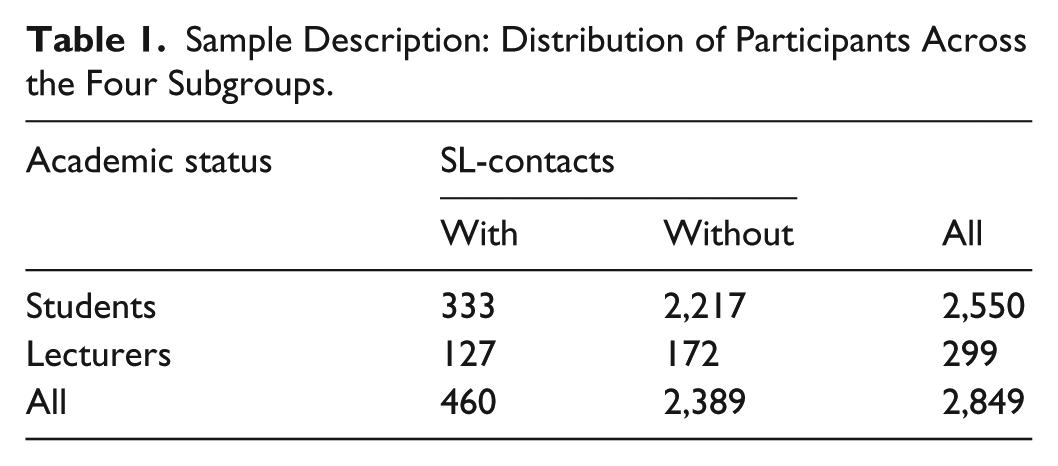
Altogether, only 16% of the sample reported about SL-contacts (460 persons: 333 students and 127 lecturers). The majority of 84% (2,389 persons: 2,217 students and 172 lecturers) had no SL-contacts. Thereby, there were substantial differences between students and lecturers: Only 12% of the students in the sample had SL-contacts, while 43% of the lecturers reported about own SL-contacts. Table 1 shows the distribution of the participants across the four subgroups (students vs. Lecturers, with vs. without SL-contacts).
Sample Description: Distribution of Participants Across the Four Subgroups.
Analysis of Control Variables
We tested for differences between the subgroups for several control variables, namely, age and gender, institution and faculty, social desirability, the importance of politeness (rating), the opinion about the hierarchy between students and lecturers, and the general usage of Facebook. Overall, we found some differences between the subgroups (e.g., unequal gender distribution across lecturers and students, younger age of students compared to lecturers). However, there was no evidence that the assessed control variables had influenced the results of the RQs.
Results
To answer the four RQs, we analyzed the multiple-choice questions by chi-square tests and contingency tables, respectively. For the detailed analyses of the single cells with significant differences (see Sharpe, 2015), we calculated the standardized residuals for each of the answering categories. Standardized residuals below −2.00 or above +2.00 were used as indicator for significant differences (with p < .05).
RQ1: Development of SL-Contacts
Participants With SL-Contacts
For the group with SL-contacts, we analyzed by chi-square tests if SL-contacts were initiated by students versus lecturers and how SL-contact requests were usually handled. The chi-square test revealed significant effects for the question of the own initiative (χ2 = 376.981, df = 4, p < .001) and for the question on the other’s initiative (χ2 = 297.192, df = 4, p < .001). The statistics on the observed and the expected frequencies and the standardized residuals can be found in Table 2 for the own initiative and in Table 3 for the other’s initiative.
Subgroup With SL-Contacts—Own Initiative: Observed Frequencies, Expected Frequencies, and Standardized Residuals.

Standardized residuals that indicate significant differences with p < .05.
Subgroup With SL-Contacts—Other’s Initiative: Observed Frequencies, Expected Frequencies, and Standardized Residuals.

Standardized residuals that indicate significant differences with p < .05.
Asked for their own initiative, the participants reported that they either sent a request and it was accepted or that they never sent a request. Vice versa for the question on the other’s initiative, the participants either reported that they received a request and accepted it or that they never received a request. These findings were partly tautological (and more a control check) because these were the logical preconditions for having an SL-contact: either sending or receiving a request that was accepted. However, the data also revealed that the declination of a request was the exception: The observed frequencies of the three yes categories of both questions (i.e., on the own initiative and on the other’s initiative) showed that contact requests were usually accepted. Only a small minority reported about the declination of an SL-contact request. In addition, the findings on the low number of “I can’t remember” answers (less than 10%) indicated that most people remembered how the SL-contact was initiated.
The comparison of the answers of students versus lecturers by chi-square test was significant for the question on the own initiative (χ2 = 19.244, df = 4, p = .001) as well as for the question on the other’s initiative (χ2 = 54.645, df = 4, p < .001). The observed and expected frequencies, and the standardized residuals for the answers of students versus lecturers with SL-contacts are listed in Table 4 for the question on the own initiative and in Table 5 for the question on the other’s initiative.
Subgroup With SL-Contacts—Comparison Students Versus Lecturers for the Own Initiative: Observed Frequencies, Expected Frequencies, and Standardized Residuals.

Standardized residuals that indicate significant differences with p < .05.
Subgroup With SL-Contacts—Comparison of Students Versus Lecturers for the Other’s Initiative: Observed Frequencies, Expected Frequencies, and Standardized Residuals.

Standardized residuals that indicate significant differences with p < .05.
The standardized residuals for the categories for both questions showed that students sent significantly more often contact requests than lecturers, and lecturers received significantly more often a contact request. We found also significant differences for the rejection of the requests indicating that lecturers declined more often compared to students. However, due to the very low frequency of these answering categories, this might be a statistical artifact.
Participants Without SL-Contacts
For the group without SL-contacts, we tested by chi-square tests if they had no SL-contacts because nobody took the initiative or if a request was sent but declined (or deleted afterwards). The chi-square test revealed significant effects for the question on the own initiative (χ2 = 8,607.209, df = 4, p < .001) and for the question on the other’s initiative (χ2 = 7,858, df = 4, p < .001). Most persons who had no SL-contacts reported that they never sent a request and they also never received a request. Only a very small minority (less than 1%) indicated that they sent a request that was declined or that they received a request and declined it. Similarly, only a very small portion (less than 1%) reported about accepted requests (that were deleted afterwards). Also for the subgroup without SL-contacts, the portion of “I can’t remember” answers was very low (1%). The statistics on the observed and the expected frequencies, and the standardized residuals can be found in Table 6 for the own initiative and in Table 7 for the other’s initiative.
Subgroup Without SL-Contacts—Own Initiative: Observed Frequencies, Expected Frequencies, and Standardized Residuals.

Standardized residuals that indicate significant differences with p < .05.
Subgroup Without SL-Contacts—Other’s Initiative: Observed Frequencies, Expected Frequencies, and Standardized Residuals.

Standardized residuals that indicate significant differences with p < .05.
The comparison of the answers of students versus lecturers by chi-square test revealed no significant differences for the answers on the own initiative (χ2 = 6.270, df = 4, p = .180). However, the chi-square test for the answers about the other’s initiative was significant (χ2 = 200.143, df = 4, p < .001). The standardized residuals showed that lecturers (compared to students) indicated more often that they received a request (significant differences for all three yes categories) and students indicated more often that they never received a request. The observed and expected frequencies, and standardized residuals for the comparison of students versus lecturers are listed in Table 8 for the own initiative and in Table 9 for the other’s initiative.
Subgroup Without SL-Contacts—Comparison of Students Versus Lecturers for the Own Initiative: Observed Frequencies, Expected Frequencies, and Standardized Residuals.

Subgroup Without SL-Contacts—Comparison of Students Versus Lecturers for the Other’s Initiative: Observed Frequencies, Expected Frequencies, and Standardized Residuals.

RQ2: Injunctive Norms (Netiquette)
We analyzed the multiple-choice items on the netiquette by chi-square tests. Based on the standardized residuals for each answering category, the netiquette rules (injunctive norms) were identified. As mentioned in the description of the questionnaire, we also presented the “I don’t know” option for all netiquette items. For the identification of the perceived netiquette rules, we omitted this option, that is, this answering category was not included in the chi-square test, because this could bias the standardized residuals and thus might bias the identification of the netiquette rules. The information about the frequency of the “I don’t know” option is provided separately as a rough exploratory indication to what degree the participants were uncertain about the netiquette.
Remark: As an additional control analysis, we also tested for differences in the answering behavior of the four subgroups, that is, students versus lecturers and participants with versus without SL-contacts. We found partly significant differences, but they mainly traced back to more or less pronounced answers whereas the overall answering pattern was identical for the four subgroups.
General Netiquette Rules
The chi-square test revealed significant differences for all questions on general netiquette rules. The statistical values of the chi-square test are provided in Table 10.
Netiquette—General Rules: Observed Frequencies, Expected Frequencies, Standardized Residuals, and Statistical Values of the Related Chi-Square Test.

Standardized residuals that indicate significant differences with p < .05.
For the question on the appropriateness of SL-contacts, most of the participants indicated that it depends on the individual case if an SL-contact is appropriate or inappropriate. The answers on the question who should make the first step revealed that most participants indicated that it is appropriate for both, students and lecturers, to make the first step. Asked how students should react when they receive a request from their lecturers, the majority of participants indicated that this depends on the individual case. To the analogous question how should lecturers react if they receive a request from their students, most of the participants also indicated that it depends on the individual case. Asked if the appropriate usage of Facebook is either private or professional, most participants answered that in general Facebook should be used for private issues only. In addition, there was a significant portion who answered that Facebook is equally apt for private as well as professional issues. Only a minority indicated that Facebook is only appropriate for professional issues. For the appropriate communication style (personal or formal), most participants indicated that it depends on the individual case.
The portion of “I don’t know” answers was different for the six questions on netiquette: For the appropriateness of SL-contacts, only 4% chose this option. Asked who should make the first step, 16% indicated “I don’t know.” For the other four netiquette items, the portion of “I don’t know” answers was between 6% and 9%.
Individual Cases
After the general netiquette rules, the participants should indicate for 17 individual cases if SL-contacts are appropriate or not. As explained in the description of the questionnaire, this item was a follow-up question for the general netiquette rule if SL-contacts are appropriate or not and the answering option that it depends on the individual case. Thus, the findings reported below provide detailed insights in the netiquette, that is, under which circumstances SL-contacts are appropriate or inappropriate. Table 11 shows the statistical values for the answers on the individual cases.
Netiquette—Individual Cases: Observed Frequencies, Expected Frequencies, Standardized Residuals, and Statistical Values of the Related Chi-Square Test.

Standardized residuals that indicate significant differences with p < .05.
For 16 individual cases, there were significant differences between the answering categories (appropriate vs. inappropriate). Only for one individual case (to reduce the distance between lecturers and students), the participants were ambivalent. Individual cases for which an SL-contact was estimated as appropriate were as follows: interest in the other, mutual sympathy, if there is an existing friendship outside the Internet, if the age difference is small, if the lecturer offers academic information on Facebook, and after the dependent relationship has ended. An SL-contact was estimated as inappropriate for the individual cases: curiosity, to show appreciation, to hint a wish for friendship, as a sincere friendship offer, if the age difference is large, to endear oneself, to receive benefits, to generally make a good impression, to make a good impression to the other one, and to have a desirable Facebook profile.
A closer look at the values of the chi-square test (as the indicator for the significance of the single results) revealed that the judgments about the appropriateness were for some individual cases much more pronounced (in the sense that high values of the chi-square test and high absolute standardized residuals indicated a clear majority ratio). The three most pronounced judgments on appropriate individual cases were as follows: an existing friendship outside the Internet, mutual sympathy, and academic information on Facebook. The three most pronounced judgments on inappropriate individual cases were as follows: to endear oneself, to receive benefits, and to have a desirable Facebook profile.
The portion of “I don’t know” answers for the questions on the individual cases was between 2% and 31%. Thus, the netiquette rules on individual cases should be (partly) handled with care, because the portion of unsure people was partly rather high.
RQ3: Descriptive Norms (Majority)
The answers on the estimation of the majority were analyzed analogously to the questions on netiquette. We used chi-square test and calculated standardized residuals. Also for the majority items, the “I don’t know” answers were not included in the chi-square test, because the answers of uncertain participants could bias the results on the descriptive norms. However, the portion of “I don’t know” answers is provided as rough exploratory indication for the (un)certainty of the participants. (Remark: We made additional control analyses to test for differences between the four subgroups. However, the found significant differences did not impact the pattern of results reported below but rather reflect more or less pronounced answers in the same direction.)
The chi-square tests of all questions on the majority were significant. The statistical values for the chi-square tests are listed in Table 12.
Estimation of the Majority: Observed Frequencies, Expected Frequencies, Standardized Residuals, and Statistical Values of the Related Chi-Square Test.

Standardized residuals that indicate significant differences with p < .05.
Asked for the distribution of Facebook contacts between students and lecturers, most of the participants estimated SL-contacts as rare. Most participants thought that students usually make the first step. Asked how students usually react to an SL-contact request, mainly two answering alternatives were chosen: The participants estimated either that the request is accepted or that it depends on the individual case. For the question, how lecturers usually react to an SL-contact request of students, most participants thought it depends on the individual case. Asked for the usual communication style, most participants estimated that it depends on the individual case if a formal or informal style is chosen.
The portion of “I don’t know” answers was rather high for all majority items (between 14% and 34%). Thus, even though there was a clear picture of the majority, about one third of the participants were uncertain.
RQ4: Comparisons Between Injunctive Norms and Descriptive Norms
We compared the injunctive norms (netiquette) and descriptive norms (majority) by chi-square tests and contingency tables for the corresponding questions on the general netiquette and the perceived behavior of the majority. We also included the “I don’t know” category in these analyses to investigate if the uncertainty of the participants relate to both sets of questions.
Remark: Please note that the answering categories were neither identical nor symmetric. Rather the answering categories comprised similar judgments that were compared to investigate if the participants’ perception of the netiquette (injunctive norm) was in line with the estimation of the majority (descriptive norm).
The chi-square test on the appropriateness and the distribution of SL-contacts revealed a significant correspondence (χ2 = 76.78, df = 9, p < .001) between the answers (see Table 13).
Relation Between Injunctive and Descriptive Norms—Appropriateness and Distribution of SL-Contacts: Observed Frequencies, Expected Frequencies, and Standardized Residuals.

Standardized residuals that indicate significant differences with p < .05.
Participants who thought that SL-contacts are appropriate estimated the distribution of SL-contacts higher, that is, they answered more often that they are medium widespread (and less often estimated that they are rare). Analogously, participants who thought SL-contacts are inappropriate estimated more often than SL-contacts are rare (and less often that they are of medium widespread). For participants who thought the appropriateness depends on the individual case, no significant differences were found. Participants who were uncertain about the netiquette were also more often uncertain about the majority.
For the questions who should made and who usually made the first step for initiating SL-contacts, the chi-square test showed a significant association (χ2 = 283.37, df = 12; p < .001) whereby the answers on both questions mirror each other (see Table 14).
Relation Between Appropriate and Usual Initiative of SL-Contacts: Observed Frequencies, Expected Frequencies, and Standardized Residuals.

Standardized residuals that indicate significant differences with p < .05.
Participants who assumed that students should make the first step also estimated more often that students usually make the first step. The analogous pattern was found for participants who assumed that lecturers should make the first step and for participants who assumed that both could make the first step. Participants who assumed that no one should make the first step indicated more often that they were uncertain about the majority. Participants who were uncertain about the netiquette were also more often uncertain about the majority.
The parallel questions on the reaction to lecturers’ SL-contact request showed a significant association (χ2 = 235.64, df = 16, p < .001) between the corresponding answering categories (see Table 15).
Relation Between Appropriate and Usual Reaction of Students to Lecturers’ SL-Contact Request: Observed Frequencies, Expected Frequencies, and Standardized Residuals.

Standardized residuals that indicate significant differences with p < .05.
Participants who thought that the request should be accepted (declined/decided for each individual case) also indicated more often that the request is usually accepted (declined/decided for each individual case) by the majority. Participants who answered for the netiquette question that the request should be ignored indicated more often for the majority question that the request is usually declined or ignored. Participants who were uncertain about the netiquette were also more often uncertain about the majority.
The contingency table for the parallel question on the reaction to students’ request revealed also a significant correspondence (χ2 = 420.86, df = 16, p < .001) for the answering categories, accept, decline, and decide, for each individual case (see Table 16).
Relation Between Appropriate and Usual Reaction of Lecturers to Students’ SL-Contact Request: Observed Frequencies, Expected Frequencies, and Standardized Residuals.

Standardized residuals that indicate significant differences with p < .05.
Participants who assumed that students’ request should be accepted (declined/decided for each individual case) indicated more often that the majority usually accept (decline/decide for each individual case). The same pattern was obtained for participants who thought the lecturers’ request should be ignored: They indicated more often that the request is usually ignored by the majority. Participants who were uncertain about the netiquette questions were also more often uncertain about the majority.
Also for the parallel question on the communication style, a significant association (χ2 = 1,057.21, df = 12, p < .001) of the corresponding answers was obtained (see Table 17).
Relation Between the Appropriate and the Usual Communication Style: Observed Frequencies, Expected Frequencies, and Standardized Residuals.

Standardized residuals that indicate significant differences with p < .05.
Participants who assumed the appropriate communication style is informal (formal/depends on the individual case) also assumed more often the usual communication style of the majority is informal (formal/depends on the individual case). Participants who were uncertain about the appropriate communication style were also more often uncertain about the communication style of the majority.
Discussion
Summary and Interpretation of Findings
Overall, in our sample, SL-contacts were rather seldom and mainly initiated by students. Remarkably, SL-contact requests were mostly accepted; only a very small minority reported about the rejection of SL-contact requests. The answers on the netiquette revealed that the seldom occurrence of SL-contacts does not necessarily mean that SL-contacts are inappropriate. Rather the appropriateness of SL-contacts depends on the individual case. Asked who should make the first step by sending an SL-contact request, most of the participants answered that students as well as lecturers can make the first step. The appropriate reaction to a contact request, as well as the appropriate communication style, depends on the individual case. Most participants indicated that Facebook should be used for private matters only; a smaller portion of participants thought it was appropriate to use Facebook for a mixture of private as well as work-related purposes.
The findings on the general netiquette indicate that the appropriateness of SL-contacts (and the appropriate reaction to contact requests) depends on the individual case. Thus, the results of the follow-up question on the individual cases are of special importance. Thereby, the judgments of the participants suggest that SL-contacts are particularly appropriate in the case of mutual sympathy, an existing friendship outside the Internet, and if the lecturer offers academic information on Facebook. However, with respect to the latter individual case (academic information on Facebook), it also has to be considered that most participants indicated that Facebook should be used for private matters only. Thus, this individual case has to be handled with care: Even though SL-contacts are appropriate if the lecturer offers academic information, the fact itself that the lecturers provide academic information on Facebook contradicts the netiquette rule on the appropriate use of Facebook (especially if the lecturer uses his or her Facebook account solely for academic and educational purposes). This interpretation can also be applied to the general netiquette rule on the appropriateness of the communication style on a case-by-case basis: In the case of sympathy and friendship (which is in line with the private use of Facebook), an informal style seems to be appropriate. However, in the case of academic information, a formal communication style should be used.
The judgments on inappropriate individual cases show that SL-contacts should not be made to endear oneself, to have a desirable Facebook profile or to receive benefit. Also, these inappropriate cases underline the importance of the netiquette rule that Facebook should be used for private matters.
Altogether, the netiquette rules were rather clear: In the case of sympathy and existing friendship, SL-contacts are appropriate and this is well in line with the private use of Facebook. On the other hand, SL-contacts are inappropriate in cases connected with flattery or to receive benefits. These findings correspond with the general web netiquette (see “Introduction” section) as a “good citizen attitude” (Pręgowski, 2009), including reliability and honesty. Furthermore, the appropriateness of SL-contacts on a case-by-case basis and the private use of Facebook are in line with prior research that has shown that Facebook is more for private use and socializing and less for academic purposes (Akyildiz & Argan, 2012; Hew, 2011; Manca & Ranieri, 2013). In relation to the statement of Madge et al. (2009) that Facebook can be seen as “social glue” of the university life, our findings provide a new aspect: Facebook is not only the “social glue” between students but can also be a platform for social contacts between students and their lecturers. The decisional point seems to be the private nature of SL-contacts, which are based on sympathy and friendship. In this sense, university life seems to be different from the professional working life, where “friending the boss” on Facebook should be avoided (Peluchette et al., 2013).
However, besides the rather distinct answering pattern on netiquette rules, there was also a substantial portion of participants who are uncertain about the netiquette between students and lecturers on Facebook. Thus, it might be beneficial to give students as well as lecturers some official recommendations (that are also in line with the communication policy of the university or college) how to behave toward one another on Facebook and other social networks.
The answers on the estimation of the majority were in concordance with the parallel netiquette questions. This concordance indicates that the subjective perception of injunctive norms and descriptive norms is congruent with each other. However, our data do not provide any information about the causal direction of this association. It might be the case that the assumed netiquette influences the perception of the majority’s behavior. Vice versa, it is also possible that the perception of the majority influences the assumptions about the netiquette. Or perhaps, our participants have assumed that the behavior of the majority can be seen as indicator for the netiquette. Last but not least, it also might be the case that the view of the majority as well as the assumptions about the netiquette are influenced by a third variable, for example, the own prior experiences on Facebook or at the university. For insights in the concrete causal interrelationships, future research is needed.
Thereby it is important to note that descriptive norms do not necessarily reflect the actual behavior of the majority. Indeed, our data suggest that the subjective answers on injunctive and descriptive norms can differ from the actual behavior: Our participants answered that it is appropriate and usual for both, students as well as lecturers, to send an SL-contact request. However, asked how their own SL-contacts emerged, our data show that mostly students initiated them. Thus, it would be interesting to investigate if and how injunctive norms are influenced when people are informed about the actual behavior of the majority.
Limitations of the Study and Conclusion
Our data were based on a German sample that was probably not representative. Especially, the participants’ interest in the topic might have been a factor of influence, that is, mainly those people participated who were curious or emotionally involved in relation to SL-contacts. Namely, the more frequent SL-contacts of lecturers in our sample indicated a higher interest in the study in the case of existing SL-contacts. That means our sample (or at least the subsample of lecturers) was biased by interest in the topic. In addition, this higher interest of lecturers can also be interpreted as a sign that the netiquette between students and lecturers on Facebook might be of higher importance for lecturers.
Please note that we investigated persons with a Facebook profile, and thus our data provided no information about the opinion of persons who do not use Facebook at all. In addition, our data were based on a German sample, and thus it would be interesting to investigate how SL-contacts and the related netiquette are estimated in other countries and cultures. Furthermore, it is an open question if and to what extent the injunctive and descriptive social norms of Facebook can be generalized to other (private) social networks. As mentioned in the “Introduction” section, we chose Facebook because of its popularity and its double-edge role for students and lecturers. However, the popularity of social networks has fluctuations, and thus also the popularity (and the usages) of Facebook might change.
Our findings strengthen prior research on the private nature of Facebook. Thus, internal networks of universities are more appropriate for the academic exchange (instead of using popular social media). Furthermore, also international academic networks like ResearchGate or Academia.edu might provide an alternative basis for the exchange of learning materials and online courses. Even though such academic networks are mainly designed for the exchange between postgraduate researchers, they might make the transition from university learning to academic work easier. Also, these networks can provide a space where sharing academic information is not only appropriate but also the explicit purpose of the network. Thus, the use of academic social networks could enable a strict separation of private and professional matters. This could lead to more (work-related) contacts with lecturers because (in contrast to Facebook) academic social networks are tools with the purpose to research and study and not to get away from it.
Against this background, our findings have two main implications for education and educational practice. First, Facebook is not the appropriate platform for studying and the provision of learning materials. For educational purposes, other platforms like (international) academic networks or wikis at the universities should be used. Second, Facebook has nevertheless an important role for the university life by providing the possibility to build social connections across academic hierarchies. This might also lower the inhibitions of young researchers (e.g., PhD students) to communicate at eye level with renowned researchers and professors. Thereby, Facebook can have an indirect effect on education by fostering a fruitful intellectual exchange across academic boundaries, which is especially important for young researchers.
To sum up, our results provide first insights in the netiquette between lecturers and students on Facebook. Remarkably, the injunctive norms in the form of netiquette are well in line with the descriptive norms, that is, the majority’s behavior is estimated as the appropriate behavior. Overall, the social nature of Facebook contacts between students and lecturers is mainly private. There seems to be a mutual common sense if and how students and their lecturers should interact on Facebook. Thus, Facebook contacts between students and their lecturers seem to be less critical than they might appear at first sight.
Footnotes
Declaration of Conflicting Interests
The author(s) declared no potential conflicts of interest with respect to the research, authorship, and/or publication of this article.
Funding
The author(s) received no financial support for the research, authorship, and/or publication of this article.
