




Abstract
This research examines the role of smartphones in refugees’ journeys. It traces the risks and possibilities afforded by smartphones for facilitating information, communication, and migration flows in the digital passage to Europe. For the Syrian and Iraqi refugee respondents in this France-based qualitative study, smartphones are lifelines, as important as water and food. They afford the planning, navigation, and documentation of journeys, enabling regular contact with family, friends, smugglers, and those who help them. However, refugees are simultaneously exposed to new forms of exploitation and surveillance with smartphones as migrations are financialised by smugglers and criminalized by European policies, and the digital passage is dependent on a contingent range of sociotechnical and material assemblages. Through an infrastructural lens, we capture the dialectical dynamics of opportunity and vulnerability, and the forms of resilience and solidarity, that arise as forced migration and digital connectivity coincide.
The Digital Passage to Europe
We the exiled ones, who live on anti-depressants, Facebook has become our Homeland. It opens the sky they close in our faces at the frontiers.
The traumatic and often protracted refugee 1 journey starts with flight and exodus from a dangerous present toward an uncertain future. The passage to Europe is a sociotechnical, embodied, and imaginative process comprising fears and hopes for a new life, and it follows no uniform pattern. Perilous, indeterminate voyages remain etched in the memories of refugees—this much was clear as we began to conduct our empirical research at various sites in France (2015–2016). Refugee journeys are profoundly unsettling, formative, and transformative experiences in which all kinds of life-baggage have come to be contained in and transported through a smartphone. Indeed, the refugee journey has become a media as much as a physical journey; a “digital passage to Europe” (Latonero, 2015; Latonero & Kift, this issue).
It is therefore surprising that with a few notable recent exceptions, relatively little attention has been paid to journeys in refugee and forced migration studies, which have rather attended primarily to the causes and consequences of migration (Crawley, Duvell, Sigona, McMahon, & Jones, 2016). The existing research on refugee journeys remains fragmented, unsystematic, and lacking in analytical focus (Benezer & Zetter, 2014). Moreover, most of these studies have yet to consider the increasingly important role of the digital in transforming refugee experiences and mobilities (Alencar, 2017; Talhouk et al., 2016). Where migrant digitalites are receiving attention in migration studies (cf. Harney, 2013; Thompson, 2009), refugee voices and experiences are lacking (Trimikliniotis, Parsanoglou, & Tsianos, 2014). This article tackles several new and pressing questions:
How is the widespread use of smartphones among Syrian refugees affecting experiences of forced displacement and migration, and vice versa?
How can we theorize the dialectical nature of this diminutive yet powerful device, the smartphone—in light of its usages by and affordances for refugees—without falling prey to unhelpful, un-nuanced binarisms (such as empowerment versus control, techno-optimism versus pessimism) or techno-solutionism?
How can empirical research on the specificities of smartphone use by refugees contribute to wider understandings of social media as used by vulnerable mobile and/or homeless groups and, in so doing, shed light on how digital infrastructures emerge and are implicated in complex operations of power, control, and inequality?
We situate our analytical focus at the intersection of refugee journeys and smartphones. Zooming in on the smartphone as our ethnographic object brought some clarity to the research: Examining our questions through the lens of the device—and its affordances (Gibson, 1979)—revealed the importance of wider sociotechnical and material infrastructures at play in refugee media journeys. As Latonero (2015) has pointed out, “social media, mobile apps, online maps, instant messaging, translation websites, wire money transfers, cell phone charging stations, and WiFi hotspots have created a new infrastructure for movement as critical as roads or railways” (n.p.). Building on Latonero’s insights, we argue that the role of smartphones in refugee journeys must be understood not only in terms of the devices’ affordances but also their associated infrastructures. For our refugee respondents, smartphone infrastructures are precarious and contingent: They depend on but have limited access to charging docks, SIM cards, WiFi, or, for example, water-proof plastic bags to keep their devices dry at sea.
As Boellstorff argues (2016), “digital ontology depends on the physical: if you pull the plug or let the battery run down, the digital no longer exists” (n.p.). Smartphone affordances hinge upon these material infrastructures in refugee journeys. What is more, Nagy and Neff (2015) suggest that a more nuanced interpretation of “affordances” ought to include notions of emotionality, materiality, symbolic power, and the imaginary. Following their argument, we aim to show that these symbolic-affective, sociotechnical, and political-imaginative dimensions are important in understanding how the affordances of smartphones—and the related sociotechnical infrastructures—reshape refugee experiences and mobilities and vice versa.
The entangled, precarious sociotechnical assemblages involved in refugee journeys make for, in Latonero’s words, “a digital passage” that he believes is actually “accelerating migration from war-torn countries like Syria, Iraq, and Afghanistan to Europe” (Nagy & Neff, 2015). Wrongly interpreted, this statement might suggest that smartphones are a precipitating cause of refugee journeys, which is not the case (Brunwasser, 2015). The notion of a “digital passage” to Europe is a useful one as it crystallizes unresolvable ambiguities expressed in the trope of the “passage” highlighted by Leurs (2015). First, the passage is much more than an in-between space. It is both the “site of dreams and an exploitative trap” (Leurs, 2015, pp. 22-23). For our refugee respondents, the digital passage is aspirational and insecure, not only a dangerous but also an emotional and imaginative experience, the space of hopes, dreams, and resilience, and of loss and despair, death, and survival. Second, refugee journeys are liminal spaces. The extreme uncertainty faced by refugees on the move presents profound challenges to their sense of identity and ontological security. These challenges are, in part, alleviated by the connectivity that the smartphone enables. Third, postcolonial concepts of the “Middle Passage,” taken by slaves on transatlantic voyages, forcefully remind us that the refugee passage is a space not only of transnational connectivity but also of power—especially the power wielded by politicians, police, and military personnel over refugees in determining their everyday existence, and their fate and future (Gilroy, 1993).
Overall, attention to the “digital passage” is a fruitful entry point into examining what is at stake when refugees are digitally connected. Our expanded definition of the digital passage for Syrian refugees seeks to hold to account powerful actors such as European policymakers and news media professionals. It also seeks to take into account the important role played by citizens, volunteers, and support groups in offering humanitarian assistance, hospitality, and care. In doing so, it fixes attention on the tensions in the journey between dreams and danger, liminality and alterity, and power and connectivity—all crucial notions in our analysis.
The article proceeds in three parts. The first section outlines the methodological challenges and approach of the research in the context of the wider project from which we developed this article. The second section sets up the overarching infrastructural analytical lens. We suggest that understanding the role of smartphones in refugees’ digital passages to Europe requires attention to a heterogeneous array of sociotechnical and material forms, practices, and contingencies. The third section then examines the particular affordances of smartphones for refugees on the move eschewing reductive lists based on simplistic or outdated models of media uses and gratifications theory. Our aim is to contribute to the urgent debate on forced migration and digital connectivity, to open up a fertile analytical approach that may begin to do justice to the complex, multifarious sociotechnical dimensions of the journeys taken by refugees to Europe.
Mobile Methods: Methods for Mobiles
This article is based on a wider research project, Mapping Refugee Media Journeys: Smartphones and Social Networks (Gillespie et al., 2016) which was conducted by six researchers at The Open University in collaboration with two audience researchers based at the international broadcaster France Médias Monde (FMM) (October 2015 and April 2016). Our prior research on the reporting of the attacks on Charlie Hebdo in Paris had forged a fruitful research encounter with FMM. The dire situation of refugees living on the streets of Paris and in the “Jungle” at Calais combined with the apparent lack of political will to respond humanely to the crisis forced us to take action. We wanted to assess the extent to which “information precarity” (Wall, Otis Campbell, & Janbeck, 2016) was part of the problem and what international news organizations should be doing to help. Our preliminary findings about how refugees use smartphones during their journeys to Europe flagged a dire lack of relevant, reliable, and timely news and information. We found that refugees were exposed to a great deal of disinformation (lies), misinformation (inaccurate information), false rumors, and conspiracy theories via social media networks; this was making their journeys even more precarious.
The research was driven by the urgent need to better understand refugees’ uses of news and information needs and to provide robust evidence in support of a pan-European approach to improving the provision of well-structured and timely information about and for refugees, which is the responsibility of signatories of the UN 1951 Refugee Convention (Article 35, UNHCR, 1951). The Mapping Refugee Media Journeys research was published as an open-source online report to ensure wide and prompt circulation among academics, policymakers, and media practitioners. It has been downloaded thousands of times by a wide range of researchers and interested parties and provoked many a debate. It also contributed to the European Commission funding a new mobile-first, web-based digital platform in Arabic, English, and French on social media for, with, and by refugees called InfoMigrants.net.
There are significant ethical and practical difficulties in researching issues concerning refugees on the move, not least in terms of their mobility and vulnerability. Our research team was mindful of these difficulties as most of us have had direct experience as researchers and/or workers in non-governmental organizations (NGOs), refugee, and other support groups for vulnerable people, for example, homeless young women (e.g., Faith, 2016). Souad Osserian’s research, conducted in 2012–2013 on Syrian refugees’ migrations from Istanbul to Europe, offered invaluable ethnographic insights (Osseiran, 2017). Marie Gillespie’s work on Exodus: Our Journeys to Europe, an Open University-BBC documentary series filmed by refugees using smartphones, also deepened our understanding, as did her three fieldwork trips to refugee camps in Lesvos (Gillespie, forthcoming). Margie Cheesman’s engagements with practitioners creating digital resources for refugees, such as Techfugees, GSMA, and the United Nations World Food Program, provided us with a deeper knowledge about the specific sociotechnical assemblages at work in refugee contexts. As a multi-disciplinary team, the wider project used a range of mixed and mobile methods (Buscher, Urry, & Witchger, 2010). These included content and discourse analysis, multi-sited interviews with refugees, policy document analysis, and horizon scanning activities assessing best practice in the digital provision for refugees. We also conducted computational social network analysis of social media communications networks. Overall, the employment of these various methodologies enabled us to triangulate diverse data sets to understand—and recommend effective solutions to—the specific vulnerabilities that refugees face in their digital passages to Europe, including, in particular, the kinds of “information precarity” that we had observed (Wall et al., 2016). We worked with refugees to understand their smartphone practices to ensure their participation in shaping the research and their voices reaching wider audiences (Tacchi, 2012).
While these research experiences inform our arguments, this article focuses on the ethnographic interview data from our wider research project. These were conducted in and transcribed into Arabic with 53 (mainly) Syrian and some Iraqi refugees in Paris and Cherbourg between September 2015 and April 2016. The first round was conducted with refugees living in Port de Saint-Ouen, an area in northern Paris and a crossroads for many Syrians fleeing the civil war at home to seek asylum in Europe. Our researchers met refugees with the help of Association Revivre, an organization which assists asylum seekers and refugees with French language learning. 2 A subsequent round of interviews took place in Cherbourg in March 2016, in the refugees’ temporary apartments. As most of the respondents had also been interviewed in Paris in September, they were familiar with the lead male interviewer and agreed to being interviewed in their personal spaces. The other respondents from the first round of interviews were dispersed to other regions, such as Saint-Etienne and Lyon. Due to the limited resources, it was not possible to follow up with all original respondents for second round interviews, but the researchers stayed in contact via WhatsApp. A supplementary round of interviews took place in November 2015 at the Emmaus Association in Paris, where refugees are provided with accommodation. 3
It was at first difficult to find refugees in Paris who were willing to be interviewed, as most we met sought to remain invisible to authorities. Many fear but also experience, to varying extents, harassment, exploitation, surveillance, arrest, detention, deportation, and destitution. Gender proved to be a stumbling block throughout the research. The lead interviewer, a Lebanese male, was unable to speak to women refugees easily. Indeed, among the couples the researcher approached in St-Ouen, none of the women accompanied by their husbands were allowed to speak. 4 Female refugees were more comfortable being interviewed on WhatsApp by female researchers, although one woman, unaccompanied by a male relative, wanted to be interviewed in person to tell her story.
Refugees’ sociotechnical practices and informational and communicative needs are multifarious as, of course, refugees are not a homogeneous group. The experiences of men, women, children, families, and individuals from and in various places at various moments can be very different. Demographic characteristics, ideological positions, and linguistic, social, and cultural competencies and forms of digital literacy and access shape uses. Not all Syrian and Iraqi refugees and asylum seekers own smartphones, but most have access to one and can benefit from shared and collective use during their journeys. The multimedia affordances of smartphones provided, in many instances, rich and often dramatic, poignant, and occasionally joyful (“we have arrived”) documentary evidence about refugee journeys. In combination with ethnographic-style interviews, this provided new possibilities for new kinds of engagements with audio-visual data. In fact, as researchers, we watched many film clips and photographs of sea-crossings or treks across tough terrain on the Balkans route, or encounters with smugglers. We also shared and exchanged music, films, and photographs. Many of the respondents kept video diaries. Some sent the researchers videos of their journeys regularly via WhatsApp. These provide powerful testimonies, and the researchers were attuned to the opportunities these offered refugees for active self-representation in research projects (Leurs, 2017). 5 Smartphones allow for the development of “mobile methods,” which can capture the profoundly affective, imaginative, and symbolic nature of refugee journeys and the regimes of mobility and immobility through which the passage to Europe is experienced (Gillespie, 2017).
Protecting refugees’ privacy and security, informed consent, trust, and reciprocity were just some of the ethical concerns in conducting this research. We were confronted with the terrible conditions in which our respondents lived, in terms of poverty but also physical or mental ill-health. For example, in St-Ouen, refugees were waiting for their asylum claims to be processed in squalid, cramped conditions in makeshift tents beside a motorway. Our research seemed trivial in this context of urgent, basic human needs. Researchers had to be mindful not to raise expectations that we might be able to provide the essential resources and assistance (legal advice, shelter, etc.) that so many were seeking. In all cases, informed consent was obtained either in writing or orally. We were acutely aware that refugees cannot always divulge information about their situation for fear of criminalisation, so we did not probe beyond what the interviewees were willing to reveal about themselves. Participants were assured of their anonymity. We use pseudonyms and, in some cases, quote interviewees with no name at all, or with little or no supplementary information to ensure anonymity. Whenever and wherever possible, we sought to offer whatever limited support that we could. We were told on many occasions that the conversations we had were appreciated.
The interviewees below wished to offer a fuller picture of their lives, experiences, and backgrounds for the purposes of the research. All were Syrian men, except one woman, Nawal, and four Iraqi men. Here, we summarize what they chose to tell us about themselves:
Hassan left Syria hoping to reach Sweden. He passed through Turkey, Greece, Macedonia, Serbia, Albania, Romania, Hungary, and Italy before arriving in France. He did not want to apply for asylum in France so avoided biometric registration. Jamil had already traveled widely, for work and pleasure, to destinations including Brazil, Iran, and Saudi Arabia, before leaving Syria. In Aleppo, he worked in acrylic teeth manufacturing, and as an international salesman buying clothing in Turkey and reselling them in Syria. Adeeb, an 18-year-old fleeing compulsory military service in Syria, arrived in France in June 2015. He passed through Algeria, Morocco, and Spain, before arriving in France. Saad, a shop owner and technology student, was from Baniyas, Syria. Nawal, a 23-year-old, was a high school student before she left Syria. She arrived in France in May 2014 and was granted refugee status. Unlike the other respondents, she was living in a hotel provided for her by the state. Abou Islam, a 34-year-old car mechanic, fled Syria; Raed, in his 40s, holds a Law degree and was an administrator in Syria; Ziad, in his 30s, was an English teacher in Syria; Abdel Kader has a Law degree from Syria; Abdel Rahman, a 21-year-old, was studying philosophy in University in Syria; Abdu, a 45-year-old was a sanitation worker in Syria; Aktham, 33-year-old, was a surgeon’s assistant in Syria; Adnan, a 30-year-old, was an accountant in Syria; Ammar, a 25-year-old, worked as a freelance writer in Iraq; Nader, 15-year-old, the youngest refugee, was a school student in Syria before he fled; Nabil was an Iraqi from Mosul; Samir was an Iraqi male from Salaheddin. Mouaz, a Palestinian 17-year-old, lived in Iraq most of his life but fled after receiving death threats. Saleem, 23-year-old, was from Idlib Province. Kenan was an Iraqi Kurdish man.
Propelled by the need in refugee contexts to understand materialities and affect in motion, our mixed and mobile methods, along with evidence drawn from mobile phones, offered multi-perspective insights into refugee lives and digital passages to Europe. With these considerations in mind, and before we turn to more detailed accounts of lived experience provided in the ethnographic interviews, we situate our analyses in their infrastructural contexts. Smartphone-mediated refugee mobilities are wrapped up in and shaped by a set of fragile sociotechnical, infrastructural assemblages.
When Is a Smartphone Infrastructure?
98% of the population in the Middle East and North Africa use a mobile phone, 84% use a smartphone, 81% use internet connections, 51% use a “high-end” device (i.e. over $500). Facebook is the most popular app, then Twitter, Instagram, Google Plus. Motives to use smartphones are having fun, staying in touch with friends and family, staying in touch with events, etc. Samsung has nearly half the market, followed by Nokia and only then Apple. Average daily time on social media: at least one hour. (Jamo, 2016)
These statistics on the rapid penetration of smartphones and the associated elements of the mobile digital infrastructure (such as Internet connection, apps, social media) in the Middle East and North Africa shed light on the technological context of this research (Vemon, Deriche, & Eisenhauer, 2016). Infrastructure is commonly understood as a metaphor for the stable or static foundations on which various major “things”—such as railways, roads, water, oil, gas, electricity, and the Internet—operate. Infrastructures are built and maintained, but usually invisible to end users. Yet, in understanding the relationship between technologies, practices, and people on the move, we must conceptualize infrastructure as an emergent constellation of structures—a relational concept, not a thing. Asking “when is an infrastructure,” Star and Ruhleder (1996) argue that infrastructures emerge with people in practice. They are connected to activities and structures and, as such, are relational entities with particular characteristics. These include the following: embeddedness, transparency, reach and scope, conventions of practice, embodiment of standards, construction on an installed base, and visibility upon breakdown. In this section, we argue that these essential characteristics are pertinent and provocative in defining the digital infrastructures that emerge during refugees’ digital passage to Europe.
Digital infrastructures are not only ubiquitous but also embedded in and entangled with a range of other structures (financial, legal, military), systems (policing and border controls), and sociotechnical arrangements (Google, Facebook). Smartphone practices among refugees are contingent upon fragile and unpredictable assemblages of material infrastructures—hardware and software. These include technical systems such as WiFi, SIM cards, charging docks, and plugs. This is the installed base of energy systems for electricity and power. Smartphones must “plug into” these other infrastructures and tools in a securitized fashion. At the same time, smartphones alone are insufficient. Refugees on the move depend on analog materials such as sealable plastic bags to keep devices dry, information leaflets and stickers at refugee camps, and hand-drawn maps to use if batteries die out.
Smartphones have the capacity and reach to connect people across locations and time zones. They involve conventional modes of participation, which are acquired via common practices and uses. Syrian refugees especially, due to the repression they face in their country of origin, replicate particular subversive smartphone practices when planning their journeys. For example, many protect their digital identities and any information about intended routes and destinations using closed Facebook groups and encrypted platforms such as WhatsApp to connect with smugglers and others on the move. Many use avatars and pseudonyms on Facebook to avoid online surveillance by state actors in Syria or other hostile groups (Gillespie et al., 2016; Moss, 2016). These practices continue outside Syria. It is in the negotiation of vulnerabilities—surveillance, privacy, hacking, sociotechnical failure—that smartphone infrastructures, usually transparent in the sense that users do not have to think about or reassemble the infrastructure when using it, become visible upon breakdown.
Infrastructural Vulnerabilities
We now illustrate our infrastructural analytic, providing accounts of refugees’ lived experiences with the contingent sociotechnical arrangements on which they rely, rather than looking simply at the device—and refugees experiences with it—as a unit in and of itself (cf. Latour, 1990, pp. 94, 99). Our principal finding was that the very first things refugees look for upon arrival to Europe are WiFi and battery charging resources. Faced with dangers at sea, informing loved ones of their safe arrival is central; without battery life refugees risk being cut off. Even for a short time this can mean failing to meet or deliver money to a smuggler on time, getting lost, or separated from companions. This reliance on smartphone connectivity is shot through with risk and exploitation as many refugees fall victim to fraud. Abu Islam, for example, bought a SIM card in Greece which, the seller informed him, was international and would work across Europe. He needed the phone to work as he made his way from Greece to Germany, but it went out of service once he crossed the Greek border into Macedonia. In the end, “13 SIM cards. That’s how I got to Europe.”
Abou Islam also commented on the difficulties he and others faced with regard to smartphone batteries: “Everyone had 2-3 batteries with him, and a charger. We constantly swap and exchange batteries.” Charging services can be expensive: Nader explained that he paid 5 Euros in Macedonia to charge his iPhone’s battery. Most of the respondents used Samsung smartphones, so it was easy to share smartphone batteries. Refugees with iPhones were at a disadvantage and depended on mains or USB chargers. Speaking of smartphone batteries, Aktham explained,
When you find a place to charge the phone, you see 50 persons around it. [. . .] In Greece, we slept a night next to the Macedonian borders. There was a man who had a car with his wife; he had an engine from which there was a wire, so we gathered around it. You’d say a spider’s web. I stayed 2 days without a phone because of battery. It was dangerous.
One central problem refugees—and homeless people—face is that without the necessary identity documentation (such as evidence of fixed address on a utility bill) it is not possible to register with a mobile network (Faith, 2016). Abdel Rahman explained that refugees often ask someone who speaks the local language to accompany them to the supermarket to buy a SIM card on their behalf. This is risky and unreliable—and not to mention illegal—as it renders individuals vulnerable to blackmail or exploitation. Nabil recounted his own experience with SIM cards in Paris:
I was advised to buy an Orange line, I bought it for 20 Euros and I added 20 Euros for credits. I provided the seller with my information but each 2-3 days the company calls me to tell me they’d stop my number as I’m not registered. I went back to the shop and he told me the problem is the company’s. Then the number stopped working. He should at least have told me I had to use the credits within 15 days. I went to the company; they told me they needed a residence permit or a passport. I don’t have a passport; I have a copy of it on my phone!
Even when passages to Europe are broken up by lengthy spells of time in internment camps, refugees still face problems maintaining stable Internet access. In such circumstances, smartphones become a kind of currency. They are bought and sold, exchanged and bartered, fought over and gifted, personalized and loved. They may be co-used by entire families or social groups traveling together. When asked what he felt like when without a phone, Hassan said, “Without my phone, I feel completely lost, stripped, naked, like missing a limb.” While this sentiment is reported by many non-refugees too, Hassan’s comment highlights the depth of the existential and physical insecurity refugees may feel at the prospect of losing or damaging their smartphones, or, indeed, their “communication rights” (Leurs, 2017).
Access to the affordances of smartphones is dependent not only on refugees’ abilities to connect with WiFi or 3G networks en route but also on their family’s access in their home countries of Syria, Iraq, or elsewhere. As Samir explained, “I wasn’t able to communicate with my family because Internet access is cut there, and the phone is cut. I haven’t spoken with them since I left.” We cannot do justice here to the heartbreak so many expressed about their communicative separation from loved ones. Talking on the phone to one’s mother or father can make the dangers of the journey bearable; having all ties cut leaves many depressed. Samir said of his pain: “I have a new baby brother born but I haven’t even seen him. I don’t know how my parents or my brothers and sisters are or even if they are still alive. But what can I do?” Abdel Rahman could connect with home but in a restricted way: “I barely talk to my parents, after 2 am, because ISIL prohibited the Internet and the satellite then.” Thus, refugees’ ability to maintain their kinship network and connection to friends in their countries of origin relies on contingent sociotechnical contexts on the ground in Syria and Iraq, and on the journey. 6
Syrians face not only ISIL prohibitions on Internet use but also genuine fear about Syrian regime and other hostile forces accessing and surveilling conversations, profiles, and other online activities, especially for political activists and dissenters on, for example, Facebook pages (cf. Moss, 2016). Online suppression extends beyond people living in Syria to include political activists living abroad—many are forced to reconsider their participation in online activism or to rely on aliases (Moss, 2016). For those inside Syria, the multimedia affordances of smartphones have made these devices a key tool for producing and circulating subversive material in resistance to the Syrian regime and ISIL. Saleem, who is called the “Hacker” by his friends, said that he did not travel with his smartphone in Syria, as he would have been identified as a political opponent to the regime. Fighters at government and ISIL checkpoints commonly demand Facebook passwords. Saleem added that even border guards will demand access to Facebook profiles to determine individuals’ allegiances in the war. Similarly, Kenan said,
When I got to the border in Turkey, the guard took my phone and asked me for my Facebook password. At first I wouldn’t give it to him because I was so scared, but they threw me in prison for 15 days and they beat me, they stole my phone and I was stuck.
Online surveillance practices render refugee journeys even more dangerous and precarious, as those cast as “undesirables” strive to remain invisible to powerful gatekeepers. Online surveillance may continue after arrival as European authorities ask asylum applicants for information about their Facebook profiles, prompting refugees to “clean” their profiles (Latonero & Kift, this special issue; Leurs, 2017, pp. 691–692). The digital traces refugees leave behind in Syrian regime-controlled or ISIL-controlled areas are grounds to be detained, tortured, and even killed (Weise, 2016). These examples demonstrate the multifarious forms of “infrastructural violence” (Rodgers & O’Neill, 2012), which range from depriving refugees of their devices, debilitating their connectivity, to killing them for their online activities. The contradictory dynamics of smartphone use by refugees becomes apparent as, simultaneously, they act as a kind of defense mechanism and means for survival.
Infrastructures are unstable assemblages that can be simultaneously occupied by regimes of control and care. Star and Ruhleder (1996) argue that infrastructures come into being when local practices are “afforded” by large-scale sociotechnical arrangements which open up access and participation. Inclusive, participatory spaces are fostered by solidarity groups, and powerful “digital solidarities” emerge among refugees, volunteers, and NGO refugee support groups (Gillespie, forthcoming). They can produce new kinds of inclusive spaces shared by refugees, activists, NGOs, and academics. Critical interventions and transformations in the practice and circulation of news and information for migrants and refugees are proliferating—from grassroots WhatsApp groups that enable refugee support groups to mobilize rescue missions, to more top–down interventions such as the European Commission–funded platform InfoMigrants.net mentioned earlier.
Refugees often referred to their smartphones as a place of comfort and connection, solace and sociality—a “mobile home” where they could escape to listen to music, watch films, and nurture social and kinship networks (Smets, 2017). During the journey, families may be separated by loss or death but also the everyday pressures of survival can be intense—anxiety and depression, marital conflicts, divorce, death, and kinship disputes—while appearing under ordinary circumstances are exacerbated by the stress of the journey. At the same time, smartphones provide access to communicative channels which provide sustenance—from daily conversations with loved ones to share images or even participating in wedding cermonies digitally (Khoury, 2015, p. 94). The powerful, affective dimensions of smartphone affordances, captured so beautifully by Maram Al-Masri (2017) in her poem quoted at the beginning of this article, crystallize how Facebook, for example, can blur frontiers and open up imaginative horizons that make the loss and separation of exile just about bearable.
Smartphone Affordances
Having elaborated on the fragile, contingent infrastructural contexts of smartphone use by refugees, we now bring into focus some of the particular affordances—or possibilities for action—offered by smartphones on refugees’ digital passage to Europe. In Communication and Media Studies, the concept of “affordances” usually refers to how users are afforded or constrained in “rational action” (Schrock, 2015). He suggests that perceptions of utility are developed in relation to strategic or rational goals and attributes mobile media with a static, codified set of communicative affordances: portability, availability, locatability, and multimediality. In light of our empirical research in refugee contexts, we seek to complexify this theorization.
This research found that smartphone affordances emerge, are recognized, mobilized, used, and disregarded by individuals, only to re-emerge in different forms in different contexts (Woodruff & Aoki, 2004). Practices of particular user groups (here, refugees—not a stable or homogeneous category) must be traced across time and space to illuminate the fluid nature of affordances, and the agency which users can exercise even in contexts of exile, sociotechnical fragility, contingency, and constraint. Like Nagy and Neff (2015), we argue that communication theory merits a more substantial theory of affordances which connects the materiality of media, the role of affect, imagination, and processes of mediation: “imagined affordances emerge between users’ perceptions, attitudes, and expectations; between the materiality and functionality of technologies; and between the intentions and perceptions of designers” (p. 1). The concept of “imagined affordances” (Nagy & Neff, 2015) helps theorize the ways in which media environments are perceived and shaped by users who exercise agency precisely because of the imagined affordances of technology. This is evident when we examine how refugee respondents perceived and discussed smartphone affordances in the research.
Mobility, Locatability, and Safety
In many cases, refugees flee their homes suddenly and without planning. Many respondents left their homes with only their mobile phones and some money—just enough for them to make their way to Europe. Digital connectivity is vital in situations of forced migration for aiding people in their onward journeys. According to refugee support workers with whom we worked, (e.g. Lesvos Solidarity in Greece), migrant deaths occur most frequently in areas with no mobile phone coverage, and most rescue operations are initiated by migrants using their smartphones. When describing the role of smartphones in their journeys to Europe, refugee respondents emphasized that first and foremost, smartphones were vital for three central things: mobility, locatability, and safety.
Many refugees have no other option but to get to Europe with the help of both smugglers and their smartphones. Digital navigation and communication platforms are essential; there are few legal alternative tools for checking one is on track (though, often, refugees do not know their destination) and reaching safety. Abou Islam said that he, like many other refugees, traveled in a small group. His group elected him as the leader because of his competence in English and, crucially, for his access to and proficiency in using smartphone applications. Abou Islam said the group depended on him and his smartphone to guide them using Google Maps as they traveled long distances on foot and during the perilous sea-crossing between Izmir and Greece in the summer of 2015. Aktham spoke about his experience crossing by sea from Turkey to Greece:
We were in the rubber boat, all the phones were in those little plastic bags we all buy, he [X] was the only one not to put his phone in a bag so he could stay in touch with coastguards and send our location to his brother in the Netherlands. Every few minutes, he used to tell his brother where we were. His brother was able to help guide us from a distance as he has already made the journey.
Refugees’ abilities to send details of their location to coastguards, friends, or family members while on the move is a matter of necessity and enable the kind of “distant proximities” that make life bearable (Rosenau, 2003). Nader, like many others, suggested that the communicative affordances of a smartphone ensured safety at sea: “Someone had the number of coastguards, he called them. His group was saved because of one contact number. It made the difference between life and death.”
Refugees actively sought to and depended on being locatable and visible to ensure their survival at sea. This desire for traceability contrasts with the imperative to hide online activities while in Syria or ISIL-controlled parts of Iraq. For refugees on the move, commuting between online visibility and invisibility is essential. Digital practices change based on which border they are crossing or which actors they expect to encounter. Negotiating the smartphone infrastructure for refugees involves much learning, as conventions of practice are used, re-used, and re-created to cross borders and avoid detection, arrest, detention, and deportation. In such a way, refugees tap into the subversive affordances of smartphones.
Staying connected with those pioneering refugees who have preceded and know the route is a crucial part of the passage to Europe. As Ziad explained,
You speak to the person who left before you and they tell you what to do. My brother left a week before me; I followed his steps, through WhatsApp and [Facebook] Messenger. I mainly used Messenger, I lost WhatsApp.
Raed, who happened to be sitting with Ziad and the interviewer at the time, added, “When we don’t have Viber, we use WhatsApp. When WhatsApp stops working we use Messenger, etcetera etcetera . . .” We observed the versatility and agility in respondents’ digital skills, as refugees jump between various smartphone applications to communicate and navigate, or selectively delete these applications when running out of battery or data.
Pioneering refugees inform others about legal–political differences between countries—for example, where best to claim asylum or how to avoid biometric registration processes in a country like Greece (which most refugees see as a transit country—and under the Dublin convention, refugees must seek asylum in the first country they are registered in). Some respondents had received tips about routes and how to prepare in dealing with state actors: “wear hair gel and dress smartly at borders.” Many access information on their smartphones before leaving Syria or Iraq and so are knowledgeable about claiming asylum in Europe. Others have many misconceptions, often based on smugglers’ narratives—for example, about anticipated wages and conditions. Smugglers’ narratives, stories of the Syrian diaspora in different European states, and images of wealth and prosperity portrayed in media all influenced what refugees expected to find in European states upon arrival (cf. Dekker et al., 2018).
Nabil explained that he received regular information bulletins from other refugees who he had previously become acquainted with on the road (Dekker et al., 2018). He spoke about a Facebook group where refugees shared information between themselves. These digital solidarity networks often endure well beyond the journey:
Where are you going? I’m going to Finland, you can have this, this and this [referring to shelter, food and financial support]. [Another refugee:] Where are you going? I’m going to Germany. I can have my fingerprints taken there and claim asylum and family reunification is easier there . . .
Refugees’ notions of the desirability of different European countries are propelled by online content. At the same time, refugee respondents explained that information and news are valued very differently according to its source. Reports coming from family, friends, and significant others, including “people in the field” (other refugees they know and trust, volunteers, activists, or NGOs), are considered the most reliable, relevant, and credible (cf. Leurs, 2017, p. 690). According to Dekker, Engbersen, Klaver, and Snel (this issue), most Syrian refugees compare different sources of information to evaluate its trustworthiness.
When asked which news sources he trusts, Mouaz responded, “I don’t trust any news or information people tell me. I trust no-one. Only my Mother.” Most respondents did not trust western, Syrian, or Iraqi mainstream news and information sources about migration and refugee issues (Gillespie et al., 2016). Just like most media consumers, refugees collect, compare, and rank different informational resources from various sources and make decisions accordingly.
Mapping a Digital Passage: The Balkans Route
Smartphone affordances for refugees have specific “imagined affordances” (Nagy & Neff, 2015). These become apparent as we analyze how refugees and those who support them, including agents and smugglers, mobilize their collective knowledge and capacities for content creation, designing, producing, and circulating media such as the digital map in Figure 1. The map is simple. It does not offer any accurate depiction of geographic terrain or distance—yet, it gives essential information in a compact, legible form. This map helped many refugees navigate their journeys to Europe. We do not know the identity of the original designers or when the original map was generated, but we do know that there exist many different versions of it. The map was initially shown to us by a Syrian respondent in Paris who had received it via WhatsApp, just like, he said, hundreds and maybe even thousands of Syrian refugees who were taking the Balkans route in late 2015. He shared it with many people, multiplying its influence in doing so. The map is entitled “The Road to Germany” (الطريق الى المانيا [al-Ṭariq ila Almanya]) with place names given in English, Greek, and Arabic. In translating the place names phonetically, the map helps Arabic speakers to accurately pronounce the names of the places that they need to get to.
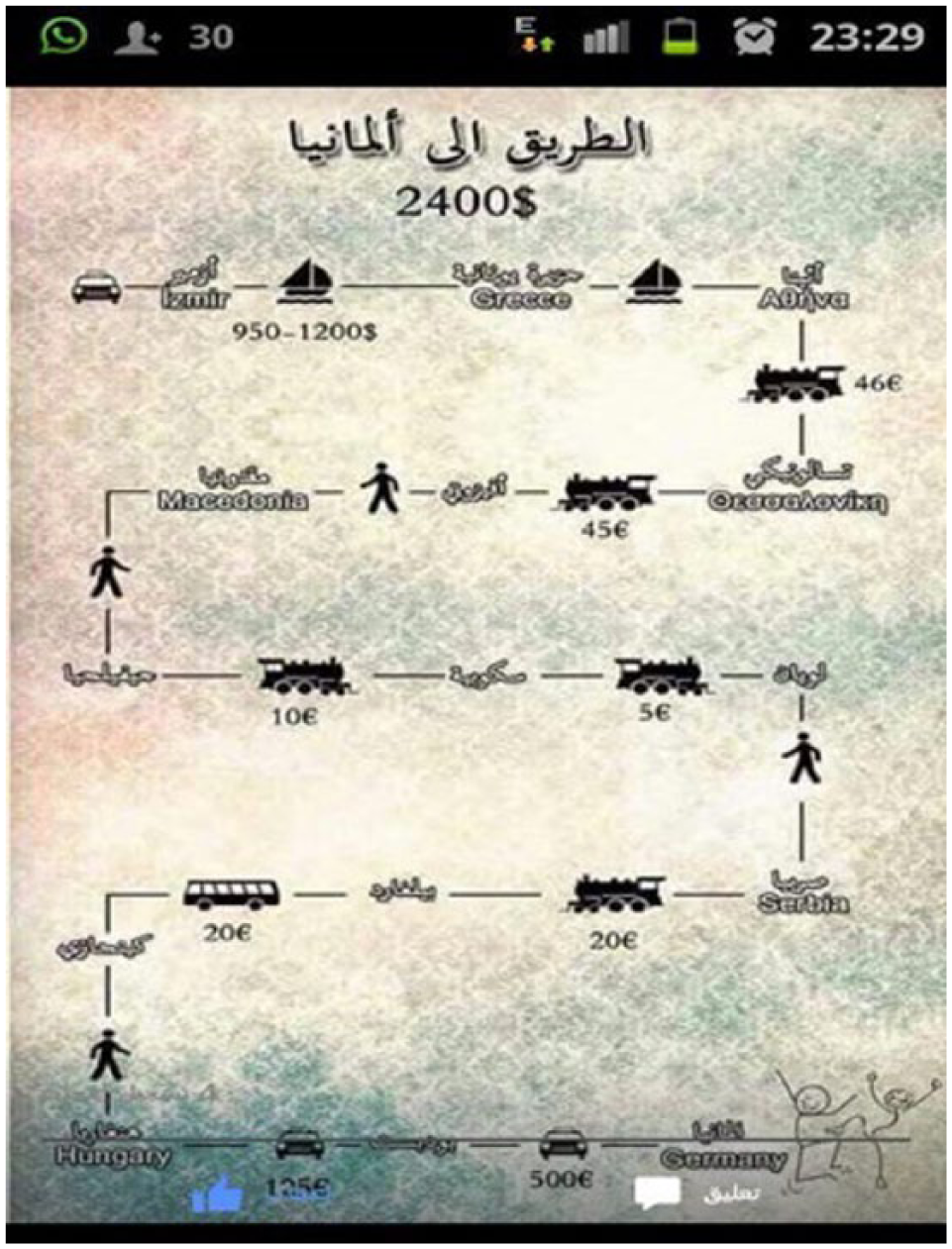
The road to Germany.
Translations into Arabic of the country and city names on the route: Izmir to Greek Island to Athens to Thessaloniki to Evzonoi [Evzoni] to Macedonia to Gevgelija to Skopje to Lojane to Serbia to Belgrade to Kanjiža to Hungary to Budapest to Germany.
The map shows that the route from Izmir in Turkey to Germany costs 2,400 US Dollars, and highlights the mode of transport and the cost of each leg of the journey. It indicates the currencies refugees need and those parts of the journey they have to make on foot. The cities featured on the map are either capital cities or border towns—the creator/s were aware of which countries and places offered the possibility of crossing borders at that time. The map also highlights places where refugees can hire smugglers to help them move on.
Accessing this resource relies on users having a smartphone with WhatsApp or a similar communication platform to receive multimedia files. It also requires Internet access for downloading, sufficient mobile storage space, and battery life to check it at various stages of their journey. The texture of the map (i.e., the digital background with hand-drawn stick figures at the bottom jumping for joy) indicates that the map underwent cycles of digital and non-digital reproduction and re-use; the map was printed, scanned, drawn on, and re-circulated. The stick figures illustrate dreams of a safe arrival in Germany—a country that it was believed at the time would welcome refugees with open arms.
The map was also used by researchers on the Mapping Refugee Media as a fruitful elicitation device in subsequent interviews: it helped to probe refugees’ acquaintances with different kinds of informational resources and sociotechnical practices. Most of the interviewees said that they were familiar with this map in some form or other and had used it on at least one part of their journey. The map contributed to refugees’ decision-making and engagements with smugglers. It allowed those following the map to compare details with those given by smugglers or others along the way. Overall, this digital map of the Balkans route shows how refugee smartphone users in specific contexts imagine, shape, and enact affordances. It demonstrates the way in which “imagined affordances” are product users’ perceptions, expectations, orientations, and assumptions and how these evolve between the material and functional aspects of technologies and between the intentions and perceptions of designers (Nagy & Neff, 2015, p. 1). Crucially, accessing these afforandances depend on a range of material, infrastructural conditions, from battery life to Internet access.
Conclusion
The mass migrations of 2015–2016 highlighted the intervention of the digital on refugee mobilities and experiences, which prompts a reconsideration of how migration and refugee journeys can and should be conceived of and researched. Relying on the firsthand experiences of Syrian and Iraqi refugees who used smartphones to reach Europe, this article applied an infrastructural lens to the analysis smartphone affordances. These included the communicative and networking affordances that enabled refugees to connect with and maintain their social networks, the locatability or navigation affordances for wayfaring, and the multimedia affordances that allow for the capture and circulation of multimedia resources such as voice recordings, maps, and images.
We explored how, with each of these smartphone affordances, comes a dialectical tension between the possibilities for benefit and harm for refugees. The same affordances that allow refugees to “keep on moving on” and communicate with families and friends are also used by hostile regimes or ISIL forces to trace and target activists and political opponents. The locatability affordances which provide orientation and are navigation and survival tools for refugees also involve geo-locatable data that enable state and non-state actors in monitoring and excluding, capturing, and detaining refugees. Furthermore, while the multimedia affordances of smartphones enable refugees to document and share their personal stories, and open up new possibilities for information gathering and the co-production of knowledge, they pose the risk of enabling the circulation of misinformation and also exposure as, for example, recorded images of torture or abuse have been known to fall into the hands of the perpetrators, causing untold harm and even death.
We have sought to offer a more nuanced conceptualization of smartphones, moving beyond the sterile debates of techno-optimism versus techno-pessimism to demonstrate the granular, ambivalent, contradictory ways in which they are at once a lifeline and can pose many risks. Refugee respondents saw the primary threats of surveillance or harm caused by smartphone use as emanating from the repressive socio-political circumstances in their countries of origin. En route, many refugees fear the infrastructural violence of infringements to their connectivity posed by smugglers or border guards, as, for example, smartphones are seized or damaged. Fewer refugees expressed fears of online surveillance by state actors once they were in Europe. As such, we argue that new, unforeseen, and imagined affordances emerge, enmeshed within the infrastructural contexts that both enable and constrain refugee mobility.
Applying the digital infrastructure approach offers a way into a deeper understanding of the dialectical tensions between threat and resource, invisibility and exposure, and mobility and immobility. Our research sheds light on the experiences of vulnerable groups on the move. A smartphone makes users visible, connected, and networked, but this may also expose them to risks. Spaces of control can be invisible and difficult to research. Refugees migrating to Europe walk a fine line between taking precautions to remain invisible to surveillant actors and organizations, and depending on smartphones for support, care, protection, and information. The material, relational conception of digital infrastructures developed in this article proposed a new analytical framework for contextualising refugee experiences within a wider sociotechnical assemblage—rather than just looking at one individual or group’s relationship with one device (Latour, 2005).
This research, at the intersection of infrastructural and affordance-based approaches, brings forth important avenues for further research. In particular, we propose this is a powerful way of thinking through accountability, justice, and ethical policy frameworks. It is evident that understandings of—and means of combatting—the multifarious forms of “infrastructural violence” (Rodgers & O’Neill, 2012) endured by refugees must be developed. We also propose that we need to investigate further how all actors, not just refugees, involved in facilitating, managing, controlling, and preventing migration use of digital devices. We must challenge the turn to digital connectivity as an easy solution to the “migration crisis” and we need to arrive at a much better understanding of the ways in which apps function as part of the digital infrastructure that enables new forms of data gathering, circulation, and power over refugees. Being alive to the ethics and politics of researching refugees alongside other vulnerable monile groups forces us to adopt mobile methods and new modes of participatory research practices and to guard against research practices and outcomes that might work to facilitate control rather than protection.
Finally, there is a pressing need for states and international organizations to reconsider—with the support of ethnographic evidence—how they might re-imagine and integrate smartphone applications into strategies and programs for refugee integration, care, protection, and outreach without falling prey to simplistic digital humanitarianism. Nevertheless, access to reliable and relevant, trustworthy and timely informations remains key to information security. As an example of the ways in which academia, policy, and practice may productively meet, we mentioned how our Mapping Refugee Media Journeys report provided the rationale and evidence to the European Commission to fund a new digital news and information platforms for (and with) refugees in Arabic, English, and French. The InfoMigrants.net initiative, launched in March 2017, is a laudable step toward reducing information precarity. Yet, the value of the platform for diverse refugee groups is still unknown, even as we continue this mobile-first platform. Despite such efforts toward better digital provision, the policy imperative for European Member States to prevent and control “irregular” migration to Europe thwarts such initiatives and compounds the dangers refugees face. They are left with no option but to engage with smugglers and criminals and to continue making dangerous journeys across seas and deserts; as we continue to document in our work in Greece and Turkey, many refugees continue to perish as the world looks on.
Footnotes
Acknowledgements
The authors would like to offer their warmest thanks and appreciation to their co-researchers Lawrence Ampofo, Becky Faith, Evgenia Iliadou, Ali Issa, Claire Marous-Guivarch, and Dimitris Skleparis. They are very grateful to them for the many insights that they contributed to the wider collaborative research on which this article is based. They are also grateful to Salem Osseiran for his assistance with translating and interpreting the map. Thanks too are due to Kevin Smets and Koen Leurs for their insightful comments on earlier drafts. Most of all, the authors’ heartfelt thanks go to those refugees who gave their time and shared their thoughts.
Declaration of Conflicting Interests
The author(s) declared no potential conflicts of interest with respect to the research, authorship, and/or publication of this article.
Funding
The author(s) disclosed receipt of the following financial support for the research, authorship, and/or publication of this article: The research included in this article received seed funding from the Centre for Research on Socio-Cultural Change (CReSC) and the Centre for Citizenship, Identities and Governance at The Open University.
