




Abstract
Worldwide, refugees are increasingly living in uncertainty for undetermined periods of time, waiting for an enduring legal and social solution. In this article, I consider how this experience of waiting is perceived through and influenced by the ubiquity of transnational digital connections, which play a central role in Iraqi refugee households in Jordan. I draw on ethnographic fieldwork conducted among Iraqi refugees in Jordan’s capital Amman to further understand the use of digital technologies in everyday experiences of prolonged displacement. Waiting is an intrinsic affective phenomenon, colored by hope and anxiety. I argue that affective affordances—the potential of different media forms to bring about affects like hope and anxiety—enable Iraqi refugees to reorient themselves to particular places and people. As “no futures” are deemed possible in Jordan or Iraq, digital technologies serve as orientation devices enabling them to imagine futures elsewhere. Through the interplay of media forms, the Iraqi refugees refract their own lives via the experiences of friends and family members who have already traveled onward and who in their perception are able to rebuild a dignified life. Transnational digital connections not only provide a space for hope and optimistic ideas of futures elsewhere but also help to sustain one’s experience of immobility. I argue that using the imagination can be understood as an act of not giving in to structural constraints and might be crucial to making Iraqi refugee life in Jordan bearable.
Introduction
In summer 2015, the realization that smartphones were frequently used by many of the people traveling in(to) Europe was a source of contention on Twitter and in the printed press (Gillespie et al., 2016; Leurs, 2016). The image of the forced yet connected migrant (Diminescu, 2008) does not fit with the stereotypical idea of the “poor, vulnerable refugee.” It incited hope for quick techno-fixes as well as fear that the device could potentially be used as a “terrorist essential” (Gillespie et al., 2016, p. 9). All of these reactions are signs of “high-tech orientalism” (Chun, 2003) that not only misrecognize the globalized availability and accessibility of digital technologies but also render the complex yet connected realities, many people worldwide find themselves in, into discriminating dichotomies that once again differentiate the “west” from the rest. Research on media-use and forced migration has potentially contributed to this distorted picture. In 2006, Cindy Horst already argued that the emergence of digital technologies would greatly affect the global social relations of refugee diasporas. Yet most literature on the mediated experiences of displacement continues to be situated in the Global North or has focused on practical potentials of digital technologies, for instance, in regard to navigating onward journeys (Betts, Bloom, Kaplan, & Omata, 2014; United Nations High Commissioner for Refugees [UNHCR], 2016). Notable exceptions important to this article are the works of Miriyam Aouragh (2011), Koen Leurs (2014, 2016) and Kevin Smets (2017). The overarching focus on Europe and its borders, however, reproduces anxieties about that very border and places Europe center stage. This article addresses “methodological Europeanism” (Garelli & Tazzioli, 2013) by focusing on the mediation of migrants’ experiences within another geographic area. I do not suggest that the experiences discussed here are disconnected from the Global North. Rather, through digital connections, colonial and capitalist entanglements come into force within refugee households beyond Europe’s borders (Ponzanesi & Leurs, 2014).
Research on digitality and border-crossing to Europe provides only a snapshot of what is at stake: the (im)mobility of many migrants is often a stretched-out process, shaped and slowed down by often exclusionary, bureaucratic border regimes within and beyond Western countries (Anderson, 2014; Schapendonk, 2012). The vast majority of conflict-affected migrants live in “prolonged conditions of displacement” (Doná, 2015, p. 67) in non-Western settings. In 2011, the average length refugees and internally displaced persons spend in this legal uncertainty was approaching 20 years (Loescher & Milner, 2011) Over the past years, this has increased to an average of 26 years (UNHCR, 2015a). Many conflict-affected migrants are caught in a legal and social limbo as they are waiting for what the refugee regime calls durable solutions—repatriation, settlement or resettlement—or for other ways to travel onward. It has been widely documented how, in the context of conflict-induced displacement, uncertainty is often the norm (Horst & Grabska, 2015) and that the workings of the institutional structures further reinforce a sense of temporariness (Allan, 2014; Malkki, 1995; Turner, 2004). Migrants living in prolonged conditions of uncertainty are often deeply engaged in what Georgia Doná (2015) calls virtual home-making practices. These mediated practices go beyond instrumental purposes. This article addresses the roles of mediated connections and images in regard to the social and subjective experiences of living in “waiting” beyond Europe. I explore how transnational mediated practices are not only influenced by one’s material circumstances but also how digitality further influences the localized experience of waiting among a particular refugee population: Iraqi refugees in Jordan. 1
I draw upon ethnographic fieldwork conducted from January to September 2015 on the mediation of waiting among Iraqi refugee households in Jordan’s capital Amman. Mediation here refers to the dialectal relationship between the social effects that different media forms bring about and the situated experiences within a particular place that potentially influences media-use (Silverstone, 2005). I consider how mediated connections and images of lives elsewhere feed into everyday experience of prolonged conditions of displacement. As their temporary refugee protection precludes the right to work, most of Iraqi refugee life takes place within the confines of their houses in front of the TV. There was at least one smartphone in every refugee household I visited. This widespread availability of smartphones—despite apparent financial struggles and insecurity about one’s financial situation in the future—suggests the importance of digital technologies. This importance of digitality, I argue, is deeply related to the understanding that being in Jordan is only a temporary state, an experience of waiting.
Waiting is a deeply affective phenomenon. Its “not yet” holds a promise as well as a threat: whether or not it will materialize (Hage, 2009; Seigworth & Gregg, 2010 p. 3). What I call affective affordances of digital technologies play an important role in the experience of waiting. Affordances are the values and utilities particular objects—in this case digital technologies—have. These possibilities for action go beyond the functional and relate to one’s presence in the social and material world (Hutchby, 2001). Different digital technologies have their own characteristics that provide different opportunities as well as limitations. Access to a wider variety of different media forms enables choices between different means for communication, information, and entertainment. These decisions are shaped by one’s social environment and also actively alter social relationships (Madianou & Miller, 2011). In this article, I consider more closely the relation between mediated connections and meaning-making processes. I bring together the work of two affect scholars, Lauren Berlant and Sara Ahmed, to further understand how mediated attachments enable people to stay optimistic and endure the present (Berlant, 2011), yet hopefully orient toward particular futures (Ahmed, 2013). Their work enables me to further understand affective affordances as the ability of media to transpire affects such as hope, but also of dread and despair
By drawing from ethnographic data on the mediated experiences of Iraqi nationals in Jordan who self-identify as refugees, I argue that digital technologies can provide one of the fundamental ways by which people who live in prolonged conditions of displacement continue to have a hopeful outlook toward the future. To make this argument, in the first two empirical sections I explore how digital technologies are able to maintain and influence one’s attachments, to people as well as to places across geographies. Digital connections leave behind impressions that potentially not only alter how one orients toward the future but also influences experiences of the present. Among the Iraqi refugees in Jordan, seeing and hearing about lives elsewhere sustain one’s experience of immobility in Jordan as becomes evident in the third empirical section. In the last section, I consider the importance of digital technologies as orientation devices. They spur the imagination enabling the Iraqi refugee households to maintain a hopeful outlook for futures elsewhere. Before I continue, I will, first, outline the context in which Iraqi refugee households in Jordan find themselves in and, second, describe the methodological approach.
Iraqi Refugee Households in Jordan
Like many non-Western countries, Jordan has not ratified the 1951 Refugee Convention. Instead, refugee protection builds upon a Memorandum of Understanding (MoU) between the Jordanian government and the UN Refugee Agency (UNHCR). In this agreement, Jordan is institutionalized as a “transit country” for those people recognized by UNHCR as asylum seekers or refugees. While UNHCR is authorized to safeguard the protection of displaced people in Jordan, this protection is temporary and precludes the right to work 2 and the ability to obtain citizenship (Kagan, 2011). This article focuses on Iraqi forced migrants, while noting that in Jordan there is also an extensive number of Palestinians who find themselves in legal limbo. The country also hosts at least 650,000 Syrian displaced “people of concern” as well as smaller numbers of forced migrant populations from countries such as Sudan, Somalia, and Yemen (UNHCR, 2015b).
As of October 2015, UNHCR Jordan had registered 50,856 “people of concern” from Iraq (UNHCR, 2015c). Some registered Iraqi nationals are new arrivals who have fled from recent atrocities of the Islamist terrorist group Islamic State of Iraq and the Levant (ISIS). Others have been living in Jordan for years as they sought refuge from the sectarian violence after the US invasion in 2003 and/or initially fled to now war-torn Syria. The majority of Iraqi refugees registered at UNHCR are from Baghdad, are highly educated, and formerly belonged to the middle class (Fafo, 2007). There is a relatively even gender distribution. Approximately 35% are children, 56% are between 18 and 59 years old, and 9.4% are 60 years or older (UNHCR, 2015c). Many Iraqi refugees are living in badly maintained apartments in Jordan’s capital Amman. Some have temporary informal jobs with the reported risk of being deported. Others get by with limited UNHCR support, by depleting their savings or by depending on relatives abroad.
The Iraqi migrants registered at UNHCR self-identify as refugees, regardless of whether they are recognized as such. Iraqi nationals in Jordan who do not appropriate the refugee label are generally not registered at UNHCR and had, upon their arrival, enough financial capital to stabilize their lives, for instance, by buying property. The appropriation of the refugee label by Iraqi “people of concern” can be linked to the hope that this label will provide a safe and legal avenue for secondary migration (Chatelard, 2016). Regardless of the length of their stay, all but two Iraqi refugees I spoke to describe their situation as “waiting” for UNHCR to provide them with the opportunity to travel onward. Currently, UNHCR does not deem return to Iraq safe, while the experience of prolonged conflict makes Iraqi refugees pessimistic about the future of and in Iraq. There has been a large number of in-country asylum applications of Iraqi nationals who found irregular means into Europe (Fandrich, 2013), but not everyone has the financial means, the social networks, or the desperation for this way of traveling onward. The hope for legalized ways to travel onward from Jordan can be further understood through what was—in comparison with other refugee populations—an extensive resettlement program for displaced Iraqi nationals. Between 2009 and 2014, 50% of the people resettled to the United States came from Iraq. In that period, a total of 98,000 Iraqis traveled via the US Resettlement program (Office of Refugee Resettlement, 2013). Yet it seems that now the resettlement slots for Iraqi are limited. UNHCR’s Resettlement Officer stated that she presumed that less than 5% of the Iraqis in Jordan would be resettled (Interview, UNHCR Jordan Resettlement Officer, 6 August 2015). This article considers the mediation of experiences of not being able to go “home” and not being able to move on either.
Situating Media Ethnography Within the Refugee Household
The study’s empirical focus on refugee households is twofold: First, Iraqi refugee life in Jordan largely takes place within the confines of their temporary homes. I was often invited into these homes, which allowed me to closely observe the role of digital technologies in people’s private lives and to witness virtual and temporary-home-making (Doná, 2015). Second, most literature on forced displacement continues to be either positioned as gender-neutral yet written from a male perspective or focuses on women alone (Indra, 1999). The focus on households enabled my understanding of gender—and also religion, generation, class, race, and sexuality—as relational. I use an intersectional lens to consider how different power differences and socio-cultural positionings play out within the household (Crenshaw, 1991; Korteweg & Yurdakul, 2013). “Hanging out” (Rodgers, 2004) with women and men, children and their parents, enabled me to consider how they live and experience their lives differently, as I will further touch upon in the analysis.
I largely drew upon personal networks, established during my first visit to Jordan in 2012 when I did an internship at the International Organization for Migration (IOM) and conducted research for a Master’s degree on rejection for resettlement. I informed all the people who were willing to participate about the nature of the research, its confidentiality, and their right to stop participating. Anonymity was secured through, sometimes self-chosen, pseudonyms. One of the families I often spend time with was the family of Mahmoud and Osman. I met Mahmoud and his wife Ruru in 2012 when this young Iraqi refugee couple were waiting for US resettlement through the country’s official resettlement program. In 2015, Mahmoud—who was now living in the United States—put me in contact via Facebook with his parents and siblings who at the time of research were in Jordan in the hope of being re-united with Mahmoud. I regularly spent time with them, witnessing their life in waiting. We drank coffee and watched TV, while they would share glimpses of their hopes and frustrations with me. Osman—Mahmoud’s 21-year-old brother—kept himself busy with volunteering for a non-governmental organization (NGO), learning English, and using his tablet to contact his Iraqi-born girlfriend in Sweden. I asked Osman and several other people I worked with to take pictures that helped to explain their everyday life to me. Osman only took one picture, showing his bed with his laptop and tablet placed on it. My phone got stolen without having made back-ups and Osman had already deleted the picture, so I sadly lost access to this picture. Adam—another 21-year-old man whose family I will further introduce in the next section—also made a picture of his bed and he could resend this to me (Figure 1).
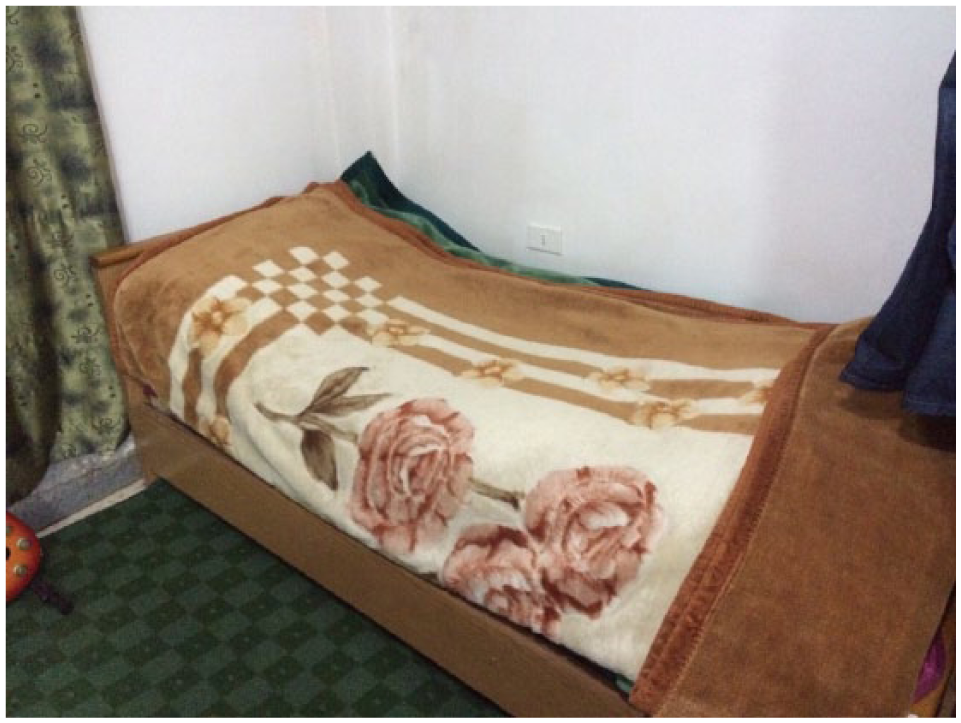
Adam’s bed, picture by Adam.
Contrary to Osman, Adam did not make pictures of digital devices, as he was conscious and cautious that would not fit with the stereotypical representation of a refugee. Yet he would often emphasize the importance of his laptop and iPhone to me as Adam told me his life in Jordan was “like a waiting stop.” Osman equally emphasized the importance of these devices and related it to his physical location:
For me it depends on the country more than the idea of having Internet or a Tablet or not. In Jordan . . . the moment I wake up. It would be a tragedy, if I would wake up one day without anything. It would be a tragedy, here in Jordan. But I don’t think so in the USA or outside. [. . . ] But even in Iraq, it would be okay.
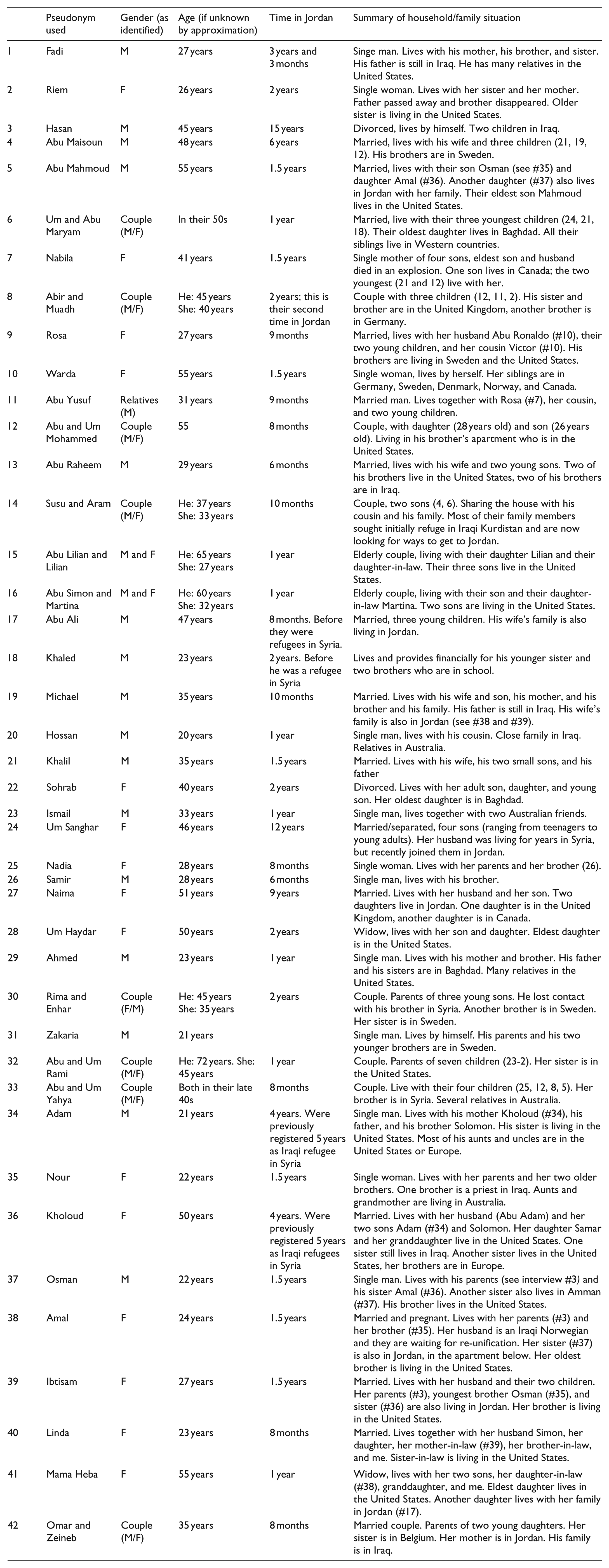
It seems that Osman believed that, especially in Jordan, access to digital technologies is vital. In his experience of in-between-ness, digital connections help him to bridge time and place, in the past as well as in the future. The analysis draws upon accounts of people like Osman and Adam. My understanding of Arabic is good enough for participant observation in the household. Twelve of the semi-structured interviews took place in English, as several men (8) and women (4) were fluent in English. The other 30 interviews were conducted with the help of an Arabic-English translator (see Appendix 1 for a breakdown of the personal characteristics of people interviewed). Working with translation raises important epistemological and ethical concerns. The presence of an extra person might mean that people are more guarded about what they say and it might make it more difficult to establish rapport, suggesting that people could omit important issues (Borchgrevink, 2003). A concern here is that the precise translation of particular emotive states might be difficult. However, through my (partial) understanding of Arabic I could double-check the accuracy of translations, and over time I established a closeness with the families that also enabled me to further grasp the emotive labor waiting requires.
This study raises other important ethical concerns: as a White, unmarried, educated woman from The Netherlands, a country for desired asylum, my presence as well as my mobility contrasted starkly with the socio-historical backgrounds and realities of my participants and especially with their wish to be in the Global North. Ethnography can help us to further connect everyday personal experiences to broader, theoretical, and political discussions (Abu-Lughod, 1997), but we need to recognize that ethnography is enmeshed within a world of power inequalities. My immersive presence and my absence through leaving the field and writing are deeply embedded and potentially implicated in broader socio-political systems of globalization, capitalism, and colonialism. It is certainly important to further reflect on this, yet it goes beyond the scope of this article. For now, I contend that Donna Haraway’s (1988) notion of situated knowledge enables me to not render the persons we work with as only innocent or vulnerable, and instead to consider power-sensitive solidarities.
The Impressions Virtual Intimacy Leaves Behind
Like Osman’s brother Mahmoud, I met Adam and his parents Kholoud and Abu Adam in 2012 and we stayed in contact over Facebook. Unlike Mahmoud, the 50-year-old Kholoud and her family were still in Jordan in 2015. After 9 years she still describes her situation as waiting to travel. Her daughter Samar was given priority by the US government for resettlement as Samar’s child was diagnosed with a severe illness and is now living in the United States. Adam is Kholoud’s eldest son. He emphasizes how Samar is still the “happiness in his family.” He bought his mother a new smartphone so that Kholoud could maintain an active role in the lives of her daughter and granddaughter despite physical distance. Their granddaughter is often hospitalized, and especially during these occasions, Kholoud and her husband reversed much of their day/night rhythm to accommodate the time differences between Jordan and the United States. They would talk for hours with their daughter through Voice-over-IP-applications like Skype, Facebook, or Viber. These applications are used interchangeably as the conversations’ quality depends on the Internet connection. The affordances of multimediality and simultaneity—the ability to see and talk to each other at the same time despite distance—enable Samar’s digital presence within the household.
The emotions associated with Samar’s mediated presence, in conjunction with her physical absence, resonate with other research on transnational relationships (Baldassar, Nedelcu, Merla, & Wilding, 2016; Leurs, 2014; Madianou & Miller, 2011). The concept of polymedia by Madianou and Miller (2011) allows me to further understand how different media (plat)forms are used and appropriated in relation to other available digital technologies. In their work on transnational motherhood, they show how “new” (social) media and “old” media form an integrated communicative environment in the lives of distanced mothers and children. The distinction between voice and text is, for instance, an important parameter of choice: mobile phones and applications like Skype imply closeness, while emails and texts are traceable yet considered as more distant. Their decisions for particular media forms at different times and for different reasons actively (re)shape their relationships.
Kholoud’s smartphone enables her to play an active role in the life of her daughter and granddaughter. Samar often sends video clips to her mother’s Viber account, providing Kholoud with the means to build up a digital archive and to acquire a sense of shared history. Kholoud also often shares electronic postcards, jokes, recipes, and dietary advice to more distant family members and friends, hence navigating different kinds of digital closeness. The layering of different technologies that provides different potentials of use—but also the emergence of smartphones and laptops as devices that have integrated different functions—provides multiple scales of maintaining digital intimacy. Digital technologies can be seen as structuring forces that alter everyday life and practices. Networked technologies are continuously restructuring information flows and alter how human beings interact with each other. Their very pervasiveness generates new intensities (boyd, 2010). In prolonged displacement, hope and despair have always been mediated, for instance, through particular material objects (Dudley, 2010) and story-telling (Al-Hardan, 2016). What is new is the ubiquity of transnational connections through digital technologies. Within the Iraqi refugee household, the more communally shared TV and more individualized smartphones were “always on” (Madianou, 2016) simultaneously, providing different input via a wide variety of sources.
It is important to situate digital connectivity in the precarious context many forced and other migrants find themselves in. Virtual intimacy is often the only means to maintain relationships. Their ability to physically travel—and therefore to visit each other in person—is heavily restricted, and thus, interactions can only take place digitally (Opas & McMurray, 2015). Transnational communication might bring about positive feelings and can be considered as coping mechanisms for offline material hardships, but what are the more lasting impressions of these digital connections? The feelings brought about by transnational connections are not always pleasant. Technological co-presence has the potential to increase the sense of longing to be physically together (Baldassar, 2016), and during hardships, physical distance can become all too real. This became particularly evident with Kholoud. I often caught her watching videos of her granddaughter while she was beating herself on her chest: a gesture suggesting the pain she feels for being physically separated, her worries, and the frustration for not being there to support her daughter with the care of her sick child. For Kholoud, virtual intimacy does not and cannot replace the longing for physical intimacy or her dream to live close to her daughter again. The digital ever-presence of loved ones leaves behind impressions, altering one’s everyday experiences in displacement. Distance hurts as also becomes clear in Adam’s comment on a televised commercial, depicting a heteronormative romanticized Arabic family: We used to be like that . . . all together. Now, all we have is Viber. Contact via smartphone is only a pale substitute for how life used to be, while romanticized representations on TV remind Adam of what has been lost.
Transnational digital intimacy cannot be a substitute for physical co-presence. Physical or virtual presence does not replace and/or displace the other. Digital developments have enabled a more complex array of multiple presences that take place next to and aside from each other (Diminescu, 2008). Through mediated behavior, a person can also come to embody and familiarize oneself with virtual and “real” places elsewhere, but these come into existence next to and not instead of one’s lived physical environment (Moores, 2012). In the next section, I will further explore how mediated connections to Iraq as a physical place further feed into the need Iraqi refugees feel to orient themselves toward a future home beyond Iraq.
Re-orienting “Home”
Home-making practices are deeply mediated: the marking out of a space as a home involves the mediated infusion of a place with familiar sounds, such as music and language (Bonini, 2011). This is perhaps even more the case for migrants: research has shown how transnational TV enables migrants to maintain an active relationship with the country of origin, to hold on to a stable sense of “self,” and to manage everyday angst around unfamiliar circumstance (Georgiou, 2006, 2012). But what do home-making practices mean in prolonged uncertainty, especially if we understand “home” as an “on-going project entailing a sense of hope for the future” (Hage, 1997, p. 103)? Where is home if it is unclear where the future is located? “Home” and belonging are deeply related concepts. Belonging is an emotional attachment, a feeling of being at ease and of being “at home” (Yuval-Davis, 2012: p. 10). The sense of (not) belonging is a perpetual and performative process that is (re)shaped through everyday experiences, one’s physical reality, and mediated, affective practices. Ideas around belonging are continuously attached and (re)oriented toward particular ideas and locations. Sara Ahmed (2006) describes migration as “a process of disorientation and reorientation” (p. 9), of finding one’s way in place, and feeling home (again). In this section, I will analyze how—within the Iraqi refugee household—mediated attachments to Iraq actually reinforce the necessity one feels to reorient oneself beyond Iraq and also beyond Jordan.
Connections to Iraq evoke unpleasant memories and worries about loved ones who have stayed behind. Digital technologies as such are also potential messengers of death and the negative feelings associated with violence and loss. Enhar, a 45-year-old Iraqi man, does not like Facebook for this very reason: Every time I open Facebook I find myself in a tragedy. Of someone I know who has been killed. Many Iraqi refugees struggle with the tensions attachments to Iraq bring. Like many older Iraqi men who now have much time to spare, Osman’s 56-year-old father Abu Mahmoud started watching Iraqi news 24/7, as he continuously compares the contrasting accounts different Iraqi news channels provide. He has a turbulent relationship with this addictive practice: I cry . . . I know it is so sad to watch it. Especially concerning my country. More than once I decided to stop. But then after one week, I have to watch again . . . It seems that Abu Mahmoud desperately tries to cling on to something that fills him with hope, but every time he turns toward Iraq, he is overwhelmed by loss.
Within the refugee household, mediated practices that connect to Iraq are a source of contestation. In this context, the localized interplay between individual- and group-oriented mediated practices is crucial. Among Syrian camp refugees in Turkey, the individually owned smartphone was often part of a more shared, collective media ecology (Smets, 2017). Within Iraqi refugee households in Amman, however, smartphones are deeply personalized. They play a crucial role to carve out an individualized yet virtual private space within the domestic confines of the home. For Nour, and equally so for many other Iraqi young adults and older women, a smartphone is crucial to escape from the televised warscapes older men often watch. Nour, a 22-year-old woman, listens to music and talks via Facebook and WhatsApp with her friends who are now dispersed over Jordan, Lebanon, and Australia. If she watches TV, Nour prefers to watch series like Bab el Hara, a popular Syrian drama series situated in the 1930s: You see a simple life, a sense of community, it is not like now. Her words suggest nostalgia—a longing for the past when life was better, but this coincides with in the recurring emphasis that there is “no future” in Iraq. But to suggest that the above-mentioned TV-viewing practices are only past or Iraq-oriented whereas the use of social media is just “virtual” would misrecognize the interplay between different media forms and its different characteristics. Information and ideas obtained through one media form feed into further actions and practices. Nour discusses recent developments in her favorite drama series online and compares what she hears of her friend’s new life in Australia to what she sees on TV. This suggests the importance of understanding the environment of polymedia. It is through the opportunity to choose between the different characteristics of multiple media forms—TV and social media—as well as through the interactions that Nour navigates her refugee life and holds onto a sense of continuity and ontological security (Georgiou, 2012). Through personal communication, popular culture, and its very interplay, she manages to find a temporary escape from the prolonged uncertainty (Leurs, 2014; Smets, in press). Her virtual practices enable her to overcome the boredom of living in Jordan, yet they equally sustain the temporary nature of that very home in Jordan.
The spatial dynamics of life in waiting—the pain of physical separation and the re-living of loss—play an important role in how Iraqi refugees in Jordan reorient their future away from Iraq. Perhaps equally as important is the emphasis that, due to prolonged legal and social uncertainty, there are “no futures” in Jordan either. This can result in the need to orient oneself elsewhere. In his state of in-between-ness, Abu Mahmoud reaches out to the possibility of finding a new place he can call home. In the summer of 2015, he felt hopeful from the news that Germany would be welcoming refugees, but he preferred to be re-united with Mahmoud in the United States. Like him, many other Iraqi refugees focus the image of their future homes close to their relatives. This preference goes beyond convenience: The home is imagined as an idealized site of continuity and familiarity, and being able to map out a future in a safe place together with one’s loved ones would restore this. Jordan, however, is often described as a “station” or even as a “prison.” Anthropologist Ghasan Hage (2015) defines the experience that one is not moving in life as “stuckedness.” This experience is characterized by immobility, invisibility, uncertainty, and arbitrariness. As becomes evident in the next section, the experience of immobility in Jordan is certainly spatial—as it relates to localized restrictions of rights—but it is also a deeply temporal, affective, and relational experience, as becomes evident in the next section.
The Impasse of Immobility
Seeing and hearing about lives lived elsewhere, in particular of “similar others”—Iraqi nationals who were refugees like them—play a crucial role in how Jordan is experienced as “being stuck.” This experience is twofold. First, for many Iraqi refugees in Jordan, the busy-ness of distanced friends and family members reinforces the notion that their time in Jordan is wasted by waiting. Abu Raheem is a 29-year-old father of two. He is tired of waiting, of searching for ways out of Jordan, and of waiting for his friends to pick up the phone:
They tell me: we were busy, we were working, we couldn’t pick up the phone. So I told them: whenever you call me, I won’t call anymore. Because you know I am not working. I always have time. And it is tiring.
Remaining hopeful while “waiting”—and not being allowed to work—is hard work. His own experiences of uncertainty are contrasted to those of friends and relatives who have made it elsewhere and who are able to rebuild and are busy doing do. Their opportunities reinforce his despair.
Adam, Kholoud’s son, also underscores his own lack of mobility through seeing and hearing the actual material mobility of distanced friends and family members: first by airplane, now by cars and bicycles. This became evident when he showed me the pictures his friends were sending him
of a lot of good things that I just want to do. [. . . ] that he is uhm riding a bicycle, he is climbing a mountain, going to a pool. [. . . ]. But here, you can’t move an inch without money . . . It is making me sad but I don’t show it, because he was like me but he got the chance to travel, so . . .
Adam compares the Western active lives his friends are living with his own lack of opportunities in Jordan. It hurts even more since his friends were once in a similar situation as him. His words and experiences are linked not only to his legal situation but also to his lack of financial capital: if he had money, he could “move” either physically away from or socially within Jordan. The experience of (im)mobility therefore not only relates to lacking physical mobility but also refers to limited possibilities for social and existential mobility within Jordan. As these two examples show, the hope for outward and upward movement is deeply related. To some extent, their narratives can be considered examples of mobility-envy (Hage, 2015, p. 5), yet their experiences seem more self-inflicted. The circulating information, stories, and rumors of people who have managed to migrate and improve their lives allow one to imagine a “good life” elsewhere as I will further explore in the next section. Within the broader context of advanced global capitalism, bodies are oriented in particular individualized ways: toward the possibility of upward social mobility, emphasizing one’s lack of mobility as personal failure. Meanwhile, those who have migrated onward might feel the social pressure to prove that their new life is indeed successful (Tuckett, 2016), and this success might be exaggerated on social media platforms. Experiences of (im)mobility and—as I will show in the next section—the imagination of the future are interpreted and negotiated through one’s situational, gendered, and generational context. Like migration, adolescence connotes a journey (Grabska, 2016). It is a temporal context-specific stage of becoming. Whereas a detailed gendered and generational analysis goes beyond the scope of this article, it is important to note that many of the younger unmarried male and female Iraqi refugees felt their opportunities for coming-of-age-mobility (such as getting married) in Jordan were also restricted because of uncertainty about where the future would be. Many parents emphasized concerns about the future of their children.
The prolonged condition of displacement in which many of the Iraqi refugees in Jordan find themselves resembles Lauren Berlant’s (2011) understanding of impasse: a situation where someone cannot or will not move forward and in which there is a creative, anxious assessment of information and possibilities. While Berlant does not directly address the physical context of migration and her work is situated in late modern societies in the Global North, many Iraqi refugees have an almost manic drive to obtain more information on where, how, and when to “travel.” Not knowing where one belongs and if one will ever belong again is overwhelming and exhausting. This is especially, but not only, the case for those Iraqi refugees who have personal experiences of violence in Iraq, who are poor or have become impoverished in waiting for years, and/or don’t have supportive transnational networks. Abir and Muadh, an Iraqi couple in their late 40s, asked a relative for financial help: My cousin in the UK said: you have to suffer so, when you come here, you know how much you suffered and you start working . . . The precariousness they endure seems to be portrayed as a rite de passage, a liminal state one needs to endure before being allowed to enter a Western country. Whereas within anthropological studies liminality is the in-between-state of a linear transition from an old to a new state (Turner, 1967), yet in prolonged displacement there is no guarantee of an exit. What is supposed to be a temporary phase has become prolonged. Meanwhile, the mobility of few Iraqi refugees like them who have found legal or illegal ways out—sometimes after years of waiting—reinforces the notion that life in Jordan is transitory and that the hope for a future elsewhere is not necessarily false. How this imagined future looks will be further explored in the next section.
Digital Technologies as Orientation Devices: Imagining Futures Elsewhere
Generally, the affective atmospheres within Iraqi households move back and forth between hope and despair. Being considered “out of place” further pushes the Iraqi refugees to orient themselves beyond the virtual: to other physical places where futures are deemed possible. The virtual is used to conceive these other physical places. In his pivotal work, Arjun Appadurai (1996) presumed that digital interconnectedness would result in a world less bounded by borders. Global cultural circulation and imagination would enable people to contest inequalities. He misrecognized that not everyone has the equal advantage of mobility and capital (Ong, 1999). The imagination, however, does play a crucial role in enabling Iraqi refugees in Jordan to maintain their optimism. Optimism, Berlant (2011) argues, is “a social relation involving attachments that organize the present” (p. 14). It is the complexity of being bound to life. This optimism is deeply mediated. Riem, a 26-year-old economist, emphasized how she was looking forward to start her life anew and told me: I still have the American dream. I have to. I want to be a nurse because I love Grey’s Anatomy. The Iraqi refugees in Jordan are not untouched by the logic of capitalism or by the American-dominated media-landscape. Riem’s American dream was directly inspired by Grey’s Anatomy, whereas Ismail—a 33-year-old Iraqi man—finds hope in the blockbuster Titanic: In the US, life is not easy. But when you have a dream as lot of society will support you to make your dreams come true. The understanding that especially in the United States—in contrast to Iraq and Jordan—aspired futures are possible is a source of inspiration and hope. Through regular digital connections with relatives and friends in Western countries, there is increased awareness that life in North West Atlantic societies is nothing like what is seen on TV or on the Internet, but this doesn’t stop the dream of imagining better futures elsewhere. Riem is fully aware of the difficulties her sister in the United States is experiencing, yet this doesn’t seem to register against her actual hopes. Like the would-be migrants in Guinea (Vigh, 2009), it seems that the intimate digital presence of faraway relatives and friends makes imagining living elsewhere a more realistic option instead of a faraway dream.
This by no means suggests that there is no criticism or rejection of what life in the west would be like. Several people I spoke to expressed concerns, for instance, about different sexual morals, alcohol consumption, and maintaining their religious practices while emphasizing the wish for a freedom they associated with Western countries and one they missed in Iraq and Jordan. Osman explained how he imagined life in the United States: Living a good life. Maybe for some time I would go partying, to cafes, mixing with people in general. I am considering this. I will be part of the society, but to a certain degree. He envisions a balanced life, enjoying Western freedoms and rights while holding onto his religious practices and sense of self. His use of the word “good life” again resonates with Berlant, as she argues that attachments to the “good life” and social upward mobility can make difficult lives bearable. Fantasies of the “good life,” Berlant argues, are deeply related to actual experiences of precarity and crisis as well as to cultural production. Especially when there are no promises for material betterment in the present, there is the need to hold onto the idea that future life is and will be meaningful. My initial response to the hope many Iraqi refugees expressed to travel to the United States was one of surprise because of the destructive role the country has played in Iraq’s upheaval. Abu Mahmoud explained, We have a saying in Iraq. It means: treat the disease with the cause. So the cause is the States and the cure is the States. His words suggest that the American neo-colonial entanglements make it more likely for the Iraqi refugees to turn and orient themselves toward that very country, just because it is accountable for their current situation. The plight of Iraqi refugees relates not only to the postcolonial remnants of the British empire and US-led neo-colonial destruction (Dewachi, 2017) but equally so to the containment strategies of Western countries (Berman, 2011) that make them fully aware of the limited opportunities for traveling onward.
The lives of many people worldwide are constrained by deeply rooted structures of global inequalities and considered through the mirror image of potential lives elsewhere. Koen Leurs (2016) questions what are the lasting effects of what he calls “transnational affective capital.” He argues that Somali migrants in Ethiopia refrain from altering the very position they are in because of the fantasies transnational connections bring: “In articulating their daily routines, it seems their subjectivity is completely future oriented. They feel stuck, their life is at a standstill, and they live in total dependency of loved ones and strangers abroad . . . .” (p. 28). In contrast to the Palestinian diaspora who managed to build online communities despite physical dispersal (Aouragh, 2011), the imagined futures based on transnational connections and mass media seem to restrict the Iraqi refugees in this study, much like the Somali migrants in Leurs’ (2016) study, from imagining and establishing more collective struggles to improve their rights in Jordan. Leurs’ notion of “total dependency,” however, seems to preclude any sign of agency. Waiting does not necessarily imply passivity. It can be an active and tiring process of constantly orienting oneself to potentialities for security. Many Iraqi refugees act. Not only is there the ongoing search for ways out of Jordan—by navigating the Internet for alternative ways to travel, by visiting the different embassies, and by organizing protests at the UNHCR to demand a solution. The hope for a future elsewhere also propels many Iraqi refugees to spend their “waiting” time meaningfully: many Iraqi refugees are, for instance, motivated to learn English or to acquire practical skills through Internet tutorials. Dreams of a better life elsewhere can also be an act of not giving in to the given context and to continue to negotiate life. Digital technologies thus serve as orientation devices (Ahmed, 2006, p. 4) that enable forced migrants to dream and direct their hopes, investments, and attention to places elsewhere to make life in Jordan bearable.
Conclusion
In this article, I have shown that in living with uncertainty hope is deeply mediated. The ubiquity of transnational connections influences the everyday experiences of Iraqi refugees who are living in waiting.
Through their affective affordances and their pervasiveness, digital connections spur emotions and leave behind impressions: they can reinforce a longing to be physically together as well as dread for a future of and in Iraq. Temporal experiences of the everyday and of movements in life are also refracted through the experiences of similar others—Iraqi nationals like them who did get the opportunity to travel. These encounters reinforced the notion that waiting time is wasted time. They not only aggravate feelings of “stuckedness” but also reinforce the necessity for staying hopeful for a future elsewhere. Digital technologies serve as orientation devices that enable forced migrants to imagine lives elsewhere, beyond Jordan and Iraq. To come back to the words of Osman, not having access to digital technologies would be a tragedy. In Osman’s experience of in-between-ness—in between Iraq and another place where a future is deemed possible—digital technologies are vital to making life in Jordan bearable and to staying hopefully oriented toward the future.
This does not imply that the notion of the “connected migrant” (Diminescu, 2008) should be celebrated. Digital connectivity enables acts of not giving in to the situation, but it is by no means the solution for prolonged legal and social insecurity. Whether imagined futures elsewhere will happen remains uncertain. The same power relations that make it more likely that people attach themselves to some ideas also make the world more hospitable for some bodies rather than other bodies. Resettlement slots are limited, and—even if people have the financial resources and the desperation to travel irregularly—the lives of migrants in the Global North are also increasingly marked by uncertainty. Their structural constraints are deeply rooted in global capitalist and neo-colonial inequalities that are the obstacles to the flourishing of these and many other migrants.
Footnotes
Appendix 1
| Pseudonym used | Gender (as identified) | Age (if unknown by approximation) | Time in Jordan | Summary of household/family situation | |
|---|---|---|---|---|---|
| 1 | Fadi | M | 27 years | 3 years and 3 months | Singe man. Lives with his mother, his brother, and sister. His father is still in Iraq. He has many relatives in the United States. |
| 2 | Riem | F | 26 years | 2 years | Single woman. Lives with her sister and her mother. Father passed away and brother disappeared. Older sister is living in the United States. |
| 3 | Hasan | M | 45 years | 15 years | Divorced, lives by himself. Two children in Iraq. |
| 4 | Abu Maisoun | M | 48 years | 6 years | Married, lives with his wife and three children (21, 19, 12). His brothers are in Sweden. |
| 5 | Abu Mahmoud | M | 55 years | 1.5 years | Married, lives with their son Osman (see #35) and daughter Amal (#36). Another daughter (#37) also lives in Jordan with her family. Their eldest son Mahmoud lives in the United States. |
| 6 | Um and Abu Maryam | Couple (M/F) | In their 50s | 1 year | Married, live with their three youngest children (24, 21, 18). Their oldest daughter lives in Baghdad. All their siblings live in Western countries. |
| 7 | Nabila | F | 41 years | 1.5 years | Single mother of four sons, eldest son and husband died in an explosion. One son lives in Canada; the two youngest (21 and 12) live with her. |
| 8 | Abir and Muadh | Couple (M/F) | He: 45 years She: 40 years |
2 years; this is their second time in Jordan | Couple with three children (12, 11, 2). His sister and brother are in the United Kingdom, another brother is in Germany. |
| 9 | Rosa | F | 27 years | 9 months | Married, lives with her husband Abu Ronaldo (#10), their two young children, and her cousin Victor (#10). His brothers are living in Sweden and the United States. |
| 10 | Warda | F | 55 years | 1.5 years | Single woman, lives by herself. Her siblings are in Germany, Sweden, Denmark, Norway, and Canada. |
| 11 | Abu Yusuf | Relatives (M) | 31 years | 9 months | Married man. Lives together with Rosa (#7), her cousin, and two young children. |
| 12 | Abu and Um Mohammed | Couple (M/F) | 55 | 8 months | Couple, with daughter (28 years old) and son (26 years old). Living in his brother’s apartment who is in the United States. |
| 13 | Abu Raheem | M | 29 years | 6 months | Married, lives with his wife and two young sons. Two of his brothers live in the United States, two of his brothers are in Iraq. |
| 14 | Susu and Aram | Couple (M/F) | He: 37 years She: 33 years |
10 months | Couple, two sons (4, 6). Sharing the house with his cousin and his family. Most of their family members sought initially refuge in Iraqi Kurdistan and are now looking for ways to get to Jordan. |
| 15 | Abu Lilian and Lilian | M and F | He: 65 years She: 27 years |
1 year | Elderly couple, living with their daughter Lilian and their daughter-in-law. Their three sons live in the United States. |
| 16 | Abu Simon and Martina | M and F | He: 60 years She: 32 years |
1 year | Elderly couple, living with their son and their daughter-in-law Martina. Two sons are living in the United States. |
| 17 | Abu Ali | M | 47 years | 8 months. Before they were refugees in Syria. | Married, three young children. His wife’s family is also living in Jordan. |
| 18 | Khaled | M | 23 years | 2 years. Before he was a refugee in Syria | Lives and provides financially for his younger sister and two brothers who are in school. |
| 19 | Michael | M | 35 years | 10 months | Married. Lives with his wife and son, his mother, and his brother and his family. His father is still in Iraq. His wife’s family is also in Jordan (see #38 and #39). |
| 20 | Hossan | M | 20 years | 1 year | Single man, lives with his cousin. Close family in Iraq. Relatives in Australia. |
| 21 | Khalil | M | 35 years | 1.5 years | Married. Lives with his wife, his two small sons, and his father |
| 22 | Sohrab | F | 40 years | 2 years | Divorced. Lives with her adult son, daughter, and young son. Her oldest daughter is in Baghdad. |
| 23 | Ismail | M | 33 years | 1 year | Single man, lives together with two Australian friends. |
| 24 | Um Sanghar | F | 46 years | 12 years | Married/separated, four sons (ranging from teenagers to young adults). Her husband was living for years in Syria, but recently joined them in Jordan. |
| 25 | Nadia | F | 28 years | 8 months | Single woman. Lives with her parents and her brother (26). |
| 26 | Samir | M | 28 years | 6 months | Single man, lives with his brother. |
| 27 | Naima | F | 51 years | 9 years | Married. Lives with her husband and her son. Two daughters live in Jordan. One daughter is in the United Kingdom, another daughter is in Canada. |
| 28 | Um Haydar | F | 50 years | 2 years | Widow, lives with her son and daughter. Eldest daughter is in the United States. |
| 29 | Ahmed | M | 23 years | 1 year | Single man. Lives with his mother and brother. His father and his sisters are in Baghdad. Many relatives in the United States. |
| 30 | Rima and Enhar | Couple (F/M) | He: 45 years She: 35 years |
2 years | Couple. Parents of three young sons. He lost contact with his brother in Syria. Another brother is in Sweden. Her sister is in Sweden. |
| 31 | Zakaria | M | 21 years | Single man. Lives by himself. His parents and his two younger brothers are in Sweden. | |
| 32 | Abu and Um Rami | Couple (M/F) | He: 72 years. She: 45 years | 1 year | Couple. Parents of seven children (23-2). Her sister is in the United States. |
| 33 | Abu and Um Yahya | Couple (M/F) | Both in their late 40s | 8 months | Couple. Live with their four children (25, 12, 8, 5). Her brother is in Syria. Several relatives in Australia. |
| 34 | Adam | M | 21 years | 4 years. Were previously registered 5 years as Iraqi refugee in Syria | Single man. Lives with his mother Kholoud (#34), his father, and his brother Solomon. His sister is living in the United States. Most of his aunts and uncles are in the United States or Europe. |
| 35 | Nour | F | 22 years | 1.5 years | Single woman. Lives with her parents and her two older brothers. One brother is a priest in Iraq. Aunts and grandmother are living in Australia. |
| 36 | Kholoud | F | 50 years | 4 years. Were previously registered 5 years as Iraqi refugees in Syria | Married. Lives with her husband (Abu Adam) and her two sons Adam (#34) and Solomon. Her daughter Samar and her granddaughter live in the United States. One sister still lives in Iraq. Another sister lives in the United States, her brothers are in Europe. |
| 37 | Osman | M | 22 years | 1.5 years | Single man. Lives with his parents (see interview #3) and his sister Amal (#36). Another sister also lives in Amman (#37). His brother lives in the United States. |
| 38 | Amal | F | 24 years | 1.5 years | Married and pregnant. Lives with her parents (#3) and her brother (#35). Her husband is an Iraqi Norwegian and they are waiting for re-unification. Her sister (#37) is also in Jordan, in the apartment below. Her oldest brother is living in the United States. |
| 39 | Ibtisam | F | 27 years | 1.5 years | Married. Lives with her husband and their two children. Her parents (#3), youngest brother Osman (#35), and sister (#36) are also living in Jordan. Her brother is living in the United States. |
| 40 | Linda | F | 23 years | 8 months | Married. Lives together with her husband Simon, her daughter, her mother-in-law (#39), her brother-in-law, and me. Sister-in-law is living in the United States. |
| 41 | Mama Heba | F | 55 years | 1 year | Widow, lives with her two sons, her daughter-in-law (#38), granddaughter, and me. Eldest daughter lives in the United States. Another daughter lives with her family in Jordan (#17). |
| 42 | Omar and Zeineb | Couple (M/F) | 35 years | 8 months | Married couple. Parents of two young daughters. Her sister is in Belgium. Her mother is in Jordan. His family is in Iraq. |
Declaration of Conflicting Interests
The author(s) declared no potential conflicts of interest with respect to the research, authorship, and/or publication of this article.
Funding
The author(s) received no financial support for the research, authorship, and/or publication of this article.