



Abstract
The animated Graphics Interchange Format (GIF) is a digital file format with a long history within internet cultures and digital content. Emblematic of the early Web, the GIF fell from favor in the late 1990s before experiencing a resurgence that has seen the format become ubiquitous within digital communication. While the GIF has certain technical affordances that make it highly versatile, this is not the sole reason for its ubiquity. Instead, GIFs have become a key communication tool in contemporary digital cultures thanks to a combination of their features, constraints, and affordances. GIFs are polysemic, largely because they are isolated snippets of larger texts. This, combined with their endless, looping repetition, allows them to relay multiple levels of meaning in a single GIF. This symbolic complexity makes them an ideal tool for enhancing two core aspects of digital communication: the performance of affect and the demonstration of cultural knowledge. The combined impact of these capabilities imbues the GIF with resistant potential, but it has also made it ripe for commodification. In this article, we outline and articulate the GIF’s features and affordances, investigate their implications, and discuss their broader significance for digital culture and communication.
Introduction
Let’s start with some vignettes.
You are following the 2016 US Presidential election campaign, primarily through social media, and it is the night of the first debate between Hillary Clinton and Donald Trump. Watching on Facebook Live, much of your attention is focused on the rhetoric and policies of the candidates, but for a fleeting instant you notice Hillary Clinton smirk and shake her shoulders in response to egregiously sexist claims made by Donald Trump. It is just a brief movement, but it could make for a witty visual response to wider narratives surrounding election discourse and coverage, and also contemporary gender dynamics and feminist politics.
You are hosting a party to watch the season finale of your favorite reality TV show. Your best friend texts you to tell you that she will be late because she has forgotten to buy ice. You want to convey your irritation (but in a humorous way that won’t come across as harshly as text-only communication might) while simultaneously reinforcing your fandom for the reality show.
It is May 2017, and you are reading the latest developments from the Trump administration’s scandal-filled first 100 days. News breaks that Federal Bureau of Investigation (FBI) Director James Comey has been fired, followed by accounts that Press Secretary Sean Spicer has been seen hiding in some bushes in order to avoid reporters asking questions about Comey’s firing. There is no footage of this, but the idea of the Press Secretary hiding from the press is striking and speaks to a recurring visual from a long-running animated TV show. You look for a way to make this connection, conveying your cultural knowledge references and political commentary at the same time.
The communicative device at the center of these vignettes is a 30-year-old file format that enables the endless looping of image sequences: the animated Graphics Interchange Format (GIF). 1 Whether it is isolating and sharing the “Hillary Shimmy” (Figure 1), texting a reaction GIF of NeNe Leakes from The Real Housewives of Atlanta (Figure 2), or remixing Sean Spicer with a clip of Homer Simpson disappearing into bushes (Figure 3), the GIF is a remarkably dexterous, malleable, and versatile file format that is central to digital cultures and communication. This malleability and versatility are key to the GIF’s capacity for interpretive flexibility; the separation of GIFs from their original texts imbues them with multiple layers of meaning that are not universally accessible to all audiences. This, we argue, provides the GIF with resistant potential: similar to double-entendre, parody, camp, and other types of layered texts, GIFs can be (and often are) used to communicate hidden meanings in plain sight.
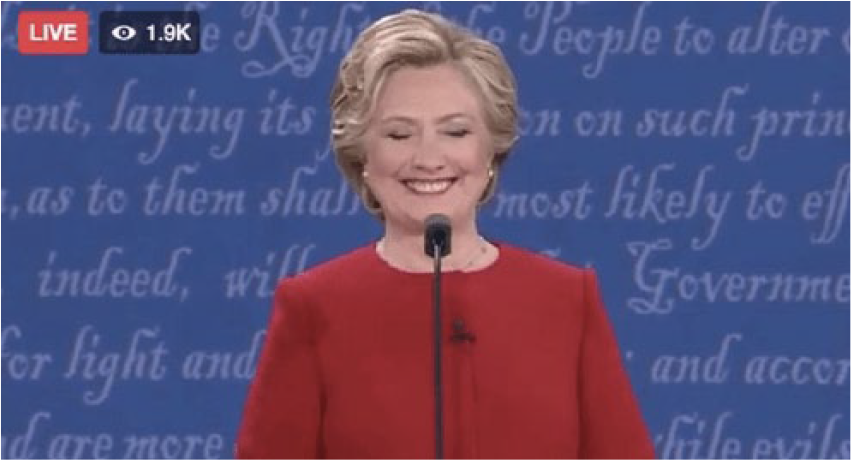
The “Hillary Shimmy” GIF. Retrieved from https://giphy.com/gifs/3oz8xxf69XA8pHD6mY.

NeNe Leakes Reaction GIF from The Real Housewives of Atlanta. Retrieved from https://giphy.com/gifs/zQbhdw5nf91wQ.

Sean Spicer as Homer Simpson disappearing into bushes. Retrieved from https://giphy.com/gifs/right-director-ooooh-7VhgTAje7DUJ2.
The Hillary Shimmy (Figure 1), for example, highlights these multiple levels of meaning. On the surface, stripped of all context, the shimmy is an animated image of a well-dressed, well-groomed woman standing at a podium shaking her shoulders while smiling to herself. While the action captured in the GIF would make it useful to communicate a variety of emotions or affective states (anticipation, self-satisfaction, sauciness, and so on), those who understand who the woman is (the first female American presidential nominee, US Senator, former First Lady) and the context of the movement (the fact that she was listening to Trump’s claims of having superior judgment and temperament) allows for a deployment that infers a more critical or political response.
A GIF like the Hillary Shimmy might be employed to demonstrate basic feelings or emotions, but it takes on further meaning with new contexts and uses. For example, if a personal care brand tweeted something about a new product aimed at “making you sexy for your man,” the Hillary Shimmy could be deployed in a way that has multiple meanings. A person could respond with the Hillary Shimmy and mean “I’m excited to use this product to make myself more appealing to men.” On the other hand, someone else could respond with the Hillary Shimmy and mean “I can’t wait to engage in a feminist critique of this product and the idea behind it.” Yet another person could respond with the Hillary Shimmy with the intent to engage in a heteronormative critique, make a joke about the target audience for personal care products, mark their political orientation, and articulate an appreciation for Hillary Clinton herself. Friends of this person (or people within the same community) would likely understand most of the meanings intended by the GIF’s use; however, strangers or people from different communities would likely miss many, if not all, of the intended meanings—or misunderstand its use entirely.
In this article, we examine the GIF as cultural text and device. This is distinct from a specific focus on the .gif file format—a minor distinction, perhaps, but one that has become important to note in response to how different social media platforms and apps treat the GIF, where not all GIFs presented are .gif files. 2 While the GIF has certain technical affordances that make it highly versatile, this is not the sole reason for its ubiquity. Instead, GIFs have become a key communication tool in contemporary digital cultures thanks to a combination of their features, constraints, and affordances. GIFs are polysemic, largely because they are isolated snippets of larger texts. This, combined with their endless, looping repetition, allows them to relay multiple levels of meaning in a single GIF. This symbolic complexity makes them an ideal tool for enhancing two core aspects of digital communication: the performance of affect and the demonstration of cultural knowledge. The combined impact of these capabilities imbues the GIF with resistant potential, but it has also made it ripe for commodification. The adoption of the GIF for commercial purposes demonstrates the recognition of these key features and highlights how the GIF has transitioned from a user-driven format within niche digital cultures to a visual device with institutional applications and investment. In the pages that follow, we outline and articulate the GIF’s features and affordances, investigate their implications, and discuss their broader significance for digital culture and communication.
GIFstory: From the Early Web to the GIF Resurgence
The animated GIF is a pervasive and central format in the web’s vernacular cultures. Furthermore, it offers rich opportunities for remix and intertextual play; user-created and remixed GIFs provide further examples of “vernacular creativity,” as users appropriate existing media and produce new content using digital media (see Burgess, 2008). However, this is only part of the story, and the GIF has a long history within digital cultures (see Eppink (2014) for a full account).
Created in 1987 by CompuServe engineer Steve Wilhite, the GIF is an image file format that used lossless data compression. What set the GIF apart from other static image formats such as the JPEG or PNG was its additional support for looping sequences. The GIF can display frames on repeat within the same image file without being the size (or resolution) of a video. For the early web, the GIF was an ideal way of adding visual content and movement to a website at a time when bandwidth was limited and video and image-editing software were less advanced. Most typical of the era is the “Under Construction” imagery (see Figure 4), where unfinished websites would feature a GIF (or GIFs) which variously included construction signage, flashing lights, and hard hats as rotating banners, heavily pixelated iconography, and more (Ulanoff, 2016).

Examples of under construction GIFs (from GIFcities).
As web design advanced and capabilities for creating and supporting images, videos, and other visual forms improved, the animated GIF fell out of favor. Initially, rumors of the GIF format being patented and requiring licenses for use led to a move by web designers and webmasters to use other, free use formats, such as PNGs (Limer, 2016). Even though those fears were ultimately unfounded, the GIF’s decline in popularity continued as it became synonymous with older, amateurish styles of web design (Eppink, 2014).
After a decade of irrelevance, the GIF experienced an unexpected resurgence. The customizability of MySpace reintroduced the GIF format through services like Blingee and was soon adopted by communities on Reddit, LiveJournal, and Tumblr, with fan communities taking a particular lead (e.g. Booth, 2015; Thomas, 2013). GIFs were also heavily promoted in Tumblr’s Radar, a curated selection of new, interesting, and popular content (see Ulanoff, 2016). The technical affordances of the GIF were integral to this adoption: the looping sequences allowed for the encoding of short snippets of video into a single image format. This was a boon for content creators, platforms, and consumers on the web: instead of having to embed short clips of video, which were far bigger files that were complicated to deploy, the GIF allowed for the embedding of single images that operated like video.
The GIF resurgence was also aided by the nostalgic proclivity of Internet culture groups for the banalities of the early web: dial-up modems, cheesy Web 1.0 design, and 8-bit pixelation. Even though GIFs are capable of supporting higher image quality, 3 the low-quality GIFs of the early web form part of the “Internet Ugly” aesthetic beloved by early users of the Internet (see Douglas, 2014). According to David Hayes, head of creative strategy for Tumblr, the GIF is “the file format of the internet generation. It’s our vinyl, our compact disc” (in Ulanoff, 2016). To capitalize on this nostalgia in a brand-appropriate way, the Internet Archive celebrated its 20th anniversary by launching “GIFcities,” a search engine for the GIFs featured in its Geocities archive (GIFcities, 2016).
However, the evolution of the GIF has meant that it has a different cachet than in its early web heyday. Although the fetishization of the GIF as a nostalgia and design object may still be relegated to niche communities, its usefulness as a format has ensured its rapid expansion into the mainstream. Because of their capacity to capture short animations, GIFs are used as illustrative formats in biomedical research and animated data visualization. Support for GIFs and other visual media on popular social media platforms has also led to the format’s use for augmenting news and information within tweets; the brevity and smaller size of the GIF over video make it a useful medium for providing short footage or animated charts which encourage others to click through to the full article. GIFs have also been used in high-fashion advertising campaigns and art shows, including an event for the format’s 30th birthday held by GIF repository Giphy (Mufson, 2017).
GIFs are now ubiquitous in contemporary Internet-based communicative environments, including text messaging, email, social media, dating apps, and workplace management software. In October 2016, Giphy announced it was serving more than 1 billion GIFs to over 100 million active users every day (@giphy, 2016). The GIF is also part of a wider landscape of visual social media, participation and creativity, and digital cultures (see Highfield & Leaver, 2016). Visual media are used within everyday social media conversations, posts, and activity, whether for personal chats or displays of political activism. They illustrate points, provide information, and act as an exclamation and reference in one, allowing them to be useful means for performing identity, humor, expertise, and community in online environments. GIFs share communicative affordances with other visual media, from the intertextuality of memes (Milner, 2016; Shifman, 2014) to the affective representation of emoji. However, how these affordances are realized differs between GIFs and other visual media, due both to technical aspects of the file format and the cultural practices that have developed around GIF use.
Communicative Affordances of the GIF
Communicative practices involving the GIF draw upon several of the format’s technical affordances. Ash (2015) focuses on aspects of the technical with duration, color, and repetition as the material features responsible for the GIF’s affective capacity (p. 122). Eppink (2014), on the other hand, argues that apparent technical shortcomings of the GIF format (such as the lack of sound or playback options) are actually critical to the creativity of GIF users and the versatility of the files. These technical elements cross over with the communicative affordances of the GIF: for instance, while looping may be a technical affordance of the file format, repetition as a rhetorical or communicative feature influences meaning and interpretation. In the following discussion, we focus on affordances and features that are crucial to these applications of the GIF: 4 the performance of affect; the relationship between polysemy, decontextualization and repetition; and the demonstration of cultural knowledge.
Our analysis draws on our research into GIF keyboard apps, GIF use on Tumblr and Twitter, and GIFs as fandom texts (primarily in English). Rather than focus on a single, context-specific data set, or indeed any claim that a particular data set is representative of GIF and digital cultures more broadly, in this article, we highlight recurring themes and practices that have appeared within our analyses. Collectively, these include the content and presentation of the RuPaul’s Drag Race keyboard app, David Bowie GIFs on Tumblr, animated infographics, news and news-inspired GIFs on Twitter, and 2016 US Presidential election GIFs. We used textual and visual analysis to not only examine the content of the GIFs but also the intertextual and paratextual connections between the GIFs in question and other media content.
Affect
One of the most common uses of GIFs—if not the most common—is the performance of affect. In their examination of GIFs within texting, Tolins and Samermit (2016) claim that “the use of GIFs presents the reproduced action as the texter’s current embodied action, which would otherwise be prohibited by the written format” (p. 76). In her study of digital media and the formation of “affective publics,” Papacharissi (2015) notes that “[a]ffect presents a key part of how people internalize and act on everyday experiences” (p. 12). GIFs allow users to respond to and portray such experiences, with loops from popular television, film, and other media used as stand-ins that “depict lived experience through affective ‘reactions’ to quotidian situations” (Kanai, 2015a, p. 323)—the mundane and the ordinary, conveyed through heightened production values, performances, and emotions.
More than just representing affect, GIFs have the capacity to augment and shape our affective performances. As with other displays and creations of “networked affect,” GIFs showcase both “the semiotic and the material in networked exchanges” (Paasonen, Hillis, & Petit, 2015, p. 6). Ash (2015) argues that GIFs have “an autonomous power to shape and manipulate users’ capacities on an affective level” (p. 120). In exploring affect among LGBT+ Tumblr users, Cho (2015) suggests that while sharing GIFs may be the “smallest and most innocuous of Tumblr practices,” it also “hints at how users trade in affect across the site” (p. 51).
Furthermore, the affective capacity of the animated GIF is not limited to the encapsulated moment. Not only do individual GIFs perform a certain moment or a certain type of affect, but selecting and using the GIF format is a performance in and of itself. The act of choosing a GIF has a different meaning than that for an emoji, Bitmoji, or even a static image, all of which may also be used for conveying affect. One reason for this is because the GIF is a community-oriented format, unlike the top-down development of emoji or Bitmoji. While GIFs may be organized by platforms or repositories, their creation is not dictated or constrained by them: users are able to make and distribute their own files.
The meanings of GIFs, however, are created within the context of a community; as Eppink (2014) has argued, “individuals process the pictures, communities make the GIFs” (p. 301). Similar to other forms of humor, the use of specific GIFs has the capacity to create in- and out-group boundaries. At the same time, any GIF may be used by different communities with their own conventions and meanings.
Polysemy and Decontextualization
One of the main communicative advantages of the GIF is that it is polysemic, offering different meanings and interpretations to different audiences. This also encourages the diverse contexts in which a specific GIF may be employed. If “polysemy enhances the popular appeal of texts” (Katz & Shifman, 2017, p. 827), then a GIF with various possible meanings potentially appeals to myriad audiences and settings. This extends to specific genres of GIFs, too. Reaction GIFs, for example, are arguably one of the more concise forms of the GIF, placing attention on a single visual action, feeling, or response. By putting a single gesture on loop, the reaction GIF acts as a proxy for, or expression of, emotion and/or affect. The cultural practices around reaction GIFs have contributed to the development of rhetorical styles using GIFs, allowing the user to provide a visual representation of how they are feeling, or how they act in a particular situation—expressions which are perhaps less well suited to text; GIFs are “a visual language unto themselves, an emotive vocabulary made out of culture” (Sha, 2016). As a polysemic and intertextual form, the GIF acts as quotation and reference as well as individual commentary or reaction, in a way that other common devices, such as emoji and emoticons, cannot offer (Tolins & Samermit, 2016).
Taking a clip from a master narrative and applying it to a new, unrelated setting demonstrates the importance of decontextualization to GIFs. A snippet put on loop, shared on social media, or added to repositories like Giphy or Imgur has the potential to be employed in countless new contexts; see the regular deployment of GIFs of Michael Jackson or Angela Lansbury eating popcorn, for instance. The GIF becomes applicable to any situation, by anybody, regardless of their familiarity with, or awareness of, its original context. Indeed, for Ash (2015), the effectiveness of GIFs is only realized by “exceeding the context of their production” (p. 122). The decontextualization of the reaction GIF has the effect of creating a new, partial narrative within the GIF that is only completed when the loop is employed; as Eppink (2014) explains, “the role of these GIFs is not primarily aesthetic; they are gestures, performed actions that are not fully realized until they meet their catalysts” (p. 303).
The meaning of a GIF changes dramatically depending on who is using it and in what context. The perpetual embedding and re-embedding of GIFs in new conversations, listicles, and coverage of different topics highlight the content’s malleability as it is repeatedly appropriated. GIFs demonstrate what Boxman-Shabtai and Shifman (2014) describe as “centrifugal multimodality”: the meaning constructed here is based not just on the content of the GIF but also on the surrounding factors (captions, messages, and the like) which provide additional context and layers for interpretation. As Morley (1980) established in regard to televisual texts, audience interpretations are often determined by subjectivity and positionality. Unlike a TV show, which usually operates as a discrete text, GIFs are used outside of their original context, allowing for additional potential layers of meaning-making. However, while the meaning and interpretation of a GIF do indeed change based on its deployment, the content of a GIF heavily influences its selection. In her discussion of celebrity GIFs, Kanai (2015a) argues that a Barack Obama GIF, for example, is “selected in order to capitalize on, distil and appropriate the meaning that Obama can lend to a particular context” (p. 327). That being said, while one person might select a GIF of Obama waving because they love him, another might select the same GIF because they (or the intended audience) intensely dislike him and want to add a layer of sarcasm or insult to the mix. In this way, the same exact text can be used to make oppositional meaning.
For McCarthy (2017), the flexibility of the GIF and its applications to multiple contexts are both key to the construction of meaning with GIFs and part of a specific GIF’s own lineage: “GIFs create new meanings in the process of exchange. Their layers accrue, bearing traces of where they have been” (p. 113). To return to the introduction’s Sean Spicer/Homer Simpson example (Figure 3), the cultural meaning of the GIF is not just drawn from the source episode of The Simpsons (1994’s “Homer Loves Flanders”) and its narrative context; for many social media users, the GIF of Simpson disappearing into the bushes has appeared in numerous other contexts, from BuzzFeed lists to Tumblr posts to iMessage threads, which have no narrative link to The Simpsons but which serve to make the depicted action iconic (and memetic; see KnowYourMeme, 2014). The Spicer/Simpson remix’s layers of meaning include the source text and cultural knowledge of Homer Simpson, the loop’s appropriation as reaction GIF and punch line for new contexts for several years, and the political climate of 2017—and the specific layers of meaning will be different for individual users, depending on their own experience of the text in its various forms. It is entirely possible, for instance, that an individual seeing the GIF has not watched the specific episode of The Simpsons (or remembers it), and the GIF’s uses and meanings may also vary across different national and cultural contexts.
At the same time, many users viewing a loop may not be completely unaware of the wider meanings and significance of the GIF and who (or what) it depicts. This can create discord between the decontextualized loop and the additional layers of cultural meaning still accompanying the clip. In October 2013, BuzzFeed posted a listicle titled “Tumblr Proves Gay Porn GIFs Are Applicable For Every Situation,” showcasing Tumblr users’ use of gay porn reaction GIFs in decidedly non-pornographic situations, such as doing homework, cooling down hot soup, and stubbing one’s toe (Bellassai & Nigatu, 2013). Decontextualization can then lead to situations where GIFs illustrate ideas and opinions which would not be endorsed by the people in the GIF or those who created the source text. This is particularly evident with politically motivated GIF use. In 2015, the Republican-led US House Judiciary Committee produced a BuzzFeed-esque listicle criticizing the Obama Administration’s immigration policy, including GIFs featuring the likes of Jennifer Lawrence, Britney Spears, and the Pitch Perfect cast (Planas, 2015). However, the use of these popular public figures and texts does not necessarily mean that the committee was representing their views; indeed, Jennifer Lawrence has been particularly outspoken regarding her distaste for the Republican Party’s policies. 5
Polysemy and Repetition
Decontextualization contributes to the semiotic instability of GIFs; unlike the somewhat stable signifier, signified, and sign described by Barthes (1972), a decontextualized reaction GIF is interpreted and assigned different meanings depending on how it is employed. The GIF’s semiotics are further destabilized by other features of the format. Repetition adds to the polysemy of a GIF, simultaneously complicating and expanding the possibilities for meaning-making. The automatic looping of a GIF allows it to create meaning, provide layers of significance, highlight details and events, encourage and reward repeated viewing, and create seamless content through perfect loops where the beginning and the end are difficult—if not impossible—to identify.
By putting moments on repeat, such as looping a gesture or reaction, the GIF can show the entirety of a movement, rather than pausing on a single frame. For a reaction like rolling eyes or raising eyebrows, the loop can showcase the moment immediately prior to the eye roll or the eyebrow raise, as well as the gesture itself. This has the effect, essentially, of resetting the action in order to repeat it over and over again. The function and results of loops are a key part of “digital seriality,” where “in the infinite loops of human and animal gesture, meaning eventually surfaces” (Maeder & Wentz, 2014). The looping experience of the GIF on social media can last for any number of iterations (full or partial), and the variable length of the loop allows it to create new emphasis and meaning, reframing “its dynamics not from a narrative goal to be executed but from the loop’s movement and self-generated dynamics” (Poulaki, 2015, p. 93). This allows the GIF to feature a new, self-contained narrative, separate to the longer sequence from which the loop is sourced: an individual GIF can provide set-up and resolution, punch line and affect, or indeed play with these dynamics to continually deny the viewer a denouement.
Putting these self-contained narratives on repeat affords the viewer with multiple opportunities. The first viewing of a GIF may establish the scene as a whole, along with the events that unfold. 6 The second viewing both underlines what has already been seen, offering the gratification of repeat viewing, and provides the option to focus on background details and other elements of the scene. The loop heightens the scene: what is funny, emotive, silly, or weird after one viewing can become more intensely so with repetition. For example, the GIF in Figure 5 shows a red panda being surprised by a rock, with the panda’s sudden reaction remaining entertaining—and even intensifying in hilarity—several loops later.

Red panda surprised by rock. Retrieved from https://giphy.com/gifs/panda-out-freaks-HafHBhn5ee3AI.
This principle is particularly relevant for humor, where repetition can make a joke go from being funny to worn-out to (with sufficient repetition) funny again. Repetition in the GIF allows a joke to sink in and for the viewer to realize the full details of the situation: set-up, punch line, and reaction. Surreal and ridiculous moments can become accentuated in perpetuity, and are perhaps more effective in condensed forms like GIFs. In doing so, the GIF format robs its original content of any sort of stable meaning, which underscores the artifice at play.
The GIF is not alone in offering visual repetition, and different cultural practices, communities, and contexts have developed around other looping visual media, such as Vine loops (see Duguay, 2016; Highfield & Duguay, 2015) and Instagram’s Boomerangs. These variously enable different content than the GIF, within their own technical and communicative constraints and features; Vine loops, for instance, enabled video and audio on repeat, but could only be a maximum of 6 s in length. The practice of repetition also connects conventions around GIF use to other digital cultural forms. Familiarity and repetition are key, for instance, to meme cultures, where memes are repeated and remixed by many, adapted for different contexts yet maintaining the same beats. Here, repetition is part of their power and their meaning, just as it is for GIFs—in content as well as form.
The polysemy and malleability of the GIF, then, are highlighted in what repetition affords: these sequences can be applied to new, diverse, and even oppositional contexts, yet remain exactly the same in form. An eye-rolling GIF remains a clip of eyes being rolled, whether in response to political issues, employed in a private text conversation, included as a reaction to a quoted tweet, or illustrating Item 23 on a listicle. The combination of transcending context, and reinforcing and extending meanings through repetition and remix positions the GIF as a key part of the lingua franca of the social web.
Cultural Knowledge
The selection and presentation of GIFs are also a performance of cultural knowledge. The GIF is not just a proxy for the individual’s particular affective or emotional state, but an illustration of the user’s knowledge of a certain text or cultural conversation through their choices. The performance of cultural knowledge and community tends to come from more niche texts such as RuPaul’s Drag Race. Someone using a Drag Race GIF is signaling that on some level they are familiar with gay or drag culture, as well as the popular conversation around Drag Race. This is further fostered by the development of resources like the Drag Race keyboard app, providing Drag Race fans with rich visual media that speak directly to the tropes and references of the community (Miltner, 2016).
Even for media that do not provide their own official GIF sets, cultural knowledge can be performed through the act of GIF creation. Fandoms extend this further, as media texts with highly active social media fans are heavily GIFed and accompanied by fans’ original creations. In addition, the creative potential of the GIF positions it as a mechanism for visual fan fiction (see Booth, 2015). Here, fan communities (and the GIF- and fan-friendly context of Tumblr) use GIFs as means for reinterpreting texts, for promoting fan-preferred romantic (or sexual) pairings from a single text, or indeed remixing and bringing together different media texts in a single loop.
Television and film GIFs are used for what Newman (2016) describes as “vernacular criticism,” “capturing and recycling favorite moments that audiences love or worship, or that express a particular feeling or experience” in recaps and analyses. They become visual quotations of key moments, actions, and dialogue. Given the availability of software and web-based tools that make it easy for any video to be turned into a GIF, it would be expected that there should be an endless supply of GIFs from a multitude of media texts. While this is partly true, there is also a canon of GIFs that are used over and over again. Although tagging and indexing in GIF repositories might be part of the explanation, another connects to belonging: using specific GIFs is like a camp wink at the audience, the user demonstrating that they are aware of not only the conventions and styles at play but also the layers of co-constituted meaning assigned to certain texts (Richardson, 2006). For Newman (2016), “GIFs are examples of vernacular creativity among groups of users with shared interests and reference points” (p. 3). Selecting and deploying an appropriate GIF enable particular meanings and interpretations to be made among communities and friendships; as Kanai (2015b) notes in her discussion of the What Should We Call Me Tumblr,
[t]he well-chosen GIF articulating one’s despondency as a single girl demonstrates a level of cultural and affective awareness of the semiotic intelligibility of the GIF, and the recognizable trials and tribulations of youthful feminine experience. (p. 21)
It is in this layering that the GIF’s resistant potential is most clear: by selecting and applying GIFs that have specific (but unstated) meaning to certain groups, they can be used as a form of social steganography (Marwick and boyd, 2014) that enables a hiding-in-plain-sight form of communication. Much like a “camp wink” (Sontag, 1964/1999), GIFs’ layered meanings allow for the deployment of in-jokes or references whose specific intent may only be recognized by the intended recipients.
Of course, the popularity of a GIF is also connected to its quality—although what counts as “quality” when it comes to GIFs is not entirely straightforward. Reality TV and mockumentary-style comedy, such as The Office and Parks and Recreation, features heavily in the canon of reaction GIFs, as do lower budget television shows and cult movies. Part of the reason that these genres are so prevalent is that the texts contained within them follow production tropes that make them eminently repeatable: over-the-top characters, dramatic editing styles, heightened gestures, and to-camera confessional asides. Making GIFs from series like the Real Housewives shows, for example, also reveals the ways in which GIFs have allowed users to upend “the good-bad axis of ordinary aesthetic judgment” (Sontag, 1964/1999). In this way, reality TV GIFs fit into a wider body of practices involving the application (and inversion) of cultural hierarchies. These include hate-watching and the “so bad it’s good” kuso aesthetic which challenges “the seemingly straightforward distinction between like and dislike, hegemonic and counterhegemonic readings, fan and not-fan” (Phillips, 2013: section 5.1). What makes a great movie or television show—plot, character development, subtle but powerful acting—can make for a terrible reaction GIF. 7 Instead, all texts are potential sources for GIFs, regardless of (or even because of) their respective aesthetic quality or cultural legitimacy; in the repertoire of popular GIFs, Here Comes Honey Boo Boo rubs shoulders with Citizen Kane. GIFs allow users to demonstrate a layering of understanding, a Russian doll of cultural meaning reflecting a hierarchy of knowledge.
GIFs and the Commodification of Affect
The features and affordances of the GIF, along with the practices that have developed around them, have contributed to the GIF’s popularity and integration into a wide variety of communicative forms. Perhaps unsurprisingly, these same features, affordances, and practices have contributed to the commodification of the format. While the GIF file format remains open and available without licensing, a swath of corporate and commercial interests has become deeply invested in GIFs and GIF culture. This is a return of sorts to the GIF’s origins as a capitalist tool: while the contemporary popularity of the GIF can be traced and attributed to its use in user-generated Internet subcultures, the GIF’s early use on the “cool” professional websites of Web 1.0 (Ankerson, 2010) belies its commercial origins.
Several GIF archives, repositories, and apps have emerged in response to communicative practices, growing technical support for the format, and developments in mobile technologies. Among the early resources for GIF users were image repositories such as Imgur (favored by Reddit users; valued at US$200 million in 2015) and Imgflip. A further entrant into the arena was Giphy, which launched as a GIF search engine in 2013. Since its launch, Giphy has expanded to include GIF-specific mobile apps. These include a mobile keyboard app (for inserting GIFs into text conversations) and GiphyCam, which uses a smartphone’s camera to record and save GIFs on your phone. By October 2016, Giphy was valued at US$600 million, while rivals like Gfycat simultaneously acquired multi-million dollar funding rounds (Winkler, 2016). Giphy has also invested in GIF creators: its Giphy Arts initiative, for instance, promotes and commissions original GIF creations both on the site and through exhibitions (Gotthardt, 2017).
Investment in the GIF not only recognizes the creative and communicative potential of these visuals but also underlines its transition from user-driven media to highly commodified content. The GIF’s commercial potential complicates in some ways its resistant potential; the creation of GIFs is institutionalized, with commercial partnerships and advertising shaping the content available to users. Responding to the popular communicative applications of GIFs, major media organizations, brands, and events have partnered with GIF services, including Giphy and the Tenor GIF keyboard app (formerly Riffsy), to develop exclusive content; these include deals with television shows such as The Late Show With Stephen Colbert and Saturday Night Live (Johnson, 2016). These commercial partnerships feature the branded content alongside the overall content provided by the apps and repositories, as an additional channel or option.
The popularity of the GIF and GIF services has also led to commercial GIFs, which appear within search results on GIF keyboards (see Chokkattu, 2017). For instance, searching for GIFs representing “omg” on the Tenor keyboard provides ads for Lyft and Snickers as top results alongside non-promotional content (see Figure 6). Of course, many of the GIFs featured are still “commercial” in a sense, taken from other media texts even if this is without permission or awareness of the content’s original creators (and which may include possessive broadcasters’ on-screen logos). Where the explicit ads differ is in trying to commodify the decontextualized affect or gestures of a GIF while simultaneously maintaining its commercial motivations. An “omg” GIF that is also a Lyft ad remains a Lyft ad (shown by the app’s logo prominently overlaid on the loop) even if used in multiple contexts in response to different prompts. This is a subversion of the resistant potential of the GIF: while the ads are still usable as commentary or performed affect, they are never shorn of their commercial intent. The ad for Lyft features a woman in a car being surprised and exclaiming “oh my God!” which tells you nothing about Lyft itself—it would be an otherwise standard display of emotion, suitable for everyday use as with other GIFs, were it not for the app’s ever-present logo.
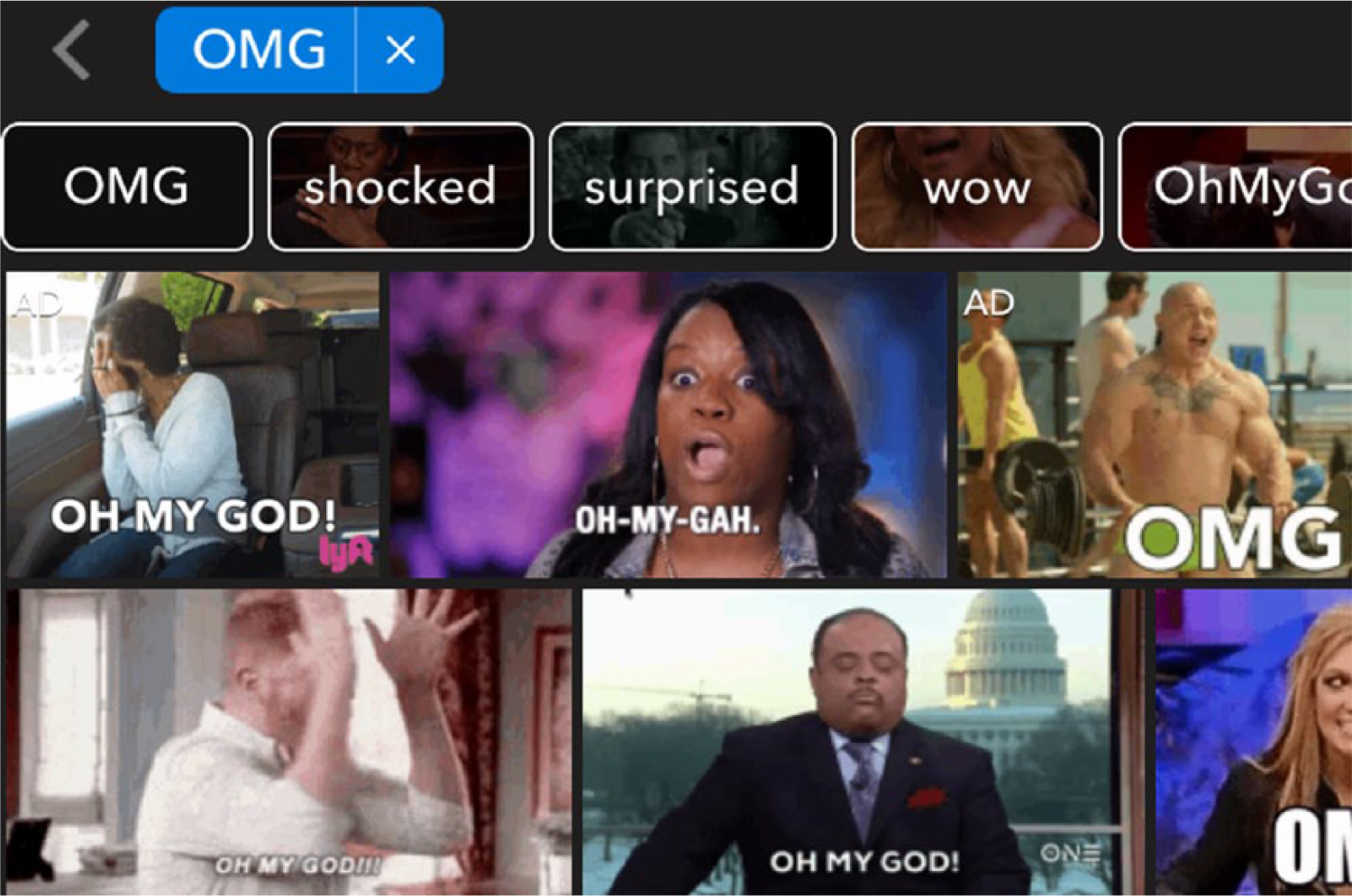
“omg” search on Tenor Keyboard App (17 June 2017); featured GIFs include ads for Lyft (top left) and Snickers (top right).
The growing prominence of advertising within the top results for searches on GIF services reflects the commodification of the GIF’s affective potential. If the likes of Tenor aim to become a “search engine for emotion” (Wagner, 2017), then the intrusion of commercial content is not entirely unexpected given the business model of search engines. However, it does illustrate the impact of metrics on what content is displayed: searching for GIFs around particular emotions or feelings provides results based on existing popularity and trends, rather than an individual’s own tastes. This may impact the performance of cultural knowledge through GIFs, where the canon (as displayed within search results) becomes reframed around the top results in searches. There is also a potential to influence affective performance here, as search results reflect commercially shaped biases toward specific texts, audiences, and sources.
The acceptance of the GIF as a medium for providing content on digital media has also led to official media policies pertaining to the format. During the 2016 US Presidential election, Giphy was an official partner of both the Democratic and Republican national conventions, carrying out live-GIFing throughout the election campaign. 8 Conversely, news media were banned from creating GIFs from coverage during the 2016 Summer Olympic Games to avoid unauthorized sharing of Olympic footage (International Olympic Committee, 2016). Such examples highlight awareness by companies, event organizers, and other stakeholders that the GIF is a popular—and important—means of experiencing and sharing visual media.
The provision of “official” GIFs also demonstrates that controlling what is provided and how it is accessed is a key concern for many media rights holders. This control extends to developing specific settings for GIF engagement. Content providers like Disney and Viacom have launched their own branded keyboards in addition to hosting their own GIF channels on Giphy. Smartphone apps like the RuPaul’s Drag Race Keyboard App offer GIFs (and custom emoji) specific to a particular show. Snaps, the developer of the Drag Race app, has also produced similar commercial keyboards for shows including Mr. Robot, Portlandia, and Broad City. According to Snaps executive Austin Bone, these keyboards are a way for media properties to “empower” their fans with custom emoji and facilitate the behavior of those who are already sending each other funny GIFs and images of the show’s characters via text message (A. Bone, personal communication, 1 May 2015).
Such “empowerment” is a lucrative endeavor. On top of inserting branded content into private conversations—an arguable advertising success in its own right—a keyboard app provides brands with valuable metrics, including real-time tracking of how many conversations are happening using the app, what content is being used the most frequently within those conversations, and by whom. These keyboards help brands achieve the holy grail of branded advertising: a multi-layered commodification of affect on the most intimate level.
The commodification of the format does not diminish the GIF’s importance within everyday communication, however. As cultural studies scholars have argued for decades, commercialized content is often interpreted and used in personal and deeply resistant ways (see Kellner, 2002) and there is evidence that this is the case with some of the currently available commercial keyboards (Miltner, 2016). Furthermore, the relationship between GIFs and commercial platforms is more than a simple case of straightforward appropriation: investments in GIF artists and creators are encouraging new and original applications of the GIF that are contributing to the evolution of the format and its culture (Gotthardt, 2017).
Conclusion: GIF Futures
Thirty years on from its launch, the GIF has become part of the digital cultural landscape in ways that are surprising, unexpected, and arguably delightful. Far from its early tropes of garish, rotating images on static websites, the GIF has gone from visual punch line to affective tool to—as demonstrated in a May 2017 Twitter exchange between Ukraine and Russia—a mechanism for cultural diplomacy and geopolitical commentary (Gallucci, 2017). As we have argued in this article, such diverse applications of the GIF underscore how the format’s polysemy and affective capacity afford users with the opportunity to provide heightened and layered communication, demonstrate cultural knowledge, and occasionally engage in displays of resistance to certain ideologies and actors. This places the GIF at the root of digital cultures, as these features are also key to much of the practices and communities that thrive online.
Newman (2016) argues that the GIF is “a format that lives best on the open web, and its most important users so far have been communities of fans who make and circulate them within a participatory culture.” Indeed, the participatory culture around GIFs remains critical to the format’s success. However, whether the GIF continues to be co-opted by corporate interests or utilized in new forms of vernacular creativity (or both!), the endless ingenuity of humans in digital environments means that the GIF’s story—and the exploration of its full potential—is likely just beginning.
Footnotes
Acknowledgements
Kate M. Miltner and Tim Highfield contributed equally to this manuscript. This article builds upon work presented by the authors, individually and collaboratively, at Society for Cinema and Media Studies conference 2017 (Chicago, USA), International Communication Association conference 2016 (Fukuoka, Japan), Social Media and Society conference 2016 (London, UK), Crossroads in Cultural Studies conference 2016 (Sydney, Australia), Theorizing the Web conference 2016 (New York City, USA), Culture and Politics of Data Visualisation symposium 2016 (Sheffield, UK), and The Stardom and Celebrity of David Bowie symposium 2015 (Melbourne, Australia). We thank Prof. Sarah Banet-Weiser, Stefanie Duguay, the reviewers of these submissions, and the Social Media + Society reviewers for their suggestions in further developing this work.
Author Note
Both authors contributed equally to the manuscript.
Declaration of Conflicting Interests
The author(s) declared no potential conflicts of interest with respect to the research, authorship, and/or publication of this article.
Funding
The author(s) received no financial support for the research, authorship, and/or publication of this article.
Notes
Author Biographies
 .
.
on Twitter.