




Abstract
Despite scholarly and popular assertions that social media transforms the possibilities for political engagement, there is little investigation to the relationship between public life and political discussion on social media platforms in the everyday lives of people in different cultural contexts. Based on 15 months ethnographic inquiry in a Trinidadian town, this article examines a political event (the hunger strike of Dr Wayne Kublalsingh) as it unfolded and how those not directly involved with the issue or activism more generally engaged with the protest on Facebook. We find that confrontational political opinion and commentary risks unfavorable kinds of attention: the judgment of others and being the subject of gossip and scandal. We conclude that political engagement over social media needs to be better understood within public life and the cultural specificities of a given context.
Keywords
In this article, we aim to better understand the relationship between public life and social media discussion in everyday contexts. We argue that Trinidadian approaches to politics and, more broadly, political engagement over social media platforms such as Facebook are based on the implications of visibility in public life. The online and offline are seen as interrelated and therefore part of the everyday, where uses of social media platforms are also a moral reflection of a person in a given community. This article is based on 15 months of ethnographic fieldwork across 2012–2014, where one of the researchers was heavily involved with activism and political observation and the other was living in a town we have anonymized as El Mirador, examining uses of social media. 1
The article contributes to studies in Internet politics and social media politics by considering non-activism, a form of everyday political engagement, where non-activism entails rejecting the elitism associated with those who consider themselves activists. We define non-activism as individuals deliberately withholding participation in explicit political causes, whether it is party politics, environmental or governance protests or being part of collective political action. Deliberate forms of withholding political commentary are representative of a specific position that asserts “I am not an activist.” We thus recognize the importance of how non-activists see themselves—as not ascribing to an activist identity. By actively refraining from visibly engaging in debate, non-activists also avoid being labeled as an activist by others. We contextualize activism in the history of carnival and resistance, where the legacy of colonial biopolitics also influences the reasons for not wanting to be associated with activism, as activism also associates one with being involved with scandal and gossip.
Not identifying with being an activist is therefore part of the habitus of El Mirador. The town’s identity is based on being considered somewhat of a backwater and a place of no particular interest, but it is also one of the places on the island fondly spoken of by its residents in terms of being quiet and retaining community and family oriented values. Hosein (2007) has explored extensively what everyday politics means in Trinidad: informal social life that contains politics that are grounded in more private, everyday concerns (p. 9). Adhering to the importance of these concerns is a reflection of being a morally correct person. Political engagement for people in these rural areas means being active in making and nurturing relationships with others who share these everyday concerns rather than engaging in wider collective political action. These themes also play out on the public-facing platform of Facebook and are the focus of the second half of this article.
An Ethnographic Case: Dr Wayne Kublalsingh’s Hunger Strike
In 2006, residents of a south Trinidadian community were targeted for relocation for the construction of a section of a highway. They engaged in 6 years of repeated and failed requests for participation in state-led consultation to review the decision. In November 2012, construction began without addressing the concerns of the affected residents, which compelled University of West Indies lecturer, Dr Wayne Kublalsingh, to embark on a hunger strike in front of the prime minister’s office in the capital of Port of Spain. Kublalsingh was not of the community but had been a nationally recognizable figure in previous land and anti-industrial struggles. His spectacular strategy aimed to seize media attention and use the citizen’s body to shock the body politic into deliberation over state authority, good governance, and sustainable development. We describe Kublalsingh’s strategy as spectacular because of his turn to the visibility of the sacrificial, suffering, and grotesque citizen’s body and the emotional, political, and moral debates it compelled in the press, online communities, and neighborhoods across the country.
Far from both the affected area and Port of Spain, in the town of El Mirador, Kublalsingh’s hunger strike was widely commented upon in conversations in bars, shops, and restaurants—any public space where residents were reading a newspaper. Opinions in this small town were fairly strong, from “He should just die” to “Those crazy people trying to stop a highway.” However, among the 267 research participants from the wider ethnography who were also Facebook friends with the researcher in El Mirador, there was very little serious engagement with the hunger strike and its implications on Facebook, the exceptions being from some university and high school students. There were only a handful of posts and comments about the hunger strike at all, mostly in the form of sharing memes—edited photos with humorous captions of Kublalsingh—or an odd statement of support or condemnation of Kublalsingh’s actions.
Ethnographic context is critical to better understand how individuals engage with politics over social media as lived relationships and everyday sociality heavily influence uses of social media and information and communication technologies (ICTs) more generally (Burrell, 2012; Coleman, 2012; Kelty, 2008). El Mirador is in one of the most underdeveloped regions of Trinidad, although it is steadily developing in terms of business and services. It is a medium-sized, semi-urban town with a population of around 18,000 and the intensified social relations of the small rural area, where most extended families would know, or at least know of each other highly influences visible political participation. In these respects, El Mirador is similar to other relatively small places where a key concern is not damaging friendships and relationships with extended family, work colleagues, former classmates, and those who supply local services through confrontation or causing division (McDonald, 2016). Even though research participants would often describe themselves as apolitical, through being embedded in these everyday relations over an extended period of time, the researcher in El Mirador was able to observe the kinds of politics those in the town do engage with. These are similar to Hosein’s (2007) observations on everyday politics as a concern with, for example, food and family, and as we emphasize, friendship and faith (p. 9). Such values are reflective of a place-based sense of identity, where those who live in El Mirador pride themselves on being unpretentious and maintaining good relationships and reject individual forms of elevating oneself over others.
By focusing on visibility, we ground our discussion in constructions of the self and readings of the body that in the Trinidadian context sees that the truth of a person lies on the outside and not within and manifests through conspicuous consumption, and performance, which culminates in the festival of Carnival. This idea derives primarily from Daniel Miller’s (1994) ethnography on consumption in Trinidad and is realized further through uses of the Internet and social media (Miller, 2011; Miller & Sinanan, 2014, 2017; Miller & Slater, 2000). From a history of colonization, where the country largely consists of descendants from enslaved Africans or indentured East Indians, an understanding of the self has emerged where the “truth” of a person—that is, evidence of a person’s identity—is seen on the surface, it is cultivated and is the product of one’s creativity and labor (Miller, 2005, p. 32). The conditions into which one is born—poverty or wealth or having certain physical attributes such as skin color—are not expressions of who a person really is, and the crafting that is invested into appearance through consumption, for example, is more representative of who they are (Miller, 2011, p. 50).
For these reasons, the importance of appearance, what is seen on the surface and visibility itself is core to the Trinidadian idea of personhood. The construction of the self through crafting appearance extends to cultivating style through clothes and accessories, decorating one’s home, modifying the appearance of one’s car, and, most recently, curating one’s social media profile (Miller, 1994, 1997, 2011). Miller (2011) has laid the groundwork for our argument further by developing the idea of truth, visibility, and Trinidadian personhood in relation to social media with an entire volume on Facebook in Trinidad. If the truth of a person is “something that Trinidadians construct and display with as many means they have, then ‘Facebook is about people knowing real you’” (Miller, 2011, p. 49). Facebook as a technology reveals truths that are deliberately displayed; it reveals unintentional truths such as when someone is tagged in a photo or at a location by another person. And most relevant to our discussion of engaging with politics, on Facebook truth is not only a construction but also a moral reflection of a given individual (Miller, 2011, p. 51). Displaying political commentary on Facebook exhibits that one is a “political” person or an activist, a label with which most in El Mirador would rather not be associated.
Trinidad is the ideal site to look at the relationship between visibility and public life as it exemplifies understanding Facebook in the context of a larger culture and history that validates the potential meanings, identities, relations, and uses that it may offer globally. For example, marriage is a global institution, but when understood in terms of kinship, its meanings differ. The culture or cosmology of a place can be understood through media use as well as the social life of media through attention to cultural and historical context. The case of Kublalsingh’s hunger strike is also one of visibility that resonates with Trinidad’s history and culture. Visibility through the hunger strike and how it was engaged with on Facebook is therefore one of the most useful entry points for thinking about the relationship between visibility and public life, where public life encapsulates the messy arena of state–society relations (Navaro-Yashin, 2002).
Political Engagement, the Internet and Social Media
There is an immense body of literature which critically examines the Internet in relation to politics and, more recently, politics and social media, beginning with considering the role of the Internet in the new social movements in the 1990s to the implications of the affordances of WiFi and mobile media such as smartphones and, in particular, their role in organizing collective political activity (Bakardjieva, 2009, 2012; Clay, 2011; Gerbaudo, 2012; Klotz, 2004; Oates, Owen, & Gibson, 2006; Papacharissi, 2004; Seib, 2012). Social network sites were perceived as instrumental in transforming Habermas’ (1969) notion of “the public sphere,” which extended the sense of optimism that the Internet would present numerous possibilities for e-governance and e-government (Chadwick & Howard, 2010; Dahlberg, 2001; Dawes, 2008; Fenton & Barassi, 2011; Postill, 2012). Attention has also turned to the role of social media in organizing political action and in the various regional experiences of the Arab Uprisings, which was in large part prompted by the work of Morozov (2009), who examined the uses of digital technologies for political repression throughout these events (Gerbaudo, 2012; Howard et al., 2011; Lim, 2012; Salvatore, 2011; Tufekci & Wilson, 2012).
However, as an anthropological study, this article considers political participation as activity that is regarded as political by the research participants, rather than a given definition in relation to democratic processes, civil society, or governance. The work presented is similar in approach to others who have analyzed Internet politics and social media’s role in political engagement by considering what political engagement means locally: for example, Tufekci’s (2014) contextualization of the effectiveness of social media in the Tahrir Square protests in Egypt (Tufekci & Wilson, 2012), Lim’s (2012) investigation of “click activism” in Indonesia, and Morozov (2009) on uses of Twitter in Iran. More recently, social media played an influential role in the Hong Kong Umbrella Movement/Occupy Central, and posting images on platforms such as Instagram was effective in mobilizing youth to participate in the protests (Tsui, 2015).
Madianou (2015) argues that ethnography might be the only way to understand in depth how uses of social media are shaped by relational dynamics according to context and is thus essential for understanding social media’s social dimensions. Several of the studies cited above aimed to examine political engagement in areas that were experiencing a crisis or transition. Bakardjieva (2009, 2012) coined the term “subactivism” to demonstrate how small-scale decisions and actions of individuals form a type of politics embedded in subjective experience, a concept similar to everyday politics. The importance of understanding how social media is used to connect with others as well as create visibility for political struggle should not be underestimated; however, this study aims to explain why individuals in the rural town of El Mirador do not actively comment on politics on Facebook and engage with collective political action. It is precisely because of reasons based on the consequences of visibility in Trinidad, residents of El Mirador preferred not to participate in debate and discussion, as increased visibility has implications for everyday public life.
Biopolitics and Public Engagement in Trinidad
Performance plays a large part in social activism, where careful attention is given to being “dramatic” and “staged,” for the purpose of becoming hyper-visible, aiming to produce excessive reactions (Gray, 2001, p. 64, Kershaw, 2003, p. 592). Being a “spectacle” is a way for social activists to grab attention, and although Gray (2001) observes that there are criticisms that activists actually divert attention by being a source of distraction, he also notes that spectacles “serve as a means of representation in the absence of access to sophisticated technologies of representation” (p. 63). This is not a new theme when looking at Trinidad’s history, where the struggles of citizens against the state become bodily, and potentially grotesque and violent, in what they perceive as the absence of meaningful dialogue.
Trinidad has a long history of struggles expressed of the body. Hosein (2007) locates these struggles within colonial politics, which, she argues, did not aim to create responsible and self-governing citizens (p. 29). Rather, colonial administrations denied (liberal-democratic) citizenship to colonial bodies and dealt power through violence, as part of colonial biopolitics. Biopolitics, then, encapsulates the way that sovereignty must be performed on bodies through violence, as well as management of health and life, and is grounded in what authorities can do to bodies and the ways bodies can resist. In the contemporary democratic state, implicitly, the complicity and submission of the body is required for the state to maintain power (Hardt & Negri, 2004; Linos, 2010). Linos (2010) identifies bodily submissiveness to state power as key theme in Foucault’s (1977/1995) analysis of discipline, where “the points of normalisation break down in the moments in which rational disciplines of the body fail to produce docile subjects”—subjects refuse to be normalized (p. 9).
The above analysis is generally in line with a literature emphasizing how resistance involves the abject body to resist dominant power and challenge the state’s terms on which biopolitics is constituted and practiced. Acts of self-sacrifice and self-directed violence as a method of protest are also often culturally specific (Linos, 2010). As a performance, hunger strikes also demand reconfiguring the relationship between state and subject (Egan, 2012). The hunger strike is an act of civil disobedience, resistance, individual moral protest, aiming to capture the attention of the public and the government (Goldman, 2009, p. 254). Contextualized within biopolitics in Trinidad’s history, these were all factors Kublalsingh was aware of as an experienced activist (Figures 1 and 2).

Dr Wayne Kublalsingh’s body seizing media attention.
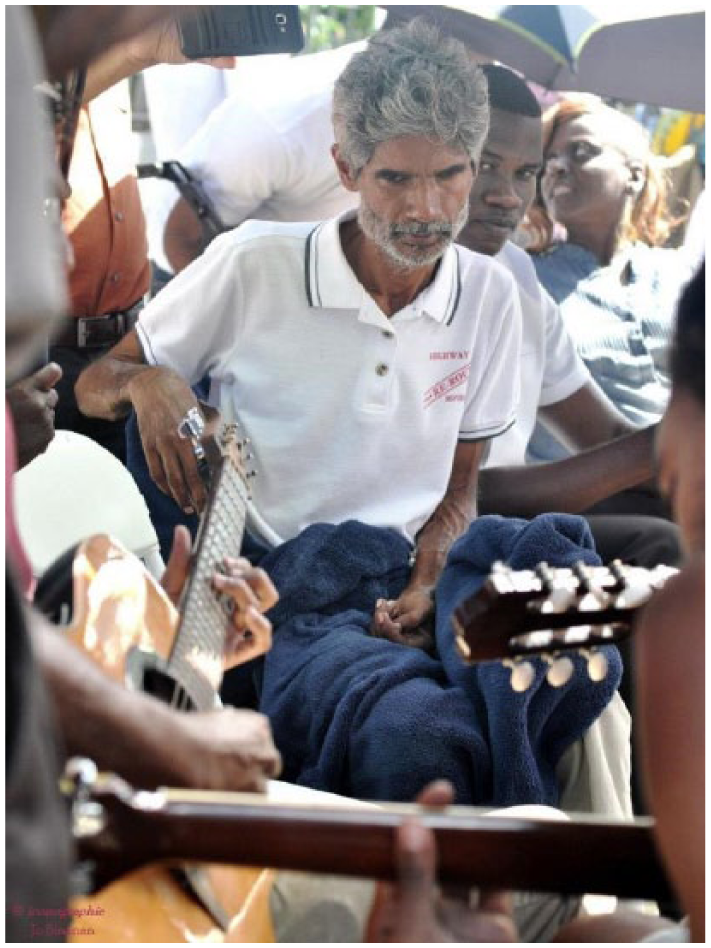
Dr Wayne Kublalsingh’s hunger strike as spectacular politics. Credit: Jolynna Sinanan.
The literature on Trinidad also reveals a recurrent theme of the informal logic in public life. Within the messy arena of both the state and the social (Navaro-Yashin, 2002) is the prominence of spectacle and visibility (Birth, 2008; Burton, 1997; Miller, 2011; Van Koningsbruggen, 1997). Trinidadians have a language for what constitutes spectacle and what it means: through bacchanal, which is mischief, chaos, and disorder (Miller, 1994; Scher, 2003). Carnival is defined by bacchanal and visibility, which is why crossing the stage is significant for masquerader bands (Green & Scher, 2007; Mason, 1998). The literature on carnival in particular speaks to how people come to exist through visibility, being seen and being on stage, whether or not one is being seen as themselves, or through a mask (Birth, 2008; Franco, 1998; Hosein, 2012; Lovelace, 1979; Mason, 1998).
The cultural understanding of uses of Facebook is less about Facebook as a technology, than an enactment of a cultural world that is Trinidad (Miller, 2011; Miller & Sinanan, 2014, 2017). The nature of performance, staging, and being seen are ontologies that are well understood in Trinidad. As already established, the construction of the external self is critically important to Trinidadian personhood; people do this on their bodies, as well as on Facebook. The appearance of things then comes from an ability to stage, style, and create a look, thereby existing through visibility. What one is performing is not as important as the performance being seen. Appearance and actions realize not only interiority but also place-based identities. Being an activist is also part of an urban, cosmopolitan identity, the exact opposite of the kinds of vales that are espoused in the country town of El Mirador.
On reflection of staging a public hunger strike, Kublalsingh stated that he wanted to “create drama.” Kublalsingh chose visibility as a form of political action not only because of previous experience in protests in the anti-industrialization movement but also because of the historical, social, and political significance of performance in Trinidad. Here, visibility is a central cultural logic, given the history of wielding visibility to advance social and economic struggles, and the ways that the ontological significance of staging may have infiltrated beyond carnival to provide sources of meaning in everyday life.
Carnival in Trinidad was born out of a spirit of resistance that was enacted by the body through performance. Ho (2000) observes that although we know little of what the first masqueraders by enslaved Africans and free coloreds were like, we do know that these groups were excluded from the elite celebrations of upper class society. Initially, enslaved Africans were also forbidden to don masks, but their celebrations included enactments of kings, queens, princes, princesses, and bourgeois social roles (judges, generals, and soldiers), where each had a position in structuring enslaved Africans’ lives and was then treated with pomp and circumstance (De Freitas, 1994, p. 69; Ho, 2000, p. 5). People’s carnival of a larger scale emerged as a celebration of emancipation in 1839 (Ho, 2000; Van Koningsbruggen, 1997).
Authorities attempted to curb night street celebrations which resulted in antagonistic clashes between police and masqueraders, which erupted into full scale riots in 1881 and again in 1884 (Anthony, 1988; Brereton, 1981; Ho, 2000). In the wake of the 1884 Canboulay 2 riots, Hosay midnight celebrations were also banned, which outraged the then minority Indian population who defied the ban and resulted in police killing a dozen and wounding a hundred participants (Ho, 2000, p. 6; Korom, 1994, p. 151; Mahase, 2008, p. 471; Sankerelli, 1998, p. 205; Van Koningsbruggen, 1997, pp. 21-28).
Ho (2000, p. 15) situates her analysis of carnival within postcolonial struggle and argues that carnival
“remains the stage on which conflicting ideas and values are dramatized and contested in the struggle for power.” She continues, “the character of carnival is such that it remains ambiguous and cannot be ‘owned’. As a symbol, carnival’s most powerful attribute is its ambiguity, which allows it to express ideals and their opposites simultaneously (Van Koningsbruggen, 1997, p. 270). Equally, carnival is not a unified ‘thing’, but a multi-stranded complex of parallel practices, total control over which is impossible. Located at the juncture of multiple meanings, it can satisfy a plethora of conflicting needs at the same time. This, carnival is best conceptualized as a verb rather than a noun (De Freitas, 1994), because it is perpetually in the process of becoming.”
As this history shows, the salience of the spectacular, staged, and even grotesque moves beyond carnival’s cultural inversions of order to the negotiation of power in relation to religious commemorations, labor rebellions, unrest by the poor over water and bread provisions, and the authoritarian domination by the colonial and postcolonial state. Not surprisingly, as we explain below, the salience of the spectacular also enables reading the meaning and relevance of Facebook in Trinidad.
Kublalsingh’s hunger strike sought to resonate with national consciousness: by creating bacchanal, by challenging state biopower, and by making his bodily performance a source of transcendent moral authority both liminally positioned outside of the law and calling for the law to be justly followed for the purposes of community, equality, and sustainable development. Yet, carnival also represents the messy intersection of biopolitics and bacchanal. Today, because of the over-commercialization associated with carnival, it is seen as an excessive party, where the main purpose is bacchanal rather than displaying a spirit of resistance or political action (Cohen, 2007; Green, 2007). Bodily political action such as the hunger strike is read in terms of spectacle and bacchanal, and to engage in political debate with the hunger strike also means becoming implicated and embroiled in the multiple meanings of bacchanal.
Facebook, Everyday Social Relations and the Meaning of “Politics”
Miller and Slater (2000) argue that technology can also be used to expand the capacities of a person. At the time, the Internet was subject to debates around homogenizing, globalizing, or localizing culture (Larkin, 2002; Pieterse, 1995; Ritzer, 1999; Thurow, 2000). Instead, in their ethnography, Miller and Slater argued that the Internet was not a global technology that would simply incorporate Trinidadian users into the distant online space of the information superhighway. By theorizing the Internet as “expansive realisation,” Trinidadians “realise” themselves through everyday internet practices; their “usage” is in fact embedded in existing social relations and spaces. The use of Facebook is similarly located in existing forms of sociality, where, for Trinidadians, Facebook is not a site that was exported by Mark Zuckerberg and its popularity with US college students, it has a life of its own that is given by its users and exists on its own terms through cultural idioms, linked to bacchanal, such as “macobook” and “fasbook” 3 (Miller, 2011).
Similar to Ho’s (2000) argument, like carnival and spectacle, Facebook exists in ambiguous terms, according to its usage. The act of existing on Facebook is to be visible, and from the empirical component of our research, individuals are incredibly discerning of what they reveal and also what they conceal. Such notions are particularly evident when entering to any sort of political discussion, including Kublalsingh’s hunger strike.
The online movement and participation in debates, primarily by University of the West Indies students, former students of Kublalsingh, and individuals who already consider themselves politically active, are probably more reflective of trends worldwide, where university students raise political awareness online and offline of movements such as Occupy, instigating public protests of the Arab Uprisings and the Chilean student protests of 2011–2012 (Bellin, 2012; Howard & Hussain, 2011; Valenzuela, Arrigada, & Scherman, 2012). Yet, we wanted to better understand the relationship between public life and online discussion in the everyday lives of people who might not necessarily belong, to borrow Bourdieu’s term, to the habitus of activism that typifies university, artistic, and social movement circles.
The Trinidadians in El Mirador were quite open to talking about party politics and political views in their own homes, in the company of friends and in neighborhood meeting places, a finding consistent with the arguments of Eliasoph (1998). Matthew for example is in his second last year of high school. He was visiting his cousin who lives in a lower income part of the town. Their house is small with a corrugated iron roof and the family mainly congregates in the gallery or the porch of the house. Matthew comments,
I saw a lot of serious posts, it’s a serious matter. People made a lot of jokes about it, but I saw Dr Kublalsingh’s actions as serious. Yes, we want the highway, but look at biodiversity. I saw jokes too and I was furious about it. How could people make fun of it, humans are greedy creatures, the more we get the more we want, people need to be more mature about it. I got into a heated debate about it on Facebook and in school. He has a right to take a stand for what he believes in.
Although Matthew feels passionate about Kublalsingh’s cause, after the debate on Facebook, he did not post or comment about the event further. His subsequent posts were photos of a trip to the zoo, a share of a music video, and photos of him out with his friends. In the same conversation, Matthew’s uncle who works as a farmer cuts in and says, “What yuh get all worked up for about Kublalsingh? Yuh cyah do nuttin! I jus’ simple simple and working on the fields, these people doh care nuttin about my problems!” 4 Matthew and his uncle have always remained close and have always been able to share a joke. His uncle’s performative style of talking and playing up of being a “simple farmer” is a common mode of banter that is also a show of masculinity. This style of conversation was previously called picong and young people today refer to as “shit talk,” where fast and witty jokes undercut a conversation from becoming too serious (Samuel, 2004). Humor and insulting others through humor ensure that insults are not intended to cause offense and is a mechanism to maintain a sense of egalitarianism, where not taking oneself too seriously also shows that one does not think they are above anyone else.
Another example is Ariane, who saw Kublalsingh’s protest as an important movement in relationship to governance in Trinidad. Ariane is in her last year of studying law at the University of the West Indies. She was the only person from El Mirador who visited the prime minister’s office to see the hunger strike for herself. She met a couple of older students she recognized at the protest and sat with them for an afternoon. One of the students said,
This is what happens day in and day out in Trinidad and Tobago, people just don’t care about environmental issues or about standing up for change. Everybody complains about the state of the country, this and that, but they won’t inform themselves about what is going on. We are just so far behind.
The other replied, “I can’t believe more people just don’t care about this. If the government can just decide to build a highway in one area and kick people off their land in one place, they can do it anywhere.” Ariane listened to their conversation quietly but later said,
I’m lucky though. I can do that [go to the protest], I have more flexible time where I can go, I know other people who support him, but they’re lawyers as well. Think about people in El Mirador, they are trying to make their day to day work, they put their kids in school, they don’t work the kind of jobs where they can just hang out and protest. The girls before, they’re right but it’s very Maraval
5
activism. They hang out at theatres and have artist friends and talk about world issues. El Mirador people don’t have this luxury. And when people from there talk about people from here, they talk about us like we’re real bush.
6
They don’t really know how we live and what is important to us.
Ariane’s Facebook profile shows different aspects of her life. She rarely posts images of herself day to day, only on occasion, and she updates her status with different themes, such as jokes about the weather, a dream she has had, or something she has eaten. She always posts using local dialect. In one instance, she writes, “First doubles raise now dis strong strong breeze jusso jusso. Is this the end of days?” 7 She frequently shares news and commentaries that have appeared around national issues, especially if they are about gender issues. As she explains, “I like to post things that cause a reaction. Not a shock, but just a strong opinion, something important, something to make you think about the country you’re living in.” However, Ariane is a less typical example. She studies law and has several friends from outside of the town. She already held an interest in gender and politics from her years attending a prestigious high school. Yet, although she has often become involved with heated debates on Facebook with her peers and other people from Port of Spain, she has never had a public debate with anybody living in El Mirador.
The opposite of Ariane would be Deborah, whose views and experiences have much more in common with those in the town. Deborah is in her mid-50s, she has lived in El Mirador her entire life, and she now assists her daughter who runs and owns a clothes shop on the high street. During periods of the day when there are few customers, Deborah is often browsing Facebook on her smartphone. She sees almost everything that appears in her newsfeed, she “likes” photos posted by others, especially if they are showing an outfit or are taken on holiday, and she posts several images herself. The most common images she posts to Facebook are family photos with her daughter and grandson and memes such as “Good Morning,” “Have a blessed day,” or others that include religious sentiments reflecting her Christian beliefs or morals around relationships. Deborah is also a typical example of how cultivating individual style is equally important. She posts photos of herself with her daughter and friends at fetes (parties) before carnival and other events where she has dressed for the occasion and where she has recently colored her hair or had her nails done.
Deborah is extremely open in face-to-face conversation in giving her opinion, including her thoughts on Kublalsingh’s hunger strike: “Starvin’ yuhself for 18 days, are yuh mad? This man just wants attention, all he is is bacchanal if you ask me.” Yet, she never posts updates on Facebook that she would consider too personal or revealing, including her opinion on political issues. Deborah simply would not post an update that would draw unfavorable attention to herself: “Everybody be macoing on Facebook, so I don’t post nutting about myself, I like my privacy, thank you.” Deborah’s views on Kublalsingh are also highly reflective of the connotations of “politics.”
For those in El Mirador, “politics” connotes anything involving corruption, political parties, and their history or commentary on the performance of previous prime ministers. They also openly debated the conduct of the prime minister at the time, Kamla Persad-Bissessar, and the national security minister, Jack Warner, alongside scandals other current politicians had been involved in. These associations were reflected in several comments in conversation with the researchers: “I’m not interested in politics” or “I don’t care about politics” or “I don’t discuss anything to do with politics”—responses suggesting a desire to disassociate from being embroiled in politics as bacchanal. Other sentiments were “Once it have anything to do with the government, we don’t take it serious.” “I hate politics with a passion, so I don’t follow that, but I see a lot of news that comes up [on my newsfeed].” Visibility has its own risks with those such as Kublalsingh being perceived as “only looking for media attention,” self-interested, narcissistic, politically ambitious, bullying, deceptive, disorderly, immature and failing to generate more than derision through inappropriate bacchanal. Instead, the kinds of politics that are visibly engaged with on Facebook concern the everyday, such as preserving good relationships through posts on the ideal state of relationships and humor, which shows a sense of egalitarianism.
Everyday Values: Morality and Humor
Religion is one of the dominant themes appearing on social media such as in sending greetings and sharing Hallmark-card-style images for occasions such as Christmas, Diwali, and Eid and posts containing overt moralizing. References to God appear most commonly in status updates by those who identify as belonging to Pentecostal or evangelical churches—for example, “He’s my king,” or “His love for us,” or “GOD made you the way you are for a reason.” More Christian-oriented posts take the form of status updates or memes with Bible verses or homilies, with some references to God or Jesus in words. Religious posts by younger Hindus are made only through images depicting the deities.
Moral commentary appears in several ways on Facebook—most often in posts around the ideal state of family, romantic relationships, and friendships. In relation to family, for example, siblings might post a status or share a meme and tag their brother or sister. Sentimental memes appear regularly, such as cute photos of puppies and kittens hugging with text to the effect of “love overcomes all differences.” Mothers’ and Fathers’ Day are also obvious occasions when those posting make public their appreciation for their parents, either sharing a meme with sentimental wording or an old or recent photo of themselves with their mother or father. Other relations are tagged in status updates or photos throughout the year, especially around family celebrations such as birthdays, anniversaries, and pujas. Moralizing around family relationships appears through publicly expressing acknowledgement on Facebook through sharing and tagging.
Moralizing as well as humor is shown through memes about romantic relationships. The perceived ideal of romantic relationships based on fidelity, loyalty, trust, sensitivity, and care is expressed by sharing memes with commentary such as “true dat” (“true that”). The desire to be appreciated is also expressed through gendered banter and visual humor.
As far as political engagement is made public, it is likewise expressed through moralizing and humor. Commentary on the moral state of the country, for example, appears through sharing a crime story from the news or posts expressing exasperation, horror, or shock at crime, usually accompanied by a link to the story or news article.
When politics does appear on Facebook, it is also mainly through humor. When a politician appears on the news, especially in relation to scandal or bacchanal, it will appear on Facebook shortly afterwards through memes and banter. Most importantly and as in forms of social interaction like picong, “shit talk,” and performative banter, humor is used to show that one does not take oneself too seriously or becomes overly upset about circumstances outside their control.
The role of humor as an important aspect of Trinidadian social and public life has been thoroughly observed and documented in Trinidad (Eriksen, 1990; Kerrigan, 2016; Lieber, 1976, 1981). It is a mode of bonding and also an equalizing mechanism against the inequalities of class, ethnicity, and gender relations. Attempting to make others laugh shows a spirit of inclusion and is a way of proving that one elevates community values over other forms of individual distinction. Through sharing common reference points and experiences, humor reinforces group norms and values and becomes a form of everyday play.
Politics portrayed through scandal, bacchanal, and humor also becomes an expression of disillusionment on the part of individuals who feel that they cannot make a difference to wider society. Derision or dismissal of politics also elevates personal values and moral orientations—for example, religion—as these are seen as important factors to take seriously.
Conclusion
Although activism as a more performative form of visibility is rejected by individuals living in El Mirador, it is not to say that these residents do not care about issues such as the environment, governance, or economic development. Non-activism is more about rejecting activism and the hypervisibility associated with being an activist than rejecting the importance of economic and social issues themselves. Conversely, economic and social issues are most relevant in the region of El Mirador as many of the surrounding villages are underdeveloped and difficult to access. Yet, it is this same population who feel they have the least impact on wider political or national issues.
For residents in a peripheral, rural area, serious engagement in political discussion runs the risk of the “wrong” kinds of visibility. As a deliberate set of actions, non-activism then becomes a form of visible identity geared toward preserving good relationships. Overt moralizing and religion are the most common topics on Facebook. Yet, everyday values are shown through an equally dominant genre of posting: humor. It is therefore not surprising that the core values of a small town do not center on the wider world, but rather, around the everyday. In El Mirador, many represent themselves on Facebook in highly normative ways as they live in a small town where social relations are highly intensified and residents know or at least know of each other or their families.
Through examining Dr Wayne Kublalsingh’s hunger strike and its reception on Facebook in El Mirador, we have demonstrated how political engagement, “politics,” and “activism” are understood by those in a small-town context and how their meanings influence a deliberate refusal to engage in collective political action. Politics and activism are associated with the logics of carnival and bacchanal, the legacy of colonial biopolitics and spectacle. And residents of El Mirador would rather not become associated with engaging in politics as spectacle. Political engagement over social media therefore needs to be better understood within public life and the cultural logics of a given context.
Kublalsingh’s spectacular action as an entry point reveals the tightly woven intersection of social life, political life, and the cultural logic of public life that is expressed through engagement with political issues on social media platforms such as Facebook. The engagement with visibility explains ordinary citizens’ (as well as activists’) engagement with issues of democracy, governance, and development, and we have highlighted not only the concurrences between the comparative modes of political engagement but also their tensions. Kublalsingh’s body politics through the hunger strike allows him to use drama and visibility to create “bacchanal,” but these do not necessarily translate, beyond enforcing the power of the spectacular, into more active forms of political engagement among ordinary people. As a deliberate form of political engagement, non-activism as explicit refusal to participate reveals practicing concerns with maintaining good relations and for coexisting peacefully in everyday sociality. The hazards of becoming visible in a particular way—as aligning with unpopular groups and practices—even through online engagement on Facebook invite controversy and attacks on the self, which influences the lack of willingness for more visible participation in civic engagement.
Footnotes
Acknowledgements
The authors would like to express their gratitude to the European Research Council for funding the fieldwork as part of the Why We Post project (ERC grant 2011-AdG-295486 Socnet), to the reviewers from Social Media + Society for their generous time and very constructive comments, and to Hebe Verrest, Larissa Hjorth, Carla Taines, Glen Donnar, Michelle Aung Thin, and Marianne Sison for comments on earlier drafts. We would also like to thank Dr. Wayne Kublalsingh.
Declaration of Conflicting Interests
The author(s) declared no potential conflicts of interest with respect to the research, authorship, and/or publication of this article.
Funding
The author(s) received no financial support for the research, authorship, and/or publication of this article.