



Abstract
This article investigates whether Twitter use motivations relate to exposure to discordant information. To this end, this research conducted an online survey of 1,350 adults of South Korea. The results reveal that using Twitter for information-seeking, public-expression, and leisure-seeking purposes helps users to encounter crosscutting exposure, while the use of Twitter for private expression does not. Offline network diversity has a significant association with crosscutting exposure, and it moderates the relationship between Twitter use for public expression or leisure seeking and crosscutting exposure. The positive association between Twitter use for leisure seeking and crosscutting exposure is stronger among younger people than among older people.
Twitter, which is a popular microblogging platform and social networking site (SNS) for publishing and sharing short (140 characters or less) messages within a tweeter’s social network (Vergeer & Hermans, 2013), is often viewed as a political stimulator that has the potential to lead to engagement in the democratic process (Park, 2013). Accordingly, 65% of 18- to 29-year-olds in the United States who use SNSs including Twitter are politically active (Pew Research Center, 2010). During the 2010 national election in South Korea, 80.7% of Twitter users voted, while the average turnout rate was 54.5% (Korea Information Society Development Institute [KISDI], 2010). Despite the increasingly important role of Twitter in terms of participatory democracy, it is not certain whether Twitter boosts or dampens the chances of crosscutting exposure—the inadvertent exposure to different viewpoints (Brundidge, 2010). Exposure to crosscutting information is considered a crucial building block of deliberative democracy (Coleman & Blumler, 2009; Habermas, 1989) and one in which political decisions should be the product of fair and reasonable discussion and debate among citizens (Cohen, 1998). Frequent encounters with heterogeneous people promote a deliberative process (Habermas, 2006) and result in “the mutual uplifting of minds” (Mill, 1859/2004) or the formation of sophisticated opinions (Arendt, 1968). Understanding dissimilar viewpoints enhances tolerance and facilitates political learning (Price & Cappella, 2002), while avoiding or ignoring contrasting perspectives is detrimental to deliberative democracy and undermines the consensual process (Wojcieszak & Mutz, 2009).
With regard to the role of the Internet in crosscutting exposure, there are two contrasting theses: diversity facilitation versus polarization. The former posits that the Internet exposes users to dissimilar viewpoints by lowering social boundaries, providing a myriad of information not readily available through other means (Brundidge, 2010; Wojcieszak & Mutz, 2009), and through network diversity, which is considered any heterogeneous network that is composed of individuals trading diverse viewpoints on a number of issues within which deliberative democracy and “public dialogue” come alive (McKuen, 1990). On the other hand, the polarization thesis claims that instead of facilitating crosscutting, the Internet promotes selective exposure, the seeking of agreeable information, by making it much easier to access content consistent with preexisting orientation and preference (Sunstein, 2007).
Despite recent scholarly efforts regarding the role of the Internet at large in crosscutting exposure (Brundidge, 2010; Y. Kim, 2011), whether and how SNSs influence crosscutting exposure still remains underexplored. This study focuses on Twitter, one of the most widely used SNS (Pew Research Center, 2014). Twitter has become something more than a tool for sending updates to a circle of users with whom a “tweeter” desires to share intimate details about his or her trivial daily activities; it has morphed into a mass communication and highly effective means of political persuasion (M. Kim & Park, 2012). Because of the vast amount of information from varying perspectives that circulates on Twitter, this study zeroes in on the relationships among crosscutting exposure, network diversity, and motivations for using Twitter. This study is informed by an online survey of 1,350 adults of South Korea, which is one of the most connected nations in the world with a high broadband penetration rate (98.5%) 1 and a tech-savvy population. Among South Korean adults, 43.5% use SNSs (KISDI, 2017) and 12.4% (5.1 million) use Twitter (Statista, 2016). In today’s South Korean politics, Twitter is widely used to disseminate information, spark up debates, and organize collective actions (Hsu, Park, & Park, 2013).
Literature Review
Diversity Facilitation Versus Polarization
A democratic society is based on several assumptions such as freedom of speech, diversity of viewpoints, robust exchange of information, and active civic engagement (Yardi & boyd, 2010). These principles become endangered when likeminded people from homogeneous groups avoid crosscutting viewpoints from groups they ideologically oppose (Sunstein, 2008). Homophily, the tendency to connect with likeminded people (McPherson et al., 2001), can lead to increased polarization or extremism (Sunstein, 2007) because it limits interaction boundaries, hampering knowledge expansion and rational discourse on public issues. If individuals are exposed to opinions that fit only their preexisting beliefs, democracy suffers (Sunstein, 2007) because the success of a deliberative democracy depends on informed citizenry and robust debate between competing ideas (Coleman & Blumler, 2009). Exposure to diversity is one of the cornerstones of democracy (Mutz, 2006).
There are two opposing arguments about the effects of SNSs on crosscutting exposure: diversity facilitation and polarization. The diversity facilitation thesis posits that SNSs function as a stimulator of heterogeneous exposure. The thesis is based on four major assumptions. First, SNSs are places to freely interact with diverse others and participate in the political process, which results in expanding exposure to more diversified information. Second, given the structural features of SNSs that enhance connectedness among weak ties (De Meo, Ferrara, Fiumara, & Provetti, 2014), it is likely that SNS users stumble upon novel viewpoints that they might not otherwise hear from more tightly knit social circles (Y. Kim, Chen, & Gil de Zúñiga, 2013). Third, SNS newsfeeds inundate users with an almost unlimited amount of information from numerous sources and contrasting viewpoints. The fourth piece of the argument that supports the diversity facilitation claim is the possibility of inadvertent exposure. People are exposed to political difference through inadvertent encounters even if they do not intentionally seek it (Brundidge, 2010).
Unlike the diversity facilitator thesis, the polarization thesis claims that SNS users tend to organize into likeminded, homogeneous groups. The basic assumption of the polarization thesis is that as individuals have the opportunity to control communication, they show a tendency toward selectivity in discussion partners and exposure to information, and they bypass discordant or uncomfortable opinions. Psychologically, the polarization thesis resonates with cognitive consistency theory (Festinger, 1957) and information processing theory (Stroud, 2007). The key assertion of these two theories is that people seek information that is similar to their preexisting beliefs but avoid information at odds with their beliefs and attitudes (Iyengar, 2011). Selectively avoiding crosscutting information leads to polarization (Sunstein, 2008) and political fragmentation (Stroud, 2008; Sunstein, 2007).
Another issue regarding the polarization thesis is filter bubbles, in which content is selected by algorithms according to a viewer’s previous behaviors online. Each SNS uses its own algorithms to maintain its loyal users and to appeal to occasional visitors (Pariser, 2011). The polarization thesis claims that filter bubbles have the potential to limit exposure to attitude-challenging information because algorithms sort information and display what individuals prefer to read based on prior viewing data (Flaxman, Goel, & Rao, 2016). Yet, at least one study contradicts the filter bubble effect with its finding that individuals’ choices play a stronger role than algorithm ranking in limiting exposure to crosscutting content (Bakshy, Messing, & Adamic, 2015).
Diversity Facilitation Thesis, Polarization, and Twitter
Both the diversity facilitation and the polarization theses can apply to Twitter. Although Twitter is considered an SNS (see boyd & Ellison, 2007, p. 211; see Kaplan & Haenlein, 2010, p. 61), it differs in that it does not require that friends be “accepted,” rather users follow whomever they choose. While connections on some SNSs, namely, Facebook, are typically among real-life friends, Twitter followers are generally strangers, many of whom do not even reveal their true identity (T. J. Johnson & Kaye, 2015). Twitter, perhaps, is best known for its ability to shape public opinion, strike up controversy, and create an instant buzz about any topic; thus, it is considered one of the most prominent social media of today (Pew Research Center, 2017).
Heterogeneous Twitter users spewing out a plethora of short bits of information representing many viewpoints, along with hashtag alerts of breaking political and social news, and the unlimited information via the public timeline (Proferes, 2015) make Twitter a hotbed for crosscutting exposure and a catalyst for participation in public discussion. But because Twitter users select whom to follow, the choice that is often made is to follow a tweeter with likeminded perspectives or interests (Alhadi, Gottron, & Staab, 2011). It follows then that some Twitter users tend to seek agreeable information and avoid exposure to cross-ideological content (Himelboim, McCreery, & Smith, 2013).
How often Twitter is used might also affect exposure to crosscutting information. Heavy use gives more opportunities for exposure to disagreeing perspectives than light use (Mitchell, Gotfried, Kiley, & Matsa, 2014). However, considering that SNSs are generally used to maintain social connections within a homogeneous network (boyd & Ellison, 2007), heavy use is not necessarily conducive to expanding the odds of encountering diversity. Therefore, it is not clear to what degree Twitter use facilitates the opportunity of crosscutting exposure:
RQ1. How is Twitter use frequency related to crosscutting exposure?
Twitter Use Motivations
Both the diversity facilitation thesis and the polarization thesis have their strengths, but this study contends that only focusing on SNS use is not enough to identify the nuanced mechanisms by which SNSs relate to crosscutting exposure.
Attention to the uses and gratifications theory has intensified with the advent of social media. Uses and gratifications theory focuses on what people do with the media rather than what the media do to people (Blumler & Katz, 1974). The uses and gratifications approach contends that media users actively seek messages that satisfy their psychological wants and needs (McLeod & Becker, 1981). But not all social media satisfy the same needs (T. J. Johnson & Kaye, 2015). For example, SNS users primarily keep up with friends and make new social contacts (Kaye, 2010), and blog users keep politically informed (Kaye, 2007; Kaye & Johnson, 2011), track social issues, express opinions among likeminded individuals, and keep an eye on the mainstream media, which they largely distrust (Kaye, 2010).
Drawing on the uses and gratifications theory, studies have identified various Twitter use motivations, for example, social motives (social interaction and recreation) and information motives (information seeking/sharing) (P. R. Johnson & Yang, 2009), talking about daily activities (Java, Song, Finin, & Tseng, 2007), social participation, checking public opinion, and entertainment (Hwang & Shim, 2010). Other motives include anti-traditional media sentiment, candidate information, personal fulfillment (T. J. Johnson & Kaye, 2015; Kaye & Johnson, in press), public expression, and mobilization motivations (Park, 2013).
To home in on Twitter motivations, this study asks the following research question:
RQ2. What are the primary motives for using Twitter?
Twitter Use Motivations and Crosscutting Exposure
There is evidence to believe that motivations are related to network diversity and thus to crosscutting exposure. For example, network diversity has been positively linked to news use, with the diversity of viewpoints encountered within a heterogeneous network likely increasing the individual’s desire for information on a wider range of topics (McLeod, Sotirovic, & Holbert, 1998). This motivation is consistent with much of the uses and gratifications literature that has long found that individuals process news content more carefully in anticipation of discussions with non-likeminded others (McLeod & Becker, 1974). In other words, network diversity promotes cognitive reappraisal of preexisting views, which in turn stimulates encountering diverse viewpoints (Mutz, 2006).
Active searching for specific content also leads to encountering diverse information (H. Lee & Kwak, 2016). Twitter users are exposed to multiple and diverse viewpoints through posts and by searching the public timeline menu (Yardi & boyd, 2010), and such information-seeking behaviors contribute to crosscutting exposure (Y. Kim et al., 2013).
Other motivations have also been linked to crosscutting exposure. Twitter users satisfying their need for public expression hope their tweets are appealing, reasonable, and well received (Valenzuela, 2013), and one good way of achieving these goals is by considering all aspects of an issue. Conversely, Tweeters who communicate only with close personal ties reduce their chances of heterogeneous encounters (Campbell & Kwak, 2012).
Even leisurely use of Twitter directs users to more diverse viewpoints. Diverse content pops up on newsfeeds side-by-side with entertainment updates, lifestyle news, and personal information about friends and acquaintances. A substantial amount of indirect media exposure occurs through friends who follow particular media sources or via retweeted messages. Such indirect and inadvertent media exposure expands significantly the political diversity of news (An, Cha, Gummadi, & Crowcroft, 2011; Brundidge, 2010).
Drawing on such reasoning, this study expects that Twitter users easily encounter dissimilar messages, opinions, and information they are not intentionally seeking. Whether Twitter is an agent of crosscutting exposure might depend on the reasons why it is used.
Therefore, it is logical to predict that motivations for using Twitter are associated with crosscutting exposure:
H1. Motivations for using Twitter predict crosscutting exposure.
But what is still unknown is the degree to which different motivations predict crosscutting exposure. Therefore, this study asks the following questions:
RQ3. Are Twitter motivations positive or negative predictors of crosscutting exposure on Twitter?
Network Diversity and Crosscutting Exposure
This study next looks at the influence of network diversity and age of Twitter users on crosscutting exposure. Diverse social networks are beneficial for democratic engagement (Xu, Stefanone, & Rui, 2013). Diversity can mean being part of a network that embraces diverse ideas as well as inclusion in one that consists of people of different social and economic strata, such as age and occupation (Hampton, Lee, & Her, 2011; Lin & Erickson, 2008).
The theoretical explanation for the expected positive link between network diversity and crosscutting exposure posits that a diverse network sparks members to reevaluate conflicting viewpoints and issues (Knight & Johnson, 1994). Reassessment enlightens individuals about alternative perspectives and leads them to careful and in-depth reflection (McPhee, Smith, & Ferguson, 1963).
Some studies about the Internet focus on how online activities help shape or expand offline network diversity (Papacharissi, 2002); however, the debate surrounding the influence of the Internet on offline network diversity is divided. There are those who suggest that the Internet creates new social opportunities (Van Laer & Van Aelst, 2010), those who argue that it supports traditional settings (Pasek, More, & Romer, 2009), and those who contend that it does neither and might even reduce offline network diversity. For example, one study found a positive relationship between blogging and higher levels of offline network diversity (Marlow, 2005), while another study showed that time spent using social media was not associated with larger offline networks (Pollet, Roberts, & Dunbar, 2011).
Such contrasting results lead to the thinking that the relationship between SNS use and network diversity has two other possibilities: (1) Offline network diversity expands online activity, and (2) offline network diversity influences crosscutting exposure on SNSs. This study takes the second approach by focusing on how offline network diversity might influence crosscutting exposure. Therefore, this study asserts the following:
H2. Offline network diversity is positively associated with crosscutting exposure on Twitter.
Offline Network Diversity as a Moderator of Crosscutting Exposure
For an offline network to help a person develop an open mindset and increase the understanding of the importance of diverse voices in democracy, it must include likeminded people and those with disagreeing thoughts (Xu et al., 2013). In contrast, homogeneous offline networks influence members to eschew different perspectives and discourage an open mindset.
Since there is no empirical evidence of the moderating role of offline network diversity between Twitter use motivations and crosscutting exposure, this study poses the following research question:
RQ4. How does offline network diversity influence the relationship between Twitter use motivations and crosscutting exposure on Twitter?
Age of Twitter Users as a Moderator of Crosscutting Exposure
That young adults are not very politically engaged has been well documented. Evidence from a range of democracies shows that voting turnout is lower among young adults, 2 and the political involvement gap between younger and older citizens is widening (Henn & Foard, 2012). Concerns about rising political generational inequalities are further fueled by a decrease in young people’s traditional news media use (Lenhart, Purcell, Smith, & Zickuhr, 2010).
SNSs, however, are a game changer in the political life of young adults, who are more active and communicative on SNSs than older generations. In the United States, almost 9 of 10 (88%) online adults aged 18–29 use Facebook compared to 72% of the 50–64 age group. Furthermore, 36% of all online adults aged 18–29 use Twitter compared to 21% of 50- to 64-year-olds (Pew Research Center, 2016).
Similarly, in South Korea, 74.4% of 20-year-olds, 61% of 30-year-olds, and 43.7% of those in their 40s use SNSs including Twitter (KISDI, 2015). Twitter alone captures between 6.6% and 10.2% of South Koreans 20 years of age and older (DMC, 2014). Because in general digital media have positive effects on political participation (Boulianne, 2009), younger citizens’ use of SNSs may compensate for the decline in their use of traditional news media and for a low level of involvement in public affairs (Holt, Shehata, Strömbäck, & Ljungberg, 2013).
Younger citizens’ fervent use of SNSs might have a motivating influence on their political attitudes and perceptions and may function as a facilitator of crosscutting exposure. Considering the lack of empirical evidence of the role of age in crosscutting exposure, this study proposes the following research question:
RQ5. To what degree does age influence the relationship between Twitter use motivations and crosscutting exposure?
Method
Data Collection
To assure the representativeness of the sample, data were collected via a stratified quota sampling method. Participants were recruited through a survey firm in South Korea, which has a panel of approximately 1 million adults. Out of the panel, a total of 5,000 adult Twitter users were selected using a two-way cross-classification sampling (age × gender). Based on these quotas, e-mail solicitations were sent out during 1–30 December 2014. A total of 1,350 participated in the survey (response rate = 27%).
Measures
Twitter Use Motivations
This study used nine items 3 drawn from previous studies (Hwang & Shim, 2010; Mischaud, 2007; Park & Karan, 2014; Zhao & Rosson, 2009). Respondents were asked to indicate how much they agree with the following reasons for using Twitter on a 5-point scale, ranging from 1 (strongly disagree) to 5 (strongly agree).
Twitter Use Frequency
Respondents were asked in an open-ended fashion how many times they tweeted or read others’ tweets during the last week.
Crosscutting Exposure
Respondents were asked during the last week how often they were exposed to politically or socially opinion-challenging viewpoints on Twitter. The responses were coded on a 5-point scale, ranging from “never” (1) to “every day” (5).
Network Diversity
Network diversity was measured by the occupations of those in the respondents’ offline social networks. This measure is based in the assumption that people in different social echelons and occupations provide different types of resources and information. The more people someone knows in different occupations, the more likely he or she is to have access to a range of information (Lin & Erickson, 2008). Drawing on Hampton et al.’s (2011) study, the current research asked respondents whether they know anyone in 21 occupations that range in occupational prestige: nurse, farmer, lawyer, school teacher, full-time babysitter, janitor, personnel manager, hairdresser, bookkeeper, production manager, operator in a factory, computer programmer, taxi driver, professor, policeman, chief executive officer of a company, writer, administrative assistant in a large company, security guard, receptionist, and hotel bell boy. 4 Network diversity was operationalized as an additive index of these 21 items.
Control Variables
Demographic variables were included as control variables in the analyses: age, gender, education, and income. In addition, this study controlled for the respondents’ interest in politics, strength of party ties, and traditional news media use. Respondents were asked to indicate their level of political interest on a 7-point scale that ranged from 1 (no interest) to 7 (very much interested). Strength of party ties was assessed on a 7-point scale ranging from 1 (very weak) to 7 (very strong). Respondent’s use of the traditional news media was measured by asking participants during the last week how often they consumed news from national television and daily major newspapers on a 5-point scale.
Analytic Procedure
To examine the hypothesized relationships between Twitter use and crosscutting exposure, a hierarchical regression analysis was run. The measures were entered in as blocks in the order of control variables, Twitter use, and network diversity. To test the moderating effects, this study created interaction terms between motivations and network diversity and between motivations and age. To avoid potential multicollinearity problems between the interaction term and its components, all the component variables were standardized (Cronbach, 1987).
Results
Demographic characteristics of the sample of 1,350 respondents resemble the profiles of the population figures of South Korea (Statistics Korea, 2016), with respect to age (mean ages: 37.6 in the sample and 39.0 in the population) and gender (50.1% female in the sample and 49.0% in the population). The annual median household income of the population (KRW4,050,000) is within the same range as the sample median (KRW4,000,000 to KRW5,000,000). There is a greater proportion of respondents with higher education in the sample (50.7% have a college degree) as compared with the population (40.2% have a college degree).
In addition, respondents use Twitter about eight times a day (M = 7.94, standard deviation [SD] = 9.52). They are exposed to challenging viewpoints a few times a week (M = 2.48, SD = 1.50), and their offline network is fairly diverse—they know people from 9 of 21 occupations (M = 8.74, SD = 5.33). Respondents are moderately interested in politics (M = 4.10, SD = 1.77) and moderately tied to a political party (M = 4.28, SD = 2.50). Respondents are moderate to somewhat heavy users of national television news (M = 3.77, SD = 1.35), but they are light readers of daily major newspapers (M = 1.84, SD = 1.40).
This study’s first research question asked how frequency is related to crosscutting exposure. As shown in Table 1, the regression model accounts for 29.9% of the variance of crosscutting exposure. Twitter use frequency failed to predict crosscutting exposure (β = .055, p = n.s.). This result indicates that the extent of using Twitter does not matter significantly in leading users to meet differing viewpoints.
Results of hierarchical regression predicting crosscutting exposure.
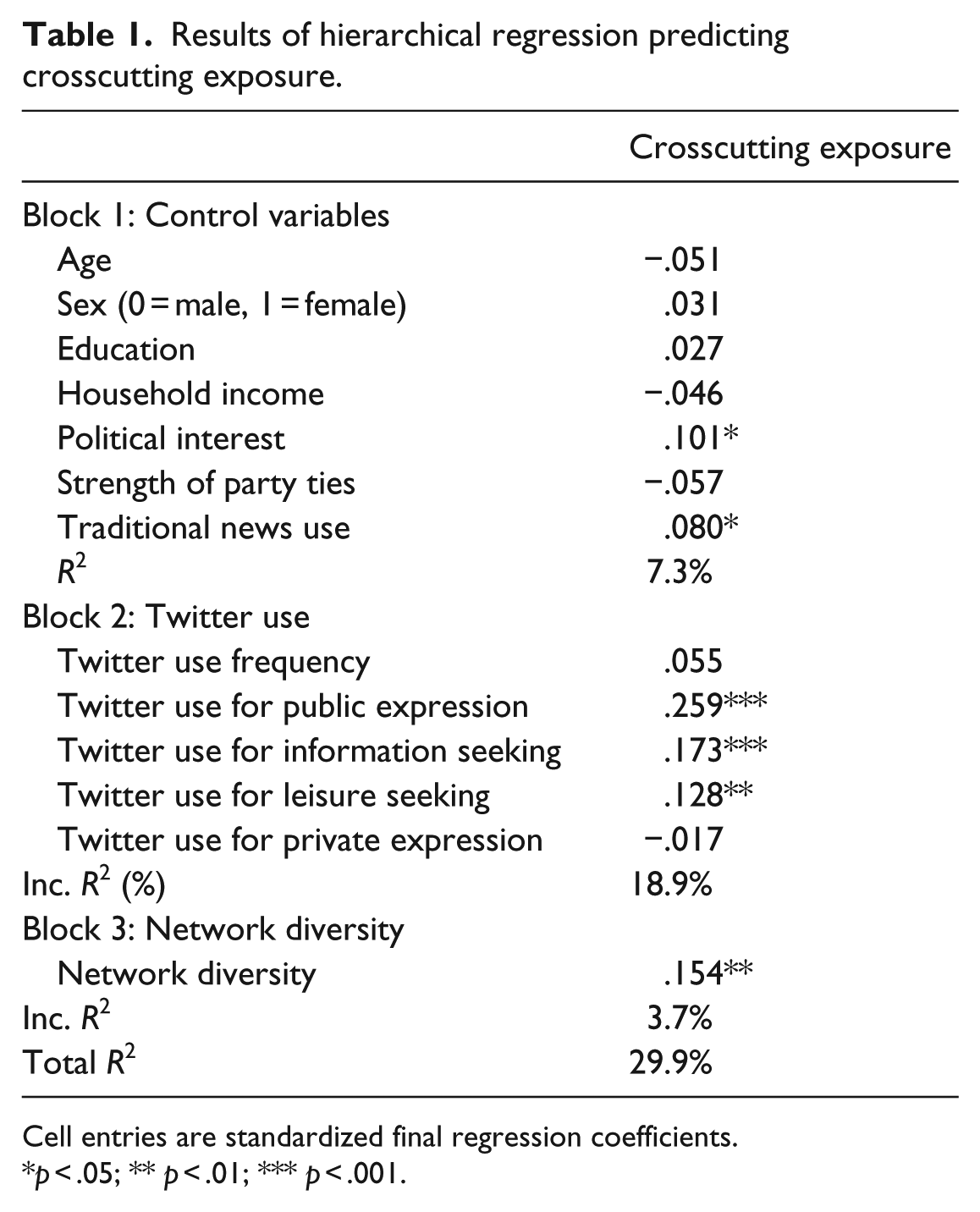
Cell entries are standardized final regression coefficients.
p < .05; ** p < .01; *** p < .001.
The second research question was asked to ascertain the motivations for using Twitter. The factor analysis uncovered a 4-factor solution. Information seeking consists of two items, each of which taps use of Twitter for obtaining useful information and checking public opinion (Spearman–Brown Coefficient = .47, M = 2.57, SD = 1.01). Public expression comprises a 3-item index that reflects use of Twitter for expressing political or social views, providing and sharing useful information with others, and commenting on news (Cronbach’s α = .85, M = 2.57, SD = 1.01). Leisure pursuing is composed of two items: (1) to kill boredom and (2) to feel fun and enjoyment (Spearman–Brown Coefficient = .57, M = 2.57, SD = 1.01). Finally, private expression is a two-item index that measures use of Twitter for recording a user’s everyday life and expressing personal thoughts and emotions to his or her personal network rather than to the Twitter public at large (Spearman–Brown Coefficient = .50, M = 2.57, SD = 1.01). Thus, this study finds information seeking, public expression, leisure pursuing, and private expression as primary motives for using Twitter (Table 2).
Factor analysis of Twitter use motivations.
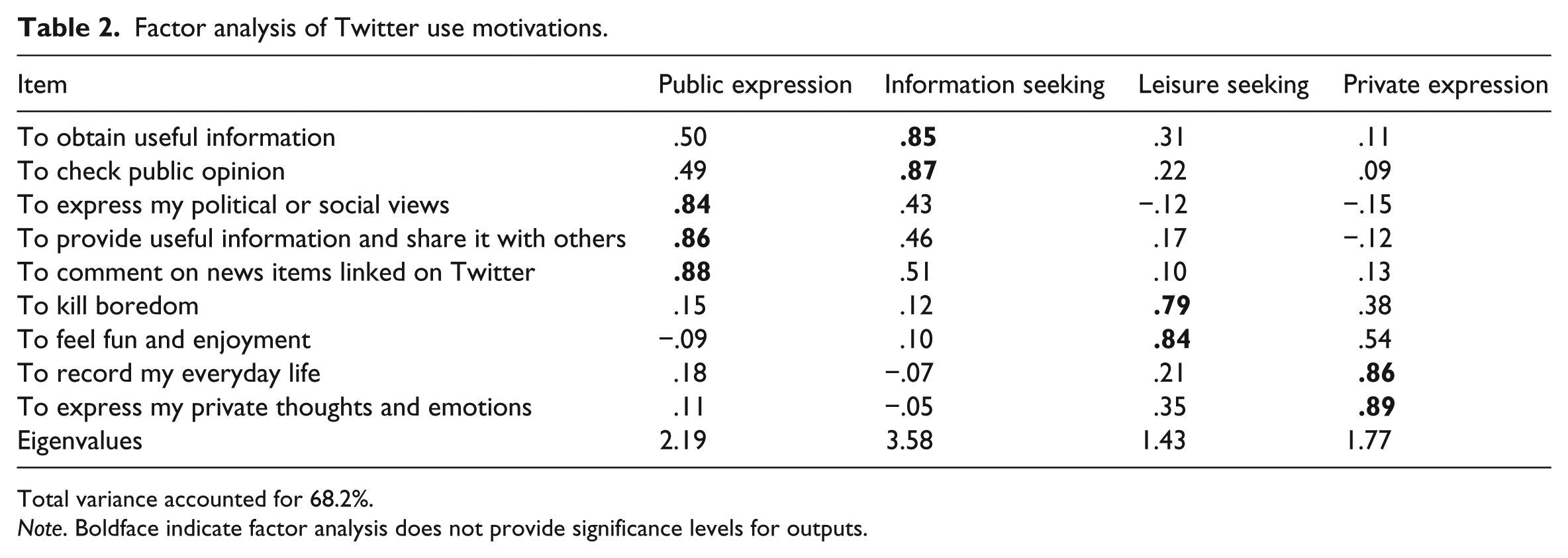
Total variance accounted for 68.2%.
Note. Boldface indicate factor analysis does not provide significance levels for outputs.
Hypothesis 1 proposes that motivations for using Twitter predict crosscutting exposure. Three of the four identified motivations are significantly associated with crosscutting exposure, partially supporting H1. Those who have a high level of public expression (β = .259, p < .001) and information-seeking motivations (β = .173, p < .001) are more inclined to be exposed to disagreeable points of view. The analysis also revealed a positive association between leisure seeking and crosscutting exposure (β = .128, p < .01), which means that those who use Twitter for leisure purposes often encounter diverse viewpoints about politics and social issues, although they do not intend to seek such diversity. However, using Twitter for the purposes of private expression does not predict crosscutting exposure (β = −.017). Furthermore, the three significant Twitter motivations are positive predictors of crosscutting exposure, as queried by the third research question (Table 1).
The second hypothesis predicted a positive relationship between network diversity and crosscutting exposure. This hypothesis is supported (β = .154, p < .01). This result indicates that people who have wider offline connections have a better chance to meet disagreeing voices on Twitter. Put another way, this finding suggests that offline resources are important in understanding involvement in the democratic process online (Table 1).
The fourth research question asks about offline network diversity in the relationship between Twitter use motivations and crosscutting exposure. This study found that offline network diversity significantly increases the positive association between public expression and crosscutting exposure (β = .094, p < .05) and the association between leisure seeking and crosscutting exposure (β = .090, p < .05). These findings suggest that Twitter users who have a tendency to express their opinions to the public or seek leisurely activities through Twitter are more likely to encounter different viewpoints on Twitter when they have a wider offline network. That is, a diverse offline connection is important in understanding the relationship between Twitter use and encountering wide and various perspectives through Twitter. A moderating impact of offline network diversity between information seeking/private expression and crosscutting exposure was not found (Table 3).
Interactive effects of Twitter use and network diversity on crosscutting exposure.

Prior blocks include age, sex, education, household income, political interest, strength of party ties, traditional news use, Twitter user frequency, Twitter use for public expression, Twitter use for information seeking, Twitter use for leisure seeking, Twitter use for private expression, and network diversity. Cell entries are standardized final regression coefficients.
p < .05; **p < .01; ***p < .001.
This study also tested the moderating role of age between Twitter use motivations and crosscutting exposure (RQ5). Age exercises a significant moderating impact on the positive association between leisure seeking and crosscutting exposure (β = −.107, p < .01). In other words, younger adults who use Twitter mainly for entertainment or leisure purposes are more likely to meet politically or socially dissimilar viewpoints via Twitter than older counterparts. Age does not moderate the relationship between public expression/information seeking/private expression and crosscutting exposure (Table 4).
Interactive effects of Twitter use and age on crosscutting exposure.

Prior blocks include age, sex, education, household income, political interest, strength of party ties, traditional news use, Twitter user frequency, Twitter use for public expression, Twitter use for information seeking, Twitter use for leisure seeking, Twitter use for private expression, and network diversity. Cell entries are standardized final regression coefficients.
p < .05; **p < .01; ***p < .001.
Discussion
This study sheds light on what roles Twitter use motivations, offline network diversity, and age may play in encountering political and social difference. Twitter users who comment on political or public issues or express their opinions publicly (public-expression motive) and those who actively seek specific information (information motive) are likely to meet diverse viewpoints on Twitter. Presumably, those who connect to Twitter to express their opinions publicly or for information are receptive to both opinion-reinforcing and opinion-challenging information because they need to satisfy their needs and to be well-versed about all sides of an issue. These findings are consistent with the diversity facilitation thesis, which contends that the use of new media for news and public affairs offers the opportunity to come across dissimilar views despite selective preferences for attitude-consistent messages (Brundidge, 2010; Garrett, 2009; Y. Kim et al., 2013). Considering that public-expression and information-seeking motivations are linked to political engagement, the above findings demonstrate that politically motivated Twitter users often encounter diversity.
Another notable finding of this study is that people who use Twitter mainly for entertainment or leisure purposes inadvertently encounter politically and socially diverse content. Twitter is a public forum where a variety of information is available (Swartz, 2011); therefore, roaming around Twitter increases the chances of encountering different perspectives regardless of the reasons for using Twitter. Although leisure-seeking Twitter users are looking for light-hearted news, they still come across dissonant viewpoints. In addition, Twitter’s hashtags and public timeline contribute to inadvertent exposure to different viewpoints (Proferes, 2015). Given that leisure-seeking individuals are usually less politically motivated than information-seeking individuals, their aversion to opinion-challenging information seems to be negligible. Therefore, it is expected that people who traverse the Twittersphere just for leisure inadvertently run into differing views.
That the motivation to use Twitter for private expression (voicing personal thoughts/emotions to a personal network rather than to the general Twitter public) did not predict crosscutting exposure makes sense considering that such conversation is expected to come from the heart and not necessarily represent a “balanced” or even well-informed perspective (Campbell & Kwak, 2011). In addition, private expression often takes place within a small intimate group of followers and small networks might encourage homophily. Indeed, several studies about mobile communication found that selective sociality can feed into network insularity, with individuals turning inward socially and detaching from the political process (Gergen, 2008; Ling, 2008). Although this study found evidence of the inadvertency claim (Brundidge, 2010) for the other motivations, it does not seem to extend to using Twitter for private expression.
This research also finds that crosscutting exposure on Twitter is related to the extent of a user’s offline network. Offline network diversity, operationalized as occupations of network members, amplifies the positive association between the use of Twitter for public expression or leisure seeking and crosscutting exposure. Considering that the analysis controlled for demographic and political attitude variables, the association between offline network diversity and crosscutting exposure seems to be solid. In other words, Twitter users with a highly diverse offline network experience greater crosscutting exposure opportunities than those with a less diverse network.
The above finding for diverse networks illustrates a nuanced pathway that connects Twitter use to social/political differences. It has been well established that a large heterogeneous network contains diverse viewpoints that trigger information seeking on a wide range of topics (McLeod et al., 1998; Nisbet, Moy, & Scheufele, 2003). In addition, those with diverse offline connections are accustomed to hearing differing voices. People with access to a large network learn about alternative perspectives to prepare for discussions with non-likeminded others (McLeod & Becker, 1974), which in turn increases the odds of encountering diverse viewpoints (Mutz, 2006).
Another important implication of this study is that Twitter is more beneficial to young adults than older adults. The analysis reveals that young citizens who use Twitter mainly for leisure-seeking purposes are more likely to meet diversity than older counterparts. This finding has two important implications. First, Twitter seems to have a strong influence on young citizens’ social and political life because they take it for granted that SNSs are platforms where diverse perspectives exist side-by-side. Indeed, 73% of Millennials said they sometimes, often, or always investigate opinions they see in their social media feeds that are different from their own (American Press Institute, 2015). Furthermore, young adults do not identify with political parties as strongly as older adults. For example, 20% of South Koreans who were born between 1988 and 1993 do not identify with any particular political party, and this percentage is larger than for independents or nonpartisans in any age group (Youth Research Center, 2014). Second, the moderating role of age indicates that Twitter might slow down the trend of political apathy among some young citizens. Particularly, it is important to note that although South Korean young adults (20s) use SNSs mostly for relationship maintenance (36.9%) or fun/hobby (21.6%) rather than information seeking (20.7%) (S. Kim, 2014), such relationship-focused or leisurely uses of SNSs offer a good opportunity to get involved in diverse issues. This result deserves attention considering that scholars have expressed concerns that many young adults use SNSs primarily for entertainment purposes and as a result become disengaged from the democratic process (Alterman, 2011; Halupka, 2014). But this study hints that Twitter has a positive impact on young citizens. However, this speculation should be understood with caution because age did not directly predict crosscutting exposure and it did not moderate the relationship between three other motivations (public expression, information seeking, and private expression) and crosscutting exposure.
Conclusion
Overall, this study’s findings support the diversity facilitation thesis in a systematic and theoretical way. Beyond prior studies’ mere focus on informational uses of SNSs (e.g., Y. Kim et al., 2013; J. Lee & Myers, 2016), this study extends the role of motivations by linking them to crosscutting exposure. This study’s findings further theoretical knowledge of the diversity facilitation thesis by suggesting that Twitter users’ response to discordant information depends on their reasons for using Twitter.
This study cautiously suggests a positive signal for Twitter’s role in deliberative democracy. Twitter brings together individuals with differing viewpoints, and studies have shown that exposure to heterogeneous content is central for creating and maintaining a deliberative democracy (Habermas, 1989; Huckfeldt & Sprague, 1995). Twitter is an excellent example of a mix of “strong ties” and “weak ties” that Granovetter (1973) asserted makes a network heterogeneous. Exposure to diverse viewpoints motivates individuals to search for information more thoroughly (Delli Carpini, Cook, & Jacobs, 2004) and to comprehend the rationale and motivation of different perspectives, which increases political understanding and tolerance (Mutz, 2002).
Exposure to diverse viewpoints is also closely linked to active citizenship. Twitter, by its very nature, fosters active participation. About 500 million tweets fly around cyberspace every day (“Twitter Usage Statistics,” 2017); thus, it is logical to speculate that increased exposure to heterogeneous content should lead to an increased opportunity of understanding and deliberating on others’ opinions and participating in discussions, which is a necessary condition of deliberative democracy (J. Lee & Myers, 2016; McLeod, Scheufele, & Moy, 1999). This study opens up a new line of research on Twitter use and deliberative democracy by suggesting a plausible model that may connect Twitter use motivations to Twitter use behaviors, crosscutting exposure, and finally involvement in deliberation.
This study also has practical implications. Since its independence in 1945, South Korea has been in political turmoil. Between the 1960s and 1980s, authoritarian regimes and dictators suffocated the voices of civil society. Since the 1990s, the political conflicts among regions and social classes have plagued South Korea (Park & Karan, 2014). The recent impeachment of President Park Geun-hye, South Korea, has seriously divided the public into confrontational “for” and “against” groups. The mainstream media are also at odds with each other and are remiss in providing a public forum of democratic and deliberative conversation. In such a historical, social context, Twitter’s role as a facilitator of encountering crosscutting messages is proving important.
Limitations and Future Research
This study’s findings should generally be understood in relation to the unique social and political context of South Korea, which is one of the most wired countries. However, considering that Twitter is widely used across the world and the number of tweeters is growing exponentially (Adweek, 2016), the implications of this study’s findings could be applicable to other countries as well.
Limitations notwithstanding, this study shows insight into the deliberative potential of Twitter. Given the wide variety of Twitter features and the fast pace of change, it may not be feasible to offer a single yes or no answer to the question whether Twitter enhances or hampers crosscutting exposure.
This study suggests that Twitter and other SNSs should be further examined in other countries and in the context of individual motivations and users’ preexisting resources, such as offline network diversity. In addition, knowledge could be furthered by looking at the relationship between Twitter use behaviors and crosscutting exposure instead of motivations. It is probable that other intervening variables might exist between Twitter use motivations and crosscutting exposure. For example, Twitter use behaviors, such as tweet frequency, hashtag use, and patterns of following other Twitter users, can muddy the relationship between use motivations and diversity exposure. In addition, given that individuals’ psychological traits, such as extraversion and openness to experience, may moderate the influence of SNSs on discussion network heterogeneity, psychological traits should be studied in future research.
Footnotes
Declaration of Conflicting Interests
The author(s) declared no potential conflicts of interest with respect to the research, authorship, and/or publication of this article.
Funding
The author(s) received no financial support for the research, authorship, and/or publication of this article.