




Abstract
Arguably, the Tea Party movement played a role in Trump’s rise to power. Indeed, it is difficult to ignore the similarities in the populist claims made by Tea Partiers and those made by Trump throughout his campaign. Yet, we know very little about the potential connections between the Tea Party Movement and the “Trump-train” that crashed through the White House doors in 2017. We take a first step at tracing the connection between the two by examining who stayed involved in the Tea Party Movement at the local level and why. Drawing on interview and participant observation data with supporters of the Florida Tea Party Movement (FTPM) over a 2-year time period, we use qualitative comparative analysis (QCA) to assess the factors that determine whether individuals stay with or leave the movement and how the structure of the movement, which relied heavily on social media, contributed to this decision. We find that individuals who identified as libertarian left the FTPM, while those who identified as “fiscal conservatives” stayed. The FTPM’s reliance on social media further explains these results. Individuals who left the movement blamed the “openness” of social media, which, in their view, enabled the Republican Party to “hijack” the FTPM for its own purposes. Individuals who stayed in the movement attributed social media’s “openness” with the movement’s successes. We find that social media helped politically like-minded people locate one another and cultivate political communities that likely sustained activist commitment to changing the Republican Party over time.
Donald Trump’s ascension to the White House astonished many. The day after the presidential election, The New York Times headline declared that Trump’s victory represented a “stunning repudiation of the establishment.” The venerable outlet was not alone. Some social scientists, however, were not completely surprised by Trump’s success. Long before the 2016 election, social scientists began outlining the ways in which information and communication technologies (ICTs), including social media, had made political parties vulnerable to movement claims (Chadwick, 2006; Chadwick & Stromer-Galley, 2016; Rohlinger, Bunnage, & Klein, 2014).
Arguably, the most relevant movement in Trump’s rise to power was the Tea Party. Indeed, it is difficult to ignore the similarities in the populist claims made by Tea Partiers and those made by Trump throughout his campaign. Yet, we know very little about the potential connections between the Tea Party Movement, which some scholars argue peaked and began to decline in 2010 (Langman, 2012; Williamson, Skocpol, & Coggin, 2011), and the “Trump-train” that crashed through the White House doors in 2017. In this article, we take a first step at analyzing potential connections by examining who stayed involved in the Tea Party Movement at the local level and why. As our case illustrates, activist persistence is central to a movement’s ability to create meaningful change. We find that not only does social media alter the factors that affect whether or not an activist persists, but it also changes the kinds of activists that persist—and this has implications for a movement’s ability to support a political candidate effectively.
Our analysis, which draws on interview and participant observation data with supporters of the Florida Tea Party Movement (FTPM) over a 2-year time period, systematically assesses the factors that determine whether individuals stay with or leave the movement and how the structure of the movement, which relied heavily on social media, contributed to this decision. We begin this article with a discussion of the individual-level characteristics scholars find relevant to movement participation over time. Since there is very little research on how contemporary movement structures, which often rely heavily on ICTs, affect individual engagement over time, we discuss the potential relevance of these individual-level factors to continued involvement in the digital age. Then, we use qualitative comparative analysis (QCA) to systematically assess what factors account for disengagement and continued involvement in the FTPM. Using these results to focus our analysis of the interview and participant observation data, we explore why individuals blame or credit social media for their (dis)engagement.
We find that many of the individual-level factors that typically account for continued involvement, including biographical availability, political experience, and the social network that lead to initial engagement, are irrelevant in the digital age. In fact, the QCA reveals that a politicized collective identity accounts for individuals’ decisions to leave the FTPM, while individuals’ feelings of efficacy explain continued involvement over time. A focused analysis of the interview and participant observation data show that the structure of the FTPM, which relied heavily on social media for its communication and organization, further explains these results. Individuals who left the movement blamed the “openness” of social media, which, in their view, enabled the Republican Party to “hijack” the FTPM for its own purposes. Individuals who stayed in the movement attributed social media’s “openness” with the movement’s political successes, organization building, and community building—all of which made respondents feel efficacious. We conclude this article with a call for scholars to find ways to conduct qualitative, longitudinal research in order to trace how ICTs shape persistence and electoral politics in the digital era.
Understanding Persistence in the 21st Century
Scholars long have been interested in individuals’ ongoing participation in social movements, or activist persistence, and typically point to the interaction among individual characteristics and organizational structure to explain engagement over time (Downton & Wehr, 1998; Nepstad, 2004). While this literature is useful for identifying the factors that influence persistence, it does not consider how social media change the ways in which political information is shared, how individuals connect with one another around political issues, or the ways in which it makes participation in all kinds of movement activities easier (Bennett & Segerberg, 2012; Bimber, Flanagin, & Stohl, 2012; Earl & Kimport, 2011)—all of which potentially affect why supporters stay or leave a movement.
Here, we summarize the individual-level characteristics implicated in persistence—biographical availability, political experience, social networks, politicized collective identity, and efficacy—and discuss their potentially changing relevance in the digital age. We do not offer a new model of activist persistence. Given the lack of research on persistence in contemporary movements, such a model would be premature. Instead, our goal is to discuss how the relevance of previously identified individual-level factors potentially influence contemporary activist persistence. As we detail later, this approach to the literature is consistent with the use of QCA, which analyzes how theoretically relevant variables combine—sometimes in contradictory ways—to produce the same or similar outcomes (Ragin, 1989).
Biographical Availability
When deciding whether to stay involved in a movement, individuals assess the costs and benefits of participation given the realities of daily life (Klandermans, 1984; Klandermans & Oegema, 1987). People with limited “biographical availability,” or those who juggle full-time employment, health problems, or family responsibilities, regard the costs of participation higher than those who do not. Not surprisingly, these individuals generally are less likely to stay involved with a movement over time (Wiltfang & McAdam, 1991). Biographical availability may be less important to persistence in the digital age (Earl, 2010). Movements routinely use social media to provide individuals opportunities to engage in both low-cost forms of participation (e.g., signing a petition) and high-cost forms of participation (e.g., attending a rally) (Bimber, 2001; Earl, Kimport, Prieto, Rush, & Reynoso, 2010; Fisher, Stanley, Berman, & Neff, 2005), which allows individuals to easily get—and stay—involved in movements regardless of changes in their lives.
Political Experience
Individuals with political skills and resources are the most likely to get involved in a movement (Dalton, Van Sickle, & Weldon, 2010; Fisher & McInerney, 2012). Political experience matters for persistence because it gives individuals the confidence to engage in other—sometimes more demanding—forms of participation (Verba, Scholzman, & Brady, 1995), which can keep them involved in a movement over time (Hirsch, 1990; Weinberg & Walker, 1969). Political experience may be less important to persistence in the digital age because movements can use social media to lower the costs associated with acquiring new political skills (Anduiza, Cristancho, & Sabucedo, 2014; Rohlinger et al., 2014). In fact, savvy movement groups use social media to identify their active supporters and encourage them to learn new political skills (Rohlinger & Brown, 2009). In short, the ease with which individuals can learn new political skills in the digital era may diminish its role in individuals’ decisions to stay involved in a movement over time.
Social Networks
Social networks based on affiliations and friendships, which have traditionally played an important role in initial engagement and persistence (McAdam, 1988), may matter less in the digital era. The “personalization of politics” changes how people think about the political world and creates networks based on interests (Bennett & Segerberg, 2012), which do not necessarily parallel the social relationships described by scholars studying earlier organizational forms (McAdam, 1989; Nepstad, 2004). While friendship networks and social groups may still matter, individuals increasingly connect with one another across geographic divides on more or less particularized interests via mediated networks (Earl & Kimport, 2011; Hwang & Kim, 2015; Theocharis, 2013). Consequently, mediated networks, or information shared from a “friend” on Facebook or discovered through Internet searches, Twitter, and news programming, may be more important than traditional social networks to persistence.
Politicized Collective Identity
Politicized collective identity, or a shared sense of “we-ness” that is oriented toward political change, is key to movement success (Polletta & Jasper, 2001). Politicized collective identity connects individuals to a community and a cause larger than themselves, providing a rationale for initial and long-term involvement (Simon & Klandermans, 2001; Taylor, 1989; van Zomeren, Postmes, & Spears, 2008). While recent research suggests that identity is important to activism in the digital age (see the May 2015 issue of Information, Communication & Society), politicized collective identity is not monolithic. In fact, psychologists argue that it should be conceptualized as “dual” because, in order to be effective as a mobilizer, individuals need to identify with both an aggrieved group (e.g., a movement or activist group) and a larger polity (e.g., the nation state), which provides a context for political struggle (Simon & Grabow, 2010; Stürmer & Simon, 2009). The importance of dual identification with a movement and a polity has implications for identity in the digital age. It may be easier for contemporary movements to activate politicized collective identity in the short (rather than long) term. In the short term, movements can make generalized appeals (e.g., “We are the 99%”) that individuals can personalize while still identifying with an aggrieved group (Bennett, 2012). Dual identification, however, may be difficult to maintain as supporters and political exigencies require a movement to clearly define who is (and who is not) a legitimate participant (Bernstein, 1997; Gamson, 1997). Shifts in how “we-ness” is constructed may cause some individuals, who feel as though they are no longer represented by the movement, to leave.
Efficacy
Individuals who feel efficacious, or as though their participation matters, are more likely to get and stay involved in a movement (Klandermans, van de Toorn, & van Stekelenburg, 2008; van Zomeren et al., 2008). Unlike the other variables discussed, scholars often find interaction effects between politicized collective identity and efficacy. For example, politicized collective identity combined with individuals’ beliefs that they will affect change through movement participation help explain initial engagement (Garrett, 2006; van Zomeren et al., 2008). It is reasonable to expect the dual identification associated with a politicized collective identity may make individual assessments regarding efficacy more important than in the past, particularly when it comes to persistence. As discussed above, movements may have an easier time cultivating a politicized collective identity in the short term when their appeals are broad. Consequently, individuals who identify with both a movement and a larger polity over time may feel more efficacious than those who do not. This would influence persistence because individuals who continue to identify with a collective are more likely to feel positively about a movement and their participation in it (Garrett, 2006; Polletta & Jasper, 2001).
In sum, given the affordances of social media, it is reasonable to expect biographical availability, political experience, and social networks to be less important to activist persistence. Politicized collective identity and efficacy, in contrast, are likely to remain important to ongoing engagement in the digital age.
Data and Methods
We use the case of the FTPM to examine how individual-level characteristics interact with social media to affect activist persistence. FTPM was founded in 2009 by Anthony, a 32-year-old conservative activist, who attended a Tea Party outside of the White House. Energized by the experience, Anthony decided to stage a similar event in Florida’s capital. He set up a Facebook page for the FTPM and invited his more than 1,500 “friends” to like the group. Within a week, the page had over 500 fans. Anthony invited the fans to the first Tallahassee Tea Party, which featured a keynote address by Dick Armey. In total, 300 Tea Partiers attended the event. Anthony capitalized on the “event buzz” and, using Facebook, grew the number of FTPM supporters online to nearly 1,000. He staged another rally the following month on tax day, 15 April 2009.
Anthony was careful not to limit the movement to conservatives. The Facebook page was non-partisan, focusing on citizens’ shared concerns that “the government [is] forking over billions of dollars to businesses that should have failed.” In fact, Anthony avoided “hot button” issues like abortion that might detract from the movement’s goals. Anthony explained,
The [Florida] Tea Party has not been focused on social issues or the cultural issues that divide America, but has been focused more on the issues that 70 to 80% of the people agree with a responsible government, accountable elected officials, and balancing the budget. Most people agree with that.
Consequently, the Facebook group attracted citizens, many of whom identified as “disillusioned” democrats and independents, who were unhappy with the “government bailout” and the recession.
Because Anthony worked full-time, he asked local activists for assistance growing the movement. Three individuals answered the call and started on-the-ground groups that supported the FTPM banner. The first group, Citizens Holding Government Accountable, was a fiscally conservative, non-partisan organization that worked to “promote good conservative elected representatives to ALL levels of government.” The second organization, Christians for Responsible Government, also strongly supported the FTPM platform but regarded Judeo-Christian doctrine as critical to “uniting Americans” and “defending our country.” The third group, Working for the American Way, integrated religious doctrine into its mission, which was to preserve “the rights and freedoms endowed by our Creator and guaranteed by our Constitution.” As a result, the movement had a “hybrid” structure (Chadwick, 2007). The Facebook page served as the “communication hub” of the movement—the place where Tea Partiers discussed ideas, candidates, values, and issues as well as organized actions and events—and the groups on the ground held monthly meetings and helped put on Tea Party events. Political divisions were kept at bay, at least initially, by Anthony, who moderated the Facebook page and discussions to ensure non-partisanship.
We employed three methods to collect data on activist persistence. First, we archived all posts on the public Facebook page so that we could track group discussions, activities, and monitor changes in the movement over time. Second, we attended 42 meetings, rallies, and events hosted by the FTPM and the on-the-ground groups. For the purposes of this article, these data were used to verify the activity level and continued participation (or disengagement) of respondents. Finally, we conducted semi-structured interviews with Tea Partiers. We used a variety of methods to locate respondents, including e-mail, listservs, online surveys, giving presentations at group meetings, distributing flyers at events, and posting flyers in local coffee shops, on the FTPM Facebook page, on campus, and in the local progressive and conservative centers. This strategy yielded a total of 33 interviews with Tea Partiers between August 2010 and April 2011, 25 of whom were reinterviewed between May 2012 and January 2013.
Respondents were asked how they learned about the FTPM, their political experience, membership in other movements, when/why they joined the movement, the kinds of activities and events in which they had participated, their online political experiences, and their feelings about activism and politics more generally. During both interviews, we asked respondents to evaluate the (in)effectiveness of the group (and discuss how they evaluated this), talk about their participation in the FTPM, and outline how often they got involved in politics through the movement relative to other organizations in which they were involved. In the follow-up interview, we asked questions regarding whether their participation, biographical availability, and support for the movement had changed. We used details from their first interviews to create probes so that we could better assess their responses. The interviews ranged in length from 25 min to 3 hr. All respondents and organizations are identified with pseudonyms.
Table 1 provides an overview of the respondent demographics. Group supporters are diverse in terms of their age, gender, relationship, and parental and employment statuses but relatively homogeneous in terms of race and ethnicity and education level. The racial/ethnic demographics are not representative of the area in which 60.42% of the population is White, 34.24% is African American, 4.19% is Latino, and 2.4% is Asian.
Demographic Characteristics of the Respondents Interviewed Twice.

We use QCA to assess what individual-level factors affect persistence in the FTPM. We consider two dependent variables: whether an individual left the FTPM (32% of the respondents) and whether an individual continued her involvement in the FTPM (68% of the respondents). QCA uses Boolean algebra to examine how conditions combine to yield a particular outcome when comparing a small number of cases. In QCA, all variables of interest are dichotomized, and the data are used to construct a “truth table,” which identifies the combinations of conditions associated with the outcome. In this way, QCA maximizes the potential for identifying different combinations of independent variables associated with a dependent variable. QCA simplifies analyses by dropping irrelevant conditions, providing a parsimonious explanation of how factors combine to yield a specified outcome (Ragin, 1989, pp. 85-102).
QCA is ideal for this kind of study. First, QCA assumes that causation is complex and, consequently, relies on combinatorial logic. QCA examines patterns of similarity and difference within a set of cases and identifies “the combinations of conditions that distinguish categories of cases” (Ragin, 1994, p. 115). Second, QCA provides another level of analytical rigor, which allows researchers to identify patterns within the data that may otherwise be invisible. When analyzing interview data, it is sometimes difficult to determine the relative importance of different variables. A researcher may see similarities among respondents but not have an effective way of determining whether a factor matters objectively or whether its relevance is spurious (e.g., the result of the interview treatment). QCA helps researchers systematically assess the relative importance of different variables more objectively and, in doing so, focuses on the qualitative assessment.
Finally, QCA allows some operational flexibility. Typically, all variables are dichotomized with 1 indicating a condition’s presence and 0 indicating the condition’s absence. In our analysis, 0 indicates a different condition (Table 2). For example, the presence of politicized collective identity (coded as 1) indicates that the respondent identified with the purpose and goals of the movement and the larger polity during both interviews. The absence of politicized collective identity (coded as 0) means that the respondent no longer identified with purpose and goals of the movement. 1 Using QCA, we generated a truth table, which provided every logical combination of causal conditions, the number of cases exhibiting each of the causal pathways, and the consistency score or the proportion of those cases that received coverage (Ragin, 2006). 2 In the following sections of this article, we report the conditions that explain why individuals leave or stay involved in the FTPM and use interview data to explore how the structure of the movement, which relied heavily on the Facebook page, played into individual-level decision-making.
Summary of the Independent Variables.
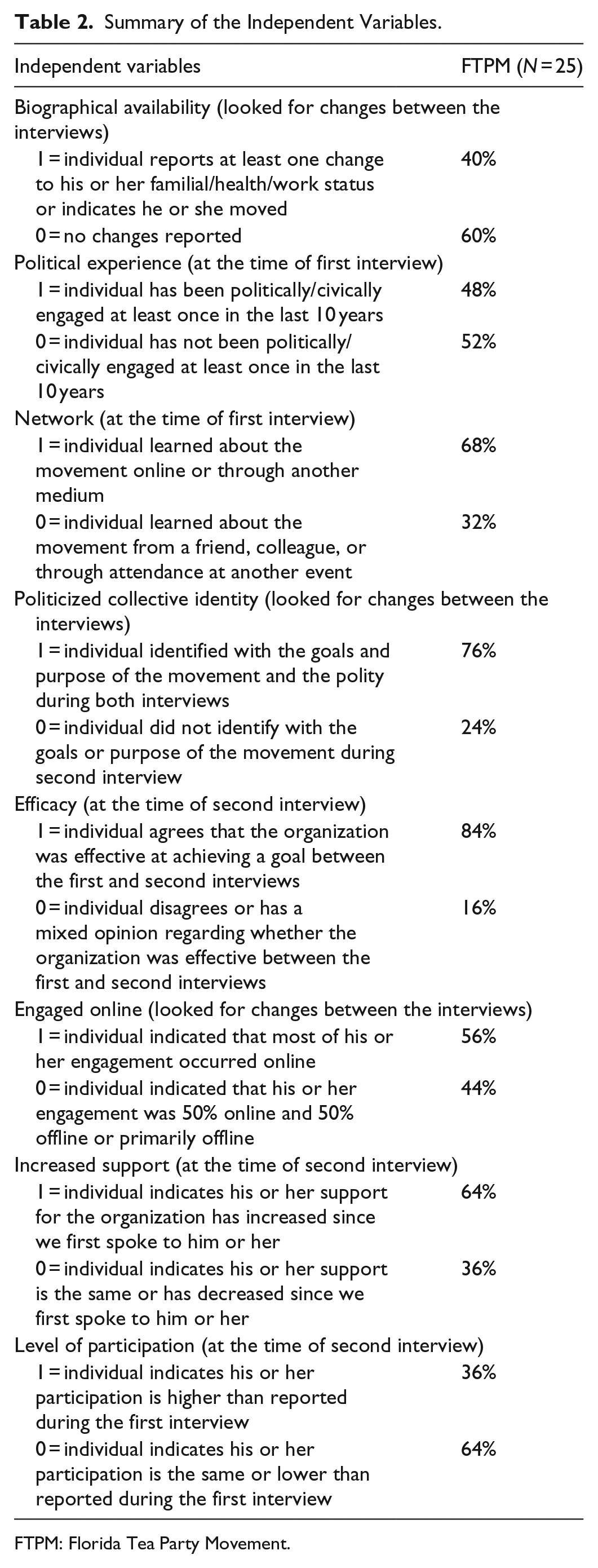
FTPM: Florida Tea Party Movement.
Leaving the Party: Social Media and FTPM’s Co-optation
Table 3 shows the conditions associated with organizational exit and persistence. Present conditions are capitalized, and absent conditions are in lowercase. If a condition is missing, then it is irrelevant to the outcome. It is clear from Table 3 that two conditions explain whether or not an individual continues his or her involvement in the FTPM: the absence of a politicized collective identity and the presence of efficacy. Stated differently, biographical availability, political experience, social networks, and changes in support and participation do not affect persistence in the digital age. This is an important finding because it suggests that social media can effectively help individuals overcome many of the obstacles associated with activist persistence.
Conditions Associated With Movement Exit and Persistence.
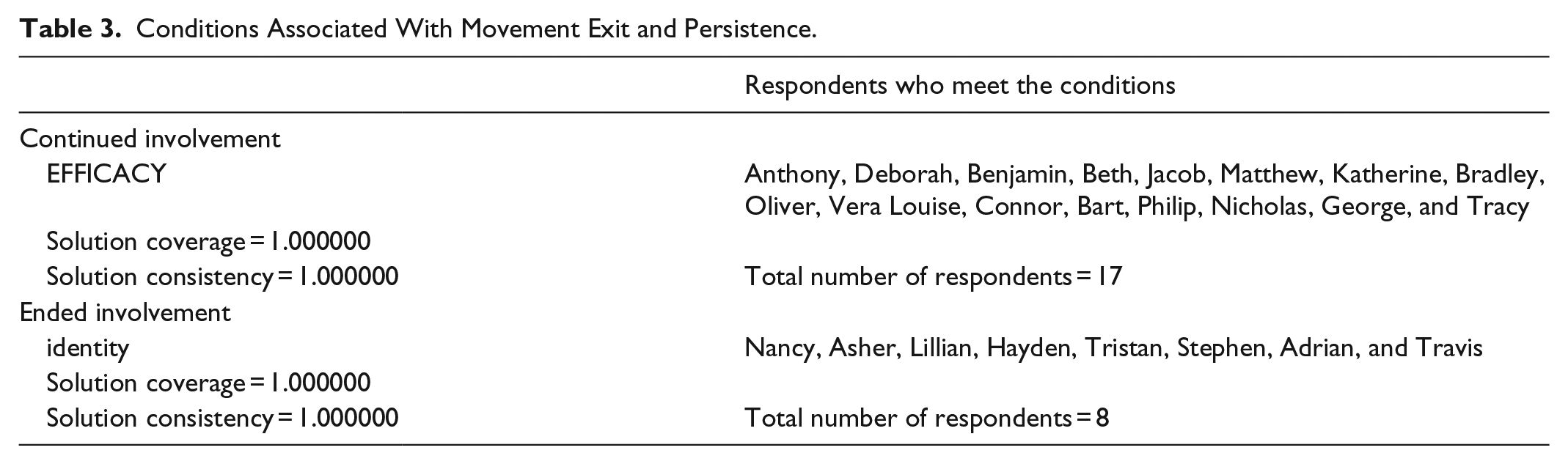
The respondents who left the FTPM no longer identified with its purpose or goals. Stated differently, respondents lacked dual politicized collective identity, meaning that while they identified as citizens engaged in a struggle over the course of America’s future, they no longer identified with the FTPM. In fact, all of the respondents who left articulated a strong commitment to libertarian values and felt as though conservatives generally and republicans specifically had taken over the movement. These respondents carefully demarcated political boundaries between “fiscal conservatives,” “social conservatives,” and libertarians in order to explain their exit from the “increasingly conservative” movement. According to respondents, fiscal conservatism is not necessarily antithetical to social conservatism, while libertarianism is. Nancy (a 49-year-old chiropractor) explained that there are “small ‘l’ and big ‘L’ libertarians”:
Small “l” libertarians subscribe to some of the libertarian principles, but not all of them. Big “L” libertarians favor less government involvement in our personal lives and less government involvement in our economic lives. In other words, just less government.
She gave gay marriage and immigration as examples, noting that
From a purist libertarian perspective [big “L” libertarianism] it’s not an issue. Even if you believe that government should in some way be involved in marriage, you would believe that everyone should have the right to access marriage . . . The small “l” libertarians oppose gay marriage but want smaller government and less taxes . . . [There are also] different schools of libertarian thought about immigration. Look at Ron Paul who is kind of a die-hard [small “l”] libertarian for what he’s been doing in Congress now for like sixty years [laughing]. He is really anti-immigration. You know, he’s in favor of closing up our borders as much as possible and enforcing our immigration laws. I’m more of a radical libertarian [big “L”]. I believe in open borders, open trade and minimal limitations on movement of people and goods across national boundaries.
Asher (a 23-year-old graduate student) agreed, referring to the distinctions between libertarians and conservatives as the “Sarah Palin and Ron Paul camps.” He explained that
The Palin camp is far more traditionally conservative, maybe even neo-conservative. Their focus is the budget, the debt, and they’re also very much concerned with traditional social issues and with a strong foreign policy presence. The Paul camp is definitely far more concerned with the budget and the debt, with social security, with Medicare, and the Federal Reserve. They are more non-interveners [when it comes to] foreign policy and when it comes to social issues . . . I’m in the Paul camp.
Their general assessment of non-libertarians was correct. All of the individuals who stayed involved with the movement described themselves as “fiscal conservatives” and understood the role of the state in market terms. According to “fiscally conservative” respondents, the purpose of the state apparatus is to further opportunities for individual profiteering while offering its citizenry a particularistic moral–religious vision (Brown, 2006; Somers & Block, 2005). Not surprisingly, almost all of the respondents called for lower taxes and voiced opposition to abortion rights, immigrant rights, and gay marriage.
Interestingly, individuals who left the FTPM attributed social media for their exit from the movement rather than simply blaming these ideological divisions. All of the respondents initially were excited by the “open,” “network” structure of social media because it maximized interaction among FTPM enthusiasts. Social media, they believed, created a democratic forum where individuals could discuss political ideas outside of party politics and commercial spaces. Nancy observed that social media created new networks of people and that “the network kind of phenomena was very valuable and very instrumental in creating the Tea Party movement.” Hayden (a 33-year old who was active in the US military) agreed, explaining that social media provided the space where citizens could discuss the ideas that made their way to the front line of the movement. He noted,
I think it’s [social media] a very effective tool. Well, like the old saying says “where there is smoke, there is fire.” If there is some outrage on the street, politicians pay attention. But you’ve got to have a back room, so to speak. [A place where people can talk] and poke that flame. As long as you have people who are engaged in the battle of ideas online, it will give it’s voice to people out on the street. So I believe it’s [social media] very relevant for the movement.
Stephen (a 50-year-old salesman) concluded,
I think it [social media] is just an incredible thing. It’s a way to reach people very quietly and at their leisure but in a very powerful and direct way. Very democratic. Like I said, I can make comments on a lot of things . . . and shape the political conversation very directly.
So, what happened? According to the respondents, the open structure of social media ultimately allowed the Republican Party to “take over,” “co-opt,” “hijack,” and “cannibalize” the movement for their own purposes. Tristan (a 22-year-old law student) explained,
It’s [the FTPM] been taken over by regular conservatives doing regular conservative stuff . . . It’s less focused on the economic liberty issues and, it seems that some other things like social issues and just general Republican “rah, rah, rah” sort of got into it.
Lillian (a 57-year-old director of professional development) agreed,
I just was kind of in a Pollyanna state of mind, hoping that it [the FTPM] would raise the level of expectation on all the politicians to adhere more closely to the issues of liberty and lower taxes and stop subsidizing the big businesses and the big banks and on and on and on. I was really hoping we would like kind of sit up straight and all the politicians would be better . . . [Now] I almost don’t want to be associated with it. It seems to have been taken over or hijacked by an extreme, right-wing, moralistic Republican Christian. You know, the Santorum bunch.
Nancy concluded that the problem with social media was that it was “too open” to co-optation. She opined,
It’s been co-opted by the mainstream politicians and the media has framed it [the FTPM] as what they wanted it to be so they can dismiss it . . . It was effectively co-opted and the grassroots fizzled very quickly. Welcome to the Internet era.
In the end, respondents with strong libertarian views left the FTPM to get involved in the presidential campaigns of their political favorites: Ron Paul, Gary Johnson, and Herman Cain.
Staying Engaged: Efficacy in the “Real” World
Among Tea Partiers, individual efficacy, or the feeling that he or she is part of a movement that matters, determined whether an individual persisted (Table 3). The 17 respondents who met this condition praised social media for precisely the opposite reason as those who left the FTPM. Tea Partiers argued that social media made the movement “nimble,” which enabled “average citizens” to “hold the Republican Party’s feet to the fire” and affect real political change. Anthony (the FTPM founder) noted that it was impossible for politicians to hide from their statements and actions in the digital age:
We’re able to take whatever a politician says, put it on the Internet right away, and let it go viral. So, I think you’re going to see a lot of that [in the future]. You know there may be a game-changing moment where Facebook, Twitter or YouTube, play an important role in the presidential campaign or another campaign. But I think generally, [the value of social media] is more about spreading information, educating citizens about candidates’ various views on the issues, and organizing [people].
Philip (an unemployed 61-year-old) agreed, adding that social media made it easy for Tea Partiers to respond quickly to politicians’ actions and important issues: “We’re like a strike team. When you give us the opportunity we can come into action and we can do it quickly.”
It is difficult to argue with the FTPM’s electoral success. All of the respondents pointed to the 2010 electoral gains made in the state of Florida. Tea Party backed candidates swept the national elections in the state (Marcio Rubio was elected to the Senate and Steve Southerland, Allen West, and Sandra Adams were elected to the House) and had astounding success at the local level. Gaining seats is not the only (or even primary) way in which supporters feel that the group has been effective. The respondents shared the view that there is little hope of moving away from a two-party system, and consequently, the only way to affect change is to commandeer (or at least heavily influence) the existing system. Unlike those who left the FTPM, those who stayed involved credited social media for the movement’s ability to “hijack” the Republican Party for its own purposes. For these respondents, the open, network structure of the movement enabled supporters to build citizen-based organizations that politicians in the state had to take seriously.
Respondents pointed to the success of the FTPM caucus, which has been taken quite seriously by Republican office holders. Respondents argued that this gave them more “voice” in the political process and an opportunity to express their discontent to party leadership. Connor (a 50-year-old retiree) noted,
They’ve [Tea Partiers] become more than just a group of people that get together and complain every now and again into, well, a group that has become very effective. We have a legislative debriefing that’s attended by legislators. The first day of session we have an open house, which is attended by numerous legislators from both sides of the aisle, which is very interesting. We’re a—I don’t want to necessarily blow the horn too loud—but we’re a force to be reckoned with.
Anthony (who is involved in the caucus) agreed, adding that he had seen dramatic changes in terms of how responsive government officials are to Tea Partiers:
They [elected officials] have been very responsive to the Tea Party. They may not agree with us on every issue, but [they] have held town hall meetings, have met with Tea Party members, [and] have met with more voters than ever. So, I think you can see politicians today are being very cognizant that they need to respond to people . . . I think the Tea Party has changed things. They changed the debate in the country. Whether people agree with us or not, I think we changed the discussion.
Louise (a 48-year-old bookkeeper) concluded, “Our voices are being heard [by the Republican Party]. So, it’s working.”
There are two related points worth making. First, as previously discussed, politicized collective identity and efficacy interact. Individuals who identify with both a movement and a polity are more likely to feel efficacious and to stay engaged over time. Second, self-identified libertarians (all of whom left) and “fiscal conservatives” (all of whom stayed involved) interpret the institutionalization of the movement’s claims differently, and this either led to exit or persistence. Libertarians view institutionalization as co-optation and see the partnership between Tea Partiers and Republicans as unequal and disadvantageous to activists (Piven & Cloward, 1977; Selznick, 1948). As seen in the comments made by Libertarians above, respondents see institutionalization as essentially incorporating the movement’s claims into the party machinery and declawing the radical potential of citizens (Garner, 1977). Respondents who stayed involved in the movement, however, view organization building positively and regard the Republican Party’s efforts to channel the group into less confrontational tactics as a signal that Republicans are listening and ready to renegotiate their position on fiscal issues. Consequently, these respondents were empowered by their new voice and influence in the Florida Republican Party and were more optimistic about the trajectory of the movement writ large.
Political effectiveness was not the only measuring stick by which respondents’ evaluated efficacy. Tea Partiers also credited social media for helping them cultivate a local political community. Specifically, respondents noted that social media connected them with like-minded citizens and “flattened” “information hierarchies,” which allowed citizens to share information and engage in a conversation about it. Deborah (a 55-year-old consultant) explained,
When people are talking to one another they’re most influenced. You cannot have a conversation with a beautiful lady on TV telling you such and such . . . People can get any kind of information they want on the Internet. They can have a conversation.
Beth (a 26-year-old small business owner) agreed noting that she had “connected with people who had comparable values” as herself and that they used social media, and the Facebook site in particular, to “find each other . . . and stay aware of what’s going on.” Katherine (a 47-year-old geographer) passionately recalled discovering this community and feeling “empowered” to “speak out” against the political status quo:
For me, realizing that so many other people felt the same way I did. I didn’t know that. You certainly didn’t get that from the [mainstream] media. You do now. But, we didn’t know that before. We thought we were this little minority. We didn’t realize there was such a great crowd of people in America who all held that same ideal in their hearts and want to see it kept alive.
Katherine credited this community for keeping her involved over time.
Katherine was not the only supporter to point to the importance of this political community for staying involved. Beth, Jacob, Matthew, Bart, Bradley, Oliver, Vera, Louise, Philip, Nicholas, and Tracy all mentioned the discovery of this political community as a reason for their continued involvement. Oliver (retired), for instance, noted he enjoyed
being with people of a like-mind and knowing that we [he and his wife] are not alone. So many of our friends are indifferent. Apathetic as we used to be. I found out there are other people that are concerned, and they weren’t concerned about politics—which party you’re aligned with.
He added that his participation in this community gave him “hope” that they could change the political system—even if it took years to do so.
The creation of a political community fostered a sense of efficacy among supporters and provided another way for respondents to evaluate the influence of the group in their lives. Individuals felt connected to one another, and this sense of attachment provided rewards beyond electoral change (Lichterman, 1996). Bradley (a 51-year-old who works in mergers and acquisitions) said it best:
I look at it as a new great awakening. It’s different, but I can see similarities and the great awakenings have always affected change. The first one led to the revolution and the second one led to the abolition of slavery. So, this one, I don’t know where it’s going to lead but I tend to look at them as good things . . . And it feels good to be connected. It feels very good to be a part of it.
There are three important points worth making about this political community. First, the individuals who stayed involved with the FTPM engaged with other Tea Partiers online and offline. In other words, the feelings of community were reinforced by offline engagement and face-to-face interaction. This is important because it suggests participation over time may be difficult to sustain online alone. Second, respondents were not necessarily part of the same political communities. Some of this was a function of geography. Respondents who lived more than 20 miles outside of the city tended to find communities that were closer to home. However, respondents did ultimately sort themselves into communities that reflected more particularistic, political worldviews. This is not surprising. After all, there were local groups in town that supported the FTPM even if they each had their own brand of politics. However, this suggests that efforts to appeal to broad identities are likely to fail over time. To survive, movements must define who they are and who they aren’t or risk collapse (Bernstein, 1997; Gamson, 1997). Finally, political communities helped activists understand that changes they sought would be achieved incrementally, rather than immediately. Several respondents noted that remaking the Republican Party in their image would take time and expressed certainty that now that they were organized, time was on their side.
Discussion and Conclusion
We find that many of the individual-level factors that typically account for persistence, including biographical availability, political experience, and the social network that lead to initial engagement, are irrelevant in the digital age. Instead, the QCA analysis reveals that individuals’ feelings of efficacy explain persistence in the FTPM. Individuals identified three different forms efficacy might take—electoral success, organization building, and political community—and cited this as evidence that they were part of an effective movement. However, our analysis of the interviews revealed that efficacy is difficult to disentangle from politicized collective identity. Respondents who stayed involved with the movement, for example, understood organization building, such as the creation of the caucus, as positive, while those who left the movement did not. These varying interpretations can be attributed to the different political ideologies of respondents. Those who stayed identified as “fiscal conservatives” and regarded the caucus as proof that the Republican Party was taking their claims seriously. Those who left viewed the caucus as a “hostile takeover” of the movement by republicans. Not surprisingly, the QCA results show that these ideological differences relative to FTPM advances account for diminished identification with the movement goals and movement exit.
We also find that respondents attributed the FTPM’s use of social media for (dis)engagement. Individuals who left the movement blamed the “openness” of social media, which, in their view, enabled the Republican Party to “hijack” the FTPM for its own purposes. Individuals who stayed in the movement attributed social media’s “openness” with the movement’s successes. While we were unable to get consistent information on why or how individuals got involved in the FTPM in the “real world,” all of those who were still involved had made some kind of connection with other Tea Partiers in the “real world.” This suggests that at least some face-to-face engagement may be critical for persistence in the digital age.
Given the relatively small sample size, our results should be generalized with caution. Nonetheless, our results are important and warrant additional investigation. While, as in the past, some segment of the citizenry is only superficially engaged, our analysis suggests that movements can use social media to reduce the obstacles associated with participation and keep people, who might otherwise leave, engaged over time. Biographical availability, for instance, does not seem to hinder participation in the 21st century. Individuals who had major life changes, such as having children, stayed involved in the FTPM despite the challenges associated with juggling multiple tasks.
The results regarding who stayed in involved in the FTPM also are suggestive. Social media helped politically like-minded people find one another and cultivate political communities that could sustain commitment to a cause over time and in ways that could affect party politics. Discontent with both political parties was apparent during the interviews. Respondents noted that politicians should be “like milk” and come with “expiration dates” and characterized both parties as “out of control.” The movement, in their view, would eventually save America from disaster. Oliver said it best during our first interview:
The nation’s on a bus. We’re heading down a steep hill and there’s a Republican [Bush] in the driver’s seat. There’s a cliff down at the bottom of the hill and if he doesn’t make a right turn, we’re in trouble. He keeps speeding and speeding and we keep yelling and yelling “Put on the brakes! Put on the brakes!” He doesn’t. So, we yank him out of there. We put this new guy in, a Democrat [Obama], and he hits the accelerator. That’s where, I think, our nation is. The Tea Party is the only brake we got right now. Both sides are sending us over the cliff.
When we followed up with Oliver in January 2013, he blamed the Republican’s Presidential loss on the party’s inability to find a candidate who could “think outside of their [Republican Party’s] box” and told us he was still focused on the “long political game.” It is easy to imagine people like Oliver, frustrated with politics-as-usual, supporting Trump’s presidential bid. Indeed, even Trump’s campaign platform synchronized with the ideological profile of those who stayed involved in the Tea Party: fiscal conservatism with an interest in fighting abortion, immigration, and gay marriage.
In short, scholars need to pay greater attention to how social media influence activist persistence and the implications of contemporary persistence for movements and political change. Our findings suggest that those who persisted in the FTPM had the motivation, skills, and the political mind-set to fuel a Trump victory. More importantly, our research indicates that seasoned activists may be critical to movement efforts in the digital age. Using social media, citizens can find one another and stay committed to a cause over time, even in the face of electoral loss. While studying persistence may be more difficult than the past, we find that it could be a linchpin to understanding contemporary political change.
Footnotes
Acknowledgements
We thank the anonymous reviewers for their insightful comments and Tara Stamm, Kyle Rogers, and J. Klein for their research assistance.
Declaration of Conflicting Interests
The author(s) declared no potential conflicts of interest with respect to the research, authorship, and/or publication of this article.
Funding
The author(s) received no financial support for the research, authorship, and/or publication of this article.