



Abstract
This article explores the emergence of the dominant mobile social media platform in Japan, LINE. In particular, the article focuses upon its usage to maintain familial ties, especially between matriarchal connections. Drawing upon ethnographic work with 12 families over 3 years, this article seeks to provide a detailed and nuanced sense of how social mobile media is deployed intergenerationally.
Introduction
In this article, we explore the rise of social mobile media in Japan in the form of the platform, LINE. As we argue, the social mobile media app LINE has become popular in Japan due to the particular technological, cultural, social, and linguistic factors informing the uptake and adoption of social and mobile media. In particular, the uptake and success of LINE can be viewed as a direct response to the way in which mobile social media shifted in and after the earthquake, tsunami, and Fukushima nuclear disaster of 2011 known as 3/11 (Hjorth & Kim, 2011; ITmedia business online, 2013; Kindstrand, Nishimura, & Slater, 2016).
Post-3/11 social mobile media—especially LINE—has become integral in many people’s everyday life and interpersonal relationships, especially in and around family communication. So much so that it can be said that LINE is the form of intergenerational communication for Japanese by enveloping mundane intimacies with hybrid forms of new media literacy. The digital genealogies of LINE reflect offline familial intimacies that both continue older familial rituals while also providing new ways for care-at-distance and what Mizuko Ito and Daisuke Okabe (2005) have called intimate ambient co-presence.
The adoption of LINE plays a vital role in broader historical practices of mobility in Japan that include long commutes as part of everyday life (Fujimoto, 2005). For Kenichi Fujimoto, understanding mobile media in Japan requires a differentiation between mobility and mobilism. As Fujimoto (2005) notes, mobilism is defined by “broader cultural and social dimensions such as malleability, fluctuation and mobilization” (p. 80). Unlike mobilism, “mobility has tended to refer to functional dimensions of portability and freedom from social and geographic constraint” (Fujimoto, 2005, p. 80). Thus, mobilism is tied to socio-geographic factors, whereas mobility infers transcendence, particularly around geographic constraints. This mobilism and mobility distinction is important when considering mobile media as part of the fabric of cultural, social, and geographic textures in everyday life.
This article draws upon a cross-cultural 3-year project exploring intergenerational use of mobile and locative media within households. In the fieldwork—which deployed ethnographic techniques like scenarios of media usage in the home, media re-enactments, and interviewing—we sought to understand the role of intergenerational mobile media use within the mundane intimacies (such as conversation with family members). Ethnography provides insight into motivations and the “why” rather than the “what” which is often the focus of quantitative research. This study does not seek to represent all LINE users in Japan but rather, through ethnography, offer in-depth understandings into the motivations in and around LINE in everyday familial contact.
We begin with an outline of the ethnographic methods in the context of the contemporary Japanese family, followed by a contextualization of the history of mobile Internet in Japan and how this informed the rise of the smartphone (sumaho). We then discuss how the success of LINE was pivotal to its timing in a post-3/11 Japan whereby social mobile media started to take on new types of both personal and political textures (Hjorth & Kim, 2011; Kindstrand, Nishimura, & Slater, 2016). In this article, we focus upon the personal dimensions—especially in terms of how LINE is used in relationships between daughters and mothers, and the creative and emotional role of emojis and stamps. The article finishes with a discussion of some of our female participants and their practices (and, in a Hochschild sense, emotional work) around LINE in the maintenance of familial mundane intimacies (Figure 1).

A typical example of LINE usage. The female participant is using LINE to look at a picture of her nephew at a restaurant while waiting for her meal.
Researching LINE Ethnographically in Families in a Post-3/11 Japan
To understand how LINE fits into the rhythms of everyday life with its mundane routines and intimacies requires us to go beyond standard interviewing methods. Instead, we need to develop ethnographic techniques that enable the researcher to engage empathetically with people’s intimate experiences in mundane life (Pink, 2015). Often mundane experience of digital technologies is difficult to access or to observe as a researcher, precisely because it happens at moments when people are alone and in situations that they are unlikely to usually share with others, let alone with researchers (Pink, Sinanan, Hjorth, & Horst, 2016). These include moments when they are waiting for a bus, on public transport, and waking up or dozing at night. That is, understanding the rhythms and moments of transition in everyday life moves in and out of short pockets of media engagement.
To conduct an ethnography of LINE means to understand mobile media practices as part of everyday life. In our ethnographies of our 12 households, we conducted interviews, scenarios of use, and re-enactments over a 3-year period. This meant visiting homes and public contexts with the participants numerous times to understand the mobile media practices as part of a dynamic process. In particular, we utilized a method known as “tactile ethnography” (Pink et al., 2016), which sought to explore what the tactile and often tacit gestures around the screen say about mundane embodied practices (i.e. what the body remembers). Tactile ethnography begins with focusing filming people’s hands in and around the screen while they go about discussing and re-enacting their practices. Through a focus on the hands, we were able to understand their ways into the technologies and the sensory experiences that were part of this—thus, opening up a route through which to gain a sense of their unspoken and often-invisible everyday technology use (Pink et al., 2016).
Our study sought to explore the role of mobile media in intergenerational intimacy. Often our chosen households consisted of one adult child and two elderly parents or grandparents, some with in-laws, and others without. These families were seen as indicative of typical configurations within contemporary Japan. According to Nonoyama (2009), high economic growth in Japan has resulted in the population being densely concentrated in urban areas and has led to the formation of nuclear families consisting of only “a couple and child/ren.” People are marrying at an older age, and fertility rates have dramatically fallen (Cabinet Office, 2013; Ministry of Health, Labour and Welfare, 2013). One-child families are typical in contemporary Japan and as the society rapidly ages, making do everyday practices through mobile media have started to dominate.
According to Amagasa (2012), the significance of the keitai in building and maintaining of familial relations in Japan cannot be underestimated. In this article, echoing Matsuda’s (2005) loose usage of the term, we chose to use keitai “to make clear our position on mobile phones and PHS: they are not new technologies/media introduced from the outside but rather technologies/media that come to be embedded in society” (p. 20). The keitai in its various guises can be understood as a continuum within Japanese 21st century. It has accompanied and entangled itself within all facets of Japanese everyday life. The most iconic of the keitai was NTT DoCoMo’s i-mode which pioneered designer Shigetaka Kurita’s 176 mobile-specific emoticons, emoji. The significance of emojis was highlighted with the recent addition to the MoMA permanent design collection (McCurry, 2016). The rise of the keitai has been deeply interwoven with the birth and growth of emojis. Part of the success of the keitai is due to the emotional and affective labor of the emoji in maintaining intimate and ambient co-presence.
In Japan, while the keitai started to spread in 1990s with its adaptation by Japanese youth, it is important to remember that it was first introduced in companies as a business tool (Dobashi, 2005). When the keitai was initially becoming popular among youth, it was viewed as exacerbating generational differences with many youths only messaging each other. This messaging practice caused conversation between parents and children to become less frequent, inciting discussions around the negative impacts of keitai (Amagasa, 2012).
In addition, there has been an accumulation of research that has questioned such a deterministic approach to technology and, instead, aimed to elucidate how keitai are incorporated into the context of family relationships through specific usage of keitai (Ito et al., 2005). Through a questionnaire conducted with high school students, Tsuji (2003) found that calls and text message communication via keitai enabled a relaxed connection between the parents and a child—particularly when geographic or physical distance (what is often called “co-presence”) was involved.
The significance of the keitai in familial relations has been noted by many Japanese researchers, including Matsuda, Amagasa, and Dobashi. In these studies, the gendered nature of mobile media practice is featured. Dobashi (2005) conducted interviews with housewives whereby the keitai was discussed as playing a central role in everyday situations to sustain family relations, particularly in the case of the parent–child/ren relationship. Based on the existing research by Japanese scholars on keitai and family relationships, Amagasa (2012) stated that keitai has become an indispensable tool in “being a family” in today’s society where families cannot be sustained without making an effort to build a “close relationship.”
Expanding from Misa Matsuda’s (2009) notion of the keitai as “mum in the pocket,” mobile media have become part of an unofficial affective care-at-distance practice. They allow for a constant co-presence or a caring surveillance for parents of children and of adult children with elderly parents. This deployment of mobile media for co-presence care is magnified in a post-3/11 context. This event had a dramatic effect on mobile media use (Hjorth & Kim, 2011; Kindstrand, Nishimura, & Slater, 2016) whereby the public lost faith in traditional media like Nippon Hōsō Kyōkai (NHK) and started to use mobile media like Twitter to keep in constant touch with intimate and to also get trusted sources of information.
Throughout our 3-year study, gendered usage of mobile media became apparent. In particular, the use of emojis and stamps (stickers) between daughters, mothers, and grandmothers was noted. These practices can be understood as part of affective care-at-a-distance and were especially powerful when families were physically separated. In this article, we focus on the use of LINE by female participants. During the 3 years, we noted particular types of affective practices between female intergenerational participants in terms of maintaining forms of intimacy as part of the family. During the study, participants demonstrated ways in which emojis and stamps could provide an affective care-at-a-distance and co-present intimacy that contributes to playful and creative ways of intergenerational literacy and connection. While the fieldwork highlighted many issues around gender and generation, for this article, we will focus upon the women’s use of LINE to understand how gendered familial practices are maintained in and through LINE. However, first we need to contextualize LINE within Japan’s specific Internet and the mobile phone (keitai) convergence.
The Internet and the Mobile Phone (keitai) in Japan
Tokyo has long been a center for mobile media. Images of media-savvy youth have long persisted in the global imaginary (Hjorth, 2003, 2003, 2009; Ito et al., 2005). In the changing fabric of Japanese familial life, the mobile phone (or keitai) has featured predominantly (Matsuda, 2009). From operating as what Misa Matsuda (2009) calls “mum in the pocket” to its crucial role in attempts at familial contact during “3/11” (Gill, Steger, & Slater, 2013; Hjorth & Kato, 2016; Hjorth & Kim, 2011; Kindstrand, Nishimura, & Slater, 2016), the keitai has been a key player in everyday 21st-century Japanese modernity and the changing formation of the family. The rise of the keitai in Japan provides a unique case study into one of the world’s first widespread use of social mobile media in everyday life. However, the keitai was not always part of family life.
The commercial use of the Internet in Japan started in 1992. Initially, Internet access was personal computer (PC)-based, consisting of a dialup connection (with the use of the phone line and modem). This system was then replaced in 2001 by high-speed constantly connected line connections known as Asymmetric Digital Subscriber Line (ADSL) by several telecommunication operators (Digital Arts, 2015). Along with the development of a faster Internet connection environment for personal computers, Internet connection services via cell phones known as keitai appeared. Keitai (from keitai denwa or handheld phone) quickly became the everyday term for mobile phones and PHS that have become ubiquitous in Japanese life from the launch of the first Internet-enabled handsets in 1999 (see Ito, Okabe, Matsuda, 2005).
Until the advent of the keitai, Internet connections via PC required various kinds of equipment and infrastructure—such as a computer, a phone line, connection equipment (such as a modem), a contract with an Internet service provider, and the configuration of all kinds of settings. A PC-based connection was also expensive as phone line rental companies billed calls on a per-minute basis. Conversely, the dominant mobile Internet service known as “i-mode”—an Internet service started in 1999 by NTT docomo—required nothing but a keitai to connect to the Internet and charged only for downloads not for the time spent browsing. The simplicity of this system meant that Internet use via keitai dramatically increased after 2000.
i-mode advanced its functions with the development of hardware and acquired 40 million subscriptions by 2004—5 years after its appearance (NTT docomo, 2009). According to NTT docomo (2009), practical services such as “news,” “mobile banking,” and “ticketing services” were the main services in the beginning but gradually entertainment-oriented services such as “game,” “chaku-uta” (downloadable ringtones made up of the melodies of songs), and “decomail” (decoration mail) appeared and became widely used. Decomail updated the image of previous text-only e-mails, since it allowed mail to be enhanced using different templates, images, color, and fonts—attaining wide popularity, especially among young female users (Figure 2).
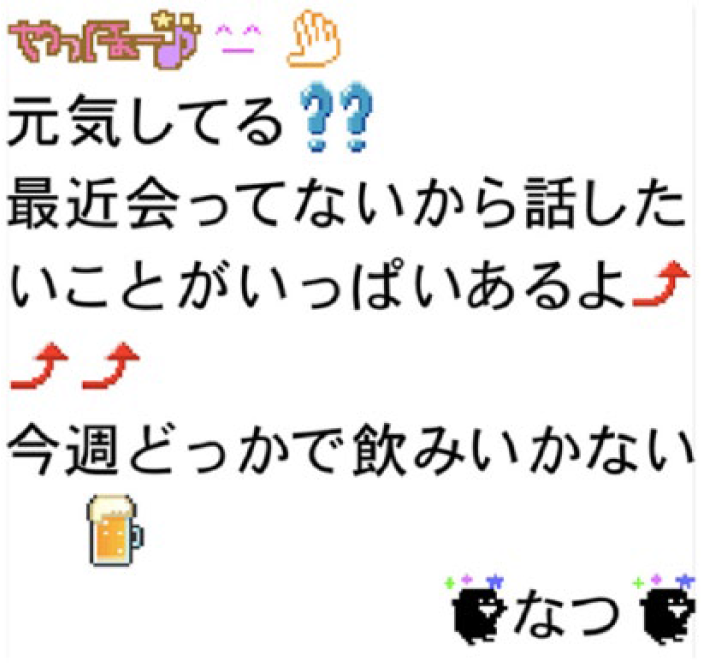
decomail (NTT docomo, 2009).
The evolution of these diverse keitai services represented by i-mode has come to be seen as synonymous with the diffusion of the Internet in Japan. According to the Ministry of Internal Affairs and Communications (MIC), while penetration rates of the Internet in the 1990s were only 21%, by 2005 rates had exceeded 70% (MIC, 2014b). A survey on Internet usage by device conducted by MIC found that computer was the main Internet access portal until 2003 (at 40%), then there has been a concurrent use of both computer and mobile device from 2005 (57%), to the situation today whereby access through computer only has decreased to just 18.6% (MIC, 2014a). Now it is impossible to untangle the connection between the Internet and the keitai in Japan.
Yet another important change in keitai use was heralded by an introduction of camera phones into the market in 2000 (Ito & Okabe, 2005). The very first version of the camera in keitai is to take photographs in 128 by 96 pixel size. Due to the low-quality (resolution) photo function, many users could not imagine its usefulness of the new feature (Ito & Okabe, 2005). However, for many of the younger generation, camera phones were deployed along messaging on keitai. The visual component allowed users to create more of a story, context, and ambience in their messaging techniques.
By 2003, a new breed of camera phones emerged. The term “sha-me” (stands for sha-mail, in that sha is an abbreviation of shashin, a photograph)—or “a photo message”—entered everyday Japanese vocabulary. Sha-me became characteristic of interactions with mobile phones. From this period, using camera phone image sharing became an integral part of keitai culture. The rise of keitai culture over the past two decades parallels changes in the structure of the family. Thus, the keitai becomes a fascinating vehicle for understanding some of shifts in lifestyle and its relationship to familial ties. However before moving onto the case studies, let us outline the specifics informing the rise of the sumaho in Japan.
Sumaho and Social Mobile Media
In Japan, the popularization of smartphones began in the late 2000s when the first iPhone arrived. According to a survey conducted by the Institute for Information and Communications Policy (IICP) in 2013, the utilization rate of smartphones was 52.8%, which was 20 points up from the previous poll (IICP, 2014). The most frequent users were people in their 20s (87.9%) followed by those in their 30s (78.7%), teens (63.3%), 40s (58.8%), 50s (32.4 %), and 60s (8.7 %).
The smartphone—called “sumaho”—is distinguished from keitai. While the keitai referred to conventional Japanese mobile phones, these devices were more akin to what other countries would define as “smart.” Keitai devices afforded a convergence of various capabilities including mobile Internet—a capability that many associate with smartphones. A prominent feature of sumaho is its flexibility in installing various applications (apps) and customizing the set of functions and appearances by an individual’s own preferences. Moreover, a touch screen became an indicator of a sumaho. The spread of sumaho has resulted in an increase not only in Internet use but also in more intense social media use among the younger generation (Ohashi & Kato, 2016). Sumaho users use social media more and longer than conventional keitai users (Sekine, 2013). In this usage, the sumaho has fueled different types of messaging and communication across the variety of social media on offer in Japan. The success of the sumaho has also led to the interrelated success of LINE. It seems that sumaho is creating more opportunities for synchronous communication.
Post 2004, Japan has seen the rise of social media represented by emerging companies, such as mixi, GREE, and Mobage. Despite maintaining an invitation-based user registration system until 2010, mixi enrollments had exceeded 10 million by 2007 (Yoshino, 2014). mixi allowed users to interact with other mutually accepted members (called “my miku”) by sharing diaries and photo albums or by interacting in “community” pages with those who share the same interests.
A feature of mixi was how it represented a sharp contrast to large-scale, anonymous Web 1.0 bulletin board services (BBS), such as 2ch (“ni-chan”), that had been popular at the beginning of the 2000s. In 2ch, users mostly interacted with an unspecified number of other users on an anonymous basis and given the anonymity 2ch became well known for its anarchic and sometimes racist and sexist content. In contrast, mixi offered a sense of security to its users as communication in mixi was based upon a mutually accepted member (my-miku) and community members (Yoshino, 2014). This type of network promoted trust and respect rather than the trolling characterized by 2ch.
GREE and Mobage harnessed Japan’s love of games by focusing upon game services. GREE is known for its world first mobile social game Tsuri suta (fishing star; GREE, 2015). GREE released successive games targeting youth and also sold in-game items (Fujishiro, 2010). By 2009, the membership surpassed 10 million. Mobage focused on combining social media with games. Its popular games include Kaitou Royale (A Royal Phantom Thief), in which a user hunts treasures with other users in the game, and Hoshikku, in which users develop the civilization of his or her star (Fujishiro, 2010). Mobage acquired 10 million users in 2008 (DeNA, 2015).
During this time, foreign social media, such as Twitter and Facebook, started to spread in the 2010s, heightened during and after the events of 3/11 (Yoshino, 2014). As of 2015, the current social media rates in Japan are 57.1%—with 91% in the 20s age group, 80.8% in the 30s, 76.3% in the teens, 60.5% in the 40s, 36.7% in the 50s, and 14.3% in the 60s (IICP, 2014). The following statistics (see Figure 3) identify the usage of the three most frequently used social media services among each age group (IICP, 2014). In order to understand the rapid uptake of LINE in Japan, it is important to contextualize it within the post-3/11 context.
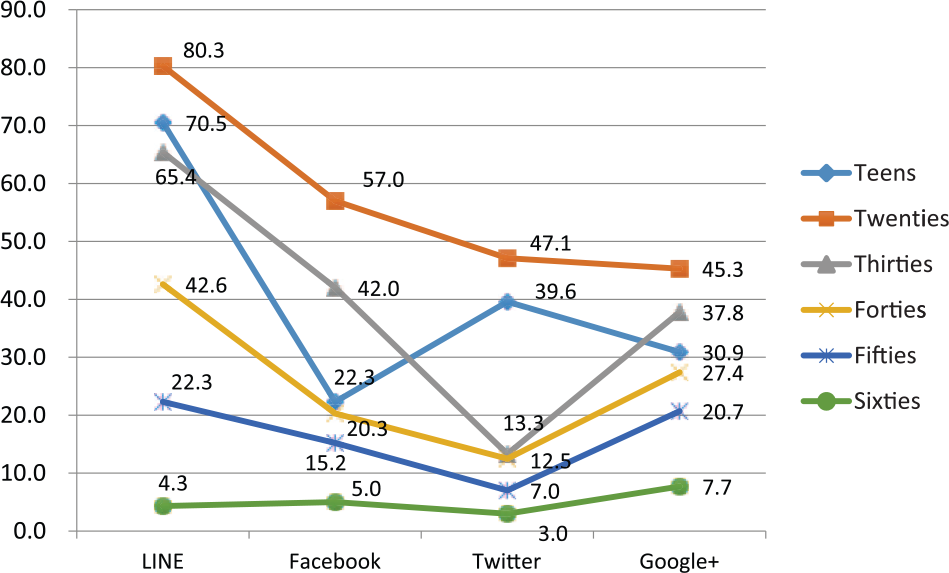
The use of popular social media (by age groups).
The Birth and Rise of LINE in the Wake of 3/11
In Japan, we see social mobile media has allowed for alternative ways in which to articulate the personal and intergenerational, as well as the political and social. For example, immediately after 3/11, it is said that in the central Tokyo (including Prefectures adjacent to Tokyo), more than 5 million people could not reach their home on that day because of the damages to public transportations. According to the survey conducted by Weather News, it took about seven times longer to reach home when compared to one’s ordinary commuting. While many stayed in their office building, some people tried to walk home. It was reported that during the walk home, many tried to use Twitter for collecting information about ongoing changes in transportation recovery. One could, in fact, spontaneously change the route toward his or her home based on communication through tweets. Social media enabled coordination at a micro-level. It was through the disaster of 3/11—and the significance of mobile media during the crisis—that gave birth to LINE.
As noted by scholars in the area (Gill et al., 2013; Slater, Nishimura, & Kindstrand, 2012), the experiences of the earthquake motivated people to utilize social media applications to gather and share information about changes in social and political climate. In addition, mobile media also operated symbolically as a vessel for containing the intimate during times of grief—some people held onto their phones as security when they could not make contact with their loved ones (Hjorth & Kim, 2011). In particular, the rise of social mobile media like LINE in Japan highlights the significance of the media in maintaining and fostering intergenerational ties. These are personal as they are political and intimate as they are public.
LINE is an integral part of the social media landscape in Japan. LINE’s significance is marked by a cross-generational use. In this way, LINE can be viewed as a metaphor for familial genealogies. LINE is a service providing text messaging among individuals or groups, as well as making phone and video calls for no charge. A stamp function—which is an advanced form of emoji (pictogram or emoticons) and decomail—allows communication without the need for text messaging, and this kawaii (cute) culture has been key to its success (Figure 4). These functions allow for more affective care-at-distance providing co-present gestures of emotion and feeling that can be seen to transcend words and be more sensitive to context than just words.

Chat with rabbit stamps on LINE.
As Stark and Crawford note, LINE in Japan has introduced the “next-level emoji” (Byford, 2014) through their deployment of stickers (stamps). As Stark and Crawford observe, “Stickers, crucially, are proprietary to each platform that sells them.” They argue “that stickers represent an attempt on the part of social media platforms—seemingly successful in the short run—to re-commodify the affective labor which, at least in part, had been lost with the standardization of emoji into Unicode” (Stark & Crawford, 2015, p. 8). However, while the ambiguities of emoji and stamps in and across work contexts like emails and social media can confuse and can be viewed as part of broader problematic affective labor practices, in the case of families dealing with distance, they can provide the intimacy and care-at-distance important in maintaining many intergenerational relationships. Moreover, in Japan, these keitai cultures have afforded ways in which to express forms of intimacy previously left tacit (Ito et al., 2005).
In particular, it is important to remember the specific role of kawaii (cute) culture that informed the intervention of emojis in Japan in 1999. In Japan, the historical trajectories toward emoji use are tied to the role of the cute (kawaii) in existing subcultural practices. Kawaii cultures play with the premature adulthood and gender conventions (Hjorth, 2003, 2003; Kinsella, 1995), and play, affect, and labor are entangled in particular ways. For example, the rise of mobile media (keitai) in Japan was marked by a personalization culture both inside and outside the device (Hjorth, 2009). These material and immaterial practices can be linked to older rituals around the personal (Fujimoto, 2005; Ito et al., 2005). These emergent mobile media cultures were framed by gendered usage—from the high girl’s pager revolution to the birth of the i-mode, deployment of the kawaii was about providing alternative voices for female users (Fujimoto, 2005; Hjorth, 2009).
LINE was developed soon after the earthquake in March 2011. The ex-president of LINE, Mr Morikawa, decided to develop LINE because he saw many people use Twitter as a communication tool between intimates at the time of the 3/11 disaster (ITmedia business online, 2013). After 2011, when LINE started its service, it has gained users in many countries, especially in Japan. As of 2015, the number of domestic registrants was 58 million which is over 45% of the whole population (LINE, 2015). The popularity of LINE has overtaken the role of the aforementioned social media like mixi, GREE, and Mobage. By deploying cute (kawaii) characters—which have played an important role in Japanese culture and expressing emotions (Hjorth, 2003)—LINE provided the growing amount of sumaho users with easy, fun, familiar, affective, and mundane ways to communicate with co-present intimates. Here, the kawaii functions to personalize and bring an emotional softening to digital encounters. The kawaii helps to embed particular feelings associated with the message, thus, allowing for building emotional ties.
As we will discuss in the following case examples, practices such as sending stamps and photographs over sumaho have become an integral part of Japanese mobile communication culture. Together with stamps, many Japanese users take photographs and send them over LINE to impart emotion and ambience for their conversations. LINE has an “album” feature that enables the users to save shared photographs into a folder—otherwise, photographs in timeline may not be kept for long. Many photographs may flow through their timelines as they keep exchanging messages. Some important photographs are kept in their albums, enabling the users to have their memorable conversations to be recovered later. In the next section, we further contextualize our family participants and then focus upon communication between our adult daughters and mothers to understand the ways in gendered genealogies play out in and around LINE as part of everyday life.
The Use of Social Media in the Family Context in Japan
In order to understand the role of social media in Japanese families, we conducted fieldwork over 3 years (2013–2016) by revisiting households and viewing media practice in situ. The participants were recruited through various channels, including students from the university that the authors belonged to, as well as via snowballing (social capital networks from friends and acquaintances). The interviews were conducted at locations the participants were familiar with, on a one-to-one basis between one of the authors and the participants, spanning 1–2 hr. Part of the process involved participants becoming familiar with the interviewer and through re-enactment, providing a detailed understanding of the various ways social mobile media plays into everyday rhythms.
Attention was focused on having a cooperative process during this interview. The participants were asked to discuss within their interviewers that took a conversation format how they came to own their first keitai and their social media usage with their family after purchasing a sumaho. The participants themselves determined who is included in their “family.” The participants were asked to bring their sumaho during the interview and to provide screen shots, to a feasible extent, of interactions between family members using social media. The participants’ name (pseudonym), age, occupation, household structure, scope of “family” assumed by the participant, and social media used with their family members are summarized below (Figure 5).

Profile of the participants.
In the study, 8 out of 12 participants used LINE most frequently in communicating with their families. All of these eight participants were females. Over the 3 years of working with these families, the significance of LINE in intergenerational relationships became increasingly dominant. In addition, six out of these eight participants have a “family” group on LINE and send messages back and forth to their families. Here, LINE operates as a digital genealogy for offline intimacies. In order to understand the use of LINE in the family context, we introduce four case studies to highlight practices as nuanced. This study is not meant to be indicative of all LINE users but, in keeping with the ethnographic tradition, exploring these stories and experiences seeks to provide nuanced insights and understandings into motivations and meanings of LINE within familial kinships. Through focusing upon LINE, we can gain insight into gendered practices in contemporary Japanese families.
Rika
Rika is a 32-year-old female flight attendant who lives in a bedsit about an hour by train from Tokyo. Just a stone’s throw away from her apartment, Rika’s only family member, her 72-year-old mother, lives alone. Rika often leaves home for work early in the morning and returns home late. Reflecting the “family-as-chosen-lifestyle” trend noted above, she and her mother respect each other’s daily rhythms by living separately. Rika’s first mobile phone was the one that her mother bought her when she was in junior high school for personal security purposes on her way home from after-school cram school. Since then, she has been using her mobile phone for communicating with her mother on a daily basis.
After graduating from university, the mobile phone became even more important in maintaining Rika’s relationship with her mother as Rika started to fly all around the world as a flight attendant. Overseas flights occasionally cause unexpected delays:
I couldn’t come back to Japan when there was a flood in Thailand and a volcanic explosion in Iceland. In these situations, if it wasn’t for mobile phones, my mother would not have been able to find out if I was OK.
In her airline, the family of employees is not allowed to make calls directly to the airline if a hijacking occurs. This makes the mobile phone indispensable in allowing Rika to communicate with her mother especially when she is abroad. Rika often does a “check-in” on Facebook when she visits abroad on business. One reason is to let her mother know where she is. Her mother does not have her own Facebook account. So Rika keeps her own Facebook account logged-on on the tablet PC, and gives it to her mother so that she can check Rika’s timeline without it being bothersome. In the past, she used to give a paper-based hotel list to her mother, but now Facebook “check-in”s suffice. LINE also has a key role in connecting the pair when they are away from each other. They can talk or chat for free by using LINE—now the most used social media app in Japan—when they have WiFi connection, regardless of their location.
Here, see Rika utilizing mobile media to share both her co-presence and co-location with her mother. We see how Japanese social media LINE is used for digital and visual reflection of, and for, kinship. These digital kinship practices play a key role in the maintenance of social rituals and gift-giving economies, as well as affording new ways to express mundane intimacies in playful and visual modes. Through the study of Rika’s media practices over 3 years, we recognized that the relationship between mother and daughter was gradually changing as they begin to adopt new mobile media technologies. Let us now turn to Mana.
Mana
One year ago, 34-year-old Mana had her heart broken. The trauma of this experience pushed her to quit her job in a provincial locality and move to Tokyo with a new job. She used to engage in an education-related job, but currently she is working full-time in a public relations section of a human resource management firm. In order to draw her loneliness from breaking up with her ex-boyfriend who she was in a relationship with for nearly 10 years, she moved into a “social apartment” in search of meeting new people. A “social apartment,” often referred to as an “interactive rented accommodation,” has a kitchen and lounge on the first floor where residents can contact and communicate with each other, associated with individual rooms.

The stamps that Mana sent to her family members.
She started to use sumaho in 2008 because her ex-boyfriend recommended it. Currently, she uses it mainly to contact her family members in Tohoku (north east region) and her “family-like mates” in the apartment to collect information or to listen to music. On weekdays she wakes up at 6:30 a.m. by wake-up call from her mother. If she wakes up earlier than the call she sends her mother a message on LINE that she is awake. This morning ritual started 1 year ago when she got a new job. In the previous workplace, she got into office at noon and worked late into the night. After she changed her career, this 10-year-long lifestyle changed to that of working from morning till night. She asked her mother to call in the morning because of being anxious about oversleep. Her mother willingly continues this new ritual every morning. Mana scarcely contacted her mother before her career change. Her mother was unhappy with the lack of contact and constantly worried about her. However, through the constant use of LINE stamps—which involve emotional and affective forms of labor—Mana’s mum feels more relieved and satisfied.
In her firm, the sumaho is prohibited during working hours. She uses it during lunchtime to check LINE, Facebook, and Yahoo! news with sandwich or onigiri (rice ball in Japanese) bought from convenience stores in her another hand. She does not have many “friends” on Facebook—only those members from her social apartment, and LINE is mainly used to contact her family members and her mates in the social apartment. In communication with her family members on LINE, they often send photographs or videos of her niece and nephews. As Mana lives away from the rest of family members, she spends much time using creatively situational stamps, such as “Cute!” and “Take care!” to create “a sense of participation” and being there. The stamps give a sense of feeling and emotional that can be hard to express in words.
Satomi
Satomi, a 31-year-old full-time housewife, lives in a town an hour and a half from the center of Tokyo by train. She lives in a duplex house with her daughter, her husband (who runs a company) and his parents. For Satomi “family” includes not only her family who she lives with but also her parents and her husband’s sisters. As Satomi states, “they are connected as a ‘family’ on LINE.”
Satomi uses LINE on a daily basis with her husband, his parents, and his sisters. They are all registered in a group called “family.” She is frequently contacts her husband, his mother, and his sister’s with messages such as “I’ve finished work now,” “I’m late because the airplane’s delayed,” or “Why don’t you all have dinner at our place?” However, Satomi says, “I communicate with them only in a businesslike manner because I don’t want them (her husband’s family) to know what I am doing.” LINE for Satomi is about echoing the intimate mundane routines of the household when physically separate.
She prefers to use Facebook to share her recent activities with her friends and her parents. She used Facebook a lot to communicate with her father during the time he worked abroad for 2 years. She wanted to show him his growing granddaughter. She says, “on Facebook we can casually view each other’s activities while email requires a reply each time.” She had a friend request from her mother-in-law, which she first accepted and then ended up blocking it. “We have a different sense of distance. She is sometimes overly friendly. I prefer to keep a suitable distance with others. I don’t like her knowing my private business,” Satomi explains.
Shizuka
Shizuka, a 21-year-old undergraduate student, lives with her mother, father, and younger sister. For Shizuka, “family” means her immediate family. She uses LINE, Twitter, Facebook, and Instagram on a daily basis. LINE is an especially big part of her life. She uses LINE from breakfast to bedtime—even when she takes a bath. She takes her sumaho to the bathroom protected with a towel (Figure 7).

Shizuka’s bathroom in which she uses her sumaho.
Shizuka loves conversation with her friends. “On LINE, you can have conversations with different people at the same time. You can’t do that face-to-face.” She does not want to use Facebook, Instagram, and Twitter with her family because she does not want them to see her conversations with her friends. She uses LINE a lot with her family. Her father works in a major consumer electronics company and knows much about latest equipment, such as computers and sumaho. He was an early adopter of LINE. Her mother also started to use sumaho and LINE from the last year. In the beginning, her mother did not use social mobile media well—but her husband and daughter inducted her, guiding her through the different processes, such as stamps. Shizuka feels her mum is improving in her literacy, although many of her messages revolve around dinner at home. In their LINE family group, they share messages; her sister sometimes sends funny happenings of the day, her father sends golf score of the day, or they send live score of their favorite baseball team’s game. Even though Shizuka spends scarce time with her family, the ease and intimacy of LINE mean she frequently chats with her family wherever they are (Figure 8).
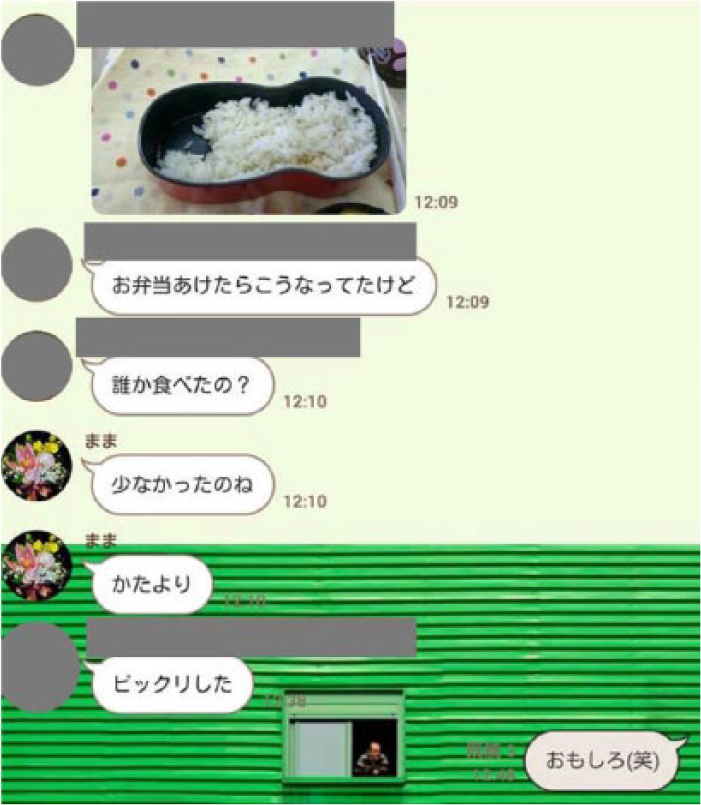
Shizuka and her mum discuss lunch box.
Haruko
Haruko, 22-year-old undergraduate student, lives with her parents. Her family consisted of her parents and younger brother. Her brother has been studying abroad for some years. She is connected to her family on LINE. When the earthquake occurred in 2011, Facebook was the only functioning communication line which every member of her family could access and communicate with each other, although phone, SMS, and e-mail were not. Since then, she has been using Facebook to contact her family. From 2013, communication with her family shifted to LINE. She made three groups on LINE for communicating with her family members: an “official” group of family, a group of family members who live together (excludes her brother), and a group of her mother and herself. In the official group of family, they tell one another what is going on in their life. As Haruko notes,
For sharing information with family, Facebook is not convenient. LINE is very useful in sending messages, pictures, videos, etc. When our family members’ life styles started to change, we became LINE users. LINE’s design is very nice. It feels like we are talking. It’s not like e-mail. When my brother graduated from a college abroad, he sent us a warm message and pictures on LINE for telling his graduation and appreciation to the family. At that time, I was also away from Japan for studying and my father was also on a business trip. All the family members were in different places. It was very moving to see my brother’s message on LINE. I also sent them a message from abroad. It was very warm moment. I was really relieved.
In the group of family members who live together (excludes her brother), they arrange daily things, for example, about the dinnertime. In the group of her mother and herself, they care each other (Figure 9):
After my brother and I grew up, my parents spend more time together. I always worry about if they are nice to each other. They are so different and often fight. When they were travelling to Hokkaido, my father sent pictures with their smile to the official group of family. But my mother sent me a message to the group of me and her for telling me that she was tired and bored. So I sent a message for asking her if she is ok. I often send my mother stamps, too.

Haruko’s message and a stamp to thank her mum.
Haruko could never imagine the types of stamp exchanges she has with her mother and father. For her, LINE allows for different types of intimacies to play out simultaneously. In particular, the emotional and affective labor—or what Arlie Hochschild (1979) might call the “feeling rules”—of stamps in LINE allows for specific mundane intimacies to be shared co-presently. As Hochschild noted in the case of casual labor around the service industry, many workers had to perform “feeling rules” and emotional care work, such as being “friendly” and “kind.”
Within the online context in which emojis and stamps dominate, the emotional work and feeling rules become part of this visual, affective culture. For some, these types of practices exploit users (Stark & Crawford, 2015), while for others such as our participants this visual culture provides an affective care-at-distance culture. While generational differences could be noted and many of the female participants in this study had to “teach” their parents and grandparents to use social media and etiquette like stamps and emojis, the deployment of LINE for emotional work was particularly heightened in the case of our mothers and daughters. However, this article does not seek to reiterate the exploitation versus empowerment models that often underline discussion of emotional labor and media. Here, LINE not only was about reinforcing kinship through repetition of mundane intimacies within the online but also served to create new ways in which the feeling rules of care could be demonstrated. As noted in the work of Ito et al. (2005), mobile media has allowed for types of intimacy and emotion to be expressed within Japanese everyday life which were previously left tacit or unexpressed.
Most of the participants in our fieldwork in Tokyo were using more than one social media service. Through a tapestry of social media use afforded by the sumaho, they were able to compartmentalize different mundane intimacies and intimate publics. However, currently LINE is the most favored social media service among female participants for maintaining relationships with their families. It offers a particular assemblage of affordances and care-at-distance (Figure 10).

Sending messages, stamps and videos to family members on LINE.
Conclusion
In this article, we have contextualized the rise of social mobile media platform, LINE. As noted, the emergence of LINE corresponds with changing use of social mobile media in a post-3/11 Japan. This usage is personal as it is familial and political as it is social. Through the exploration of LINE, we see that social mobile media is shaping, as well as being shaped by, familial rituals. These rituals are, as we argue, gendered in their practices.
In this article, we focused upon the intergenerational practices between daughters and mothers to understand some of the emergent forms of care-at-distance and intimate co-presence is playing out through LINE. As we argue, LINE operates as a digital form of kinship and genealogy. In this entanglement, the online and offline create dynamics around how contemporary forms of intimacy are playing out across co-present contexts.
LINE can be viewed as a form of digital kinship. The notion of digital kinship embeds the study into broader debates about the changing (or residual) nature of what it means to be a “family” in an age of networked media, as argued by both Clark (2012). Kinship has always been important in ethnographic understandings of culture. With the added dimension of the digital, we see how kinship moves in and out of online and offline spaces and, in turn, how these spaces have come to develop their own histories, connections, and memories. Through emoji and stamps, LINE also allows for new modes of emotional and affective care-at-distance to be expressed. More work is needed into the growing significance of social mobile media in shaping, and being shaped by, digital kinship.
Footnotes
Declaration of Conflicting Interests
The author(s) declared no potential conflicts of interest with respect to the research, authorship, and/or publication of this article.
Funding
The author(s) disclosed receipt of the following financial support for the research, authorship, and/or publication of this article: This work was supported by the Australian Research Council Linkage with Intel, Locating the Mobile: locative media in households in Tokyo, Shanghai, and Melbourne (LP130100848).