




Abstract
This study asks whether users’ encounter with normative discourses of lifestyle, consumption, and health on social media such as Facebook gives rise to agency. The theoretical framework draws on reception analysis, for its implied, but central interest in agency that lies at the intersection of texts and audiences. Based on a critique of the “participatory paradigm,” a paradigm that situates the locus of agency in the structural opposition between senders and users, in the norms of rational deliberation or in the figure of the activist, gaps are identified which can be filled by adopting an explicit focus on the socio-cultural practices of ordinary audiences in their encounters with media discourses. The study investigates user agency on seven Facebook groups and pages with the help of a three-pronged perspective based on the notion of the media–audience relationship as (1) power structure, (2) nexus, and (3) reception. The analysis reveals that the structure at play on these Facebook groups and pages does not encourage user agency. However, user agency manifests itself through user interactions and expressive sense-making processes associated with reception. The benefits of such audience agency are a public, collective, and communicative sense-making process and an expansion of the professionally controlled text.
This article argues for the relevance of reception analysis (for a presentation, see Schrøder, 2016), and by implication the notion of audience, for the study of user agency on social media. In the first part of the article, a brief overview of the literature concerning user agency within the “participation paradigm” (Livingstone, 2013) points to gaps which can be filled by adopting an explicit focus on reception analysis and exploring the socio-cultural practices of ordinary audiences in their encounter with media discourses. This focus is then developed with regard to theories of the publics (Warner, 2002) and of the media–audience relationship (Livingstone, 1998), the latter providing the backbones of the methodology.
The article then turns to the empirical part of this study, which consists in a rudimentary-yet-comprehensive discourse analysis of Facebook pages and groups on the topics of health, lifestyle, and consumption. The article suggests looking at the media–audience relationship from the vantage of three perspectives (power structure, nexus, and reception) in an effort to acknowledge the multifaceted complexity of the concept of user agency in its application to social media. The findings, presented for each of the three kinds of relationship, confirm previous research to the effect that the textual structure of Facebook does not encourage user agency (Van Dijck, 2013), but they also reveal the roles that interaction and reception play for user agency.
The Participation Paradigm: User Agency on Social Media
Much research on agency has turned to online environments (Bennett, 2008). The question of online agency has been extensively researched within what Livingstone (2013) calls the “participation paradigm” in which the notion of audience is replaced by “produser” (Bruns, 2008), a contraction between “production” and “user” to signify the new productive capabilities of the audience, whose role had been traditionally limited to media consumption. 1 Optimistic voices argue that users are taking over the means of media production or otherwise functions that were traditionally reserved to senders (Bruns, 2008; Jenkins, 2008; Rosen, 2006), while critical voices underline the failure of users to reverse the structural relation between senders and users and conceive social media as a prolongation of the status quo (Carpentier, 2011a, 2011b; Milioni, Vadratsikas, & Papa, 2012; Van Dijck, 2013). While much research has been directed toward the study of produsage and participation, other agentic aspects of social media uses have not received as much attention.
Three Main Research Positions on User Agency
Despite the extensive attention given to the question of agency on social media within the participation paradigm, there remain gray zones that are less covered by research. These gray zones concern the socio-cultural practices of ordinary users, understood as audiences or publics, in their experiential, interactional, and converging encounters with media discourses. Research on social media agency has concentrated in three areas of research, which, without being mutually exclusive, have produced specific bodies of knowledge. While research is more porous than classifications usually suggest, the identification of these three trends reveals gaps in the literature on agency, gaps which have informed the conceptualization of this study (Table 1).
Divergent interests between senders and users. A first body of research assumes diverging interests between users and senders. A main assumption of the participation paradigm is that, as the audience engages in acts of production, they take over various tasks, roles, responsibilities, or powers—that is, agency—that were once the privilege of senders or content producers. This separation and opposition between senders and audiences has a long history and is of crucial importance in the field of media studies (Livingstone, 2004, p. 79). For example, in his seminal work, Stuart Hall (1980) associated the notion of audience agency with resistance to media influence, and since then, audience agency has been conceptualized in structural opposition with the agency of media senders.
While scholars such as Jenkins and Carpentier (2013) may disagree on the outcome of participation, they both discuss user agency from a sort of Lavoisier’s law in which nothing is created that is not loss. The structural opposition created between senders and (prod)users assumes that agency is a competitive resource, that is, a resource for which citizens appear to be in competition with traditional producers and senders of media content. More agency to the sender means less agency to the user, and vice versa.
My contention with this body of research is that it ignores the role that experience or interaction can play in the constitution of agency and tends to analyze agency solely in terms of its structural configuration. Moreover, this position is only valid if one assumes diverging interests between senders and users, but one can certainly imagine that users gain agency in independence of or in collaboration with senders. Many of the interactions observed on the Facebook pages and groups under scrutiny for this research do not conform to the divergence model of agency, as many users express converging interests with the senders. In the current media landscape, both divergence and convergence need to be considered (Mathieu, 2015b).
The normative approach of rational deliberation. A second body of research within the participation paradigm is conducted under the influence of a normative approach, inspired in one way or another by the original work of Habermas (1989/2008). To caricature, the approach consists in stating a normative ideal for users’ participation, for example, the ideal of deliberative rationality, and conducting empirical research that concludes, unsurprisingly, to the non-alignment of practices to these standards.
There is an alternative to the normative approach which reception analysis has contributed to establish: the socio-cultural tradition. There are debates as to the legacy of the socio-cultural tradition in media research, 2 but the approach has successfully been applied to Internet and digital media research (Bakardjieva, 2011). In the present case, the usefulness of the socio-cultural tradition resides in its considerations for the perspective of users, in its genuine interest for what participants are trying to accomplish through their often mundane cultural practices. The socio-cultural tradition assumes that people’s practices carry or express meanings that are to be valued in their own terms and not in relation to some normative ideals.
The activist-citizen. Finally, a third body of research can be identified around the figure of the activist. Research in participation has amply documented ways by which activists use new and social media for purpose of organization, communication, and diffusion. Conducted on the impulse of online ethnography (Camerini & Diviani, 2012; Mascheroni, 2013), such research has contributed to establish a non-media-centric approach to questions of agency (Couldry, 2011) that also moves concerns away from the notion of audience.
Neveu (2014) makes a distinction between the “activist citizen” and the “active citizen” in order to distinguish the two categories of citizens concerned by the study of agency. While the activist citizen is heralded for its efforts at disrupting social orders that maintain or promote inequalities and injustices in society, by contrast, warnings are issued concerning the (lack of) agency of ordinary citizens, who are said to be apathetic, disinterested in the political, or disaffiliated from one another. 3
As argued by Neveu (2014), who remarks that “order” is etymologically related to “ordinary,” practices of ordinary citizens manifest themselves within the social order, while the activist’s ambition is to disrupt and replace an existing social order. Contrary to the activist, the agency of the ordinary citizen is one that is located within the established resources and limitations available ordinarily. Thus, in order to be properly understood, the parameters by which ordinary agency can express itself by ordinary citizens demand a different set of concepts and methods than what has been used for the study of the activist citizen, which the notion of audience can provide.
Three Research Positions on User Agency and Their Possible Counter-Positions.

Users as Publics
Following Scannell (1998, 2007), it is easy to recognize how the converging socio-cultural practices of ordinary citizens are regarded from the vantage point of a “hermeneutics of suspicion” in the three research positions presented above (see also Mathieu, 2015a). While, ordinary audiences may seem to be participating, or given the illusion that they are, their contribution is not meaningful if it does not involve a gain of power over senders, disrupt the social order, or live up to some standards established by prescriptive theory. As a result, ordinary audiences are often seen as victims, dupes, or fakes. While there is surely some truth in these observations, this ingrained suspicion in research limits the scope of evidences that can be collected about user agency.
Recent thinking on the notion of “public” (Warner, 2002) provides a different understanding of the role of users in the new media environment, and consequently of agency. This approach to agency, in which users of new and social media are predominantly understood as citizens-audiences, underlines the capacity of the audience to organize itself as public around social media texts. Different concepts have been suggested to capture this new reality: “recursive publics” (Kelty, 2005), “networked publics” (boyd, 2011), or “ad hoc publics” (Bruns & Burgess, 2015).
Loosen and Schmidt (2012) suggest the apparition of new forms of public spheres that are provisionary, formed, for example, around a Facebook page created spontaneously about a specific issue. Blondeau and Allard (2010) suggest that, through their reflexive engagement on social media, users constitute themselves as public of texts, and by the same token contribute to define and expand these texts. The public engagement with the text can take many forms in online environments, such as curation (Macek, 2013), redistribution (Jenkins, Ford, & Green, 2013), gatekeeping (Kwon, Oh, Agrawal, & Rao, 2012; Singer, 2014; Tandoc, 2014), remixing (Lessig, 2009), or positioning (Mathieu, 2015b).
Fish, Murillo, Nguyen, Panofsky, and Kelty (2011) observed in a variety of participatory contexts on the Internet that, as publics start to take over the roles and responsibilities of senders (or what they call “organizations”), they abandon the very qualities that defined them as audience of text, that is, those qualities that make it possible for them to organize themselves as publics of texts. This approach contrasts with the understanding of agency as a competitive resource between senders and users and rather argues for two distinct forms of agency. The notion of public clarifies that user agency belongs to a different ontology than the agency of senders and that there is indeed agency in the notion of audience.
For example, as underlined by Warner, publics are critical and speculative in their use of texts, which contrasts, according to Fish et al. (2011), to the ascendant that senders exert over texts. Sender agency differs from the contextualization operated by publics in that, according to Fish et al., it tends to be strategic and managerial, to depend on hierarchical and accountable decision-making, to be narrowly defined and oriented toward closure, action, goals, and the doable. By contrast, audiences’ appropriation of texts attempts to open up the text (in the semiotic sense of the term), is speculative, deliberative, critical, and independent, only constituted through voluntary attention, as publics are not accountable to any stakeholders but themselves.
The dilemmas that arise between audience agency and sender agency can be observed in the difficulties that bottom-up, citizens-led social movements such as the Indignados face as they organize themselves and claim their own means of representation (Montero, 2014). Tensions between the multiplicity of voices in the movement against the need to voice a common narrative are telling of the different agency at play in publics and senders.
Methodological Considerations
The tradition of reception analysis forms the framework of the methodological approach. Reception analysis is not a foreign approach to the study of agency and has in the past contributed to our understanding of agency as a sense-making process of contextual appropriation of texts. Especially the notion of active audience has contributed to situate agency within a media–audience relationship (Livingstone, 1998; Livingstone & Das, 2013). The methodological framework of this study borrows the conception of agency developed through the theory of the media–audience relationship.
The advent of new and social media has seen the exploration of new methodological venues, also for the study of reception. This study follows the lead suggested by Livingstone (2004) to the effect that reception and uses are reunited in online environment. The technology-mediated activities of the users of online platforms, such as selecting, sharing, liking, commenting, and remixing, leave traces that are observable to the analyst. Much of these traces are expressed through language, making it possible to apply some form of discourse analysis to social media, such as an analysis of online interactions (Steensen, 2014). This methodology is rather unusual in relation to reception analysis, which has traditionally relied on the interview method in order to invite respondents to elaborate on their reception of mediated content.
A reliance on discourse analysis offers some advantages, such as being unobtrusive and providing access to naturally occurring data, two aspects on which the methodology of reception analysis has struggled with. It also avoids problems with sampling such as self-selection bias (Marichal, 2013). However, it presents limitations, some of which can appear serious in light of methodological principles well established in reception analysis. It is not possible to contextualize textual data into organizing categories that have been used in reception analysis, such as gender and education, to situate audience interpretations nor to explore the motivations of users or disambiguate the evidences produced about reception. Moreover, so-called lurkers (Bechmann & Lomborg, 2013) are being excluded de facto from such analysis, although they may arguably form the main category of audience of these Facebook pages.
Facebook Pages on Health, Lifestyle, and Consumption
The analysis rests upon a corpus of seven Danish Facebook pages or groups on the topic of health, lifestyle, and consumption (Table 2). The existence of these pages and groups, and their investment by users, is a relatively recent phenomenon. In 2007, Facebook allowed non-profit organizations to present pages that users could like and follow (Marichal, 2013). Facebook developed this model to include commercial presence on the network and allowed organizations to operate more control over their “text.” As such, the development of Facebook pages followed a model that was originally and primarily user-based to become a sender-based network. A distinction was then introduced between Facebook pages, which represent official public presence of for-profit or non-profit organizations, and Facebook groups, organized around grassroots communities of interest. 4 Each type sees a particular design and layout and entails different administrative tools and rights.
Pages and Groups Considered for the Study.

NGO: non-governmental organizations.
Users’ participation in these Facebook pages and groups should be considered in light of an increasing burden of responsibility placed on individual citizen-consumers to face lifestyle risks and problems (Halkier, 2015). As Halkier argues, the mere presence of these discourses in the public sphere makes them normative and hence invites citizens to position themselves toward these norms. Yet, the stream of users flowing to these pages could also signal a change of paradigm concerning the production and communication of knowledge related to lifestyle, consumption, and health, which Van Zoonen (2012) suggests is increasingly organized around an “I-pistemology.”
The pages and groups retained for this study were chosen because they involved different issues within the theme of food consumption, hence providing a broad view of the phenomenon. Some pages belong to official institutional sources, such as the Danish Ministry of health (Sundhedstyrrelsen), and others to the organized civil society, such as the consumer right association Tænk, who administers the Facebook page Kemikaos, while others are the creation of grassroots communities.
Table 2 shows the amount of page members, on official count or appreciated by the amount of likes, which has been rising exponentially over the past years. This investment can be seen in the amount of posts published during the year 2014 alone compared to the total amount of posts, in some cases accounting for about half of these posts. A noticeable difference between these pages and groups concerns the much smaller amount of interactions on community-based groups compared to sender-based pages.
Even though the topic of this research is not particularly controversial and the participants do not appear to constitute a vulnerable group—quite the contrary—a decision was made to completely render anonymous their presence in this report. These Facebook pages and groups are public spaces of discussion, but their participants are unaware of being research objects. It is important that these spaces remain owned by the people who invest them, despite an increasing surveillance of citizens, which the research community should not be a part of. The anonymity of the participants is furthermore justified as the focus of the study is not on people, but on the interactions that take place on Facebook.
A Three-Pronged Analytical Framework on User Agency
Following the tradition of reception analysis, and especially its investigation of the relationships between media and audiences, I suggest examining agency from three varieties of media–audience relationships: (1) as a power structure, (2) as a nexus, and (3) as reception. The three types of relationship can be represented along a continuum from structure to interaction to experience, which relate respectively to three main interpretative epistemological positions known as (post-)structuralism, interactionalism, and phenomenology. By looking at these three different perspectives on agency side by side, the analysis is able to draw conclusions about agency that are multifaceted. Table 3 presents a schematic overview of the main components of the analytical framework.
The Three-Pronged Analytical Framework.

The Media–Audience as Power Structure
Within this category are analyzed the structural relations between senders and users, and in particular how the structure of Facebook articulates these relations and governs the dynamics of interaction between senders and users. 5 The analysis of the power structure considers the disposition of the page and the valorization of the sender or the user on these pages, in terms of the editing capacities that are imparted to them. Also, attention is paid on how interactions are structurally organized.
As part of this analysis, the classical encoding/decoding model formulated by Stuart Hall (1980) is considered, especially as it refers to notions of textual power and resistance from the part of the audience. The notion of textual power takes special significance in light of recent research showing how technological affordances constrain and orient user interactions (Van Dijck, 2013). Finally, the notion of genre, including an attention to the speech acts that are performed on its name, is also considered. Here, the interest is to find out whether users’ interactions conform themselves to the expectations created by the genre or whether their contribution attempts to challenge established norms.
The Media–Audience Relationship as Nexus
The interest of this category is in the materiality of the media–audience relationship, in the negotiation of meaning that takes place between the media text and the audience. At stake is an assessment of the respective contribution of the text and of the context of the audience in the negotiation of meaning. What aspects of the text are allowed to enter the sense-making activity of users? And what aspects of the users’ context contribute to inform their interpretation?
In this analysis, attention is paid to establish categories that are sensitive to the interactions taking place on the Facebook pages. It draws on various discourse analytical notions relevant to the study of interactions indebt to pragmatics and conversation analysis. The interactions between senders and users, as well as between users themselves, are coded as adjacency pairs (Sacks & Jefferson, 2006). 6 For the purpose of this analysis, the first hundred posts on each page were considered. 7
In terms of their functioning, these interactions can uncover how text and context relate to each other in interpretation. For example, contextual insertions concern the aspects of contexts that are brought forth in the interpretation of the text and at times visible in the comments of users. Here, a basic categorization was done on the basis of four main dimensions of contextual experience: knowledge, values, emotions, or actions (Gjedde & Ingemann, 2001). These four dimensions are useful in that they can reveal priorities in the form of experience by which users encounter these normative discourses.
The Media–Audience Relationship as Reception
The analysis of reception directly follows the suggestions made by Kim Schrøder (2000, 2003) in his multidimensional model of reception. The model includes five dimensions that are meant to describe the audience’s experience of the media text. In this study, these categories are, however, adapted to the reality of studying online interactions via discourse analysis.
In short, motivation concerns any interventions that rise or signal interest in the text. User posts are categorized as comprehension when they facilitate the understanding of the text. Discrimination is used when a comment points to the constructed character of the message. The dimension position is used when an intervention supports or rejects the normative discourse at play in the page. Finally, the category implementation is applied when a comment deals with the implementation of the normative discourse in everyday life. As for the previous analysis, the first hundred posts of each page and group were considered for the analysis of reception.
Findings
Analysis of the Power Structure
There are noticeable differences between the structure of pages and groups. An analysis of the structure of pages leads to the conclusion that the power structure does not encourage user agency. Most pages are structured around a diffusion model of communication from sender to users. Some pages do not even allow users to post on their own initiative, but limit them to commenting posts published by the sender. And when allowed, user posts are visually marginalized in the overall architecture of the page. Specimen 1 from Figure 1 provides an example of a page that only allows reactive posts (highlighted in green). Specimen 2, a page that allows users to post on their own initiative, provides additional space for user posts, yet their interventions are confined to the bottom left of the screen. Specimen 3 is a Facebook community group and is therefore essentially constituted of user posts that occupy the center of attention.
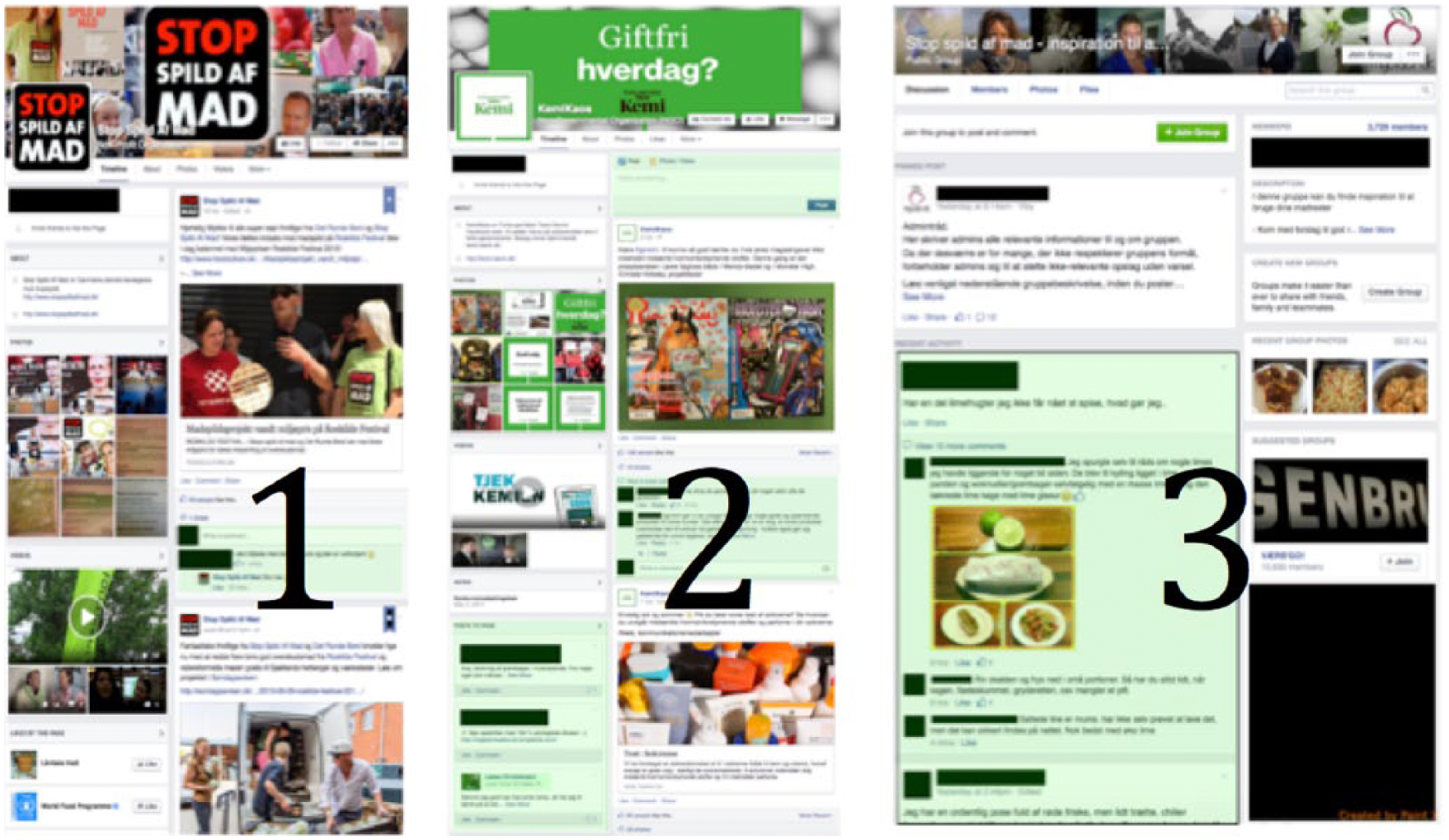
Specimen of Facebook pages and groups.
There are few interactions between users on pages that are administered by an institutional sender. The adjacency pairs concerned are mostly sender–user and user–sender, often of the question–answer form. In contrast to the community-based groups, which rely exclusively on user posts without a clearly identifiable sender, the Facebook pages give the impression that it is the sender who initiates interaction, even when this possibility is provided to users. Typically, a post is created by the sender, who often shares some resources that fall under its interests and presumably its audiences, for example, a link to a press release of another organization, a video on YouTube, or a news article. These texts are then reacted upon or commented by users. An example is the page “Stop food waste” that announces the work done by its volunteers at a music festival and link to an article in a local newspaper, which is reacted upon by 19 users expressing their support and comments to the announcement.
In both pages and groups, there is not much discord between the participants, contrary to what is observed in online news forums, which are known to encourage bigotry and other “carnivalesque” expressions of the audience (Bakardjieva, 2008). In fact, most users can be said to be sympathetic toward the sender or other users, expressing their support, also via the like button. These expressions of support and sympathy indicate that Facebook pages and groups function for the most along a model of converging interests. Of the 19 users who responded to the announcement mentioned above, 8 expressed their support to the senders, with comments as short as “Great!.”
When the power structure established by the relationship between the media text and the audience is considered from the perspective of the genre, which falls essentially within two main relationships, statement–reaction and question–answer, the reading of users indicates for the large part a “preferred reading” (Hall, 1980). In Facebook groups, few infringements to the genre, as established in the “about” section, are attempted. In Facebook pages, instances in which users explicitly challenge the sender are rare. On the whole, users offer little resistance to the control that the sender operates on the agenda and the content presented to them. The example of an exception may serve to illustrate the rule: a rare instance in which a user contests the claims made by the sender Kemikaos following the divulgation of results showing the presence of suspicious chemicals in the product of company X:
Fair enough! I know that you have refused to talk to one who is called [name] from [company X] who knows all about these things and you neither relate to the fact that it has never been proven that the fluoride gets into the food . . . I still mean that it is a storm in a glass of water and that you have not investigated the matter properly. (My translation from Danish
8
)
Analysis of the Nexus
While the previous analysis described the structure of interaction at play on Facebook pages and groups, and showed how senders have ascendency over users, an analysis of the nexus pays attention to “what is going on” in these interactions, including the speech acts performed. The analysis of the nexus reveals a more nuanced picture.
Table 4 presents the main categories describing specific adjacency pairs and the speech acts taking place for the majority of users’ interventions, sometimes as a response to the sender, sometimes initiated by the users themselves.
Main Speech Acts Performed on Facebook Pages and Groups.
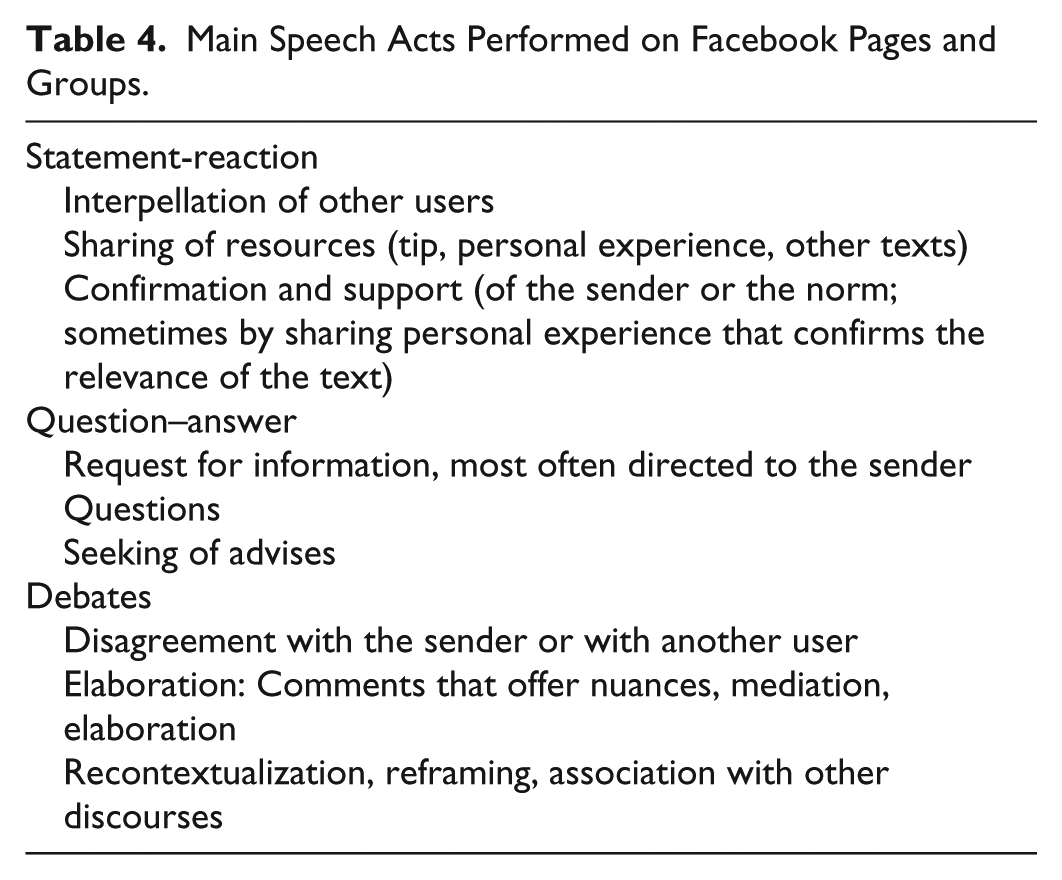
All of these speech acts encourage normative discourses to enter the concrete experience of users, engaging with their implications and applications in everyday life. But there are main differences between pages and groups in this regard.
The raison d’être of the Facebook group dealing with the prevention of food waste is chiefly concerned with the application of the normative discourse in everyday life. Most interactions are request for and sharing of advises, tips, recipes, rules of thumb, and so on. Few users take the occasion to assert their favorable views toward the norm, which is for the most taken-for-granted and accepted. Interactions on these groups are not extensive, but rather instrumental, and they do not approach normative discourse outside of its practical application in everyday life. However, many of these interactions provide elaborations and additional resources, and requests for information are almost always answered by other users.
The interactions taking place on Facebook pages are often initiated by the institutional senders of these pages and here user agency appears in contrast to the abstract and disembodied articulation of normative discourse in institutional discourse. In these interactions, users display agency in at least two ways. First, even though users can be said to comply with the control that senders exert over the structure of interactions, they display agency by taking the text out of its preferred canons and by opening it up via various contextual insertions. Second, users are able to exert interactional pressure on the sender, which encourages the latter to make modifications, adaptations to its original discourse.
The last two categories of speech acts, question–answer and debates, are especially interesting because they invite the sender to come out of its institutional canons and enter other discourses that are sometimes more relevant to the users. The interventions of users bring other realities at play and sometimes force the sender to adopt different modes of expression, such as emotions, that are not often considered in the institutional articulation of normative discourse. That is, through their interventions, users are able to modify the text or invite the sender to do so. In their comments, users make apparent the contexts in which normative discourse is meant to acquire its relevance. Some users invite senders to anchor more clearly their texts into context and these invitations are sometimes (but not always) fulfilled by senders.
For example, users do not necessarily want to know which chemicals are present in a given product, but want to know whether the product is “dangerous” or what “consequences” its use may have for their health. Consider this response provided by Kemikaos to a user who asks about microwaved popcorn, after a test revealed the presence of dangerous chemicals in the packaging: “Dear [name], it is
The interactions at play on Facebook pages encourage the sender to establish relationship with the users that are more complex than what the diffusion model of communication implies. Senders may be pushed to side with users, to give concessions or admit the shortcomings or the difficulties of application of normative discourse in everyday life. Such invitations can be interpreted in a model of divergence, as an opportunity for senders to maintain or reclaim control over the message. But the same phenomenon can also be seen as a convergence of interests, as it provides the opportunity for senders to clarify, diversify, and increase the relevance of their message for users. Even if the sender can be said to give its message more impact, privileging its own version, the text enters the realm of context and is transformed by it.
As remarked before, few questions openly challenge the authority of the sender. But a closer look reveals that senders often engage in various forms of repairs in their answers. That is, they attempt fixing something they believe has been broken by the comments or questions of the users. These repairs concern issues that are only presupposed in the comments of the users, and while highly implicit, they provide some evidence of the agency that users can exert on senders. For example, while apologizing that a particular product was not part of those tested by its team, the sender Kemikaos points to the right of consumers to obtain information from producers about the presence of dangerous chemicals.
At times, the senders can be said to benefit from the work done by users, as users expand the original discourses in ways that would be difficult to achieve without compromising their official position or their role and responsibility as an institutional sender. For example, consider how the technical language of the sender “you risk to have
Senders can be restrained from engaging in some aspects of sense-making, such as discussing controversies, attributing blame, disciplining other users, and hence leave this “dirty work” to the discretion of users. As users embark in such activities, it is quite telling that senders remain silent and do not engage directly. For example, users who make “incorrect” assumptions or make erroneous statements about the science behind normative discourses are rarely shamed by the sender, but often put to their place by other users. “There is a difference between bacteria and chemicals,” says one user to another who attempted to contest the merits of biological agriculture with a claim that city kids are not enough exposed to bacteria.
A telling instance that illustrates the complexities of this kind of interactional agency can be found in the scientific discourse adopted by the sender in their presentation and promotion of normative discourse. Senders often rely on science to ascertain their discourse, for example by presenting the latest research associated with the theme of the page. Reliance on this scientific discourse makes the text formal, univocal, abstract, predictable, technical, and factual. The interventions of users open up the text toward their lifeworld and expand the horizon of the text. Yet, it is also interesting that some users align to the discourse of the sender and discipline other users by relying as much on a factual–technical language in their comments.
Analysis of Reception
Notions such as produsage have emphasized the idea that users also produce as they consume content, but the opposite is also true: users “receive” as they produce. While the notion of produsage emphasizes the agentic–productive activities of users, I want to suggest the notion of expressive reception to cover the same empirical reality, yet with a theoretical emphasis placed on reception and its agentic implications. Throughout expressive reception, users make their reception visible to themselves and to others. Expressive reception is primarily defined by its public character, rather than by what it can say about private, individual, or mental reception. As users comment, share, and circulate meaning, they engage into visible, public, and collectively articulated processes of reception. What can be observed through a discourse analysis such as the one suggested in this study creates limitations about what can be known of reception, but its public nature is however more clearly articulated.
In the few lines that make up their comments, users make visible different aspects of their reception. In fact, many of the posts analyzed express more than one dimensions of reception. By far the most frequent dimension expressed through expressive reception is the dimension of motivation and is visible in the interpellation of other users. The commenting function of the Facebook pages allows users to attract the attention of other users in their network on given posts by typing their username. Such behavior expresses the dimension of motivation because users assume that a post is relevant to one or more of their connections. In doing so, users contribute actively to establish and expand the relevance of the text.
The dimension of comprehension is underlined in the requests for information and the questions that users ask, especially concerning the technical–factual aspects of a normative discourse. Although the asking of questions presumes a more powerful sender as the repository and authority of knowledge, in doing so users invite senders to clarify, disambiguate, illustrate, and explain their discourse, which can only be beneficial for its comprehension, even for the users who are simply lurking. For example, following the news of a new project on packaging, one user asks, “Aren’t there newer forms of packaging that decompose fast and are not damaging the environment?”
Comprehension also concerns the reactions and the contextual insertions of users. As such, this dimension often flirts with that of implementation, that is, the extent to which the text is implemented in everyday life. As hinted before, the dimension of implementation is crucial, especially for Facebook groups whose genre and interactions are defined by this dimension, as in the case of the prevention of food waste. Implementation is first and foremost a way to bring normative discourse in the context of everyday life. Here are few examples of suggestions and tips that signal the implementation of normative discourses on food waste in everyday life:
Maybe we should give leftover foods to nursing homes, so they could get a good meal on that day! Frozen grapes are really good as eatable ice cubes:)
While the dimensions of motivation, comprehension, and implementation shine in the produsage activities of users, the dimensions of discrimination and position are less common, without being completely absent. On the whole, few posts will bring to light the constructed character of the text or contest the position articulated by the sender. When users position themselves, it is in general favorably toward the sender, expressing their converging interests. They accept the semiotic universe in which these normative discourses are articulated. As mentioned before, users who contest these discourses are often reprimanded by other users.
Conclusion
In the existing literature, user agency is often conceptualized as participation opposed to the agency of the sender, measured against normative ideals or belonging to a particular group of users. In this article, I have argued for the relevance of the notion of audience in exploring user agency.
To some extent, the participation paradigm denies agency to ordinary users, but as pointed out, these findings are often confined to a specific perspective on agency, be it structural, normative, or social. In order to recognize the complex character of agency in the notion of audience, this analysis resorted to a three-pronged perspective stressing the roles of structure, interaction, and experience as sources of audience agency. The result is a more nuanced understanding of the agentic possibilities provided by the use of Facebook by ordinary users in their encounter with normative discourses on health, lifestyle, and consumption.
The analysis of power structure reveals that a convergence of interests between users, and between senders and users, animates most encounters with normative discourses on lifestyle, consumption, and health. On one hand, the structure of Facebook groups, which are anchored in a community of users, provides more agency to users, but these groups display considerably less interactions compared to Facebook pages, and the nature of these interactions is also less varied and does not engage crucially with normative discourses. On the other hand, for Facebook pages, this convergence is to the structural advantage of senders, given their privileged position on these pages.
The growing popularity of Facebook pages seems to witness the return to a sender-based regime of meaning on Facebook. Increasingly, user activity is organized around senders and their discourses, in which users perform the role of audience, albeit in an expressive way. Thus, the notion of audience has not disappeared entirely from the current media landscape and is even being emphasized on Facebook pages. This does not need to spell the end of user agency on social media, however, as this three-pronged analysis reasserts that there is agency in the notion of audience.
The analysis of nexus shows how users of both Facebook groups and pages insert normative discourses in concrete experience and everyday life. However, for Facebook pages, these contextual insertions are more varied and they contrast with the agency of senders, encouraging them to take users into account and to make compromises to the institutional articulation of normative discourses. The analysis also suggests the notion of expressive reception as a form of user agency situated in the prolongation of the analysis of power structure and nexus. Expressive reception helps connect normative discourses with users and contextualize such discourse in everyday life.
These findings suggest that, despite a structural advantage for users, Facebook groups remain sluggish, perhaps because they miss the editorial leadership that an institutional sender can bring. Yet, despite a structural disadvantage on Facebook pages, users display more convincing agency, especially in their interaction, which crucially depends on the presence of the sender. This points to the importance of taking the notion of audience seriously in the study of agency. It appears also that the agency revealed in the notion of expressive reception is more useful when users take upon the role of audience, as visible sense-making processes contribute to articulate these users into a visible public of normative discourses.
Footnotes
Declaration of Conflicting Interests
The author(s) declared no potential conflicts of interest with respect to the research, authorship, and/or publication of this article.
Funding
The author(s) received no financial support for the research, authorship, and/or publication of this article.