




Abstract
This content analysis examines media depiction of events in Ferguson, Missouri, following the shooting of the unarmed teenager Michael Brown by a police officer. Using images from the Twitter feeds of nine major media outlets in the month following the shooting, it identifies themes present in those images. Descriptive statistics reveal differences in the roles of people who appear to be White and those who appear to be Black. The two groups are rarely pictured together. The visual narrative presented on Twitter depicts two distinct sides. Police are consistently shown prepared for conflict, but rarely are protesters in images with police. The implications of these findings are explored through the theoretical viewpoint of agenda setting.
Introduction
On 9 August 2014, Michael Brown was shot dead by a police officer in Ferguson, Missouri. What came after was a media storm that coalesced around a series of events. The protests that followed became known as the Ferguson riots, and they were a major focus of media attention. Stories questioning police militarization became popular in the public interest, often using images of armored vehicles and tear gas. Reports included photos and video more akin to a war zone than an American city. As a developing story, 24-hour news outlets, including CNN and Fox News, gave regular updates. However, social media lent themselves to an even greater extent to the play-by-play style of storytelling emerging from events in Ferguson. As a result, major news outlets tweeted pieces of news and news images. This is a content analysis that focuses on those images.
Using visual framing analysis, this research examines the depiction of events in Ferguson. The research analyzes images from the Twitter feeds of nine major media outlets in the month following the shooting. Coding the images from tweets sent from media accounts about Ferguson reveals the potential impact of the iconic images of the event. In the same way that past studies looked at the agenda-setting function of traditional media through visual framing analysis (Coleman & Banning, 2006), this study seeks to analyze the visual story that the news media create on Twitter. While a lot of research has successfully used visual framing analysis to examine traditional media, new media have not received the same level of attention (Douai, 2014; Lee, Ryan, Wanta, & Chang, 2004; Parry, 2010; Schwalbe, Silcock, & Keith, 2008).
New media, particularly social media, have a unique set of characteristics. Being both visual and able to be quickly scanned, they combine the inherent qualities of screen-based print and broadcast (Bernhardt, 1993). Images are not received in exactly the same way on social media as they are in traditional media. Video, even shot for television and used online, takes on different characteristics once it has been posted to social media. Tweets from news sources often use still images taken from video clips to represent the linked content. These images, which are commonly of prominent figures speaking, become part of the collective visual memory. Therefore, this study includes video stills along with photographs in the sample. By using visual framing analysis to describe elements of social media, this study can add to our understanding of not only the portrayal of events in Ferguson by the media but, more specifically, how the events were visually presented on Twitter as a form of new media.
Literature Review
Images in Online News
A common narrative in the coverage of the protests in Ferguson, Missouri, was conflict. Stories were presented in both print and broadcast media about clashes between police and protesters. The images used in conjunction with these conflict-based stories showed a police force that looked very militaristic. As numerous news outlets reported, the local police force had taken part in a nation-wide initiative that outfitted officers with equipment the US military no longer used (Redden, 2014). By looking like soldiers in a war zone, Ferguson police officers contributed to a visual narrative similar to those studied in military conflicts (Douai, 2014; Zeng & Akinro, 2013).
Powerful news images emerged from the protests. A woman cries as someone pours milk over her face to cool the effect of tear gas (Seitz, 2014). This image, combined with many more of protesters holding signs and shouting, can elicit an empathetic connection to the protesters. In contrast, repeated images of police officers standing calmly together in anticipation of violence call upon iconic images of officers keeping the peace. The fact that Michael Brown was shot by a police officer makes this peacekeeping narrative a potentially significant influence in how people view events in Ferguson. What makes the pictures posted on Twitter relevant and important is not just the mass use of Twitter as a news medium but also the manner in which pictures are chosen and posted (Armstrong & Gao, 2010). As Parry (2010) notes, the inclusion, as well as the omission, of photographs in a newspaper creates a sense of salience. The same construct can be applied to online news and social media. The chosen images create patterns that reinforce latent ideas (Zeng & Akinro, 2013).
Visual Framing Analysis
Visual framing analysis has its roots in textual framing analysis, which considers the framework with which we analyze information. The organization of information is key in understanding an experience (Goffman, 1974). Texts make information salient through repetition, placement, or association with familiar cultural symbols (Entman, 1993). Similar to news stories in text, visual stories make use of tone and source. For example, visual framing analysis of media coverage of military conflicts revealed a patriotic tone. Images published in news magazines’ coverage of the invasions of Iraq and Afghanistan contained almost none of the people living in those countries (Griffin, 2004). Instead, American magazines focused on the arsenal of weapons and equipment:
There is a great preoccupation with photographs of fighter planes lined up on the decks of aircraft carriers, of pilots in the cockpits of war planes, and with the seemingly endless lines of tanks and armored vehicles “rolling” into Iraq. (Griffin, 2004, p. 395)
The visual framing of the war in Iraq changed from one of weapons to a frame of human interest as the invasion of US troops transitioned from a battle at a distance into a full-scale occupation (Schwalbe et al., 2008). The increase in the number of faces in these human interest style photos is explained in part by the fact that troops were on the ground instead of dropping bombs from the air. Schwalbe et al. (2008) note that this meant photographers could accompany troops into Baghdad, but this access did not generally result in increasing number of images portraying injury or death.
To classify useful visual frames, this study uses research related to another protest. Aziz Douai (2014) identified three dominant frames used by newspapers in print and online in their coverage of G20 summits: lawlessness and violence, law and order, and civil liberties. See Figures 1 to 5 for examples of all image categories in relation to this study. The lawlessness and violence frame was used to describe pictures of police and protesters clashing, their aftermath, and other violent acts. The law and order frame was identified as pictures of police maintaining order and ensuring citizens’ safety. In this study, that frame will be adapted slightly to include any image of a police officer, police gear, or police equipment where no action is taking place. This frame was useful in classifying the many images of police officers standing still from Ferguson. Civil liberties, the third frame, was also useful here as a way to identify protesters in action. In this study, two frames were added to the list: talking heads and community grieving/coming together. The talking head allowed for classification of screenshots from newscasts. Community grieving refers to Brown’s funeral and memorials. Coming together, which was grouped with community grieving, included images of rebuilding. These images were put in the same category because they conveyed the same idea of processing tragedy as a community.

Law and order—police gear or police officers not taking action; police appearing in control of situation.
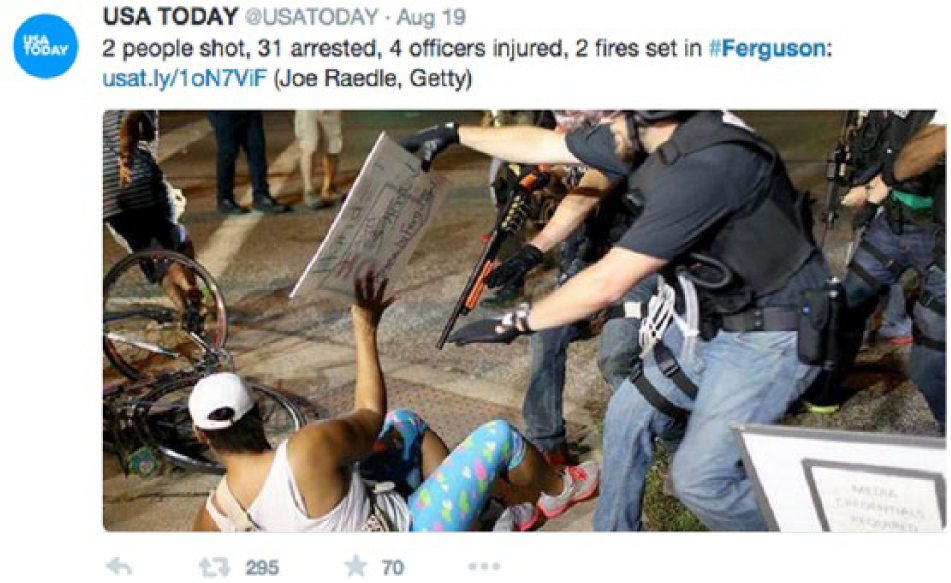
Violence—police or protesters acting against each other; threats of physical confrontation; injuries (e.g., protesters’ eyes being treated for tear gas burns).
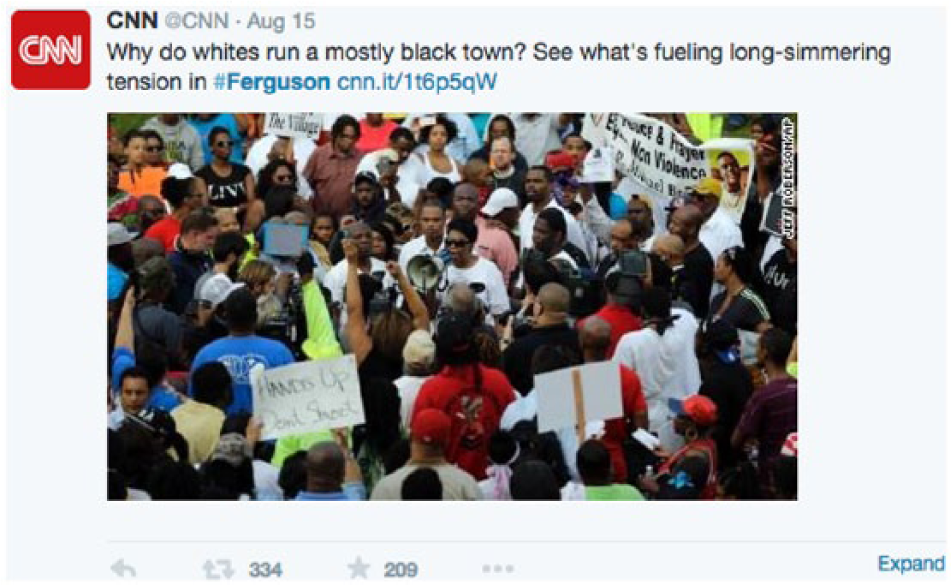
Civil liberties—people involved in an act of protest; violence not the subject of the image.

Talking heads—screenshots of anchors, commentators, politicians, and other well-known individuals speaking; an official making an organized speech.
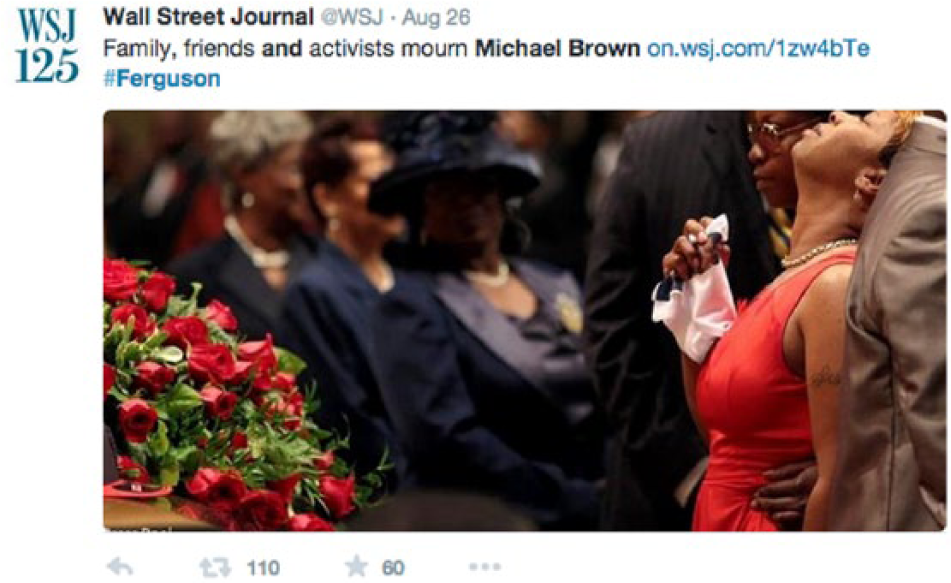
Grieving/coming together—funerals, memorials, or any clear grief conveyed over loss of a person; community rebuilding; people joined together, often in prayer, not a protest.
Agenda Setting
Agenda setting, as articulated by McCombs and Shaw (1972), provides the theoretical justification for this study. Understanding in what way the events in Ferguson are portrayed is useful when considered in the context of the media’s role in defining the importance of an issue. The protests in Ferguson became a large-scale news event with coverage by national and international media. Photographs of protesters and police officers became a typical image associated with stories about Ferguson in foreign media. What many of those stories focused on was an attribute demonstrated in the images: most of the protesters appeared to be Black and most of the police officers appeared to be White (Taylor & Noack, 2014). Following an assertion made on Meet the Press on 17 August, several American news outlets provided data on the percentage of Black residents in the population of Ferguson (67%) and the fact that there were three Black police officers and 50 White police officers working for the city. No shortage of evidence existed to report on race as an issue. The image of those police officers and protesters created a clear message and a narrative in which to think about it. Police are often a symbol of power and authority, while protesters appear angry and oppressed. When agenda-setting theory highlights race as the salient issue, the attributes associated with power for both groups also come into play. These multiple attributes frame the issue.
Research that considers text or image from both a framing and agenda-setting perspective has been described as second-level agenda setting, where tone and emphasis are important in analyzing visual information (Coleman & Banning, 2006). Studies of political campaigns, like war-related stories, rely strongly on images to convey and reinforce ideas. The idea of looking beyond the initial question of what is being pictured to how it is being pictured is useful in political campaign studies in examining attitudes toward images (Kiousis, 2005). Combining the research of visual analysis and agenda setting allows for greater insight by simply identifying not only what is pictured but also how it is portrayed. So if first-level agenda setting can be described as the media influencing what we think about, second-level agenda setting can be described as the media influencing how we think about it (Craft & Wanta, 2004).
Race in Images
Another important point to examine in this study is the specifically potential differences in how race is portrayed by the news media. One now-infamous example of races receiving different phrasing happened during the coverage of post-Katrina New Orleans. The Associated Press sent a photo of a young Black man in chest-deep water carrying a garbage bag of food, with the caption stating that he had been “looting” a local grocery store. On the same day, Getty Images forwarded a photo of a young White couple in chest-deep water, also carrying garbage bags of food, yet the caption stated they “found” food in a local grocery store (Ralli, 2005).
Academic research has examined how different races receive different levels of attention, and types of attention, by the news media, namely, in the form of portrayal in images. Voorhees et al. (2007) found that during the coverage of Hurricane Katrina’s aftermath, most people got their news in the form of images, either photographs or television, and that it enforced negative frameworks about the actions of minorities, mostly by focusing on examples of criminality and reckless behavior rather than examples of communities coming together and helping each other.
Dixon’s prolific work on the representation of African Americans in the news media allows for a strong basis of academic analysis of the power of images, namely, the power of the media to build lasting and negative schema in the differences of racial representation. He has found that based on the population data of California, television news tends to over-represent African Americans as criminals while at the same time over-representing White people as the victims of crimes (Dixon, 2015; Dixon & Linz, 2000). The same results were found when comparing one race versus another, as well as looking specifically at the roles of sources within stories. His work also looked at skin-tone specific to African Americans, finding that people who watched more television news tended to feel discomfort after seeing the image of a darker-skinned perpetrator of a supposed crime versus someone with lighter skin (Dixon & Maddox, 2005). White people are also over-represented as being the victim of a violent crime, while also over-represented as police officers, when compared to the population as a whole (Dixon, Azocar, & Casas, 2003). Based on Dixon’s extensive work, this study progressed with two major understandings. The first is that the media indeed tend to treat different races differently when it comes to visual representation. The second is that said differences indeed have an impact on those who see them.
News on Twitter
Twitter has grown to be a powerful force in social media, both as a business and as a social model for people accessing and interacting with news stories on a common mediated platform. About 23% of all Internet users use Twitter on a regular basis (Duggan et al., 2015). Twitter has rapidly grown as a platform over the last decade, now averaging about 320 million monthly active users (DeSilver, 2016). Its global reach is about four times bigger than its domestic, making Twitter an international trading post for ideas, commentary, and news. The Pew Research Center has also found that of the six quantifiable types of Twitter group structures, one is clearly identified as a “broadcast network,” which operationalizes as key news-maker figures sending messages to active audience members who amplify their messages (Rainie, 2014). The ease by which people can receive and amplify news messages on Twitter has made it a powerful force in news, with 63% saying they get their news from there, up from 52% in 2013. That 63% number can be broken up into a number of important news topics as well, with data showing that those who get their news from Twitter are more likely to see news about national government and politics, international affairs, business, and sports than those who get news on other social media platforms. On top of that, work from researchers like Murthy (2011) points to an increasing use of Twitter as a form of citizen journalism. Twitter allows those from disenfranchised demographics to have a say in what events are seen by a wide audience. Twitter’s power, then, can be to elevate previously unknown stories into the national spotlight. Twitter’s growing population means that there is an ever-increasing audience. That growth includes the audience for news media.
Hypotheses
The hypotheses reflect the idea that Twitter has a strong following and that through second-level agenda setting, the images posted on that medium convey messages to the audience about the events in Ferguson. The first hypothesis says that like the military in Griffin (2004), a battle-ready police force will be available to journalists, and therefore a common image. The racial distinctions between Black and White will speak to more than just the first-level agenda-setting issue of racial division. By portraying Black people as in action, and White people as removed and staid, the second hypothesis will explore the characteristics associated with each image. The fourth and fifth hypotheses address the way in which media presented events. By showing that the use of news reporter, anchor, or commentator and infographics increased as time progressed, the media’s need to repackage news content will be apparent. These hypotheses will likely be most obvious on the cable network news where the demand for content is greater. Based on previous research, the following hypotheses are posited:
H1. Images tweeted by the media about Ferguson will fall under the “law and order” classification more often than any other of the four categories: lawlessness and violence, civil liberties, talking heads, and community grieving.
H2. Images tweeted by the media about Ferguson will be more likely to portray people who appeared to be Black in action or interacting than to portray people who appeared to be White in action or interacting.
H3. The proportion of “talking head” images tweeted by the cable and network news media about Ferguson will increase over the 4-week period.
H4. The proportion of infographics/text-only images tweeted by the traditional newspaper media about Ferguson will increase over the 4-week period.
Method
This study uses a qualitative content analysis to compare images posted on Twitter. This method involved identifying themes using a sample of images, examining images within a certain date range and from specific Twitter accounts, and then providing descriptive statistics related to those themes. Choosing which images to code was a three-step process. First, a list of Twitter accounts was developed for the top three traditional newspaper companies based on circulation, as well as the top three broadcast networks and the top three cable news networks based on ratings. The accounts studied for newspaper were the following: USA Today @usatoday, The Wall Street Journal @wsj, and The New York Times @nytimes. The accounts studied for broadcast and cable news were the following: ABC News @abc, CBS News @cbs, NBC @nbc, Fox News Channel @foxnews, CNN @cnn, and MSNBC @msnbc. Each of these was the primary Twitter account for that news outlet. CNN, for example, has a number of accounts tied to its reporters as well as CNN Breaking News. These additional accounts were not included in the sample.
The second step in defining the list of images was curating a list of hashtags. Hashtags are searchable words or phrases attached to a tweet so that users see related threads and are identifiable by the symbol # at the beginning of the phrase. Using these identifiers was necessary to determine the tweets related to Ferguson among the news organizations’ Twitter posts. The hashtags were chosen after looking at multiple sources of news about Ferguson on Twitter. They were the following: #HandsUpDontShoot, #MichaelBrown, #MikeBrown, #Ferguson, #FergusonShooting, #MikeBrownShooting, #FergusonRiots, #FergusonProtests, and #DarrenWilson. Although hashtags are common for identifying the subject of a tweet, some news organizations, such as The New York Times, were less likely to utilize them. Therefore, to catch tweets that did not use hashtags, the following search terms were included using “AND” to link two words together in Twitter’s advanced search: Ferguson; Mike AND Brown; Michael AND Brown; Darren AND Wilson. All the tweets coded originated with the accounts, hashtags, and search terms listed. They did not include tweets sent to the account or retweets from other accounts.
Finally, the time period for collecting Tweets was set to within 1 month of the shooting of Michael Brown, which occurred on 9 August 2014. Although press coverage continued well beyond this point, the first month captured the media’s initial narrative for the shooting, protests, and aftermath. It also provided 31 days of content in which multiple Ferguson-related events occurred. In addition to the initial shooting of Michael Brown and subsequent protests, there was coverage of a police-enforced citywide curfew. The officer who shot Brown, Darren Wilson, became the focus of a campaign to bring Wilson to justice. As a result, groups formed to support Wilson. There were impact stories about the community of Ferguson that included damage done to local businesses by looters during protests. The period of time for the sample used by this study was designed to include all of these events, but does not include more organized national protest efforts such as “Ferguson October,” the aftermath of the grand jury’s decision not to indict Darren Wilson, or the significant growth of the Black Lives Matter movement, all of which happened after 9 September 2014.
Using the advanced search option on Twitter, https://twitter.com/search-advanced, the hashtags, search terms, account, and date range were entered. By default, Twitter displays the “Top” results, but provides the option for “All.” The coders selected “All.” Only tweets with images were coded for this study. Each image was coded for content and specific attributes (see Figures 1 to 5). No tweet was coded in multiple categories. The categories were mutually exclusive.
The primary message/shot-type category addressed H1: images tweeted by the media about Ferguson will fall under the “law and order” classification more often than any other of the four categories: lawlessness and violence, civil liberties, talking heads, and community grieving. There were also questions on the coding sheet relating to the depiction of the law and appearance of military equipment in the scene. This information provided further context for the idea that police militarization would be a primary theme in the coverage of Ferguson. Measure reliability was addressed using three previously developed image categories. The “law and order,” “violence,” and “civil liberties” categories were adapted from analysis of media coverage of G20 summit protests (Douai, 2014). The two remaining content categories were developed before coding began based on themes discovered in Twitter media coverage of Ferguson (Glaser & Strauss, 2009).
Multiple coding questions addressed H2: images tweeted by the media about Ferguson will be more likely to portray people who appeared to be Black in action or interacting than to portray people who appeared to be White in action or interacting. First, the coder identified the predominant race pictured. This was based on appearance. In order to code a picture as predominately one race or the other, the coder had to be able to clearly see that more than 75% of the people pictured had a similar skin color. Coding only included two races because those were the focus of the study. Although physical appearance does not clearly indicate race, this study focuses on what the viewer sees. As a result, the perception of race was important. Second, the coder determined the degree to which people appeared to be physically moving in the photo. Third, the level of interaction was identified based on how closely people were pictured in relation to one another. In determining majorities for both race and people in action, coders were not required to count and record the total number of people in each group in each image. Coders were instructed to estimate the three-quarters majority needed. In some cases, that did involve counting to compare, but in others, large or indistinct groups were pictured, which would have made precise counting difficult. Intercoder reliability was key in determining the internal validity of these measures.
Intercoder reliability was performed using two independent coders. A total of 65 units were coded. Those 65 units were selected at random using a random number generator. The 65 units represent about 10% of the overall sample. All variables were tested. All variables were within the acceptable range to continue for all available statistics. The lowest percent agreement was 82% and the lowest Krippendorff’s alpha was .765 for the variable that examined action within the image. The action variable represented one with inherent difficulties in coding, but with numbers still in the acceptable range it was clear the coding instructions worked. The majority of the other variables were upper 90% in percent agreement and upper .80 for Krippendorff’s alpha.
Coding the content type for each image addressed H3 and H4 regarding the proportion of news reporter, anchor, or commentator and infographics/text-only images. The category news reporter, anchor, or commentator was described in coding instructions as one or more people pictured speaking inside a studio or clearly speaking to a camera outside of a studio based on items such as captions, logos, and a reporter facing the camera. The infographics/text-only images category was used for graphs, charts, stats, and other non-photographic images. The category did not include text within a photo, such as a protester with a sign. Like television broadcasts and screenshots, news organizations with a print product sometimes use an image of their newspaper in their Twitter feed. Coders were asked to evaluate these based on level of text. If more than three-fourths of the newspaper page presented was one picture, it was considered a picture of the product and was not coded infographics/text-only. Otherwise, the predominance of headlines, story text, cutlines, and teasers was considered enough to convey that the focus was not on the photo or photos, and it was coded infographics/text-only.
Results
This study looked at images tweeted about the events following the shooting of Michael Brown in Ferguson, Missouri, from nine major news media outlets. From those accounts, 665 tweets were posted with identifying hashtags or search terms during the 1-month period. MSNBC tweeted the most images with 223. The Wall Street Journal and NBC News both had more than 100. USA Today, The New York Times, ABC News, and Fox News had more than 50. This meant that CNN and CBS News were clearly underrepresented with fewer than 50 tweets with images each. However, the sample was fairly balanced between newspaper, broadcast, and cable TV companies. This research did not seek to draw a comparison between these companies, but aimed to use them as representative of mainstream media on Twitter.
The results uncovered an interesting trend that was not hypothesized. This trend was the separation of police and protesters in images. The images were of only police 21% of the time and of only protesters 19.9% of the time. Therefore, roughly 40% of all images were just police or just protesters. Despite the fact that police and protesters were pictured in close physical proximity, only 7.7% of the images included both police and protesters.
The “other” category, meant to classify infographics, objects, and unclassifiable images, accounted for 39.5% of the images. This was likely due to the variety of images and difficultly of definitively identifying people as protesters as opposed to mourners or people just standing around. Coders were instructed to consider what was happening in the image when selecting categories. A person was defined as a protester if they held a sign or if the people pictured appeared to have a common goal that could be interpreted as protesting. Indicators for making that interpretation included groups of people facing the same direction, groups of people appearing to move together, and people confronting law enforcement. Although “law and order” was among the most often chosen with 13.2%, “violence” accounted for 15.2% of the images.
Violence was classified as police and protesters acting against each other. Coders were instructed to classify any image where smoke or gas was visible or protesters had clearly come in contact with it to be coded as violence. Images where police were clearly aiming their weapons were also coded as violence. These two types of threats, rather than physical interaction, accounted for the majority of violent images. For example, a line of officers in riot gear could portray “law and order,” but the same officers aiming paintball guns, or pictured with the presence of tear gas canisters, indicated the police were acting defensively; therefore, the image is one of violence.
The portrayal of law enforcement was coded as a separate category from subject with three options. About half the images did not include police. Two others, riot gear and military uniform, were coded separately, but combined because of the similarities of military and riot gear helmets, especially when viewed at night. The riot gear/military group represented 19% of the images. The remaining option, police uniform only, accounted for 13% of the images. The picture of law enforcement most often included shields, helmets, batons, arm and shin guards, as well as rifles containing pellets. A third military-related item was the inclusion of police or military equipment. Police equipment was most often a police car, but also included vans and visible handguns. Only 32 of the 665 images included this type of equipment. However, 92 images included military or riot equipment. Visible gas was the most common military or riot equipment. Armored vehicles were also common.
Subject Type.

Table 2 shows a difference in identifiable physical contact based on race in the images. Race indicates that more than three-fourths of the people in the image appeared to be of one race. Images of people who primarily appeared to be Black were 39% more likely to show physical interaction than images of people who primarily appeared to be White. The results based on action were not as large a difference, but a difference was observed between photos primarily featuring people of a single race. Approximately 55 of the 203 primarily Black photos featured people in action. Of the 138 primarily White photos, 30 clearly showed subjects in action.
Interaction Based on Race of People Presented in Physical Contact.

The number of primarily Black versus White photos alone may be some indication of how events in Ferguson were framed. The clearest example of division by race involved the subjects of images. In images where people appeared primarily to be White, the subject of the photo was most likely to be police. While 55 of the primarily White images were of police, two of the primarily Black images were identified with police as the main subject. The subject breakdown by race can been seen in Table 3.
Image Subject Compared by Race.
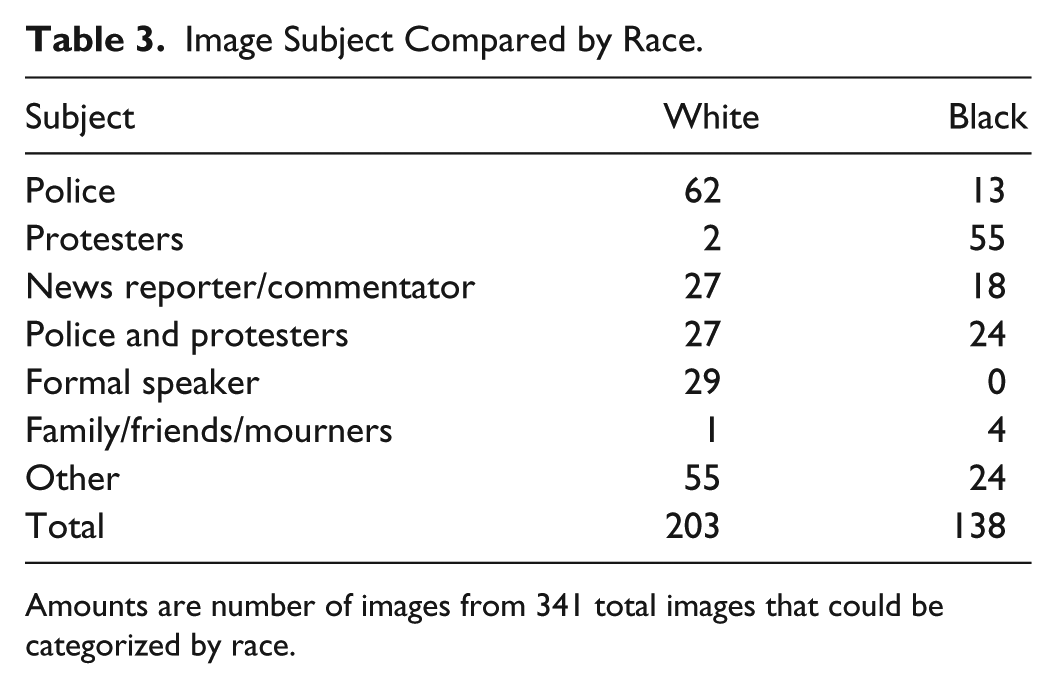
Amounts are number of images from 341 total images that could be categorized by race.
The “news reporter, anchor, or commentator” subject category showed an increase over time. However, the number of these images increases in proportion with the daily number of images only until 26 August, roughly the middle of the observed month. On that day, one-third of the images were “news reporter, anchor, or commentator.” The percentage then drops down to zero for most of September. So, while the number increases over time according to percentage, it does not continue to increase into the fourth week. The “news reporter, anchor, or commentator” was not one of the largest categories overall. The greatest number of instances of “news reporter, anchor, or commentator” images occurred on 19 August when 12 of the 75 tweets with images fit into that category.
There was not a clear time period increase or decrease in use of infographics/text-only images. However, the use of infographics reached its highest point on 19 August when eight infographics/text-only images appeared. This number can be primarily attributed to the release of Michael Brown’s autopsy report on 18 August. The report included a diagram showing where the body was shot. The diagram was the most-repeated infographics/text-only image in the data.
Discussion
The purpose of this study was to examine the visual narrative created by tweets posted by mainstream media about the events in Ferguson, Missouri, following the shooting of Michael Brown. The findings suggest that the images of Ferguson were of divided forces working against each other. On one side stood White police. On the other, Black protesters were in motion. The two sides rarely existed in the same image. This visual separation reflects a real racial and social divide. The exclusion of protesters in images of the police, and vice versa, could be the result of how events played out.
The visual separation of police and protesters may be one of the reasons that the first hypothesis was not supported. H1 stated that images tweeted by the media about Ferguson will fall under the “law and order” classification more often than any other of the four categories: lawlessness and violence, civil liberties, talking heads, and community grieving This hypothesis was not supported because “law and order” was utilized fewer times than “lawlessness and violence.”
The second hypothesis was one way of examining visual portrayals of race. It was supported and reflected a general trend of racial division in the images tweeted. H2 stated that images tweeted by the media about Ferguson will be more likely to portray people who appeared to be Black in action or interacting than to portray people who appeared to be White in action or interacting.
The third hypothesis was supported by the data. H3 stated that the proportion of “news reporter, anchor, or commentator” images tweeted by the cable and network news media about Ferguson will increase over the 4-week period. The other hypothesis that addressed changes of time was not supported. H4 stated that the proportion of infographics/text-only images tweeted by the traditional newspaper media about Ferguson will increase over the 4-week period.
A major limitation of this study was the time period used. The events in Ferguson continued to develop as this study was written. A longer time period could encompass protests that continued through the announcement that Darren Wilson would not be indicted. There are also a number of related cases that received media attention since the shooting of Michael Brown. It would be interesting to see whether the visual coverage on Twitter uses similar frames.
While coding the images, there were some practical limitations. Often protests occurred at night and the apparent race of subjects was not discernible. The quality of photography and size of images used on Twitter was also an issue. Fox News and The New York Times often chose a format where images appear as 1 inch by 1 inch thumbnails, many of which would be difficult for someone scrolling through Twitter to discern.
A major limitation was scope. The Twitter news media accounts that were the focus of this study represented popular traditional media. Limiting the scope of news media covered meant ignoring the significant role of communication outside of the mainstream. Black Twitter, which is not an official entity, but a reality in a racially divided country, played a major role in disseminating information and organizing individuals in the wake of Michael Brown’s death.
Conclusion
The visual portrayal of the events in Ferguson created a narrative that is reinforced through the agenda-setting function of the media. The fact that police were as likely to be featured as protesters conveys the focus of the story. This supports the prominence of the “law and order” theme. These two findings taken in combination demonstrate a narrative to the audience: police are present to uphold the law and maintain order.
The implications of the findings related to race and appearing to be in action are less clear. A viewer could interpret this as a greater amount of control among people who were not moving. Action often occurred in connection with expressions of emotions. Even without a clear understanding of what action implies to the viewer, it is a characteristic reinforced through repetition. This is particularly true within the context of Twitter. Repetition is one of the only ways an issue’s importance is conveyed on the social media.
The influence of Twitter on the national conversation surrounding the events in Ferguson is undeniable (Fung, 2014). This study provides insight into the method by which a news story is conveyed on social media. The agenda-setting function of the media is heightened by the reach of social media. Almost two-thirds of American adults use social media (Perrin, 2015). However, story prominence plays less of a role in setting the public agenda on social media, which presents content uniformly. This study also has implications for second-level agenda setting. Visual separation between police and protesters and the staid portrayal of police officers demonstrate a consistent narrative. Identifying the salient characteristics of protests in Ferguson could help to illustrate similar patterns in media coverage of subsequent protests.
Future research could look at how the visual narrative compares to the textual narrative in tweets. Based on the findings of this study, the complex issues between law enforcement and the Black community may have been visually apparent. This study does not approach the question of whether or not the text of the tweets, or the hyperlinked stories, reflected the visual narrative. There is also potential for specifically examining the social movements that grew out of these events in the context of media coverage.
Footnotes
Declaration of Conflicting Interests
The author(s) declared no potential conflicts of interest with respect to the research, authorship, and/or publication of this article.
Funding
The author(s) received no financial support for the research, authorship, and/or publication of this article.