




Abstract
This article is concerned with how the gendered, raced, and classed practices of readership of a humorous meme on Tumblr organize forms of sociality and belonging along these lines. Based on the anonymous Tumblr blog, WhatShouldWeCallMe, the meme narrates feelings and reactions related to youthful, feminine, Western “everyday” experience through the use of captions and Graphics Interchange Format (GIF) images. Drawing on the feminist Cultural Studies tradition of text-reader analysis as well as New Literacy Studies approaches to literacy, I suggest the practices of readerly participation in the meme require a social rather than individual set of competencies and knowledges. I propose “spectatorial girlfriendship” as a term encompassing how the texts of the meme require the reader to operationalize gendered, classed, and raced classificatory knowledges and construct social forms of commonality on this basis. In the meme, the reader “gets” the joke by aligning an ostensibly incongruous GIF and caption, remixing and matching existing classifications of people, bodies, and objects. I demonstrate how spectatorial girlfriendship as a readerly lens arranges, transacts, and interacts gender, class, and race in multiple ways, indexing social inequalities without recognizing them as such. Bodies in the GIFs become “stock” images, used for selective resignification. Consequently, while offering pleasures of an understood readerly feminine commonality, participation in the meme is structured unequally, going beyond the reader’s ability to decipher the GIF and caption in the posts. The meme privileges an ideal reader constructed through postrace, postfeminist “theories” of the useability of gender, race, and class.
Introduction
In this article, I consider how the gendered, raced, and classed practices of readership of a humorous meme on microblogging platform Tumblr construct forms of belonging and exclusion along these lines. Drawing on the tradition of feminist Cultural Studies post-race’ scholarship attentive to the reception of media texts together with socio-cultural approaches to literacy (Lankshear & Knobel, 2006, 2008), I theorize the ideal reader and the practices of reading constructed by these texts, identifying the social assumptions required for “getting” the joke. Viewed as a social system (Burgess & Green, 2009), literacy constructs forms of knowledge as canonic as well as certain literate subjects who are better able to navigate and “get” the texts which circulate in digital cultures. Here, I suggest that the texts which are constitutive of the meme require a literacy that I term spectatorial girlfriendship, which privileges a reader who can mobilize neoliberal, postfeminist (Gill, 2007), post-race (Eng, 2010) assumptions about how gender, race, and class operate, in the very practice of decoding meaning.
The meme I consider is based on the popular Tumblr blog WhatShouldWeCallMe (“WSWCM”). Initially, a set of “inside jokes” between two long distance best friends located on east and west coasts of the United States, the founder blog became well known in early 2012 for its “reaction-GIF” form of narration. Attracting coverage in news sites like Forbes and garnering up to 1 million views per day in the early days of the blog (Casserly, 2012), the blog also inspired a number of spinoff blogs on Tumblr imitating this mode of narration of feminine experience. In the blog, Graphics Interchange Format (GIF) images combined with situational captions are used to articulate feelings related to everyday moments associated with youthful femininity, such as “when someone tells me my ex still talks about me” or “when I’m the only single one out of my friends at a wedding” (Figure 1).
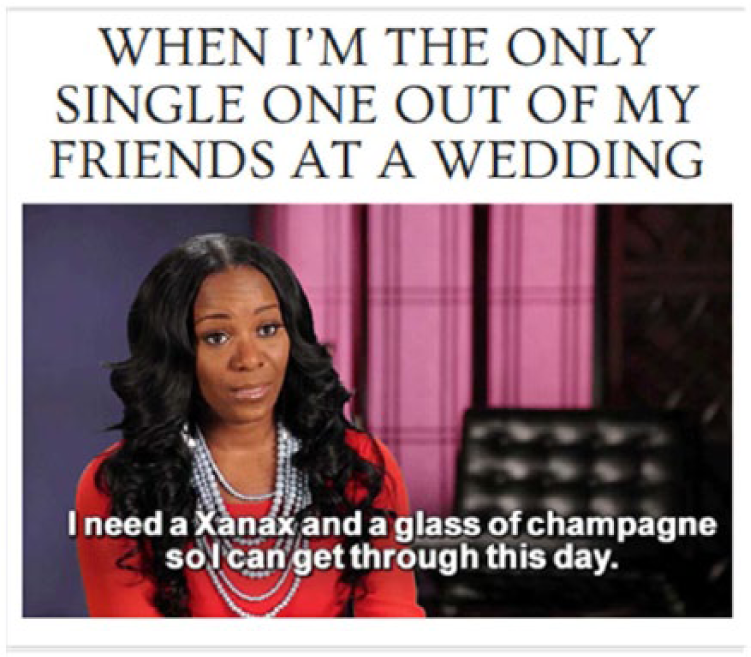
“Only single person.” WSWCM.
In the highly visual form of narration of the meme, I explore how the literacy required mobilizes fundamental aspects of identity such as gender, race, and class as discrete elements that may be seen or unseen, in order for the humorous punchline to be transacted.
Following Shifman (2014), the original WSWCM blog or “founder” and spinoff, or “follower” artifacts are constitutive of a meme: a set of digital items sharing common characteristics, created with awareness of each other, which are circulated, imitated, and adapted by many users online. Analyzing five of the follower blogs together with the founder blog, whose creators agreed to participate in ongoing research, I position the follower blogs as a means of exploring the common literacy required for participation in the meme. This article emerges from my research into digital negotiations of postfeminist (Gill, 2007) discourses of feminine individuality, and as such, the follower blogs were chosen as part of my sample given they were representative of the dozens of follower blogs which consistently engaged with the themes relating to youthful Western femininity expressed in the founder blog. As such, these blogs do not necessarily reflect the diversity of the ways Tumblr users have “read” the original blog. Rather than foregrounding the follower blogs’ adaptation strategies similar to research conducted by scholars such as Shifman (2014) and Milner (2012), this article’s exploration of the founder and follower blogs provides a means of exploring the gendered, raced, and classed literacy of spectatorial girlfriendship that they all mobilize. This speculative theorization of the social nature of literacy, I hope, may be extended in future research on memes focusing in a more comprehensive fashion on how literacy is demonstrated by followers through their individuated adaptations.
This article considers what the literacy required for meme participation can tell us about the gendered, raced, and classed ways in which everyday digital sociality is enacted. In the first part of this article, I locate my approach in relation to Cultural Studies text-reader analyses of media and the New Literacy Studies movement, highlighting the insights of emerging work on memes that show ways in which texts construct insiders and outsiders. I then propose “spectatorial girlfriendship” as a way of conceptualizing the nature of the literacy practices relating to the WSWCM meme and the sociality constructed by these practices. Spectatorial girlfriendship requires an ideal reader who is able to instantaneously mobilize and imagine the world in terms of the social classifications of youthful, Western, middle-class feminine culture. Finally, drawing on the work of Nakamura (2008, 2014), I show how spectatorial girlfriendship as a readerly lens arranges, transacts, and interacts gender, race, and class in multiple ways, indexing social inequalities without recognizing them as such.
The Social Nature of Texts, Reading, and Literacy
Cultural Studies has long foregrounded the importance of texts as means of understanding media cultures, their significance, and their connections with power (Couldry, 2000). In examining the context of production, distribution, and consumption of texts, Cultural Studies scholars have sought to identify how meanings attached to identity are made and normalized. Feminist scholars in this discipline have particularly sought to understand how female audiences have read or interpreted media texts, identifying their pleasures, resistances, and uses, rather than attributing an ahistorical or apolitical discrete meaning to texts (Ang, 1997; Hermes, 1995; Radway, 1984; Stacey, 1994). Going beyond deconstructions of representations in texts, scholars have used this text-reader model to identify “circuits” of meaning (Hall, 1980, 1996) which enact understandings of identity.
Understanding reading as a form of meaning making which both draws on and remakes social norms can highlight the way vectors of identity such as gender, race, and class may be organized through texts. This Cultural Studies–inflected view of reading and meaning making intersects with New Literacy Studies’ understanding of literacy as embedded in ideological, social, and cultural contexts where power and authority regulate meaning (Street, 1984, 1995). As Collins and Blot (2003) point out, literacies across diverse historical and cultural contexts have worked as forms of micro-power, enabling certain forms of collective identity practice while disabling and regulating others. Literacies are constructed through discourses which operate on taken-for-granted “theories” of legitimate and correct ways to think and feel, constructing ideal and “normal” subjects (Gee, 1996).
While the idea of reading has been central to studies of literacy, contemporary studies of digital literacy tend to cast literacy as an individual competency in terms of information and communication technology (ICT) skills or knowledge (Lankshear & Knobel, 2008) rather than rooted in interpretation as a socially informed practice. An emphasis on technical skills, proficiency, and knowledge is reflected in much scholarly literature on media literacy in general (Koltay, 2011; Potter, 2010; Warnick, 2012). Literacy has often been associated with the textual rather than the audiovisual, and as such, media scholarship has often focused on “reception” in relation to visual broadcast media such as television (Livingstone, 2004). Now, in relation to digital media scholarship, Livingstone (2008) notes that the reversion to an interest in literacy has sidelined Cultural Studies notions of the text and reader and associated circuits of meaning.
I suggest, however, that these differing approaches may both be productively operationalized. There is value in understanding certain forms of digital participatory culture through an intersecting understanding of Cultural Studies text-reader models and literacy as a socially shaped competency. Indeed, Livingstone (2008) suggests that there are useful analytic parallels to be drawn between media literacies and media audiences. An argument for a hermeneutic approach to digital media is also made by Das and Pavlíčková (2014), who show how youthful users’ constructions of imagined authors online determine the meanings ascribed to their readings of online texts. Burgess and Green (2009) draw on Street’s (1984) work within the New Literacy Studies model in their work on YouTube, suggesting that literacy must be viewed as a historical, political “system that both enables and shapes participation” (p. 72). Thus, while it is still necessary to consider individual competencies in discussing digital cultural participation (Burgess & Green, 2009), these competencies ought to be situated as social practices, rather than autonomous individually based skills (Street, 1984, 1995).
I draw on these socio-cultural approaches in situating the readership practices of the WSWCM meme as both social practices and competencies which construct differentiated forms of belonging. After obtaining consent to analyze the founder and five follower blogs in the meme, I conducted a close discursive and affective (Wetherell, 2012) analysis of approximately 800 blog posts dating from early posts in March 2012 to June 2014. My aim in adopting this textual approach is to foreground the ways identity striates the way in which popular cultural artifacts may be interpreted and circulated online, as well as situate digital literacy as a socially shaped rather than individually determined competency. These readership practices relate at one level to the reader’s ability to align an incongruous image with a caption to make meaning, but like other digital vernaculars, relates more broadly to how social belonging and value is imagined and made.
Belonging Through Social, Digital Vernaculars
The WSWCM meme is a “reaction GIF” meme, communicating feelings and reactions to everyday situations through incongruous GIF images and captions. GIFs excerpt about three or so seconds of movement from film, television, and other video footage which are then constantly looped in the image. GIFs can thus be described as capturing “moments” quite literally (see also Grindstaff & Murray, 2015). The posts produce meaning by matching a caption describing an everyday circumstance with an ostensibly unrelated GIF image as the punchline, a format which has been taken up by the follower blogs in the meme.
The meme’s style of narration can be seen as representative of the turn to the visual more broadly in social media (see, for example, Lim, 2015). Eppink (2014) argues that Tumblr as a platform is responsible for awakening mainstream interest in GIFs as an aesthetic form of communication in social media news sites and more broadly, digital forms of narration. Unlike stock images which are taken to straightforwardly represent the content of a post or story, GIFs are often used deliberately as incongruous images, requiring the reader to understand the relevant element to pick out of an otherwise ill-fitting image. In early 2012, the WSWCM founder bloggers were interviewed by Forbes magazine as the popularity of their blog was taking off. When asked, “why are GIFs funny” by their interviewer, one of the bloggers explains by reference to one of their favorite GIFs, featuring a herd of sheep rapidly circling a slowly moving car:
I think part of it is that you’re taking a picture of something that totally doesn’t apply to what you’re talking about in the broader sense, but once you put a caption on it, a light bulb just goes off and it makes sense. . . . I mean, that picture is funny by itself, but then you add the caption “How you feel when you’re the only sober person in a bar,” and it somehow just makes sense. Because everything around you is just too much, and you’re moving slowly through the crowd and nobody cares about you because they’re all just drunk and having a good time. You’re the car . . . once you put that caption on it and it’s just like, Bingo. (Casserly, 2012)
I extract the post featuring the GIF below (Figure 2), but it is more understandable when viewed as a moving image online on the blog.

“Only Sober Person.” WSWCM.
The point that I wish to make here is that the meaning of the post is not simply “there,” waiting to be uncovered. The “light bulb” moment requires the conceptual alignment of the GIF with the caption. Even if one can read the caption, the post as a whole might not make sense. The circulating sheep and the car might retain an undissolvable autonomy from the caption; the reader might not be able to make the leap to understanding that the collation of image and text together seeks to articulate the metaphorical feeling associated with the situation.
This article focuses on how reaction-GIF posts may be read in order to be in on the joke. It is thus important to note the way in which the GIF generates and amplifies affect through the particularities of its technical structures through movement, color, and repetition (Ash, 2015). In the context of Tumblr, Cho’s (2015) work positions the GIF’s looping movement as a powerful component of Tumblr’s queer “reverb,” the repetitive, intensifying circulations of affect that catalyze shared queer affinities. Given my focus on a set of humorous blogs in which feelings are described and enacted through GIFs, my use of the term “affective” draws attention to its emotional elements (Wetherell, 2012) more so than the Deleuzian frameworks within which Ash and Cho operate. However, it is useful to note how GIFs in different digital contexts have been interpreted as producing a sensory affective intensity, ranging from revulsion to amusement (Ash, 2015) to the erotic (Cho, 2015).
In this context, the reaction-GIF blog posts both code and articulate feelings associated with particular situations. The meme, then, circulates a humor seen elsewhere on the web, in the context of remix image sites and platforms like Reddit or Imgur (Meese, 2014) or in memes in general which spread across digital spaces (Milner, 2012; Miltner, 2014; Nakamura, 2014; Shifman, 2014). Whether or not they use GIFs or other types of images, memes have been noted to show digital participants’ discerning use of intertextual media, mixing and matching popular culture references to demonstrate affective affinities with others (Knobel & Lankshear, 2007; Milner, 2012). However, memes are not simply of interest as new formations of sociality, but also as mechanisms through which hierarchies of knowledge and belonging are organized (Shifman, 2014; see also Burgess, 2007). In a meme, what is required is the sophisticated social ability to “key” one’s production in the right tone or style rather than producing something unique or highly differentiated (Miltner, 2014; Shifman, 2014). As Burgess (2011) argues, it is important to understand user-created content as a form of cultural practice which has more to do with citizenship and belonging, than “spectacular creativity” (p. 323). In discussing how a meme can encapsulate social practices of belonging and identification, I suggest that participation in the WSWCM meme, whether reading or authoring posts, relies on common sets of social knowledges. Beyond some technical requirements related to finding GIFs and uploading them, I suggest that the literacy required in authoring posts is very proximate to the act of discerning reading.
A clue to the fundamentally readerly aspect of the authoring process is provided in an interview I conducted with one of the follower bloggers. She begins with a stock of interesting GIF images which she has found on Tumblr, then “reads” them and generates meaning from them:
more often or not, I scroll through the GIFs and I think, what could I use this for, what could I apply this to, and if I don’t come up with something, I move on until I get a couple of posts put together just from looking at the images so . . . I would say probably 85% of the time that’s the way I do it, I just go through the images thinking, how can I use it, what context can I put it in, that will be relatable to people, and then only 25% of the time I’ll think, this is an incident [which has happened to me] which somehow needs to be a post.
As such, this process of creation requires the re-reading of the GIF to convert it into something that is new and socially applicable for an unknown audience. I elaborate next how this ability to read requires the mobilization of a gendered, classed, and raced set of affective, classificatory knowledges.
Introducing WSWCM Literacy: The Social Classifications of Spectatorial Girlfriendship
I now move to the more specific question of what conceptual and socially predicated readerly knowledges enable the literacy required for participation in the WSWCM meme. The WSWCM meme can be understood as the imagined product of an active, social form of readership underpinned by immersion in contemporary feminine practices and digital cultures. I term this readership “spectatorial girlfriendship” to highlight the normative reader who can “get” the texts. Spectatorial girlfriendship reflects a social positioning required to recognize the narratives parceled in the texts, combined with a classificatory proficiency with which to read the mode of this narration. To explain this, I will initially break down these elements separately though they are very much entangled in practice.
Drawing on the work of Dobson (2011) and Winch (2013), spectatorial girlfriendship is a portmanteau term I use to capture the premise of shared feminine knowledges and experiences in WSWCM reading practices. Spectatorial premise, similar to the idea of convention or “genre” (Thumim, 2012), refers to the set of assumptions underlying practices of looking and interpretation within a particular medium (Dobson, 2011); girlfriendship is an affective social relation which is saturated within larger postfeminist cultural narratives about feminine commonality and neoliberal normativity (Winch, 2013). By postfeminist Winch signifies a media sensibility (Gill, 2007) which selectively incorporates feminism as common sense in order to dismiss its continued relevance as a social movement, privileging individual resilient women over collective feminist struggle (McRobbie, 2009). I wish to foreground the way in which girlfriendship operates here to invite others to see based on a feminine commonality and a sophisticated affective and cultural literacy which relies on classed and raced postfeminist presumptions. Postfeminism also coincides with a simultaneous post-racial sensibility (Banet-Weiser, 2007; Nakamura, 2008) where race becomes an individualized accessory rather than a power-striated system of social and cultural relations.
This girlfriendship literacy is enacted through a mechanism of classification, whereby the reader must be able to understand people, objects, and life moments in heuristic categories. Drawing on Foucauldian concepts of the archive, Beer (2014) suggests that classificatory competency is central to contemporary infrastructures of social participation. This “classificatory imagination” (Beer, 2014) can be seen in the way that individuals now take on the work of documenting and monitoring in ways which produce certain subjectivities and ways of belonging. I point, for example, to the classifications of the post “when I see a girl wearing a velour tracksuit out in public,” posted by follower blog 2ndhandembarrassment (Figure 3). One must be able to recognize the velour tracksuit as an instant signifier of classed and gendered disapproval. The punchline in the GIF articulates a knowingly excessive disapproval of this fashion faux pas. This feeling, “You’re tacky and I hate you,” is articulated by Billy, a young boy who designs and makes the costumes for his fellow students’ rock band in the film School of Rock (White & Linklater, 2003). In the movie, Billy’s campness is amped up as he takes on the persona of a precocious fashion designer. Thus, the articulated disapproval can be read as a campy but ultimately disciplinary projection enacted on the unknown girl for her lack of taste.
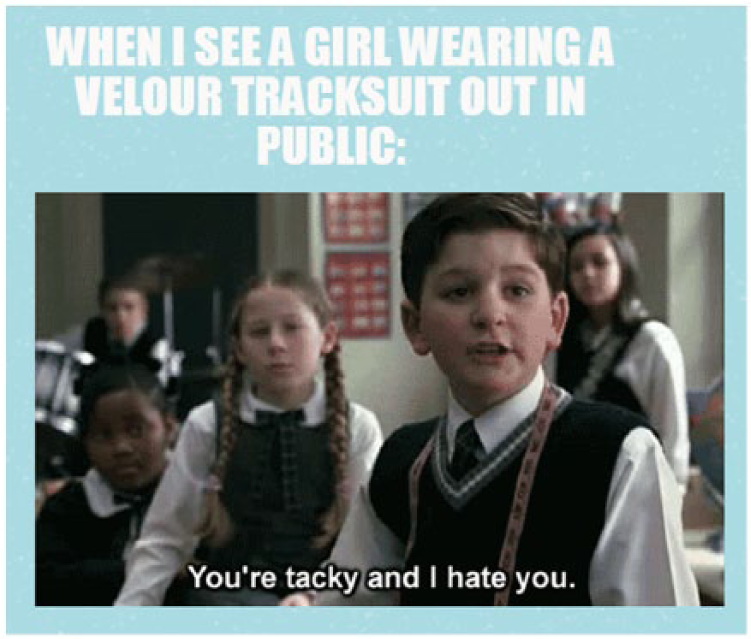
“Velour Tracksuit.” 2ndhandembarrassment.
I suggest that the reader need not necessarily be familiar with the exact pop culture context from which the GIF is derived. Although the process of deciphering the meaning of the GIF may be more instantaneous through having watched School of Rock, readership may still take place without the exact pop culture referent. The literacy relates more to familiarity with a Mean Girls–style joke which exaggerates a classed feminine distaste for other women’s or indeed, other girls’ unbecoming or “tacky” clothes. The spectatorial girlfriend is expected to classify the significance and signification of bodies, facial movements, expressions, and speech in line with postfeminist presumptions of the caption, as there are few other cues with which to read the GIF. Indeed, the very context of “digital context collapse” (boyd, 2011; Marwick & boyd, 2011) suggests that spectatorial girlfriendship becomes more vital in constructing meaning.
The way in which individuals are increasingly classified online through categories and mechanisms not necessarily of their own making has been articulated as a central problem of digital life by scholars who interrogate commercial practices organizing users into data nodes (Andrejevic, 2011; Fuchs, 2015; Shepherd, 2015; van Dijck, 2013). My focus here, however, is of how classification also produces certain knowledge-based forms of sociality. What I wish to highlight is not simply that classification is being done, but that it becomes part of a girlfriendship lens with which to view and produce activity for participants in digital publics. The classificatory moments in the WSWCM texts are organized through the productive activity of documenting, recording, and distinguishing. Rather than narrating an episode of time in one’s life, the “when” which usually prefaces the situational caption of the post indicates the generalizing work of classification: “when my boyfriend forgets to DVR the Voice”; “when I see some chick getting all flirty with my crush”; “when someone gives unsolicited comments on my love life.” The moment is not simply one that may or may not have happened, but one is that is meant to indicate a form of typology.
Together with the way in which the people mentioned in the posts are all types, boyfriends, “some chick,” and so on, the literacy required for the WSWCM classificatory texts produces an ideal reader. The reader must bring knowledge from their location as spectatorial girlfriend into the classificatory moment offered by the WSWCM meme in its digital, distributable text (see also Kanai, 2015). The momentary temporality of the blog post requires the deciphering work to be done immediately, connecting or disconnecting categories of meaning. The WSWCM texts organize the self according to recognizable categories of shareable feminine moments. Such texts, which are distributed, or liked as “relatable” moments work to classify both the author and reader; the relatable structure of the meme asks the reader how they might fit in its collection. The texts invite the reader to construct the self and the world in similar categories: “when my friends see how much weight I’ve gained this winter”; “when I hear my frenemy got dumped by her boyfriend”; “when I try to talk to someone attractive.” The ability to divide one’s lived experience into these specific categories is a form of textual, but social production which connects readers and authors in the WSWCM meme. In this way we see how classificatory processes are a productive form of identity work and connection.
Overall, then, spectatorial girlfriendship requires a digital, classificatory literacy to provide a form of organizational, constructive reading. In the GIF and caption format, WSWCM texts play with the juxtaposition of images and text, to produce an unexpected connection and reappropriation of existing categories of meaning. This literacy enables the reader to “get” the rules of engagement of the WSWCM meme, where the acts of readership and authorship are predicated on playing with the (in)congruity of bodies and text, and so where meaning is not necessarily transparent. I now turn to how spectatorial girlfriendship operates in relation to the meme texts, and how its exercise may show unequal forms of belonging that a reader may experience, at the same time as being able to access the forms of meaning in this meme.
Applying Spectatorial Girlfriendship in Order to “Get” the Joke
This lens of spectatorial girlfriendship is vital for entering into and participating in the feminine social imaginary of the WSWCM meme. Readers are required to actively draw on existing classifications derived from the feminine knowledge which constitutes spectatorial girlfriendship, to bring a text to life and to project themselves in it. However, in projecting the self in the text, this does not signify that the reader must necessarily feel the same as the “I,” the subject projected by the authorial voice. Rather, the literacy derived through pre-existing social affective–discursive experience and knowledge is the starting point for entry.
Reading can only be “transacted” (Rosenblatt, 1978) through the classificatory knowledges that one brings to the text, providing a lexicon of concepts that one must apply in order to get the joke when bodies are reclassified in incongruous ways. In the joke underlying WSWCM texts, there is always the sense that its associated readership practices require playing with existing classifications of signification and significance, facilitating new associations between things which might have not seemed to be congruous. Since the affective and discursive meaning of the GIF is not necessarily self-evident or inherent, it requires the mobilization of a clear understanding of the useability of bodies, on the part of the author and reader. Put another way, the criterion of useability asks how bodies in the GIFs which are already classified through gendered, raced, and classed affects and discourses may be instrumentalized to make new meanings or reproduce them.
These new associations may be viewed as more or less workable by different readers depending on their social and political location and on how entrenched the meanings to the bodies and objects in the GIF are in broader social matrices. The feminine body, for example, has a history of meanings attributed to its circulation in patriarchal visual culture which are difficult to dislodge; this stickiness of the classificatory meanings attached to the feminine body becomes evident in the WSWCM texts as I demonstrate in this section. My contention is that the ability to see and invent new associations between things in this meme is most successfully effected through an ideal reader who is able to view historical meanings of bodies as a resource rather than as structures of containment, in line with postfeminist and postrace understandings of identity.
In many instances, a scenario may be imaginatively produced from a GIF capturing something which has very little to do with the narrative fragment communicated in the situational caption. One such example can be found in the post “every time I start to catch up on my reading” (Figure 4).

“Catching up on my reading.” WSWCM.
The GIF features a car, stuck in traffic on a highway, which manages to speed up, then crashes into a barrier. The car is the vehicle through which the blogger articulates this failure to properly capitalize on her progress. The car’s movement is used to convey both the momentum, the speeding up of her reading, while the car’s abrupt crash becomes the blogger’s crash—the inability to pull through. On the face of it, this is quite a creative and singular reconstruction of what the car crash means: in Internet speak, the “fail.” By plugging in this moving image of the car into the caption “every time I start to catch up on my reading,” a new association and thus meaning is created, written into the movement of the car. The humor lies in being able to connect disparate bodies, and make this link between the car’s movements and the broader movements of the study cycle of a university student.
In other instances, the meaning of the post relies on the pinning of the bodies within the GIF to broader, conventional classifications, requiring the reader to recognize the bodies as heuristic citations of entrenched figures within the social imagination. This act of recognition and meaning making on the part of the reader acts to make femininity stick to particular bodies, reinforcing existing classifications of it. A typical post which does this work is the post which contrasts the “ideal” or “the expectation,” and “reality.” I take the post on follower blog WhatShouldBetchesCallMe: “When I have to wear a bathing suit for the first time this summer” (Figure 5). Like the first image in the WSWCM post, the first image here, “expectation,” is occupied by the body of a slim, White, busty young woman; she preens, playing with a captain’s sailing cap on her head, wearing a striped bikini. The “reality” GIF which is contrasted features a young, bare chested, white, chubby man from the movie Easy A (Royal & Gluck, 2010). Sitting on a row of bleachers, he says, wincing, “I’m just a fat piece of shit.” This blunt, hyperbolic expression of self-loathing instrumentalizes bodies which effectively cite entrenched notions of appropriate and idealized femininity. The man’s body is used to signal a disgust with its patent lack of fit within a feminine bodily ideal.

“Bathing Suit for First Time.”
In another post, “when a guy gives you a compliment,” similar binaries are operationalized (Figure 6). In the “most girls” GIF, which clearly sets out a heterosexual frame of expectation, former reality star Heidi Pratt wears a large string of pearls, and plays with her long, blonde hair while smiling at an off-camera host. Pratt is notably a former star of The Hills (DiVello, Travis, Abed, & Sands, 2006), an MTV reality show with high production values about the lives of a group of rich young friends in California. This is contrasted with the “me” GIF featuring Paul DelVecchio from reality series, Jersey Shore (Salsano, Jeffress, & French, 2009), looking bewildered and off guard. A recent MTV hit, Jersey Shore became notorious as contemporary “trash TV” (see e.g. Sisson, 2012) showcasing the lives of young Americans purportedly representing Italian-American culture, generally shown interacting in social spaces like spas and nightclubs.
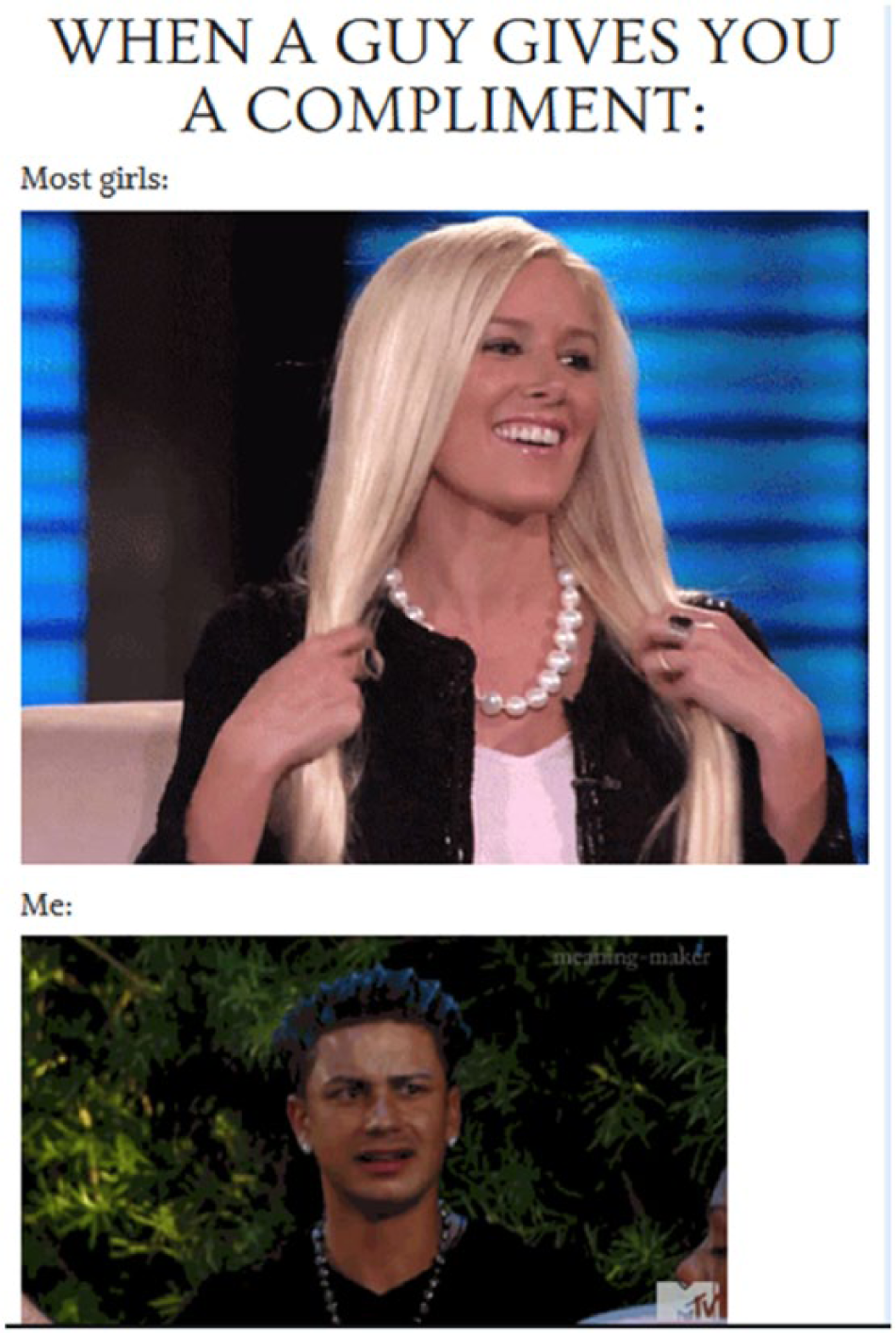
“When a guy gives you a compliment.” WSWCM.
Apart from the look of consternation on DelVecchio’s face, it is clear that his masculine face, and comedic low culture “guido” persona (Sastre, 2014) are together played for laughs as an articulation of “me” or the blogger in contrast to the normative white, feminine, middle-class attractiveness in the first GIF.
The comparison between the two GIFs is somewhat overblown, like the “fat piece of shit” post above (Figure 5). However, in both, what is mobilized is heuristic shorthand for “what doesn’t fit.” The bodies that are used are pulled together to reassemble dominant binary classifications of what doing gender entails. This practice of assembling ideal femininity through slim, (usually) white, “heterosexy” (Dobson, 2011) young women and contrasting the author’s non-ideal femininity channeled through ill-fitting bodies such as those of older women, men, animals, or exaggeratedly comical bodies, is a recurring theme throughout the meme. In this way, the blogs pin bodies to existing dominant gender classifications to make meaning, and reproduce the dominance of these classifications through this pinning.
Alternatively, sometimes bodies are taken and used as though they are not situated in strata of prior classificatory meaning. However, when this is done, I argue these bodies are wrenched from prior meanings not in spite of, but precisely through a contemporary neoliberal, postfeminist, and postracial sensibility. Both the settled meanings of bodies and their purported freedom from the historical, political, and social are mobilized for meaning making. Here, meaning making practices operate through a presumption that any body/anybody is free to be used to express a particular sentiment or situation. I take the example of the post on follower blog TwoDumbGirls, “When the tennis coach says I’m too old for the team” (Figure 7). The GIF is preceded by the words “I’m like,” indicating the GIF represents the reaction of the blogging author. The GIF features the face of a young Asian man, the grittiness of the image suggesting an amateur video. He faces the camera front on, and when he shouts, the caption “That’s waisis!” (that’s racist) appears.

“That’s waisis.” TwoDumbGirls.
Here, this non-white body is taken from his own self-production and appears to have been appropriated at least twice; first, in the GIF to strip his words of protest from him and replace them with a mockery of a non-Western accent, and second, by the blogging practice on TwoDumbGirls which then uses this GIF to denote a theatrical feeling of middle-class discrimination. This discrimination is playfully instrumentalized to demonstrate a sort of poutiness at the “ageism” of presumably being refused membership of the university tennis team, given the presence of other posts discussing undergraduate college experience. This may tie in with the self-branding of the blog, which is named “Two Dumb Girls,” playing up youthfulness and a type of “blondeness” or humorous feminine naïveté. “Waisis” may be a way to suggest a girlish baby-talk which is a knowingly ridiculous response to being deemed “too old.” This imposed baby-talk also works as a double mechanism, infantilizing and feminizing the man featured in the GIF: a common way of managing Asian masculinity in the West (Eng, 2001).
The juxtaposition of the affect of the knowing silliness of the TwoDumbGirls and the visual meanings stemming from the use of this Asian body is jarring for the reader who is not positioned in a relation of selective instrumentality in regards to racial difference. Indeed, such presumptions of freedom to use, occupy, and control may be seen as part of what Sullivan (2006) characterizes as the “ontological expansiveness” of White privilege. The reading required seeks to enact an expansive post-racial, postfeminist power of being outside of previous meanings, converting bodies into homogeneous resources available for self-production. Relations between bodies are flattened and simplified; through their compression and transformation into GIFs, bodies become free stock which one can rework and through one’s own labor, make one’s own.
In becoming this stock of meanings which can be selectively drawn on, every body/everybody may use or be used in this flat “database logic” (Manovich, 2001) where one is free to draw connections between bodies that are compressed into a form of data. This playful, superficially equal mixing and matching may appear apolitical or even harmless such as in the Figure 4 post where the car enacts the catching up on one’s reading though, indeed, one may wonder what distress the unseen driver may have felt in the moment captured in the decontextualized GIF. In identifying this database logic, my aim is not to argue that all such products of remix are problematic, but to highlight potential connections with postracial and postfeminist logics when bodies that have been particularly marked, fixed, and contained by race and gender, become subject to the presumption that such meanings may be decontextualized, erased, or instrumentalized in blog posts through authorial intent.
I draw on two similar examples demonstrating the way in which bodies are used which require the strategic suppression or forgetting of historical meaning, and difference. On Pitchin’ Hissy Fits, the situation “when my roommate flat out ignores me” (Figure 8) is illustrated by the explosive reaction of actor Nicholas Cage in the horror film The Wicker Man (Labute, 2006). In what looks like a log cabin, he advances menacingly toward a woman, whose back and long, blonde hair we see, and with a blow to her face, knocks her to the ground. The filmic context is dramatic; the two seconds capturing his slow, deliberate movement before his blow lands on the woman invites the feeling of dread. The movie which involves Cage’s character consistently eliminating evil neo-pagan women has been argued to be an unintentional comedy in much Internet commentary. Yet, when isolated from this context of distanced, ironic spectatorship, the brief visual sequence in the GIF cannot unambiguously erase the gendered violence within it, though it may be clumsily enacted by Cage. The post attempts to appropriate this scene here to make this violence enacted by a masculine body on a feminine one a humorous exaggeration of the violence enacted by the feminine author on her frustrating roommate.

“When my roommate ignores me.” Pitchin’HissyFits.
A similar post on WhatShouldBetchesCallMe performs the reaction “when all my friends are crushing on a guy that is so overrated it makes my head hurt” (Figure 9), “crushing” meaning to have romantic desire for someone. This time the GIF is sourced from what looks like an ostensibly humorous YouTube clip. The GIF features a young man, who first states, appraisingly, “Yeah . . . I’d hit that . . .,” “hit that” signifying in colloquial terms to “hook up with” or to have sex with. The young man goes on to say, delivering the punchline with emphasis, “With my car.” The humor evidently plays on the double meaning of “hit.” In the context of WhatShouldBetchesCallMe, this produces a new meaning where “crushing” on a guy is translated, in postfeminist speak, to something more worldly: a willingness to “hit that,” producing the guy as a sexual object. Consistent with the branding of the blog that articulates a knowing, ironic “mean girl” persona, the author, “Total Betch,” is shown to be above feeling fatuous desires for an “overrated” guy; her postfeminist heterosexual taste is discerning and rational. I suggest, however, that the post still carries a residue of masculine violence in the casual colloquialism which constructs the (feminine) body, first, as an object of sexual desire, and then, as the object of one’s motor vehicle. This analysis evidently presumes a heterosexual context for the clip, which I acknowledge may not be correct. However, the key element I wish to foreground here is that a masculine body, casually objectifying another body as a source of humor, is viewed as an available position to inhabit for the feminine author/reader here, as long as she is able to construct the meaning from the image and caption. In this way, a postfeminist sensibility demonstrates the sense that masculine violence may be easily reclassified as potential feminine violence.

“Crushing on a guy.” WhatShouldBetchesCallMe.
Interestingly, the masculine body which is instrumentalized here is not a White body; the young man is also Asian in appearance. The use of this body contrasts with the way in which the other young, Asian man is used in the TwoDumbGirls post I consider above. The attempts to control and appropriate the words and meanings of these bodies, through the blogs, are similar in the way they ask the spectatorial girlfriend to suppress difference. However, this suppression operates to allow different affects and narratives to be voiced. The TwoDumbGirls post (Figure 7) requires the spectatorial girlfriend to simultaneously see and not see the race of the first young man, so his words can be re-articulated to achieve the punchline of “that’s waisis.” The WhatShouldBetchesCallMe post (Figure 9) requires the girlfriend reader to discard the relevance of the race of the young man as his masculinity is foregrounded; however, one must also selectively forget the way in which the words re-enact masculine violence so the feminine author/reader may appropriate them. The post transacts race and gender as though they are discrete markers of identity that can be made relevant or irrelevant through authorial intention.
My reading shows how meaning is unwieldy; existing classifications and associations are sometimes written or read over with difficulty in this selective humorous remixing and matching. I contend the anchoring of masculine bodies within meanings which enable and normalize the practice of violence by these bodies, means that the reader may struggle to appropriate them, particularly in the Nicolas Cage (Figure 8) and the “I’d hit that” (Figure 9) posts. Nevertheless, these bodies, like those of the crashing car, or of Paul DelVecchio from Jersey Shore, are positioned as available for appropriation and use. This suggests that the requisite literacy here is enabled or made possible by understandings of the exchangeability of bodies and meanings, as resources which can be freely and/or selectively resignified. Bodies as floating signifiers are used, reworked, and reclassified according to a logic of exchange, in which wider digital circulation equates to the accrual of value (Jenkins, Li, Domb Krauskopf, & Green, 2008; Marwick, 2013).
Concluding Thoughts
I have sought to highlight this uneasy mixing and matching to make visible the ideal reader who is able to distill certain knowledges and politics in order to “get the joke,” politicizing the sociality offered by the readership required for participation in this meme. The spectatorial girlfriend, drawing on dominant modes of recognition and intelligibility made available in postfeminist, post-racial digital cultures is required to selectively use and suppress difference and to forget traces of meaning which anchor and essentialize bodies in order to align the GIF and post. Here, the choosy classificatory homogenization, circulation, and differentiation of bodies is taken for granted. The spectatorial girlfriend must ignore the sedimented layers of meaning which attach to certain bodies in order to mobilize those bodies in digital circulation.
The WSWCM meme demonstrates some key movements in the circulation of thoughts, feelings, and ideas in digital cultures. The first movement relates to the narrowing in the gap between readership and authorship, showing that shared literacy rather than the question of original production is of greater importance in digital cultures like memes. Second, this participation requires sophisticated mobilizations of social knowledges which construct forms of sociality which are not equally open to all digital users. The classificatory imagination of digital culture combined with assumptions relating to the useability of the social is visibly operationalized in these shared spaces of meaning. Post-racial, postfeminist narratives of how identity operates in the world are not simply “out there” for youth to make meaning of their lived experience, but now in a visual format, form part of the literacy required to take part, and feel central in these cultural spaces.
The practice of using any body which is available, I argue, positions the ideal reader as the rational, instrumental user of neoliberal culture, competent in navigating data-saturated contexts. This does not mean that the literacy practices of the meme exclusively relate to postfeminist or postrace-type knowledges. Indeed, the ability to use one’s classificatory imagination to connect absurd associations can describe much of the literacy required to “get” Internet-based humor. But this imagination constitutes part of a network of knowledges that produces the literate subject in a relation of expanding instrumentality to social meaning and social difference. This practice of mixing and matching may mean a certain disconnect between the reading position which is invited of the spectatorial girlfriend, and the actual reader. Even if the reader is able to arrive at the “correct” reading of the post through drawing on their classificatory competencies, a mismatch may be felt between the rules of meaning construction set up by the text, which invites a humorous response, and the reader’s own lived experience in the world. One might, as I did, find the “waisis” and other posts jarring while finding the “crowded bar” post with the circulating sheep very funny. Accordingly, while offering broader pleasures of recognition and commonality, the reader most at home in the WSWCM meme is one whose social experience and location correlates most closely with the subject of postfeminism more generally: the middle-class, youthful, White feminine subject who feels free to use meaning as a selective classificatory tool, both drawing on and strategically forgetting existing classifications.
Footnotes
Acknowledgements
Examples of the data from my research sample of the Tumblr blogs have been included in my article as figures, with hyperlinks. I obtained permissions to reproduce these data from the creators of the blogs prior to conducting research. Thank you to the Faculty of Arts at Monash University for their generous support, without which this article would not have been written. Special thanks also go to my PhD supervisors, JaneMaree Maher and Amy Dobson.
Declaration of Conflicting Interests
The author(s) declared no potential conflicts of interest with respect to the research, authorship, and/or publication of this article.
Funding
The author(s) received no financial support for the research, authorship, and/or publication of this article.