




Abstract
Social networking sites offer various opportunities to express opinions on politics and public affairs and to disseminate information to a large circle of acquaintances. The present research aims to identify the characteristics of people who consider themselves as opinion leaders on these new channels, the features they use in order to influence others, and the psychological motives they pursue. A survey (N = 527) among Facebook users identified political interest and personality strength as significant predictors of perceived Facebook opinion leadership, while the influence of extraversion was not significant. Those who write private messages on political debates do this in order to raise awareness of specific topics, while opinion expression in public status updates is also strongly connected to self-presentational goals (impression motivation). Moreover, the motives of presenting oneself positively and convincing others are particularly important for people with high personality strength. The present findings extend previous knowledge by redefining the concept of opinion leadership in new media environments and describing motivational links between individuals’ predispositions and their activities to influence others’ opinions. On a practical level, the pronounced role of self-presentational motives is likely to have important implications for the dynamics of public debates in social media.
Keywords
Recent developments in the media landscape have led to renewed interest in the concept of opinion leadership (Choi, 2015; Schäfer & Taddicken, 2015; Weeks, Ardevol-Abreu, & Gil de Zúñiga, 2015). In the early days of mass media, Katz and Lazarsfeld (1955) described a two-step flow of communication in which opinion leaders received information from the media and passed them along to their acquaintances, which was assumed to shape attitudes and behaviors of the less active recipients. This process of influencing peers and directing their attention to specific topics and views—typically conceptualized as face-to-face conversations between acquaintances—is now also possible in current social media applications: Social networking sites (SNS) such as Facebook offer various opportunities to express opinions on politics or public affairs, raise awareness of specific topics, and send links to media contents to the whole friend list. While SNS were originally seen as a tool for social relationships and self-presentation, recent studies recognized that they also serve as sources of information on news and public affairs (Bode, 2016; Choi, 2016) and as a forum for political expression and participation (Gil de Zúñiga, Copeland, & Bimber, 2014). For these reasons, SNS may be a particularly relevant arena for opinion leaders.
First studies on informational uses of social media primarily focused on the outcomes of political expression and news sharing such as increased political participation (e.g., Valeriani & Vaccari, 2015) or greater involvement with regard to the shared news stories (e.g., Oeldorf-Hirsch & Sundar, 2015). Furthermore, it has been shown that news stories that have been shared by Facebook friends who are regarded as opinion leaders elicit perceptions of higher trustworthiness (Turcotte, York, Irving, Scholl, & Pingree, 2015). However, less is known about the predictors of political expression and news sharing on SNS and the motivations of users to engage in the dissemination of content on public affairs. In order to offer new insights into this topic, the goal of this research is to examine the characteristics of people who emerge as opinion leaders on public affairs topics on Facebook. We argue that this is not only relevant for theoretical reasons as a novel application of the classic opinion leadership concept but that identifying the influentials (Weimann, 1991) in this new context will also help to understand the dynamics of public opinion formation in the contemporary (social) media environment. Specifically, we aim to explore (1) the personality traits which are related to the use of SNS for influencing others’ opinions on political and societal topics, (2) the features (status updates, private messages) that are used by SNS opinion leaders, and (3) which psychological motives they pursue by passing along information and publishing their opinions.
In the following, we will transfer the traditional concept by Katz and Lazarsfeld (1955) and related research on offline opinion leaders with regard to the characteristics of SNS and present results of a survey on opinion expression on Facebook.
The Two-Step Flow Model
The development of the concept of opinion leadership dates back to the seminal Erie County study by Lazarsfeld, Berelson, and Gaudet (1944), in which they investigated the relations between mass media usage and voting behavior. One central finding was that interpersonal communication was one of the main sources of influence with regard to people’s attitudes and behavior, stronger than the direct influence of mass media. Katz and Lazarsfeld (1955) followed this path and identified people “who were likely to influence other persons in their immediate environment” (p. 3), the so-called opinion leaders (by asking whether respondents have actively tried to convince others or have been asked for advice). They concluded that media effects operate via a two-step flow. First, opinion leaders get their information from the mass media and then transmit it to their network: “Ideas, often, seem to flow from radio and print to opinion leaders and from them to the less active sections of the population” (p. 32). Based on their initial studies, opinion leaders for public affairs were characterized as people with a large circle of contacts and social skills (“gregariousness, or extent of contact with other people” (p. 223)), who frequently use mass media and are interested in their domain.
Beyond general criticism of the theory, for instance, regarding an unclear differentiation of information and persuasive influence (Robinson, 1976) and a simplification of a process which may rather consist of a multi-step flow (Weimann, Tustin, van Vuuren, & Joubert, 2007), the emergence of digital media has raised the question of whether the presuppositions of the two-step flow model are still valid in online environments or have to be modified. Since the Internet offers an almost unrestricted amount of information as well as a variety of sources and allows recipients to personalize their news channels, one interpretation could be that sources are able to reach their audience more directly (in a one-step flow, as suggested by Bennett and Manheim (2006)) and that personal influence loses its importance. However, the rise of social media, reproducing interpersonal relations on the Web, has made it more likely that personal influence still plays an important role in the diffusion of news and political opinions. In this line, a survey study with a representative sample of German Internet users (Schäfer & Taddicken, 2015) identified clusters of opinion leaders, followers, and inactive parts of the population, which are similar to the originally assumed roles. Furthermore, network analyses with Twitter data on South Korean political discussion groups (Choi, 2015) or the German federal election (Dang-Xuan, Stieglitz, Wladarsch, & Neuberger, 2013) which identified influential users support the notion that the communication processes on a social media site resemble those of the two-step flow hypothesis.
SNS as an Arena for Opinion Leaders
The affordances of SNS such as Facebook can be regarded as an ideal venue for influencing others: Users are able to reach their whole network via public status updates (which may contain opinion expression on political and societal debates or shared media content) or send personalized messages to specific members of their friend list as a form of private communication. As described by Oeldorf-Hirsch and Sundar (2015), SNS news sharing as “passing along information that is already available elsewhere and making it personally relevant to their social network” (p. 241) closely resembles traditional ideas of opinion leadership. Choi (2016) highlights the opportunity to recontextualize news by forwarding articles and adding comments as well as the opportunity to endorse news (by “liking” them) as central dimensions of news sharing. Similarly, expressing one’s opinion toward a public affairs topic publicly to a number of friends can be interpreted as attempts of disseminating information and convincing others. The trend that SNS are moving beyond their original purpose of (private) social connections by including profiles of politicians and news media and are increasingly used with regard to news and public affairs content (Kümpel, Karnowski, & Keyling, 2015; Valeriani & Vaccari, 2015) has contributed to the potential of Facebook as an arena of opinion leadership. In this line, a recent essay by Katz (2014) emphasized the political opportunities that could be connected to SNS: “We are suggesting that the social media—more than the mass media—may well contribute to the mobilization of protest outside the home” (p. 459).
Compared to face-to-face situations, SNS communication typically involves a larger audience (when communicating via public status updates). On one hand, this strengthens the potential influence of the disseminated information or opinion. On the other hand, the broad composition of the friend list (including acquaintances from different contexts) makes it difficult to tailor the message to the audience (Marwick & boyd, 2011) and might therefore reduce people’s willingness to express their opinion on controversial issues. Furthermore, speakers have more time to carefully compose their messages on SNS (Walther, 2007), which allows for a more thoughtful selection of suitable content than in face-to-face communication.
Taken together, the specifics of SNS offer conditions that are very well-suited for opinion leadership but differ in the above-mentioned respects from offline settings. This leads to the question of whether the characteristics and mechanisms of opinion leadership in social media settings are different from the assumptions on personal influence in classic realms and which kind of users particularly take advantage of SNS features in order to express their opinions and influence others. While there is an emerging body of research on opinion leadership on the microblogging service Twitter (Choi, 2015; Dang-Xuan et al., 2013; Park, 2013), less is known about the facets of news sharing and opinion expression on SNS such as Facebook that highlight interpersonal contacts more strongly and predominantly reproduce existing friendships. The question of how the specifics of these private SNS affect patterns of news and opinion sharing gains further relevance since Facebook has become one of the major sources of news and political debates in younger parts of the population (Mitchell & Page, 2015). Drawing on theoretical assumptions and empirical findings on offline opinion leadership and first results on political talk on social media, we next discuss potential characteristics and psychological motives of users who act as opinion leaders on SNS.
Characteristics of Opinion Leaders on SNS
According to the classic concept (Katz, 1957), opinion leaders can be characterized by personal predispositions (“who one is”), domain-specific factors (such as competence and interest in the domain/“what one knows”), and social connections (“who one knows”).
While it was originally assumed that there is little overlap between leaders in different domains, later work has begun to identify overarching patterns that may be crucial for general opinion leadership (see Gnambs & Batinic, 2012). As one attempt to detect influential people and the domain-independent tendency to act as opinion leader, the construct of personality strength was introduced (Noelle-Neumann, 1983; Weimann, 1991): People with high personality strength are characterized by charisma and a self-perceived ability to be successful and persuade others. Although the description is relatively broad and boundaries toward related constructs are not fully defined, validations of the scale show that people with high personality strength indeed have more central roles in their network (Weimann, 1991). Personality strength has been shown to be highly connected to a higher socioeconomic status while being unrelated to media exposure (Weimann, 1991), which differs from initial findings by Katz and Lazarsfeld (1955). However, since the role in communicative networks and perceptions of being persuasive represents the core of being an influential, the scale has become widely used in opinion leadership research (with some studies employing personality strength as a direct operationalization of opinion leadership; e.g., Schenk & Rössler, 1997; Shah & Scheufele, 2006). Given the conceptualization as a non-domain-specific trait, we aim to test the hypothesis that personality strength is also crucial in the new context of SNS:
H1. Personality strength predicts SNS opinion leadership and the frequency of opinion expression.
Based on the five-factor model of personality (Costa & McCrae, 1992), Gnambs and Batinic (2012) also highlighted conceptual overlaps to the more general personality trait of extraversion because being communicative and active in social situations (as central characteristics of extraverts) can be seen as a prerequisite for disseminating information and influencing others. Supporting this argument, they found a significant relationship between extraversion and the general tendency to emerge as an opinion leader in one’s network. When focusing on computer-mediated communication, however, it has been argued that introverts might benefit from the asynchronous nature of communication to compensate for their social deficits (see Valkenburg & Peter, 2007). In the light of these potentially opposing directions (extraversion as a facilitator of expression vs the Internet as a venue of expression for introverts), we posit the following research question:
RQ1. Is there a relation between extraversion and SNS opinion leadership as well as the frequency of opinion expression?
With regard to the domain-specific factors, political interest has been described as a key variable in explaining opinion leadership in public affairs (Katz & Lazarsfeld, 1955). While recent investigations (Trepte & Scherer, 2010) show that opinion leaders are not necessarily more knowledgeable (and instead rely on their communicative skills), being interested makes it more likely that content from this domain is easily accessible and that people find it relevant to express opinions on these topics. Along these lines, a study on Facebook usage among young American adults showed a positive relation between political interest and the frequency of political postings (Vraga, Thorson, Kligler-Vilenchik, & Gee, 2015). Thus, we hypothesize the following:
H2. Political interest predicts SNS opinion leadership and the frequency of opinion expression.
Concerning the aspect of “who one knows,” the number of SNS friends may appear as a modern manifestation of gregariousness and the extent of social contacts (Katz & Lazarsfeld, 1955). Thereby, it appears plausible to assume that those with higher numbers of Facebook friends are more active in trying to make use of the opportunities of opinion expression and news sharing. Furthermore, the mere number increases the likelihood of actual influence in getting others’ attention and feedback. On the other hand, an overly broad audience might limit people’s willingness to express their opinion because it is more difficult to find a viewpoint which is acceptable for all friends from different contexts (Marwick & boyd, 2011). In a survey with a convenience sample of American college students, Jang, Lee, and Park (2014) found a negative relationship between the number of friends and Facebook opinion expression on gay rights and general politics, which leads them to the conclusion that “users are susceptible to cross pressures from multiple group norms co-residing within the same network” (p. 274). Given these opposing directions, we propose the following research question:
RQ2. What is the relationship between the number of friends and opinion leadership on SNS?
Motives of Opinion Expression on SNS
With regard to the psychological mechanisms that are decisive for acting as opinion leaders, it is pivotal to also consider the motives that are pursued by engaging in online opinion expression and news sharing, which may add explanations that go beyond the effects of predispositions such as political interest. First and foremost, intentions to spread information as well as to influence others’ views are implicitly included, albeit not clearly separated (as criticized by Robinson, 1976), in the original concept of opinion leadership. The former aspect—dissemination of information—for instance, in order to raise awareness for specific topics, can be interpreted as altruistic (Kümpel et al., 2015) and prosocial in that sharing news is helpful to increase the knowledge of the group (Yang, Kahlor, & Griffin, 2014). With regard to social media, initial results of a survey among American university students (Park, 2013) showed that Twitter usage is motivated by the desire to provide useful information. The latter aspect of persuading others toward a specific position represents an even stronger intention of influence, which may consist of general enjoyment of convincing others (Noelle-Neumann, 1983), as well as in the conviction that a specific view toward a personally relevant topic should be spread. In this line, Springer, Engelmann, and Pfaffinger (2015) found a relationship between the desire to persuade others and the frequency of writing user comments on online news sites in a convenience sample of German Internet users.
However, it is also highly conceivable that opinion expression on SNS is spurred by more self-related goals. The social media context has been shown to be a fertile ground for selective self-presentation (Walther, 2007) in that users try to convey an advantageous picture of themselves (impression management; Krämer & Winter, 2008; Leary & Kowalski, 1990) by choosing content that portrays them in a positive light. Messages on political or societal topics may be particularly helpful in creating such a positive impression in the sense of showing one’s interest in complex topics (which is widely seen as desirable) or “impressing” others with knowledge. First results in this realm showed that online news sharing is related to the goal of status seeking (Lee & Ma, 2012) and that word-of-mouth on marketing topics is partly motivated by the desire to be admired and hold an influential social position (Rose & Kim, 2011; see Kümpel et al., 2015). Given that being logged in on SNS is likely to highlight social contacts and activate self-presentational concerns, we assume that opinion leadership in public affairs topics is also driven by the motivation to present oneself positively (impression motivation). Therefore, we propose three distinct motives of opinion leadership that are derived from the original conceptualization as well as from the affordances of SNS:
H3. The motives of (1) disseminating information, (2) persuading others, and (3) creating a positive self-presentation predict opinion leadership on SNS.
When focusing on specific SNS behaviors such as posting public messages, commenting other users’ postings, or sending private messages, considering users’ motivation might also help to predict the selective usage of these diverse features. Given that private messages on SNS allow users to tailor the content to the specific interaction partner, this feature might be an ideal means for opinion leaders to inform and persuade their peers in a targeted way (similar to face-to-face conversations). The same goals with an even larger (but more diverse) target group can be achieved with public status updates since they are able to reach a greater circle of people. Beyond that, status updates can primarily be used to present oneself in a positive way (Winter et al., 2014) in relation to users’ motive of impression management. Such acts of expression to arouse a positive impression would also be possible in one-to-one messages but are typically less common due to the lack of a broad audience. Therefore, we expect the following pattern:
H4. The motives of (1) information and (2) persuasion predict private opinion expression on SNS.
H5. The motives of (1) information, (2) persuasion, and (3) self-presentation predict public opinion expression on SNS.
Regarding the relation of the personality variables mentioned above and the motives that can be pursued by SNS users, it can be assumed that people with specific traits are more prone to pursue certain motives than others. We believe that considering this interplay is likely to provide more insights about the psychological mechanisms of online opinion expression and news sharing as well as to explain the link between personality traits and behaviors of opinion leadership that has not yet been addressed by prior research. Specifically, it is expected that personality strength with an emphasis on the enjoyment of convincing others and high status (Noelle-Neumann, 1983; Weimann, 1991) is primarily related to persuasive and self-presentational motives, while political interest as a more topic-dependent variable (Vraga et al., 2015) is driven by informational goals and issue-related persuasion. Similar to personality strength, extraverts are likely to place a higher priority on a positive self-presentation which is helpful to attain social contacts (Gnambs & Batinic, 2012)—if extraverts engage in opinion expression, this might therefore be an explaining factor. Thus, the following set of hypotheses is posited:
H6. The relationship between personality strength and SNS opinion leadership is mediated by the motives of persuasion and self-presentation.
H7. The relationship between political interest and SNS opinion leadership is mediated by the motives of information and persuasion.
H8. The relationship between extraversion and SNS opinion leadership is mediated by the motive of self-presentation.
Method
Sample
The present research used an online survey to test the hypotheses on opinion leadership on the SNS Facebook. The survey was primarily addressed to young Facebook users, who are particularly involved in news consumption and political discussions on this platform (Mitchell & Page, 2015). For recruitment, the online survey was advertised via postings on diverse Facebook channels, including student groups as well as public political and news channels. As an incentive, respondents took part in a lottery in which they had the chance to win one of 13 coupons for an online retail shop (1 × €100, 2 × €50, 10 × €20). The study started on the day after the German federal elections 2013 and was online for 1 month.
The sample consisted of 527 participants (310 females) whose age ranged from 18 to 63 years (M = 23.99, standard deviation [SD] = 6.58). Due to the recruitment in student groups, more than 80% of the participants were students (82.7%), while 10.4% were employees, and 3.4% were self-employed. 1 All participants had a private Facebook account and spent on average 72.61 min per day (SD = 80.41) on Facebook. The average number of people in participants’ Facebook friends list was 285.79 (SD = 443.56).
Measures
Media Use
Besides patterns of general media usage, participants were asked how they use Facebook in the context of politics and public affairs (for instance, regarding political events such as elections, news on current national or international events, or societal debates). In this regard, we differentiated between public and private opinion expression on Facebook. Public opinion expression was assessed by three questions on status updates on political and societal events (e.g., “how often do you post status updates with a link to an online article on political and societal topics [including an additional comment on your opinion]?,” Cronbach’s α = .88, M = 2.43, SD = 1.41), and private opinion expression was operationalized by two items (e.g., “how often do you send private messages in which you refer to online articles on societal topics and comment on these?,” α = .80, M = 2.95, SD = 1.51). All items were measured on a scale from 1 (never) to 7 (every day).
Facebook Opinion Leadership
Furthermore, it was assessed to which degree participants perceive themselves as influential among their Facebook friends. In line with prior research (e.g., Park, 2013; Shah & Scheufele, 2006), we regard these self-perceptions of influence as proxies of opinion leadership. However, it has to be noted that this measurement may be subject to response biases or social desirability. For the domain of SNS, we adapted items of generalized opinion leadership (Gnambs & Batinic, 2011) to the Facebook context. Participants rated six items which generally referred to being an opinion leader on Facebook (“Among my Facebook friends, I often decide which issues are current,” “My Facebook friends often discuss topics that I brought up,” “I usually succeed if I want to convince other Facebook users about something,” “It is easy for me to persuade other Facebook users,” “I have the impression that my Facebook friends regard me as a good source for advice,” “I often use my persuasive skills during Facebook discussions to reach agreements quickly”) and four items pointing to political and societal topics (“I think that many of my Facebook friends benefit from me expressing my opinion on societal topics,” “I often have the final say in Facebook discussions on societal topics,” “I think that my opinion on societal topics is important for my Facebook friends,” “I am convinced that many of my Facebook friends follow my opinions on societal topics”) on a 7-point scale. The 10 items had a high internal consistency (α = .95) and were averaged (M = 2.61, SD = 1.33).
Personality Strength
The 10 items of Noelle-Neumann’s (1983) personality strength scale were used to measure to what extent people perceive self-confidence in leading and influencing others. Items such as “I usually count on being successful in everything I do” were measured on 5-point scales (α = .83, M = 3.38, SD = 0.64).
Extraversion
Levels of extraversion were assessed using the NEO Five-Factor Inventory (FFI) scale (Borkenau & Ostendorf, 1993; Costa & McCrae, 1992) which includes 12 items on a 7-point scale (e.g., “I really enjoy talking to people,” α = .77, M = 4.45, SD = 0.83).
Political Interest
The extent to which participants are generally interested in politics was measured with a scale by Otto and Bacherle (2011) consisting of five items such as “I observe political events with great interest” rated on a 7-point scale (α = .94, M = 4.98, SD = 1.64).
Motives for Opinion Expression
Those who reported that they participated in at least one SNS activity in the context of political and societal topics (N = 514) were asked about their motives to engage therein. The first half-sentence was the same for all 15 original items (“When I post civically relevant information or comments on Facebook, I do this . . . ”), and the other half covered different motives for opinion leadership suggested by the literature (see above). The items were grouped in an exploratory factor analysis (principal axis analysis and varimax rotation). The empirical eigenvalues resulting from the first analysis were then considered in a parallel analysis (Horn, 1965) which proposed three as the appropriate number of factors. We, therefore, calculated a second exploratory factor analysis (principal axis analysis and promax rotation) with the fixed number of three factors. The three-factor solution with all 15 items explained 69.07% of the variance (see Table 1). The first factor consisted of seven items which refer to the motive of distributing relevant information (e.g., “to draw other people’s attention to this topic,” α = .94, M = 4.60, SD = 1.63). The second factor relates to the motive of persuading others (e.g., “to convince others of my opinion toward the topic,” three items, α = .87, M = 3.26, SD = 1.65). The third factor includes five items which cover the motive of self-presentation (e.g., “to show others that I am interested in political and societal debates,” α = .88, M = 2.75, SD = 1.45).
Factor Loadings of the Three Factors Representing Motives for Opinion Leadership.
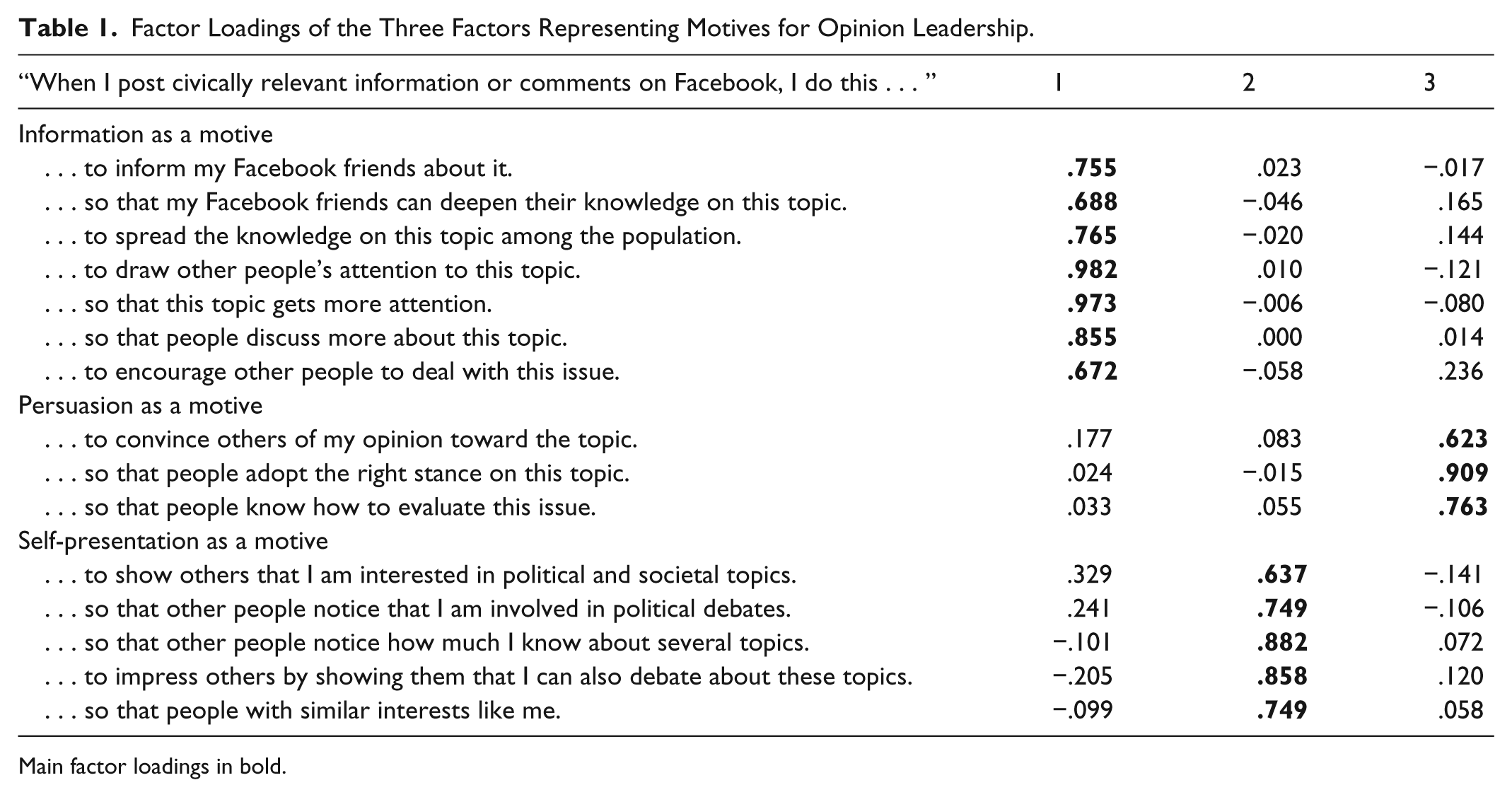
Main factor loadings in bold.
Results
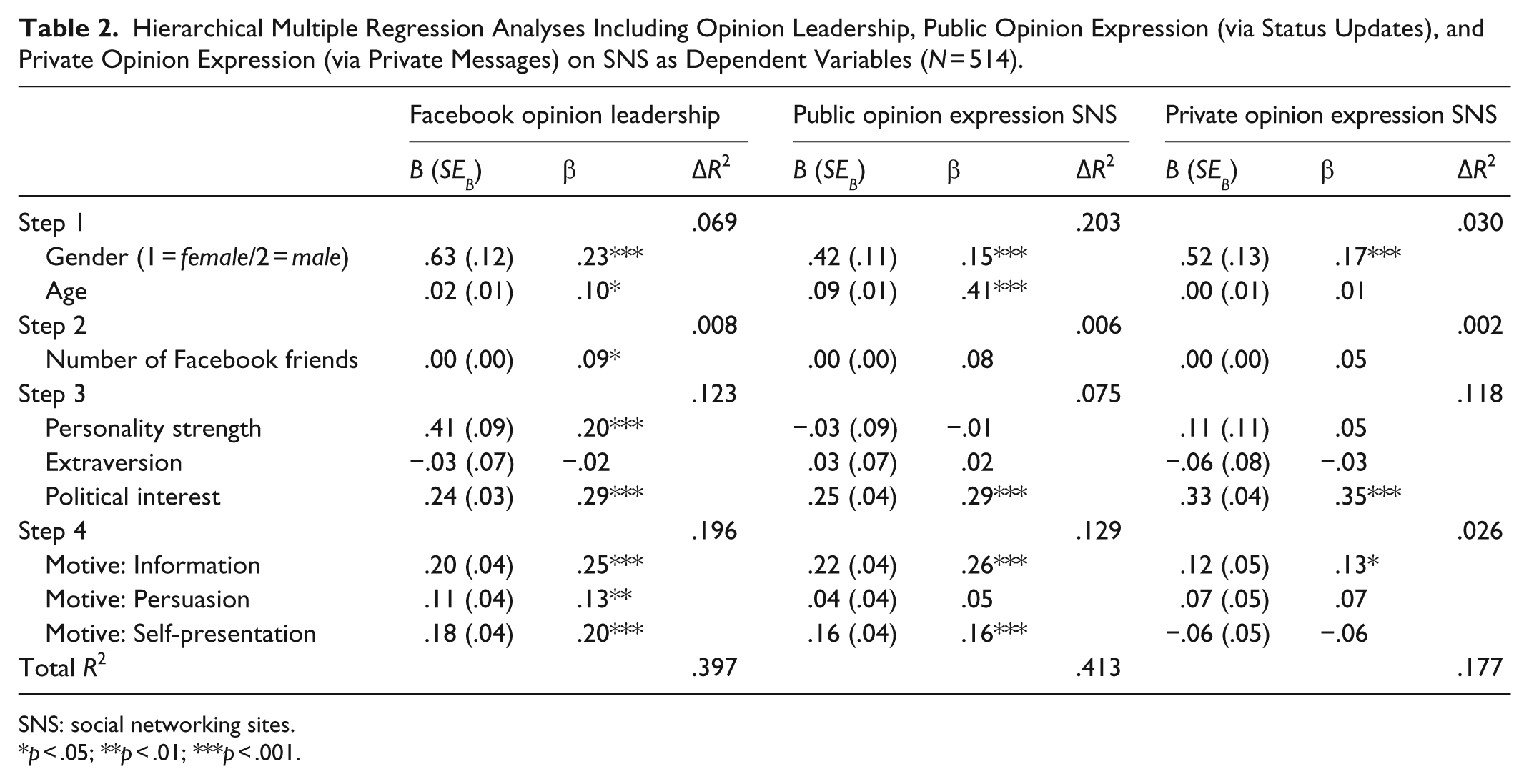
To test our hypotheses, we first conducted three hierarchical regression analyses with the dependent variables: (1) Facebook opinion leadership, (2) public opinion expression (via status updates), and (3) private opinion expression (via private messages). As predictors, the following variables were entered: (1) age and gender (as control variables); (2) number of Facebook friends; (3) personality strength, extraversion, political interest; and (4) the motives information, persuasion, and self-presentation. For the criterion Facebook opinion leadership, the explanation of the variance in the final model was 39.7% (F(9,504) = 36.82, p < .001), while it was 41.3% for public opinion expression (F(9,504) = 39.39, p < .001) and 17.7% for private opinion expression (F(9,504) = 12.01, p < .001).
With H1, we expected that personality strength would predict opinion leadership on Facebook. Indeed, Table 2 shows that personality strength is a significant predictor of Facebook opinion leadership (β = .20, p < .001). However, personality strength is not significantly associated with the frequency of opinion expression acts in public and private environments on Facebook.
Hierarchical Multiple Regression Analyses Including Opinion Leadership, Public Opinion Expression (via Status Updates), and Private Opinion Expression (via Private Messages) on SNS as Dependent Variables (N = 514).
SNS: social networking sites.
p < .05; **p < .01; ***p < .001.
Concerning RQ1, the regression models consistently showed that extraversion is significantly associated neither with self-perceived opinion leadership nor with public and private opinion expression.
Supporting H2, our findings revealed that political interest is a significant predictor of Facebook opinion leadership (β = .29, p < .001). Table 2 moreover demonstrates a significant positive relationship between political interest and public opinion expression (β = .29, p < .001), as well as private opinion expression (β = .35, p < .001).
With regard to RQ2, the data showed that the number of friends on Facebook significantly predicts opinion leadership (β = .09, p = .037). More specifically, the more friends people have in their Facebook list, the more they perceive themselves as opinion leaders. Results also showed a weak positive relationship between the number of friends and the frequency of public opinion expression (β = .08, p = .051), but this effect was beyond the conventional level of significance.
H3 made assumptions about how specific motives influence self-perceived opinion leadership on Facebook. As predicted, opinion leadership was significantly predicted by the motives of information (β = .25, p < .001), persuasion (β = .13, p = .005), and self-presentation (β = .20, p < .001).
With H4, we expected that people would use private channels to express their opinions in order to inform and persuade others. The data partially supported this hypothesis: While the motive of informing others was a positive predictor of private opinion expression (β = .13, p = .010), the motive of persuasion was not.
H5 assumed that public opinion expression would be determined by the motives of information, persuasion, and self-presentation. The data demonstrated that the motive of information (β = .26, p < .001) and the motive of self-presentation (β = .16, p < .001) were significant predictors of public opinion expression, while the motive of persuasion was not. Hence, H5 is partly supported. 2
In addition, it is remarkable that demographic variables also emerged as significant predictors: Results showed that males are more prone to express their opinions on Facebook than females. Furthermore, the regression models indicated that older users are more likely to act as opinion leaders and express their opinion on public channels.
In order to test H6, H7, and H8, we conducted mediation analyses using the SPSS macro INDIRECT by Preacher and Hayes (2008). Furthermore, we calculated 5,000 bootstrap resamples (with a percentile-based 95% confidence interval) to ensure that estimates about mediational patterns were reliable. To test H6, we considered personality strength as independent variable; the motives of information, persuasion, and self-presentation as mediators; and Facebook opinion leadership as dependent variable. Results revealed that the influence of personality strength on Facebook opinion leadership decreased when the three motives were entered in the model (path estimate of the total indirect effect: .18, confidence interval: .07 to .30). As expected, the indirect effects through the motive of persuasion (path estimate of the indirect effect: .07, confidence interval: .02 to .12) and through the motive of self-presentation (path estimate of the indirect effect: .08, confidence interval: .03 to .14) were significant, while the indirect effect through the motive of information was not (see Figure 1). Thus, H6 was supported.

Mediation model including unstandardized regression coefficients for personality strength as independent variable; information, persuasion, and self-presentation as mediators; and Facebook opinion leadership as dependent variable. The unstandardized regression coefficient between independent and dependent variable without controlling for the mediators is in parentheses.
Testing H7, we accounted for political interest as independent variable; the motives of information, persuasion, and self-presentation as mediators; and Facebook opinion leadership as dependent variable. Again, the total indirect effect emerged as significant (path estimate of the total indirect effect: .10, confidence interval: .07 to .15), and results supported this hypothesis, showing that the indirect paths through the motive of information (path estimate: .04, confidence interval: .02 to .07) and through the motive of persuasion (path estimate: .03, confidence interval: .01 to .05) were significant. Even the motive of self-presentation was found to be a significant mediator (path estimate: .03, confidence interval: .01 to .05) of the relationship between political interest and Facebook opinion leadership (see Figure 2). 3
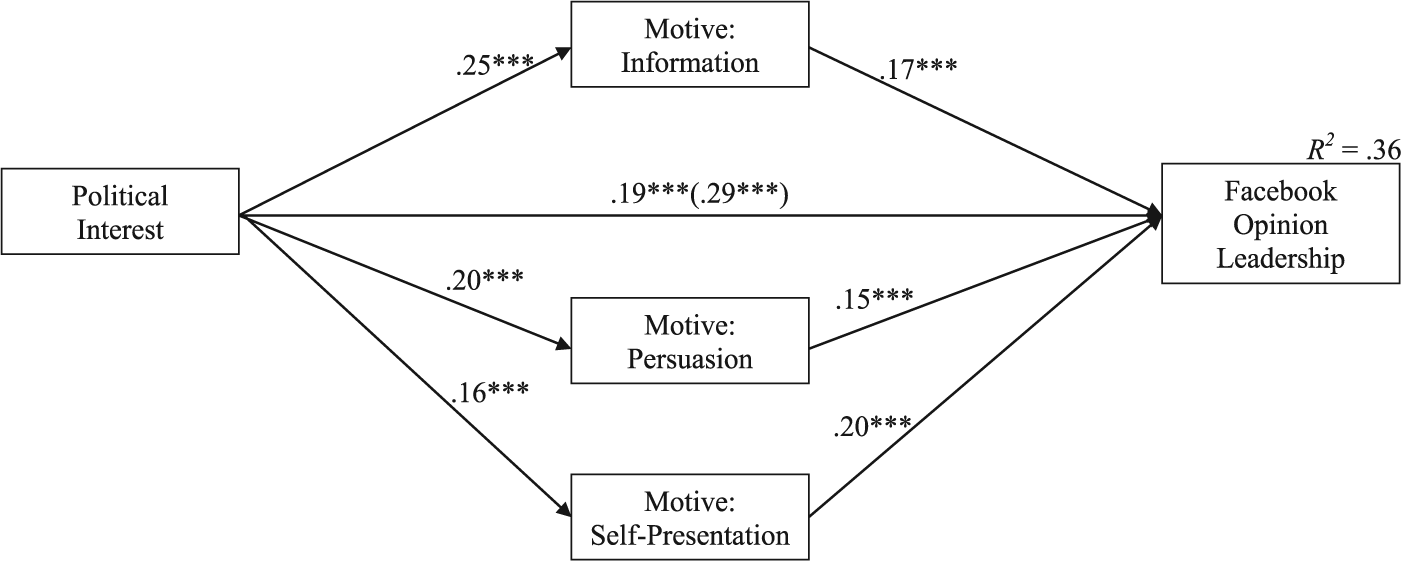
Mediation model including unstandardized regression coefficients for political interest as independent variable; information, persuasion, and self-presentation as mediators; and Facebook opinion leadership as dependent variable. The unstandardized regression coefficient between independent and dependent variable without controlling for the mediators is in parentheses.
Since extraversion was not related to the motives as proposed mediators, which is a precondition for the effect assumed in H8, we regarded this hypothesis as not supported.
Discussion
Given the rising importance of SNS for the dissemination of news and the opportunities of mass–interpersonal communication between peers in this context, we argue that the classic concept of opinion leaders (Katz & Lazarsfeld, 1955) is able to serve as a framework to understand current dynamics of public opinion in social media. Based on survey data, this study investigated the personality traits which predict self-perceived opinion leadership on Facebook and the underlying psychological motives that may explain the frequency of online opinion expression and news sharing as well as the selective usage of specific features. In the following, we will discuss the implications of our findings in order to characterize opinion leaders in social media environments and to contribute to the theoretical advancement of the two-step flow model (see Choi, 2015).
Concerning individual predispositions and the question of “who one is,” personality strength, which has been identified as a key factor in offline realms (Noelle-Neumann, 1983), also emerged as an important predictor of opinion leadership in SNS. This suggests that people with a higher perception of charisma and abilities to be successful take advantage of the opportunities of new media to express their opinion on public affairs in front of a large audience. However, when assessing the frequency of activities such as posting status updates (instead of the perception of one’s own opinion leadership), personality strength does not play an important role anymore, suggesting that people who perceive themselves as convincing might be more interested in the quality than in the mere quantity of their opinion expression acts.
By examining the interplay of personality traits and users’ goals in a motivational approach, this is one of the first studies to also answer the question of why people with greater personality strength aim to be opinion leaders: Results indicate that they pursue specific motives, namely, to not only persuade others of a specific point of view (which is implicitly included in the original concept; Weimann, 1991) but also present themselves in a positive light. The latter aspect suggests that opinion expression is not always related to the topic itself or the outcome in terms of persuasion but also serves a more self-related goal of impression management (Krämer & Winter, 2008) by demonstrating that one is knowledgeable and interested in public affairs. The motive of disseminating information in a less opinionated manner, however, was not relevant for people with higher personality strength.
In contrast to personality strength, extraversion did not emerge as a predictor of opinion leadership on SNS. While a dispositional extraversion has been shown to be important for persuasive attempts in face-to-face communication (Gnambs & Batinic, 2012), it is possible that less talkative people also have a chance to become opinion leaders in online environments. This is in line with considerations that the mediated nature of online communication might help introverts to satisfy their communication needs (Valkenburg & Peter, 2007). The present results therefore suggest that being talkative in offline realms is not a prerequisite for becoming an online influential. As a result, the group of people who are capable of emerging as opinion leaders might be larger than in offline realms, which might bring attention to the ideas of introverts that would otherwise not be heard and thus lead to higher opinion diversity.
With regard to domain-specific variables, our results underline the crucial role of political interest, which was the most consistent predictor of opinion leadership and opinion expression throughout all channels. This is in line with early conceptualizations by Katz and Lazarsfeld (1955) as well as recent findings on political talk on Facebook (Vraga et al., 2015) and demonstrates that the affordances of SNS provide an ideal venue for politically interested people who aim to engage in deliberation. While also related to persuasive and self-presentational intentions, the most important motivation connected to political interest appears to be the dissemination of civically relevant information.
Regarding the question of “who one knows,” the number of Facebook friends can be interpreted as an indicator of gregariousness (Katz & Lazarsfeld, 1955), although prior research has also argued that an overly broad audience might limit people’s willingness to express their opinion on controversial issues (Jang et al., 2014). Our results showed a small but significant positive relation between the number of friends and SNS opinion leadership, which supports the interpretation that a large network is helpful for spreading information and opinions—in contrast to results by Jang et al. (2014) who found a negative relation between the number of friends and the amount of political talk on gay rights. This discrepancy might be due to differences in the central dependent measure (frequency of talk vs opinion leadership) or the specifics of the highly sensitive topic and deserve further attention. Moreover, it is not clear whether a high number of friends is a prerequisite for acting as an opinion leader (by increasing the feeling of potential influence) or whether opinion leaders, rather, have gathered many friends due to their active posting behavior.
With regard to motivational aspects, our analysis supported the theoretical assumptions that the goals of disseminating information, persuading others, and presenting oneself in a positive light are crucial goals spurring opinion leadership and opinion expression. While the predominant motives vary with specific personality traits (as mentioned above), they are also able to explain the selective usage of specific features: Results showed that private SNS messages are mostly influenced by the motive of spreading information, while writing status updates as a public form of opinion expression is also connected to self-presentational goals, which can be explained by the larger audience (Winter et al., 2014).
In comparison with classic conceptualizations of opinion leadership that include information and persuasion as predominant goals, our findings for the new media realm highlight a pronounced role of self-presentational motives. This is in line with initial findings on news sharing with the goals of feeling important or gaining a higher status among the circle of friends (Lee & Ma, 2012) and relates to the general salience of impression motivation and social contacts in the context of SNS (Krämer & Winter, 2008): Posting and discussing political content is likely to be influenced by the overarching goal of creating a positive impression within SNS (in the sense that even in a heated discussion, Facebook users tend to have the audience in mind), and it can also be a promising means of impression construction itself (by conveying the picture of a politically interested or knowledgeable citizen). Although offline opinion expression is not always free from self-presentational concerns either (Leary & Kowalski, 1990), the large audience and the affordances of SNS might particularly strengthen the role of impression motivation in opinion leadership. This might have important implications for the dynamics of public debates: On one hand, using political postings as a form of self-expression and identity building (Papacharissi, 2009) is legitimate and might foster political interest and participation; on the other hand, self-presentational concerns might lead to a focus on popular topics and positions as well as to a restriction of opinion expression concerning important but controversial topics (Vraga et al., 2015). Along these lines, a deeper analysis of the antecedents and effects of impression-motivated opinion expression on SNS appears to be a worthwhile endeavor for future research.
When interpreting the results, some limitations have to be kept in mind. It should be noted that the present results were gathered with a convenience sample since participation in this study was voluntary. The sample mainly consisted of students and people with a relatively high political interest. Although this target group is particularly likely to become politically outspoken on social networking platforms such as Facebook (Mitchell & Page, 2015), it seems advisable to consolidate the findings with a more representative and heterogeneous sample. Additionally, the survey was conducted in an election year (directly after a major election), which might not be generalizable to patterns in times in which political topics are less salient. Moreover, the main dependent measures were based on self-reports on the frequency of specific behaviors, and respondents might have been influenced by social desirability (e.g., when asked about the goals of persuading others). Although surveys have been the predominant method in analyzing opinion leadership, it would be interesting to expand research to the consideration of both self-perceptions and others’ evaluations (Schenk & Rössler, 1997) as well as objective measurements (Dang-Xuan et al., 2013): Are those who perceive themselves as opinion leaders successful in attracting the attention of their followers and which kind of users are seen as particularly influential within their online network? The present operationalization of opinion expression included several behaviors such as passing along and “sharing” information as well as expressing opinions, which could be interpreted as different processes (Robinson, 1976). For future research, a more differentiated view on specific SNS behaviors (e.g., what kind of opinions are expressed?) and the quality of these behavioral patterns (Choi, 2016) might be helpful to “cluster” different kinds of online opinion leaders.
Conclusion
These limitations notwithstanding, this study sheds new light on the phenomenon of opinion leadership on contemporary websites. Our data reveal that the affordances of SNS provide a convenient venue for political talk and news sharing and thereby address the predispositions and motives of potential opinion leaders. According to our analysis, people with high personality strength and high levels of political interest are also those who try to influence others in the social media context. Extraversion (which was shown to be related to offline opinion leadership), however, does not seem to be relevant online. Taking a motivational perspective, this is one of the first studies to address the question of why opinion leaders with certain characteristics engage in opinion expression: Among the key motives of disseminating information, convincing others, and presenting oneself positively, opinion leaders with high personality strength mainly pursue self-presentational and persuasive goals, while political interest is most strongly related to the motive of passing along information in a more neutral manner. Thereby, these findings advance the two-step flow model by providing a new link between personality characteristics and opinion leadership. Motivational differences are also able to explain the selective usage of SNS features: While those who write private messages on political topics do this in order to raise awareness of specific topics, public opinion expression in status updates is also highly connected to self-presentational goals—which might shape the selection of topics or positions that are advocated. A further investigation of this interplay of predispositions and motives will help to advance our understanding of the dynamics of public opinion in the evolving landscape of social media.
Footnotes
Declaration of Conflicting Interests
The author(s) declared no potential conflicts of interest with respect to the research, authorship, and/or publication of this article.
Funding
The author(s) disclosed receipt of the following financial support for the research, authorship, and/or publication of this article: The present study was funded by the Science Support Centre of the University of Duisburg-Essen, Germany.