



Abstract
Pinterest is now the fourth most popular social network site after Facebook, Twitter, and LinkedIn in the United States, offering its own suite of functions. This study investigated why individuals use specific features of Pinterest such as pinning, creating, liking, following, commenting, inviting, sharing, checking, searching, and browsing different categories. An online survey (N = 113) revealed that a brand new set of gratifications (specific to digital media) predicted a large number of user behaviors in Pinterest. The results showcased the predictive value of affordance-based gratifications in shaping specific user behaviors on social-media.
Introduction
As the fourth most popular social network site (SNS) after Facebook, Twitter, and LinkedIn (eBiz, 2016), Pinterest offers a unique suite of features and functions, such as pinning, creating, liking, following, commenting, inviting, sharing, checking, searching, and exploring different categories. Clearly, these features are quite widely used, but we know very little about why. What motivates the use of these features? Extant research on Pinterest does not quite provide an answer. To be sure, Pinterest has attracted significant research interest among scholars, despite its relative youth. At least three streams of research can be identified—the effects of gender on Pinterest usage (Barnett, 2012; Chang, Kumar, Gilbert, & Terveen, 2014; Gilbert, Bakhshi, Chang, & Terveen, 2013; Ottoni et al., 2013), Pinterest as a social curation and information literacy tool (Dudenhoffer, 2012; Hall & Zarro, 2012; Kamath, Popescu, & Caverlee, 2013), and people’s motives for using Pinterest (Miller, Chang, & Terveen, 2015; Sashittal & Jassawalla, 2015).
Hall and Zarro (2012) were among the first to examine Pinterest in terms of its content, user comments, and user behavior. Using Pinterest’s application programming interface (API), they collected a random sample of 1,000 pins and found that the most popular ones pertain to food and drink, home and garden decoration, and apparel and accessories. They also discovered blogs to be the major source of pins. They found that “repining” is the most frequently observed user behavior, and most user comments pertained to sharing opinion and judgment, engaging in dialogue, sharing a personal history with the image, and providing additional narrative details. Based on these results, Hall and Zarro (2012) concluded that Pinterest is a sharing and curating platform, which is beneficial for information use, reuse, and creation on the social web.
Miller et al. (2015) conducted a survey to examine the effects of two contributing factors on whether people try a social medium and whether they continue using it. They chose Pinterest because it has the most skewed gender distribution, with females being the major users. The two factors are the external perception of the site and the site’s initial user experience. They found that Pinterest users tend to view Pinterest as a place to discover and collect, and share with others, while non-users view it more as just a place to share with others. They also found that male non-users referred to Pinterest users being females. Finally, they discovered social bootstrapping (importing contacts from one social site to another) is a contributing factor to the gender gap in Pinterest.
Although previous research has examined the motivations for overall usage of Pinterest (Miller et al., 2015; Sashittal & Jassawalla, 2015), the motivations for using specific Pinterest features are still unknown. Pinners can “pin” pictures/videos they consider interesting and classify them into user-named categories such as fashion, animals, and so on. Pinners can follow other users or boards and “like,” “re-pin,” or “comment” on pins. In addition, pinners can explore different categories and search the pins they want to find. Moreover, pinners can check notifications, share pins to other social-media platforms, and invite other pinners to contribute to the boards they created. In order to examine the motivations for using specific features on Pinterest, this study employed the Uses & Gratifications (U&G) approach (Katz, Blumler, & Gurevitch, 1974; Rubin, 1994).
U&G 1.0
Why do users pin? Some common reasons might be making a wish list, preparing for a trip, or planning a project. These reasons reflect users’ motivations and gratifications for using Pinterest, as explained by U&G theory (Katz et al., 1974; Rubin, 1994), which posits that audiences actively and discriminatively select media to fulfill their needs rather than passively consuming media. This theory has been used frequently to explain the motivations toward using new media. With the popularity of the Internet, a growing body of scholarship has explored users’ motives for using the Internet (Nambisan & Baron, 2007; Papacharissi & Rubin, 2000; Stafford, Kline, & Dimmick, 1999; Valkenburg & Soeters, 2001). U&G research examining how individuals use computers at home (Perse & Dunn, 1998), online services (Lin, 2001), the Web (Charney & Creenberg, 2001; Flanagin & Metzger, 2001; Kaye, 1998; Parker & Plank, 2000), and bulletin boards (Garramone, Harris, & Anderson, 1986) has shown that information-seeking, entertainment, surveillance, managing personal relationship, establishing identity and status, and acquisition are the most satisfied needs through Internet usage (LaRose, Mastro, & Eastin, 2001).
With the mushrooming of new media technologies, scholars have started to extend U&G theory to examine motives using social media such as Facebook (Papacharissi & Mendelson, 2011), MySpace (Raacke & Bonds-Raacke, 2008), and other online SNSs (Lampe, Wash, Velasquez, & Ozkaya, 2010). By utilizing the U&G approach, Smock, Ellison, Lampe, and Wohn (2011) identified nuanced user motivations for using a series of Facebook features such as status updates, wall posts, comments, private messages, and so on. The findings of their study indicated distinct motives for general Facebook use as well as use of specific Facebook features. Furthermore, motivations differed from each other even for use of similar features, which calls for a more nuanced approach to understanding the uses and gratifications in the context of new media.
Sundar and Limperos (2013) suggested users’ needs may evolve with newer media and can be nurtured by different technologies. With the development of newer media, traditional U&G measures cannot fully examine the gratifications obtained by a plethora of new affordances that are unavailable in traditional media. For instance, traditional U&G scales could not capture the essence of why people click the “like” button on social media. To address this, they developed a new scale to capture gratifications triggered by technological affordances of modern digital media.
MAIN Model as U&G 2.0
Their approach, labeled “U&G 2.0,” is based on four classes of affordances—modality, agency, interactivity, and navigability—identified by the MAIN Model (Sundar, 2008). Modality refers to the different presentation methods in new media that appeal to different human perceptual systems. This affordance can trigger heuristics related to realism, coolness, novelty, and being there, which can be conceptualized as gratifications sought by media users. “Realism” is the degree of realism in the mediated portrayal. For example, the use of picture modality has a higher level of realism than text modality. “Coolness” is the conscious acknowledgment of the hipness of the digital devices, as evidenced by their originality, attractiveness, and subcultural appeal (Sundar, Tamul, & Wu, 2014). For instance, the attractive layout, stylish photographs, and the ability to communicate with like-minded others through “boards” would likely make Pinterest a cool medium when compared to other social media. “Novelty” is the gratification users seek when they use a new technology (Sundar, 2008). Given its relatively recent entry into the social-media market and its niche status, Pinterest could definitely fulfill a need for novelty. “Being there” is the gratification obtained by feeling immersed in the mediated environment (Sundar, 2008). The introduction of innovative navigational tools to follow particular boards and the ability to acquire content through the use of “pin buttons” can serve to transport users into a mediated reality, thereby fulfilling the “being-there” gratification.
Agency refers to the fact that all individuals are agents or sources of information (Sundar, 2008), giving rise to five gratifications: agency-enhancement, community building, bandwagon, filtering/tailoring, and ownness. “Agency-enhancement” is the gratification driven by the affordance that lets users to serve as sources of content (Sundar, 2008). By pinning something on the Web, users of Pinterest are able to express themselves and assert their agency. “Community building” is the gratification derived by the affordance that conveys others’ reception of their postings (Stavrositu & Sundar, 2012). Like Twitter, Pinterest allows users to follow like-minded others and form communities based on mutual interests. “Bandwagon” is the gratification derived from the system providing users information regarding the majority’s opinions (Sundar, 2008). The number of “likes” and “repins” received by one’s pin, for example, can serve the bandwagon gratification. Filtering/tailoring is the gratification obtained by the affordance of customization (Sundar & Limperos, 2013). For example, the home-feed feature in Pinterest provides information tailored to each individual’s interests. Ownness is the gratification pertaining to the creation and ownership of content (Sundar, 2008). This heuristic is quite ubiquitous among user-generated media. In Pinterest, users can upload pictures to create their original content and ensure that it is properly attributed to them.
Interactivity is the affordance that allows users to interact with and through the medium (Sundar, 2008), giving rise to at least four major heuristics related to interaction, activity, responsiveness, and dynamic control. “Interaction” means users have the option of specifying their needs and preferences on an ongoing basis (Sundar, 2008). For example, the commenting function offered by each pin can serve the interaction gratification. “Activity” indicates the departure from the passivity that characterizes usage of traditional media (Sundar, 2008). In Pinterest, there are plenty of opportunities for users to go beyond browsing different categories and actively participate in pinning, commenting, creating boards, planning activities, and sharing ideas. “Responsiveness” is the degree to which the medium is responsive to user’s needs (Sundar, 2008). “Dynamic control” means that users are offered a variety of choices so that they can control the nature of interaction (Sundar, 2008). The ability of Pinterest to immediately respond to user’s actions and changing tastes is likely to meet these gratifications.
Navigability is the affordance enabling users to move through the medium, which consists of three major gratifications: browsing/variety-seeking, scaffolding/navigation aids, and play/fun (Sundar, 2008). “Browsing/variety-seeking” is the gratification that users derive from navigating freely from within and outside a particular site or interface (Sundar, 2008). For example, the infinite scrolling technique allowing users to browse endless content has been adopted by Pinterest to create a better browsing experience (Ahuvia, 2013).
“Scaffolding/navigation aids” refers to the gratification expressed by users who expect to be guided through during the interaction (Sundar, 2008). The guidance tools that Pinterest has for new users serve this purpose. “Play/fun” is the gratification derived from navigability affordances, such as being able to follow a favorite board, which can induce a sense of play and fun, thereby promoting escapism and immersion among users (Sundar, 2008).
In sum, a variety of newer gratifications, derived from technological affordances (see Table 1), could underlie various Pinterest behaviors.
U&G 2.0 (Sundar & Limperos, 2013).
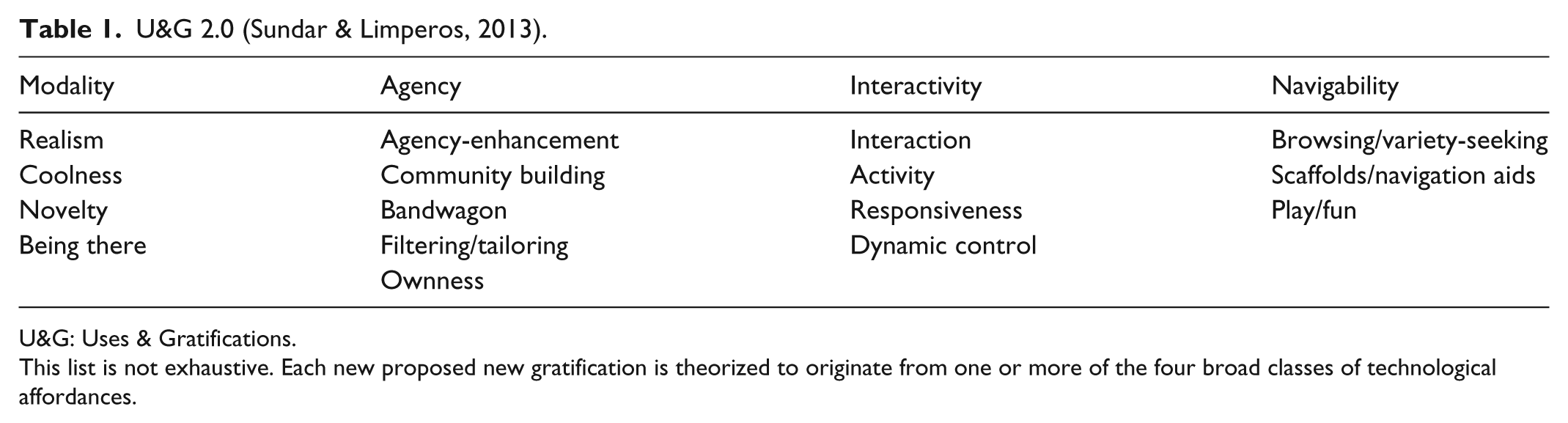
U&G: Uses & Gratifications.
This list is not exhaustive. Each new proposed new gratification is theorized to originate from one or more of the four broad classes of technological affordances.
Research Question
Given the various activities possible in Pinterest, it is expected that user’s motives for utilizing each feature would be different. Scholars using the traditional U&G approach argued that information-seeking, entertainment, surveillance, managing personal relationships, establishing identity/status, and acquisition are the needs that are most likely to be gratified by Internet usage (Parker & Plank, 2000). However, with the development of innovative technologies providing far more specific action possibilities, social media likely trigger and satisfy new and more nuanced gratifications, as argued by U&G 2.0 (Sundar & Limperos, 2013). Therefore, this study aimed to examine individuals’ specific uses of Pinterest features based on the new gratifications proposed by Sundar and Limperos (2013) with the following research question:
Study Design
An online survey was conducted at Penn State University (N = 113). Data were collected from 10 October 2013 to 30 October 2013. All respondents were undergraduate students. The majority of the participants were females (N = 66, 58.41%). The average age of the participants was 20.69 (standard deviation (SD)= 1.01, range = 19-24). The majority of the participants were White (N = 85, 75.2%) and in senior year of college (N = 64, 56.6%).
Independent Variables
The major independent variables in this study are a battery of new gratifications based on heuristics generated from the MAIN model and labeled as U&G 2.0 by Sundar and Limperos (2013), as shown in Table 1. According to Sundar and Limperos (2013), affordances of media technology can shape user needs, giving rise to new and distinctive gratifications. As shown in Section 3 of Appendix 1, all of them were measured by a 5-point Likert scale (1 = strongly disagree; 5 = strongly agree) starting with the statement of “I use Pinterest because . . .” A few items were modified to fit the context of Pinterest. Table 2 shows the means and SDs for each gratification.
Descriptive Statistics for Independent Variables.

SD: standard deviation.
In addition to the new gratifications, several demographics (i.e., age and gender) and general Pinterest usage (i.e., number of followers and number of users participants followed) were also measured as independent variables.
Dependent Variables
The dependent variables of this study are the frequencies of ten Pinterest behaviors: searching, checking, pinning, liking, commenting, following, creating, exploring different categories, sharing, and inviting. Similar to the independent variables, all of these variables were measured on a 5-point Likert scale (1 = never; 5 = all the time). Table 3 shows the general user information and frequency of the ten Pinterest behaviors.
Descriptive Statistics for General Pinterest Information and Dependent Variables.

SD: standard deviation.
Data Analysis
To answer the RQ, a series of multiple regression analyses with the forward stepwise method was conducted to examine the relationship among the 16 gratifications derived from the MAIN model and the ten different Pinterest behaviors. Table 4 reports the statistics associated with this analysis.
Results of Multiple Regression Analysis With Gratifications Under MAIN Model as the IVs and the Pinterest Behaviors as DVs.

IV: independent variable; DV: dependent variable.
Gratifications shaded in gray indicate negative predictors. Non-significant predictors are not included in the table.
p < .001; **p < .01; *p < .05.
Results
Predictors of Pinterest Behaviors
Specifically, scaffolding (β = .30, p < .01) and coolness (β = .28, p < .01) positively predicted the likelihood of pinning, together explaining 25% of the variance. Scaffolding (β = .33, p < .001) positively predicted the likelihood of creating (R2 = 10%). Dynamic control (β = .33, p < .001) positively predicted the likelihood of liking (R2 = 10%). Both realism (β = .39, p < .001) and community building (β = .30, p < .01) positively predicted the likelihood of commenting, whereas coolness (β = −.29, p < .01) negatively predicted the likelihood of commenting. Together they explained 23% the variance. Novelty (β = .28, p < .01) positively predicted the likelihood of following (R2 = 7%). Coolness (β = .33, p < .01) and browsing (β = .25, p < .05) positively predicted the likelihood of exploring different categories, together explaining 25% of the variance.
Coolness (β = .28, p < .01) and browsing (β = .27, p < .05) positively predicted the likelihood of searching (23% of the variance explained jointly by the two predictors). Responsiveness (β = .41, p < .001) and realism (β = .28, p < .01) positively predicted the likelihood of checking, together explaining 28% of the variance. Being there (β = .29, p < .01) positively predicted the likelihood of sharing, while play (β = −.29, p < .01) negatively predicted such likelihood. Together they explained 19% of the variance. Realism (β = .37, p < .01) and community building (β = .28, p < .01) positively predicted the likelihood of inviting, whereas play (β = −.23, p < .05) negatively predicted the likelihood of inviting (18% of the variance accounted for by the three predictors together).
Discussion
The major finding of this study is that a brand new set of gratifications (specific to digital media) predicted many user behaviors in Pinterest, thus highlighting the empirical utility of the U&G 2.0 framework (Sundar & Limperos, 2013) for studying future technologies. This framework emphasizes gratifications derived from four classes of affordances, namely modality, agency, interactivity, and navigability.
Modality refers to different presentation modes appealing to different human perceptual systems (Sundar, 2008). Gratifications arising from modality predicted a range of behaviors. For instance, the realism gratification positively predicted commenting, checking, and inviting. The pictorial nature of Pinterest emphasizes the visual over the verbal, conveying reality in a manner that is readily obvious to the user instead of requiring cognitive effort. Those who are drawn to Pinterest because it offers an environment mimicking real life are more likely to engage in commenting, checking, and inviting because these activities are analogous to real-world face-to-face interactions. The coolness gratification positively predicts pinning, exploring different categories, and searching. Since pinning is a unique feature of Pinterest, especially compared to other features (i.e., chatting, commenting), it may satisfy the need for coolness. Infinite scrolling is a presentation technique used by Pinterest allowing users to browse endlessly when they scroll down the page. This design feature is a critical aid for users seeking coolness, as it helps them effortlessly explore categories in search of unique, distinctive, and stylish ideas. However, coolness is negatively related to commenting frequency. Since commenting is a common feature of social-media platforms, those seeking coolness from Pinterest are less likely to comment within this platform, as there are several other venues for this kind of activity. Results also showed another modality-related gratification novelty, positively predicted following. The more people follow, the greater the likelihood of discovering new things. Finally, being-there gratification was found to be a positive predictor of sharing. The use of visual modality and related affordances in Pinterest probably elicited a feeling of virtual presence, encouraging users to share pins with friends and families.
Agency refers to the fact that all individuals are agents or sources of information (Sundar, 2008). While self-agency is related to agency-enhancement gratification, as also filtering/tailoring and ownness gratifications, collective agency provides bandwagon and community-building gratifications. The last mentioned is positively related to both commenting and inviting behaviors. When pinners perform these two behaviors, they are actually benefiting other pinners, thereby providing the community-building gratification.
Among the gratifications related to the interactivity affordance, dynamic control positively predicted liking. In Pinterest, when a pinner likes a pin, it will be automatically stored on the pinner’s page. This implies that liking gratifies users’ needs for controlling and managing their information (as well as self-presentation) online. In addition, responsiveness is found as a positive predictor of checking. This implies that the design of the notification system in Pinterest is adaptive and responsive to those who check notifications frequently.
Among the gratifications related to the navigability affordance, it is found that browsing was positively associated with exploring and searching, scaffolding positively predicted creating, and play was negatively related to sharing and inviting. Both exploring and searching are behaviors that allow pinners to explore and search for information. This indicates that pinners who appreciate these two types of behaviors are more likely to receive gratifications that allow them to browse freely in Pinterest. Those seeking scaffolding probably appreciate the step-by-step instructions provided by Pinterest for guiding users as they create boards. The negative relationship between the play gratification and sharing and inviting activities suggests that those seeking to play on Pinterest are less inclined to use networking activities offered by this platform; instead, they prefer to browse and explore on their own.
The repertoire of affordances in Pinterest caters to a wide array of user gratifications, thus explaining the widespread appeal of this social-media platform. The gratifications discovered in this study—ranging from coolness to scaffolding—are far more nuanced and informative than the broad “umbrella” gratifications typically identified by traditional U&G studies, such as information-seeking and passing time. Although this study is conducted under the context of Pinterest, U&G 2.0 could also be extended to other social-media platforms such as Facebook, LinkedIn, and Twitter to explore the relationship between specific features on these SNSs and user gratifications. Future research on uses of new and emergent media would do well to probe deeper and identify specific gratifications, as we have done here, in order to better understand the psychological appeal as well as behavioral adoption of those media.
Despite fruitful findings, this study has several limitations. First, the sample size is relatively small. Second, our sample comprised entirely college students. Future research with participants from various backgrounds can test the generalizability of our findings. Given the gendered nature of Pinterest (Ottoni et al., 2013; Zarro, Hall, & Forte, 2013), a study with a larger sample may compare the differential effects of affordance-based gratifications on male versus female behaviors in Pinterest. In addition, future studies would do well to examine the new and emerging features of this medium, such as allowing users to add geographical locations on their pins, and examine their relationships with specific psychological gratifications.
Footnotes
Appendix 1: Questionnaire
Declaration of Conflicting Interests
The author(s) declared no potential conflicts of interest with respect to the research, authorship, and/or publication of this article.
Funding
The author(s) received no financial support for the research, authorship, and/or publication of this article.