




Abstract
Almost since the advent of the Internet, there has been great interest in analyzing and understanding online communication from the perspective of public sphere theory. The question of whether the properties of the Internet and, specifically, social media actually contribute to the public sphere is the matter of ongoing and somewhat heated scientific debate. The aim of the article is twofold. First, we propose a hierarchical model of generalized functions of public sphere. On a theoretical level, we interweave different strands of thought on the public sphere, and the resulting model is more inclusive and less rigid than each of those strands on their own. We identify four generalized functions: identity building, agenda-setting, control and criticism, and deliberation. The Internet does not contribute equally to these functions and we evaluate the impact of the Internet on each of these functions as a diminishing marginal utility. Second, we empirically explore the plausibility of our model in a global comparative analysis with focus on the Internet. With the help of macro-level variables which indicate the structural preconditions for a public sphere, we identify the highest possible function of the public sphere for each country to which the Internet can potentially contribute. Based on this approach, future research can be contextualized: case-study-based research can plausibly articulate expectations regarding the impact of the Internet on the public sphere.
Keywords
Does the Internet contribute to the public sphere? This seemingly simple question has been notoriously difficult to answer for the better part of the past two decades. Almost since the advent of the Internet, there has been great interest in analyzing and understanding online communication from the perspective of public sphere theory (e.g. Dahlberg, 1998; Keane, 1995; Sunstein, 1995).
It is hardly surprising that the Internet has been garnering attention from public sphere scholars for a long time. The Internet as a network of networks has some inherent technical properties, such as interactivity, openness, and the potential for equality, that lend themselves to reflections from a public sphere perspective. In order to analyze the Internet in such a manner, online communication is often contrasted to classical mass media, because the latter offer, for the most part, only a one-way stream of information flow, whereas the Internet holds the potential for many-to-many communication without some of the limitations of physical many-to-many communication, such as the need to convene in one geographical location (Calhoun, 1998). In this line of reasoning, the Internet evoked images of a possible digital agora early on (Rheingold, 1993b). In recent years, the interactivity of the Internet is perhaps most prominently on display with social media (boyd & Ellison, 2007): if by social media we mean Internet-based applications that allow the creation and exchange of User Generated Content (Kaplan & Haenlein, 2010), then social media represent the most acute and a very immediate form of an interaction between users who are not merely a passive audience, but active and interconnected agents.
The question of whether these properties of the Internet actually contribute to the public sphere, that is, whether the potentials of the Internet are actually realized, is the matter of ongoing and somewhat heated scientific debate (for an overview, see Schäfer, 2015). Some authors maintain an optimistic position. They see the change the Internet brings about as significant (e.g. Shirky, 2011) and expect it to give rise to new waves of democratization (e.g. Bohman, 2004; Lagos, Coopman, & Tomhave, 2014; Langman, 2005) because the Internet represents a highly fertile soil for public communication among citizens. Other authors are more cautious in their conclusions. They argue that an impact of online communication on the public sphere is to be expected, but they see the impact as a limited one (Dahlgren, 2005; Gerhards & Schäfer, 2010; Papacharissi, 2002). Others still dismiss the notion of the Internet as a contribution to the public sphere and warn of a threat to democratic processes by mistaking online communication as a functionally and structurally equal counterpart to a more conventional understanding of the public sphere (e.g. Dean, 2003; West, 2013).
How does this ambiguity with regard to the Internet’s relevance for the public sphere come about? On their own, many findings have high degrees of plausibility and validity. But synthesizing all of the fragmented pieces of theoretical and empirical research into a coherent big picture is a daunting task. Not only is there a great amount of research, but the research also relies on differing notions of the concept of the public sphere. The public sphere is not a clear-cut theoretical concept and there can be, we believe, rational disagreements over its definition. In order to assess the relevance of the Internet for the public sphere, it is necessary to take this diffuse theoretical nature of the public sphere into account and offer a very explicit theoretical and empirical understanding. We aim to do so with this article.
The first step is the introduction of a less rigid understanding of the public sphere. We propose a theoretical model of generalized functions of the public sphere. Instead of being fixated on what the public sphere ought to do, it is more fruitful to think about the degree to which the empirical functions of the public sphere are realized. Such a functional, outcome-oriented perspective lends itself to a generalization: to which degree these functions are met is not a question that can only be asked in Western democracies. In a second step, we perform an exploratory data analysis based on certain structural preconditions in order to assess the potential impact of the Internet on the public sphere. In a comparison of over 160 countries, we examine whether there is a plausible correspondence between our theoretical functions of the public sphere and the empirical structural preconditions for the possible realization of the public sphere in these countries. Our approach strikes a balance between theoretical argumentation and empirical analysis in order to provide a theoretico-empirical framework for further case-study-based research.
The Contested Concept of the Public Sphere
The concept of the public sphere is one that is widely recognized and intuitively palpable, but rather difficult to clearly define and operationalize in empirical terms. While there is little disagreement over the idea of a public sphere in and of itself, the specific meaning of that concept is contested. The nature of this disagreement is not simply one of different authors meaning completely different things when talking about the “public sphere.” Rather, the contestation over the concept of the public sphere arises precisely because there is usually a baseline agreement over its meaning, and given that baseline agreement, disagreements over the concept’s normative valence as well as its necessary and sufficient dimensions arise. The public sphere thus displays the typical properties of an essentially contested concept (Collier, Hidalgo, & Maciuceanu, 2006; Gallie, 1955). What makes the public sphere an essentially contested concept is the realization that the conceptual disagreements over the public sphere, deep though they are, can be rational in nature: if informed and coherent enough arguments are presented, conceptualizations of the public sphere can reasonably differ from each other without any of them being necessarily more correct than the others.
The contested state of public sphere conceptualizations arises primarily from the fact that the public sphere is not a phenomenon that can be clearly observed and measured. Dewey (1927) described the public sphere as “The lasting, extensive and serious consequences of associated activity . . .” and remarked that “In itself it is unorganized and formless” (p. 67). The formless nature of the public sphere led Lippmann (1925) to describe the public sphere as a “phantom” that “does not select the candidate, write the platform, outline the policy any more than it builds the automobile or acts the play” (p. 57). These two early conceptualizations by Dewey and Lippmann already demonstrate the nature of the public sphere as an essentially contested concept. Even though the differences in the conceptualizations between Dewey and Lippmann are sometimes portrayed as fundamental, they did actually have a shared baseline agreement (Schudson, 2008), but differing views on the capacity of the public sphere to sustain the functioning of a democratic republic.
An overview of more contemporary strands differing but rational concepts for the public sphere is presented by Ferree, Gamson, Gerhards, and Rucht (2002a). The authors are interested in what qualities a public sphere should have in order to “nurture and sustain a vigorous democratic public life” (p. 289). The four models the authors identify (representative liberal, participatory liberal, discursive, and constructionist) differ on the input, throughput, and output dimensions and originate from different traditions of normative thought. In part, those different traditions of normative thought are due to the country- or region-specific political realities, such as the differences between corporatist and pluralist interest-group participation (cf. Schmitter, 1974 for an elaboration on corporatism and pluralism).
The magnitude of disagreements between different conceptualizations of the public sphere can be greater still. For example, some authors maintain that the public sphere should not serve any normative ends nor be based on any normative premises. One of the more prominent proponents of such a non-normative public sphere is Luhmann (2000). By embedding the concept of the public sphere in his systems theory approach, Luhmann strips the public sphere of any rationality pretensions and understands it from a purely descriptive-functional angle.
Faced with such a multitude of conceptual understandings, one might get the impression of the public sphere as an “anything goes” approach. However, as mentioned before, the public sphere as an essentially contested concept means that different conceptualizations are not arbitrary, but instead have a shared baseline around which different understandings are built. We operate in this very fashion with the model that we introduce: our starting point is a common baseline understanding of the public sphere, to which we add further aspects. Moreover, these additional aspects in our proposed model are not new but derived from well-established theoretical and empirical findings. The innovation in our model is the manner in which we collate these different aspects into one concept.
A Model of Generalized Functions of the Public Sphere
In this section, we introduce a model of generalized functions of the public sphere. The functions in our model are summarized in Table 1, along with their requirements, possible effects, and the magnitude of impact that the Internet can have for the realization of these functions. These aspects are discussed in the following subsections.
Summary of the Hierarchical Model of Generalized Functions of the Public Sphere.

Three Properties: Functionalism, Generalization, and Hierarchical Order
The baseline understanding which serves as our theoretical starting point is the public sphere as a network of communication:
The public sphere can best be described as a network for communicating information and points of view (i.e., opinions expressing affirmative or negative attitudes); the streams of communication are, in the process, filtered and synthesized in such a way that they coalesce into bundles of topically specified public opinions. (Habermas, 1996, p. 360)
This definition incorporates several important aspects. First, we are interested in communication and thus we do not conceptualize the public sphere as a geographical, but a communicative space. Second, the public sphere is not simply the sum of existing atomistic communication, but can be conceptualized as a network. Third, when bundled into public opinions, streams of public communication can have impact.
Habermas is one of the most well-known proponents of a normative conceptualization of the public sphere. Even though we use his baseline definition as a starting point, we do not embrace his normative elaborations. We do not operate with a priori beliefs on what the public sphere should do, but we propose instead to focus on what the public sphere actually does. Thus, the first property of our proposed model is a functionalist one. A functionalist perspective, of course, is not new. For example, the aforementioned perspective of Luhmann (2000) is functional in nature. A functionalist perspective is also proposed by Dewey (1927), who builds his analysis on the premise that a researcher should focus on describing what the public sphere is and not what it ought to be. 1
The second property of our proposed model is generalization. The generalized functions that are identified in the following subsections are universal: those functions apply to any polity, not just Western liberal democracies.
The third property of our model is the hierarchical order of the functions. The four functions have a quasi-Maslowian (Maslow, 1943) functional ordering in that higher functions are likely to be realized more often when the lower functions show a greater degree of saturation. The higher functions always incorporate all the lower functions and add a new functional layer on top. This does not mean that in reality, instances of higher functions can only happen when lower functions are permanently met. However, a higher function will only exhibit permanence when the lower functions do so as well.
First Function: Identity Building
Engendering a sense of collective identity among a group of people is the first and most basic function of the public sphere. We refer to this function as identity building, a concept popularized by Weber (1922/1978) with his Vergemeinschaftung. 2 He understood it as the “subjective feeling of the parties . . . that they belong together” (Weber, 1922/1978, p. 40).
The idea that societal integration through collective identity building is the first step to creating any sort of body politic is an old one. It is traceable at least to Aristotle, who argued that individuals’ teleological purpose was to be a citizen of the polis. Contractualist theories of political legitimacy, beginning with Hobbes (1651/1998) and Locke (1689/1988) in the 17th century up to Rawls (1971) in the 20th century, refer to a (contrafactual) moment in which individual people recognize each other as equals and decide to form a collective. The philosophical ideal of collective identity was perhaps most vigorously expressed by Rousseau (1762/2001), who described the transformation of individuals into citizens by partaking in the general will.
From a less philosophical and more sociological and psychological point of view, there is a general consensus that collective identity is socially constructed (Eisenstadt & Giesen, 1995; Tajfel, 2010) and that communication plays a vital role in creating any collective identity (Hardy, Lawrence, & Grant, 2005; Hogg & Reid, 2006).
Identity building is not normatively loaded; whether collective identity is desirable or not is a matter of case-by-case interpretation. It is, however, clear that any collective identity always has a demarcating aspect: the group one feels to belong to is in part defined by not being part of another group. Thus, where there is collective identity, there is intergroup bias (Castano, Yzerbyt, Paladino, & Sacchi, 2002; Mullen, Brown, & Smith, 1992) with its possible consequences, such as nationalistic fervor or religious radicalization. Collective identity is both a necessity for and potential threat to democracies.
Impact of the Internet
In the early days of the Internet, Rheingold (1993a) noted that online communities “might be something entirely new in the realm of social contracts, but . . . they are in part a response to the hunger for community that has followed the disintegration of traditional communities around the world” (p. 62). Papacharissi (2002) and Dahlgren (2005) also emphasize identity building in the online environment. On this level, the public sphere is highly fragmented and far from ideal, but it might help people to “cultivate a collective identity” (Dahlgren, 2005, p. 152). The identity building function of the Internet is especially relevant in authoritarian countries. For example, Yang (2003) stresses identity building as a main function of a virtual public sphere in the Chinese context.
Clearly, then, the Internet has a potential impact on identity building. However, that impact will be of medium magnitude, because it is very much dependent on the availability of the Internet. If only a small fraction of the people has access to the Internet and engages in online communication, a collective identity, logically, does not form.
Second Function: Agenda-Setting
When the first function of identity building reaches some level of permanence in the form of a collective identity, it becomes likelier that the political elites will become receptive to public communication: agenda-setting takes place.
The term “agenda-setting” can refer to different processes. In communication science, agenda-setting is usually understood in the tradition of McCombs and Shaw (1972). From this perspective, the aim is to find out how the mass media agenda impacts the issue salience of ordinary people as well as of the political system. In political science, agenda-setting is understood in a more abstract way. The political elites as political institutions are a system that receives stimuli from their surroundings, and these stimuli can elicit responses if they pass a certain threshold (Jones & Baumgartner, 2005). Our understanding of agenda-setting is a combination of these two perspectives: public communication is the stimulus that the political elites receive, and given a relatively high level of identity building, the stimulus can be significant enough for the elites to be receptive to it.
Agenda-setting as a stimulus–response exchange between the public and the political elites does not necessarily pertain to democracy. From the perspective of the extant political powers, engaging in this form of agenda-setting can be no more than self-interest with the goal of conservation of power.
Impact of the Internet
Research indicating that the Internet can play an important role for the agenda-setting function in less democratic countries is beginning to accumulate. A prominent example is China, where it has been observed that online communication can disrupt classical flows of agenda-setting. State-sponsored media traditionally had the role of setting the government agenda onto the public, but online communication is beginning to reverse the effect in some instances: state-sponsored media in China are becoming receptive to online communication (Hassid, 2012; Rauchfleisch & Schäfer, 2015; Tang & Sampson, 2012). Moreover, this agenda-setting effect of online communication on state-sponsored media is also likely to serve as a stimulus amplification that makes a response by political elites likelier (Jiang, 2014). A similar reversal of agenda-setting flows has been observed in South Korea, although the amplification effect is a lot stronger, because the media system is less restricted than in China (Kim & Lee, 2007).
The potential impact of the Internet on the agenda-setting function is high. Online communication can, as argued above, coalesce into communication flows that either on their own or through amplification effects through mass media elicit responses from political elites.
Third Function: Control and Criticism
When the first and second functions achieve relative permanence, agenda-setting grows into another type of exchange that is best described as control and criticism. The political elites are still receptive to stimuli stemming from the public through agenda-setting. In addition, political accountability changes the nature of this process insofar as the public, in turn, reacts to the actions undertaken by the political elites which results in further stimuli that the political elites are, again, receptive to. In other words, a policy cycle emerges (Lasswell, 1956). Functionally, a policy cycle can be described as a principal–agent-relationship (Calvert, McCubbins, & Weingast, 1989; Eisenhardt, 1989; Miller, 2005). The principal (the citizens) is (implicitly or explicitly) giving the agent (the political elites) a mandate. The public sphere is the way the principal monitors and, if necessary, corrects the agent by giving stimuli feedback.
Why should political elites engage in such a policy cycle? We do not have to speculate about changes in the intrinsic motivation of political actors—there is no need to assume a sudden motivational transformation of political actors once the public sphere achieves higher levels with more permanence. Instead, it is very likely that the specific institutional configurations within a country matter. In democracies, formal political power is tied to popular sovereignty and as a consequence, political office is temporarily granted by popular elections. It is in the self-interest of political actors to be adequately responsive to public stimuli so as to increase the probability of retaining office.
Impact of the Internet
The logic of the control and criticism function is one of accountability. While the Internet cannot create the institutional preconditions necessary for a policy cycle based on accountability, it can expand and expedite existing processes. A prominent example for this is the implementation of so-called “e-government”: services that make access to governmental information easier, encourage interaction and promote transparency (Bertot, Jaeger, & Grimes, 2012). E-government has been found to contribute to citizen trust in their government (Tolbert & Mossberger, 2006) and has been linked to a reduction of perceived (Elbahnasawy, 2014) and actual corruption (Krishnan, Teo, & Lim, 2013).
The potential impact of the Internet on the function of control and criticism is medium. The main reason is the institutional barrier necessary to allow for control and criticism. However, when the institutional configuration allows for a control and criticism policy cycle, the Internet can contribute to such a policy cycle by making observation by and feedback from the public simpler and more immediate.
Fourth Function: Deliberation
Deliberation is the fourth and final function of our model: when the prior functions are realized with some permanence, the public sphere is in such a good shape that instances of deliberation, that is, of rational disputes over validity claims (Habermas, 1976) seem to enter the realm of the possible.
Impact of the Internet
The potential contribution of the Internet to deliberation is obvious: it represents an opportunity to engage in rational discussion over validity claims, because in principle, the Internet offers a communicative space that approaches an ideal speech situation (Buchstein, 1997; Heng & de Moor, 2003), that is, a discursive setting in which anyone can question existing and introduce new claims.
The potential impact of the Internet on the deliberation function is low. The prerequisites of deliberation are just as difficult to fulfill online as they are offline (cf. Zamith & Lewis, 2014), and those demanding criteria of rational discourse are more likely to be met by professional communication in the mass media than by “layman” online communication which is often characterized by a semi-private attitude toward the communication situation (Rasmussen, 2014).
The Impact of the Internet on the Generalized Functions of the Public Sphere as a Diminishing Marginal Utility
In the previous subsections, we have described the four generalized functions of the public sphere and the potential impact the Internet has on those functions. The potential impact of the Internet is not universal: it is medium for identity building, high for agenda-setting, medium for control and criticism, and low for deliberation. In essence, this means that we expect the potential impact of the Internet on the functions of the public sphere to be a diminishing marginal utility. The logic of the potential impact of the Internet as a diminishing marginal utility is visualized in Figure 1.

Visualization of the diminishing marginal utility of the Internet for the functions of the public sphere.
Translating the Model of Generalized Functions Into a Comparative Research Program
We have introduced the model of generalized functions of the public sphere in order to further the debate on the question of whether the Internet contributes to the public sphere. We have specified different magnitudes of impact that the Internet is likely to have for each of the four functions of the public sphere. Now, it is necessary to translate the model of generalized functions into a comparative research program. The goal is to arrive at an empirical cross-country comparison that is theoretically informed by the model of generalized functions of the public sphere. More specifically, we want to address the following research question:
RQ. What is the hierarchically highest function on which the Internet potentially has an impact for different countries?
The Impact of the Internet on the Generalized Functions of the Public Sphere: Structural Preconditions
The model of generalized functions of the public sphere describes four functions of the public sphere. We have argued that the Internet potentially impacts those functions, and that this potential impact is of different magnitude for the different functions. The model of generalized functions of the public sphere describes four functions of the public sphere. We have argued that the Internet potentially impacts those functions, and that this potential impact is of different magnitude for the different functions. In order to, in a next step, assess the highest function to which the Internet is likely to meaningfully contribute in a given country, it is necessary to first define some empirical criteria for doing so. We call these criteria the structural preconditions for the realization of the public sphere: the structural preconditions are macro-level variables that encompass the main empirical dimensions of the degree of realization of the functions of the public sphere. In other words, the structural preconditions are indicators that indicate, probabilistically, which level of the functions of the public sphere can be realized in a given country.
With the idea of Occam’s Razor in mind, it is necessary to select as few variables as possible that carry as much information as possible as the structural preconditions. We propose three macro-level variables, and thus structural preconditions, that serve this purpose. First, since we are interested in finding out what the possible impact of the Internet on the functions of the public sphere is, an approximation for Internet usage has to be taken into account. Second, any country-level analysis of the public sphere is incomplete without taking into consideration mass media, because mass media still provide a master forum (Ferree, Gamson, Gerhards, & Rucht, 2002b). Third, political institutions matter. More specifically, the level of public communication is dependent on the level of civil liberties that are granted—public communication is, naturally, a function of the rights to communicate publicly.
For all of these three structural preconditions, suitable and carefully curated macro-level data exists. For an approximation of Internet availability, we use data on Internet penetration. We use data published by The World Bank (2014) that show the Internet penetration rate as the number of Internet users in a country per 100 people for the year 2012. The importance of the Internet penetration rate in the context of the Internet and public sphere has been recognized before (Kluver & Banerjee, 2005). It is a valid and reliable approximation for Internet usage.
For the structural precondition of mass media, different macro-level variables are possible. For example, one could focus on the absolute number of media outlets available in a country in order to approximate for media plurality. Alternatively, one could focus on the access to mass media, something akin to the access to the Internet. We choose a different and, we believe, more meaningful route by using data on media freedom as provided by the “Freedom of the Press” index published by Freedom House (2013) that covers the year 2012. The Freedom of the Press index ranges from 0 to 100, where 0 means highest media freedom. Media freedom is a suitable macro-level indicator because it is an approximation for how likely the mass media can operate freely and independently from government and other restrictions. Usually, media freedom is a very normative concept, but in this context, it is simply the functional component of media freedom that is of interest: the freer mass media are, the closer they come to truly contributing to the higher functions of the public sphere. For example, the more the media are controlled and censored, the less likely they are to contribute to agenda-setting. Instead of relaying stimuli from the public to the political elites and provoke responses, state-controlled media relay stimuli from the government onto the public.
For the structural precondition of civil liberties, we rely on the civil liberties dimension of the Democracy Index that covers the year 2012 (The Economist Intelligence Unit, 2013). The civil liberties dimension of the Democracy Index ranges from 0 to 10, where 10 means full civil liberties. Civil liberties as measured by the Democracy Index encompasses measures for the rule of law, freedom of religion, and respect of human rights and property. Crucially, it also covers freedom of expression, association, and protest. The civil liberties dimension of the Democracy Index also touches upon Internet use. 3 Overall, civil liberties are an approximation for the institutional status of the freedom of expression, in a direct and indirect sense. It directly covers whether citizens are formally allowed to voice their political opinions publicly. Other indirect aspects of freedom of expression are also relevant, because they indicate what level of repercussions are to be expected for voicing one’s opinion publicly. For example, formal freedom of expression is not very meaningful without rule of law, because political elites can curb and punish unwanted public communication at will. These variables, measuring so-called coordination goods, have also been identified as an important driver for democratization (de Mesquita & Downs, 2005).
Exploratory Data Analysis
In the previous section, we have described the three macro-level variables which we use to compare countries in order to determine what the highest function of the public sphere to which the Internet contributes is in different countries. On a methodological level, the actual comparison could, in principle, be performed in a multitude of ways. Two factors are relevant for the choice of an appropriate method. First, we want to compare countries according to three macro-level variables at once, and second, the available data covers 166 countries. 4 We are thus faced with data of a complexity that, effectively, bars the use of qualitative, non-standardized analysis. For that reason, we perform the data analysis with the help of unsupervised learning algorithms. More precisely, we decided to apply cluster analysis, because cluster analysis is a well-established method in the social sciences for grouping observations into homogeneous classes.
There are different variants of cluster analysis. In order to determine the most suitable variant, we analyzed the distribution of the different variables with the help of kernel density plots (Scott, 1992). The results of the kernel density estimations are reported in Figure 2.
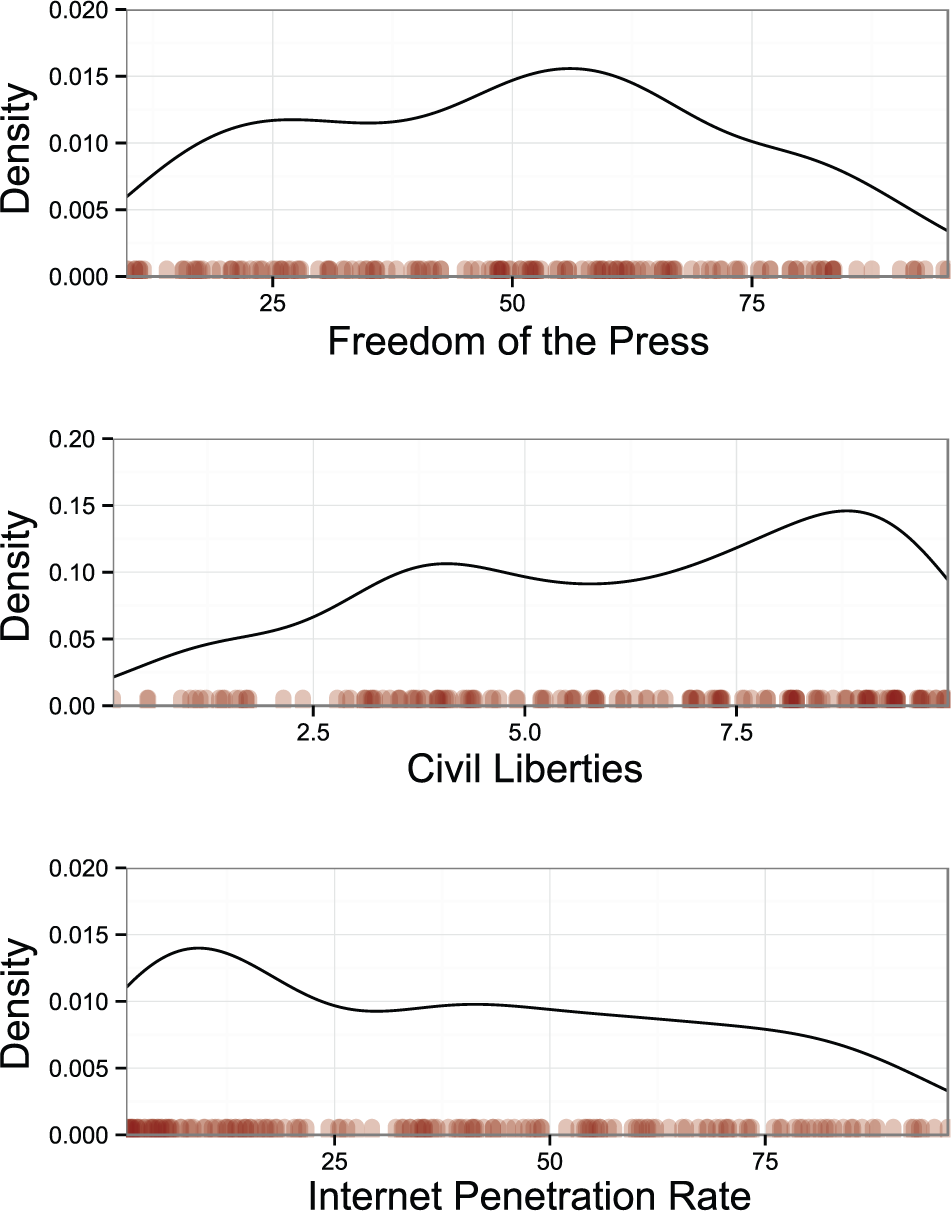
Kernel density plots for all three variables with a rug on the x-axis.
For all three variables, groups of countries with different Gaussian distributions can clearly be expected. This can be exemplified with civil liberties and its two peaks or with Internet penetration rate and the peak at an extremely low rate in the density plot. Based on the results of the kernel density estimations, we decided to implement a Gaussian mixture model (GMM) with expectation-maximization (EM) algorithm (Fraley & Raftery, 2002). This method can suitably cope with outliers and different densities in groups. Furthermore, the solution of the GMM that fits best to the data can be determined with the Bayesian Information Criterion (BIC) (Schwarz, 1978), which brings with it a number of advantages (Fraley & Raftery, 1999). Additionally, GMM with EM states the uncertainty of the classification for every observation. This helps to overcome the problem of static theoretical typologies with cohesive categories and allows for a better interpretation of the results on a per-country basis. The uncertainty reports the likelihood of every single case for every cluster to actually belong to that cluster.
We used the Mclust Package in the R programming environment (Fraley, Raftery, Murphy, & Scrucca, 2012). In order to decide which model fits best to the data, we compared the BIC for all of the possible combinations (n = 789). A three component model with ellipsoidal varying distribution, volume, shape, and orientation was the best-fitting solution. Whether these country groups 5 make sense in light of our model of generalized functions of the public sphere will be analyzed in the discussion. Table 2 shows a summary of the variables for each group. Figure 3 shows the classification and covariance for the groups, and Figure 4 summarizes the three variables for each group as boxplots.
The Three Components of the Cluster Analysis With the Means and Standard Deviation (SD) in Brackets.


Overview with the classification.

Tukey-boxplots for each variable and group.
As mentioned above, the uncertainty for every country was calculated. Uncertainty is an estimate for a country’s likelihood to actually belong to the assigned group. A high uncertainty 6 indicates that a country might belong to another group.
Three Different Country Groups
The biggest differentiator between the first group and the other two groups is the first group’s very low Internet penetration rate (see Figure 5). Group 2 consists of countries with a flawed media freedom and low civil liberties, but these countries have a higher Internet penetration rate than the countries in Group 1 (see Figure 6). Still, they are well below the high levels of saturation for all three macro-level variables that can be observed for Group 3. Besides very high civil liberties with a low standard deviation, the media is free and the Internet penetration rate is high in the countries of Group 3. The countries with the highest uncertainty in Group 3 (Italy and Trinidad and Tobago) are those with the lowest Internet penetration rates and civil liberties (Figure 7). It should also be noted that Group 3 has the lowest total population. The total population of all countries in Group 3 is lower than the population of China or India as single countries.

Section of the scatterplot with the countries of Group 1 with the two variables civil liberties and Internet penetration rate.

Section of the scatterplot with the countries of Group 2 with the two variables civil liberties and Internet penetration rate.

Section of the scatterplot with the countries of Group 3 with the two variables civil liberties and Internet penetration rate.
Discussion
Three different groups of countries were identified in our empirical model. These groups can be understood in terms of the proposed theoretical model of generalized functions of the public sphere: for all groups, the Internet has the potential to contribute to the functions of the public sphere. However, the highest of the four functions to which the Internet can potentially contribute is different for each group.
Group 1 mainly represents countries where the Internet at most has the potential to contribute to identity building. All countries in this group have a very low Internet penetration, which means that online communication can only contribute to the function of identity building. For agenda-setting and, eventually, criticism and control as next steps, the Internet penetration rate has to be higher. Countries with relatively high Internet penetration rate in Group 1 show a high degree of uncertainty and are on the path to agenda-setting.
When more people have access to the Internet, as is the case in Group 2, it becomes more likely that the Internet contributes to agenda-setting, because a critical mass of people can be reached and potentially mobilized, which means that the threshold of the political elites to perceive public communication is more likely to be reached. The success of agenda-setting is also heavily influenced by civil liberties and media freedom. The higher the civil liberties, the more likely it is that people will openly speak out. Also, the higher the media freedom, the more likely it is that critical issues will be picked up and amplified by the media. This aspect has already been highlighted in studies in the South Korean (Kim & Lee, 2007) and Chinese (Jiang, 2014) context, future research, thus, should focus more on cross-country comparisons. China and South Korea both belong to Group 2, but they have different preconditions which heavily influence the probability of successful agenda-setting.
For criticism and control to be realized, more civil liberties are needed, as can be found in Group 3. Only in countries with a high degree of civil liberties can the political system be openly criticized without fear of severe punishment. Due to the high Internet penetration rate, a great majority of people affected by an issue of common concern can participate in public online communication. However, given that the other structural prerequisites, civil liberties and media freedom, are so highly developed in Group 3, the Internet can be expected to contribute relatively little to the already highly realized functions of the public sphere. The interplay of all three variables on a high level enables control and criticism.
Besides these general results, some countries in our analysis are of special interest because of their current position. All countries with a high uncertainty in our model (e.g. Mongolia and Indonesia in Group 1, Bulgaria and Portugal in Group 2, Italy and Trinidad and Tobago in Group 3) are interesting cases, because they have the greatest potential to move up or down one step.
Furthermore, with Bahrain, United Arab Emirates (UAE), Kuwait, and Qatar, an interesting sub-group can be observed in Group 2. These countries share one common characteristic: their economies heavily rely on oil revenues, which possibly hinders democratic development (Ross, 2001) and strengthens authoritarian rule. With fast growing Internet penetration rates in countries such as Iran and Russia, this sub-group within Group 2 that is dependent on natural resources might in the future become more saturated and will develop into a separate group. These future developments might also affect our theoretical reasoning. Future research should closely observe these countries. Without a change in civil liberties, the Internet will not contribute to higher functions of the public sphere. This sub-group of countries exemplifies that there is not a predetermined development toward more civil liberties and media freedom. Internet penetration is the only macro variable which is constantly increasing, but a direct impact on political institutions is unlikely.
Deliberation: The Grand Thing That Never Was?
Empirically, we have identified three groups of countries. For each of those groups, we argue that the Internet potentially contributes to the functions of the public sphere, but the highest function to which the Internet potentially contributes is different for each group. The empirical results do not, however, perfectly correspond to the model of generalized functions of the public sphere: there is no separate fourth group where the Internet could contribute to the function of deliberation. This lack of a fourth group could prompt three responses. First, deliberation could be removed from the generalized functions of the public sphere. Second, the data analysis could be redone in such a way that it results in four instead of three country groups. Third, the nature of deliberation and its relevance as a generalized function of the public sphere could be reassessed. We are convinced that only the third option is a reasonable one. Neither an ad hoc alteration of the model of generalized functions nor the massaging of data so as to produce some desired results are scientifically sound options.
We are not of the opinion that deliberation is obsolete or non-existent. However, deliberation is first and foremost a micro-level concept that stems from pragmatics, or, more precisely, from speech-act theory (Habermas, 1976). This makes empirical research on deliberation a very demanding enterprise that yields modest results at best, not least when it comes to micro-level research (Neblo, 2007). It is hardly surprising, then, that macro-level variables do not identify countries where the Internet can contribute to deliberation.
There is no reason to remove deliberation from the model of generalized functions of the public sphere. We use the model of generalized functions as the theoretical foundation of a macro-level cross-country comparison centered on the question of the impact of the Internet. For this empirical research program, the function of deliberation is of little importance. Of course, that does not mean that the function of deliberation in the model of generalized functions cannot become more relevant in other empirical contexts, such as case-studies or micro-level research. However, we do think that a debate on the real-world relevance of deliberation should take place. Deliberation currently enjoys great prominence in public sphere research, as is indicated in Figure 8, and a myopic focus on deliberation means that the other functions of the public sphere receive too little attention.
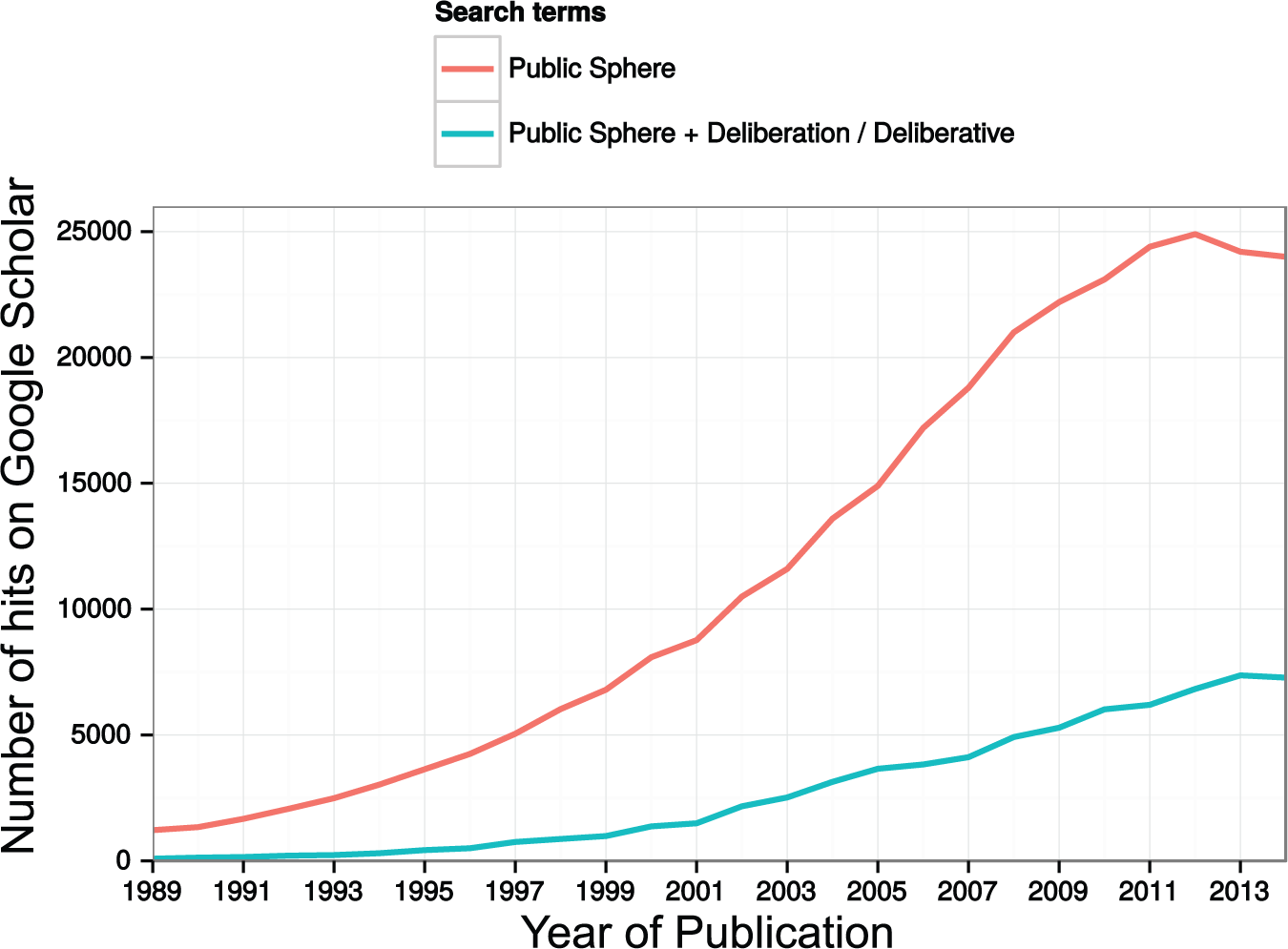
Comparison between the keywords Public Sphere and Deliberation/Deliberative on Google Scholar.
Of course, we are not the first ones to notice that deliberation in a narrow, micro-level sense is a tough conceptual nut to crack. That is precisely the reason why a number of theoretical advancements propose to think of deliberation not as a narrow, micro-level concept that also has macro-level implications, but instead as a genuine macro-level concept in its own right. One of the more promising strands of thought in this context is the idea of deliberation as deliberative systems (Mansbridge et al., 2012), where the locus of research lies on the systemic level, not on individual acts of communication. Deliberation as deliberative systems offers the tantalizing prospect of making deliberation observable and understandable on the macro- and meso-levels without the need for individual micro-level acts of deliberation to actually take place. Promising though this novel line of reasoning is, we believe that further research is needed to clarify whether deliberation as deliberative systems, if it is fully severed from its conceptual micro-level roots, means not only “deliberation on a different scale,” but also “deliberation in a different sense.”
The Transformative Potential of the Internet
Theoretically, we have described the contribution of the Internet to the functions of the public sphere as a diminishing marginal utility. The greatest impact of the Internet, we have argued, is to be expected for the function of agenda-setting.
Empirically, we have identified three groups of countries and interpreted these groups in terms of the highest functions of the public sphere to which the Internet can potentially contribute. The most relevant of those groups is the second one, where the Internet penetration rate is high enough for significant parts of the populations to have access to online communication, but civil liberties and media freedom are not as well developed as, for example, in Western democracies.
The theoretical impact of the Internet as a diminishing marginal utility explains what the transformative potential of the Internet for the public sphere is. Our empirical analysis identifies where this transformative potential is most likely to occur. The theoretical expectations and the empirical findings lead us to the following conclusion: the transformative potential of the Internet lies in its potential contribution to the function of agenda-setting for the countries belonging to the second group.
Outlook
Based on the results and arguments put forward in this article, future research can be contextualized and case-study research can plausibly articulate expectations regarding the impact of the Internet on the functions of the public sphere. The reasons for this are twofold.
First, structural configurations influence how likely actions are. This is the core logic of the generalized functions of the public sphere. If, for example, a given country has low civil liberties, media freedom, and Internet penetration, it is not at all impossible that some sort of control and criticism cycle will occasionally happen. It is, however, unlikely that the control and criticism cycle will happen often enough to achieve permanence. This means that the relationship between structures and actions in our model of the generalized functions of the public sphere is not one of determinism: we do not believe that structural configurations represent either an a posteriori smoking gun to completely explain or an a priori tool to exactly predict singular events. Instead, the structural configurations indicate likelihoods.
Second, structures tend to be path dependent. This means that the empirical strategy from this article is suited to be turned into a longitudinal project. By repeating the macro-level measurements we did in this article over time, it will become visible what countries are on which trajectory in terms of functions of the public sphere. This means that it might become visible when a country is on a path toward reaching higher levels of the public sphere functions, and, thus, in which countries the transformative potentials of the Internet are likely to be realized.
For both of these reasons, the understanding of the potential impact of the Internet on the functions of the public sphere as proposed in this article merits scientific attention.
Footnotes
Declaration of Conflicting Interests
The author(s) declared no potential conflicts of interest with respect to the research, authorship, and/or publication of this article.
Funding
The author(s) received no financial support for the research, authorship, and/or publication of this article.