




Abstract
This article investigates the relationship between social media platforms and the production and dissemination of selfies in light of its implications for the visibility of lesbian, gay, bisexual, trans, and queer (LGBTQ) people. Applying an Actor Network Theory lens, two popular visual media apps, Instagram and Vine, are examined through a comparative walkthrough method. This reveals platform elements, or mediators, that can influence the conversational capacity of selfies in terms of the following: range, the variety of discourses addressed within a selfie; reach, circulation within and across publics; and salience, the strength and clarity of discourses communicated through a selfie. These mediators are illustrated through LGBTQ celebrity Ruby Rose’s Instagram selfies and Vine videos. Instagram’s use expectations encourage selfies focused on mainstream discourses of normative beauty and conspicuous consumption with an emphasis on appearance, extending through features constraining selfies’ reach and salience. In contrast, Vine’s broader use expectations enable a variety of discourses to be communicated across publics with an emphasis on creative, first-person sharing. These findings are reflected in Rose’s Instagram selfies, which mute alternative discourses of gender and sexuality through desexualized and aesthetically appealing self-representations, while Vines display her personal side, enabling both LGBTQ and heterosexual, cisgender people to identify with her without minimizing non-normative aspects of her gender and sexuality. These findings demonstrate the relevance of platforms in shaping selfies’ conversational capacity, as mediators can influence whether selfies feature in conversations reinforcing dominant discourses or in counterpublic conversations, contributing to everyday activism that challenges normative gender and sexual discourses.
Introduction
“Be the person your dog thinks you are” was the mantra espoused in celebrity Ruby Rose’s Instagram (@rubyrose) bio in September 2015. With more than 5 million followers, the account showcases concert posters, anti-animal cruelty posts, and glamorous selfies. Her account dons a blue verification badge, Instagram’s (2015d) mechanism for signaling public figures’ official accounts, and she posts almost every day. In contrast, Rose does not have an official, verified Vine account and has tweeted to confirm this on two occasions (Rose, 2015a, 2015b). However, two Vine accounts 1 have repurposed videos of Rose as Vines, 6.5-s video clips, including mash-ups of media appearances and first-person, self-shot videos. Despite coming out, identifying as lesbian at age 12 (Evans, 2015), and being regarded as an LGBTQ 2 (lesbian, gay, bisexual, trans, and queer) pop culture icon (Same Same, 2010), Rose’s social media presence does not focus on sexuality or LGBTQ politics.
This article is interested in Rose’s selfies and first-person Vines as self-reflections with varying capacity to produce and circulate forms of LGBTQ visibility. In this context, the definition of “selfie” (2015) as “a photograph that one has taken of oneself, typically one taken with a smartphone or webcam and shared via social media” is broadened to include similarly recorded and disseminated videos. Although Rose did not personally post (video) selfies to Vine, the material sourced for Vines often differs from or shortens and recontextualizes her Instagram videos. Through a cross-platform comparison, this study uses Actor Network Theory (ANT) to identify the influence of platform components (e.g. features, activity flows) on the production and dissemination of selfies, illustrated through differences across Ruby Rose’s presence on each platform. ANT considers all actors in a given set of relations, such as relations of people and technology in the use of Instagram and Vine, taking into account the possible courses of action that non-human actors (or, objects) make available to other actors (Callon, 1986; Latour, 2005).
This article follows an ANT approach of tracing the networks of relations (Latour, 2005) configured through these platforms to examine how they influence the conversational capacity of selfies. Drawing on previous research showing how selfies range in a conversational spectrum from being primarily presentational (e.g. Marwick, 2015) to including elements that engage broader publics (e.g. Raun, 2014), a walkthrough method (Burgess, Light, & Duguay, 2015) is used to identify platform “mediators” (Latour, 2005, p. 39) as elements that shape and influence selfie production and dissemination. Specifically, this study identifies how these apps influence selfies in terms of the following: range, the variety of discourses addressed within a selfie; reach, the circulation of selfies within and across publics; and salience, the strength and clarity of discourses communicated through a selfie. Mediating differences across apps are explored through examples of Ruby Rose’s Instagram and Vine presence to discuss how selfies’ conversational capacity has implications for LGBTQ visibility.
Conversational Selfies Within Platform Politics
Senft and Baym (2015) discuss how a selfie is an “object that initiates the transmission of human feeling in the form of a relationship . . . [and] a gesture that can send (and is often intended to send) different messages to different individuals, communities, and audiences” (p. 1589). They describe relationships selfies can form, such as “between viewer and viewed, between individuals circulating images, between users and social software architectures” (p. 1589). This article focuses on the latter relational arrangement, reconceptualized as a relationship between selfie producers and social media platforms. Given Kavada’s (2015) declaration that “Conversations are what social media are designed for and where they draw their power from” (p. 1), platforms’ influences are interrogated to determine their role in the production of minimally conversational selfies, limited to mainly self-presentational messages congruent with dominant discourses, in contrast to more conversational selfies, which address and challenge discourses across publics. In this context, discourse is understood, according to Foucault (1969), as “the group of statements that belong to a single system of formation” (p. 107), constituting ideas, values, and attitudes that construct particular understandings, or knowledge, about people. Publics are conceptualized as gatherings of people around a discourse (Warner, 2002). Messages communicated through selfies can feature in conversations reinforcing dominant discourses within existing publics or form counterpublics, gathering people around alternative and opposing discourses (Fraser, 1990). Platforms reflect the “power of the architects of conversations” (Kavada, 2015, p. 1), such as software designers, as they play a role in configuring networks of relations through which discourses become materially enrolled within everyday social media practices.
Minimally conversational selfies uphold mainstream discourses in publics while avoiding counterpublic discourse. Marwick’s (2015) examination of microcelebrity on Instagram, or Instafame, found that popular users’ selfies were mostly self-promotional, displaying adherence to normative beauty standards, proximity to celebrities, and affluence. These practices are part of Instagram’s economy, in which users foster cultural capital through conspicuous consumption and self-branding, with some even generating economic capital through paid brand promotion (Abidin, 2014). Marwick (2015) found that popular Instagrammers engaged in limited conversation or did not respond to comments on their selfies. These highly self-presentational images displayed a disciplined and managed personal front (Goffman, 1959), exercising sustained control over appearances to build capital by reinforcing mainstream discourses.
In contrast, a growing body of literature describes selfies that challenge dominant discourses of gender and sexuality across publics. Tiidenberg and Gomez Cruz’s (2015) research into women’s Not Safe For Work (NSFW) selfies on Tumblr found that individuals formed a relationship with their selfies, which helped them to internalize “corporeal truths” (p. 11), combating body shaming discourses. Wargo (2015) found that LGBTQ high school students’ Tumblr selfies have a similar effect, producing digital “artifacts as sedimented identity texts” (p. 8). These selfies facilitate individual identity realization and counter peers’ misconceptions, for example, by featuring a basketball jersey to assert masculine gender identity despite stereotypes about the effeminacy of gay men. These selfies are self-presentational, but they also reflect and propagate counter-discourses of sexuality and gender to oneself, peers, and publics.
The difference between Instafamous selfies and those serving as identity texts on Tumblr can be identified as their contrasting range, reach, and salience—that is, the degree to which their messages convey a range of discourses, reach multiple publics, and are clearly accessible to these publics. Thumim (2012) acknowledges digital media scholars’ widespread use of Goffman’s (1959) notion of self-presentation as the ongoing performance of the self, but argues that self-presentations co-exist with, and are conceptually different from, self-representations. According to Thumim (2012), “When a self-representation is produced it becomes a text that has the potential for subsequent engagement” (p. 6). While this may apply to any social media post inviting further interaction, such as through comments and likes, the above examples illustrate how selfies can evoke more or less engagement, which can be understood as a selfie’s conversational capacity. In visual media platforms’ networks of relations, selfies are produced by actors—through negotiations between human users and non-human app features, software codes, and algorithms—while selfies, too, are actors with qualities, such as range, reach, and salience, which influence whether they feature in conversations across publics.
Using ANT to identify platforms’ role in shaping the conversational capacity of selfies situates this study within Science and Technology Studies, acknowledging the mutual shaping of users and technology in the development and appropriation of new technologies (MacKenzie & Wajcman, 1985; Sismondo, 2010). Attention to social media architectures heeds more recent invocations from platform and software studies to consider how social media and their coded software are not neutral actors (Gehl, 2014; Van Dijck, 2013). Instead, they are shaped by the politics of “platforms” (Gillespie, 2010), constituting social software companies’ tension between providing services for content generation and community building while simultaneously turning a profit. Such politics are subtly evident in algorithms, like Facebook’s Newsfeed rendering some users invisible (Bucher, 2012), and more blatantly obvious in design features, such as dating site menus categorizing gay men into niche markets (Light, Fletcher, & Adam, 2008). This article aims to more fully understand selfies’ relationship with social media platforms, specifically, mobile image-based apps.
LGBTQ Visibility Through Social Media
Queer theorists understand gender and sexuality as performative since they are enacted through and shaped by dominant discourses (Beasley, 2005). Berlant and Warner (1998) discuss the ubiquity of heterosexual culture and its “sense of rightness and normalcy” (p. 554) as heteronormativity. To counter heteronormativity, they rally for increased visibility of queer, or non-normative, performances of sexuality in public. Visibility of non-normative identities in mixed spaces of public discourse can give rise to “queer publics” (Berlant & Warner, 1995, p. 344) that open possibilities for new understandings around sexuality and gender. Berlant and Warner (1995) describe these as publics that “can comprehend their own differences of privilege and struggle” (p. 344). The conversational capacity of LGBTQ people’s selfies, as performances of sexual and gender identities, therefore influences the potential for circulating counter-discourses and forming queer publics.
LGBTQ people have long engaged with digital technology in ways aligning with the “selfie genre,” involving representation “that foregrounds staged self-reflection” (Bellinger, 2015, p. 1809). Physical selves were reflected even within early text-based digital technology, such as through same-sex attracted men’s discussions of sexual fantasies in chat rooms (Campbell, 2004) and women’s use of ASCII symbols (e.g. <> as a vulva) for flirting within a lesbian bulletin board system (Correll, 1995). These embodied sexual expressions have shifted toward photo-based selfies, such as those exchanged through dating apps like Grindr (Race, 2014), and remain supported by textual and symbolic self-reflections, such as emojis like  used to represent a penis (Rogers, 2015).
Beyond sexual conversations, LGBTQ people have employed staged self-reflections on social media to engage in identity development and circulate new understandings across publics. Ferreday and Lock (2007) explored how cross-dressers’ photo blogs facilitated development of a “real, transvestite self” (p. 171) as they displayed complex experiences of cross-dressing. “Coming out” videos on YouTube are staged, following common rhetorical conventions (e.g. disclosure, relief, appeals to community), but self-reflective in describing personal stories with which others can identify (Alexander & Losh, 2010). Similarly trans YouTubers chronicling their transitions and everyday lives make way for others to claim a trans identity while providing representations of trans people that can correct injurious media depictions (Raun, 2014). Trans people’s selfies have also featured prominently in political movements, such as selfies tagged #WeJustNeedToPee protesting legislation and norms restricting trans people’s use of public restrooms (Nichols, 2015). From their circulation across LGBTQ counterpublics and broader publics, it is clear that these selfies include a range of discourses (addressed to other LGBTQ people as well as heterosexual and cisgender individuals), have a far reach, and are sufficiently salient to influence understandings of sexuality and gender.
LGBTQ people’s visibility alone does not, however, challenge dominant discourses and form queer publics. Media representations are often assimilative, maintaining an “equal rights” discourse of sameness with heterosexual and cisgender people (Richardson, 2005; Warner, 1999). Assimilative representations can reinforce stereotypes that silence and obscure difference instead of increasing acceptance of diversity (Barnhurst, 2007). Commercialized gaystreamed (Ng, 2013) content produces a form of LGBTQ visibility marked by the depoliticized activity of consuming products and building lifestyles branded as gay. Berlant and Warner (1998) assert that heteronormativity is not only supported through discourses communicated among people but is also materially embedded in everyday objects. From an ANT perspective, discourses like heteronormativity are constructed through actor networks of material relations (Law, 2009). Platforms comprise material relations shaping selfies’ conversational capacity in ways that can contribute to a range of assimilative and counterpublic forms of LGBTQ visibility.
Cross-Platform Comparison of Conversational Mediators
Instagram and Vine were chosen for this study because of their emphasis on visual content and shared qualities conducive to comparing their politics and design. Both are owned by popular social media companies: Instagram was launched in 2010 and purchased by Facebook in 2012 (Stern, 2012), while Vine was released by Twitter in 2013 (Chang, 2013). As primarily mobile apps, they allow for recording, editing, and disseminating visual content. Vine offers 6.5-s videos, while Instagram allows users to record photos and, through an update following Vine’s launch (Instagram, Inc., 2013), now provides functionality for 15-s videos. Both apps permit content sharing across social media while providing their own platforms for user interaction and accruing followers. The platforms incorporate user-generated hashtags, which identify subjects, events, locations, or emotions captured in images (Highfield & Leaver, 2015), as well as temporal and geospatial tagging, enabling users to build personal narratives (Hochman & Manovich, 2013). Among these similarities, it is possible to identify differing affordances and constraints relating to selfies’ conversational capacity.
Ruby Rose’s Instagram and Vine selfies are used to illustrate platform mediators of conversational capacity. As an LGBTQ media personality with a history of public self-representations countering normative gender and sexual discourses, Rose’s selfies have the potential to communicate counter-discourses across publics. Rose has been open about her same-sex relationships, announcing her engagement to Phoebe Dahl through Instagram (Rose, 2014a). Identifying as gender-fluid (Evans, 2015), she critiqued gender norms in her short YouTube film, “Break Free,” which she described as “about gender roles, Trans, and what it is like to have an identity that deviates from the status quo” (Rose, 2014b). Rose has reached international audiences through her role in Orange Is the New Black, a TV show praised for exploring experiences of transgender and same-sex attracted women (Rolling Stone, 2015). Despite being an LGBTQ icon, Rose’s social media highlight her career, passion for other causes, and everyday life. Inclusion of her same-sex relationship and gender-fluid appearance have the potential to constitute everyday activism (Vivienne & Burgess, 2012), where the visibility of non-normative aspects of her life is political in itself. However, the decision not to have sexual identity at the forefront of one’s self-representation has been identified as a post-gay aspiration that can have both discourse-challenging and assimilative outcomes (Ghaziani, 2011). Therefore, Rose’s selfies present an opportunity to identify how platforms influence conversational capacity in ways that amplify counterpublic discourses or render them invisible.
Instagram and Vine are interrogated through the walkthrough method (Burgess et al., 2015), which systematically traces relations among actors that are configured through apps’ everyday use. These relations involve what Van Dijck (2013) has termed “techno-cultural constructs”—technology, content, and users—as well as “socioeconomic structures” (p. 28) of ownership, governance, and business models. The walkthrough draws on ANT’s relationality (Law, 2009), identifying how actors in an app’s network of relations define and shape each other. Actors consist of intermediaries that transport meaning across a network without changing it and mediators that “transform, translate, distort, and modify the meaning or the elements they are supposed to carry” (Latour, 2005, p. 39). This study identifies non-human actors within platforms’ networks of relations that mediate the conversational capacity of selfies.
Involving step-by-step examination of Instagram and Vine’s design, features, and activity flows (how the app guides users through sequences of action), the walkthrough commenced with downloading the app and continued through registration and everyday use. Field notes and screenshots were recorded while exploring the apps’ interface, functions and features, textual content and tone, as well as aesthetics and symbolism (Burgess et al., 2015). Observations were supplemented with analysis of app companies’ help centers, terms of service, blogs, and related news articles, which identified how platforms’ ownership, governance, and business models were linked to technological mediators.
While data were collected using iPhone app versions from June 2015, subsequent updates have been considered when possible. Findings are relevant within this particular context, involving analysis of a small sample of Rose’s selfies, and do not represent all uses of these platforms. Analysis is limited and partial, since the walkthrough collects data about app mediators but not about users’ responses to mediators. Users have the ability to adopt, resist, or reappropriate platform affordances (Oudshoorn & Pinch, 2003), making platforms work for them in ways that may deviate from the following examples. Considering this, the findings show how platform mediators can shape users’ avenues for producing and disseminating conversational selfies.
Conversational Mediators
The following sections identify key platform mediators shaping selfies’ conversational capacity in terms of their range, the variety of discourses communicated; reach, circulation to others and across publics; and salience, the prominence of discourses communicated. Apps’ expected use, expressed through descriptions and app store ratings, suggests the kinds of images they should be used to produce, encouraging the reinforcement of certain acceptable discourses. This is seconded by how the apps present model content through navigational features, which—together with cross-platform connections—affect whether a selfie reaches particular publics. Content generation tools provide ways of presenting messages through images, which influence how salient they are in relation to dominant discourses. These mediators are examined in relation to Rose, identifying how they may modulate her selfies’ conversational capacity to produce and circulate discourses regarding gender and sexuality.
App Description and Rating
App stores shape the conversational capacity of selfies as they provide official descriptions, ratings, and example images (Figure 1), setting expectations for user content. Instagram’s description declares,
Instagram is a simple way to capture and share the world’s moments. Transform your everyday photos and videos into works of art and share them with your family and friends. See the world through somebody else’s eyes by following not only the people you know, but inspirational Instagrammers, photographers, athletes, celebrities and fashion icons. Every time you open Instagram, you’ll see new photos and videos from your closest friends, plus breathtaking moments shared by creative people across the globe. (Apple, Inc., 2015a)
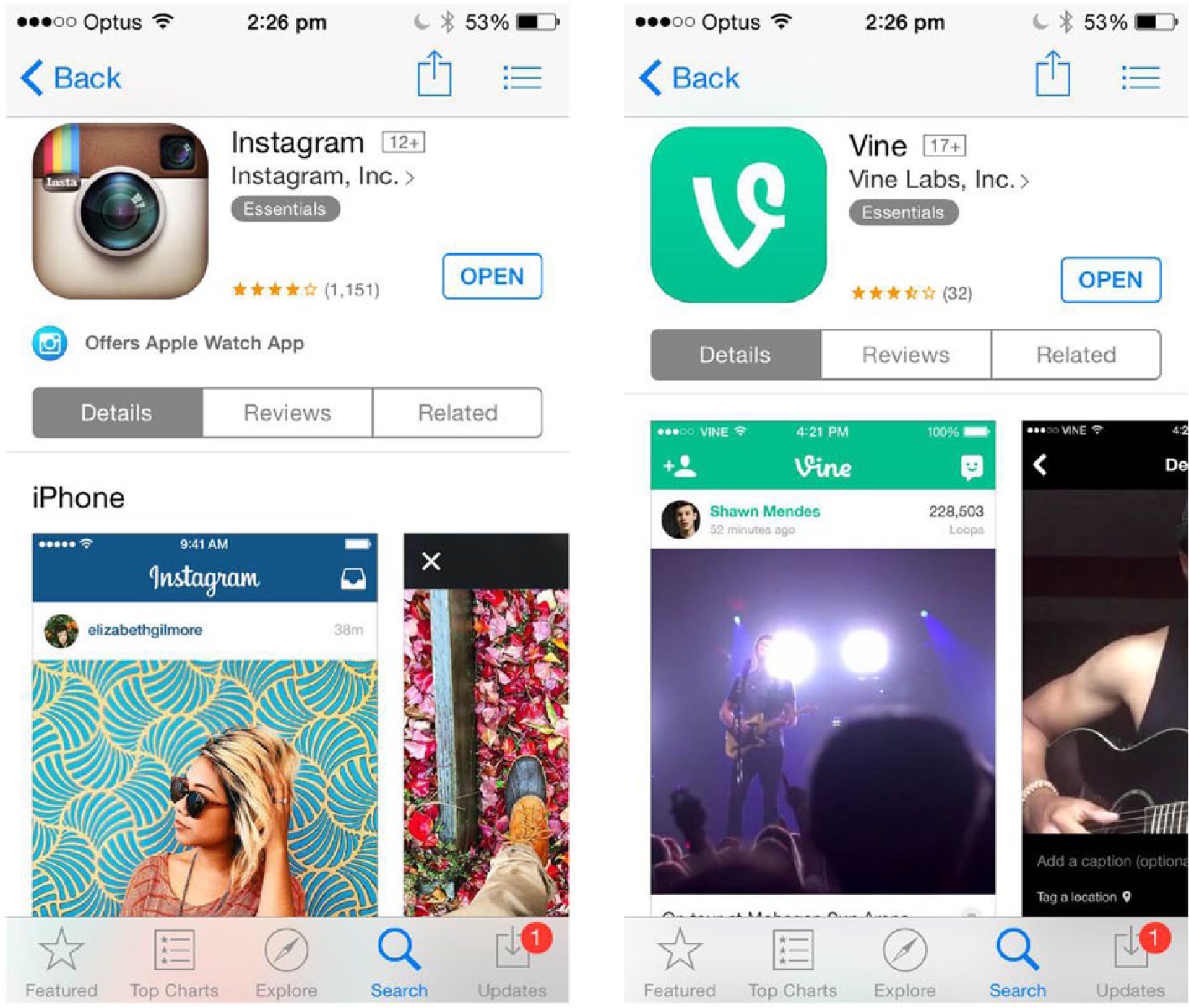
Apple’s mobile app store screens for Instagram and Vine.
This provides clear instructions that users should “capture and share” existing moments instead of creating new and unheard of moments. In fact, “everyday photos” are only appropriate for the app once they have been transformed into “works of art.” The description emphasizes passive viewership of celebrity and microcelebrity culture, seeing the world through others’ eyes instead of providing personal and countering perspectives.
The subject in Instagram’s example portrait is positioned strategically in front of an aesthetically pleasing background, basks in perfect lighting (perhaps augmented through a filter), and re-creates a confident celebrity pose while displaying fashion items. Similar to individuals featured in Instagram’s registration screens, this model user is young, affluent, appeals to gender norms, and captures moments outside of the everyday. Rose’s Instagram selfies conform to this expected use, engaging in mainstream discourses of youthfulness, consumption, and beauty. Rather than displaying the everyday, her selfie (Figure 2) captures being on set in Ibiza while displaying an affluent lifestyle. Rose’s Instagram selfies frequently focus on her celebrity experiences, emphasizing commercial products through shout outs to designers and promoting Dahl’s clothing line (@faircloth_supply).

Instagram selfie (Rose, 2015f).
In contrast to Instagram’s app store page, Vine’s description reads,
Vine makes video fun. You can watch, create and share short looping videos—anytime, anywhere. Through these videos, called Vines, people have an entirely new medium to express themselves and their creativity. Vine empowers anyone to share stories with the world and is a space where people can connect, entertain and be entertained. (Apple, 2015b)
This pitch envisions users actively engaged in a creative process telling personal stories rather than seeing “the world through somebody else’s eyes,” as Instagram suggests. Vine emphasizes fun, entertainment, and connections without constructing a hierarchy between everyday users shooting video “anytime” and (micro)celebrities capturing inspirational moments. Although the example screenshot (Figure 1) features singer Shawn Mendes, the image largely obscures his face and instead places attention on the shot’s first-person perspective. This foregrounding, through an individual’s point of view, situates selfies within conversations centering on personal stories and experiences. Rose’s playful Vines fit these use expectations: Figure 3 is from a video where she addresses an imagined audience—“Ladies and gentlemen, I have decided to see what it would look like if I didn’t have no tattoos.” Panning the camera across her arms and returning to her face, she declares, “Well that’s a very weird looking situat-” cut off by the 6.5-s limit. This video gives fans a personal view into Rose’s everyday life, as it appears to be in preparation for a gig that requires covering her tattoos. Her messy hair close-up without make-up contrasts drastically with her glamorous Instagram selfies. While her joking tone and poor grammar maintain “fun,” as Vine encourages, she communicates a self-reflection about her tattoos, which are an ongoing source of contention in her career (Croffey, 2014). Her clip ties into the controversial nature of visible tattoos on women’s bodies, contributing to debates around gender discourses and tattooing in conformity with and resistance to conventional notions of femininity (Atkinson, 2002). While Vine’s emphasis on first-person self-representation facilitates a range of personal yet political discourses that are coherent within its platform, this clip originates from a longer version on Rose’s Instagram that appears out of place next to polished selfies.

Tattoo cover-up Vine (Rose, 2015h).
App store safety classifications also delineate the range and salience of discourses communicated through selfies by banning certain types of expression. Figure 1 shows Instagram’s safety rating, acceptable for ages 12+, while Vine is for individuals aged 17+. This difference has been attributed to Vine’s early relaxed censorship (An, 2013), following Twitter’s historical ambivalence toward censorship (Griffin, 2015), which has become more rigid to appease advertisers and app store stipulations. Both companies now censor hashtags paired with “inappropriate content” (e.g. nudity, violence, and drug-related behavior) (McHugh, 2013). Olszanowski’s (2014) identification of feminist artists’ responses to Instagram’s censorship of their nude selfies demonstrates that such stipulations shape selfie production. Some artists reduced their selfies’ reach by changing their accounts to private, while others reduced salience by covering body parts that would invoke a platform response.
Instagram’s lower age rating and longstanding censorship signal to users to keep their selfies clean and proper, while Vine’s more relaxed approach and higher rating indicate that selfies can contain content blurring the line of appropriateness. This difference in expectations for user conduct is reflected by Rose’s bright, in focus, desexualized Instagram “family portrait” in contrast to a dark, pixelated Vine of the couple kissing passionately at one of Rose’s gigs (Figures 4 and 5). While the portrait speaks to heteronormative and assimilative discourses of monogamy and domesticity with same-sex sexual desire maintained as private and hidden (Warner, 1999), the make-out scene unapologetically displays same-sex sexuality. Although making out is not “inappropriate” enough to warrant removal on either platform, Instagram’s rhetoric encourages selfies that avoid offending through assimilation with mainstream discourses.
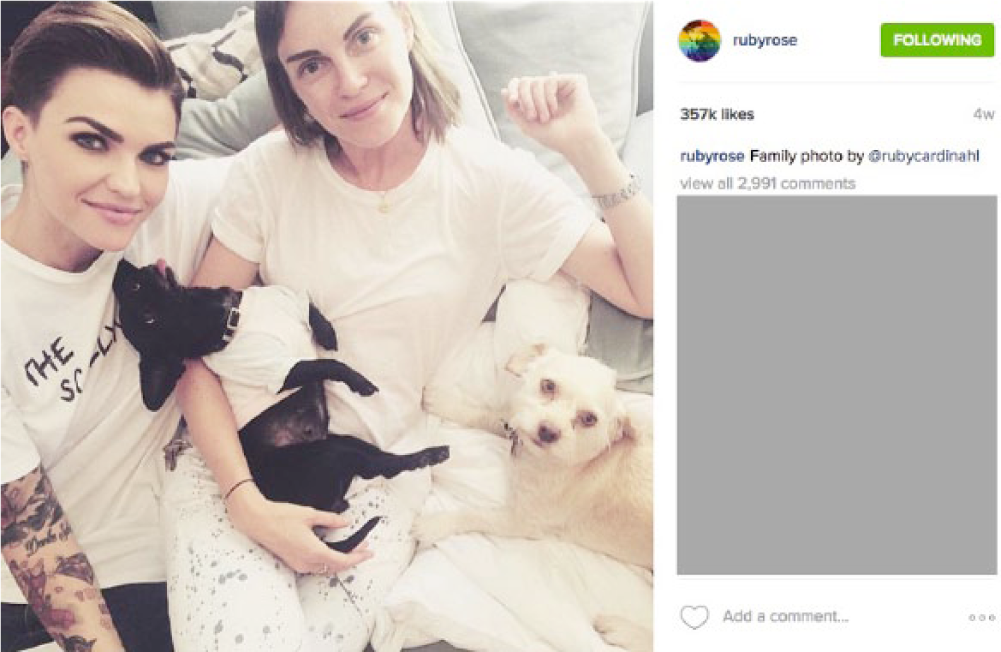
Instagram family photo (Rose, 2015d).

Vine make-out (Rose, 2015c).
Content Navigation
The apps’ navigational features (Figure 6) prompt activity flows influencing selfies’ range, in terms of their variety of discourses, and their reach within these platforms. On Instagram, individuals are guided to follow model users listed on its “Suggested” screen, after which they can tap the “Explore” icon to view content these accounts have liked (Constine, 2014), finding more Instagrammers to follow who have been vetted by these model users. Instagram (2015b) explains that suggested Instagrammers are chosen for their “commitment to creativity and community” and warns, “Keep in mind, we only highlight members of the community that follow our Community Guidelines.” These guidelines repeat Instagram’s values noted earlier, encouraging users to foster “an authentic and safe place for inspiration” (Instagram, Inc., 2015a). This guides users to create selfies congruent with the dominant discourses employed by Instagram’s model users (celebrity glorification, consumerism, normative beauty) since they see this content the most. It also affects the reach of selfies questioning these discourses, as they will never be promoted by the app.

Content navigation on Instagram (left) and Vine (right).
Although Vine lists popular Viners under its “Explore” tab, its content “channels” are the most prominent way to navigate videos. Upon registration, users are presented with 16 channels to which they can subscribe (Figure 6). While some channels feature celebrities, many organize content into everyday genres. Contrasting with Instagram’s model user approach, this form of navigation encourages users to cover a variety of topics rather than focusing on “inspirational” content. However, while the app permits users to assign Vines to particular channels, videos are only featured in channels based on “a combination of their popularity and editorial curation” (Vine, Inc., n.d.). Given that selfies communicating counter-discourses must compete with a dearth of popular banal content, this algorithmic and manual curation also influences their reach.
Individuals with many followers, however, may garner the algorithmic attention necessary to circulate counter-discourses into channels where they can visibly challenge dominant discourses in creative ways. In one Vine (Rose, 2015e), applicable to the channels “Comedy,” “Music,” and “Animals,” Rose sings Iggy Azalea’s “Fancy” in a pet shop to a hamster whose cage is labeled “Female Fancy Hamster.” This playful repurposing of a song by an artist known to be homophobic (Hope, 2015) provides a subtle counter discourse highlighting the absurdity of its lyrics and, consequently, Azalea’s persona (whether or not this is Rose’s intention). This illustrates Latour’s (2005) notion that local actor networks can have connections with multitudes of other actor networks in assemblages of relations through which the local eventually comprises the global. In this example, local actor networks, including Rose, everyday settings, users reappropriating her video, and Vine, connect to global actor networks relating to pop culture and politics. This capacity for selfies to include messages with a range of discourses involving multiple actor networks increases their reach through inclusion in conversations across publics.
Despite other ways of finding content, such as searching by hashtag, users are guided to navigate the apps primarily through suggested Instagrammers and Vine channels. These navigational features generate “calculated publics” (Gillespie, 2012), produced by platform curation and coded algorithms that label, organize, and elevate model content. These calculated publics uphold the values entrenched in platform discourse, providing impetus for selfie producers to imitate such content as it is ubiquitous and has the furthest reach within the platform.
Cross-Platform Connections
Connections between apps can also influence selfies’ range, reach, and salience, since individuals tailor self-representations to audiences while companies determine how prominently content appears across platforms. From registration to profile construction and use, Instagram and Vine guide users to connect with Facebook and Twitter, respectively, allowing users to easily find contacts and post their own content across these platforms. While users can individually choose which contacts to follow, both apps provide “Follow all” buttons. Making these connections imports Facebook and Twitter audiences for selfies on Instagram and Vine. Since social media users alter their behavior in relation to an imagined audience (Marwick & boyd, 2011)—users’ conception of the community who will receive their posts—this functionality may result in an overlapping of audiences leading to self-censorship and posting only widely acceptable content (Hogan, 2010). Since Rose’s Facebook page almost exclusively contains cross-posts from Instagram, these polished, celebrity-oriented images are deemed sufficient for her multiple audiences. Importing audiences can limit selfies’ conversational range as it increases pressure for individuals to appeal to mainstream, non-controversial discourses congruent with previous impressions established with these audiences.
Selfies’ conversational qualities are also affected by biases against connections with rival platforms. Instagram has disabled photo integration with Twitter (Crook, 2012), so cross-posts appear as captioned links rather than embedded in users’ feeds. This favors conversation within Instagram or, at best, between Instagram and Facebook users (as Instagram photos are visible in Facebook’s Newsfeed) since Twitter users must take extra steps to engage. Similarly, Facebook has blocked Vine users from finding Facebook contacts within Vine (McHugh, 2013). If users wish for Facebook contacts to see a Vine, they must cross-post it to Facebook, where conversations occur within its context (including its values and guidelines) and not Vine’s.
Apps’ differential functionality for cross-posting others’ content also affects selfies’ reach. With historical outcries over ownership and the use of Instagram content in advertising (Bishop, 2012), Instagram deliberately omits features allowing users to post others’ photos in their own feeds (although multiple third-party apps provide this “regram” functionality). The company explicitly tells users, “Don’t share content that isn’t yours” (Instagram, Inc., 2015c), burying the option to post others’ content to Facebook and Twitter beneath a red “Report” button. Such strict stipulations and design aspects permeate user norms. Rose’s few regrams include the original Instagrammer’s username, clarifying that she has not stolen the content, and she does not encourage users to regram even her most promotional images.
In contrast, Vine facilitates and encourages sharing others’ content. Its terms note that the company will act if copyright infringement is reported (Vine, Inc., 2014), but do not discuss exclusive content ownership in the same way as Instagram. Vines appear with a prominent sharing button, which is explained for new users: “Spread the word. Now you can share everywhere, all at once.” This button allows sharing through text message, Twitter, Facebook, Tumblr, or “revining” to one’s own feed with a revine counter displayed under videos to indicate popularity. Those who post Rose’s videos encourage others to revine them. Among the two accounts, Rose’s (2015g) video with the most revines catches her thinking to herself and then, noticing the camera, smiling and saying, “Did you hear me—in my brain—working out my lines?” This is another candid, everyday self-reflection that personalizes Rose and the alternative discourses of gender and sexuality for which she stands, reaching widespread audiences through more than 5,000 revines.
Instagram’s emphasis on ownership as a rationale for reduced functionality and platform norms against sharing others’ content constrains selfies’ conversational range in ways related to broader debates over intellectual property and digital replication (Benkler, 2006). In his explanation of how digital technology is changing creative production, Benkler (2006) describes information as “both the input and output of its own production process” (p. 37). Strict intellectual property agreements limit the inputs to new creative outputs otherwise facilitated by digital reproduction. Instagram impedes users from adding their voices with others’ selfies and inhibits their recombination in conversations outside of its dominant discourses. Alternatively, Vine’s functionality for easily sharing others’ videos to platforms such as Tumblr inspires the creation of Vines with discourses engaging Tumblr’s multiple LGBTQ minority (e.g. pansexual, asexual) communities (Highfield & Duguay, 2015). Vine’s encouragement of sharing fosters community practices of remixing and cross-posting, which increase the reach and range of selfies’ discourses.
Content Generation Tools
Apps’ content generation tools include mediators that can influence the salience of discourses communicated through selfies. Instagram offers a suite of post-production tools, allowing users to alter the brightness, contrast, and other elements of photos individually or through filters, many of which are also available for videos, applying numerous adjustments at once. Chandler and Livingston (2012) discuss how filters counteract the banality of digital photography’s flawless replication. Through filters that “simulate the visual language of analogue photography” (Chandler & Livingston, 2012, p. 1), users mimic older developing techniques and fabricate technical “faults,” adding distinctiveness and transforming photos into the unique works of art that Instagram encourages. In Figure 2, Rose’s selfie appears to apply a warmly tinted filter that lowers contrast and adds graininess, resulting in a finished photo that could feature in a vintage music festival flyer. According to Kohn (2015), filters serve as “instant emotion buttons” (p. 3) that generate a particular mood and foster the tendency for discussion on Instagram to focus “on the aesthetic processing and design and on works that easily—almost inevitably—elicit positive responses since they utilise predetermined formulas” (p. 4). Critical discourses may be present in Instagram photos but they may not enter conversation because aesthetically pleasing qualities overpower their salience. Although Rose’s (Figure 2) position in front of an other-worldly backdrop could allude to the role of intensive drug use in Ibiza’s music festival scene (Beaumont-Thomas, 2014) or her pose displaying strong, tattooed arms could counter gender stereotypes, the conversational salience of any controversial or counter discourse is muted. Instead, the filter brings Rose’s appearance and celebrity style to the forefront, reflected in swathes of adoring and objectifying comments, such as “I can’t breathe. She’s so god damn hot.”
While Vine offers tools for the recording process (e.g. crosshairs for centering shots) and the ability to cut or re-order clips, it does not provide filters or other post-production tools to alter a video’s appearance. This coincides with the app’s expected use: since Vines can be fun and spontaneously “taken anywhere,” there are no tools for polishing them into beautiful scenes. Generally, Vines in the Ruby Rose accounts do not include any third-party edits (or filters if poached from Instagram). By showing what appear to be raw cuts of Rose’s life, these videos provide a form of visibility with which both LGBTQ and heterosexual, cisgender people can identify. Similar to the studies of LGBTQ YouTubers mentioned earlier, providing a view of one’s personal life alongside acknowledgement of gender and sexual identity can generate a sense of solidarity, inspiring others to come out and providing reassurance for individuals feeling isolated. This visibility can also constitute everyday activism (Vivienne & Burgess, 2012), as Rose’s low-tech Vines showcase ordinary aspects of life (e.g. visiting a pet shop, thinking through a task) common to many people. This has the potential to challenge heteronormativity as it demonstrates sameness, not through striving toward heterosexual and normative gender values but simply through everyday shared qualities and experiences that warrant acknowledgement of another’s humanity. At the same time, it counters assimilation by including distinctive qualities of Rose’s personality and by not minimizing non-heterosexual or non-cisgender displays. Rose’s Vines communicate her personhood, demonstrating that she is not less deserving of respect and rights if she makes out with her girlfriend in public or regularly presents in a gender-fluid manner.
Although Instagram provides many content generation tools, its aesthetic formula decreases the salience of counter-discourses in selfies, while Vine’s scarcity of tools leaves room for users to increase the salience themselves. Without a layer of editing or filters, Viners’ personal aspects become salient, making identity discourses prominent and available for conversations across publics. Permitting a variety of discourses that are salient enough to address a range of people, the conversational capacity of these personal selfies could give rise to the types of mixed “queer publics” referred to by Berlant and Warner (1995), publics comprehending difference and perpetuating alternative discourses of gender and sexuality. However, this may change with Vine’s recent addition of a “Music” tab during video editing (Vine, Inc., 2015), which allows for audio tracks, especially those from popular promoted artists, to be easily added to Vines. This may become the audio-based equivalent of an Instagram filter—increasing the salience of popular discourses while possibly drowning out alternative messages.
Conclusion
This article has examined platform mediators that influence selfies’ conversational capacity in terms of the range, reach, and salience of their discourses. This responds to scholars who have conjectured about a relationship between platforms and selfies, such as Tiidenberg’s (2015) reflection that it seems that “Instagram’s sociotechnical affordances suit complacent performances and the reproduction of dominant ideologies” (p. 1754). While not exhaustive, this article has examined Instagram and Vine’s technological components, contrasting their conversational mediators to identify how they influence selfies’ communication of discourses in a particular context. Instagram’s expected use and model users encourage selfies focused on discourses of appearance, normative beauty standards, and conspicuous consumption, constraining their reach by emphasizing content ownership and obfuscating connections with rival platforms. Vine’s broader use expectations leave room for a variety of discourses, at the same time narrowing selfies’ reach by curating content channels but augmenting it by encouraging revines and cross-platform posting. Instagram’s content generation tools reinforce a focus on aesthetic appearance, decreasing the salience of counter-discourses, while Vine’s scarcity of editing tools and encouragement of creative, first-person sharing allows users to emphasize personal experiences. Since users can harness and reappropriate platform features for their own purposes, this analysis cannot (and should not) be reduced to simplistic conclusions about one platform being better or worse than the other in relation to producing selfies. Rather, it identifies mediators that can shape selfies’ conversational capacity in ways that influence whether they feature in conversations aligning with dominant discourses or in counterpublic conversations, forming new discourses and challenging existing ones.
Considering these mediators through Ruby Rose’s selfies identifies the implications of conversational capacity for LGBTQ visibility. Rose’s Instagram selfies tend to be highly self-presentational, aligning with dominant discourses glorifying beauty, youthfulness, and affluence. They mute discourses of alternative gender identity and sexuality through desexualized, proper, and aesthetically appealing self-representations. In contrast, clips featured in Rose’s Vines display an unedited, spontaneous, personal side with which both LGBTQ and heterosexual individuals can identify, as her commonalities with others are displayed alongside her gender-fluid, lesbian identity. The range, reach, and salience of these Vines allow for everyday activism by showcasing personal experiences across publics. While this study is limited by the walkthrough’s focus on platforms and the interpretive nature of content analysis, it makes way for future research involving discussions with LGBTQ users about how they experience and respond to platform mediators in ways that further modulate the conversational capacity of their selfies.
Footnotes
Acknowledgements
I would like to acknowledge the Social Media Lab for supporting our Selfies workshop at Social Media & Society 2015 and to thank the workshop participants who helped these ideas begin to take shape. Thank you to the reviewers, colleagues, friends, and family who helped bring these ideas to fruition through discussions, debates, brainstorming, and all of your support.
Declaration of Conflicting Interests
The author(s) declared no potential conflicts of interest with respect to the research, authorship, and/or publication of this article.
Funding
The author(s) received no financial support for the research, authorship, and/or publication of this article.