




Abstract
This article offers a preliminary investigation into what I term “selfies of ill health” and traces the expansion of the autopathographic genre in visual media from professional art photography to the vernacular selfie in recent years. In this context, the word autopathography is used to describe self-representational practices that offer a first-person perspective on experiences of illness or hospitalization. I first situate the genre by identifying several typologies of selfies of ill health, including diagnostic selfies, cautionary selfies, and treatment impact selfies. I then focus on the forms of identity performance that selfies, and selfies of ill health in particular, deploy. I argue that the performative qualities of certain selfies of ill health overlap with salient characteristics of autopathographic practice in the arts. Using Karolyn Gehrig’s #HospitalGlam series as a case study, I examine how autopathographic selfies can also construct a politicized dramaturgy of the lived body, notably by enabling individuals like Gehrig to “come out” as being invisibly ill. I conclude that the dramaturgical thrust of such autopathographic imagery is to convey both the centrality of medical experiences in subjects’ lives and their specific desire to be publicly identified as persons living with illness. In light of this, although selfies of ill health may have opened up new avenues for autopathographic practice thanks to the affordances of social media, their communicative intents remain consistent with those of earlier forms of autopathographic photography.
Introduction
Among many new trends of online self-imaging that have arisen thanks to the ubiquity of smart phones, the rapid increase in data storage capacities, and the proliferation of image-sharing platforms, representations of illness have gained an unprecedented public presence. These “selfies of ill health,” as I dub them, are surprisingly wide-ranging in scope: broadly disseminated images include a number of celebrity hospital selfies (e.g., Yahoo Celebrity UK, 2013), an aspiring model’s bikini selfie showing two colostomy bags (Birch, 2014), a selfie-video of a stroke in progress (Ahmed, 2014), and the #NoMakeupSelfie trend purportedly used to help raise cancer awareness (Dockterman, 2014). Notwithstanding the widespread tendency to pathologize the very phenomenon of taking and sharing selfies (Senft & Baym, 2015), selfies of ill health constitute a significant incarnation of the autopathographic genre in contemporary image-based practices, given the abundance and range of these images now in circulation. Autopathography, a term coming from literary studies, refers to a sub-genre of autobiography in which the life narrative pivots around an experience of illness, an accident, or trauma, hence the replacement of the root word bios with pathos. The term is adopted here to describe visual self-representational practices that offer a first-person perspective on experiences of illness or hospitalization. This article presents a preliminary investigation into a particular subset of selfies of ill health which, while anchored in earlier forms of performative photography, provide new outlets and purposes for autopathographic practice thanks to the affordances, both technological and imagined (Nagy & Neff, 2015), of social media.
Situating Selfies of Ill Health: A Preliminary Overview of the Genre
As Theresa M. Senft and Nancy K. Baym (2015) have noted in their pioneering review of this “global phenomenon,” the selfie is not merely a “photographic object”; it is also “a practice—a gesture that can send (and is often intended to send) different messages to different individuals, communities, and audiences” (p. 1589; emphases in original). As such, even within the specific category of selfies of ill health, a number of discrete sub-genres may be distinguished, both in terms of the subject matters the images address and in terms of their communicative intents. The following typologies of selfies of ill health are grounded in my personal observations of the genre’s emergence in social media and are nourished by my ongoing research in the area of autopathographic photography (Tembeck, 2008, 2009, 2011, 2014). The examples from which these typologies draw have been culled from images that garnered widespread attention in social and mass media, as well as images retrieved through limited online searches, using keywords such as #hospital, #selfie, and #me. The descriptors used to differentiate the categories of selfies of ill health listed below are chosen in accordance with Carolyn R. Miller’s (1984) understanding that “a rhetorically sound definition of genre must be centered not on the substance or the form of discourse but on the action it is used to accomplish” (p. 151). As such, the categorizations that I propose to distinguish different types of selfies of ill health depend not only on their variations in form or thematic content but also on their variations in communicative intent.
A first sub-grouping of selfies of ill health encompasses selfies whose appearances and purposes are essentially indistinct from those of selfies produced in any other context, except for the fact that these images may include indications of either a medical environment (e.g., medical furnishings) or a health condition (e.g., a hospital gown). These selfies reproduce the familiar poses and framings of selfies at large, but without any apparent modification attributable to the experience of illness or hospitalization. While such self-images may indeed be tied to medical experiences, these experiences hardly appear to direct or even inform the image’s content. In other words, a selfie taken by a patient in a health-care environment does not necessarily amount to an autopathographic selfie.
A second grouping of selfies of ill health circulates among online communities to promote or offer support for certain behaviors that are generally deemed pathological: images shared on Tumblr in the “pro-ana” and “pro-mia” movements (supporting anorexia or bulimia), for instance, or self-injury photographs circulating on Flickr (Seko, 2013). Setting aside the difficulties in addressing the subject matters of these images, it is of note that they are generally directed toward like-minded online communities: people who already partake in similar behaviors, or who are curious to learn more about them, with the intent to perhaps try them out themselves (see De Choudhury, 2015; Schott & Langan, 2015; Seko, 2013). As such, while pro-ana or self-injury selfies may ultimately find their way to the eyes of the general public, their intended target viewership is decidedly more restricted.
A third category of selfies of ill health serves to acknowledge the impact of illness or treatments on the subject. These autopathographic images are often circulated for the benefit of peer education, but in contrast to the two instances above, their intended audience is not limited to communities with a confirmed interest in a particular health condition. Images fitting within this category include what I term diagnostic selfies: Stacey Yepes’ April 2014 selfie-video, taken as she was experiencing numbness on the left side of her body while in her car, first educated the medical community by aiding Yepes’ physicians to come to a conclusive diagnosis of her transient ischemic attack or mini-stroke. Once the video was shared online and then covered by the press, it served to help the general public recognize the signs of a stroke as well (e.g., “Stroke Diagnosis,” 2014). Other forms of popular education illness selfies include what I describe as cautionary selfies: photographs that are intentionally circulated as a warning to the public. For instance, Tawny Willoughby’s widely disseminated April 2015 posting of a photograph on Facebook shows her facial scabs resulting from skin cancer. The image is accompanied by a comment in which Willoughby (2015) promotes the use of spray tan and sunscreen over tanning beds and sun exposure. Treatment impact selfies such as Laura Price’s (2014) time-lapse video composed of selfies taken daily, which document her changing appearance over a period of 18 months after she had completed chemotherapy treatments, also fall under the broader category of illness impact selfies that are shared for the benefit of peer education. This characteristic is only reinforced by the ways in which such images are received and framed by popular media (e.g., Hodgekiss, 2014).
The above categorizations offer but a preliminary glimpse into the genre of selfies of ill health, and would merit further expansion through future research. My focus here is primarily on images that belong to the third category of selfies of ill health—autopathographic images that attest to the impact of illness or its treatments on the subject—however these still need to be understood in relation to broader practices of selfies at large, and against other categories of selfies of ill health in particular. In an autopathographic selfie, the representation of an experience of illness not only constitutes an integral part of the image’s subject matter but also serves to publicly attest to the pictured subject’s identity as an individual living with illness. While this form of self-imaging emerged alongside other related products of the Web 2.0 generation, including the rise of e-patient movements and the growth of online illness support groups, autopathographic selfies can also be understood as the prolongations of earlier forms of performative self-representations that center on the experience of illness (Tembeck, 2009). In light of this, in the article’s next section I will situate the expansion of the autopathographic genre from professional photography and performance to the vernacular selfie in recent years. My aims are to identify the primary characteristics of these emerging selfies of ill health and to investigate the extent to which they overlap with other forms of contemporary autopathographic imagery in the arts and with broader social media practices. In the subsequent section, I will examine how a more politicized dramaturgy of the lived body can be discerned within the autopathographic selfie and identify specific representational codes called upon to that end in Karolyn Gehrig’s #HospitalGlam series. Gehrig’s production repurposes the selfie medium in order to explore the relationships between illness and representation in everyday life, shedding light on the personal and political stakes of making ill health publicly visible online. While hers is not necessarily a dominant incarnation of the autopathographic selfie genre, it offers a particularly compelling case study through which to better understand selfie production as a form of identity performance that holds repercussions both on and offline.
A Picture to Be Seen: Selfies and Identity Performance
Current scholarship positions the practice of the selfie in the aesthetic line of the self-portrait and in a technological lineage that descends from automated photographs enabled by devices such as Polaroid cameras or photo booths (Levin, 2014; Rettberg, 2014; Tifentale & Manovich, 2015). While this aesthetic and historical positioning accounts in part for the selfie’s characteristic subject matter (a picture of oneself) and production format (rapid, automated image capture and treatment), it does not take into consideration the immediate and ubiquitous modes of dissemination that are proper to the web. As Alise Tifentale and Lev Manovich (2015) observe, these characteristics are so intimately bound with selfie production that they cannot be distinguished from its unique raison d’être: the instantaneous and prolific spread of the selfie across multiple social media and image-sharing platforms is integral to what constitutes its distinct identity within a broader array of self-imaging practices.
As a born-digital genre, the selfie is not just an automated picture of oneself; the selfie is, per the Oxford English Dictionary’s (OED) definition, a self-image that affords instantaneous sharing with myriad receivers, both known and unknown to the pictured subject: “A photographic self-portrait; esp. one taken with a smartphone or webcam and shared via social media” (“Selfie, n.,” 2014). By this token, the selfie is very much a publicly oriented image of oneself, specifically destined to circulate amidst the shifting ecologies of social media environments and beyond the control of the original emitter. The selfie is thus implicitly social, but since it is often directly tied to social networks (e.g., through the instant connectivity of apps like Instagram to users’ Facebook or Twitter accounts), the selfie is also susceptible to appropriation and remediation (Baym & boyd, 2012). 1 Even when used in the somewhat more “fixed” form of an online avatar or profile picture, the selfie effectively becomes a technology of embodiment (Jones, 2002), a virtual social (inter)face through which users engage with other actors—human or non-human—who are surfing the web.
Given its widespread sociality, the selfie offers a privileged means through which to continually explore possible relationships between one’s personal sense of identity and one’s public self-image. As Rob Cover (2013) has suggested, rather than seeing social media users’ identities as “fixed, static, and merely represented or expressed through online activities,” scholars ought to consider the ways in which social networking sites operate as a space for the continued, ongoing construction of subjectivity—neither as a site for identity play nor for static representation of the self, but as an ongoing reflexive performance and articulation of selfhood. (p. 55)
In this optic, activities undertaken in social media are not merely reflective of the everyday presentations of self that occur offline; rather, they count among the very spaces through which such explorations are effectively performed today. With its characteristic seriality due to frequent iterations and its insertion into larger forms of online autobiography or self-portraiture such as personal profile pages on social media accounts, the selfie is a particularly apt site for investigating longitudinal performances of the self. Their discrete incarnations become interwoven with other photographic traces of everyday activities, from meals eaten to people encountered, places visited, or events witnessed. 2
What most distinguishes the selfie from earlier forms of self-portraiture is the fact that the publicly oriented function of the image is already embedded within the gesture of taking the photograph, given the immediacy and potential breadth of its dissemination—hence my framing of this form of self-portraiture as a type of dramaturgy: the selfie crystallizes what Erving Goffman (1959) dubbed “front stage” behavior. However, certain forms of pre-digital autopathographic imagery also conveyed a strong transitive intention, suggesting—perhaps surprisingly so, given their ostensibly taboo subject matters—that these self-portraits were emphatically meant to be seen by others. With the intent to show oneself in these autopathographic images, certain scripts played out that helped to determine not only what exactly was to be seen but also how it ought to be interpreted.
For instance, in autopathographic photographs and self-portraits produced by professional artists—ranging from Albrecht Dürer’s self-portrait drawing as a sick man in the early 16th century, through to Frida Kahlo’s, Günter Brus’, and Hannah Wilke’s painted and photographic self-portraits in the 20th century—there is a recurrence of the subject shown in a frontal pose with a gaze directed straight toward the viewer, consistent with the willful intent to show oneself as being ill or in treatment. 3 Such a pose carries a demonstrative quality; it appears to say, “I present myself/my body in this way before you for you to observe.” Particularly in the context of breast cancer activism, being seen as sick (or as having been sick) was in part the very purpose of the self-portrait images produced by Jo Spence in the United Kingdom (Figure 1) and Matuschka in the United States (Dykstra, 1995; Spence, 1988). Both photographers specifically sought to counter the illness’ lack of visibility outside of a medical context, and wanted to produce images that ill women might relate to differently than pictures of cancerous cells seen through the lens of a microscope, or of women wearing wigs and mammary prostheses, having effectively evacuated the disease from their sight (Cartwright, 1998).
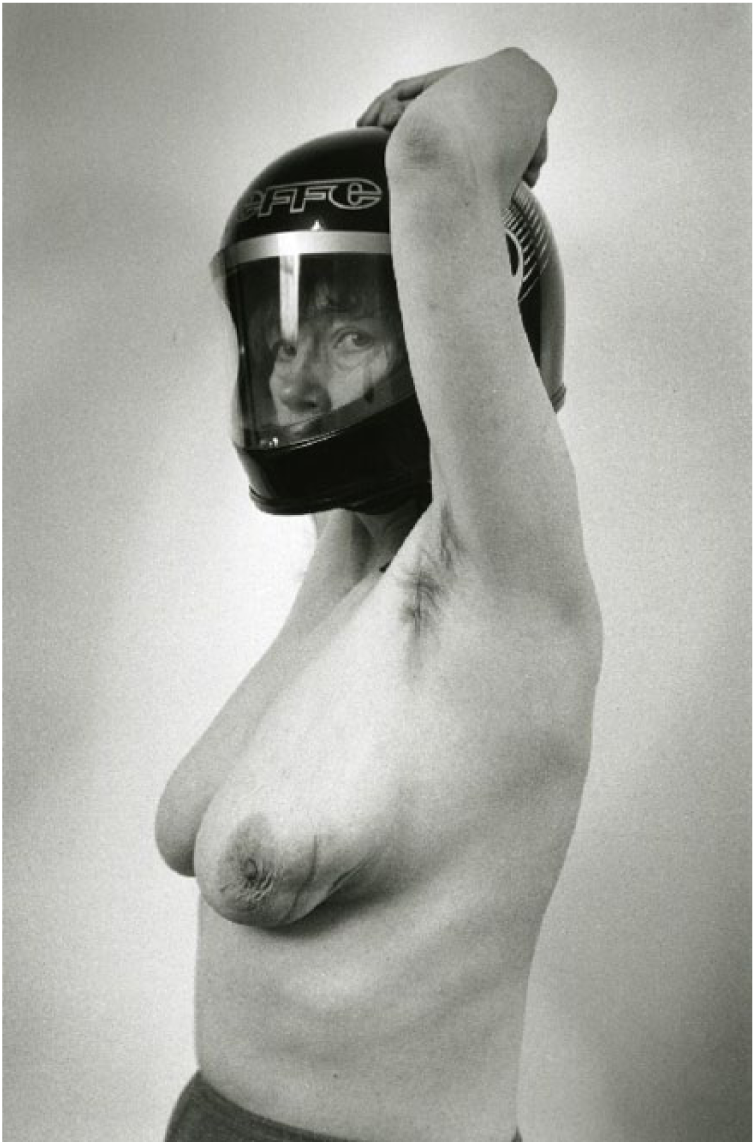
Jo Spence/Terry Dennett, Crash Helmet Portrait, 1983, The Cancer Project series. ©Jo Spence Memorial Archive. Courtesy of Terry Dennett.
Autopathographic photographs such as these also carry a documentary function, attesting to personal experiences of illness or hospitalization. Since the disease itself often cannot be shown, its presence becomes legible only through the signs of its treatment or of the medical environment in which the picture is taken. In their respective autopathographic self-portraits, performance artists Günter Brus and Hannah Wilke may be read as being sick or in treatment due to the medical paraphernalia that surrounds them, while Matuschka’s and Spence’s scars on the breast become the visible indices of the malignant tumors that were once present, now removed (Tembeck, 2009). But in addition to offering indirect visual evidence of present or past ailments, explicitly autopathographic images—images that feature or announce illness as integral to their subject matter—operate as statements confirming that these experiences should be regarded as integral parts of the subject’s life, even when the image does not necessarily give any indications as to how the health condition is experienced. This particular function of the autopathographic image—the deliberate inclusion of illness in the photographic account of oneself (Tembeck, 2009)—can also be found in selfies of ill health. What is common to the vernacular selfies of ill health and to the autopathographic photographs produced by professionals is the communication of a decidedly willful display of the health condition on behalf of the author. In a visual culture where non-medical representations of diseases such as breast cancer were long excluded (Cartwright, 1998), the deliberate inclusion of signs of illness in one’s public self-image has often been positioned as an affirmative, if not activist, gesture (e.g., Dykstra, 1995; Spence, 1988, 1995).
Nevertheless, the cool frontality and often impassive expressions found in the autopathographic self-portraits produced by the artists listed above lie in sharp contrast to the highly affected duck-face poses that we are accustomed to expect of selfies. This is perhaps due to the selfie’s dual function as icon of the self, on one hand, and as object endowed with the capacity to confirm, deny, or negotiate group membership within social media environments and beyond, on the other (boyd, 2011; Levin, 2014). Nowhere is this duality clearer than in celebrity hospital selfies, which espouse the codes of these two seemingly incompatible impulses: showing one’s ailing condition as well as one’s exceedingly mastered appearance, as evidenced in hospital selfies recently circulated by Miley Cyrus, Justin Bieber, Kelly Osborne, Lady Gaga, Lily Allen, and many others. 4 But in contrast to Matuschka’s production, which combined the slick look of fashion photography with the sight of her mastectomy scar, the celebrity-type “sickbed selfie” (Yahoo Celebrity UK, 2013) all too often denies any specific value to a particular health condition. A celebrity selfie by any other name is simply yet another celebrity selfie: the context changes, but the pose remains. The same applies to a vast breed of selfies of ill health produced by non-celebrities who wish to emulate celebrity life—a desire that, after all, is at the origin of selfie hype. 5
Like few vernacular media phenomena before it, selfie production combines the fantasy of Joseph Beuys’ “jeder Mensch ein Künstler” (everyone is an artist) with Andy Warhol’s prediction that “in the future everyone will be world famous for fifteen minutes” (Knowles, 2009). Warhol himself produced a hospital selfie avant la lettre while recovering from surgery in 1968, after having been shot by Valerie Solanas. Holding a 35-mm camera in one hand, Warhol captured his bare-chested reflection in a mirror with a flash, inaugurating a hospital selfie pose that would unwittingly be repeated by countless others some 40-odd years later. Warhol’s spontaneous self-portrait exposed a large scar on his abdomen. The image was processed and printed by Royaltone photo service, which offered a bonus wallet-size print (Zuromskis, 2013), as if in anticipation of the present-day selfie’s propensity to be distributed. 6 Astonishingly, the sculpture of the self that arises from the conjunction of Beuys’ and Warhol’s declarations is remarkably stereotypical: I am undoubtedly not the first to note the irony whereby a type of image that is regarded as an icon of individuality (if not self-absorption) should be reducible to a set repertoire of familiar gestures. Selfie aesthetics, which are predicated among other things by the technological affordances of mobile devices and their apps, 7 have been summed up in recurrent patterns of arm’s-length shots and pouty poses, captures of one’s mirrored reflection, as well as close-ups and other predictable positions within the picture frame, such as angles offering flattering views of the subject’s profile, cheek bones, or arm musculature (Bruno, Gabriele, Tasso, & Bertamini, 2014; Morrison, 2013; Tifentale & Manovich, 2015). Were it not for the addition of descriptive metadata to these images, such as location hashtags (e.g., #hospital), or the interpretation of contextual visual information (such as medical furnishings) indicating that these particular selfies are likely related to health conditions, many selfies of ill health would in fact show few distinctions from selfies of (very) good health. 8
Were it possible to undertake a rigorous survey of existing selfies of ill health in the manner that was attempted for funeral selfies (Gibbs, Meese, Arnold, Nansen, & Carter, 2015), for instance, I suspect that the majority of images collated might be described as politically innocuous. 9 My partial perusal of the web suggests that the hospital selfie equivalent (in volume, at least) to the duck-face pose is a point of view shot showing an injured limb or body part, a hospital identification tag on the wrist, or an arm attached with an intravenous (IV) drip, a peripherally inserted central catheter (PICC) line, or in the process of having blood drawn. Many of the images encountered using informal keyword searches (e.g., #hospital, #selfie, #me) hold a purely documentary function within the subject’s visual narrative of the self, stating “I was here” (in the hospital, clinic, or ambulance) or “this happened to me” (with “this” referring to an ailment, accident, or medical procedure). 10 Other groups of selfie images pertaining to ill health, such as bedside selfies in the hospital with loved ones, participate in the larger social narratives that are instantiated by the selfie genre at large: the proclamation that the pictured “I” is not isolated and the aspiration to conserve, or potentially elevate, one’s social standing online as well as offline (Levin, 2014; Wendt, 2014). The social currency warranted by this breed of selfie of ill health exists either precisely thanks to—or on the contrary, notwithstanding—particular health-related circumstances. It is also of note that many hospital selfies are not in fact related to long-standing health conditions, but rather to recent accidents or injuries. This is especially the case with celebrity sickbed selfies (see, for instance, those featured in Yahoo Celebrity UK, 2013). In contrast to such images, chronic or acute health conditions appear to generate further-reaching reflections on the relationships between illness and representation, and on the social and political stakes of publicly identifying oneself as being sick or disabled as a consequence of illness. For the final part of this article, I turn my attention to a series of selfies of ill health that are exceptional in terms of their capacity to bring together the lighter sides of selfie culture with the more radical stances of performance practice.
Rendering Illness as Spectacle: #HospitalGlam, Theatricality, In/Visibility, and Activism
Mise-en-scène and masquerade are well-established strategies in professional photographic self-portraiture (Bright, 2010; Kent, 2006). Such theatrical approaches to self-display have been the subject of queer and feminist readings of photographic works by Claude Cahun or Cindy Sherman, for instance (Rice & Gumpert, 1999). Comparable aesthetic strategies were employed in the photographic autopathographies of Jo Spence as well as Hannah Wilke, who staged herself with reference to historical artworks in addition to poses from the worlds of fashion and popular culture (Tembeck, 2008). Bob Flanagan pushed the theatrical mise en abîme somewhat further by staging himself as a sick patient within a gallery setting. For the duration of his exhibition Visiting Hours, first presented at the Santa Monica Museum of Art in 1992, museum-goers were invited to visit Flanagan, who had Cystic Fibrosis, in a hospital room entirely reproduced within the art space (Drier, 1996). The photographic work of Karolyn Gehrig, instigator of the #HospitalGlam social media movement launched in 2014, can be situated within a hybrid lineage that descends from such precedents. Owing to her professional training in the arts, Gehrig’s production bridges advocacy and aesthetics through the fulcrum of her performative selfie practice.
On her Instagram profile, Gehrig identifies herself as a “Queer Disabled Artist + Writer / Ehlers Danlos Syndrome / #HospitalGlam” (Gehrig [karolynprg], n.d.). The subtitle on her Tumblr page reads, “Taking the shame out of being in treatment one selfie at a time” (Gehrig [#HospitalGlam], n.d.). Media accounts refer to Gehrig’s health condition as a disabling chronic illness and connect her selfie production with a desire to not feel invisible despite the invisible nature of her diagnosis (Bahadur, 2015). A chronic connective tissue disorder, Ehlers–Danlos Syndrome (EDS) can lead to a variety of other health conditions that require regular medical consultations. Visits to the hospital are thus an ordinary part of Gehrig’s current life experience. She began to document her frequent medical appointments by taking selfies and planning special looks for these photographs, inserting a touch of glamour into her medical regimen (Figure 2).
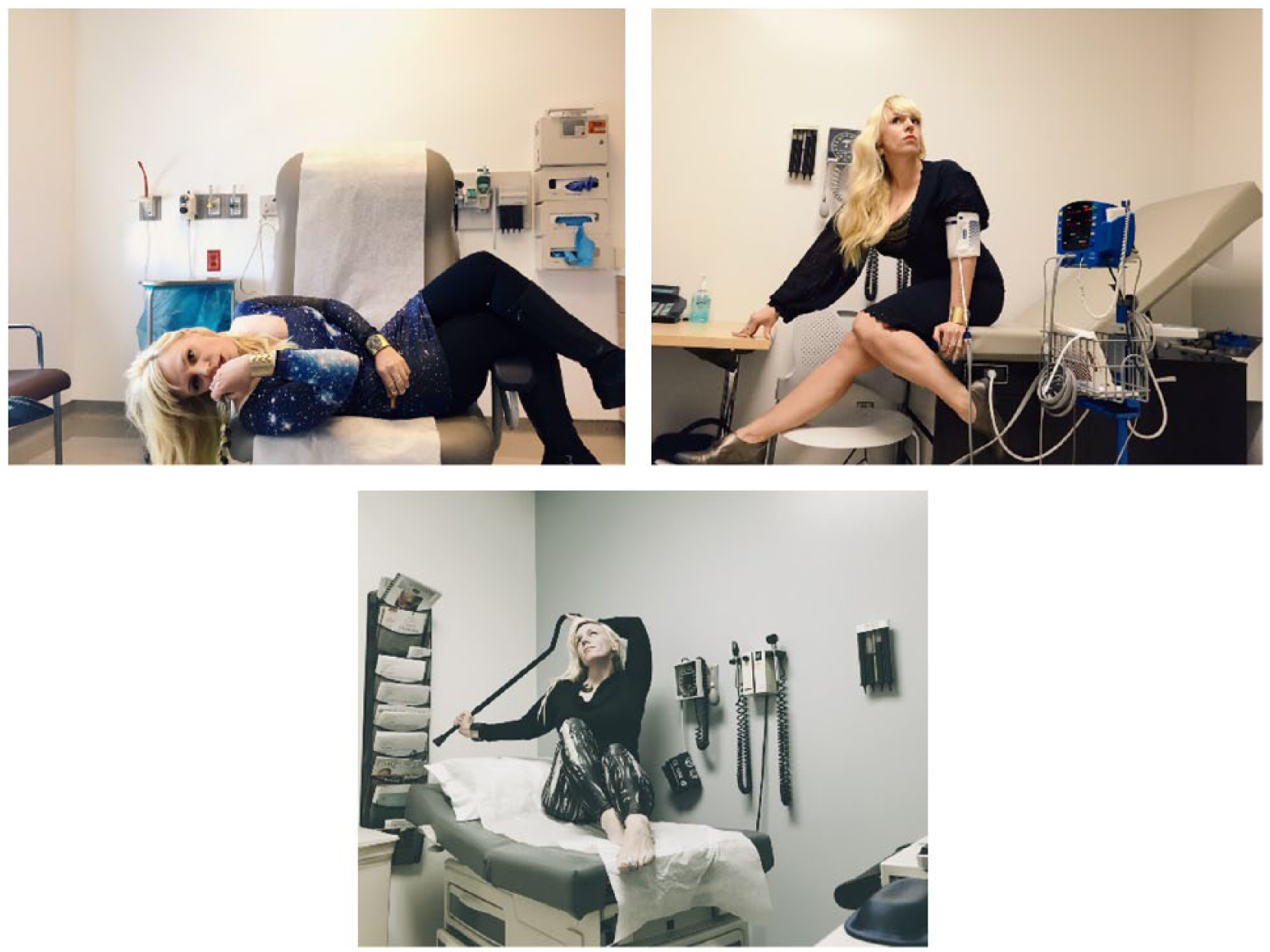
Karolyn Gehrig [#Hospitalglam]. Selection of auto-timer selfies posted on Tumblr as part of #HospitalGlam, 2014–2015 ©Karolyn Gehrig. All images courtesy of Karolyn Gehrig. Retrieved from http://hospitalglam.tumblr.com/post/113572883129/last-summer-i-laughed-too-hard-and-landed-in-the; http://hospitalglam.tumblr.com/post/112153654344/karolynprg-ill-be-joining-letterstothrive; http://hospitalglam.tumblr.com/post/114025774989/hospitalglam-is-also-active-on-twitter
Gehrig’s presence is noticeably posed in these images. At times she adopts the far-away gaze of fashion photography; in other instances, her direct stare into the camera lens is more reminiscent of the seemingly unrehearsed selfie genre. One such posting consists in a before and after shot, showing Gehrig with and without pink lip-gloss (Figure 3). A comment accompanying the image on her Instagram page parrots the instructional rhetoric of makeover blogs, repurposing it for the benefit of patient empowerment. With a discernible note of camp, Gehrig writes, “#HospitalGlam tips: Color makes an impact and draws attention to your features. If you are advocating for yourself, drawing attention to your mouth is not a bad thing. Go bold. You’ll like it” (Gehrig [karolynprg], 2015, March 25). Similarly, a number of Gehrig’s #HospitalGlam posts emulate spreads in fashion magazines. At the request of her followers, Gehrig’s comments often credit the designers whose clothing and jewelry are featured, or reveal the makeup application techniques she employed (e.g., Gehrig [karolynprg], 2015, March 25) (Figure 4).
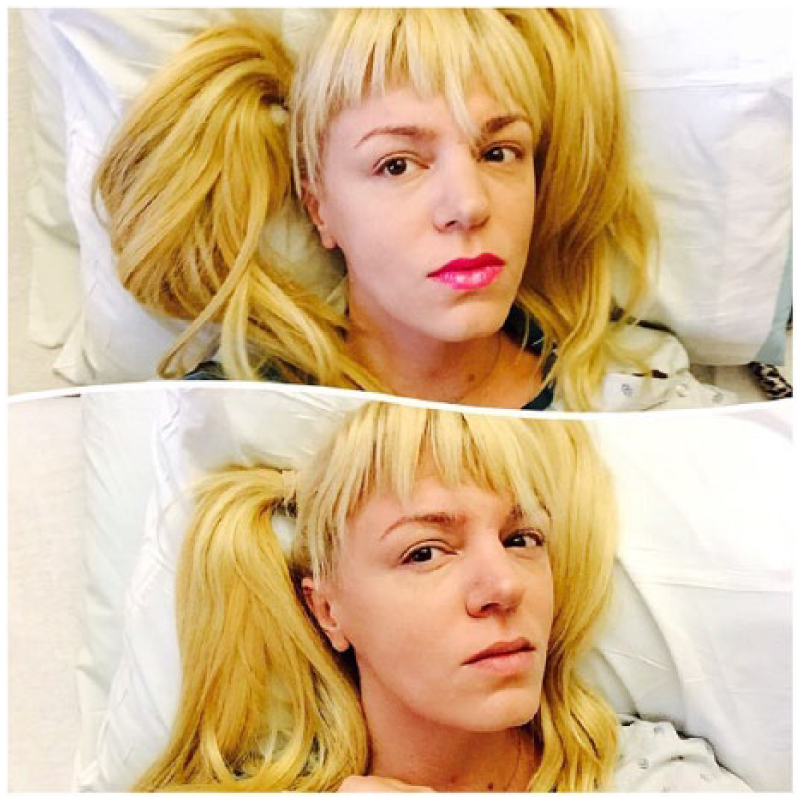
Karolyn Gehrig [karolynprg]. (2015, March 25). #HospitalGlam tips [Instagram post]. Retrieved from https://instagram.com/p/0o9npHh0UU ©Karolyn Gehrig. Courtesy of Karolyn Gehrig.

Karolyn Gehrig [karolynprg]. (2015, March 20). I have had an exquisite night [Instagram post]. Retrieved from https://instagram.com/p/0c_EzSB0bL/ ©Karolyn Gehrig. Courtesy of Karolyn Gehrig.
Just as autobiography scholar Laurie McNeill (2014) has read Six-Word Memoirs as auto/tweetographies and Aimee Morrison (2014) positions selfie practice as a form of life-writing (see also Fallon, 2014), Gehrig’s Instagram feed could be read as a visual autopathography. Jill Walker Rettberg (2014) has noted that “the serial nature of most digital self-representation is closely connected to the tradition of the diary” (p. 44), so in this vein, Gehrig’s Instagram feed presents a loose analogue in visual form to a written diary or journal that documents and reflects upon illness. Seen from a cumulative, longitudinal perspective—not restricted to a singular image, but rather as a series of pictures produced within a given timeframe—Gehrig’s #HospitalGlam selfie production finds itself woven into other elements recorded from her everyday experiences on her Instagram feed, ranging from dinner with friends to interactions with her dog. Her selfies of ill health punctuate the thread of images that are unmarked by illness, effectively inserting her private and invisible condition into the public online picture of her everyday life.
Setting aside the potentially reparative dimensions of her selfie production,
11
Gehrig’s self-stagings on her Instagram feed can also be read as acts of coming-out as being invisibly ill or disabled, to use Ellen Samuels’ (2002) analogy. From this perspective, Gehrig’s selfies constitute online political performances that have significant bearing upon her offline experiences as well. Gehrig’s description of her process for taking selfies in the doctor’s office helps to instantiate this claim. She explains, I find a place where I can set my phone down and look through the viewfinder to see where the frame will be. Using Camera Genius, I set a timer to repeat at 10 second intervals and turn off the sound. I step into the frame, si[t] or stand however feels comfortable, and focus on my breathing. I count out 10 seconds between shots, figuring that I’m probably off a little. To me, it is extremely calming and centering. I am focused on how my body feels in space. If the doctor enters and I am still doing it, I explain what I’m doing and that I’ve been posting the photos online to help reduce the stigma surrounding invisible illness. Then the camera stops and we have our appointment, like normal. When I get home, I filter and post the photos using [the app] VSCO Cam. (Gehrig [#Hospitalglam], 2015, February)
Gehrig limbers up for the performance. From her account, it is unclear whether this performance consists in posing before the camera, interacting with the doctor, or both; however, it appears that each benefits from her “centering” activities. Like an actor warming up, Gehrig’s attention to her body and breathing allow her to be more present to her future selfie image, as well as to her immediate experience: one informs the other. “By photographing myself,” Gehrig adds, I find some comfort in that space and reacquaint myself with my body. By the time the doctor enters, I’ve checked in enough that I feel confident enough to speak about my concerns and take a more active role in my treatment. (Gehrig [#Hospitalglam], 2015, February)
Gehrig’s performance before the camera enables her to be more at ease within the medical space. While the texts accompanying the images on her social media profiles frame #HospitalGlam as an outward-reaching political intervention—seeking to raise awareness, reduce stigma, and heighten the visibility of EDS—Gehrig’s poses before the camera also serve her immediate personal needs, allowing her to be more attentive to her body and, in so doing, to take charge of the situation at hand in the doctor’s office or waiting room.
12
Like Spence, Wilke, and others before her, Gehrig’s autopathographic pose (Tembeck, 2009) constructs a particular dramaturgy: it is staged not only to be seen by others, but also to be read in specific ways that emphasize Gehrig’s sense of personal empowerment even as she produces the selfie. The comments accompanying her photographs serve as the stage directions that orient our gazes in receiving her self-images. One such comment, annotating a photograph that shows Gehrig (Figure 5) sitting in a waiting room wearing a dress whose pattern consists in magnified images of pills, affirms, Having #ehlersdanlos means my #disability is often an #invisibleillness and maintaining a visible presence in my non-disability communities while doing #hospitalglam has been valuable. I care for myself and I have no shame attached to the health issues that make up my life. (Gehrig, 2015, January [2014, October 16])
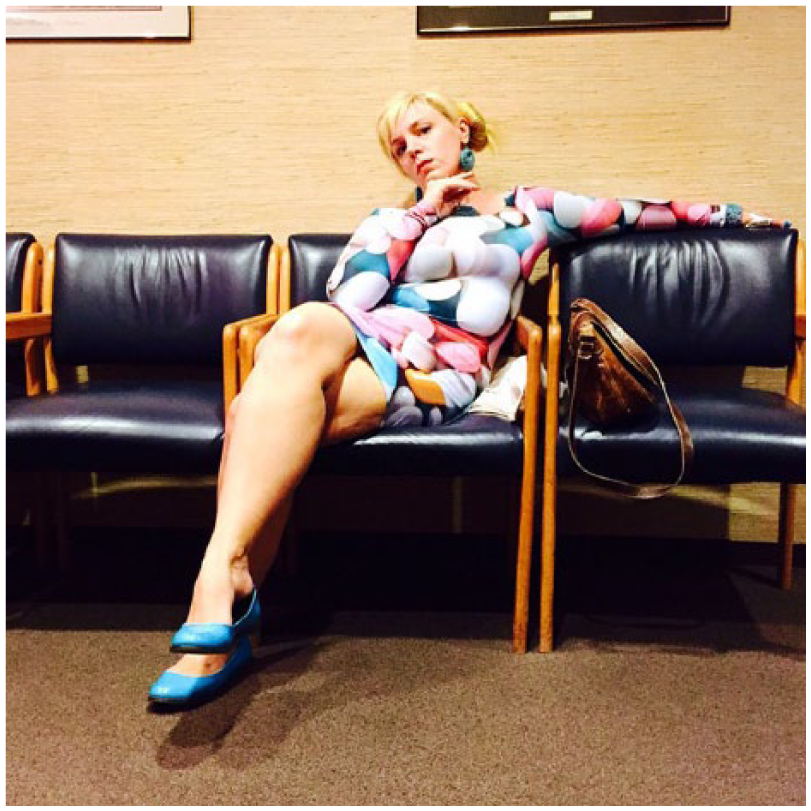
Karolyn Gehrig [#Hospitalglam]. (2015, ca. January [2014, October 16]). This Waiting Room [Tumblr post, reblogged from Hyper by Extension]. Retrieved from http://hospitalglam.tumblr.com/post/105702098527/karolynprg-this-waiting-room-hospitalglam ©Karolyn Gehrig. Courtesy of Karolyn Gehrig.
The mutual reinforcement between comment and image is a characteristic of digital intermediality and confirms the specificity of Gehrig’s work as selfie production in contrast to self-portraiture. 13 As Martin Gibbs et al. (2015) have noted, the capacity for users to tag images and thereby “insert their photo[s] into a wider ‘hashtag conversation’” is central to Instagram’s “platform vernacular” (i.e., its specific affordances) (p. 258). The interplay between images and words—potentially generated by numerous authors but rejoined through the use of common hashtags—allows for a broader “discursive field” to be opened beyond the singular post, since Gehrig’s selfies can be attached to “multiple hashtags, accompanying captions and comments from other people” (Gibbs et al., 2014, p. 260). While still anchored in a representation of the self, here the selfie becomes a point of entry for discussion among individuals identifying with diverse communities, ranging from EDS patients and disability advocates to fellow fashion or jewelry aficionados.
Both Gehrig and social media bloggers who have covered her production use the language of activism to refer to her selfies: recurring words used to describe her practice include “empowerment,” “starting a movement,” countering “stigma,” and so on. Without a doubt, Gehrig’s project is informed by a politics of visibility: her #HospitalGlam selfies position her as a self-identified, chronically ill individual, effectively exacerbating the public legibility of her private health condition. In going public with these selfies of ill health, Gehrig resists the possibility that she might pass as not disabled, both online and offline. The public medical setting for her selfie production gives her a pretext to instruct potential bystanders of her activism in social media: in turn, her Twitter, Tumblr, and Instagram feeds accomplish a similar didactic function online, alerting her followers (and through their reblogs, their friends) to Gehrig’s experience of living with EDS.
While Gehrig’s selfies ostensibly place her health condition in the foreground—if only by virtue of the medical locations in which they are shot and the hashtags that accompany them—they also play with the dubious visual legibility of her illness. On more than one occasion, Gehrig has blended medical accoutrements with fashion accessories in such a way as to cast doubt upon their mutual identifications: a black webbed necklace recalls the curling of cords attached to medical instruments in an examination room (Figure 6); silver finger splints become unrecognizable amid an array of jewelry worn on her hands (Figure 7); a net placed around her head for an electroencephalograph test is assorted with an outfit inspired by a recent Beyonce performance during which the singer sported similar headwear. In confounding their appearances in this manner, one wonders whether Gehrig’s trimmings are the products of artifice or necessity: where do the medical aids end and the fashion accessories begin?
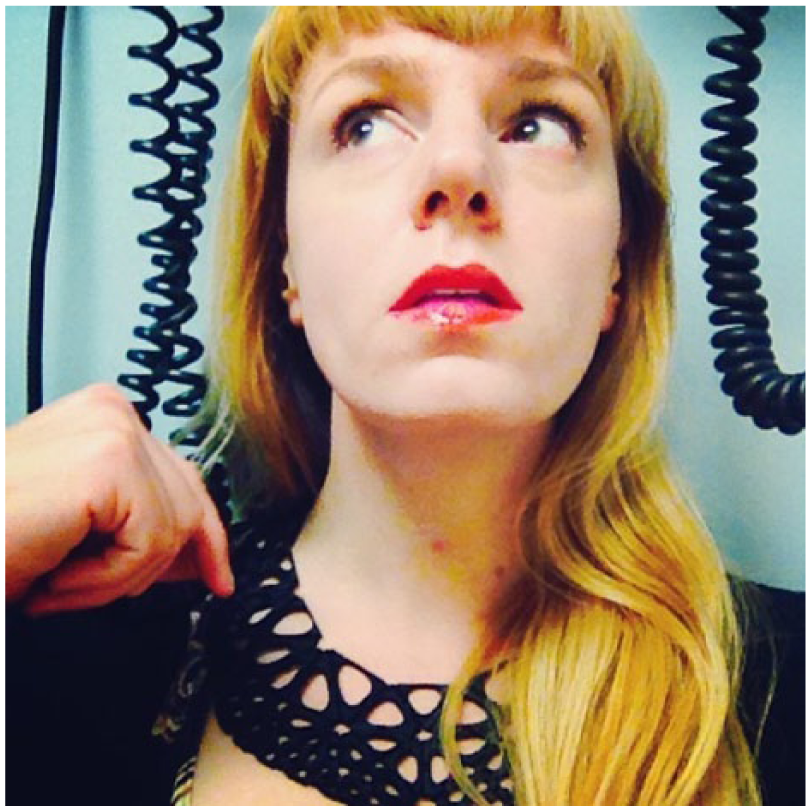
Karolyn Gehrig [karolynprg]. (2014, June 2). Next up: Neurology [Instagram post]. Retrieved from https://instagram.com/p/owucMNh0V7/?taken-by=karolynprg ©Karolyn Gehrig. Courtesy of Karolyn Gehrig.

Karolyn Gehrig [karolynprg]. (2015, January 21). All hail the protective qualities of silver [Instagram post]. Retrieved from https://instagram.com/p/yIePKRB0bz/?taken-by=karolynprg ©Karolyn Gehrig. Courtesy of Karolyn Gehrig.
Gehrig’s production is certainly not representative of the majority of existing selfies of ill health, either in its sophisticated form or in its more radical intents. Nevertheless, while hers began as a singular voice, the call for participation instigated by her #HospitalGlam movement has prompted unsuspected avenues for creative self-expression by other patients—primarily young women—as evidenced by the numerous re-posts on her Tumblr page (http://hospitalglam.tumblr.com/). In opening up a space for the public visibility of her own health condition, Gehrig has managed to skirt certain aspects of the “conundrum of visibility” (boyd & Marwick, 2009, pp. 412-413) inherent to social media which, while promising full exposure, are generally only consumed by the few (Baym & boyd, 2012, p. 322; boyd, 2011, p. 48). Tying patient and disability advocacy to her non-health-related interests in fashion, art, and jewelry, Gehrig’s selfies of ill health reach beyond a community of peers who already partake in her politics. Her images of illness function as patient-centered counter-representations to the medical and diagnostic pictures that also populate the web, such as those now circulating through the Figure 1 app, which international news media have dubbed “Instagram for doctors.” Such images reproduce conventions of medical textbook photography, showing afflicted body parts in isolation, after having removed any identifying marks from the depicted individual. Whereas the doctors’ images aim to protect patient confidentiality, Gehrig and other partakers in #HospitalGlam selfies seek on the contrary to affirm their identities as subjects living with illness (“#HospitalGlam is about you, not the procedure,” Gehrig affirms in her #HospitalGlam Frequently asked questions [FAQ] [2015]). Their public proclamations of ill health are achieved through the inclusion of recognizable health-related content within the selfie image and through the appendage of contextual information in hashtags, captions, metadata, and so on. In this respect, selfies of ill health draw upon the specific affordances of social media in terms of their production and dissemination; however, their communicative intents remain consistent with earlier forms of autopathographic self-representation, both in visual and narrative forms. The dramaturgical thrust of such imagery is to convey both the centrality of medical experiences in the subjects’ lives and their specific desire to be publicly identified as persons living with illness.
Footnotes
Declaration of Conflicting Interests
The author(s) declared no potential conflicts of interest with respect to the research, authorship, and/or publication of this article.
Funding
The author(s) received no financial support for the research, authorship, and/or publication of this article.