



Abstract
This project joins a growing conversation about the cultural significance of memes (and Internet memes in particular), offering a critical analysis of Republican Jesus—one popular image macro that mocks contemporary American conservatism—in order to illustrate the rhetorical potential of these putatively harmless do-it yourself (DIY) creations. Ultimately, I argue that Republican Jesus offers a critique of contemporary conservatism that creates “perspective by incongruity” and, thereby, creates a space for ideological struggle.
Keywords
Contemporary American conservatism has become something of an ideological hydra. In order to continue to appeal to the mass of people over the years, Republicans have fused traditional conservatism—still embodied in staunch resistance to socialism, fervent nationalism, faith in law and order, and exaltation of civilized culture and tradition—with strands of libertarianism, neoliberalism, neoconservatism, and evangelical Christianity. And for the last 35 years, conservatives have mobilized voters by trumpeting pet issues drawn from these annexed territories. This hybrid has yielded considerable electoral success too. And yet, these are not perfectly happy marriages. Neoconservatism and libertarianism clash over the appropriateness of American intervention overseas; traditional conservatism and libertarianism differ on the role of government in regulating private behavior, and all figure the role of the state differently. But none of these articulations has been as politically productive or problematic as the incorporation of evangelical Christianity with mainline Republican politics. In this essay, I analyze “Republican Jesus,” a popular Internet meme that skewers conservative political ideology and, thus, works to disrupt the various ways that Christianity has been linked with the conservative political project—and, thereby, pries open discursive space for alternative interpretations of a Christian politics.
This project proceeds in five parts: first, I articulate a theoretical perspective founded in post-Marxist thought about the development of ideology and ideological struggle; next, I offer a brief recapitulation of the historical articulation of mainstream conservatism with evangelical Christianity; I move on to detail the “Republican Jesus” memes which now circulate on the Internet; based on this description, I provide an analysis of the rhetorical significance of this phenomenon; and I conclude by considering the implications of this project for communication scholars and for those interested in winning Christians back for progressive politics.
Ideology, Articulation, Contradiction, and Ideological Struggle
At this point in human history, to refer to ideology is to risk invoking a constellation of unintended implications and entailments. 1 So, before moving on to a discussion of contemporary conservative ideology, it seems appropriate to develop a more precise sense of the post-Marxist framework within which I conceptualize and deploy this term. Ideology refers to the “mental frameworks—the languages, the concepts, categories, imagery of thought, and the systems of representation—which different classes and social groups deploy in order to make sense of, define, figure out and render intelligible the way society works” (Hall, 1996b, p. 26).
This conception of ideology marks a significant deviation from Marxist orthodoxy in at least two important regards: it rejects the thesis of “determinateness,” and it rejects the notion that there exist necessary “correspondences between dominance in the socio-economic sphere and the ideological” (Hall, 1996b, p. 29). Ideology clearly has political and material consequences, but is not to be imagined as simply a product of economic concerns (e.g., the base). Instead, ideology is understood as the overdetermined product of a multitude of processes (with economic concerns among them) and as an influence upon many other overdetermined processes in a given social formation. Furthermore, there is no necessary connection between one discursive element and another or between any discursive element and a particular political interest (Slack, 1996, p. 119). Ideology does not spring fully developed from the mind of an individual or from a given class; and an element of ideology (e.g., the notion of private property for example) does not contain within itself an inherent, essential class quality.
Instead, ideology grows by annex and by necessity; it is cobbled together, through partial, contingent acts of articulation (Hall, 1996b, p. 41). This is what Hall means when he writes of a Marxism without guarantees: no longer can it be posited that any given element of discourse carries, per force, a particular class valence. Instead, elements are sutured together and given new meanings within discourses. And, generally, these sutures (i.e., articulations) are enacted not on the basis of some grand scheme but only under the force of necessity and often by intuition or sheer coincidence. Thus, there is little to be gained in seeking for a generating principle or a principle of coherence within a given discourse. If one were to seek for a metaphor for such a post-Marxist conception of ideology, one might settle upon the shantytowns that have been erected in the slums of global capitalism’s newest hubs. Markets, homes, and streets are constructed in an ad hoc fashion according to what works and what is cheapest. They do not typically proceed on the basis of any blueprint or even internal logic; they simply proceed. Such a reconfiguration of ideology requires revision, likewise, to our sense of how ideology is deployed in the service of established interests.
The idea that the material exploitation of labor is supplemented and legitimated by control over thought and language, which received only prefatory attention from Marx and Engels, 2 enjoyed fuller expression in the writings of Italian political activist Antonio Gramsci (1981/1987). In his works, hegemony is positioned as a counterpart to repressive force: in addition to control over the state military forces that are occasionally deployed to coerce the masses to return to working and consuming, ruling classes also continuously leverage their disproportionate control of the means of intellectual production (e.g., media institutions, think tanks, entertainment outlets, and educational institutions) to establish intellectual and moral leadership over other classes and groups and, thereby, ensure that they come to think and act in ways that do not threaten the establishment in the first place. Thus, Gramsci explains that it is not only the coercive force of state power but also the “routine structures of everyday thought” (i.e., hegemony) that work to forestall attempts to modify relations of power and exploitation (Gitlin, 1979, p. 252).
If one construes ideology as an accomplishment—a product of contingent, partial articulations, which do not necessarily emerge from any sort of essential logic—then hegemony cannot consist in the creation and dissemination of an ideological discourse that is all of a piece; instead, it consists in the active articulation of a universe of elements into semi-coherent discourses that contain the most salient antagonisms and reify the status quo so long as the status quo benefits the power bloc (Hall, 1996b). And, if we may push this analogy further, this logic of contingency also suggests the major problem of hegemony: managing the inherent instability of such ad hoc projects. Like the unplanned and uncoordinated construction of dwellings, markets, and alleys, ideological articulations are likely to contain instabilities that, if stressed, can pull down the entire structure. These contradictions represent what Michel Foucault (1969/1972) describes as “spaces of dissension”: the points where ideological discourses fail to seamlessly explain the universe are opportunities to pry apart taken-for-granted associations and schemes that otherwise operate below the level of the said (p. 152).
The presence of such contradiction, however, is not necessarily fatal to the project of hegemony. Contradictions may exist but remain insignificant, or they may be repaired through new articulations. A contradiction only becomes politically salient to the degree that the contradiction is made symbolically intelligible and significant. The example of human slavery in the “land of the free” is an obvious example. Nearly all alive today recognize immediately the gap between the hegemonic discourses that legitimated governance and civil society and the institution of slavery which persisted in this country for hundreds of years. But, this rupture was only converted into a salient opportunity for political struggle—what Laclau and Mouffe (1985, p. 127) term an antagonism—by rhetorical action that drew attention to, dramatized, and expounded upon the significance that contradiction. In the next section of this essay, I recapitulate the major ideological articulation that delivered the Republican Party from the 20th to the 21st century and also set up its most enduring contradictions.
Marrying the Messiah to the Market
For the better part of the 20th century, the Republican Party campaigned on a platform of traditionalist conservatism. At mid-century, Russell Kirk (1953/1985) described the sense of American conservatism in terms of six canons: “belief in a transcendent order, or body of natural law, which rules society as well as conscience”; resistance to the promotion of uniformity, egalitarianism, or leveling of society; the affirmation of the necessity of classes and social order; deep faith in the necessity and interrelationship of property and freedom; an emphasis on tradition and social upbringing as the proper means of taming anarchy and controlling vice; and a deep distrust of any suggestion that social change is inherently for the better (pp. 8-9). Durable commitments to anti-communism, neoclassical economic policy over and against Keynesian managed economies and the New Deal, and the use of state power (both repressive and pedagogical) 3 in promoting law and order were natural outgrowths of these views. Such platforms delivered Presidents Harding, Coolidge, Hoover, and Eisenhower to the Oval Office.
But in the 1960s and 1970s, a complex of forces shifted the political landscape. Barry Goldwater’s miserable showing in the 1964 election suggested to critics that the party had become too militarist in its approach to foreign policy and too extreme in its opposition to meliorist social programs like welfare. In the New York Times, James Reston wrote that, with his feverish Communist paranoia and strident pro-business agenda, Goldwater had “wrecked his party for a long time to come” (as quoted in Perlstein, 2001, p. 513). Thomas Dewey, moderate Republican and former Governor of New York, regarded the party’s shift to hardline conservatism as a death knell and warned that it would deliver every future election to the Democrats (Farris, 2013, p. 125).
While those dire predictions would immediately prove overstated, observers were correct in assessing a sea change in the American public. Richard Nixon won the election to the Presidency on the basis of his appeal as a practical and honest moderate who promised to end the Vietnam War; but his party remained a continual minority in the House and Senate. The counterculture and rights movements of the “new left” widened the “generation gap” and yielded new ranks of liberal issues-oriented voters (Friedman, Gold, & Christie, 1972); widespread disillusionment with the federal government’s handling of the Vietnam War stirred fervent anti-war and anti-establishment sentiment (Bailey, 2009; Zinn, 2005); increased competition from South and East Asia combined with an oil shock to slow the economy (Lickleider, 1988); and the Watergate Scandal slowly corroded Nixon’s ability lead any kind of coalition. In 1974, the Democratic Party secured a supermajority in Congress. On August 9, Richard Nixon resigned the office of the presidency in disgrace. Two years later, Jimmy Carter, the two-time Georgia governor who ran as the son of a peanut farmer, political outsider, 4 and moderate liberal, won the election to the Presidency.
Surprisingly, it would be Ronald Reagan, a retired B-movie actor and political outsider most associated with Barry Goldwater, who restored the Republican Party. Though he had tried both tax and spending reforms, Carter’s administration was unable to do much to help the slumping economy 5 or the more general perception of a malaise affecting the nation. Now, the “Reagan Revolution” married Goldwater’s strident conservatism and libertarian positions toward national defense and the economy—made newly interesting by the obvious failure of mainstream political thought on the left or right to end the malaise—with a powerful new social politics imported from the fringes of Christian belief (Kengor, 2014). 6 A vociferous evangelical Christian movement had grown out of rising discomfort with capitalist consumerism; permissiveness and narcissism in American culture; and decay in public morality exemplified in increasingly violent and profane film, television, and music, divorce rates, and the proliferation of abortion (Schulman & Zelizer, 2008, pp. 29-51). Reagan appealed to evangelical Christians in a way that neither party had before. Between the contest of the individual championed by old-line conservatives, and state-managed society championed by the Left, his new conservatism interjected the family. It was the family—not the federal government—that could better solve the problems facing America; and it was the family (implicitly the bourgeois, Christian, heterosexual, nuclear family) whose values could best guide the United States. Evangelicals and Dixiecrats alienated by Democratic support for the civil rights movement fled en masse to the Grand Old Party (GOP). In 1976, Jimmy Carter had won the election as a Democrat and a “born-again” Christian who had no formal stance against abortion and favored expanding the rights of homosexual Americans. He won every state in the Deep South. Ten years later, the born-again Christians who elected Carter in Texas and much of the American South would be squarely within the Republican Party; and they remain so today.
This hybrid platform has allowed Republican lawmakers to leverage hot-button social issues like abortion and gay marriage to appeal to Christian middle and working-class voters even as they enact starkly neoliberal policies that eviscerate public programs and eliminate protections for the very same laborers (Frank, 2005; Goodman, 2006). But like all articulations, the marriage of evangelical Christianity with traditional conservatism, neoliberal capitalism, and libertarianism is an inherently unstable one that has required continual political struggle to maintain. Perhaps the most notable of these ruptures has to do with the relationship between the individual and wealth.
In a capitalist economy, the pursuit of wealth is not only acceptable, it is held to be the engine that drives societal progress. “Greed is good”—Gordon Gekko’s famous line—exemplifies a basic premise of neoclassical economic theory and the basis of neoliberal politics. Free markets, to the degree that they really exist, are said to be interchanges where individuals pursuing their own personal wealth produce a maximally efficient economy. In neoclassical theories of economics that uphold capitalism as the best humanity can do, the pursuit and accumulation of wealth is a wonderful thing. Private vice, Mandeville (1714/1924) wrote, yields public benefits. And in the long post-war boom between the 1940s and 1970s, it was perhaps easy for many to imagine that our unique brand of capitalism was the tide that would lift all boats, 7 that individual pursuit of wealth was the engine of creation that would raise the standard of living of all humans across the globe. But two energy shocks combined with new low-cost competition from the developing world and nations finally recovering from two World Wars spurred inflation and bit into profits (Abel & Bernanke, 1998, p. 433). The ownership classes responded in the 1980s by crushing labor both politically and economically (Harvey, 2007, p. 17). Over the next three decades, union power was tamped down, manufacturing was largely outsourced to the global south, and Congress held the line on the minimum wage. For a while, the growing trend of women entering the workforce helped to prop up family incomes, but by the turn of the century, there was no doubt that the working class was in deep trouble (Massey, 2007). These trends were only worsened by the global economic meltdown spurred by subprime lending, real estate speculation, incredible risk-taking in financial derivatives, and a shocking lack of regulatory oversight. Since then, the economic recovery described by newscasters has largely been reserved for the wealthy. As economist Richard Wolff (2013) noted, nearly all of the gains made since the 2009 low have been realized by corporations, banks, and the owners of industry. Stock values are up and corporate profits soar, but those good fortunes have not made their way to workers. “The top 1% of income-earners in the US took 19% of the national income in 2012, the largest share since 1928.” Meanwhile, income for the other 99% of all earners rose by an average of 0.4% during that time. And although unemployment numbers have improved somewhat, the nature of American employment has changed for the worse. Increasingly, skilled and semi-skilled positions have been eliminated or moved abroad, and many are now employed in part-time, flex-time, or service sector jobs that offer less stability, less compensation, and fewer long-term prospects for advancement (Mui, 2014). By many measures, the gap between America’s ruling elite and the average worker yawns wider than it has at any point since the Great Depression (Gass, 2014; Neuman, 2013).
Perhaps no work has more comprehensively and decisively underscored this point than Thomas Piketty’s (2014) bestselling Capital in the Twenty-First Century. Like many others, Piketty reports that we are now experiencing levels of inequality unparalleled in a century. Worse yet, he finds that the “reduction of inequality in developed countries that took place between 1910 and 1950” was basically a fluke—less a result of any economic policy or tendency of capitalism toward equilibrium than the convenient side effect of disruptions created by two enormously wasteful World Wars and technological tumult (p. 20). Indeed, he demonstrates that where it has spread, capitalism has created and deepened economic inequality. And perhaps most distressingly, Piketty warns that the best data available suggests that the world economy is trending ever further away from egalitarianism and toward “patrimonial capitalism”—an economic regime in which almost all economic gain is realized through accumulated capital, not labor, in which the only reliable means of becoming rich is to be born rich, and where the wealthy will live in ever greater luxury while the poor sink ever further into misery.
What is a devout Christian to make of this situation? How, she might ask herself, can one who believes in the inherent worth of all humans square herself with the recognition that a tiny percentage of the populations of a few countries now enjoy almost unimaginable wealth while the great majority grow ever poorer? What does it mean that one of God’s children can spend US$5 for a coffee specialty drink at whim while another begs for clean water? How can one applaud an economic arrangement in which one gains wealth by extracting value from another? What is a Christian to make of a society in which healthcare and even justice appear to be available only to the extent that one can afford to pay? She might be tempted to open her Bible and seek guidance in the teachings of Jesus—the son of God who warned his followers, “Do not lay up for yourselves [i.e., hoard] treasure on earth” (Matthew 6:19)? Perhaps she will find Paul advising her to warn the rich “not to be haughty, nor to trust in uncertain riches but in the living God, who gives us richly all things to enjoy” (1 Timothy 6:17). Indeed, the gospel redounds with admonitions to eschew materialism, to seek the Lord rather than wealth, and to share openly (Mark 10:21-22; Luke 14:12-14; Luke 11:39-42). And perhaps none put the case more starkly than Matthew (19:24) who records Jesus teaching his disciples: “Again, I say to you, it is easier for a camel to go through the eye of a needle, than for a rich man to enter the kingdom of God.” She might even be tempted to ask herself the following: What would Jesus think of capitalism? Would he be a capitalist? Could Jesus even approve of our participation in such a system?
A number of businessmen and preachers have jumped to sooth this growing contradiction. They offer the multitudes a symbolic salve for their wounds. The “prosperity gospel” (it is also called the gospel of abundance) eliminates the old distinction between material and spiritual riches (Bowler, 2013). Advocates like Joel Osteen and Creflo Dollar reassure their followers that material wealth (and earthly wellbeing in general) is an outward sign of inward grace; God, they believe, blesses his followers with material prosperity and, as such, their gains are not to be scrutinized. For those at the top of our economy, this is a message of absolution. Enjoy your Ferrari; take care of your second home! God has blessed you and wants you to have it, they say. And if we find ourselves on the outside looking in, prosperity theology teaches, we must work on ourselves—become better followers of the Lord—rather than working toward progressive political struggle here on earth. Of course, such a theology requires a rather selective reading of the primary sources, and not all are quite convinced. Still, non-denominational evangelical Christianity (the way that these churches most often describe themselves) is rapidly outpacing the established churches (Stetzer, 2015).
Other contradictions betokened by the articulation of evangelical Christianity and contemporary conservative politics are not so easily contained, however. While nearly every contemporary denomination of Christianity extols the values of pacifism and clemency, neoconservatism recommends a robust national defense, which, apparently, even includes preemptive war (Schmidt & Williams, 2008). This staunch support for national defense is typically bound up with fervent nationalism, which may run counter to the Christian notion that all of humanity is equal in the eyes of the Lord.
Trouble looms at home too. Traditional law and order conservatism has typically levied harsh penalties (e.g., life prison sentences and the death penalty) to deter crimes that threaten the social order; evangelical Christianity extols charity and forgiveness to all. Neoliberal capitalism commends a wide range of vices typically forbidden by Christian ideology on the grounds that private vices lead to public benefits. And while the libertarian will generally applaud the broadest possible reading of the second amendment, the notion of self-defense or (as in the invasion of Iraq) even preemptive self-defense would appear to run in direct contradiction to the teachings of Jesus Christ. These are but a few examples of the numerous contradictions incited by the articulation of Christianity with the GOP’s mixture of traditional conservatism, neoconservatism, neoliberalism, and libertarianism. In the next section of this essay, I detail one popular Internet meme that works to point out and widen many of these latent contradictions in the discourse of conservative Christianity.
WWRJD: What Would Republican Jesus Do?
Davi Johnson (2007) describes the meme as a recurring pattern of thought or argument: a “replicator that functions as the basic unit of cultural exchange” (p. 22). Originally coined by famed geneticist and atheist Richard Dawkins (1976/1989, p. 192) in an attempt to model the spread of information in the digital age, meme is etymologically linked to memesis—the act of copying. A meme is an element of culture that is passed from person to person in a fashion analogous to the way that genes propagate throughout a society. That is, to the degree that a gene proves useful for an organism’s survival in a given environment, it is likely to become widespread. Likewise, memes represent recurring patterns of thought, expression, argument, performance, and so forth, which, to the degree that they are found useful, proliferate through reproduction (Spitzberg, 2014).
Although memes themselves are hardly new, scholarly attention to memes as memes is a fairly recent development. Limor Shifman (2013) has suggested a tripartite typology of memetic dimensions: content, form, and stance. That is, meme often signals the propagation through a social body of an idea or ideology. Perhaps Christianity is the ultimate exemplar of a viral idea. One can look to a more recent example in the notion of sexual harassment—an idea that scarcely existed prior to 1990 has now traversed most developed societies and is an established part of culture and law. Second, the object of memesis is often the “physical incarnation of a message,” as in the viral sharing of a genre or pattern of expression. Examples here include the propagation of “vocal fry” among young women, the use of “So,” to begin a sentence, or the spread of “knock knock” jokes. And third, memes often replicate a stance—“the ways in which addressers position themselves in relation to the text, its linguistic codes, its addressees, and other potential speakers” (pp. 364-366). Critics in the 1970s and 1980s identified, for example, a sort of detached irony synecdochic of the postmodern condition. The “too cool for sincerity” stance caught on and became normative particularly on sitcoms and late night television. Of course, many memes operate along multiple axes. A model example here is the case of the Human Rights Coalition’s (HRC) campaign to spread a message of solidarity with gay and lesbian couples through the prominent display of a stylized = symbol. The visual simplicity of the symbol and the rhetorical force of its emphasis on the God term “equality” (rather than some sort of special exception possibly implied by “gay rights”) led to the image being shared across social networks, t-shirts, and bumper stickers. The HRC’s marriage equality symbol spread both a message and a particular physical incarnation of that message.
Others have begun attending to the rhetorical work done by memes, especially as they proliferate online. Bonilla and Rosa (2015) have argued that hashtag memes (e.g., #HandsUpDontShoot and #Ferguson) that traverse social media networks serve as virtual sites for the consolidation of texts that counter dominant media narratives. Anderson and Sheeler (2014) have examined the significance of memes and meta-memes in the formation of Hillary Clinton’s public image. And Shifman (2014) contends that many photo-based Internet memes extend and subvert the fundamental assumptions and practices associated with iconic images, stock photos, and amateur photography.
In this project, I am interested in a very specific kind of meme—the image macro. While a great number of memes have “gone viral” in recent years (Rick-rolling, planking, the Harlem Shake, the Ice Bucket Challenge, the duckface, and Gangnam Style spring readily to mind), the general public tends to reserve the word “meme” to describe image macros. Image macros typically combine a recurring image with a few lines of simple verbal content intended to produce a humorous effect. Image macros are memes par excellence: they are compact, easily shared, and work by providing a socially useful—typically humorous—unit of discourse that the user can deploy in response to a particular exigence.
Overwhelmingly, image macros appear in the service of satire. Milner and Burgess (2015) seem to have them especially in mind when they describe the Internet memes as “media texts (or ‘rules’ for making texts—think joke formats) collectively created, circulated, and transformed by cultural participants.” Like many online memes, image macros partake of the “Internet ugly” aesthetic—a style that eschews slick image modification techniques and carefully edited copy one finds in mainstream advertisement, entertainment, and journalism in exchange for slapdash text and amateurish production values that, Douglas (2014) argues, conveys humanity, authenticity, and a satirical stance toward mainstream media content.
Image macros are also recognizable as a form of vernacular rhetoric (Shifman, 2014). A topic of increasing interest, vernacular has alternately been described as a particular sort of discourse which “resonates within and from historically oppressed communities” (Ono & Sloop, 1995, p. 20) and “the mundane transactions of words and gestures that allow us to negotiate our way through our quotidian encounters” (Hauser, 1999, p. 14). The difference between these two definitions is significant: Ono and Sloop attend to the rhetorical invention which is sometimes produced by the material conditions of marginality; Hauser is making a broader distinction between a society’s official discourses and the common discourses which circulate among the public.
Robert Glenn Howard (2010) synthesizes these approaches in offering an etymologically rooted theorization of vernacular that originates from the margins but necessarily becomes common as well. Derived from the Latin verna, which names a home-born slave in Rome fluent both Latin and an indigenous language, vernacular is speech that is both Other and native—“a cultural hybrid” (p. 250): Even as it [vernacular] expresses its alterity, it acknowledges the priority (the dominance) of its masters: the institutional forms that allow its voice to be heard as alternate . . . As a result, it is never completely separate from institutions. Instead, the institutional authorizes the vernacular in the sense that all vernacularity relies on the institutional to create the grounds on which the vernacular can enact its distinction. (Howard, 2010, p. 251)
Because marginal others must almost always rely on the institutional framework of the dominant to authorize their speech, the vernacular always exists in dialectic with the official or institutional. Image macros exemplify this hybrid status insofar as they are typically produced by the common person but are produced and circulated on the basis of content production and social media networking software owned and managed by multinational corporations. This institutional support both funds the image macro’s circulation and constrains the range of its potential to critique and offend sensibilities.

One of the earliest examples of an image macro was the “O RLY?” owl. The abbreviation (short for “Oh, really?”) is pasted in a blocky white font over a photograph of a snowy owl whose wide eyes and open beak seem to convey exaggerated interest. The simple image quickly became a shorthand way of indicating snarky disbelief in dubious claims.
The bulk of image macros currently being circulated today differ from the O RLY? owl in that they invite modification rather than simple circulation. A typical image macro consists of an amusing or unusual photograph along with one to two lines of text, which are argumentatively similar but modified to suit a given situation. The Creepy Condescending Wonka image macro, for example, features a still photo taken from the classic 1971 Willy Wonka and the Chocolate Factory. The screenshot captures Willie Wonka (played by Gene Wilder) resting his head on one hand, staring offscreen, and half-smiling. As the name suggests, users have interpreted the image as an expression of condescension or an unsettling leer. Above and below Wilder’s photograph, lines of text may be positioned. The consumer of the image macro seems meant to read the lines in the voice and character of Wilder’s Willy Wonka. One typical example reads: “[Top]So a Mexican man is picking tomatoes for $0.59 an hour. [Bottom]Tell me again how immigrants are taking all the good jobs.” While each iteration of the meme pertains to different issues, the structure of the communication is durable—the consumer sees the familiar image of Willy Wonka and reads the lines of text in relation to her or his knowledge of that character’s mood or personality. So when we read about rhetoric about undocumented laborers, the US tax code, or marijuana, we are prompted to consume these lines of text from the perspective of Mr. Wonka, the brilliant man who condescendingly tolerates the habits and close-minded worldviews of the annoying, hypocritical children and parents visiting his chocolate factory.

In nearly all cases, 8 the Republican Jesus meme is built with traditional Western images of Jesus Christ, which typically depict Jesus in deeply familiar pastoral scenes or in the midst of performing one of the great miracles chronicled in the Bible (the “feeding of the multitude” is an especially popular choice). Superimposed on these images are lines of text that echo contemporary conservative talking points. Sometimes, the effect is simply to put conservative talking points in the savior’s mouth, often with absurd results. In one example, Jesus instructs two young white-appearing children, “Remember to support overseas tax-havens for the rich.” An image of Jesus delivering a sermon to the masses has been appended with a new lecture: “. . . and so the job creators [sic] obscene new wealth will flow unto every one of you. I call it trickle down economics.”
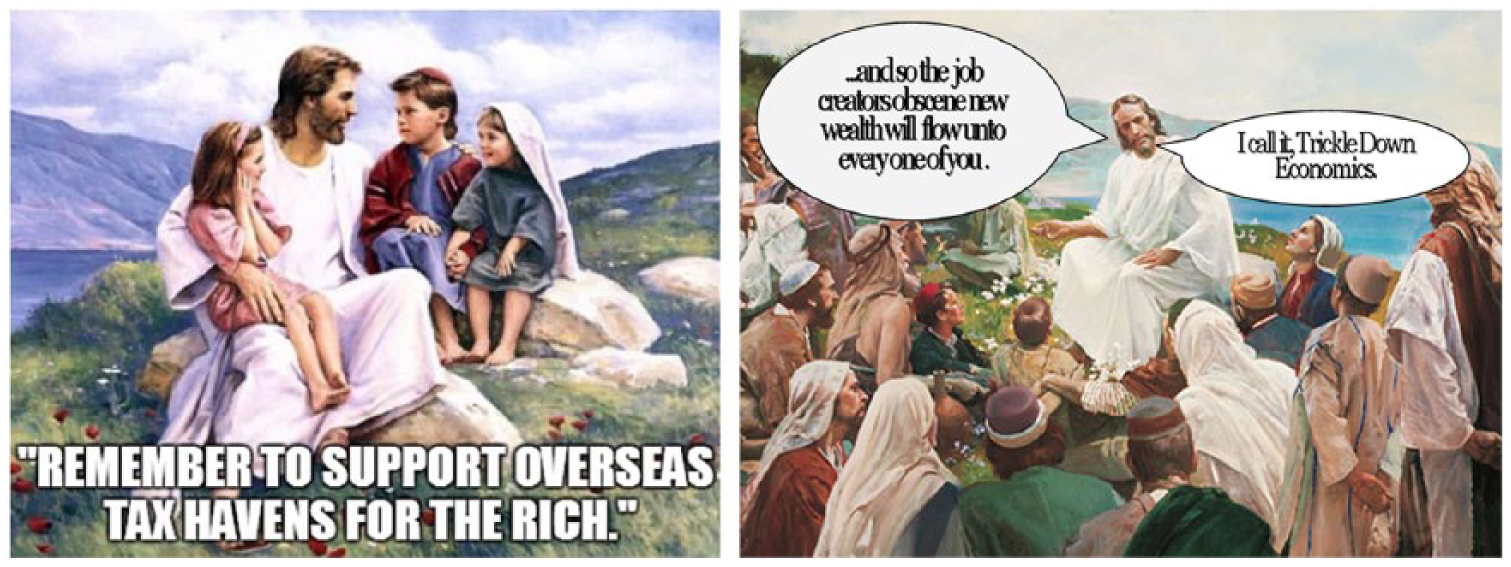
More often, memes feature Jesus reversing course on his prior position. In one example, Jesus stares wistfully into the distance while copy reads, “You are blind and want to see? Sorry, pre-existing condition. Next!” In another, Jesus engages a follower in a close conversation. “Is it true that I should give everything I have to the poor,” the stranger asks. “That’s ridiculous,” Republican Jesus replies, “If they don’t like being poor, they should just get a job like everybody else!!” Upon a depiction of Jesus feeding of the multitude the following copy appears: “We can’t feed all these people. That would only create dependency.” An image of Jesus visiting the poor features a new caption: “And when the poor came forth unto me, I asked . . . why art thou a taker and not a job-creator?”

Firearms are a frequent subject of Republican Jesus’ teachings as well. In one example, entitled “Republican Jesus loves the little children,” an image of Jesus crouching to speak to a child has been transformed, via the magic of photo editing software, into a one-on-one shooting lesson. Jesus, now clutching a large handgun, instructs a young white-appearing child, “Jenny, I want you to die from a lack of healthcare, not a lack of ammo.” In another image, Jesus is depicted sitting beside a stream, his familiar shepherd’s staff replaced with a bolt action rifle. The copy attached reads, “If they are hungry, cut benefits to programs that feed them. If they are sick, deny them healthcare. If they are strangers, deport them.~Republiconnians 13:2-4.” Another image, which likely depicted the savior’s arms outstretched in an act of love, has been altered to depict Jesus brandishing dual handguns and carrying a rifle on his back; his robe festooned with a large amount of cash, the confederate flag, and buttons reading “I am Pro Life,” and “I (heart) Death Penalty,” and “HAITI.” In one variation, an image depicting Jesus holding an infant has been retouched such that Jesus now embraces an assault rifle. The attached copy reads, “cause you know what Jesus would want . . .”

Often, Jesus’ familiar and already westernized appearance has been modified to comport more readily with conservative politics. One series of Republican Jesus memes features a cartoon drawing of Jesus—with familiar white skin, long brown hair, and beard—dressed in traditional business attire—navy suit jacket, white button-down shirt, red tie, and an American flag lapel pin. He characterizes the feeding of the multitudes as a business transaction: “. . . and after I performed the miracle with the loaves and the fishes, I sold them to the multitude at a huge markup . . . sweeeet.” In another variant entitled “WWRJD: What Would Republican Jesus Do?,” the savior is again outfitted in a business suit; this time, he has accessorized his ensemble with an automatic weapon and a confederate flag.
What Does Republican Jesus Do?
Republican Jesus does powerful work by creating what Kenneth Burke (1973) termed “perspective by incongruity.” Perspective by incongruity is described as a sort of symbolic “atom-cracking” (p. 308). Burke argued that humans, by nature, are critics who learn from experience to associate stimuli with symbols and to group symbols together into larger associational groups. These associations (we might also call them articulations) help us make sense of past experiences and our place in the world, and they shape our interactions in future ones. Unfortunately, Burke wrote, these associations are always of only limited use and, in some cases, can devolve into “trained incapacities.” Pairing familiar signifiers with unexpected partners offers new understandings and points to the limits of prior articulations. In this case, explicitly pairing Jesus with contemporary conservative talking points works to underscore the deep hypocrisy of (and thereby pry apart) longstanding and typically unchallenged linkages between Christianity, capitalism, social conservatism, neoliberalism, and neoconservatism. Familiar images of Jesus feeding the poor throw into sharp contrast the cold indifference of capitalists and their elected officials to the plight of the underclass. Likewise, the visual depiction of Jesus healing the sick highlights the GOP’s allergic reaction to universal healthcare. Familiar images modified to make Jesus look more Republican—in business suits, with short hair cuts, and brandishing firearms—further serve to emphasize the deep rift between the life and morality of the Prince of Peace and that of the capitalist and militarist positions endorsed by the party.

So we should read these memes as much more than entertainment. Republican Jesus does the work of ideological struggle—it locates and pries open spaces of dissension in hegemonic articulations of Christianity with capitalism, militarism, neoconservatism, and neoliberalism. To stop at this recognition, however, would be to fail to appreciate the unique political significance of memes as memes. The activist, who purchases a “Save the Whales” bumper sticker, signals to the world his or her support for a cause and replicates that cause’s message, thereby transmitting the message to a broader audience and signaling an incremental increase in its number of devotees. So does the reader of a newspaper who circulates a copy of a particularly powerful political cartoon. Of course, these memes function in this way as well. Individuals who encounter Republican Jesus can simply share the meme by liking it, posting it to their Facebook or Twitter streams, or by circulating it in other media. But unlike a powerful piece of oratory or an ideologically loaded bumper sticker, what is transmitted in the sharing of Republican Jesus is not simply the sharing of content. In the sharing of the meme, individuals are also prompted—via fast, free web sites and smart phone apps—to create new instantiations of the meme. The activist who makes use of Republican Jesus transmits an awareness of an ideological contradiction, and then each new user of the meme supplies the specific materials that substantiate the signaled contradiction.
Memes like Republican Jesus, then, offer at least two potentialities beyond ideological struggle at the level of perspective by incongruity. First, they may serve as a significant means of political consciousness building. To the extent that what ultimately is transmitted in each iteration of a meme is only an argumentative kernel, the discourse generated by that meme may be expanded and elaborated far beyond the imagination of any one producer of the meme. As each new user of the meme instantiates the meme with new specific examples of the contradiction, the public’s perception of that contradiction is expanded. Examples may be heaped on top of examples to generate a far broader awareness of the contradiction than could ever have been suggested in a given speech or pamphlet. As each person contributes data germane to their own lives, they also have the opportunity to recognize their commonality and perceive solidarity with others who struggle to be good Christians in a capitalist, neoconservative, and neoliberal culture.
Second, memes such as Republican Jesus may also function in the service of ideological subjectification. Interpellation, the process by which ideology constructs individuals as concrete political subjects, is frequently deployed interchangeably with the “mode of address,” or the “second persona.” These terms denote an awareness of the power of rhetorical texts to constitute an audience, to speak it into social existence. In Althusser (1971/2001), however, interpellation entails more than mere address: interpellation occurs not at the moment that the individual is (mis)recognized as such and such a subject but at the moment where the auditor acknowledges that (mis)recognition as legitimate recognition and signals her or his assumption of that subjectivity. Heyse’s (2011) analysis of the United Daughters of the Confederacy, for example, identifies catechisms for small children as a primary means of interpellating new generations of children into subjectivity as southern descendants of the men who fought in the Civil War. Schoolchildren became members of a reborn Confederacy not at the moment that they were spoken to but when they spoke back as members of the Confederacy. Memes like Republican Jesus allow a similar form of interaction. Creating a new instantiation also signals interpellation; it positions the former recipient of the meme as ideologically aligned with it. The creator of the new Republican Jesus constructs the meme and then shares it via some social media platform as one in-the-know about that ideological contradiction. In that act, they signal their oppositional subject position.
Parting Thoughts
In this essay, I have argued for the rhetorical significance of Republican Jesus as a particularly novel form of ideological struggle. I have argued that, as a complex verbal and visual argument, Republican Jesus works to identify and widen “spaces of dissension” in the hegemonic articulation of Christianity with other conservative ideologies. Moreover, I have argued that memes—and image macros in particular—are a form of vernacular rhetoric that may function to build consciousness and interpellate subjects.
An intervention of this sort is especially notable for progressives in light of the Left’s almost complete abandonment of evangelical Christians. In the last three decades, conservatives have consolidated their ties to evangelicals, making abortion and gay marriage evergreen wedge issues that drive voters to the polls. Progressives have had little to offer Christians in the way of a counternarrative. Things could certainly be otherwise: in the early 1990s, for example, second-wave feminists found themselves partnering up with the “moral majority” in opposition to pornographic and violent media content. Since that time, however, various loyalties to Hollywood and to Lesbian, Gay, Bisexual, Trans, and Queer (LGBTQ) publics have limited the Democratic Party’s odds of convincing evangelicals that they are the party of “family values.” Contemporary Christian attitudes toward gender roles, abstinence, homosexuality, transgenderism, and the like seem to render impossible a future in which a devout Christian could recognize the Left as the most pious vote. But these issues are hardly the only ones that can become politically salient for Christians. To recognize that hegemonic discourses of Christianity have been successfully articulated with a conservative policy agenda is not to foreclose the possibility that such links can be undermined and replaced with more humane, productive ones.
During the writing of this essay, Pope Francis issued an encyclical letter entitled “On Care for Our Common Home.” In this lengthy statement of official policy, his Holiness advocates forcefully against the environmental destruction, violence, injustice, and economic inequality created and exacerbated by global capitalism. Christians are called, he writes, to become stewards of God’s creation. Recalling the book of Genesis, his Holiness reminds readers that humankind is called to “till and keep” God’s creation. Unfortunately, “a sober look at our world shows that the degree of human intervention . . . is actually making our earth much less rich and beautiful, ever more limited and grey” (Francis, 2015). The Pope locates the cause of environmental decline in the employment of technology and science in the service of greed and consumerism. He regards environmental, human, and social degradation as concurrent effects of the same root problems: consumerism and capitalist expansion. He warns the faithful to be skeptical about a core tenet of neoliberal capitalism—that free markets solve all problems. And he discounts the promise of technology and science as value-free enterprises capable of solving our problems. And ultimately, the encyclical calls for the development of an “integral ecology” which will marry science with humanism. Such integration is necessary because, he writes, “There can be no renewal of our relationship with nature without a renewal of humanity itself. There can be no ecology without anthropology.”
While there is no evidence that he is interested in such a project, the Pope’s emphasis on humanity’s Biblical obligation to care for the world and the need to fill our hearts with spiritual riches rather than material ones illustrates the potential for the articulation of Christian and other faith traditions with a progressive critique of the establishment in a way that has largely been abandoned since the 1970s. Indeed, one could imagine even more Republican Jesus memes supplied with material pertinent to other objectionable elements of conservative politics. In the late 1990s, evangelicals commonly adopted What Would Jesus Do? (WWJD?) as a motto for their mission to live in the world as Christ would have them. Rather than foregrounding chastity and heteronormativity, progressive articulations of Christianity might emphasize scriptural values of egalitarianism, charity, clemency, and acceptance. One might ask, “Whose marriage would Jesus hate” or “Who Would Jesus Bomb?” One might even dare to ask whether Jesus would purchase a high-quality firearm for self-defense. In counterposing contemporary conservative politics with the figure that many conservatives hold in highest regard, Republican Jesus opens a space of dissension, suggesting that what the “real” Jesus Christ might do, and what a true Christian might also be obliged to do, is to be an anti-war protestor, a liberal or, God forbid, a socialist.
Footnotes
Declaration of Conflicting Interests
The author(s) declared no potential conflicts of interest with respect to the research, authorship, and/or publication of this article.
Funding
The author(s) received no financial support for the research, authorship, and/or publication of this article.