




Abstract
This article analyses transparency among groups of journalists by examining journalists’ tweets. It also answers a call from previous researchers on transparency on Twitter for further studies based on more representative samples of journalists. The study draws on a quantitative content analysis of Swedish journalists’ tweets during 1 week in spring 2014. The total number of tweets analyzed (N) is 1,500. A total of 24% of the journalists’ tweets can be described as being explicitly transparent. However, the findings indicate that while journalists on Twitter indeed discuss how the news are produced (disclosure transparency), they show less personal transparency, and hardly ever invite the audiences to interact or take part in the process of making news (participatory transparency).
Introduction
Transparency has become one of the most important journalistic norms, not least because it is believed to promote credibility and accountability. In an essay on the concept of transparency, Plaisance (2007) argues that “for journalists confronted by an often hostile public, transparency is more than academic; it is an essential element of credibility” (p. 193). When Plaisance published his essay on transparency in journalism in 2007, he noted that “journalists themselves seem ambivalent about their commitment to the ideal of transparent behavior [and are] reluctant to expose newsroom deliberations to public scrutiny for various reasons” (p. 193), and that journalists rarely disclosed the methods of their work. However, this was written before the adoption of Twitter (and other social media) in journalism.
Since 2006, Twitter has evolved to be one of the most important social media platforms in journalism, both for news organizations and for individual journalists (Ahmad, 2010; Hermida, 2013, 2014). It is a potent tool for research, networking, audience interaction, and content distribution, as well as for organizational and personal branding (Artwick, 2013; Hedman, 2015; Neuberger, vom Hofe, & Neurnbergk, 2014). In a study of the adoption of Twitter in newsrooms, based on observations and interviews at an US newspaper, Revers (2014) suggests that Twitter promotes transparency in journalism as it “fosters a processual rather than definitive understanding of news, perceived as an ongoing discussion rather than a final product” (p. 821), and therefore pushes journalists to adopt new practices. He comes to the conclusion that
Journalists viewed Twitter as a possibility to engage and excite audiences for their work. News corporations viewed Twitter as a way to promote consumer loyalty, which can me monetized. The professional concern for audience engagement and the economic concern for consumer loyalty mutually reinforced each other, especially at a time of crisis. (Revers, 2014, p. 822)
As Twitter allows the public to “follow” both news organizations and journalists of their choice, the public has the possibility of obtaining further information on ongoing news stories, of learning more about the profession of journalism and how news are created, and of getting to know the chosen journalists on a more personal level. In the words of Plaisance (2007), they can “begin to weigh what claims and sources deserve their trust” (p. 203).
There are a number of aspects of transparency in journalism. Disclosure transparency explains the process of making and the rationale behind the news, and participatory transparency aims at audience interaction, collaboration, and dialog (Karlsson, 2010; Phillips, 2010). There is also what is described here as personal transparency, which includes personal opinions and details from journalists’ private spheres (Hayes, Singer, & Ceppos, 2007). And while online news “warrant disclosure transparency” and participatory transparency because of the instant publishing model, as argued by Karlsson (2010, p. 538), I would also argue that disclosure, participatory, and especially personal transparency are promoted by the evolving norms and practices in social media. All these aspects of transparency flourish among journalists on Twitter, thereby also contributing to the blurring of boundaries between the professional and private spheres (Cozma & Chen, 2012; Lasorsa, 2012; Lawrence, Molyneux, Coddington, & Holton, 2013; Robinson, 2011). The transparency of different groups of journalists on Twitter has so far not been analyzed.
In this context, the purpose of this study is to analyze transparency among groups of journalists by examining journalists’ tweets. The study is based on a quantitative content analysis of a randomized sample of 2,543 Swedish journalists’ tweets during 1 week in May 2014. The number of tweets analyzed is 1,500.
Transparency in Journalism
There is a growing demand for transparency in journalism, as well as in the rest of the society. One reason for this is an overall growing demand for organizational transparency, as “the transparency pursuit has great potential for enhanced organizational effectiveness and widened democratic practices,” as described by Christensen and Cheney (2015, p. 70). Another concerns co-creation and participation: as digital technologies and social media enable and even encourage user participation, transparency is one way to relate to all those people outside the news organizations that engage in journalistic activity (Baresch, Hsu, & Reese, 2010; Westlund, 2013; Williams, Wardle, & Wahl-Jorgensen, 2011).
There are several objectives for more transparency in journalism: audiences want news media to be transparent about their sources, journalistic principles, and mistakes; news organizations want their audiences to think of them as objective, accountable, and transparent, and journalists hold transparency as one of the most important professional ideals (Chadha & Koliska, 2014; Groenhart, 2012; Heise, Loosen, Reimer, & Schmidt, 2013; Phillips, 2010; van der Wurff & Schönbach, 2010). Essential to all arguments for transparency is its link to credibility and accountability.
1
Transparency is also closely related to participation and interactivity “as in the increasing ways in which people both inside and external to journalism are given a chance to monitor, check, criticize and even intervene in the journalistic process” (Deuze, 2005, p. 455). Plaisance (2007) concludes that “openness is the best way to build public trust and accountability” (p. 192), and Meier (2009) describes transparency as “a case of demonstrating trustworthiness by open self-reflection, building-up a relationship with the audience and binding the loyalty of the target audiences” (p. 7). Hayes et al. (2007) suggest that
In a traditional environment, journalists simply ask readers or viewers to trust them [ . . . ] It is a lot to ask [. . . ] The unbounded and interconnected nature of [online media] gives journalists an unprecedented opportunity to build credibility through a form of information transparency that has never before been feasible. (p. 271)
But transparency also challenges core values of the profession of journalism. Lewis (2012) describes this as a kind of tension, whereby journalists recognize and encourage audience interactivity, dialog, and participation on one hand, while on the other hand, they “fall back on professional defenses” (p. 850). At the same time, signs of a growing hybrid logic of adaptability and openness can also be identified (Lewis & Usher, 2013).
Disclosure and Participatory Transparency in Online News
Research on transparency in the online news media environment has concentrated on two parallel strands, which Karlsson (2010) identifies as disclosure transparency and participatory transparency. While disclosure transparency is about explaining and showing how news are made, participatory transparency is an invitation to audiences to interact and take part in the process of making news in different ways (cf. Deuze, 2005; Feighery, 2011). Of course, news organizations and journalists have always had the opportunity to explain the rationale behind the news and to invite the audiences to discuss and influence the content. However, digital publishing provides opportunities for a kind of transparency that was very difficult, if not impossible, to achieve in the past. It achieves this by means such as hyperlinking to original sources and documents, correcting, and acknowledging mistakes, using time stamping to make it easier to trace updates, and so on, and by providing new techniques for getting the audiences involved in the news like including email links, comments, blogs, chats, and polls (Hayes et al., 2007; Karlsson, 2010; Phillips, 2010; Singer, 2011).
Researchers have found, however, that despite the many technological possibilities for implementing transparency features and the existence of a strong normative ideal that promotes transparency, news organizations seem to utilize them to a limited extent only (Chadha & Koliska, 2014; Karlsson, 2010). As Plaisance (2007) points out, journalists “have been reluctant to expose newsroom deliberations to public scrutiny” and have failed to “provide full disclosure about the methods of their work” (pp. 193, 195), even though this could increase their accountability. It also seems as if, even though the audiences appreciate the disclosure transparency and the possibilities of interaction, most of them are in fact not interested in actually interacting with journalists (Robinson, 2011; van der Wurff & Schönbach, 2014).
Disclosure, Participatory, and Personal Transparency on Twitter
As Karlsson (2011) points out, journalistic processes that were once hidden from the audiences become visible in online media, as “user participation and immediacy have altered the digital frontstage area, not only in theory but also in practice” (p. 291). In social media, these processes have become even more visible, as social media brings possibilities for more—and new aspects of—transparency (Chadha & Koliska, 2014; Meier & Reimer, 2011).
When journalists adapt to the norms and practices of blogging, Hayes et al. (2007) found that they could contribute to journalistic accountability by explaining the rationale behind the news and humanizing the reporter, “allowing him or her to talk about the experience of covering a particular story or about personal reactions to news events” (p. 273). When journalists adapt to the norms and practices of Twitter, they not only make humor a regular part of their tweeting, as shown by Holton and Lewis (2011) and Molyneux (2014), but Lasorsa (2012), Lasorsa, Lewis, and Holton (2012), and Lawrence et al. (2013) also found them to be transparent in the sense that they link and tweet about their jobs and how the news are created, that is, disclosure transparency. Noguera-Vivo (2013) found that the j-tweeters (journalists that are active on Twitter) regularly ask for information and engage in conversations, that is, participatory transparency. Molyneux (2014) also found that the j-tweeters reveal opinions and other personal or private, if sometimes mundane, information about themselves. In other words, they provide a personal transparency, thereby adding transparency on the level of the individual journalist to transparency on the level of the process that had previously been the norm (cf. Lasorsa, 2012; Lasorsa et al., 2012).
Feighery (2011) argues that social media, as a result of the increasing transparency, “foster trust relationships” (p. 172). Today, however, it seems that journalists on Twitter tend to follow the tradition of a somewhat limited transparency from the online news environment (Lasorsa, 2012; Lasorsa et al., 2012; Lawrence et al., 2013), rather than adopting the “news as an ongoing discussion” view suggested by Revers (2014).
One possible explanation for this is the “tension between professional control and open participation” described by Lewis (2012). Another explanation is suggested by Robinson (2011): historically, audiences consumed the work product of an author. The digital and social media environment has changed that, and “what had been a private matter between the audience member and the journalism turned into a relationship between the online visitor and the journalists in public spaces” (p. 199) where journalists become celebrities, revealing personal information about themselves to create a sense of intimacy with their followers (cf. Marwick & boyd, 2011). In other words, as social media push journalism toward more transparency, the journalist is no longer judged only by what he or she publishes, but also by how he or she appears, professionally and privately, in the context of social media.
Twitter and Transparency in Journalism
There is more to Twitter in journalism than journalists who are transparent in their tweets. Research has shown that news organizations increasingly use Twitter to promote and distribute content (Armstrong & Gao, 2010; Engesser & Humprecht, 2014; Messner, Linke, & Eford, 2012; Newman, 2011), as a platform for live coverage of events (Herrera & Requejo, 2012; Parmelee, 2013; Vis, 2012), for audience participation (dialog, crowdsourcing, interaction, etc.) (Artwick, 2013; Phillips, 2012), and branding (Bruns, 2012; Greer & Ferguson, 2011), and that Twitter can be a potent professional tool for research (Broersma & Graham, 2012; Hedman, 2015).
Twitter is not exclusive to media organizations and journalists but, in Hermida’s (2010a) words, is “part of an ambient media system where users receive a flow of information from both established media and from each other” (p. 3), where the value lies not in the single bits and parts of information but rather in the flow of information, and where “journalists would be seen as sense-makers, rather than just reporting the news” (Hermida, 2010b, p. 304). I would argue that what journalists reveal about themselves and the process of making news, and how they engage with their audiences, is crucial for how much sense they in fact make.
The purpose of this study is to analyze transparency among groups of journalists by examining journalists’ tweets. It also answers a call for studies based on a more representative sample of journalists on Twitter (Lasorsa, 2012).
RQ1. To what degree do journalists show disclosure transparency (i.e. job talk) when tweeting from their personal accounts, and what differences are there between groups of journalists regarding disclosure transparency?
RQ2. To what degree do journalists show participatory transparency (i.e. engaging the audiences) when tweeting from their personal accounts, and what differences are there between groups of journalists regarding participatory transparency?
RQ3. To what degree do journalists show personal transparency (i.e. sharing private information) when tweeting from their personal accounts, and what differences are there between groups of journalists regarding personal transparency?
Methods and Data Collection
The study was conducted in Sweden. Although the general use of social media among Swedish journalists is high, previous research has shown that Swedish journalists in general are not very active on Twitter and that there are large differences in professional norms and attitudes between the relatively small group of high-active users and their less active colleagues (Hedman, 2015).
Sample
As many journalists do not identify themselves as journalists in their Twitter presentations, and there is no mandatory system of registration of journalists’ accounts, there are obvious difficulties in determining the population of journalists on Twitter and hence no way to draw a randomized sample. Researchers on Twitter in journalism can solve this problem in different ways: by searching for words such as “journalist” or “reporter” in the Twitter presentations and letting the findings equal the sample, 2 building on strategic samples small enough to let the researchers search for the chosen journalists’ Twitter usernames manually (e.g. Cozma & Chen, 2012; Noguera-Vivo, 2013), or building on self-recruited lists or lists compiled by others (e.g. Artwick, 2013, 2014; Lasorsa et al., 2012; Lawrence et al., 2013). All these strategies will leave the researchers with a purposive sample.
For the purpose of this study, a different approach was applied. “Journalists” in this context includes all journalists, and the aim has been to find a more representative sample of journalists on Twitter, regardless if they regard Twitter as a foremost professional platform or as a platform for personal/private use. From spring 2011, the researcher has manually collected Swedish journalists’ Twitter usernames. The collection of usernames has taken place both as systematic manual searches and during the researchers’ own professional and private use of Twitter. Each time the researcher found a “new” journalist, the username was stored in a separate list and the journalists’ lists of followers and followed were searched for yet new usernames. News and interest organizations’ lists of employees, members, and so on were searched in the same way. One advantage with this snowball sampling is that the resulting list of usernames consists of journalists who have identified themselves as such in their Twitter presentations, as well as journalists who do not disclose their profession in their presentations and perhaps not even in the content of their updates (but are identified as journalists by their peers). Furthermore, during the collection of usernames, emphasis was placed on finding journalists’ representative of different groups of journalists and a diversity of workplaces and types of work, as well as being engaged in different levels of Twitter activity ranging from high-end to low-end users. In May 2014, the list included 2,634 usernames.
Background Variables
To be able to analyze differences in transparency among groups of journalists, the following background variables are used: gender, workplace location (geographical region), and workplace. All these variables are also found in the Swedish Journalist Surveys (SJS), 3 a postal survey with high representativity that has been conducted every 5 years since 1989.
Furthermore, three dichotomous variables were constructed for the purpose of determining whether an account was most likely intended for professional or personal usage: whether the account information contains a disclaimer (i.e. “my views are my own and not my employer’s”), whether the account can be regarded as “professional only” or not (i.e. whether it contains information exclusively referring to employer and professional position), and whether the journalist self-identifies as a journalist (or reporter, editor, etc.) in the account information or not.
Some of the Twitter metadata are also used as background variables: number of followers, follows, and updates, and information on when the account was created. These variables are used to analyze whether Twitter activity (i.e. high-end and low-end users) is related to degree of transparency.
Dependent Variables
To analyze transparency in journalists’ tweets, the following dichotomous variables were constructed: disclosure, participatory, and personal transparency. The variables are not mutually exclusive; the constructed tweet “Wrapping up this story on the car crash now. Are there pictures out there? Pls send! Must make it home to family dinner at 8” would fall into all three categories, and sometimes inter-related; like in “I really, really HATE it when my boss tells me to make another phone call 5 mins before deadline.”
The three categories of transparency are divided into one explicit and one implicit part. The explicit transparency is manifested in the tweeted text message, while the implicit transparency is indicated by the presence of other features (described below). By dividing transparency in explicit and implicit like this, it is possible to distinct a more active form of transparency (explicit) from a passive (implicit). One tweet can show both explicit and implicit transparency.
Disclosure transparency (RQ1). All explicit job talk, explaining how the news are created and tweets related to news work (i.e. “Spent the morning talking freedom of the press and journalism at a school. Many questions surprised me! So fun!” or “@reply We have a mix of content, award-winning investigative journalism and entertainment, just like on tv.”). Disclosure is also indicated by the presence of links to individual material or other sites (news sites, original sources, etc.) and by the inclusion of work-related pictures (news or “behind the scenes”).
Participatory transparency (RQ2). All explicit references to the audiences, discussions on news, journalism, or news work, crowdsourcing, or urges for interaction in any way (i.e. “If you have any information on corruption, please contact me at [email]” or “Leave a comment on my story: ‘Middle aged with a new job? How did you find it? [link]’”). This is also indicated by the presence of “mentions” in the tweet, and if the tweet has received an answer or not (“reply”).
Personal transparency (RQ3). All tweets that reveal explicit personal information, such as opining, references to family or activities outside work, and details from the private spheres (i.e. “My 8 month old daughter celebrates the day with a new tooth [picture]” or “I’ve slept terribly bad tonight. It started when I decided I should have a sleep-in.”). The inclusion of personal or private (not work related) pictures is also an indicator of personal transparency, as is the presence of geo location information, which makes it possible to determine exactly where the journalist was when the tweet was sent.
An attempt to divide disclosure, participatory, and personal transparency in sub-categories (such as for disclosure transparency, talk about work in the newsroom, talk about journalism, and talk about ongoing news) proved impossible, as there was not enough information in the tweets to do this.
The visibility of journalists’ networks, as in “follows” and “followers,” is also a feature of transparency (as argued by Verweij, 2012). However, a network analysis of journalists’ Twitter connections goes beyond the aims of this study.
Collecting Data From Twitter
In May 2014, two sets of data were retrieved from the open Twitter database through the use of the public API (cf. Bruns & Burgess, 2012; Gaffney & Puschmann, 2014; Kumar, Morstatter, & Liu, 2013). The first dataset, retrieved on May 2, contains information on all the accounts on the list of usernames: id, name, username, joining date and time, location, presentation, numbers of followers, numbers followed, lists, and updates at the time of retrieval. A manual review of the account information was performed to exclude individuals who explicitly no longer worked as journalists, after which the sample included 2,543 usernames. Using all available self-disclosed account information, the dataset was then manually coded by the researcher for the background variables. A second independent research assistant coded a subsample of 10% of the cases (255 cases), and Krippendorff’s Alpha (Hayes & Krippendorff, 2007) was used to estimate inter-coder reliability. The estimates for the background variables used in this analysis are as follows: gender 1.00, workplace location .97, workplace .96, disclaimer in bio .93, “professional only” account .96, and self-identify as journalist .91.
The second dataset contains all the tweets from the usernames on the list during a week in May 5-11, including username, tweet, date and time, the number of retweets, favorites and replies, geo location, whether the tweet contains a link, and if the tweet was deleted or not during the period of data collection. The tweets were collected by a software program that continuously monitored all the accounts on the list for updates, again by the use of the public API.
The two sets of data were merged into a single dataset. From the total of 70,901 journalists’ tweets during this week, a sample of 1,500 tweets were randomized. Following Lewis, Zamith, and Hermida (2013), who conclude that computational methods are “somewhat limited when more latent features are of concern” (p. 45), this randomized sample was then manually coded by the researcher for the dependent variables. The independent coder coded a subsample of 10% (155 tweets). The inter-coder reliability estimates for the dependent variables are as follows: disclosure .90, participatory 1.00, and personal .87. However, considering the estimates for the participatory and personal variables, one should notice that the findings show few examples of these in the sample of tweets which could lead to an over-estimation of inter-coder reliability.
Representativity
In an overview of the strengths and weaknesses of different methodological approaches to social media content analysis, Giglietto, Rossi, and Bennato (2012) point to the difficulties in sampling data “because in most of the cases the distributions are extremely skewed” as a few users are much more active than most others (p. 154). When analyzing a randomized sample of tweets from a larger population of journalists, who are more and less active, over a particular period of time, the skewedness is less of a problem. Lasorsa (2012), who studied transparency among the j-tweeters with the most followers, points to the need to use a more representative sample of journalists. An analysis of the purposive sample of 2,543 Swedish journalists’ usernames, using the account information and the manually coded variables in the first dataset, shows that for key variables where there are comparative data available from the SJS, 3 there is a high degree of correspondence, especially when bearing in mind that not all accounts display information on all these variables (Table 1).
Comparison of samples of journalists (%).

SJS: Swedish Journalist Surveys.
The column “J-tweeters in SJS 2011” represents the answers from respondents in the survey that use Twitter (write and/or read, all answers but “never”).
Findings
All tweets are written within a specific context. This is true also for journalists’ tweets. The week of data collection did not include any national breaking news events, or any general discussions about journalism among journalists on Twitter. However, the data for this study were collected in the run-up to the general elections to the European Parliament at the end of May 2014. In the week of the data collection, the semi-finals and final of the European Song Contest (ESC), a yearly event on European public service television, took place. This is shown clearly in the distribution of tweets (Figure 1): the Swedish participant was in the semi-finals on Tuesday and Saturday was the evening of the grand finale, corresponding to the two peaks in the journalists’ flow of tweets.
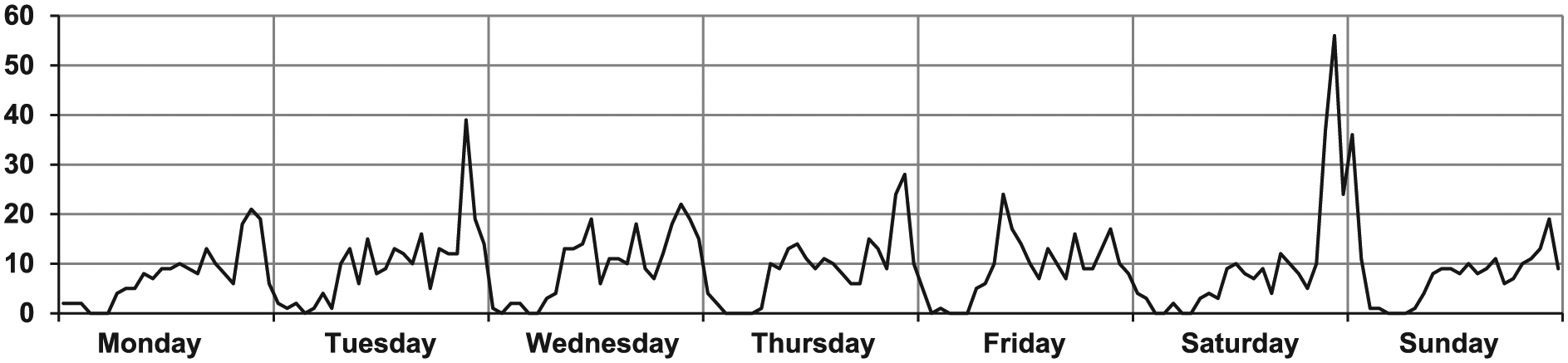
One week of journalists’ tweets (number). The distribution of tweets (N = 1,500) during the week of May 5-11, 2014.
However, the total number of tweets per day is spread evenly over the whole week with the exception of Monday, indicating that the ESC did not increase the total number of journalists’ tweets during this week. When analyzing the findings, one needs to take into account that the elections to both the European Parliament and the ESC are likely to have influenced the content of journalists’ tweets during the period of data collection, but there is no reason to believe these events affected the degree of transparency in the tweets.
An overview of the categories of tweets in the sample shows that about a quarter of all the tweets from the Swedish journalists are retweets (Table 2). This corresponds to the share of retweets as shown in comparable research by US political journalists (24%) and influential Spanish journalists (23%) (Lawrence et al., 2013; Noguera-Vivo, 2013). Only 21% includes a link to a website, which is far less than in tweets from US or Spanish journalists (27% and 32%, respectively). Almost two-thirds of the Swedish journalists’ tweets contain one or more mentions. Only a small share of the Swedish journalists’ tweets includes a picture (7%).
Categories of journalists’ tweets.
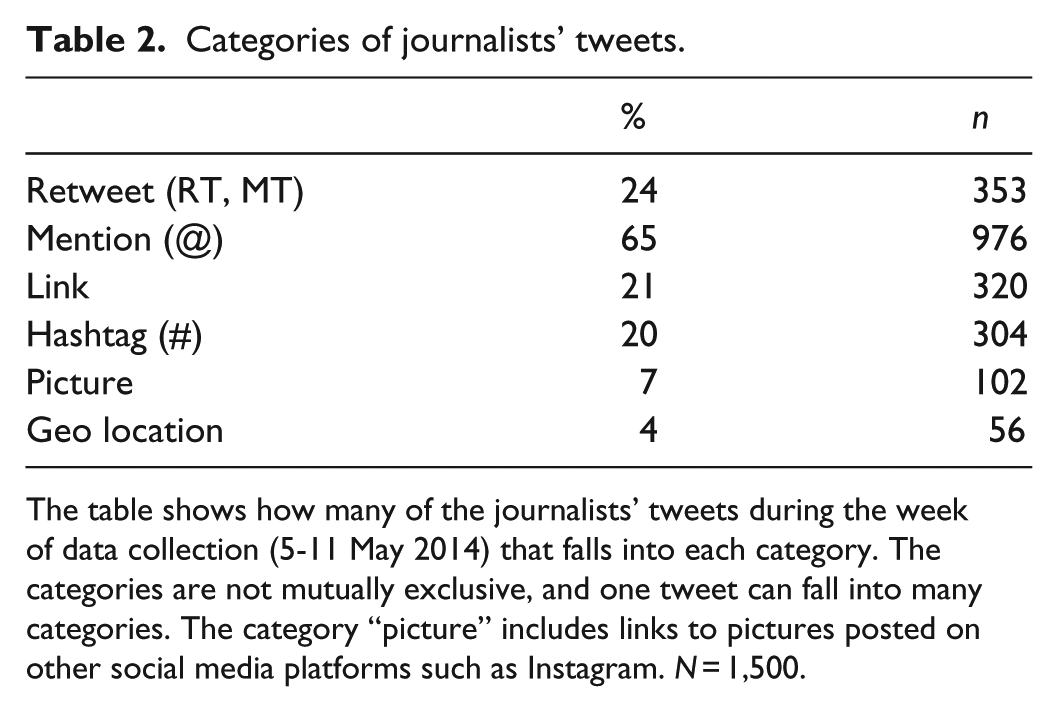
The table shows how many of the journalists’ tweets during the week of data collection (5-11 May 2014) that falls into each category. The categories are not mutually exclusive, and one tweet can fall into many categories. The category “picture” includes links to pictures posted on other social media platforms such as Instagram. N = 1,500.
Journalists in Public Service More Likely to Tweet About Work (RQ1)
Of all the tweets from Swedish journalists on their personal accounts, 14% contain explicit disclosure transparency; that is, job talk or references to work or journalism and so on (Table 3). There are no gender differences with regard to the degree of disclosure transparency, but there are differences related to workplace. Journalists in public service radio and television tweet more about their work (22% and 18%, respectively) than journalists from other workplaces.
Transparency in tweets among groups of journalists (row %).

The table shows the share of tweets with a specific form of transparency from a specific group of journalists. The different categories of transparency are not mutually exclusive. The “explicit” transparency refers to transparency in the tweeted text message itself. The “implicit” category refers to the maximum number of other features of transparency and the explicit transparency. The categories “followers,” “follows,” and “sent tweets” were divided in three equal parts each based on the numbers in the original sample of Swedish journalists on Twitter (n = 2,543).
p < 0.05; **p < 0.01; ***p < 0.001. The significant tests relate to two different measures of association: Cramer’s V for “Workplace location,” “Workplace,” and “Twitter account created,” each category tested separately where 1 = working in/at/account created, 0 = other; and Kendall’s tau-c. Percentages in the same column and group that share superscripts differ at p < .05 in the post hoc test (Tukey).
N = 1,500.
The findings further indicate that the more active a journalist is on Twitter (as in number of sent tweets), the less transparent she is about work. A total of 21% of tweets from the journalists who have been tweeting the least contain disclosure transparency, compared to 13% among the tweets from the most frequent tweeters.
In the context of this study, if a journalist’s Twitter account only contains information on employer, beat, and contact information, it is regarded as a “professional only” account. Journalists with such accounts show more disclosure transparency than others (18% and 13%, respectively), indicating that when a Twitter account is so obviously connected to the employer it is more common to use it for discussions on how the news are made.
An ordinary least squares (OLS) regression analysis where all factors (gender, workplace location, workplace, number of followers, whether the account information contain a disclaimer or not, whether the account can be regarded as “professional only” or not, whether the journalist self-identifies as a journalist in the account information or not, number of followers, follows and updates, and when the account was created) are tested simultaneously in a single model shows that workplace and number of sent tweets have significant effects on the explicit disclosure transparency (Table 4).
Transparency among groups of journalists (OLS, standardized beta).

p < .05; **p < .01; ***p < .001.
When implicit indicators of disclosure transparency are included in the bivariate analysis (work related pictures and/or links to own material or other web sites, together with the explicit job talk in the tweets), 32% of journalists’ tweets show disclosure transparency. While there are only small differences related to gender and workplace location, differences related to workplace are significant. Journalists at public service radio show most disclosure transparency (40%), followed by journalists at the tabloids and local/regional newspapers (36%), while only one of four journalists at the metropolitan newspaper shows this kind of transparency. The differences related to Twitter activity are also significant (44% of tweets from the least active journalists show disclosure transparency, compared to 30% among the most frequent tweeters). The difference related to whether the account is professional or not (42% and 31%, respectively) and if the journalist self-identifies as a journalist or not (33% and 22%, respectively) are also significant.
Almost No Invitations to Dialog and Participation (RQ2)
Only very few of the journalists’ tweets (1%) contain explicit references to the audiences, discussions on news, or proposals for interaction in any way (Table 3). Again, it is the journalists who work in public service radio and television who are the exception. In these groups, 3% of their tweets indicate explicit participatory transparency. Can this be a sign that journalists on Twitter do not use this social media platform for dialog and participation? However, as mentioned above, almost two-thirds of journalists’ tweets contain a mention (Table 2). In fact, these findings indicate that the frequency of invitations to dialog and participation is low, but that Swedish journalists do indeed use Twitter for conversation and dialog.
Again, the OLS regression analysis using ordinal regression where all factors are tested in a single model shows significant effects from workplace on explicit participatory transparency (Table 4). Employees on public service radio and television are more transparent in this regard than journalists working on other types of media.
When the implicit indicators of participatory transparency are included in the bivariate analysis (such as the presence of mentions and replies, together with the explicit dialog and interaction), 65% of all tweets indicate participatory transparency (Table 3). Men are more likely than women to be transparent in this respect (68% and 62%, respectively). There are also differences related to Twitter activity: the more active (as in the number of tweets sent) a journalist is and the more followers she has, the more interaction with other tweeters. However, it may very well be the other way around: the more interactive a journalist is, the more she tweets and the more followers she gets.
Gender Differences in Personal References (RQ3)
Personal transparency is indicated by the tweeting of personal or private information, such as opining, making references to family or activities outside work, or including details from the private sphere. It is in this category that the most significant gender differences can be identified. The bivariate analysis shows that women’s tweets are almost twice as personal or private than those of men. A total of 15% of all tweets sent by women reveal personal or private information, compared to 8% of those sent by men (Table 3). There are also differences relating to workplace: journalists working in television (13% and 16%, respectively) are almost twice as personal in their tweets than are journalists working at the public service radio or the tabloids (both 7%). The findings further indicate that workplace location does not affect the level of personal transparency, nor does how active journalists are on Twitter, or how many followers they have. These findings are further strengthened by the OLS regression analysis (Table 4).
What clearly has an effect is whether an account is seen as “professional only” or not. Journalists with accounts that are clearly associated with their employers are far less personal in their tweets than other journalists (6% and 11%, respectively). There is also a significant difference related to if the journalist self-identifies or not as such in her account information (17% and 10%, respectively).
When including the implicit indicators of transparency in the bivariate analysis (personal or private pictures and geo location information, together with the explicit personal transparency in the tweets) another correlation emerges: the longer a journalist has been active on Twitter, the more personal and private she becomes. A total of 20% of all tweets sent from journalists who have been on Twitter for more than 6 years are personal or private, while only 13% of all tweets from journalists who have been active for up to 3 years show any personal transparency, indicating that journalists can indeed adapt to the evolving norms and practices of Twitter, as shown in previous research (Lasorsa, 2012; Lasorsa et al., 2012; Molyneux, 2014), and that this increases over time.
Overall Transparency and the Redundant Use of the Disclaimer
A total of 24% of journalists’ tweets show some explicit transparency—disclosure, participatory, and/or personal (Table 3). In the OLS regression analysis, it turns out that only gender has a significant effect on overall transparency (Table 4).
An important consideration is whether the journalists tweet from a more or less professional account, or provide a work-related description in their account presentations. As shown above, journalists tweeting from a “professional only” account show more disclosure and participatory and less personal transparency. They also have fewer followers and have sent fewer tweets than journalists who have added some personal (not work related) information in their Twitter presentations (not in table). For journalists who withhold information on workplace and workplace location in their account presentations, the opposite is true: they show less disclosure and participatory transparency and are more personal and/or private in their tweets. The same goes for journalists who chose not to self-identify as such in their account information.
Some tweets (13%) are sent from an account with a disclaimer of some sorts, “Tweets are my own” or “All views are mine and not my employer’s.” When the disclosure and participatory transparency are mostly work related, as demonstrated above, a disclaimer could indicate that a journalist would tweet in a more personal and/or private style. However, there are no differences in transparency related to disclaimers. Hence, the use of a disclaimer in the Twitter presentations appears to be redundant.
Transparency in Journalists’ Tweets: Much Ado About Nothing?
In this article, I have analyzed the transparency among groups of journalists by examining journalists’ tweets. Twitter provides an opportunity for individuals to “follow” one or more journalists of their choice, and therefore get not only more information on ongoing news but also knowledge of the work in the newsrooms and of journalism, andmay perhaps help followers “get to know” the journalists themselves on a more personal level (or, in the words of Hayes et al. (2007), humanize the reporter behind the news). Following Hermida (2010a, 2010b), I have argued that what journalists reveal about themselves and the process of making news, and how they engage with their audiences, is crucial for how much sense they in fact make. The main arguments are that transparency builds trust and accountability (Plaisance, 2007), and a relationship to audiences (Feighery, 2011; Meier, 2009), and hence that the more transparent journalists are, the more trustworthy, accountable, and credible they will be in the eyes of the audiences.
The individual members of the audiences who “follow” journalists on Twitter for the purpose of understanding the news and journalism may very well get disappointed, though. The findings in this study indicate that most journalists’ tweets are not explicitly transparent in this sense, and also that Swedish journalists tend to follow the tradition from the online news environment of a somewhat limited transparency, as shown in previous research. Of course, the level of transparency varies among individual journalists, but when analyzing a random sample of tweets (N = 1,500) from a representative sample of journalists, we find that 14% of all tweets show disclosure transparency, 1% participatory transparency, and 10% personal transparency. Taken together, 24% of journalists’ tweets are explicitly transparent in one or more of these respects. However, while a news organization can set up a Twitter account with the explicit purpose of being transparent, individual journalists are not obliged to tweet about news work or journalism—or about their personal and private lives—from their personal accounts. One can also argue that being active on Twitter is being transparent per se, and that it perhaps does not matter what journalists’ tweet about—that, following Revers’ (2014) argument, journalists’ tweets are part of news as an ongoing discussion, regardless of what they actually tweet about, and, as Robinson (2011) argues, journalism is increasingly about creating a relationship between audiences and journalists. Further research is necessary to answer the questions about what the journalists’ “followers” on Twitter and other social media expect from this relationship, and whether following journalists’ tweets really has an effect on trust, accountability, and credibility.
When all the findings in this study are considered, we can distinguish two separate approaches among journalists on Twitter, resulting in different levels of transparency (explicit and implicit). The skeptical tweeters are probably active on Twitter because they have been encouraged to, by their employers or colleagues. These journalists have a “professional only” account and tweet moderately and are more likely than others to tweet about work-related issues (news, news work, and journalism) and links to news. They are also less likely to share personal or private information. The enthusiastic tweeters, on the other hand, are considerably more active and do not distinguish private from professional or work-related tweeting, thereby blurring the boundaries between the professional and the private spheres. They are also the most likely to invite their followers to discussions on news or to participate in the making of news (although they rarely do so). There is also a gender dimension regarding transparency in journalism. Female journalists are more transparent than males, especially when it comes to being personal or private.
The blurring of the boundaries between the professional and the private works both ways. Journalists with a “professional only” account show personal transparency. And journalists who do not self-identify as such in their account information, and hence perhaps could be expected not to use Twitter in their capacities as journalists, indeed show disclosure and participatory transparency. For journalists on Twitter, it is obviously hard to keep the personal out of the professional and vice versa.
The OLS regression analysis shows that besides the gender dimension, the level of transparency on Twitter is not related to factors such as workplace or type of work. Age could be a relevant factor, but there is no way to determine the age of an individual tweeter from the account information. Neither is the level of transparency related to the level of Twitter activity. Instead, other factors are obviously at play here. I would suggest that further research search for these factors in two different directions: at the organizational level, that is, in the newsrooms (organizational demands, policy documents, influence from editors and colleagues, etc.), and at the individual level, as previous research has shown that such things as trust in other people are related to online behavior (e.g. Metzger, 2006; Park, Campbell, & Kwak, 2012).
News organizations increasingly regard social media as not only a place for research and distribution of content but also as an important platform for audience participation and branding. In all this, transparency plays an important part, especially to build trust and accountability. As a consequence, news organizations increasingly demand from their journalists that these are active not only with a personal account on Twitter but also on several social media platforms. However, it is obvious that news organizations cannot trust individual journalists to “do the transparency work” for them. This also raises several questions. (1) Can a personal social media presence be part of the job description of a journalist? As research has shown, not all journalists are active in social media, and the level of activity varies between those who are. (2) How much personal and private transparency can be expected from a journalist? A journalist can choose to set up a more or less “professional” social media account, where disclosure and participatory transparency is an important part of the content, but do the audiences really need to know the journalist on a personal level in order to make sense of the news? In other words, does journalism now include not only the content but also the journalist herself? And if so, is this an inevitable consequence of the growing hybrid logic of adaptability and openness identified by Lewis and Usher (2013)? I would argue that these are crucial questions for future journalism.
This article also answers a call for studies based on a more representative sample of journalists on Twitter. This study shows that a thorough manual search for journalists’ Twitter usernames can result in a sample that is representative on key variables, coded from information in the Twitter account presentations. An alternative approach would be to search for all Twitter accounts that include “journalists” or “reporter” in the presentations and let the findings equal the sample, thereby missing out journalists whom do not identify themselves as such but instead get a larger sample.
A limitation of this study is the number of variables that are possible to code from the information in the Twitter account presentations. Future researchers could exploit the possibilities of combining datasets retrieved from the open Twitter database through the use of the public API with, for example, surveys to increase the number of background variables such as age.
Footnotes
Acknowledgements
The data used in this study were collected in cooperation with Filip Wallberg, journalistic lecturer at University of Southern Denmark.
Declaration of Conflicting Interests
The author(s) declared no potential conflicts of interest with respect to the research, authorship, and/or publication of this article.
Funding
The author(s) received no financial support for the research, authorship, and/or publication of this article.