



Abstract
The Internet can be used to reconfigure access to information and people in ways that can support networked individuals and enhance their relative communicative power vis-à-vis other individuals and institutions, such as by supporting collective action, sourcing of information, and whistle blowing. The societal and political significance of the Internet is a matter of academic debate, with some studies suggesting a powerful role in creating a “Fifth Estate,” and other studies challenging such claims. Research on this issue has not yet comprehensively focused on social network sites and those operating in a very liberal-democratic context. Based on an embedded case study of Facebook use in Finland, this study focuses on the uses of social media in building communicative power, such as in capacity to foster social movements in ways that conform to conceptions of the Internet’s Fifth Estate. The case study combines qualitative and quantitative methods to examine a sample of 2,300 Facebook pages and their online and offline activities and impact qualities. The results located 27 pages that reached a threshold we established for identifying online social movements with the potential for enhancing their communicative power, with a small minority of four cases appearing to have actualized communicative power. These findings not only reinforce the potential of Fifth Estate activity on social media but also underline the challenges of societal change in this predominantly entertainment-oriented social context. In addition, the study showcases the intertwined process of online and offline attributes affecting societal influence of online social movements.
Introduction
The use of social media, or social network sites (SNS), has increased exponentially since 2004 when Facebook was launched, followed by many other SNS, such as Twitter in 2006. Given the worldwide diversity of SNS, it is difficult to generalize about their role, but they are primarily focused on supporting the networking of social interaction, such as in connecting friends. Nevertheless, the use of social media for societal change and political activities is potentially critical because these networks are formed around important social communities and relationships that could be turned to societal influence.
Despite famous examples of the use of social media such as in the Arab Spring (Rane & Salem, 2012), not much SNS research is focused on an overall societal picture of communicative power formation, including “networked individuals” (individuals as independent actors interacting via Information Communication Technologies [ICTs] with numerous diverse others via multiple Internet arenas simultaneously; see, for example, Rainie & Wellman, 2012), challenging both governance institutions and corporations, and the media impact in all this. SNS research has been more focused on specific political activities and networked individuals’ intended activities, such as building on friendship ties (Ellison & boyd, 2014). Studies of the political uses of SNS have focused on a general worldwide scale or on non-democratic, newly democratic, or relatively authoritarian national contexts (e.g., Bakardjieva, 2011; Bennett & Segerberg, 2012; Castells, 2012; Curran, Fenton, & Freedman, 2012; Lim, 2012).
This study explores the degree that SNS have been used for societal influence in the broadly liberal-democratic context of Finland, where national political–administrative traditions would be open to citizen initiatives and collective action. We ask whether SNS are used in ways that can enhance the relative “communicative power” of their users relative to other individuals and institutions (Castells, 2007; Dutton, 1999; Habermas, 1996). Although the role of SNS in political initiatives and collective actions is a matter of considerable debate in Internet studies, various research has concluded that the Internet as well as SNS can play an important role in social movements and collective action (e.g., Bennett & Segerberg, 2012; Castells, 2007, 2012), civic political engagement and participation (e.g., Feezell, Conroy, & Guerrero, 2009), and civic corporate monitoring and challenging (e.g., Champoux, Durgee, & McGlynn, 2012).
Habermas (1962/1989, 1996) introduced the public sphere as an (offline) arena where individual people joined to critically debate and unite against illegitimate use of power and state domination and theorized how this discourse creates communicative power. Flynn (2004) further explains that Habermas’ communicative power is “the key normative resource for countering the norm-free steering media of money and administrative power” (p. 434). Whether or not one adopts notions of a public sphere, the potential for the media and the Internet, in particular, to be used in ways that enhance the “communicative power” of networked individuals has been developed by a number of scholars (Dutton, 1999; Garnham, 1983), such as by enabling the rise of a Fifth Estate that could hold institutions more accountable in ways analogous to the press in an earlier era (Dutton, 2009; Hidri, 2012). However, questions have been raised about whether communicative power online can translate into meaningful societal or political change as opposed to a form of “clictivism”—simply generating online activity.
The potential communicative power of individuals networked through social media is the focus of this study. Specifically, on Facebook, are the individuals networked around liking particular “pages” which are seen in this study as prime paradigms of “online social movements”, that is, collectivities of individuals using Internet and social media to organize and achieve societal change (Castells, 2007; Snow, Soule, & Kriesi, 2004), which operate today in both online and offline arenas (Castells, 2012), and may be capable of translating their communicative power into a Fifth Estate. Collective action is one of a number of strategies of the Internet’s “Fifth Estate” (Dutton, 2009; Newman, Dutton, & Blank, 2012), but this is a central aspect of online political and societal change that merits study in a particular online context. The Fifth Estate develops from individuals, enabled by ICT networking and sourcing information that is independent of authorities, to increase their communicative power to bypass and hold powerful institutions of society (media, corporations, and state) accountable. We use the term “actualized communicative power” (ACP) in this study to denote the achievement of societal influence or change, conforming to the potential attributed to the Fifth Estate.
The key objective of this study is to identify as a specific case of SNS, online social movements on Facebook that exhibit a potential for enhancing the relative communicative power of their users vis-à-vis institutions, or others that are the target of their activities. This is executed by searching all Facebook pages within a well-defined population to detect those fitting a set of five selection criteria that are anchored in theories of communicative action (further detailed in section ‘Data and Methods’).
The study’s related objective is to detect those movements we have identified that make a difference and achieve ACP. We determine this through qualitative case studies of each of the pages identified as potentially relevant to Fifth Estate activities. In doing so, we also explore possible attributes of online and offline activities and impacts that appeared to explain why some pages were successful in actualizing their communicative power.
Given that there is neither accepted scale nor set of attributes for determining the political or societal effectiveness of online movements’ actions, the article also seeks to move closer to a definition of the attributes and possible scales that could be used to compare the relative effectiveness of online social movements in translating communicative power into societal change.
Finland was viewed as an important setting for this case study since the nation is at the high-end in its use of Facebook (95% of all Finnish SNS users following Facebook; Statistics Finland, 2014a) and also has a global reputation for its liberal-democratic political–administrative traditions. Facebook was chosen as the object of study not only because it is the most popular SNS in Finland, but it also offers the facility for individuals to create pages to network while also providing open access for researchers. The database of Fanilista.fi that lists more than 2,300 of the most popular Finnish Facebook pages was the source of the sample population.
The study sought to examine three specific research questions (RQs) in its main objective of examining the extent of SNS in building the communicative power of online social movements, the process of their online and offline activities, and their influence on the achievement of societal change. The RQs were as follows:
How many Facebook pages from this population fit the set criteria of online social movements with potential for creating greater communicative power?
Are there examples of pages creating movements with this potential demonstrating actual societal change in ways that conform to conceptualizations of a Fifth Estate?
How do relevant online (online activity and gained membership size) and offline (offline activity and gained media visibility) page attributes influence the effectiveness of online social movements in translating communicative power into societal change?
Communicative Power Online
There are a number of distinct but often complementary perspectives on the emergence of communicative power in the online world, including the ways in which the Internet enables individuals to search independently, and otherwise source, distribute, or leak information; network with others; and become sources of collective intelligence (Dutton, 2012). The Internet’s role in supporting social or political movements can be seen as one important form of communicative power. Social movements have been defined by Snow et al. (2004) as collectivities acting with some degree of organization and continuity outside of institutional or organizational channels for the purpose of challenging or defending extant authority, whether it is institutionally or culturally based, in the group, organization, society, culture, or world order of which they are a part. (p. 11)
More generally, Castells (2007) has defined social movements as “collective actions aimed at changing the values and interests institutionalized in society, what is tantamount to modify the power relations” (p. 249).
Social movements have been tied to the Internet as a space for launching or reinforcing their activities and interactions, and the Internet has been found in many cases to be useful to achieve their objectives (e.g., Zimbra, Abbasi, & Chen, 2010). Castells (2007, 2012) especially emphasizes the potential influence of people coming together in digital social networks and forming against government and corporations which formerly controlled channels of communication. These networked social movements born in the digital age have power because they are autonomous, free from institutional control, and operate in different venues, such as online as well as offline social networks and public space. To some scholars, such as Snow et al. (2004, pp. 4-5), “social movements and the activities they sponsor” have become one kind of “a Fifth Estate” activity, as we posit in this article.
Dutton (2009, 2012) and also Newman et al. (2012) argue that networked individuals are enabled by ICTs to develop relatively more communicative power by sourcing and disseminating information independently from authorities or institutions. Collective action is one of many ways in which their sourcing and collaboration might be used to exercise this communicative power, but remains one important approach. By linking up with each other online, networked individuals can enhance their communicative power relative to other estates (such as government, corporate, and media) and hold them more accountable, thereby challenging institutional authorities and power holders, and effecting change in policy or practice.
The written press, first described as the “Fourth Estate” by Edmund Burke in 1787, and later defined (Carlyle, 1846; De Tocqueville, 1835), has been a strong institution and societal controller/monitor in many liberal-democratic societies since the 19th century. The Fifth Estate reflects an additional source of pluralist accountability that might also shift the relative power of other estates in particular circumstances. Through giving voice and independent sources of information to the users, that is, individuals as producers and users of digital information, SNS tools can contribute to leveling societal roles and increasing citizen involvement in democratic processes (Bruns, 2007). For example, bloggers as a manifestation of the Fifth Estate have been seen as “watchers of the watchdog” in their power to monitor and hold mainstream media accountable (Cooper, 2006). Hidri (2012) further explains that the Fifth Estate is not against an extension of, or the end of the Fourth Estate, but merely a “new approach to building social reality outside of the dominant molds of media and regulations applied in the communication industry and production of meaning” (p. 19).
SNS and Communicative Power
Prime paradigms of SNS, such as Facebook, Twitter, and Myspace, are classified as venues that can support more democratic participation and expression, creating a place for people to communicate and network with people with similar concerns and interests (Lai & Turban, 2008). Papacharissi (2013) argues that by SNS a “networked self” can be actualized, saying, The flexibility of online digital technologies permits interaction and relations among individuals within the same networks or across networks, a variety of exchanges and ties, variable frequency of contact and intimacy, affiliation with smaller or larger, and global and local networks formed around variable common matter. (p. 208)
One of the most studied aspects of SNS has been online political discussion and citizen engagement. Research has shown that SNS group usage can have positive effects on political participation (e.g., Bode, Vraga, Borah, & Shah, 2013; De Zúñiga, Jung, & Valenzuela, 2012). More precisely, Kushin and Kitchener (2009) found that Facebook, due to its unique features, increases the possibilities of political discussion and bringing together people with different perspectives. Feezell et al. (2009) found that membership of political Facebook groups increases offline political participation.
Beyond the political sphere, narrowly defined, the Internet has also enabled networked individuals to challenge or monitor businesses, corporations, and media companies: “Today, corporate wrongdoings, public gaffes, and unsatisfactory service that originate offline migrate into the social media sphere within minutes in the form of angry posts, wall-based conversations, and activist-orchestrated attacks” (Champoux et al., 2012, p. 22). Facebook, more than other SNS, has been seen as a venue for angry consumer groups targeting companies. These outbursts are also often quickly picked up by mainstream media (Champoux et al., 2012).
At the same time, critics of this view have argued that political participation on the Internet most often amounts to little more than “slactivism” (Morozov, 2009). This term describes a feel-good type of activism online which is easy to do and which is a product of the click-based culture of SNS. Furthermore, SNS have been viewed as an inefficient venue of political mobilization because they are oriented to such low levels of commitment, which leads to protests instead of long-term political projects, and are not only perceived as self-referential and motivated by users’ personal fulfillment but also as lacking sufficient coordination and organization to produce concrete results (Curran et al., 2012).
The Finnish Context and Facebook
Finland is a Nordic welfare state with a population of just over 5.4 million. In comparison to 150 other countries, the World Audit (2014) ranks Finland as the third highest with respect to democracy, press freedom, and lack of corruption. Also, the Finnish culture is considered to be a consensus-driven political culture, oriented to discussion and problem solving (Reunanen, Kunelius, & Noppari, 2010), and it has not traditionally been a foundation or arena for radical challenges against governmental or business organizations. In comparison to totalitarian countries where oppositional views and political movements are restricted or denied, Finland possesses numerous free venues of expression and networking for political action. Consequently, social media in political action is seen as having less significance (Nordenstreng & Wiio, 2012).
Finns, across both genders, are comparatively active Internet users. Official statistics (Statistics Finland, 2014b) for 2014 show that for the adult (aged 16–74 years) population, Internet usage within a 3-month period was very high (92%) as was usage several times a day (70%). Finns are also active SNS users with 56% of the population being registered to a SNS (Statistics Finland, 2014a). Founded in February 2004, Facebook has not only become the largest SNS worldwide, with over a billion monthly active users and over 54 million pages (Statistic Brain, 2014), but also the most popular in Finland with 95% of SNS users as followers (Statistics Finland, 2014a).
Facebook generally comprises people’s individual profiles, newsfeeds, different applications, groups, and “pages”. Pages were designed originally to be used for real businesses and brands to communicate to the public (cf. groups for individuals’ usage). In practice, pages have been created very often for networking purposes by individuals. Pages are founded by one or more person as an administrator. They can be found and seen by anyone and are joined by “liking” the page. They have therefore become a primary space on Facebook for collective efforts at networking around particular issues or causes.
Data and Methods
This study applies the analysis of Internet and Facebook content, quantitative communication data analysis, media analysis, and case studies to determine the degree to which Facebook pages are being used for social movements and whether they are effective in changing policy or practices targeted by the movements. Facebook was chosen because of its nationwide popularity and because it enables individuals to create pages for networking. Furthermore, Facebook’s format provides open access for page-content research. While open groups are almost as open as pages, other types of groups are more restricted. Moreover, there is a list available as an online database, of Finnish Facebook pages, while none exists for groups, thus making a comprehensive group database for research less feasible to define.
Detection of Facebook Pages With Potential Communicative Power
The main data of the study consist of a weekly updating of the official listing of the most popular Finnish Facebook pages on the Fanilista.fi (2014) database. Preliminary qualitative reviews of this database indicated that activities of some citizen-based Facebook pages shared many features of common definitions of social movements and could be discovered through this data set. These online communities, if successful, should be capable of challenging the power holders of society and causing real-world power-shifts in line with the potential of a Fifth Estate. On the basis of developing definitions of online “social movements” (Castells, 2007, 2012; Snow et al., 2004, p. 11) and the “Fifth Estate” (e.g., Dutton, 2009, 2012; Hidri, 2012), the authors set five selection criteria for identifying pages with potential to achieve communicative power and the role of a Fifth Estate. The five criteria are pages which
Were set up by individuals acting with some degrees of organization and continuity;
Use ICTs to enable creation of networks of individuals;
Work independently, outside of conventional institutional or organizational authorities;
Use Internet-enabled sourcing and dissemination of information;
Were formed for the purpose of challenging, supporting, or holding to account a societal authority, institution, or issue (i.e., seeking to effect societal change).
The process of identifying and selecting Facebook pages for in-depth analysis consisted of four phases (see Table 1). On 1 January 2014, the aggregate of the Fanilista.fi sample (N = 2,329 pages) incorporated a set of categories (N = 142), of which the six most popular categories by number of pages (n) were Local businesses (n = 182), Companies (n = 155), Communities (n = 151), Musicians/Bands (n = 148), Products/Services (n = 119), and Non-profit organizations (n = 118). The less popular 136 categories had a range of page counts from 1 to 85. These categories were combined for the purpose of the study as “Other.”
Four-Phase Process of Detecting the Finnish Facebook Pages With the Most Potential for Enhancing Communicative Power.

When applying the selection criteria to each of the 142 categories, only two categories were suitable for further analysis: “Communities,” which was populated by 151 pages and “Other,” which had a small but distinct category of Causes with 6 pages (see Table 1). As it was not clear whether all the remaining pages fit the five criteria we established, all 57 pages within these two categories were reviewed and grouped into eight new categories defined according to the basic objectives and activities of the pages, enabling further evaluation of them fitting the main selection criteria. These eight categories were as follows: (1) Discussion/Entertainment/Informative (those whose main activity/objectives include discussion and entertainment; n = 61), (2) Corporate/Organization (official corporate/organization brand pages; n = 53), (3) Cause/Mission (pages with specific joint social movement missions, challenging an authority or societal state of issues; n = 16), (4) Protest/Support (pages specifically protesting/supporting a cause/person; n = 11), (5) Dare mission (such as breaking records; n = 7), (6) Politics (such as official pages for politicians or parties; n = 3), (7) Spam/Advertising (n = 3), and (8) pages on the list but not found in Facebook (n = 3).
Further content analysis of the157 pages indicated that only two categories comprising 27 pages met all of the selection criteria: (3) Cause/Mission (n = 16) and (4) Protest/Support pages (n = 11; see Table 2), providing a basis for addressing the first RQ. The final 27 pages were found to be formed in the SNS context by individuals independent from institutions or organizations and using ICTs to source data, to disseminate data, discuss, network, and organize. Furthermore, they could all be defined as communities with an aim of forming social movements and/or challenging powerful institutions of society over issues, and in this respect, pursuing societal change.
The 27 Finnish Facebook Pages Judged to Have the Potential to Enhance Online Communicative Power.
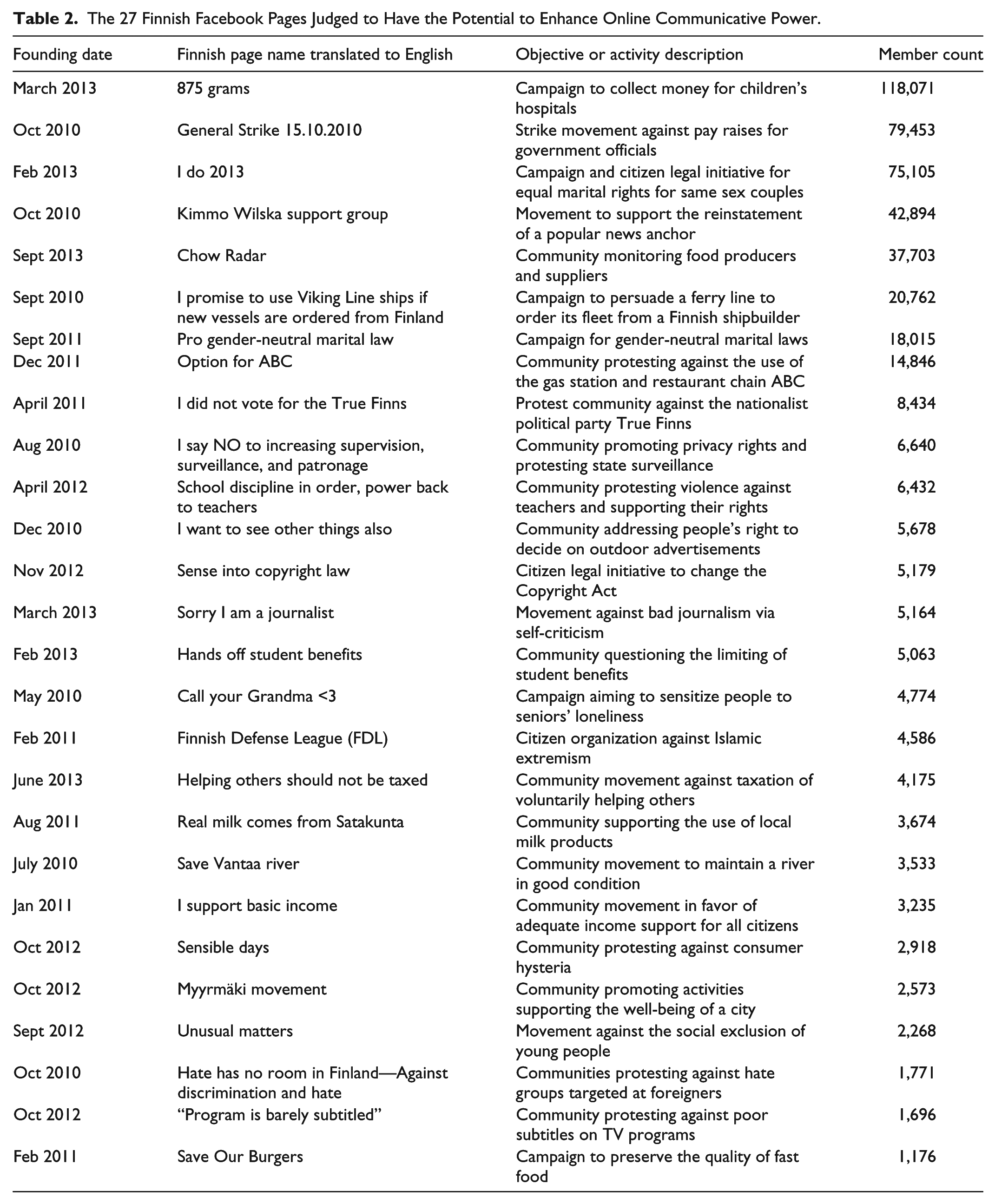
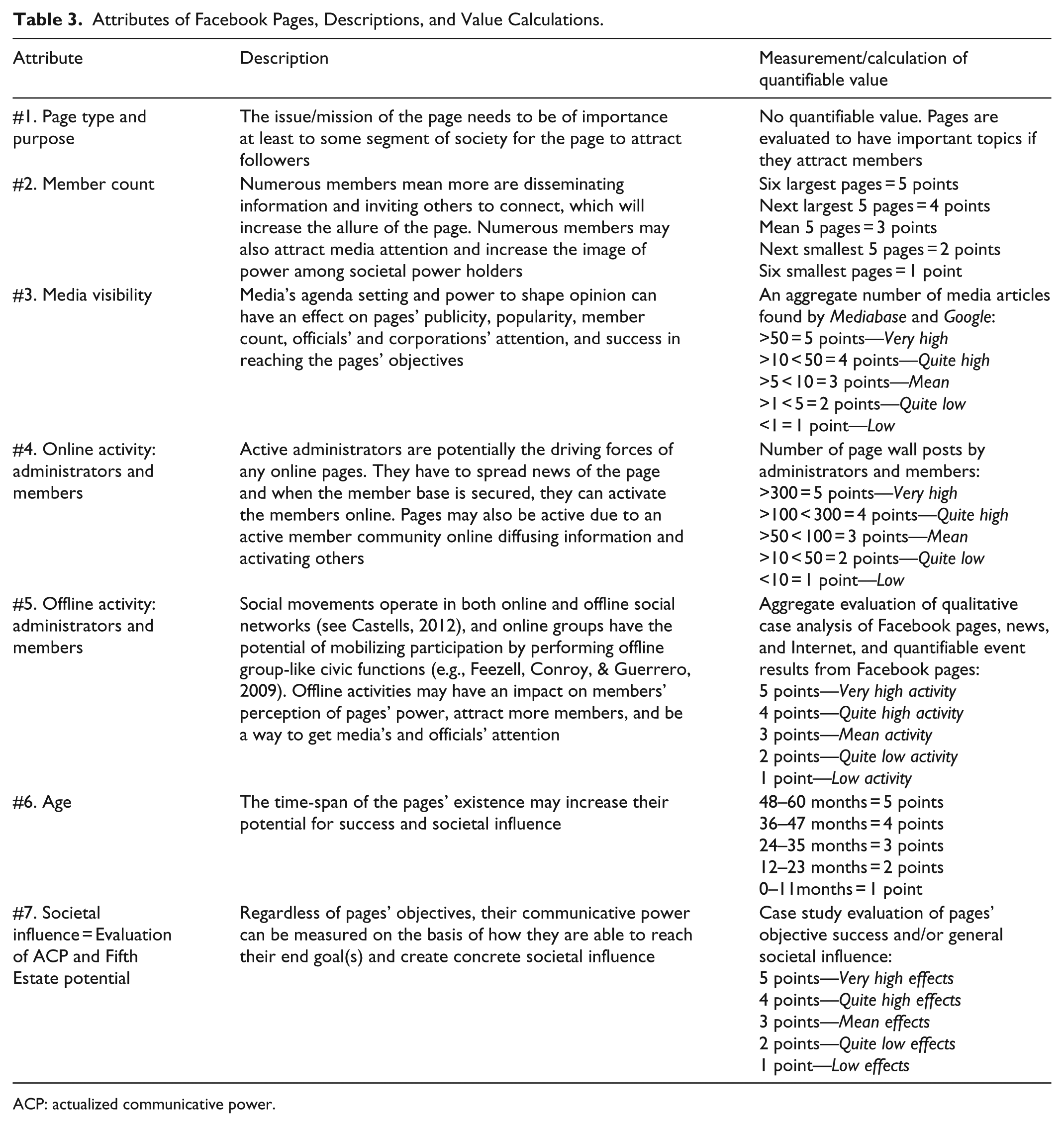
The study of whether a SNS enables an online social movement to enhance its communicative power requires a mix of both qualitative and quantitative methods to assess a set of attributes (see Table 3) on which the Facebook pages could be evaluated. The qualitative aspect of the study was made from the researchers’ observation and analysis in January 2014. Specifically, the pages’ offline activity evaluations were based on observing page administrators’ and members’ page wall post suggestions, discourse of events and activities, formed events, and Internet sources and news stories related to their actualization and reporting of participants. The first example (translated into English) is of the Viking Line page administrator’s wall post discourse indicating offline activity (i.e., the leader participating on a ship cruise with other page members) and one member’s comment: Greetings from Grace, from the first seminar on the brand new ship. (16 January, 2013) Today trying the Viking Grace! ☺ (January16, 2013)
Attributes of Facebook Pages, Descriptions, and Value Calculations.
ACP: actualized communicative power.
The second example is of a media news story concerning the I do 2013 campaign’s sold-out support concert: The since spring planned I do 2013 support concert’s tickets were sold out in ten minutes. (Hokkanen, 2013, 24 April)
Offline activities were also quantified from all the pages that had official listings of their events (a feature of Facebook pages). Thus, the specific quantifiable values of offline activities (see Table 3) were based on an overall evaluation of both aspects (see evaluations in the ‘Appendix’). The pages’ general societal influence (SocInf) was based on the researchers’ case study evaluations of either or both the mission success of specific pages and any general societal change they achieved, which this study considered as “actualized communicative power” (ACP) and paradigmatic of an emerging Fifth Estate. The short case studies grounding the SocInf analysis are presented at the end of the ‘Results’ section.
The data required for quantitative analysis of each page’s online activity were retrieved via Facebook semi-public application programming interfaces (APIs), 1 including Facebook query language (FQL) and Graph APIs. The retrieved content included all public posts by administrators and members to the page wall. These data represent numerical accumulations since the day each page joined Facebook up to 30 March 2014.
Media analysis was conducted using two different search engines during week 14 in March 2014. First, Mediabase, a software tool, was programmed to subscribe to RSS-feeds of Finnish news and media outlets and enable word searches, and analysis of the news content was used to do Internet searches for the 27 pages’ names. 2 By the time the analysis was conducted in March 2014, the tool had been in operation saving news content for exactly 12 months and included 53 online versions of the most popular traditional Finnish newspapers. 3
Second, because some of the pages had been active before Mediabase was used to begin searching in March 2013, Google was used to search for the page names. The first 50 returned articles for each page name were then reviewed. All the stored news stories were read and those made by recognized online newspapers, TV, and radio, relating to the activities of the respective pages, were saved and stored. While this review concurrently provided a valuable qualitative perspective on the pages, the primary objective of this search was to count the number of stories mentioning each of the pages.
This study recognizes the problem that the “age” of the pages affects the results of the pages’ attribute results as some pages had been alive under a year and others many years at the observation period, but it still focuses on the entire lifespans of attribute results. This is because the age of the page is not a stable variable of, for example, how much online activity occurs on a page: Some pages’ high peaks of activity have already passed at the beginning of the period due to the specific mission characteristic, such as the General Strike which was focused on a 1-day event after which all activities and media attention vanished, and others continue as long-term projects, such as the Chow Radar page.
Attributes and Levels of Measuring Facebook Pages’ Communicative Power
One objective of this study was to discover whether there are specific online and offline actions and impact attributes that shape the relative success of Facebook pages’ objectives. Since research into SNS pages has not previously used this approach, a list of attributes was developed for this study. The study relied on (1) qualitative observations and the studies of other researchers to indicate which attributes were most likely to have the most significant effect and (2) an in-depth analysis of the six most, and the six least, popular pages with the attributes. The authors finally settled on seven attributes that appeared most significant, all of which except for #1 were evaluated on a scale of 1 (low) to 5 (high; see Table 3).
The overall scale 1–5 was selected for consistency with all the scales, as the results could be adjusted to them in their overall result contexts. First, the existing member counts and months of pages’ existence could be indicated by an acceptable value point from 1 to 5 from the smallest to the largest. Second, the overall results of coverage, lowest and highest scores by page, average of six smallest and largest, and overall average amounts of media articles found (e.g., n = 171, lowest n = 0/highest n = 79, average six smallest = 1.5/six largest = 27, and general average = 14.25) and page wall posts were used to set scales best describing the level of the action in their overall result context. Finally, offline activity and societal influence scoring was made on the same scale but through a more qualitative evaluation, uniting quantitative event notices to observation analysis in offline activities, and using the overall case studies as indicators of societal influence.
Results
First, because all the 12 pages under scrutiny attracted members of the public, they were all judged to be of some importance to a segment of society. In addition, we knew the sizes of the pages’ memberships—those who “liked” the page—and the “ages” of the pages. Hence, Table 4 displays how the pages were analyzed with points ranging from 1 to 5 (1 = low, 5 = high) according to the number of memberships, age, and the remaining four attributes: media visibility, online activity, offline activity, and the attribute measuring ACP and Fifth Estate potential, that is, general SocInf.
Six Most and Six Least Popular Facebook Pages Rated According to Attributes and Societal Influence.

MB: number of Mediabase news; G: number of Google news; A: administrators’ activity; M: members’ activity; AD: number of administrators’ posts; ME: number of members’ posts; MO: months of pages’ existence.
Offline activity evaluations are introduced in the Appendix.
As SocInf reflects the apparent actualization of communicative power, four of the largest pages were judged to have acquired very high ratings in this respect, noted by (5) influence values (see Table 4) and thus can be considered as case examples of pages with the potential for communicative power that actually reached a level of influence on society (ACP). To visualize how the action and impact attributes related to the success of the SNS pages, the other attribute results are displayed in Figures 1 to 5 in relation to SocInf values. A basic hypothesis common to the relationships displayed in the figures is that the value/significance of the attribute is judged in comparison with the page’s SocInf (equal or higher SocInf compared to each attribute = high significance of the attribute).

Facebook pages’ memberships related to societal influence evaluated in a range of 1 (low) to 5 (high).

Facebook pages’ media visibility and correlating societal influence evaluated in a range of 1 (low) to 5 (high).
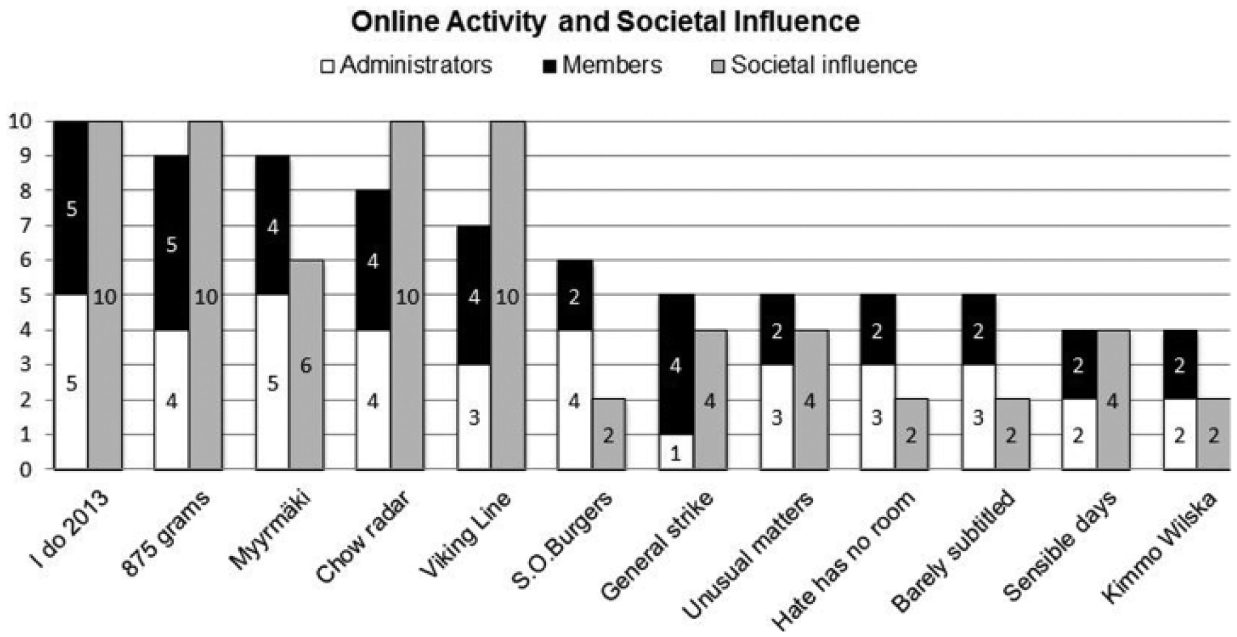
Facebook pages’ online activity and correlating societal influence analyzed with separate administrator and member activity evaluated in a range of 1 (low) to 5 (high).

Facebook pages’ offline activity points and correlating societal influence analyzed with separate administrator and member activity evaluated in a range of 1 (low) to 5 (high).

Facebook pages’ existence related to societal influence evaluated in a range of 1 (low) to 5 (high).
Figure 1 suggests four different types of pages (see Table 5). Four are among the most popular and influential, high on number of likes and influence, such as 875 grams. Three are low in popularity and influence, such as Hate has no room. However, there were some popular pages that had relatively little influence and less popular that had relatively more influence.
Types of Pages According to Popularity and Influence.

In the context for the size of membership (Figure 1), the results indicate that the common hypothesis is valid in 83% of the cases as the SocInf values are equal or higher compared to member counts, but that among the other 17% there are anomalies. Among the four highest SocInf pages, the member count value average is 5.
In the context of media visibility (Figure 2), the results indicate that the common hypothesis is valid for 92% of the pages. Among the highest SocInf pages, the media visibility average is 4—media visibility roughly corresponds with societal influence.
In the context of online activity (Figure 3), there are interesting differences. On one hand, SocInf values for 58% of the pages are lower than their online activities; however, on the other hand, those that were relatively high in activity online did tend to have more social influence. For example, among the four highest SocInf pages the online activity average is 4.25. 4
In the context of offline activity (Figure 4), expectations are supported in that 92% of the pages that were influential had higher offline activity. Among the four highest SocInf pages the offline average is 3.5 with one major anomaly lowering the average, where Chow Radar indicated low offline activity but high influence.
The lifespan of the pages’ existence appears not to be the best indicator of pages’ SocInf (see Figure 5). Although the hypothesis is valid in 58% of cases, most of the “older” pages have low SocInf, and among the four highest SocInf pages, the age average is 2.25.
Overall, the first, but overly simplistic observation is that the size of membership seems to be one key attribute because pages with large memberships generally have more success in achieving ACP. However, there are major exceptions that are interesting alternative patterns.
In the following section, the case studies, on which the SocInf values were based, are covered and used to further examine the dynamics of the qualitative aspects of the specific pages to determine various success factors and, for example, why ACP was not the automatic preserve of the largest pages, and why for instance some pages succeed without offline activities.
Brief Case Studies
Although, especially among the most popular societal causes, there are various actors and campaigns involved in certain issues which had been in operation before the current cases, the pages presented here are identified by the authors based on the case study observations as the leaders and/or main actors of the specific causes. Moreover, the identifications are seen to be reinforced by the public, media and authorities, especially among the cases recognized as achieving ACP.
The largest page, 875 grams, had the greatest possible SocInf value. The father of a premature baby created the page. The page’s initial mission was to provide an environment that enabled friends to display their interest in the baby’s well-being. As the interest expanded beyond the couple’s familial, the father changed the mission of the page into an official campaign for collecting money for children’s hospitals. The specific campaign, carrying the 875 grams name and the “father” as its public face, received high popularity among the (online) public and (mass) media. High media visibility is probably the result of high levels of administrator activities both on and offline, which was ably supported by the members, as well as celebrities who have supported the campaign. The media have referred to the page as a Facebook phenomenon (e.g., Tamminen, 2013, March 31). The success of the specific fundraising campaign has raised around €300,000 in donations for a new children’s hospital and helped to donate an incubator. The page’s ability to tap into people’s inherent empathy with the plight of premature babies and to raise significantly large funds indicates a high level of ACP.
The General Strike 15.10.2010 page, despite having the second largest membership that at one time peaked at over 100,000, was unable to convert its potential into high SocInf. The page was formed to plan a general strike protest against government officials’ pay rises. Societal institutions were unsupportive, the media described the mission as a failure, and local government branded the strike and all its activities as illegal. On 15 October 2010, the day of the General Strike, less than 100 strikers turned up. Explanations of the mission’s failure may include, first, that the threshold of signing up to a protest page on a SNS is much lower than actually joining the protest and, second, the poorly planned and organized unrealistic mission lowered the potential of the page in the eyes of the participants, and the media and authorities did not grant it legitimacy.
The I do 2013 page achieved maximum SocInf value. Since March 2012, the Finnish government has been required by law to consider passing into law any civic initiative that has more than 50,000 certified adult signatures. The aim of the page, originally formed by friends, was to achieve equal marital rights for same sexes via a civic initiative petition. The minimum number of signatures was achieved the day the campaign went public and within 6 months the Facebook page had become a registered citizen association; had gained the support of armies of volunteers, human rights organizations, and public figures; and gained a total of 167,000 signatures. The page’s “leader” handed the signed petition to the parliament proceedings. Although the parliament’s law committee decided against bringing the petition into law in June 2014, the parliament plenary session voted in favor of the law on 28 November 2014 and historically approved the first crowdsourced civic law initiative in Finland. Although there have been other groups aiming at the same law change, and no doubt have raised awareness of the issue before thus paving the way for the initiative to be passed, the I do 2013 campaign can be seen as the main driving force of the final law change, also recognized by the media, public, and authorities.
The Kimmo Wilska support group despite having the fourth largest membership failed to convert its potential into high SocInf values. The page seeks to persuade Finland’s public broadcasting service to reinstate one of its popular news anchors who pretended to be drinking beer while reading news during a live broadcast. What was meant to be a joke related to an alcohol control news story. The failure of the mission may be due to the fact that although people found the gimmick and its media attention interesting for a while, the issue is not close or personal enough for people to take more action than mere “like” clicks of support. In addition, the mission lacked recognition by the media or authorities.
The Chow Radar page gained high SocInf value. A collective of anonymous administrators created what they later claimed to be Finland’s most influential food media. The page’s mission is to reveal scams concerning the sale of unhealthy food and provide information on better options. The mission does not seem to need offline activities, preferring to operate strategically as an online source that uses public pressure to challenge corporations and officials. The offline activities in this case are the societal impacts, that is, consumer behavior changes. Each of the many online actions, for example, law petitions and boycotts, have been supported by as many as several thousands of people who have joined the actions and disseminated activity-related information through their own Facebook pages. Consequently, Chow Radar has received quite a lot of media exposure and gained the attention of enterprise corporations. We conclude that the page’s success in achieving ACP is due to its recognized role as a corporate, official and societal moderator, and source of information.
The Viking Line page achieved a high level of ACP due to achieving its aim of persuading Viking Line AS (a ferry line) to order its proposed addition to its fleet from a Finnish shipbuilder. A key component of the page’s campaign was to link “liking the page” to a promise by the members to use Viking Line ships at least once a year for 3 years if the company purchased a Finnish-built ship. The page’s leader actively contacted Viking Line, and once the page member count reached close to 20,000, Viking Line invited representatives of the Facebook page to open cooperation discussions. In October 2010, Viking Line ordered the new ship from the Finnish shipbuilders STX Turku. News stories indicated a connection between the Viking Line’s order decision and the Facebook page, and the ferry line company legitimated the mission by recognizing its communicative power through cooperation.
The case studies to some extent explain why sheer size of membership cannot be considered as a direct indicator of reaching success in societal change (ACP). Two of the largest pages failed in SocInf due to many factors. The Myyrmäki movement was able to attract a good-sized membership in its local environment and activate people effectively both online and offline, thus achieving average SocInf. The other smaller national Sensible days and Unusual matters pages reached only some SocInf perhaps due to quite low levels on all of the measured aspects.
Discussion
While the influence of SNS on societal and political change is a matter of debate, there are case studies of instances when online networks played a critical role in social movements and other Fifth Estate activities. The question not addressed is how common are these instances in the larger scale of social networking. This study looks at Facebook pages as prime paradigms of online social movements in one country as a basis for estimating the prominence of societally and politically influential sites.
To do this, with a step-by-step content analysis process, the study searched the Fanilista.fi database of first categories and then individual pages that could have a potential for communicative power using criteria developed from the theoretical definitions of social movements and the Fifth Estate. The findings show that while 2,302 of the 2,329 pages are corporate or business based or oriented to entertainment and discussion, a small, but visible and significant number 1% (27 pages) can be considered as examples of Facebook pages with potential to achieve communicative power.
We then identified examples of the Facebook pages that appeared to have achieved their ambitions and therefore conformed to conceptualizations of an effective Fifth Estate role. By evaluating the general SocInf of the six largest and the six smallest pages (by membership), the study identified four cases as having achieved significant communicative power: Chow Radar, Viking Line, 875 grams, and I do 2013. At this first analysis level, unifying factors among the pages appear to be their membership size, their ability to tap into the societal consciousness of people and to attract cooperation and/or enough group power to force recognition in the eyes of legally or otherwise societally recognized institutions/organizations.
Looking more closely at online and offline attributes that may be significant in achieving influence, the study selected five attributes (pages’ membership size, media visibility, online and offline activities, and age) for evaluation and compared the attribute results of the 12 pages against the SocInf values. The results showed that especially the online attributes (size and online activity), but also all the first four, were important in building success. Among the most successful four pages, their significance was in the following order: (1) membership size, (2) online activity (especially leaders), (3) media visibility, and (4) offline activity. Pages’ ages were not considered as reliable indicators of SocInf in this study (specifically designed to focus on the entire lifespans of attribute results) as the pages were in different stages of their mission: some old (failed) ones still alive on Facebook, but inactive and some old and new pages continuously active in both online and offline activities. Further studies should concentrate on online social movements’ success factors specific to their respective mission stages.
Nevertheless, no one attribute appeared to dictate ACP alone, and their variance and aggregate impact should be further tested. By indicating and testing possible online and offline attributes to measure communicative power, this study provides further possibilities for examining how significant the detected attributes are for online social movements with different strategies and objectives. A number of factors beyond the attributes, and beyond the reach of the brief case study explanations, could also be seen to affect the achievement of ACP and need further research. Some of these can be classified as (1) good leadership and organization, (2) provision of good background information, along with active information sourcing and dissemination, and (3) the crowdsourcing of freelance professional help.
This study concludes that in online social movements, online and offline arenas are interdependent in shaping the significance of their communicative power (e.g., Castells, 2007, 2012): Unlike the “former” ruling arena of public discussion, the press and (mass) media (addressing societal issues, which lead to offline discussion and at times also activities, which sometimes lead back to media agenda), the Fifth Estate arena also functions as a space allowing information input, and powerful networks, of individuals, potentially leading to constant shifts of discussion and actions from online to offline, and back online. Table 6 summarizes how the Fifth Estate era process of communicative power formation, supplemented by the still strong and meaningful Fourth Estate public discussion processes (see Hidri, 2012), is a combination of case by case changing online and offline activities and impacts, where both are significant and intertwined.
Online and Offline Activities and Impacts Entwined Within the Fifth Estate Arena Process of Communicative Power Formation, Building on the Grounds of the Traditional Fourth Estate Arena.

Overall, although we conclude that it is possible for Facebook pages to develop a Fifth Estate role, there are high thresholds, and the emergence of social movements is the exception rather than the rule. This may be due to various reasons. First, the number of potential online pages with Fifth Estate aspirations is low because the possibilities to create pages and groups for networking purposes on SNS like Facebook are still dominated by the entertainment and social functions, for which the site was designed. Although entertainment and discussion objectives do not necessarily exclude formation of communicative power, and might well increase the potential for reaching larger communities, these pages are less likely to pursue concrete societal change than to participate in activities that are social and entertaining. Second, online social movements may still lack recognition as legitimate actors of society as Internet and SNS activism is seen more as “slactivism” (Morozov, 2009) and as motivated by users’ personal fulfillment, without the ability to create concrete results (Curran et al., 2012).
Nevertheless, SNS do provide a platform for well organized and led social and political movements. SNS pages in Finland with a legal and culturally accepted basis (non-radical social movements) have gained positive reactions and cooperation from corporations and media, and, despite some hesitation, from political decision makers and government. This may reflect a subtle shift from traditional representative politics toward citizen involvement in decision making and their political empowerment in Finland. In addition, the press adopting news topics from SNS pages and their missions can increase the Fifth Estate’s role in societal agenda setting as so called “gatewatchers” alongside the Fourth Estate (see Bruns, 2003).
Conclusion
The Internet is an effective innovative public space, which has the potential to enhance social movements by facilitating individuals to network with other like-minded people in ways that can enhance their communicative power consistent with conceptions of the Fifth Estate. This study shows how the Fifth Estate can be actualized in the context of one SNS, Facebook. Although very limited in frequency, about 1% of Facebook pages created in Finland developed the potential to enhance the communicative power of networked individuals. No one expects all or most Facebook pages to lead to social movements—that would be absurd.
The importance of this study is that, first, the study methods reveal one way of detecting and content analyzing a SNS and drawing a picture of the Facebook “page” scene from the perspective of enhancing the communicative power of online social movements. Second, this study is one example of the possibility of developing operational definitions of the communicative power of online pages, although it leaves many questions unanswered. As neither a scale nor set of online and offline attributes against which the communicative power of online movements can be measured exists, this study made a move in the direction of providing relative rankings of sites on critical dimensions of both. The study suggests that further research might advance the development of theory and reliable indicators of the impact of SNS and their potential to contribute to a Fifth Estate role.
This study is not without limitations. As there are no available success criteria for achieving communicative power, the study relied much on the researchers’ qualitative analyses, observations, and judgments of the Facebook pages and their influence. Thus, the results are guided by qualitative assessments that are subjective but strive to be transparent and which appear to yield conclusions that have a reasonable level of face and construct validity.
Furthermore, a comprehensive database of Finnish newspapers and their news would require purchasing access to each existing digital news media archive. Consequently, the study relied on other options, such as the Mediabase research tool, which provides good quantitative data but cannot be considered comprehensive due to its current scope and timescale, and the Google search for online news, which usually gives different return results, and whose results are affected by the users’ Internet activities. Nevertheless, the analysis appeared to provide a relative ranking of media coverage that would be likely to hold up to the inclusion of further media.
The study gives a view of communicative power formation in a specific online environment, cultural context, and target sample, leaving room for various future research possibilities. Similar research could be replicated in different social media and SNS platforms and also in different cultural contexts.
Footnotes
Appendix
Facebook Pages’ Offline Activity Evaluations for Determining Quantifiable Values.

| Page and value | Administrators’ offline activities | Members’ offline activities |
|---|---|---|
| 875 grams | Various offline activities performed by the leader, such as TV appearances, newspaper interviews, participation in fundraising events, and a published book on the issue | Members mostly function as a support base on FB. FB wall communication indicates some statements of interest and participation in activities |
| A = 5/M = 3 | No event creation info on FB | No event participation info on FB |
| General Strike 15.10.2010 | The leader encouraged members to take part in one demonstration on the strike starting date in Helsinki or their home towns | According to news stories, only around 20 people gathered in front of the congress building to protest with posters and megaphones despite indicated will on FB wall |
| A = 2/M = 2 | One event presented on FB | 117 event participation confirmations on FB |
| I do 2013 | Various newspaper and TV interviews and numerous events, concerts, standup shows, picnics, and recruiting local leaders to form signature gathering groups on the streets initiated by the leader(s) | FB wall communication indicates strong interest in and support for various offline activities |
| A = 5/M = 5 | 11 events presented on FB | 2,339 event participation confirmations on FB |
| Kimmo Wilska support group | No event or other offline activities suggested, encouraged, or reported | No suggestions or indication of participation in offline activities |
| A = 1/M = 1 | No event creation info on FB | No event participation info on FB |
| Chow Radar | No event or other offline activities suggested, encouraged, or reported | No suggestions or indication of participation in offline activities |
| A = 1/M = 1 | No event creation info on FB | No event participation info on FB |
| I promise to use Viking Line ships if new vessels are ordered from Finland | Leader has made many FB wall reports of contacting and meeting with company representatives and organizing group celebration cruises | FB wall communication indicates quite strong interest in and support for offline activities, for example, participation in the group cruise, meetings, and indications of keeping the cruising promise |
| A = 5/M = 3 | No event creation info on FB | No event participation info on FB |
| Sensible days | No event or other offline activities suggested, encouraged, or reported | No suggestions or indication of participation in offline activities |
| A = 1/M = 1 | No event creation info on FB | No event participation info on FB |
| Myyrmäki movement | Various offline activities organized from streets cleaning, yard sales, and dinners to general meetings initiated by the leader(s) | FB wall communication and event pictures indicate quite strong interest and participation in offline activities |
| A = 5/M = 4 | 46 events presented on FB | 2,441 event participation confirmations on FB |
| Unusual matters | Some encouragement and reports of recruiting local volunteers by the leader(s). Mostly info around other projects’ events | FB wall communication indicates small levels of interests and participation in offline events |
| A = 2/M = 2 | One event presented on FB | Three event participation confirmations on FB |
| Hate has no room in Finland | No event or other offline activities suggested, encouraged, or reported | No suggestions or indication of participation in offline activities |
| A = 1/M = 1 | No event creation info on FB | No event participation info on FB |
| “Program is barely subtitled” | ||
| A = 1/M = 1 | ||
| Save Our Burgers | ||
| A = 1/M = 1 |
FB: Facebook; A: administrators’ numerical overall activity evaluation value; M: members’ numerical overall activity evaluation value.
Declaration of Conflicting Interests
The author(s) declared no potential conflicts of interest with respect to the research, authorship, and/or publication of this article.
Funding
The author(s) disclosed receipt of the following financial support for the research, authorship, and/or publication of this article: This work was supported by the Media Industry Research Foundation of Finland, and the Governance and Design of Collaborative User-driven Innovation Platforms project at the Danmarks Tekniske Universitet through a grant from the Danish Research Council.