




Abstract
Since it erupted in 2009, the Greek debt crisis has disrupted Greek people’s quotidian life both at a socio-political and at a personal level. In the contemporary social media ecosystem, with the massive bulk of user-produced and user-consumed content, narratives that concern this critical turning point in Greek modern history have found fertile soil to thrive. In this article, having enmeshed discourse-centered online ethnography (Androutsopoulos, 2008) with small stories research (Georgakopoulou, 2007), the dimensional approach to narratives (Ochs & Capps, 2001), and stance-taking (Du Bois, 2007), I look at how a Greek Facebook user has recounted her emotions, thoughts, opinions, and assessments toward the Greek crisis. In doing so, I point to the intertextual, multimodal, and synergetic nature of these narratives. The article argues that Facebook can function as a powerful grassroots channel for expressive storytelling within a period of major socio-political upheaval. It also shows how Facebook has stretched our conception of what (digital) storytelling is as different Facebook affordances propel into different ways of narrating within the medium.
Keywords
Introduction
Back in early 2009, when I submitted my doctoral research proposal on the exploration of Facebook discourse and the construction of identities, no one could have foreseen that my plan would take an unexpected turn within the next years because of the eruption of the Greek crisis. Research in social sciences and humanities is never conducted in a socio-historical vacuum. Social media are not detached from a given society either—they rather constitute its cardiograph as has already been evidenced by the cases of the Arab Spring, the Spanish Indignados, the UK riots, and the Occupy Wall Street movement (see, for example, Gerbaudo, 2012). The economic and socio-political turnaround in Greece dominated the lives, and concomitantly the content of Facebook posts, of the people I was studying. The amount of data I had garnered in respect of the Greek crisis dictated the necessity to scrutinize the phenomenon in parallel with the initial aims of my research. With this in mind, and leaning on the frameworks of small stories, the dimensional approach to narratives, and stance-taking, this article seeks to document, describe, and analyze the stories that a Greek female Facebook user, Helen, has shared about the crisis and its repercussions: austerity, unemployment, governmental instability, the rise of far-right, demonstrations, and lingering uncertainty and insecurity both at a socio-political and at a personal level.
My own understanding and usage of the term crisis herein are not restricted to the economic—financial and fiscal—crisis but encompass a multiple sense of crisis as political, social, moral, emotional, ideological, and humanitarian as well. The discussion in the sections that follow has been guided by two lines of argument. First, the crisis is enacted and represented in discourse (Blommaert, 2014; Fairclough, 2009; Wodak & Angouri, 2014). Hay (1996, p. 255) weaves the interrelationship between crisis and discourse by writing that crisis “is not some objective condition or property of a system defining the contours for subsequent ideological contestation” but “it is subjectively perceived and hence brought into existence through narrative and discourse.” Away from the rigidness of traditional media and political speeches, the Greek crisis is “vernacularized” 1 (Georgakopoulou, 2014) and discursively represented by “ordinary people” in live streamings of citizens’ assemblies in squares, independent web-based news media outlets, amateur photographs and videos from demonstrations, critical blog posts in English and other languages to reach international audiences, Facebook posts (which will concern us here), tweets, hashtags, memes, street graffiti, documentaries, and political satire (Boubari, 2011; Papailias, 2011).
Second, Facebook, as an outlet for crisis discourse representations, gives ample room to the process of “reflexivity” (Archer, 2007 in Chalari, 2012), namely, people’s ability to critically see themselves in relation to their social context. Consider two examples from my dataset: Dear politicians, I’m fed up with your dilemmas! The only dilemma I have in 18 degrees sunshine is: coffee break from work in Exarcheia or Monastiraki? It’s very awful and none of us had expected it. But what are you going to do? Are you going to cavil all day or are you going to try with those things that have been left to you to have a good mood or even disposition and enjoy as much as you can your days and your moments? Yes, it’s not the best to have your plans and lasting efforts hindered but since this is something which is unfortunately happening, try to do the best that you can with what you have. (Original text in Greek)
The first example is a Facebook status update which tackles with humor governmental instability in Greece during the crisis. The second example is a Facebook comment, abstracted from a longer interaction, which functions as a piece of advice on how one should face the crisis.
That said, this article is organized as follows. First, I give a brief overview of the theoretical frameworks employed in the study introducing the notions of small stories and stance. This is followed by a description of the data and methods of analysis. I then move on to the main part of this article, in which I present and discuss different modes of and resources for crisis storytelling focusing on specific Facebook postings. I close with the implications and contributions of my findings.
Social Media Stories: Three Theoretical Frameworks
Stories told in social media environments are diverse, versatile, and multifaceted. Their topics can range from light-hearted and mundane descriptions (e.g., a status on going out on a rainy day without an umbrella) to thought-provoking and emotional accounts (e.g., tweeting about one’s battle with cancer). Social media stories can be recounted publicly (e.g., via blog postings) or semi-privately (e.g., via status updates visible only to friends). Their indispensable ingredients are words, images, gifs, sounds, links, or pastiches of those hinging on the affordances and constraints of each platform. Social media stories may be ephemeral, small in size, and marginal to other kinds of talk, falling outside the canon of traditional literary narrative; yet, they stand out as being selective, artistic, reflective, playful, and emotive (Page, 2012, p. 3). The ways in which social media stories can be explored are likewise diverse. This study is positioned within the sociolinguistic and discourse-analytical cohort drawing on insights from the small stories framework (Georgakopoulou, 2007), the dimensional approach to narratives (Ochs & Capps, 2001), and stance-taking (Du Bois, 2007).
Small Stories
The small stories paradigm (Bamberg & Georgakopoulou, 2008; Georgakopoulou, 2006, 2007) was conceived and developed as a response to the existing prevailing models of narrative studies (e.g., Labov, 1972) which defined narrative strictly on the basis of textual criteria privileging the long, teller-led accounts of past events or of one’s autobiographical story (Georgakopoulou, 2015). The milieu of small stories research is to be found in “anti-essentialist views of identity, society and culture” placing emphasis on the “multiplicity, fragmentation, context-specificity and performativity of our communication practices” (Georgakopoulou, 2015, p. 257). Within this context, narrative is seen as a social practice which is “sequentially embedded into and occasioned by a single event and presents a trajectory and history beyond it” (Georgakopoulou, 2014, p. 520). The term small stories refers to under-represented and “a-typical” narrative activities, such as tellings of recent, ongoing, or still unfolding events, future or hypothetical events, shared (known) events, allusions to (previous) tellings, deferrals of tellings, and refusals to tell (De Fina & Georgakopoulou, 2011, pp. 116–117). These tellings are non-canonical (i.e., they do not necessarily fulfill prototypical definitional criteria of the narrative inquiry such as beginning–middle–end, a complicating event, and a clear evaluation of the events), normally small in length, typified by fluidity, plasticity, and open-endedness, occurring in the small moments of discourse, and within everyday life situations, rather than constituting distinct, fully-fledged units (Georgakopoulou, 2007).
Small stories research eclectically synthesizes frameworks from different disciplines, mainly sociolinguistics, discourse analysis, and biographical studies. This epistemic convergence steered Georgakopoulou (2007) towards developing a heuristic for small stories research, which consists of three distinguishable yet interconnected levels of analysis:
Ways of telling: verbal and semiotic choices of a story, interactional management during the telling, intertextual links to other stories;
Sites: the situational context of a story (e.g., physical arrangements in which narrative activities take place; mediational tools employed by participants);
Tellers: participants of a narrative activity with particular roles of participation and with specific biographies.
Three very significant subgenres of small stories include breaking news stories (currently burgeoning in social media environments) where tellers “share the reported events straight away, as they are still unfolding” (Georgakopoulou, 2007, p. 42), projections where the teller constructs a taleworld of events that have not yet taken place (Georgakopoulou, 2007, p. 47), and shared stories which are close to the traditional narrative in that they refer to past experiences (usually in past tense) and may involve more than one teller fostering, thus, solidarity among members of a group.
So far, the small stories framework has been employed by both sociolinguists and social scientists in varied contexts, including interviews, counseling, education research, political discourse, gender, and diasporic identities (for a meticulous overview of relevant studies, see Georgakopoulou, 2015). Providing an interesting addendum to the small stories agenda, Page (2010, 2012) sees Facebook status updates and tweets as belonging to the genre of small stories with the recency of events and the ongoingness of telling being predominant, influenced by the medium’s given online discourse situation. Subscribing to this line of research, in this article I treat Helen’s Facebook posts on the Greek crisis as small stories which are small in size, fragmented, shared, co-constructed, intertextually linked (to one another as well as to other external texts), and afforded by certain Facebook particularities.
Narrative Dimensions
Small stories research is in tune with Ochs and Capps’ (2001) sociolinguistic dimensional approach to narratives. According to this approach, a story possesses certain qualities of narrativity (i.e., how close or far a text is from a prototypical narrative) in varying degrees. In this light, Ochs and Capps (2001, p. 20) have proposed five dimensions that are relevant to a narrative: tellership, tellability, embeddedness, linearity, and moral stance (Table 1).
Dimensions and Possibilities of Narrative.

Source: Adapted from Ochs & Capps (2001, p. 20).
As far as social media stories are concerned, Page (2012, pp. 11-16) makes a series of insightful observations on how Ochs and Capps’ dimensions are both facilitated and hindered by social media affordances (without touching upon the moral stance dimension, though). Starting with linearity, she points out that social media stories can be told either within an individual unit of social media (e.g., a tweet, a status update) or across multiple units (several sequenced tweets or statuses or unfolded in comments) (Page, 2012, p. 12). As she remarks, the episodic quality of social media stories lies in the temporal nature of the narration. This may refer to the date and time stamps, which articulate the “here and now” of telling (cf., telling world, Georgakopoulou, 2007), and the content produced by social media participants, which constructs the time relative to the reported events in their lived experience (cf., taleworld, Georgakopoulou, 2007).
Turning to the tellership dimension, due to the interactive nature of social media, narration does not come from a single teller but is multi-party and co-constructed (Page, 2012, p. 13). Page here does not disregard that there are hierarchical asymmetries among social media participants concerning their contributions to storytelling (e.g., forum moderators who may delete offensive posts). Tellability of social media stories, on the other hand, pertains to the role of the narration in building social relationships and shaping narrator’s identity being “at the heart of the social quality of social media” (Page, 2012, p. 16).
Social media stories cannot be understood and assessed without taking into account the context(s) in which they are embedded. Page (2012, pp. 14–15) itemizes six core contextual elements when analyzing social media stories:
Social media participants: the users who participate and their relations to one another;
Imagined context: the project contexts which participants create based on background knowledge and cues provided in computer-mediated communication;
Extrasituational context: the offline social practices in which participants are involved, their values and beliefs, as well as their social circumstances (e.g., age, gender, nationality);
Behavioral context: the physical situation in which participants’ engagement with social media occurs;
Textual context: the immediate verbal co-text within which social media stories are situated, the surrounding discourse (e.g., comments, other posts), the screen layout, and resources.
Generic context: the social media platform in which the story is created, its affordances, purposes, and netiquette.
I will return to Ochs and Capps’ dimensions in light of my data in Section “ Narrating the Greek Crisis on Facebook.”
Stance-Taking
In consonance with Georgakopoulou’s (2013b) narrative stance-taking and Ochs and Capps’ (2001) narrator’s moral stance, I see stance as a key concept in analyzing social media stories. One of the most vital things people do with words is taking a stance (Du Bois, 2007, p. 139). The term stance refers to the expression, whether by overt assertion or by inference, of a writer’s or speaker’s personal attitudes, feelings, beliefs, evaluations, judgments, or commitment toward a precise target (Biber & Finegan, 1989; Du Bois, 2007; Englebretson, 2007). This target can be an interlocutor, a person represented in the discourse, ideas represented in the discourse, or other texts (Kiesling, 2011). Stance, therefore, is an umbrella term underneath which various linguistic features can be gathered like modality, evaluation, evidentiality, hedging, politeness, appraisal, and metadiscourse (Lampropoulou & Myers, 2012).
Yet, stance, as Du Bois (2007, p. 163) has pithily remarked, is not only a linguistic act but also a social act: Stance is a public act by a social actor, achieved dialogically through overt communicative means, of simultaneously evaluating objects, positioning subjects (self and others), and aligning with other subjects, with respect to any salient dimension of the sociocultural field.
So, in any given stance statement, there are four major components: (1) the person expressing the stance (the stance-taker), (2) the topic under discussion, (3) the resources being drawn upon, and (4) the addressee (the reader or the hearer in any stance-taking situation; Barton & Lee, 2013, p. 87).
A central notion pertinent to stance-taking is that of alignment (or disalignment; Du Bois, 2007), namely, our lining up (or not lining up) with others’ attitudinal assessments, beliefs, and assumptions. Stance is always an act of self-presentation and social judgment via which we express something not only about ourselves but also about others (as being or not being like us), and in this fashion we inevitably say something about our view of the world (Thurlow & Jaworski, 2011).
Understanding stance-taking acts is crucial in understanding how narratives are produced and distributed in social media. Facebook, the focus of this contribution, mobilizes stance-taking by means of its built-in features: (1) the prompt “What’s on your mind,” which urges users to write about, reflect upon and share their intimate feelings, responses to their life experiences, and/or views of the world; (2) the system of comments, where stances are not only taken by a single user but are constantly created, expressed, discussed, negotiated, and renegotiated collaboratively by a networked public (Barton & Lee, 2013, p. 31); and (3) the “Like” button, which indicates alignment with views and preferences among Facebook friends.
Methods and Data
The data for this article come from a larger online ethnographic study on the discursive construction of identities on Facebook (Georgalou, 2014a). Drawing on empirical evidence from five Greek Facebook users, the study explored (1) how they constructed themselves, (2) how they were co-constructed by their Facebook friends, (3) the role of multimodality in these identity constructions, and (4) the kinds of textual practices they adopted to construct their identities. By dint of close discourse analysis of both verbal and visual modalities, I identified the ways in which the particular users located themselves in terms of place and time; shared their expertise and buttressed solidarity among colleagues and fellow students; communicated emotions, tastes, thoughts, opinions, and assessments; and controlled the flow of information on their walls to secure their privacy.
Methodologically, my study was situated within the discourse-centered online ethnographic paradigm (Androutsopoulos, 2008), which coalesces online ethnography with discourse analysis of log data. Such an approach takes on two dimensions: a screen-based and a participant-based one. The former centers on systematic, longitudinal, and repeated observation of online discourse (Facebook profiles here), while the latter relies on direct (face-to-face and/or mediated) engagement with the producers of this online discourse (Facebook profile owners here).
My participants, five Greek users (two females: Helen and Carla; three males: Alkis, Gabriel, and Romanos; total mean age = 28 years), were recruited via convenience sampling (i.e., they were friends of friends). Initially, they were sent a message in which I explained the purposes of my study, asking them to fill in an online questionnaire. Those interested were invited to participate in a series of semi-structured online interviews via email, instant messaging, and/or Facebook messages. From the time my informants and I became “friends” on Facebook, I conducted bi-weekly observation of their profiles. The hours spent browsing their Facebook Timelines varied according to their frequency of posting and the wealth of interactions unfolded. My data tapestry were woven by Facebook profile information, status updates, comments, video and article links, photos my informants have taken themselves or have found elsewhere in the internet, interview excerpts, survey, and field notes as well as my informants’ comments on drafts of my analyses. Table 2 gives a rough idea of my data corpus in numbers. 2
Data in Numbers.

Interviewees were asked to sign a consent form in which they were assured that their material (information they add about themselves, status updates, their comments, their friends’ comments, images, other multimedia) would remain confidential and would be used for academic purposes solely. Concerning the use of third-party comments in the study, I either asked for their posters’ permission or asked my subjects to do so on my behalf. Throughout my dataset, I have preserved pseudonymity for my informants and anonymity for other Facebook users.
The data that this article looks at comprise Facebook posts along with interview excerpts (direct quotes and reported speech mediated by my words) from one of my five informants, Helen. The inclusion of Helen as a qualitative case here was motivated by two factors. First, Helen was the most prolific and systematic crisis story-teller out of my five informants. The other four were quite uneven in when, how often, and what kinds of things they posted in relation to the Greek crisis. As a result, their data were not adequate enough for me to develop a solid theoretical explanation within the small stories framework and the dimensional approach to narratives, which would in turn be compared and contrasted to Helen’s case. 3 Second, during my observation and data collection period, Helen had joined the social movement of Aganaktismenoi (Greek indignados—indignant citizens) in 2011 and participated in several other demonstrations in Athens. Not only was she an active and conscious citizen physically but also digitally feeding her Facebook Timeline with authentic first-hand visual material of what was going on in the Athenian streets. Such kind of data was almost entirely missing from my other participants’ postings.
Helen was born in 1979 and lives in Athens, Greece, while she visits the United Kingdom for 2 months every year working as an English for Academic Purposes (EAP) tutor in various British universities. She has a BA in English Language and Literature, an MA in English Language and Literary Studies, and a PhD in Linguistics. She works as a lecturer in Academic English in Athens. She speaks Greek (native), English, and Spanish. She was recruited for my study in October 2011. She has been a Facebook member since 9 September 2007. The chief reason she opened her account was to sustain bonds with networks of hers that are geographically dispersed (cf., Gosling, 2009). Helen’s Facebook friends list included 216 people by the end of 2012. Many of them are non-Greek speakers and that is why her status updates are written almost exclusively in English. When I started gathering data from her Facebook profile in May 2010 (my data collection ended in April 2013), the austerity measures had already been put forth by the Troika (European Union, International Monetary Fund and European Central Bank), resulting in massive strikes, protests, riots, and generally social unrest all over Greece. The crisis events which Helen narrates herein cover the time span February 2010–October 2012 (consult the crisis timeline in Appendix 1 for the events taking place in Greece at that time), while the time frame of my analysis was May 2012–February 2014.
Before moving on to the data analysis proper, two points should be taken on board. First, Helen was not an owner of a smartphone or a tablet during the data collection period. This means that all her posts were made from a desktop computer and/or a laptop, usually in her closest possible proximity to the crisis-related event. Second, for practical reasons of space, I had to decide which of Helen’s small stories would be included here. The instances that made it to the final selection were those that aptly illustrate the manifold and nuanced ways in which linguistic, multimodal, and technological affordances can be creatively exploited and mixed in narrating the Greek crisis. So, in lieu of presenting these instances in chronological order, I center on specific modes of narration clustering my main findings into (1) verbal stories, (2) cross-modal stories, and (3) narrative stance-taking. Such a categorization, though, should not be taken as exhaustive, but as an endeavor to proffer a coherent account in terms of presentation and argumentation.
Narrating the Greek Crisis on Facebook
Verbal Stories
Very much can be covered verbally in Facebook small stories in sharp contrast to those shared in Twitter, which should fit within the constraints of the 140-character limit or be distributed over several tweets to achieve linguistic cohesion and coherence (Dayter, 2015). In the following examples, I have selected a number of Helen’s verbal stories that portray how the dimensions of linearity, tellability, embeddedness, and tellership are (re)shaped within the context of Facebook and vis-à-vis the crisis.
Helen, in Figure 1, just 1 day after the 6 May 2012 elections, reports on the unprecedented results, with the (re)emergence of the far right in the face of the neo-Nazi political party Golden Dawn. In doing so, she reconstructs a linear story anchoring in past background knowledge of the pre-existing political rhetoric in Greece. For some, the result of the elections was breaking news; for Helen, though, it constitutes a temporally and causally ordered sequence. Notably, she finishes off with a projection (“I’m afraid . . . iceberg . . .”) about the worst that perhaps is yet to come.

Verbal story after May 2012 elections.
In Figure 2 (translated as “Elections part II: Crazy Anthony, mangas and the secrets of Greece’s swamp . . .”), Helen posts about the second round of the elections, in 17 June 2012, and their final result, according to which the liberal conservative New Democracy was the largest party and Antonis Samaras became the new Prime Minister.

Verbal story after June 2012 elections.
The tellability of this small story rests on intertextuality (i.e., the traces one text bears of preceding texts, for example, by means of quoting, alluding, echoing, or linking). Relying upon her cultural capital (Bourdieu, 1979/1984), Helen wittingly forges parallels between the result of the elections and Penelope Delta’s books. Delta (1874–1941) was one of the most prominent Greek authors of children’s books, who drew inspiration from historical events in Greece. She was also Samaras’ great grandmother. O Tρελαντώνης (Crazy Anthony), O Mάγκας, 4 and Tα Mυστικά του Bάλτου (The Secrets of the Swamp) are three of her most well-known and influential books. Helen’s mapping goes like this: Antonis Samaras is crazy Anthony (Antonis is the Greek equivalent of Anthony) who, like Mangas, has come to the difficult position of governing and has to prove if he has the guts to confront the crisis while Helen likens Greece to a swamp insinuating (and disapproving of) predominant mentalities in Greece such as clientelism, apathy, and prioritizing the personal over the collective interest (Chalari, 2012). Through these intertextual references, Helen addresses those Facebook friends of hers who possess the same background knowledge presuming that they would be able to make the necessary inferences.
In terms of embeddedness, the verbal content of Helen’s small stories is essentially contextualized and complemented by Facebook’s architecture. A status update like the one in Figure 3 should not be viewed as a mere check-in or a routine announcement but as a discursive practice embedded in a broader socio-political and historical context. It is Facebook’s timestamp (15 June 2011) that assists us in deciphering that Helen was going to Syntagma Square in Athens to join the Aganaktismenoi movement which was at its zenith at that period.
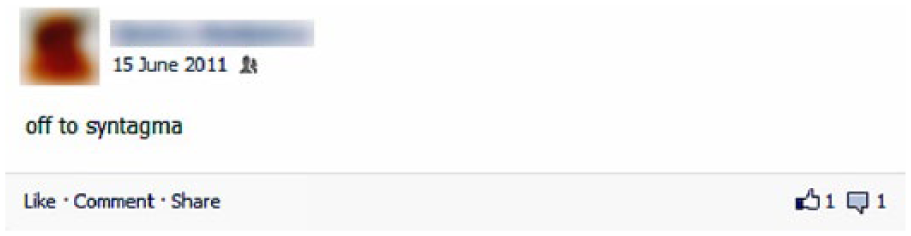
Socio-political check-in.
Helen’s small story in Figure 3 was recounted just before she was about to experience the event first-hand. Nevertheless, her stories were not always embedded within her physical setting. As she conceded in one of our interviews,
5
i was here [in Athens] most of the time but some posts were made when I was in Hungary [where her partner lives] and if I wrote some posts in September [2011] then I was in England but mainly I was here and I participated in what was happening hm.. even if I’m not in Greece I write posts on issues related to the situation here.
Helen suggests that when you feel affixed to a place, you do not always have to be on the ground to show that you care about your place. You can use Facebook for storytelling while being on the sidelines.
Turning now to the tellership dimension, Facebook’s generic context brings out the interpersonal nature of storytelling. Helen feels the need to talk about, reflect upon, and share her experiences and thoughts on the crisis. Her small stories, however, do not fall into the void but are narrated so as to be perceived and interpreted by an audience which can actively engage in and contribute to her storytelling. The facility of commenting, as can be seen in Figures 4 and 5, enables the development of stories which are endowed with multiple, synergetic tellership. 6
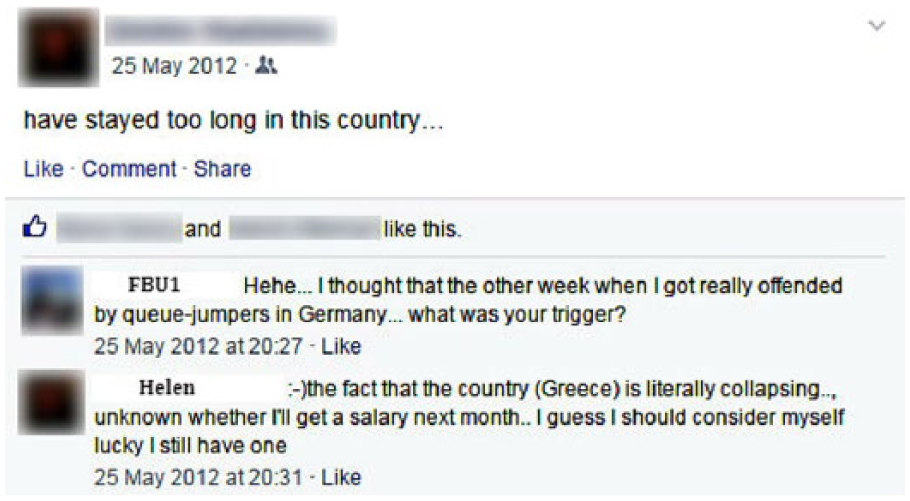
Collaborative construction of stories.

Collaborative construction of stories II.
The frustration-littered update in Figure 4 is unpacked if we take into account that it was posted nearly 2 weeks after the May 2012 elections in Greece and the failure of political parties to form a new government as none of them had won an absolute majority of parliamentary seats. Helen distances herself by selecting the deictic expression this country which in this context has a pejorative nuance seen as attitudinal dissociation from Greece. In the subsequent comment, her (international) friend offers her own small story of why she thought of the same thing about Germany. Her question (“what was your trigger?”) leads Helen to a more developed narrative making (cf., Georgakopoulou, 2013a) in her response compared to the information provided in the status.
In a similar vein, Figure 5 displays a case of collaborative construction of the story on Greek unemployed and their medical insurance sparked by a New York Times article which Helen had posted. Helen’s telling in Comment 2 is unfolded after her (Greek) friend’s initial comment. 7
This synergy in story building concurs with Dayter’s (2015) findings on the even distribution of storytelling among Twitter participants. The upshot of the two foregoing examples for narrative is twofold. First, although it may not have been Helen’s original aim at all to flesh out a story (her status in Figure 4 is rather vague, while in Figure 5 she just shares a link without any opening comments), further storytelling is triggered and provoked by her friends’ comments. Second, the way in which her stories progress is highly dependent on the content of her friends’ comments.
Cross-Modal Stories
Facebook offers its participants the affordances to go beyond mere verbal storytelling and piece together different semiotic modes in communicating their stories. This section considers how Helen exercises citizen journalism with self-generated visual content as well as how she draws upon and experiments with stories already encapsulated in particular cultural items (e.g., memes and song lyrics/titles).
Exercising Citizen Journalism
Helen often shares on her Facebook Timeline photographs she has taken herself from demonstrations held in Athens. She usually plunges into this visual storytelling without any opening or subsequent comments so as to not appear affiliated or being identified with a particular political party. Consider what she has said on that: i want to give my own version of an event to report on an event in my own way without making an explicit political comment generally I’m careful with that
Figure 6 is a vivid illustration of Helen’s visual storytelling. It is an instance of what Scollon and Scollon (2003, pp. 151, 217) call “transgressive semiotics,” namely, when a sign violates either intentionally or accidentally the conventional semiotics at that place. It depicts an empty Athenian store, probably one of the hundreds that have closed down on account of the crisis, with two labels on its window, “ΠΩΛEITAI” (for sale) and “ENOIKIAZETAI” (to rent), and underneath them a poster that promotes tourism in Greece. At any moment in time, these three signs would compose a transgressive semiotic system. Nonetheless, because of the socio-political situation in Greece, this triptych functions on a symbolic level. The visual story recounted through Helen’s lens is that Greece (the land, its people) is available for sale to or to be rented by its creditors.

Image shot by Helen (posted on 23 October 2011).
In Figure 7, we see an Aganaktismenoi rally in Syntagma Square, outside the Greek parliament, as photographed by Helen. Figure 8 (next page) is shot outside Marfin Bank in Stadiou Street, Athens, where three employees died when the building was set on fire by hooded people during the nationwide strike on 5 May 2010 (thus the flowers). By dint of these citizen journalism tokens, Helen narrates wordless yet very powerful stories which imply that she is there, at the heart of the events, protesting and documenting. Such an implication entails “an implied selection of a specific audience as the designated one” (Georgakopoulou, 2014, p. 527) for her stories. Helen’s specific audience includes Facebook members who experience and are concerned about the Greek crisis either from the inside (Greek residents) or from distance (Greeks living abroad) as well as friends from abroad who have knowledge of and interest in the current Greek reality.

Image shot by Helen at Syntagma Square (posted on 30 May 2011).

Image shot by Helen at Stadiou Street (posted on 6 May 2010).
Recycling Ready-Made Stories
Helen’s visual storytelling also included images that she had found elsewhere in the Internet. By way of exemplification, in Figure 9 (next page), she shares an Internet meme, that is, a cultural unit (e.g., joke, rumor, popular tune, catchphrase, fashion trend, image, jingle) that spreads rapidly and effectively from person to person via the Internet (Häkkinen & Leppänen, 2014; Shifman, 2013). Facebook is based to a great extent on such propagation and recirculation of content that is made by users for users. Helen posts this meme to problematize the perception of what a Greek is thought to be (rioter for the police, lazy for other countries, vandal for the media, payer for banks, dreamer for himself or herself, protester who stands up for basic goods in reality). Leaning on my ethnographic observation and interviews with Helen, there are biographical snippets inscribed in and narrated through this meme: Helen participates in demonstrations herself; she holds a PhD and feels insecure regarding her professional future (cf., “unknown whether I’ll get a salary next month” in Figure 4).

Meme circulated in the Internet and shared by Helen (20 February 2012).
Figures 10 to 13 (next page) are some of Helen’s Facebook profile pictures uploaded in different time spans resonating different crisis events.

Profile picture on 24 February 2010.

Profile picture on 26 May 2011.

Profile picture on 6 November 2011.
Profile picture on 6 May 2012 and 28 October 2012.
Helen narrates us what is going on by selecting a picture congruent with the situation. Figure 10 was uploaded when a nationwide strike was staged after the approval of the first austerity package measures by the Greek parliament. Figure 11 (translation from Greek: “TODAY IT’S RAINING . . . IT’S RAINING INDIGNATION!”) refers to Aganaktismenoi assemblies in Athens Syntagma Square. 8 The day 26 May 2011 was indeed a rainy day, but this did not prevent the protesters from gathering outside the Greek parliament. Helen chose the Mafalda 9 strip in Figure 12 (translation from Spanish: “the worst is that the worsening begins to worsen”) as a profile picture the day the then Greek Prime Minister, George Papandreou, resigned. Figure 13 became her profile picture twice: (1) when the first round of May 2012 elections took place and (2) when Greek journalist Kostas Vaxevanis was arrested in Athens after publishing in his magazine Hot Doc the Lagarde list which included the names of prominent Greek tax evaders, protesting in this way against the Greek government’s failure to further investigate the issue.
Beyond visuals, Helen shared music to talk about and contemplate crisis-related issues (cf., Pettijohn & Sacco, 2009). As illustrated in Figure 14, Helen uploaded the Greek song Σιγά μην κλάψω (I won’t cry) one day before the elections in Greece on 17 June 2012.
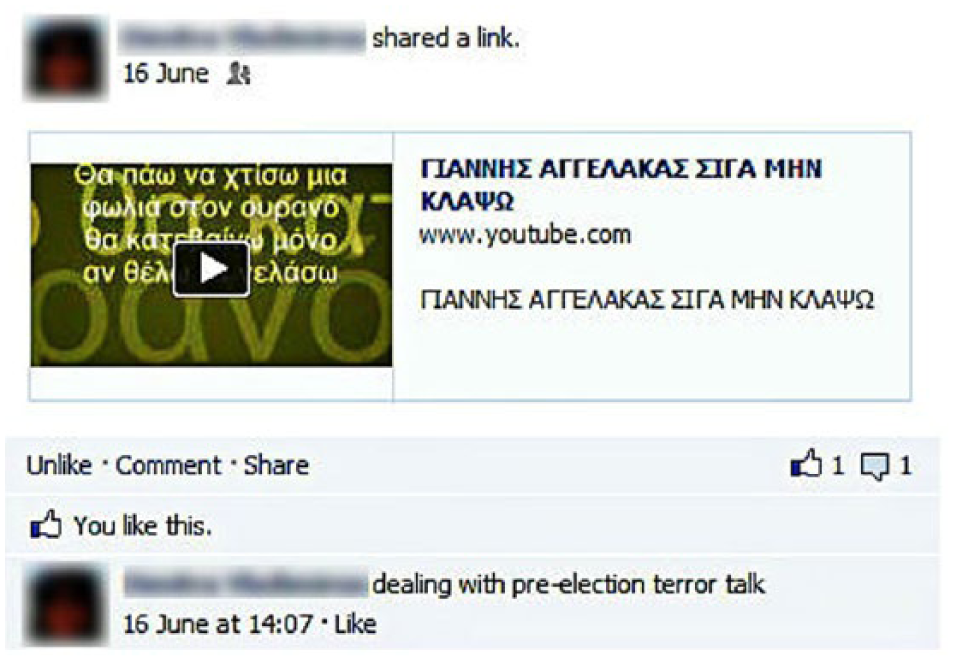
Posting a music link to complement a story (16 June 2012).
The chorus lyrics
10
below give us a taste of what this song is about (original in Greek): And when they fear I might get crazy/they tell me to go somewhere to cry secretly/and I should remember that this scenery/I am small, too small to change. But I, with a wild proud dance/will fly like an eagle over the sorrows/I won’t cry, I won’t fear.
Combining Helen’s comment, “dealing with pre-election terror talk,” with the lyrics, we can deduce that she draws a kind of parallelism between the song’s “they” and the Greek politicians, on the one hand, and the song’s “I” and herself as a conscious Greek citizen, on the other. It is as if the politicians threaten and warn people that they have no other choice of salvation but voting them, that citizens are helpless without them, and they are incapable of changing the situation on their own.
What we witness in the above instances (Figures 9 to 14) is that entextualization and resemiotization are key semiotic resources in the construction of Helen’s small stories. Entextualization (Blommaert, 2005, pp. 46-48) involves two related processes: decontextualization (taking discourse material out of its context) and recontextualization (integrating and modifying this material so that it fits in a new context). Resemiotization, on the other hand, refers to the unfolding and rearticulation of meaning from one semiotic mode to another (Iedema, 2003). In telling her stories, Helen extracts “instances of culture” (e.g., the Mafalda strip, I won’t cry lyrics) and relocates them in her discourses and repertoires (cf. Leppänen, Kytölä, Jousmäki, Peuronen, & Westinen, 2014). By means of these processes, she invests the original artifacts with fresh meanings which transform the original narrative from whence they came (Davies, 2007) into a new narrative that features social, cultural, and historical aspects of the Greek crisis.
Narrative Stance-Taking
It can be gleaned from the examples thus far that Helen is not a mere storyteller of the crisis but a stance-taker of the crisis as well (cf., Georgakopoulou, 2013b; Georgalou, 2014b). A substantial caveat needs to be taken into account at this juncture. Jaworski and Thurlow (2009, p. 197) have cogently argued that “the stance evaluation nexus appears to permeate all aspects of meaning making, all communicative functions, and all levels of linguistic production.” Chiming with them, I see stance as a thread that runs through most of the small stories in this article. My decision to single out stance for a separate section was taken for purposes of neatly aggregating how Helen communicates her feelings and thoughts toward the crisis.
Revisiting some of my previous examples, in Figure 1, Helen expresses a series of judgments. First, she addresses in a generic way (“you”) the affective position of Greek voters (“shocked”). Second, she condemns the fascist political party, Golden Dawn, calling them “thugs” while she challenges other parties’ and politicians’ tenets with the pre-modifying adverb “supposedly” implying that their moderation is nothing but a smokescreen. Her belief that there were serious problems in the Greek political scene (rendered through the iceberg metaphor) prior to Golden Dawn’s rise is softened with the hedge (i.e., device that downgrades her commitment to the statement) “I’m afraid” via which she does not wish to impose her opinion on her audience.
In Figure 4, Helen’s stance seesaws from uncertainty (“unknown,” “I guess”) to recognition of obligation (“I should consider”). In the same tone, in Figure 5, she shifts from a specific (“for me”) to a general stance (“you have,” “you don’t experience”) to invoke a shared perception (Myers & Lampropoulou, 2012) but not a shared experience as she is still a member of the workforce. Her attitudinal stance is compacted in the noun “destruction” as a highly, negatively charged evaluation of the crisis. Grounded then on Syrigos’ (Head of Greece’s largest Oncology Department) voice, directly quoting him from the New York Times article, she takes an affective “stance follow” (Du Bois, 2007, p. 161) to his statement (i.e., she takes a stance on his stance): “so scary.” Once more she appears uncertain (“don’t know”), yet at the same time assertive (“can’t accept”). The stance-taking devices she employs in both Figures 4 and 5 suggest that she stands in an adversarial position: on the one hand, she provisionally feels secure because she has a job with a salary and an insurance; on the other, she sees a bleak future for both employed—including herself—and unemployed Greeks.
Narrative stance-taking is not always that transparent but may require the reader to draw certain inferences. For instance, in Figure 14 (pre-election song), the stance is conveyed through the song title I won’t cry. Helen chose it to yield a fearless stance toward the upcoming elections. Moreover, stances are not necessarily Helen’s own words. She also relied largely on intertextual and cross-modal materials to convey her stances as were the cases with the Delta allusions in Figure 2 (which added irony to her proposition), the meme (Figure 9), Mafalda’s strip (Figure 12) and other images found online (Figures 10, 11, and 13). By sharing them, Helen shows her alignment (or disalignment in the case of Figure 2) with the stances they already represent or imply.
Concluding Remarks
The purpose of this article was to investigate how the Greek crisis is narrated in the form of small stories at the grassroots level of Facebook activities. Being informed by insights from discourse-centered online ethnography and the frameworks of small stories, narrative dimensions, and stance-taking, I drew on data from Helen, a Greek Facebook user who frequently posts about the crisis. Helen is a highly educated, polyglot person, who travels and intermittently works abroad. That background of hers was not a parameter set at the beginning of my research but rather a matter of the way I developed my sample through inviting and snowballing. Therefore, this study neither purports very broad representativeness nor allows overgeneralizations from the data. Through my analysis and discussion, I was able to give a “thick description” (Geertz, 1973) of what Helen did in narrating the Greek crisis on Facebook. Albeit partly idiosyncratic, these findings help us to obtain an intimate view of how Facebook can be used as a platform for grassroots activism enhancing our understanding of small stories, social media, the Greek crisis, and their intersection.
Overall, we saw that Helen’s small stories about the crisis revolved around a range of topics: the actors who are responsible for the crisis (e.g., politicians), the actors who deepen the crisis (e.g., far-right, voters), the repercussions of the crisis (e.g., austerity, unemployment, vulnerable welfare system, demonstrations, strikes), what other responsible bodies report about the crisis (e.g., Syrigos in New York Times), as well as her own position within the crisis (e.g., as a protester, as an employee who might lose her salary). These findings differ from previous studies on small stories and social media (e.g., Dayter, 2015; Georgakopoulou, 2013a; Page, 2010; Vásquez, 2012; West, 2013), which have zoomed in on the rather mundane events (not world-disruptions and complications) which users recount in and across their postings. Of course, not all of Helen’s small stories bore on the crisis. In my larger dataset, there were instances where she too tackled the minutiae of ordinary, everyday life events such as marking essays, cooking, and cycling. Yet, within the thread of her larger life narrative, Helen simultaneously produced small stories on the big, disrupting, and ongoing event of the Greek crisis. In observing her Facebook Timeline, I simultaneously dealt with her individualized crisis timeline as this appeared in her posts.
Helen’s small stories were necessarily audience-oriented. After having been triggered by a crisis-related event (e.g., Vaxevanis’ arrest), she felt impelled to talk about it inviting her readers to co-construct meanings. By creating intertextual links, Helen addressed Facebook friends that possessed the same background knowledge presuming that they would be able to disentangle the inferences. “The enjoyment of intertextuality rewards those grasping the source with an elitist feeling” (Adami, 2012, p. 143) of being part of a shared narrative. Her choice of language too (she mostly writes in English) indicated deep concern about her audience. Such a decision proves to be pivotal in the “vernacularization” of the Greek crisis (Georgakopoulou, 2014) because her English message could reach and inform a wider, international audience. What also mattered in the construction of her small stories was that she was very careful with how she committed herself to their content appearing to be well aware of her audience’s existence. As the data at hand indicated, Helen tended to downgrade the certainty and opinionatedness of her statements via low modality 11 choices (e.g., “I guess,” “I don’t know,” “I’m afraid”), which “can be seen as part of the process of texturing self identity” (Fairclough, 2003, p. 166). With this texturing, she also textured her uptake of an audience comprising colleagues, friends, and students of hers, who read her stories and formed their impressions about her accordingly.
Both tellership and tellability dimensions in Helen’s stories were fortified by stance-taking. Helen evaluated crisis events and characters, articulating her feelings and thoughts both straightforwardly and tacitly. What was intriguing, therefore, was not that she told stories about the crisis but how she told these stories. Her storytelling was not strictly restricted to linear, detailed verbal descriptions. It was also encapsulated in semiotically striking images, an Internet meme packed with various ideologies, a song title, a comic strip, any “act of contemporary expression using contemporary linguistic means and aesthetics” (Boubari, 2011) via the processes of intertextuality, entextualization, and resemiotization. I would therefore argue that in this both networked and turbulent era, Facebook can enhance, enrich, and broaden our perception of what (digital) storytelling is as different Facebook affordances propel into different ways of developing stories within the medium.
As described earlier, the small stories template includes three subgenres: breaking stories, projections, and shared stories. Helen’s stories did not neatly fit in just one subgenre as some of them referred to still unfolding events (e.g., “the worst is that the worsening begins to worsen” in the Mafalda strip) or planned activities in the near future (e.g., “off to syntagma”). That Helen did not own a smartphone with access to the Internet entailed that more often than not she told her stories some hours or even some days after she had experienced specific crisis-related events. Thus, in most of the cases, her stories were not purely instantaneous (Papacharissi & de Fatime Oliveira, 2012) but acquired the integrity of a narrative post-factum (Dayter, 2015; e.g., after the elections, after a demonstration). This small delay, which made room for retrospective reflection and evaluation, between the taleworld (the content of stories about crisis events) and the telling world (the actual timestamps that appeared on Helen’s posts) enabled Helen to filter (akin to what happens in traditional media) what crisis moments and milestones she should document (e.g., which photos from the demonstrations she considered worthier to be shared). In sum, Helen’s networked small stories on the crisis give rise to a hybrid subgenre which blends autobiography with news reporting, fact with opinion, subjectivity with objectivity, and emotion with meaning (cf., Papacharissi & de Fatime Oliveira, 2012). My contention is that this hybridity lies in the very fact that the crisis permeates and saturates all aspects of living: social, cultural, political, personal—offline and online.
Recent research has demonstrated how citizens have exploited social media in times of crisis to co-ordinate demonstrations (e.g., Fuchs, 2014; Gerbaudo, 2012; Tsaliki, 2012), to transpose crisis news stories across different platforms (e.g., Georgakopoulou, 2014), and to parody and satirize politicians (e.g., Häkkinen & Leppänen, 2014). The work reported here has shown how people can utilize Facebook as a grassroots channel to position themselves within (the Greek) crisis: to express agonies, share experiences, raise awareness, inform and anti-inform, understand, reflect upon, evaluate, and respond to what is happening. One could argue that Helen’s small stories on Facebook may seem individualistic, marginal, and fragmented; insufficient to bring about a drastic change; or spark off an uprising. Yet, as Papacharissi (2014, p. 5) has insightfully explained, social media “do lend emerging, storytelling publics their own means for feeling their way into the developing event, frequently by making them a part of the developing story.”
Footnotes
Appendix
Timeline of the Greek crisis (October 2009–June 2012).

| 2001 | Greece joins the Eurozone. |
| 2008 | Global economic downturn reaches Greece, which already has heavy sovereign debt from previous years. |
| October 2009 | Social democratic party PASOK (Panhellenic Socialist Movement) wins the elections. George Papandreou as Prime Minister. |
| December 2009 | Government divulges a funding gap in its accounts. |
| 9 February 2010 | First austerity measures package (tax increase, pensions frozen, changes to employment regulation, mergers and closures of public organizations, privatizations). |
| January 2010 | Greece is on the brink of default. |
| 2 May 2010 | Papandreou signs “Memorandum of Understanding” with Troika, composed of the European Union, the International Monetary Fund (IMF), and the European Central Bank (ECB). |
| 5 May 2010 | General nationwide strike. Marfin Bank events in Athens. Three employees are killed. |
| October 2010 | Christine Lagarde (Managing Director of IMF) sends to Giorgos Papakonstantinou (Greek Finance Minister) a list of wealthy Greeks with undeclared accounts in Swiss banks. |
| May–August 2011 | Greek Indignant Citizens Movement (Aganaktismenoi) swarm every evening at Athens Syntagma Square to protest against austerity. |
| 28 June 2011 | General strike. Riot police clashes with protesters. |
| 29 June 2011 | Government sanctions new austerity measures. |
| 14 September 2011 | New tax on property collected through electricity bills. |
| 28 October 2011 | Protests on National Day. |
| 31 October 2011 | Papandreou announces a referendum on austerity package. The referendum is never conducted. |
| November 2011 | Papandreou resigns. Lucas Papademos, former vice-president of ECB, is appointed interim Prime Minister. |
| 12 February 2012 | Memorandum 2 voted in Parliament. Violent protests in Athens. |
| 6 May 2012 | First round of elections. Center-right party Nea Dimokratia (New Democracy) is first. Left-wing party SYRIZA (Coalition of the Radical Left—Unitary Social Front) is second. Far right-party Chrysi Avgi (Golden Dawn) in Parliament. |
| 17 June 2012 | Second round of elections. Coalition government with the participation of New Democracy, PASOK, and DIMAR (Democratic Left). Antonis Samaras, New Democracy president, becomes Greece’s Prime Minister. |
Acknowledgements
I am most grateful to the two anonymous reviewers whose constructive comments on a previous draft of this article enabled me to restructure and improve the argument of the present version. Special thanks also go to Helen for participating in the study.
Declaration of Conflicting Interests
The author(s) declared no potential conflicts of interest with respect to the research, authorship, and/or publication of this article.
Funding
The author(s) disclosed receipt of the following financial support for the research, authorship, and/or publication of this article: This work was partly supported by the Centre for International Mobility (CIMO) Finnish Government Scholarship Pool (KM-13-8683).
1.
2.
Screenshots, apart from visual material, depict Facebook interactions as well. Several of them were also imported in my Word documents, while others were imported only in the final written product after reading and rereading screenshots from my data reservoir. Moreover, differences in numbers, as shown in the table, are contingent on my informants’ activity on Facebook. For example, in marked contrast to Helen, Gabriel usually delves into lengthy interactions with his Facebook friends. Alkis, on the other hand, as the most active user of all, posts almost every day and exchanges many comments with friends. Carla’s two profiles, personal and professional, were examined in parallel, so I opted for having one document with textual information from both profiles. Interviews and feedback on my analysis are merged into one document for each participant as in a number of circumstances follow-up questions emerged from participants’ commentary.
3.
Theoretical saturation (Glaser & Strauss, 1967) of all five informants’ data was reached with reference to different identity constructions, a topic which I discuss elsewhere (Georgalou, 2014a).
4.
In Greek, “mangas” is used to refer to someone who has guts; in the book, it is used as a name for a dog—to make a pun—which, after running away from home, is unprepared and weak to confront previously unknown dangers.
5.
All interviews were originally conducted in Greek.
7.
Helen said in the interview that she opts for exchanging comments with Greeks in English because someone who does not speak Greek may want to intervene. Neither does she nor do her other Greek friends want to exclude them. As she highlighted, the purpose is to keep the discussion open for non-Greek speakers as well.
8.
Interestingly, the Aganaktismenoi story is told by Helen episodically, across different Facebook posts and time spans, and in different modes and materialities: a verbal status update on joining Aganaktismenoi (Figure 3), a picture depicting Aganaktismenoi (Figure 7), and a profile picture that hints at Aganaktismenoi’s rallies ( ).
).
9.
Mafalda is a comic strip created by Argentine cartoonist Joaquín Salvador Lavado (known as Quino). The strip features a little girl named Mafalda with a deep concern for the state of humanity.
10.
Written by Giannis Aggelakas and released in 2005.
11.
Modality refers to those features in a text that express the speaker’s/writer’s attitudes towards themselves, their interlocutors, and the topic at hand, that is to say, what they commit themselves to in terms of truth or necessity. Modality can have high (e.g., must, always), median (e.g., should, probably), or low (e.g., may, perhaps) levels of commitment.