




Abstract
Background
Preferences of informal caregivers of people with neurocognitive disorders for technological solutions are important in user- centered design approaches. It is crucial to take into consideration the needs and preferences of users when developing new technology to facilitate their uptake.
Objectives
The objective of this study was to determine caregiver preferences for potential technological solutions to help address their needs and compare technology preferences of caregivers who provide care to those with and without neurocognitive disorders (NCD).
Methods
This was a quantitative descriptive study. We surveyed informal caregivers of older adults with disability in Canada. Participants were asked to answer questions about their preferences for 10 potential technological solutions that could be developed to make caregiving easier.
Results
Data from 125 respondents (72 caregivers of people with NCD and 53 caregivers of people with non-NCD-related disabilities) were analyzed. Generally, caregivers preferred web-based solutions as these were among the first five choices for both groups combined. However, there were some differences in the order of preference of potential solutions in both groups.
Conclusion
Informal caregivers of people with NCD preferred web-based solutions to help address their needs.
Introduction
Older adults living with a cognitive or physical disability often receive care from a relative or friend who in such instances takes up the role of informal caregiving. Informal care occurs in different forms, including physical assistance with activities of daily living, planning to access services, and emotional support. 1 Caregiving may provide caregivers with a sense of accomplishment and in some instances improve the quality of the relationship between the caregiver and care recipient.2,3 However, informal carers frequently need to contend with mental and physical stress. For example, compared to non-caregivers, informal caregivers are more likely to experience depression, poor personal health, burnout, and disruptions to careers.4,5 The level of stress caregivers experience is associated with the type of disability and degree of dependence of the care recipient. 6
Providing care for an older person with a cognitive disability such as neurocognitive disorder (NCD) can be challenging. For example, people with dementia may need ongoing continuous surveillance. In addition, caring for a person with dementia at home may represent a high-risk situation for informal caregivers that makes them susceptible to adverse health consequences such as depression and physical stress. 7 Hence, it is important to find effective supportive strategies, especially when caring for people with NCD such as dementia. 8
While many programs, policies, and technological products are being created to support the care of people with disabilities, caregiver input in the creation of these products is often limited. 9 It is important to identify the specific needs of caregivers and match these to the appropriate interventions or solutions. For instance, caregivers of people with NCD report needing better information and other resources that could aid their caregiving tasks such as assisting with activities of daily living.10,11 Identification of caregiving needs should guide the development of solutions to address them.
Assistive technology (AT) is one means to make caregiving easier. Informal caregivers who use AT report peace of mind knowing when the needs of the person they support have been addressed. 12 The use of AT designed for persons living with a disability can help promote independence and reduce the burden of care, thus potentially reducing the number of hours of help needed from an informal caregiver. The need for lesser hours of assistance reduces dependence on the caregiver and lowers caregiver stress. In addition, key AT can help make care planning more seamless.13–15 For instance, electronic equipment such as smartphones and computers can be used to coordinate care. 16 Similarly, an experimental study of the impacts of AT on users and their informal caregivers found users found it significantly decreased care burden. 17 Thus, several forms of technology including telephones and web-based resources have the potential to improve the well-being of caregivers by reducing the burden associated with caregiving.
Using user-centered design to develop technological solutions is an optimal way to ensure the interventions are acceptable to end-users. 18 However, this approach has not been used extensively with informal caregivers. Given that user involvement is central to the design of technology that is both relevant and useful, prioritization of solutions by caregivers of people with disability is a vital step towards designing the solutions they need. 18
List of potential technological solutions.

The study was intended to illuminate the implications of the context of care on the solution preference of caregivers. The objective of this research is to determine caregivers’ prioritized preferences for potential technological applications to support caregiving activities for care recipients with NCD. The potential solutions were conceptualized in collaboration with caregivers and care recipients in a previous study. 19 In addition, we compared the potential technology preferences of caregivers who aid those with and without NCD.
Methods
This was a quantitative descriptive study. We used a web-based survey to identify and rank the technology preference of caregivers in two groups: those taking care of people with NCD and a second group taking care of people without NCD. Institutional Review Board approvals were obtained from the local university (#H15-01,164) and health authority research ethics boards. Our presentation of survey findings was guided by an adaptation of the Checklist for Reporting Results of Internet E-Surveys (CHERRIES). 21
Survey design
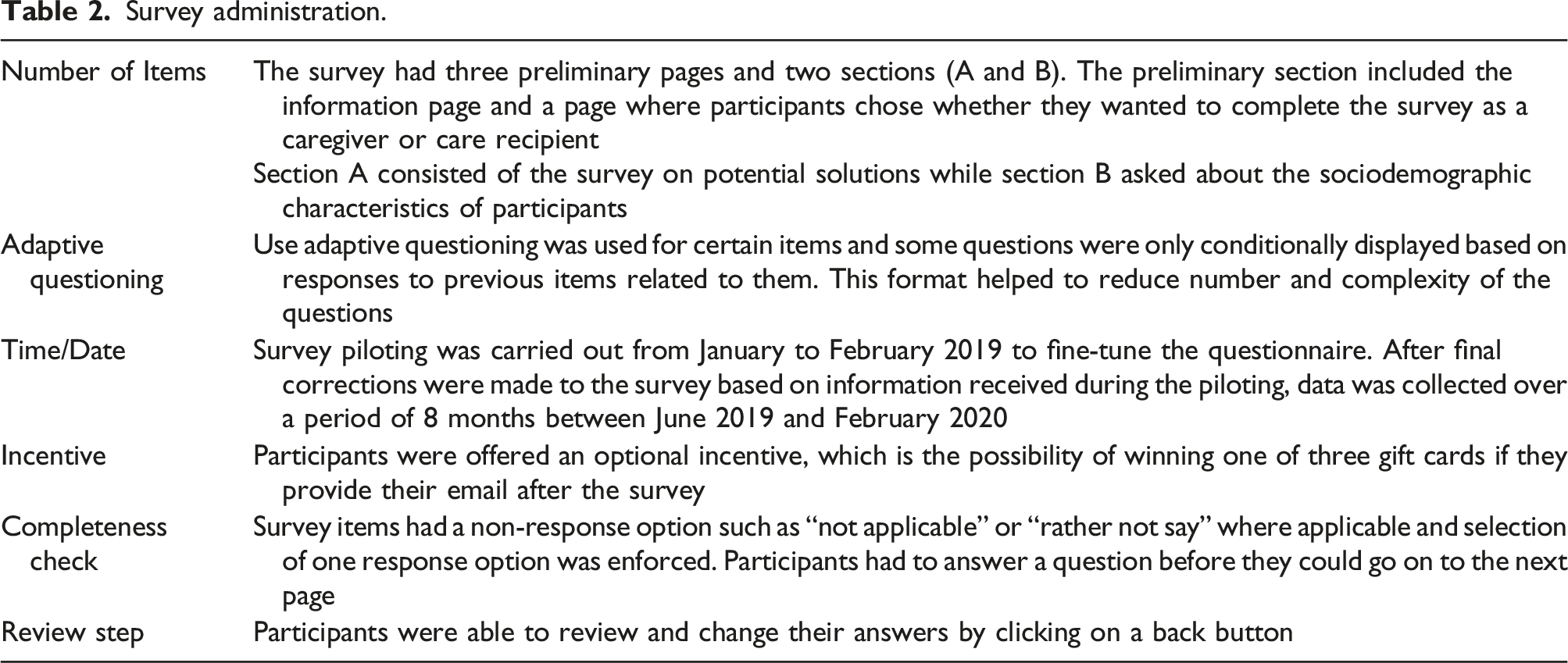
The survey was developed following the method described by Glasgow (2005) and refined after two cognitive interviews and a pilot testing with caregivers to ensure reliability. To obtain representation from speakers of both Canadian official languages, the survey was translated from English to French by the Quebec team and made available in both languages before circulating the survey link to caregiver groups. The survey was subjected to an expert panel review to improve content validity. The questionnaire was pre-tested among 5 informal caregivers to ensure its clarity and suitability to the target population. Necessary amendments were made before the questionnaire was used for the actual study.
Participants
In the current study, informal caregivers of those living with disability were involved to prioritize the most preferred technologies. A convenience sample of Canadian adults in British Columbia and Quebec, aged 19 and above (18 and above in Quebec) was recruited who were either current or past caregivers of an older person with disability. Participants needed to be able to communicate in French or English and the completion of the survey served as their consent to take part in this study. NCD was defined based on the fifth edition of the American Psychiatric Association’s diagnostic and statistical manual of mental disorders. 22 Respondents were asked whether the care recipient’s diagnosis of NCD had been made by a health professional according to a similar question in the Canadian Community Household Survey. 23
Recruitment
Respondents were recruited by the authors via caregiver support groups across the country as well as through social media, disability and diagnosis specific organizations newsletters, and word of mouth. Study poster was displayed around [anonymized] and study brochures were handed out to interested individuals. Interested caregivers were directed to the online survey via a link in the study advertisement. A study information page preceded the online survey described the study (e.g. aims and time requirements) and explained that completion of the survey served as consent.
Data collection
An online questionnaire was used to collect quantitative data from informal caregivers. In the survey, caregivers answered questions about the importance of the 10 shortlisted solutions to meet their specific needs. The survey requested participants to identify the reason for any preferences stated and to provide their perspectives on the relevance of each solution.
Survey administration.
Data analysis
Descriptive statistics for quantitative measures such as age and mean hours spent working or providing care were calculated. Preference ratings were allocated to the technological solutions according to their importance based on caregiver responses. The survey was presented as a Multiple Rating Matrix and the comparison of alternative solutions was conducted using the Pugh matrix analysis.24,25 The formula: Σ Rank (r)* multiplier = rank score was used to estimate a rank score (rs) for each of the solutions. The multiplier were numbers 1–5 corresponding to the rating options (not at all, slightly, moderately, very much, and extremely) under the question that asks how important participants think it would be to develop a solution.
The solutions were ranked to determine the most preferred technology. Characteristics of caregivers of people with NCD were compared with those caring for people without NCD using the Kruskal Wallis and t-tests.26,27 Data collected from this survey were analyzed with Microsoft Excel and SPSS version 24.
Results
Demographics of participants.

aKruskal Wallis.
bt-test.
Most of the participants were female although the NCD group had a higher proportion of female participants and were significantly younger than the non-NCD group.
Caregiver respondents were mostly spouses/common law partners, Caucasian and lived with their care recipients in both groups. Caregivers in the NCD group were less likely to have assisted the care recipient for a longer period although they provided care for more hours per week to care recipients that were significantly older than their counterparts in the non-NCD group.
Overall preferences of all participants
Figure 1 displays the ranking of solutions preferred by all participants involved in this study, including caregivers providing care to people with and without NCD. In general, the web-based resource for hiring paid healthcare aids was the most prioritized (rank score = 494) while the meal container was least preferred (rank score = 305). Preferences of all participants (numbers on chart represent rank score (rs) (n = 3914).
Inter-group analyses
The choices of participants based on the group they belonged to in terms of caregiving in the context of NCD are shown in Figures 2 and 3. The numbers on the charts represent the mean rank score calculated for each potential technological solution. Preferences of participants in the NCD group (n = 2626). Preferences of participants in the non-NCD group (n = 1373).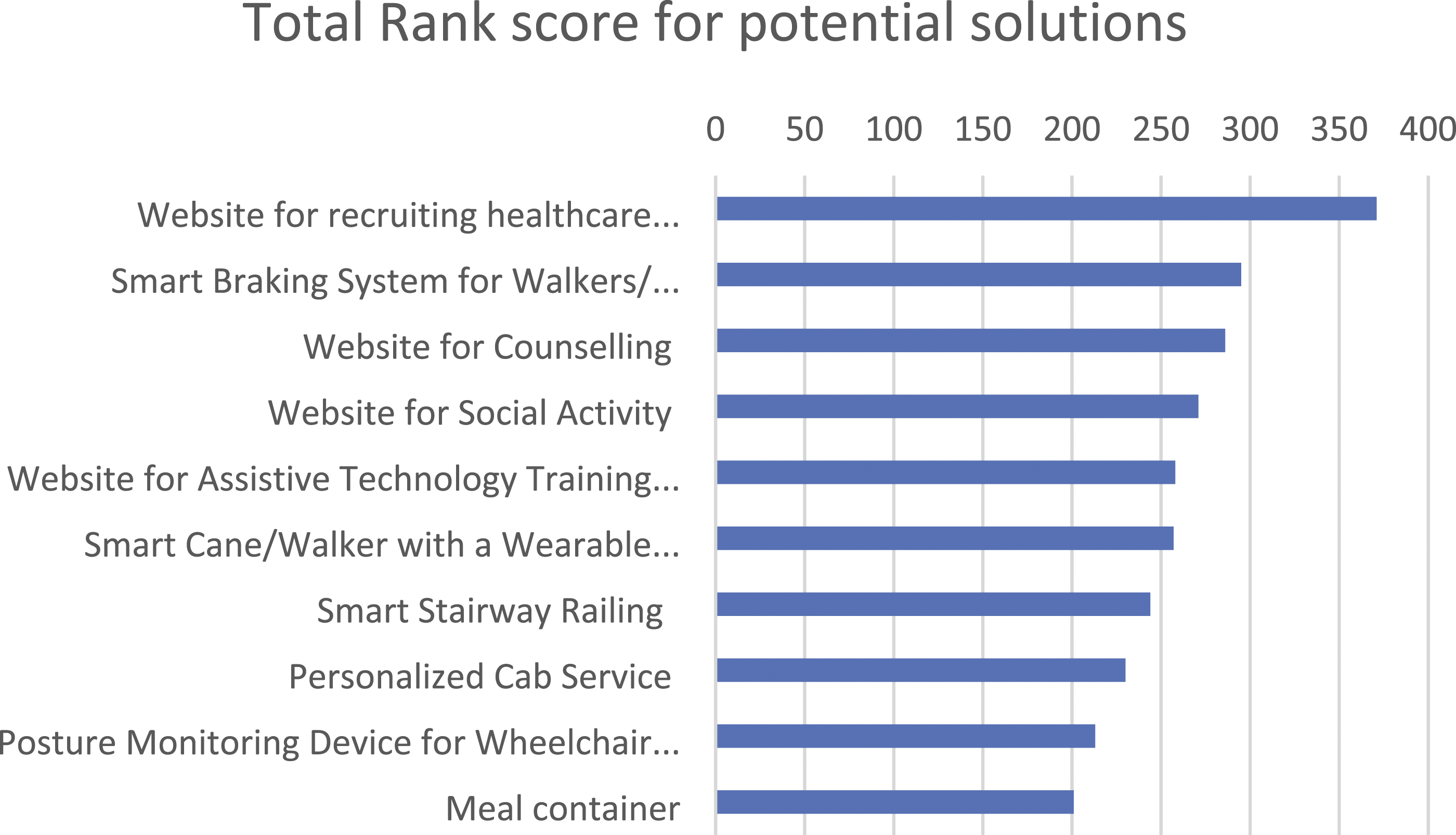

The preferences of caregivers of people with NCD displayed in Figure 2 were different from those providing care to people with non-NCD related disability (Figure 3). For example, the smart braking system for walking aid devices was ranked higher by NCD caregivers than non-NCD caregivers. The biggest difference between the two groups is also about the preference for the smart braking system for walking aid devices, which was in the 9th position for the non-NCD group ranking. While the rankings of other solutions did not show such large differences, there are some variations between groups that are worth pointing out. All the web-based solutions were ranked in the first four positions by the non-NCD group. In addition, having a personalized cab service and posture monitoring device were more preferred by non- NCD caregivers.
Eight of the solutions were ranked differently by caregivers in different groups. Two of the potential solutions (personalized cab service for transportation and posture monitoring device for wheelchair users) differ in position between the two groups by three places and two (website for social activity, website for AT training, and smart cane/walker with a wearable bracelet) differ in position by two places between both groups.
Discussion
This human-centered design study explored preferences of informal caregivers of people living with NCD in terms of the technological solutions they are seeking to help make caregiving easier. The preferences of participants providing care to people living with NCD were also compared to those of caregivers caring for people with other conditions that are not NCD.
Overall, caregivers seemed to desire web-based solutions as these were among the first five choices for participants when all preferences were considered regardless of their context of care group. Caregivers’ preferences for web-based solutions may be due to the ease of using apps and web pages for planning and completing tasks without having to be physically present as well as the potential for asynchronous access to these resources on their own schedule. For instance, web-based applications can be used anytime for counselling and scheduling or completing appointments. 28 In addition, websites and applications have the potential to reduce waiting times, eliminate the need for transportation and reduce cost (transport/parking) to the care-recipient. 29
Considering the ranking of solutions by group, the technology preferences of caregivers varied based on how useful they were perceived for their specific situations. Differences in preferences between the NCD and non-NCD groups may also reflect their unmet needs. People who have challenges with their cognitive abilities as seen in most NCD may have greater need for smart devices. Caregivers of people with NCD on average were more interested in solutions that would allow them to be more independent as they access services or carry out their normal day to day activities even if they had cognitive or memory impairment. The loss of cognitive abilities associated with NCD might be responsible for the preference for web-based solutions and smart systems among caregivers of people with NCD. This finding is consistent with prior research results that suggested daily function and self-efficacy regarding ability to manage memory impairment were of utmost importance to patients living with NCD. 30 The relatively higher ranking of a posture monitoring device by caregivers of people with non-NCD-related disabilities may be a pointer to the need for a solution that could help in physical disability situations. Likewise, affinity for mobility-related solutions among caregivers in this group reflect preferences that would help provide support for people who provide care in the context of physical disability. Having access to solutions that make transport and appropriate paid care more accessible to people with physical disabilities have been shown to provide relief to their informal caregivers and offer users a better quality of life.31,32
Generally, caregiver’s preferences for potential solutions mirrored certain needs that are generally influenced by the degree of help required. Research has shown that the level of impairment or stage of disease of the care recipient is a determinant of their level of healthcare and caregiving needs.33,34 Different types of AT tend to have varying effects contingent on indications for them and how well the user is able to maneuver them for their functional benefits. For instance, depending on functional status, canes are preferred to crutches in maintaining gait stability as the latter may be regarded as cumbersome and are increasingly out of favor by some users. 35 Similarly, the website for AT training for caregivers and users meant more to those in the NCD group probably because they need specific and simplified instructions to guide their use of assistive devices. In addition, some of the potential solutions may be more focused on people with specific needs or have a broader appeal because the pertain to larger number of caregivers. For example, only wheelchair users would have a need for the posture monitoring device on wheelchairs. 36 Thus, the ranking of such technology might be restricted to those who require it. While ‘niche’ solutions are quite important and may be particularly preferred by those who need them, they might not have been ranked higher by the general cohorts of participants. Furthermore, it is unclear what informed caregivers’ ranking decisions, whether they might have ranked devices based on their perceived impact generally or for themselves and their care recipients specifically. Therefore, it is difficult to adopt a ‘one size fits all’ approach to developing solutions for informal caregivers and the people they care for.37,38 It is pertinent to continue to involve caregivers in conversations about their technology needs and how they would like to address them in a human-centered design context.
The relatively lower ranking of the website for social activity by caregivers of people with NCD is surprising, as previous studies have found that one of the unmet needs of informal caregivers often is to find social support and understanding by others 39 and caregivers often desire to interact and share ideas with their peers. 31 However, this may reflect a perception that socialization is considered less essential than care recipients’ basic activities of daily living. Nevertheless, the ranking of each item based on how they were rated by survey participants is relative and should be interpreted with care. The survey questions asked participants to rate solutions based on how important they considered them. Although caregivers may rate a solution higher than others, it is likely that they would still find the other solutions useful.
Limitations
This study has some limitations. First, the participants recruited through convenient sampling are not representative of the entire population of Canadian informal caregivers. Notwithstanding the sampling technique, the participants were able to access the survey and provided valuable information for analysis to provide context for this research. Our ranking was based on how important participants considered each solution and this helped confirm choices in situations where solutions may have equal importance. Second, our use of preferences as an indicator of care intentions is to an extent, subjective. However, questions about intentions have been proven to be very simple and efficient to predict health related behaviour. The assessment of preferences of caregivers provides basis for analyzing and comparing preferred technological solutions.
Conclusion
We surveyed caregivers about their preferences regarding potential technological solution and compared the preferences of those providing care to people with NCD with those who are not. Our findings suggest that in both groups caregivers generally prefer web-based solutions. Although some potential solutions were ranked higher than others, the less preferred ones are not necessarily unwanted but may have less broad appeal. Further research could focus on identifying the reasons why caregivers and care recipients prefer specific solutions and contextualize how such could help relieve caregiving burden.
Footnotes
Acknowledgements
We thank the Networks of Centres of Excellence AGE-WELL network for funding this study. The preliminary findings in this paper were presented at AGE-WELL’s 5th Annual Conference, New Brunswick, 2019.
Declaration of conflicting interests
The author(s) declared the following potential conflicts of interest with respect to the research, authorship, and/or publication of this article: Francois Routhier and Claudine Auger had salary support from Fonds de recherche du Québec– Santé (FRSQ) Research Scholar program.
Funding
The author(s) disclosed receipt of the following financial support for the research, authorship, and/or publication of this article: This work was supported by the Networks of Centres of Excellence AGE-WELL network (AW CRP 2015-WP 2.1).
Guarantor
OA.
Contributorship
WBM, FR and OA researched literature and conceived the study. All authors were involved in protocol development, gaining ethical approval, patient recruitment and data analysis. OA wrote the first draft of the manuscript. All authors reviewed and edited the manuscript and approved the final version of the manuscript.
