




Abstract
Objectives
This work presents an ambient-assisted living application that encourages seniors during nocturnal wandering episodes to return to bed in calm and comfort reassurance.
Methods
Structuring knowledge by designing a software architecture capable of delivering high-level analysis and processing. A senior’s home has been upgraded into a smart home enabling the gathering of habits for two weeks and set up for personalized assistance over four weeks. Home automation devices associated with Actigraph monitors and self-reported sleep were used for more accuracy.
Results
The architectural model can be used in ambient-assisted living applications for which data collection is permanent and continuous. Its layered organization facilitates the management of specific and general activities of daily life. The results of the home experience show that the system gave a notification whenever the need arose. On the other hand, it allowed the caregiver to get more information about the lifestyle of the senior.
Conclusions
Future work should focus on providing more services to contextualize assistance. Ontology is used to structure all the ambient knowledge of the smart home. We also plan to do more home experiments.
Keywords
Introduction
Due to its context-sensitive nature, ambient intelligence is a highly multidisciplinary field; therefore, it is subject to continuous interactions and cross integration. To benefit from the ambient systems, stakeholders must ensure that the needs of individuals are taken into account and that the technology meets each of the user’s requirements. Software solution lies in implementation of an architecture capable of taking into account evolution over time and capable of scaling. The context awareness approach makes it possible to take into consideration these problems of adaptation and generalization.
Context refers to any information that can be used to characterize the situation of an entity, when an entity can be a person, a place, or a physical object.1,2 Context gives key information to adapt assistance depending on what and where people are performing activities. 3 For example, if assistance must be delivered while the senior is on the phone in his bedroom, the assistance system must adapt to the way it provides the advice. First, the system must find the appropriate location to display this advice, for instance, on the smartphone or on a screen in the bedroom, avoiding places outside the bedroom. Second, the system must evaluate the priority between the phone call and the advice, deciding to let the senior completes his phone call or shifting his attention to the advice. It is therefore necessary to interpret the context for taking appropriate and personalized decisions. 4 This mechanism is known as context awareness, and it must be applied to foster well-being and aging at home.
To facilitate aging at home and allow seniors to foster autonomy in achieving the activities of daily living (ADL), it is important to consider the context in which these people live. Taking into account the context of the assistance makes it possible to better adapt the solutions of pervasive computing and ambient assistance.5,6 Above all, it anticipates people’s needs and acts accordingly.
Several solutions based on ambient-assisted living (AAL) and context awareness have been developed.5,7–11 They are aimed to foster autonomy at home for seniors by providing environmental cues either to recall an activity or to monitor the way to perform it. This study focuses on assistance for senior suffering from Alzheimer disease who experience nocturnal wandering episodes. Nighttime wandering is due to temporal and spatial disorientation and may provoke anxiety and risk of falling.12,13 Wandering is qualified by movements without specific or apparent purpose, but which is not entirely random.14–16
A contextual assistance system is therefore useful to create a calm environment that diminishes anxiety and encourages people to go back to sleep. This article describes, on the one hand, how the nighttime wandering assistance system (NAS) 17 has been improved to take into account the situation of the senior. On the other hand, it describes the experimental procedure undertaken to assist a senior with Alzheimer’s dementia during nocturnal wandering episodes and the results of the six-week experiment.
The rest of the paper is organized as follows: The next section discusses the related works, the subsequent section describes how to adapt the nighttime wandering system to be context aware, the penultimate section describes the sensor network and presents the results of the experiment, and the last section concludes the article.
Related work
This section is organized in two parts: one reporting some contributions on context awareness and the second on AAL.
Context awareness
Anytime, anywhere, and anyone are the keywords that lay the foundations of a contextual assistance system. A context-aware system is a system able to provide customized services that use environmental and user’s profile information in order to display appropriate assistance according to the user’s needs. Multiple projects have been studying context awareness, some presenting the basic theory,1,18 others being applied to specific applications.19,20
Prominent among the definitions of context1,4,18,21 is the one proposed by Dey and Abowd:
1
Context is any information that can be used to characterize the situation of an entity. An entity is a person, a place, or an object that is considered to be relevant to the interaction between a user and an application, including location, time, activities, and the preferences of each entity.
Among literature, some tool kits are developed to offer reusable components for building context-sensitive systems. The framework Context Toolkit provides reusable components to support rapid prototyping of sensor-based context-aware applications. 1 Some authors propose context Fabric infrastructure, a database-oriented approach to provide context abstraction by defining a context specification language and a set of core services. 3 Middleware for context awareness and semantic interoperability has been developed.22,23 It uses the ontological representation to set up a context. Some authors have also used multi-agent systems to implement context representation.24–26
AAL system
Deployed AAL systems deal with much contextual information, based on a sensor/actuator information, user actions, user profiles, and ambient information such as humidity, temperature, and so on. The AAL technologies that accompany aging in place present several challenges as:
Facilitate communication between the senior and caregivers, Monitor the health parameters of the senior, Monitor the environment and activities of the senior’s daily life using sensors to ensure greater comfort and safety, Facilitate the mobility of people out of their homes.
To address those challenges, several solutions are used.7,10 Among them, the AAL middleware and the ontological representation are mainly preferred, because of their facility for processing and integrating various technologies.
Nighttime wandering assistance system
The NAS aims to detect the onset of episodes of wandering in order to provide assistance during night. 17 It meets the needs arising when people are awake at night and encourages people to go back to bed. It is designed using a ubiquitous and ambient approach to create an environment that is sensitive to the presence of a person. It requires a design approach centered on users, which puts the technology in the background. It gives way to assistance that transforms homes into smart homes.
Several opportunities are offered by this approach to support senior to perform certain ADL. Based on life habits, it is possible to adapt the home environment in which they live to their illness and age.
To monitor the circadian rhythm, NAS proceeds in two phases. The first phase, called the monitoring phase, involves the installation of a set of sensors in the home to gather the activities and habits collection. The second phase, which is the assistance phase, involves the installation of actuators and offers personalized support on the basis of the information collected. The NAS provides objective data on the behavior of the resident, which are supplemented by physiological and subjective data collected from the senior and his caregiver.
Context awareness architecture for NAS
To identify, assemble, and describe context regardless of the application and interfaces, we developed a generic context aware architecture. It is composed of generic modules that communicate together to gather and process useful contextual information (Figure 1). This architecture is divided in three layers. The aim of the first layer is to gather contextual information, either from the environment or from the user. The second layer contains the previously gathered information from the first layer and provides an inference engine for reasoning about the explicit context information. The third and last layer communicates with the context awareness application programming interface (API) that provides assistance. It offers services to process this contextual information.

The context-aware architecture organization.
Environment context layer
The environment context, which is part of the first layer, specializes in collecting information in the smart environment via sensors. It is subdivided into three independent sub-context modules that offer various services related to the environment: acquisition, filter, and abstraction modules.
Context acquisition
The context acquisition module is the entry point of the architecture. It collects physical values from the devices like the sensors dispatched in the environment. The physical values are information gathered directly from a sensor or result from signal processing algorithms. A systematic method is applied step by step to determine the context of each datum.
Context filter and merger
The data collected by the heterogeneous sources are sent via different communication protocols to the controllers in charge of the management and maintenance of the underlying network of sensors. Sensors and controllers have limited computing resources. It is therefore impossible at this layer to perform information processing. Middleware is responsible for aggregating all heterogeneous data into homogeneous data streams and making them available to the upper layer.
Context abstraction
The context abstraction module is aimed to visualize the data of the smart environment in a simple and comprehensible way. It provides patterns for understanding the creation of the environmental context module. Information of this module is used by the context processing or is displayed directly on a user interface. This module is therefore useful for validating and testing the quality of the information collected from the environment, thanks to interfaces that display various data and sensor states.
User context layer
Seniors with Alzheimer’s disease experience their illness in very different ways, so case-by-case modeling is highly recommended. Knowledge of the person’s profile and lifestyle is relevant to contextual information for AAL. This knowledge makes it possible to better adapt the system to the user needs.
User context modeling
A user context adapted to the individual needs begins with a precise description of the person’s story. The user-centered design approach can largely answer this question by building scenarios of the habits. 18 In this architecture, the design of the user context is not related to the capabilities of the user but to the needs of users expressed by caregivers.
Profile information can be: At what stage is the disease? Does the person do physical activities? How does she conduct a specific activity? What is her favorite hobby? What is her musical taste, her favorite food? How does the person behave with the system? A user model is said to be context-aware when it is able to provide the system with information about what the user is doing at anytime and anywhere, so that it can be able to adapt to offer the desired assistance. This reflects the difference between the activities that a person is allowed to perform and the activities they regularly perform, but may have difficulty doing so?
User scenario modeling
The scenario-based design places the user at the center of the process. More generally, the user is considered as a co-creator or as a co-designer. The user-centered design brings the various stakeholders around the same table, involves them early in the process, and keeps them involved during all stages. Some authors show how to build around a formal specification a scenario based on a hierarchical model of tasks. 27
Generally, Alzheimer’s disease evolves over time and if the system is not aware of this evolution, the assistance will no longer be appropriate. Establishing a user’s profile may require a long process that also depends on the type of experiment performed. It is therefore advisable to collect, refine, and gradually adapt the profile of the person in the AAL system.
User context filter
The user context filter module integrates preferences and needs policy used to select the best scenario needed to monitor and to assist the senior. This approach avoids a set of false positives. Only the relevant information is transmitted to the external modules for processing.
Context processing and adaptation layer
This section shows how the execution and information processing layer are organized to allow an AAL application to be context aware. This layer provides ubiquitous high-level access to information from the user’s context and environmental context. Once all the data have been collected by the acquisition units, they are sent to context composition, context mediation, context adaptation, and context reasoning modules.
Context composition
The context composition module allows a standardized view of the data of the first layer. It processes composition, merge, and aggregation operations to construct description models. These models represent a possible execution context based on a subset of information coming from the underlying layers. These descriptive context models are called context patterns.
The composition process identifies a strong connecting link that bonds a sequence of data to derive the following context information. For example, composing the three following events—the door opening contact, the infrared beam crossed, and no movement in the room—allows to deduce that the person is out of the room.
Merge is an operation that brings together multiple data and information to predict or estimate the current state. This method essentially reduces the uncertainty by using redundant information. For example, the pressure on the bed and the movements detected by the motion sensor observing the bed can be merged as a presence on the bed.
Aggregation is the operation that performs a set of mathematical operations to smooth the data. Among these is the calculation of a threshold, a maximum, a minimum, a median or an average. For instance, time is aggregated to estimate how long people have used the microwave.
Context mediator
Each context pattern generated by the context composition is sent to a selection and pre-processing queue. A context mediator chooses which pattern to run based on policies established by the requirements of the assistance to be offered. It sometimes interrupts the normal execution of a process to execute a higher priority assistance based on safety or urgency criteria. For example, during meal preparation, if fire hazards occur, this dangerous situation will be treated first.
Context reasoning
The context pattern chosen by the mediator is sent to the reasoning context module, a specialized module that analyzes the context and proposes the most appropriate assistance solution. It validates the integrity of the patterns and the structure of the related contextual information. The context reasoning module serves as an inference engine for the high-level contextual information.
Several techniques are used to make this reasoning. There are, among other things, semantic approaches using ontologies, fuzzy logic, Bayesian networks, first-order logic, and even descriptive rules. This module chooses the best actions of assistance and the actuators for displaying environmental cues. If an action is produced, it induces a change in the person’s environment. The information is therefore sent to the context adaptation module.
Context adaptation
The adaptation module context builds the local feedback loop to inform the context of the environment and the user context which changes have occurred. Therefore, it informs first the environmental context to update the status of the environment, and then it informs the user context to build a history of the assistance that has been suggested and how the user was reacting.
Context manager layer
The context manager layer is responsible for micro-service management, persistence of information and group management policies for actuators, sensors, and users. Micro-services refer to a set of independent, low-coupled assistance applications designed to perform a single task. The set is orchestrated using the RESTful API.
The use of micro-service makes easier to manage the deployment and management of distributed applications. For example, the storage context module is responsible for the persistence of the data collected. The discovery service manages scaling operations, group membership, and network maintenance operations. A micro-service for the management of access rights and user privileges in the system can also be set up.
Experimental assessment
This section presents a six-week deployment of the augmented NAS system based on context awareness. This experiment puts particular emphasis on the creation of the contextual environment, the construction of functional modules and its deployment at home.
Materials and methods
Participants
The participant is a woman, and we will call her Pauline. Pauline lives alone in a triplex habitat, she only uses the ground floor (Figure 2). Her house is located in the countryside and her caregiver comes every morning and every evening to inquire about her day. In the morning, the caregiver organizes the day of Pauline, provides care, and helps for her toileting and dressing. In the evening, she reassures herself that Pauline has had a good day and helps her to go to bed.

The house of experimentation.
During the day, Pauline receives occasionally the visit of some close relatives. Pauline has a cat and likes to play puzzle games. She is 78 years old and has worked in a sewing industry. MoCA (Montreal Cognitive Assessment) was administered to determine the level of cognitive impairment. The MoCA is a brief instrument developed for screening a cognitive impairment taking into account different cognitive domains.
The results of the MoCA test give after adjustment a score of 18/30 points, indicating the presence of moderate cognitive impairment. Initially, the raw test gave a result of 17/30 points, a correction was made according to the level of education of Pauline.
The evaluation of the objectives of this experiment makes it possible to highlight two aspects of the Single Case Experimental Designs. 28 First, a proof of concept demonstration that the nighttime wandering system can operate as intended. Second, to help caregivers by providing them with more information about Pauline’s day-to-day activities, and then hoping that the system would be helpful in reducing Pauline’s nighttime wanderings.28,29
Experimental protocol
Once the participant was recruited, we proceeded to obtain authorizations by the ethics committee of Centre Intégré Universitaire de Santé et de Services Sociaux. Recruitment was conditioned by a set of criteria, including the fact that the person must be over 65 years old, possibly suffering from Alzheimer’s dementia, live at home, have no severe depressive symptoms, and have no history of alcoholism, etc.
The experiment was conducted in four phases:
profile identification, home identification and scenario explanation, monitoring phase, assistance phase.
Profile identification
Once the ethics committee agreement was obtained, we met the caregiver. The meeting goal is to determine together the audience scenarios, the needs, and the requirements of Pauline. Among other things, we asked the caregiver which impacts Pauline’s condition had on her day and her night. Then, we met Pauline. The first visit had a dual purpose: first completing the cognitive tests and questionnaires and second describing the house.
The Dementia Rating Scale (DRS), the MoCA, the Neuropsychiatric Inventory, the Geriatric Depression Scale, the Cornell Scale for Depression in Dementia, and the 36-Item Short Form Health Survey were completed. Cognitive assessments revealed deficits in verbal fluency and short-term memory. To assess the sleep profile, the Pittsburgh Sleep Quality Index and the Insomnia Severity Index were also completed.
Home identification and scenario explanation
The second purpose of Pauline’s home visit, in the presence of the caregiver and Pauline, was to establish a mapping of the space involved in the scenarios assistance. This facilitates the identification of the elements on which it is appropriate to place one or more sensors. The purpose and process of each scenario were explained. Then, we signed the consent forms, one for Pauline and the other one for the caregiver. Pauline can read and write, she has signed her own form.
Monitoring phase
During the second visit, around 30 wireless sensors were installed as described in “Materials and methods” section. We recommended to Pauline to continue to live as usual without worrying about the equipment deployed.
During the first week of monitoring phase, we collected, tested, and validated the data to ensure the proper functioning of the collection devices. This verification week was mainly used to adjust the scenario to Ms Pauline’s lifestyle and refinement of collection techniques (adding sensors, changing orientation, moving sensors, excluding unused parts of the assistance).
Once test phase completed, the data collecting phase of the experiment began and lasted 14 days. During these 14 days, no assistance is offered. We are simply collecting data on Pauline’s activities. Each data collected allowed us to corroborate the facts obtained from Pauline and her caregiver. We could thus establish a baseline to better define the assistance to offer.
Assistance phase
This phase consists of installation of the actuators for the accompaniment of Ms Pauline in case of a night wandering episode. During the first week of assistance phase, we collected, tested, and validated assistance to ensure the proper functioning of the actuator and sensor devices. This verification week was mainly used to adjust the scenario to Ms Pauline’s lifestyle. Then for 15 days, we assisted Pauline.
The experiment ended with another DRS and MoCA cognitive test. The same battery of cognitive tests and questionnaires was performed at the end of the protocol.
Materials
The experiment was adapted to Ms Pauline’s requirements. The technological devices were deployed as the scenario unfolded in order to better meet Pauline’s requirements (Figure 2). The simplified plan indicates furniture, sensors, and actuators that play a role in NAS. All devices are wireless solutions to avoid housework in Pauline’s apartment.
Data analysis
For six weeks, the system has collected data continuously for seven days a week and 24 h a day. Data for test days after sensor installations and actuator installations were not removed from the datasets. At the beginning of the experiment, Ms Pauline dropped off some sensors. She deliberately removed them from the wall. She told us later that she had forgotten why we were there, she thought that this material was forgotten. Later, during the experiment, four wall-mounted sensors fell due to adhesive failure, preventing us from collecting data for two days. Then, a breakdown of electrical energy added an extra day without data due to the absence of the inhabitants to restart the system right away.
A total of 1,827,789 sensors data were recorded in the database that have been reduced to 1,523,656 after smoothing process. For night time monitoring purpose, we limit the analysis of data between 8:00 pm and 8:00 am, giving a total of 360,174 entries.
Results and discussion
The objective of NAS is to provide environmental cues to favor a restorative sleep and avoid wandering for people with Alzheimer. This induces two questions: What are the senior behaviors during the night? Does the NAS assistance help diminish wandering behaviors?
The sensors dispatched in the various rooms have gathered information about Ms Pauline activities during the experiment. This allows us to answer the first question, examining all the behaviors during the last two phases of the experiment, monitoring and assistance phase.
To answer the second question, we will compare the night behaviors between the monitoring phase and the assistance phase. Analysis is made on data collected from 8:00 pm to 8:00 am. For two nights (nights 5 and 6), the equipment was turned off. Pauline went out also during the 32nd night, visiting her daughter. Therefore, the analysis covers 39 nights under 42 nights experiment.
Night behaviors
During the night, Ms Pauline spent more time in her bedroom than in other rooms. Figure 3 shows the average time spent per room from 8:00 pm to 8:00 am. During 39 nights, the senior spent more than 6 h in her bedroom. The second room where she spent most of the time after the bedroom is the living room and then the kitchen. She goes to the bathroom at least twice a night.

Time spent per hour and per room.
Some nights, like nights 9, 18, and 35, Pauline was agitated. At the beginning of the experiment, the senior was stressed by the new equipment. It is reflected at nights 2 and 3. She tore off some sensors, other sensors fell. We fixed them and explained to Pauline, with the help of her caregiver not to worry about the equipment. On nights 34 and 35, her caregiver reported that Pauline was ill and the sensors revealed heightened agitation.
For studying wandering behaviors, we look at the number of times Ms Pauline came out of her bedroom and the cumulative duration spent out of the bedroom (Figure 4). For each night, the number of exits from the bed and the bedroom is calculated starting after Ms Pauline has laid on her bed for the first time. Lying down supposes Pauline is on her bed and nowhere else in the house. Pauline leaves her bedroom at least two to three times per night. But some nights, Pauline was particularly agitated. At nights 8 and 9, Pauline went out of her bedroom for an average of 10 outings for a total of 6 h combined. Her caregiver has mentioned a period of illness. During the 35th night, Pauline left her bedroom five times, spending a total of 9 h outside it. The motion sensors in the living room and the pressure on her sofa indicate that she spent the most part of the night in the living room.

Total bedroom exits and duration of exits in hours across nights.
In an attempt to describe the agitated behaviors, we have used an automatic classification. The idea is to analyze the behavior of Pauline’s nights in order to highlight the similarities between each night. In this case, unsupervised learning is used to classify nights according to similar patterns. We submitted between three and nine clusters to the Weka k-means algorithm. 30 It appears that five clusters are the optimum number of classes for better classification. That is, a classification in which inter-cluster links are strong and extra-cluster links are weak. Initially, the grouping of data by cluster should allow us to observe if the characteristics of the nights of the collection phase are close to those of the assistance phase. Thus, the results obtained through the use of k-means algorithm would make it possible to adapt the components of the architecture and the context of reasoning. What was done during the first week of the assistance phase. Classification is influenced by the duration outside the bedroom, rather than the number of times the senior leaves the bedroom. Table 1 shows the distribution obtained across the five classes.
Results of the classification of nights by k-means.

The largest class contains 13 instances and clusters the quietest nights. During the nights of that class, Pauline spent more than 9 h in her bedroom. The second class contains 11 instances for an average of 6 h per night spent in the room. The agitated nights are clustered in the fourth classes, which contain nine instances for an average of 5 h.
Information gathered by the sensors all along the nights points out behavior patterns of quiet nights and agitated nights. Generally, during a quiet night, Ms Pauline goes to bed at 8:30 pm until 8:00 am and has fewer than three outings. Figure 5 shows the time spent per room during a typical quiet night. Between 8 pm and 9 pm, Ms Pauline goes back and forth, especially in the living room and the bathroom. At 10 pm, she lies on her bed until 8 am. Twice during this night, she wakes up, at 11 pm once to go to the bathroom and the other one, at 5 am, going to the living room just for few minutes.

Zoom in activities per room and per minute for the 37th night.
Figures 6 and 7 show agitated nights when Ms Pauline exhibits wandering behaviors. During the 30th night (Figure 6), at 8 pm, Pauline is in her bedroom and then goes to the kitchen, the bathroom, and the living room before returning to her bedroom. We can surmise from this behavior that she needs to use the bathroom. It is only at 10 pm that she stays for a long time in her bed. But, between 4 am and 5 am, Pauline leaves her bedroom to settle on the sofa where she fell asleep.

Zoom in activities per room and per minute for the 30th night.

Zoom in activities per room and per minute for the 34th night.
The 34th night is also very agitated. Pauline does not sleep much and presents episodes of wandering. Figure 7 shows that she goes back and forth between her bedroom and the other rooms. At 3 am, she leaves her bedroom and spent the rest of the night in the living room. It is only at 7 am that she returns to her bedroom. These walks and returns are what we call nocturnal wandering.
Pauline does not have only bad nights. It will be remembered that the classification has given a higher percentage of nights with more than 9 h spent in the room.
Nighttime wandering assistance
Nighttime wandering assistance is provided at the 21st night when the actuators (automatic control of lights and voice messages) are installed.
Comparison is made between nights with and without actuators, regarding the time spent on average in each room per hour (Figure 8). It turns out that Pauline spent more time in her bedroom when the assistance is provided. She spent less time in the kitchen but more time in her living room. As expected, NAS reacts when necessary with light or voice assistance. However, more research and data are needed to assess the effectiveness of the NAS.
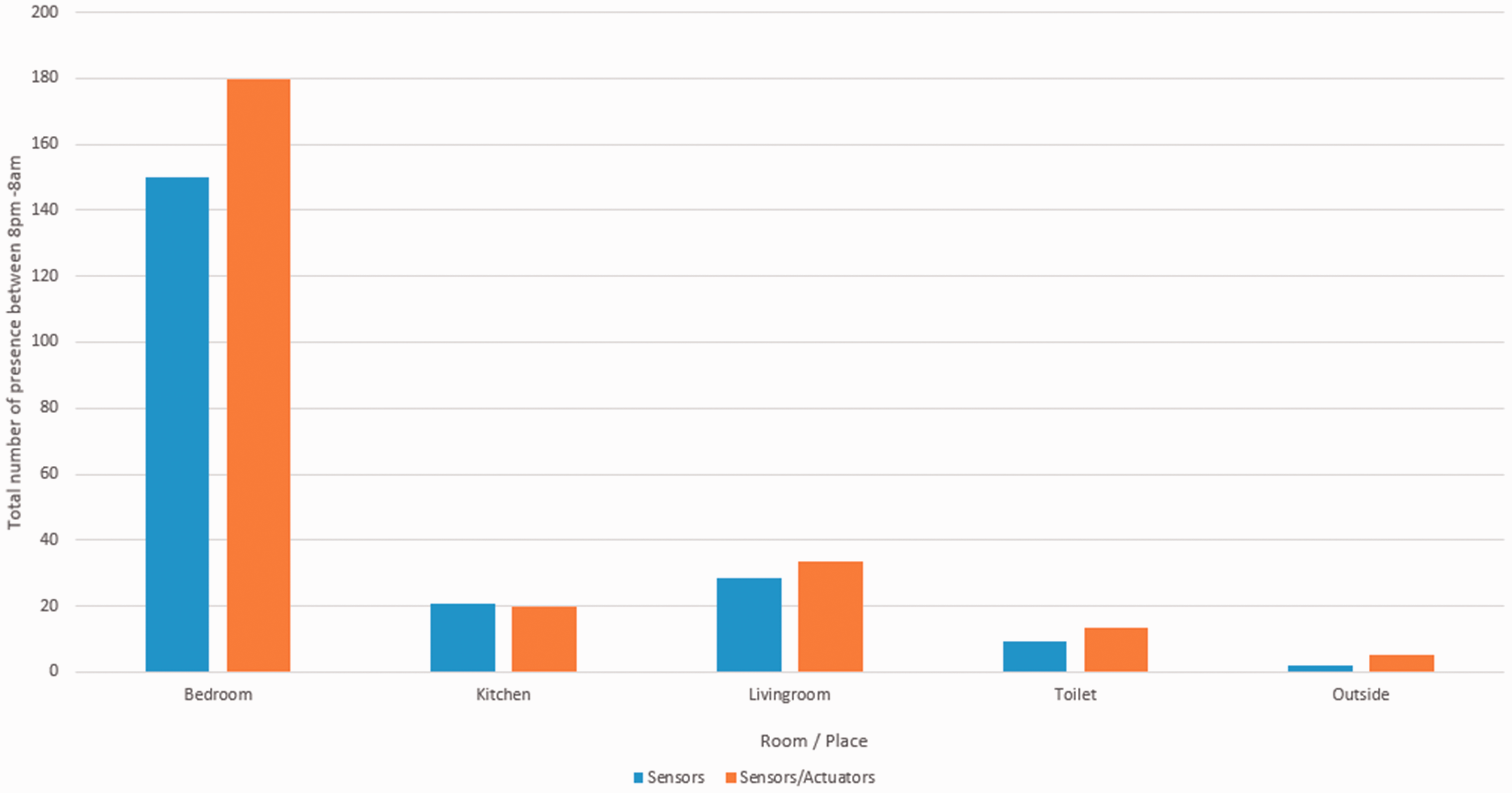
Comparison of activities in rooms between monitoring and assistance phase.
A reminder in the form of light is displayed every 10 min but just when Pauline is more than 25 min outside her bedroom. As shown during the night 23 (Figure 9), she leaves three times her bedroom but none of the actuators has been triggered. This is explained by the fact that she returned to bed before 25 min.

Prompting per bedroom exit and per night.
During the monitoring phase, it turns out that Pauline opened the outside door. Caregivers were concerned because Pauline lives alone in a rural area. We did not know if she was just opening the door to let her cat out or if she was going outside. The management of light being automatic, it seems that Pauline went several times to check that the lights were well extinguished. It then increases the number of times she gets up from the bed. We then decided to display a vocal message every time Pauline opens the door. This message recorded by his daughter urges Pauline to go back to bed. The management of the lights being automatic, it seems that Pauline went several times to check that the lights were well extinguished, hence the increase in the number of lifts. However, the data show that Pauline responds well to her daughter’s message. We chose a voice message to inform Pauline because she used to receive instructions to take her medications by an automatic phone call. It was the user context Layer analysis that also allowed us to identify the use of the voice.
According to the schedule of the experiment, we had two additional days in assistance phase. Mainly, because we wanted to take into account the days for which the sensors fell. This is probably what explains the subtle difference between the more activities in assistance phase in the living room than in monitoring phase as shows in the Figure 9. However, it is normal for bathroom and the outdoors to have more activities. We remember that she goes to the bathroom at least twice a night and that every morning and every evening she has a caregiver who comes to take care of her.
Conclusion
The NAS goals are twofold, monitoring nights of people with Alzheimer and provide environmental cues to encourage restorative sleep by limiting nighttime wandering episodes. NAS is a smart system that delivers vocal messages and visual cues depending on context. It is actually crucial to display assistance just when needed to avoid over stimulation that may disturb the sleep. NAS is then built to infer the appropriate assistance based on contextual analysis.
Home-based experimentation has demonstrated the effectiveness of NAS from a data collection point of view. However, the small amount of data available and the short duration of the experiments were insufficient to allow analysis of the reliability of Pauline’s behavioral change. Collecting information on the behavior of a person with moderate Alzheimer’s dementia has helped the caregiver to get accurate information about the quality of the night of her mother. She discovered the sleep patterns, including the time to sleep, the great overall percentage of quiet nights, and the limited risk of going outside.
The technology installation had an impact on the first nights of the participant. But reassurance by the caregiver and establishing the trust with the research team have rapidly overcome stress. The results show that the assistance is well accepted but further experiments are necessary to assess the impact on senior nights.
The experiment lasts 42 days, 20 days for the monitoring phase, and 22 days for the assistance phase. It turns out that this period is not enough to accurately determine nocturnal behavior and to understand the impact of the assistance on the sleep of the senior. We recommend for the next experiments to conduct at least two months experimentation with more than one month of continuous assistance. We also recommend making sure that the caregiver cooperates during the experiment to overcome misunderstood or stress from the senior.
Footnotes
Declaration of conflicting interests
The author(s) declared no potential conflicts of interest with respect to the research, authorship, or publication of this article.
Funding
The author(s) disclosed receipt of the following financial support for the research, authorship, and/or publication of this article: This work was supported by the AGE-WELL NCE by the work package 3.3 Technology for Supporting Functional Autonomy and Independence (WP3 TECH-FAI) under the project iNnovative Easy Assistance Reassuring System (3.3 b NEARS).
Guarantor
HKN
Contributorship
DL, IV developed the documentation for obtaining the ethical approval and carried out the cognitive tests and the data analysis. HKN, HP, SG researched the literature, conceived the study and design the NAS. HKN wrote the first draft of the manuscript. DL and HP have implemented the experimental protocol. HKN undertook the experiment, the data collection and processing. All authors reviewed and edited the manuscript and approved the final version of the manuscript.
Acknowledgements
The findings within this paper were previously presented at AGE-WELLs 4th Annual Conference, Vancouver 2018. We thank Pauline and her caregiver.
