



Abstract
Introduction
Dementia has become a major global concern and surveillance technology might provide support for informal caregivers and people with dementia. However, the needs of caregivers and people with dementia for surveillance technology have not been reviewed.
Method
A scoping literature review was used to identify the needs of caregivers and/or people with dementia towards surveillance technology. Electronic database searching was undertaken on LexisNexis, PubMed, Scopus, EMBASE, MEDLINE, Cumulative Index to Nursing, Allied Health Literature, PsycINFO, Web of Science, Assistive Technology database, and Google Scholar. Eligible studies were synthesized by theme.
Results
Twenty-eight eligible studies were identified, with the majority reporting the needs of caregivers rather than people with dementia. The predominant themes for caregivers were location accuracy, and increasing the safety of the person with dementia. People with dementia wanted simple useful technology that fits within their capacity and existing routines.
Conclusions
The needs of people with dementia must be considered when designing surveillance products. Studies have mostly focused on caregivers and discount ST product requirements. Further work is required to establish effective use of surveillance technology in dementia care. Therefore, further research should cross analyze these results by examining both the needs of caregivers, and people with dementia.
Introduction
Dementia is recognized as a major global health problem with an aging population and the demand for care is increasing. 1 In 2015, 46.8 million people were estimated to be living with dementia, and estimated costs were $818 billion in the United States.2,3 In Europe, dementia was identified as a societal challenge and the necessity for research on technology-related care was highlighted.4,5 Technology, as part of health care delivery for people living with dementia, is expected to grow in Europe.6,7 In the literature, the focus is on supporting older adults to live independently at home and to delay institutionalization 8 with families using technologies such as surveillance technology (ST) to diminish risks. 9 “Wandering” away from home is considered a major risk in dementia due to the potential adverse consequences such as injury and even death. 10 STs, product devices that monitor movements with the intention of cost-effectively supporting health and independence, 11 are preferable to sedation or incarceration as a strategy for protecting the person with dementia from harm. ST has particular relevance for informal caregivers (hereafter “caregivers”) as products are perceived to increase safety by monitoring a person with dementia such that the caregiver can intervene if necessary. 12
A challenge of reviewing ST is the inconsistent terminology. Surveillance has been classified as: an assistive technology (AT); 13 assisted living technology (ALT); 12 ambient assisted living (AAL); 14 information and communication technology (ICT); 9 or smart home technology (SHT). 15 A second challenge is the range of products that could be considered relevant to surveillance, including: video and audio monitoring products, environmental sensors that alerts (formal) caregivers, tagging systems with wearable transmitters, and global positioning system (GPS) tracking systems. 16 For the purpose of this review, we use the definition of ST as comprising “monitoring systems that can allow for 24-hour supervision by caregivers”, with specific technologies including, but not limited to: monitoring products, personal and social alarms, telecare, electric tagging and tracking, and GPS.9,12,13 A third challenge is the rapid advance of technology and the proliferation of products, with the potential consequence of studies becoming quickly out of date. Design features such as shape, size, buttons, and so on have a powerful influence on whether and how technologies are used. 17 Technological products to support those who wander have been available since the 1980s; 18 however, many ST products available for purchase online continue to be nonpreventative devices, which track but do not send alerts. 19 For example, even in April 2018 only half of the “top 10 lifesaving location devices for dementia” include GPS. 20
Previous research has mainly focused on needs related to the broader category of AT, 21 through focus groups, interviews, questionnaires, and ethnographic studies. 15 Such studies are challenging to synthesize due to different data collection instruments, inconsistencies, or criteria used. 22 Robinson et al. 13 conducted focus groups in which they describe both the perspectives from people with dementia and caregivers towards technology. Results showed that caregivers had a great interest for the use of trackers. Yet people with dementia had concerns over caregiver surveillance (i.e. big brother is watching). 13 Later McCabe and Innes, 23 examined the perspectives from older adults, caregivers, and people with dementia through focus groups. All participants thought that a discreet GPS product would be useful and outweighed ethical and privacy concerns. McCabe and Innes 23 found differences between focus groups and stresses the importance of developing technologies that can be adapted for individual users. Indeed, a review of unmet needs from caregivers and people with dementia showed that “ICT” should be personalized to fit the needs and capacities of those involved. 24 For products to be successful, the needs from those who might use them have to be included. 23 However, few studies have explored the needs of caregivers and people with dementia, and failed to address implications for ST development.23,25,26
There is a knowledge gap of needs listed in such a manner that it can be used by designers for product development. Therefore, this review is based on the assumption that a closer investigation of caregivers and people with dementia ST needs might shed new light on technology design and development. Following this line of enquiry, this study aims to outline the different needs of caregivers and people with dementia towards STs, within a scoping context. In particular, the study examines (1) the nature of use of STs by caregivers and people with dementia, (2) and ST design needs among caregivers and people with dementia.
Method
An iterative scoping literature review was employed, 27 to map out the state of published knowledge concerning the needs of caregivers and people with dementia towards various ST. The scoping review consisted (1) a literature search (2) selection of eligible literature through application of pre-defined eligibility criteria (3) data synthesis through thematic analysis.
Search selection and strategy
Search terms.

AT: assistive technology; ALT: assisted living technology; AAL: ambient assisted living; ICT: information and communication technology; SHT: smart home technology.
Eligibility criteria.

ST: surveillance technology.
Following the initial search, the search terms were validated through discussions with 15 researchers from the Interdisciplinary Network for Dementia Using Current Technology (INDUCT) at the winter school in Germany (January, 2017). Additional keywords were recommended. These keywords are shown in Table 1 by the Boolean operators AND/OR. To further facilitate the search, Boolean operators between each of the keywords has been applied.
The search strategy was repeated in January 2017 using the re-defined search terms. The searches initially resulted in 135 publications and websites. The search was updates by adding studies found by google alerts only in January 2018. After the exclusion criteria in January 2018, an “AT” report was circulated to the main researcher, which led to the identification of four additional studies. Twenty-eight studies were included in the final review.
Synthesis strategy
All eligible studies were read in detail and field notes were placed in the data set by the first author. Data on requirement specification in relation to users’ needs were extracted. A categorization of features was developed (Table 3) through an iterative process of applying the categorization to each successive study, adding and collapsing feature descriptions and the constituent items. Features and items were tabulated for each study, and described narratively. Feature and item categorization was discussed with the two other authors and further refined.
Flow diagram showing selection of studies. Themes of features and items.

Results
Of the Twenty-eight included studies, the majority are from the United Kingdom (N = 10) and the United States (N = 7) with a minority in the Netherlands (N = 3), Canada (N = 3), and Germany (N = 2). Individual studies collected data in Sweden, Ireland, Scotland, France, Norway, Spain, and Israel. Sample sizes range from single cases to 208 carer dyads. Most studies are qualitative, using interview or focus group methodologies with four studies reporting results from questionnaires.
Thematic results of user perspectives on surveillance technologies.
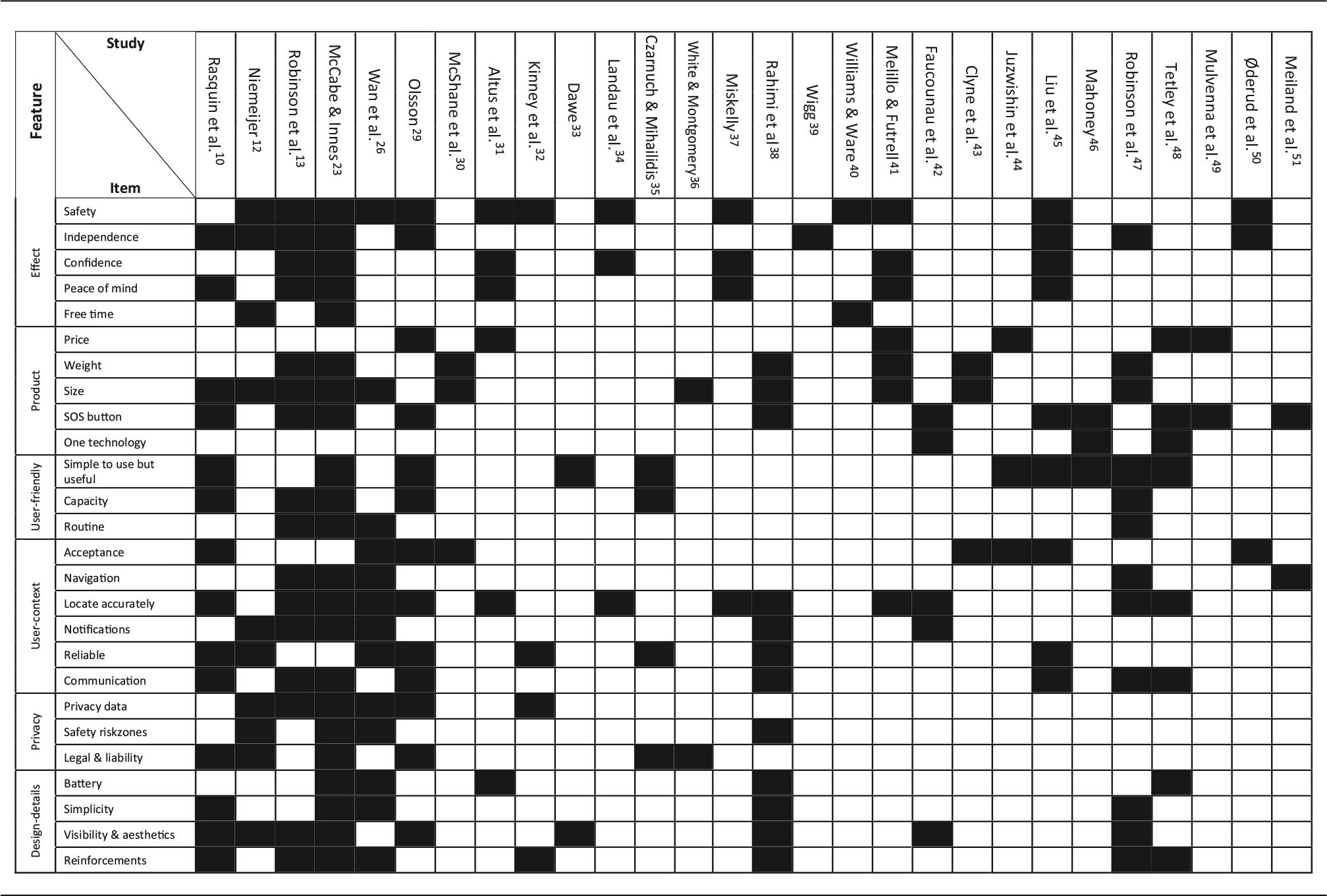

Effect
Sixteen of the 28 studies considered the effect or impact of surveillance technologies on the carer or person with dementia, for example increased confidence and peace of mind. ST was seen as increasing autonomy and independence for people with dementia, and reducing caregiver burden.26,50 However, benefits were often associated with risks or drawbacks. For example, one study described how people with dementia used ST and could walk around freely, but caregivers want to know their location constantly, or even prevent them from walking again thus restricting autonomy. 12 People with dementia commonly expressed the need to be able to walk outside independently13,23,39,45,47 but were aware of limitations, for example that monitoring restricts their freedom and that there are risks associated with carrying a product that could get stolen.13,23 In addition, caregivers pointed out that they often lack time and need ST that gives them more free time, or diminishes the time required to do a certain activity. 40 Unfortunately, using ST might actually be time-consuming, especially when false alarms happen. 12 Caregivers expressed the view that ST use would result in greater confidence and peace of mind if they could rapidly locate a lost person.13,45 However, it is of concern that caregivers may be falsely reassured by the technology. To quote Landau et al. 34 “The major benefit [to caregivers] seemed to be their perception that tracking would control wandering and prevent their relative from getting lost or harmed in any way (emphasis added)”.
Product characteristics
Price
Both caregivers and people with dementia associated ST with a “high cost”. 49 When caregivers identified problems for using ST, costs was one of them; yet they were willing to pay for it.31,41 Given the international spread, studies took place within different funding contexts. In Sweden, for example, the municipality would not pay for ST. 29 However, in one study the majority of participants thought the government should pay for ST. 44 It is a challenge for caregivers and people with dementia to decide what the best cost option is for ST in their situation. 48 The amount that consumers are willing to pay for ST remains unclear as numbers differ per product and there are other options to consider (e.g. purchase, rent, lease). 44 In one Canadian example published in 2015, one caregiver was willing to pay around 100 dollars, another thought 17 dollars per year was acceptable for an emergency phone whereas a third found a fee of 15 dollars a month was reasonable for multiple smart technologies that monitor. 44
Size and weight
Early studies reported that caregivers thought the ST receiver was too large for easy use 30 with caregivers and people with dementia concerned that products would be left at home due to their size and weight. 47 Recent studies found that caregivers want something similar sized to a wristband or a watch.23,26 Some caregivers prefer smaller products to enable covert use ST on people with dementia;36,43 however, this raises the ethical debate on covert surveillance as the smaller the product, the larger the involuntary compliance by people with dementia, as it is difficult to know if ST is being used on them. 12
SOS-button
People with dementia described how they need help in case there is an emergency.23,51 Hence, a considerable amount of literature is about pendant alarms, emergency buttons, or sometimes referred to as products with SOS-buttons. However, in one study a person with dementia worried the SOS-button may be pressed in error triggering a false alarm. 13 People with dementia do not want to have too many buttons involved due to the new learning required and the risk of accidental activation. 48 A caregiver explained that the person with dementia did not understand such buttons and sometimes activated it by mistake. 48 Accordingly, caregivers have expressed concerns about receiving too many alerts, 46 and that false alerts should be minimized.42,45,48 Consequently, both need a large-enough recognizable SOS-button to press in an emergency. 45 There was a lack of consensus over ideal design with caregivers in one study advised that designs should incorporate only a single SOS-button with a protective case, 38 whereas caregivers in another study wanted three buttons, and the person with dementia one. 10
One technology
Caregivers were concerned of having to use too many components also termed “technologies”.46,48 For example, when there is a charger attached to a watch it could be easily detached and become lost or forgotten to bring along. 48 Another example is where the caregiver had a mobile phone to track; but, the person with dementia forgot to carry the tracker. 42
User-friendly
Simple to use but useful
The use of ST by caregivers and people with dementia has been studied by several authors. 23 Caregivers and people with dementia need a product that is simple but useful.10,44,45,48 People with dementia stress the importance of a “simple to use” ST.23,47,51 Caregivers argued that a product should be intuitively simple to use, require little skill, with manuals or technical support provided in order to learn how to use it.46,52 By contrast, other caregivers thought that a manual would be too difficult to understand. 29 ST is perceived as useful when caregivers and people with dementia encourage each other, have low anxiety and a high level of acceptance for using such products. 44 In terms of social context, caregivers and people with dementia would use ST for the others’ peace of mind or safety. 45 Within such context, their mutual perceived usefulness of, and intention to use ST is positively influenced. 45
Capacity
There seems to be an ambiguous relationship between technology that is simple to use and user’s capacity. Especially ST should be flexible in use as the disease progresses.13,47 Each individual has different skills, sensory abilities and experiences with, and attitude towards technology and, consequently, caregivers need ST to be adaptable to individual needs.29,52 Further, caregivers thought gender, age, and the stage of the disease would influence the ST usage. 29 Nevertheless, caregivers often described that the person with dementia would not be able to understand using ST.10,29 If ST is too complex and does not fit individual capacity, it is less likely to be routinely used in daily life by people with dementia. 47
Routine
Caregivers and people with dementia need ST to fit within their routines, and be easily integrated into day to day tasks.13,26,47 People with dementia routinely use ST more if it fits within activities such as walking and washing.13,26,47 However, if a person with dementia has to use ST but never has used it before, it will eventually be disposed. 47
User-context
Acceptance
Some caregivers expressed concern about the attitude from a person with dementia towards a passive alarm, yet thought the person would accept it. 29 Therefore, caregivers need ST to be a familiar product as they feared that otherwise the person would not accept the product. 26 Seeing that people with dementia who have unknown products attached to them would sometimes remove them. 30 Another important consideration for acceptance is performance expectancy and whether caregivers and people with dementia perceive ST as useful. 45 A study found that people with dementia were encouraged to use ST by their caregiver for reasons of peace of mind and decreasing caregiver burden. 44 Also, people with dementia stated they carried the ST, not because they need it, but in case the caregiver wanted to locate them for safety reasons. 50
Navigation
Some caregivers and people with dementia expressed the need for indoor navigation and prefer the functionality of having outdoor navigation with movement sensors.26,51 For example, one person with dementia described wanting a large navigation screen similar to TomTom. 23 Navigation is needed as people with dementia want keywords to support them to go back or guide them home.13,26,47,51
Locate accurately
A predominant theme for caregivers is the need to locate accurately. Caregivers need accessible ST that locates those who wander quickly and accurately.26,31,37,41,48 For example, caregivers considered locating someone within 10 m as inaccurate. 10 Accuracy can be achieved by showing the exact street in a rural area, 48 or a common travelling route, or a history of routes which can identify and predict the person with dementia’s location.26,38 Further, ST should; monitor health and safety status; provide actual reporting life (i.e. the amount of real time location is updated); be accessible and quick, back-up data; connect to an app or support platform; support cooperative monitoring (i.e. system that supports access, communication, and coordination between professionals).26,31,37,41 Some caregivers want actual reporting life to be accessible without the internet. 42 Internet was often ruled out because participants described they did not know how to use it. 23
Notifications
More modern designs incorporate “geo-fencing”, where a safety area is set up using GPS so that when the person with dementia leaves this area, the caregiver receives a notification. 12 In this case, caregivers expressed they need the option to choose between displaying or concealing the real-time location of the person, and be able to set the tracker so that it automatically or manually provides updates (e.g. tracking or polling mode). 26 This option is important as caregivers experienced that continuous display of location and receiving notifications drained the battery. 42 Some caregivers expressed they need to receive a loud alarm in case of an emergency. 38 In contrast, people with dementia expressed concern that receiving notification noises from ST in public would be embarrassing. 13
Reliable
Notably caregivers expressed they did not trust ST and the notifications they received, and thought the ideal product should be reliable for them and the person with dementia.12,26,45 A caregiver explained that one provider sold a ST with technical problems and consequently the person with dementia could not be found. 29 Reliability also entailed that ST would have a system that works, functioning is guaranteed, and is 99.9% reliable. 12 In addition, caregivers need waterproof and shock-resistant ST. 38 Similarly, caregivers expressed their need for ST that loads with speed and a minimum of technical problems.26,32,52
Communication
Studies have revealed that caregivers and people with dementia expressed the need to be able to communicate through ST.13,45,47 One study tested GPS and global communication system products with caregivers and people with dementia. 47 Results showed that both want a two-way communication. Interestingly, one person with dementia expressed the desire to talk quietly to the technology. 47 However, another study found that a person with dementia was unable to use the buttons in order to communicate. 48
Privacy
Privacy data
Much ethical debate from professionals is about the need for a product that does not invade privacy. 23 This debate, however, lacks the perspectives and experiences of caregivers and people with dementia. People with dementia subject to ST are the ones who may have to scarify autonomy or privacy for safety. 12 In theory, ST should be able to increase safety and maintain autonomy or privacy simultaneously. 26 In practice, however, people that wear ST could feel embarrassed and uncomfortable as the caregiver would know their exact location. 12 One argument is that caregivers should be respectful and diligent about this by not filming toileting behavior or making pictures.12,32 Yet, compared to formal caregivers, those who care for person with dementia, cohabiting or otherwise, are more likely to accept filming in the home. 43 Indeed, some caregivers were excited about placing cameras in the home and receiving images from ST when the family member with dementia would wander, 32 whilst spouses found it important to involve the person dementia in the decision making of using ST. 29 Furthermore, placing a camera in the home may lead to other concerns, for example other family members being able to log onto the website and receive the data. 29
Safety zones
With privacy there are other concerns about who has access to ST data, especially with design considerations such as; reporting life, backup of data, or if the product is connected to a monitoring app or support platform (i.e. third party that has access such as an alarm center).12,26 In one study, participants expressed the view that immediate family members should be the first to respond, whilst others argued this should be done by an alarm center. 23 Furthermore, ST with geo-fencing collects data about a person’s location. 26 Therefore, ST should have a fine-grained adjustability of privacy and safety settings, which provides the user to suit the technology to their needs.12,26 For example, one study provided the option for users to involve an alarm center. 38
Legal and liability
Some studies pose the question if using ST would result in legal or liability issues. 12 One conclusion is that unobtrusive ST should not undermine individual autonomy, control, dignity, or privacy. 12 In one study, caregivers preferred technologies that were autonomous and unobtrusive. 52 Although this might be true, other caregivers would sometimes disguise, or hide the small ST without consent inside the pocket of the person with dementia.12,23,36 Therefore, one study posed the question of who is authorized to know the location of the person with dementia. 10
Design details
Battery
Caregivers and people with dementia require ST with long battery-life including display of remaining duration and receive notifications when the battery is running low,23,26,31 for example, a lithium ion battery. 38 Caregivers experienced difficulties when a product shut down at times of need. They want a long battery life to avoid constant charging or change of battery. Further, some thought a charger should be anchored to the product to prevent detachment. 48
Simplicity
A predominant theme found for people with dementia was the need of simplicity. One study with the focus on “AT” adoption by caregivers and young adults with cognitive disabilities including dementia, reported the need for designers to consider the multiple individuals and stages involved in the technology adoption process. 33 Simplicity should be embedded in the design, configuration, documentation, maintenance, upgrade, or replacement. 33 Another designed ST with options for “starters” and “experts”. 26 The starter sees a design with reduced settings to “start” using the product easily and intuitively with basic tailorability, and the expert sees all settings that can be tailored to their needs. The switch between these options should be easily accessible.19,26 This study concluded that a design should have a small screen, and a configuration process with few buttons and manageable functions.26,33 Somewhat different from a study were caregivers needed a large screen with a reduced menu style, so that one does not get lost within the product. 38 Another study found that people with dementia, liked the iPod Nano as it was simple and the external design was aesthetically pleasing. 47
Visibility and aesthetics
In one study, some participants would feel embarrassed by using ST, whilst others were more open about it. 23 Studies found that ST should be attractive because people with dementia who found a certain product ugly would not wear it.42,47 Caregivers did not like ugly products either as they were then looking for the removed product. 42 People with dementia need a small familiar looking ST so that it is discrete and less stigmatizing ST.23,47 Feelings of stigmatization occur when the person with dementia visibly wears ST; for example electronic bracelets on the body. 12 In an earlier study, two persons with dementia expressed they would want to carry an identity card as they were used to it. 13 For the same reason, in a later study, participants expressed they would prefer pendant alarms. 23 Colour might also be important, as for example, one man was strongly against pink. 23
Reinforcements
Caregivers want reinforcements that are flexible in use and can be added to or remove from a product.26,47 For example, ST should have an expandable strap that could be taken on and off, because when the illness progresses the person with dementia might forget to wear ST.13,47,48 Much literature describes how ST should be fixed to the person with dementia. 10 However, in another study participants had no clear answer to whether or not ST should be flexible or fixed to the body. 23
Discussion
This study sought to bring together the needs from caregivers and those living with dementia as identified in literature about ST. The research conducted in this area remains predominantly qualitative, with the majority reporting on the needs from caregivers. However, the voice of the person with dementia is gaining presence in more recent studies, and differences in perspective are being revealed. Problems arise when the voices of people with dementia are excluded 53 as people with dementia want to influence products, services and policies that affect their lives. 54
Many of the identified studies reported the effect of safety, independence, and peace of mind. Safety is often highlighted by describing “wandering behavior” where a person with dementia walks aimlessly or attempts to leave the house. 55 This fear of a person with dementia getting lost might lead to people becoming scared of wandering.56,57 However, “walking out of the house” may not be “aimless wandering”, 56 but healthy and meaningful exercise or activity.50,57 There appears to be an ongoing conflict between caregivers and people with dementia perspectives of “wandering” and the need for ST to increase safety and independence.13,47 Further, the large debate about privacy is mostly from the perspectives of professionals. 23 Other literature does suggest that caregivers need fine-grained privacy settings. 58 However, privacy settings are not a consideration in a recent list of top 10 location devices for dementia. 20
Findings suggest that safety is relevant in multiple features, and often depends on the user-context and user-friendliness. Caregivers were concerned if the person with dementia would accept and know how to use ST. Taking an example from the “top 10” list, PocketFinder features a user-friendly app and a long battery life, which would fit with the needs identified in this review. However, SOS-buttons are redundant when they are unreliable and/or the person cannot use it. Consequently, four out of the top 10 ST for dementia (including the PocketFinder) may rely on irrelevant features perhaps because usefulness to the person with dementia is not fully considered by designers.
The findings also suggest that higher levels of acceptance can be accomplished by ensuring that ST are experienced as “useful”, that is when the functionality of the product can do what is needed and the users are able to access that functionality. 59 This study also highlighted that the perception of usefulness can be influenced by the social context in which ST would be used. However, current findings about how well people with dementia can use ST mainly stems from caregiver perspectives. Few studies report that people with dementia need navigation that provides them with directions and the ability to communicate. The feature of navigation, for example people with dementia using ST to navigate their walking route, was not mentioned in the top 10 ST for dementia.
The largest amount of information on needs expressed by people with dementia concerned the feature “user-friendly”. People with dementia need ST to be simple to use and useful. This coexisted with another predominant theme found for people with dementia, namely, the need for simplicity of design details. Simplicity might also contribute to an increased perception of ST as useful, which, as mentioned above, will likely lead to people with dementia accepting and using ST. Overall, the reoccurring coexistence of needs often stems from two pertinent needs of safety and simplicity. This might explain why caregivers customize technology by adapting or combining new products or parts with technologies already in the home or affordable outside. 60 For example, one caregiver attached a child-lock to the door alarm was because they were afraid that the person with dementia would continue to leave the house at night. 29 In other words, the door alarm did not meet the needs of safety and simplicity. However when caregivers do this “tinkering” to adapt products to their changing needs, it might again result in a mismatch amidst applicability and capacity. 17
Strengths and limitations
The review presented here used a transparent and rigorous scoping process to identify relevant literature that was not limited to any specific evaluative design or to peer-reviewed papers. The keywords for searching the databases were developed and refined over the years of searching, but some key studies were only identified through personal contacts, indicating the challenges of searching for this topic. The source literature is limited by small sample sizes, and the predominant focus on caregivers. The benefits of this inclusive nature of a scoping review 61 highlights the importance of covering practical, ethical, design, and usefulness findings from various interdisciplinary studies. This method has enabled the production of a roadmap for further investigation of needs towards technology design that stresses the importance of including the voices from people with dementia.
Implications
Designers face a challenge when considering conflicting needs translated into ST design. However, from a human–computer interaction view it is not only designers who need to acknowledge user-needs in ST. More attention needs to be paid to the practices of users, industry and academia partners and in the ways in which they interact, which can benefit the evolution of a design solutions. 26 Nonetheless, improved designs will not be found and not used if older versions such as the “top 10 life saving devices” are the first ST consumers find when searching online.
A recent systematic review of AT for memory support in dementia conducted searches in databases such as the HCI bibliography and human–computer interaction resources.62 Future searches should include broader databases and keywords such as “wayfinding” and “safer walking technologies”. Furthermore, whilst ST is preferred over strategies such as locking doors and medication, relying on “not so useful” technology means that technology will continue to fail as a solution for dementia care. As many have previously argued, technology should not be a substitute for care. One implication is the continuation of conflicting needs between caregivers and people with dementia, and that currently provided technology may not be considered useful. The findings also lead us to believe that current research practices will continue to produce the same results if we do not consider individuality. Future research should concentrate on individuality and conflicting needs in different countries. In addition, there is a need to further investigate the technologies available on the market and compare them with the ones found in the literature. Finally, although there is a need for small sized ST, this does not necessarily mean designers should develop products, which can be covertly used. Rather, it shows the continuous ethical debate and stigmatization that could occur when people with dementia wear ST.
Conclusions
The needs of people with dementia must be considered when designing surveillance products. Previous studies have mostly focused on caregivers, and do not go in-depth into ST product requirements. Further work is required to establish effective support to technology development, intervention projects, services, and dementia care. Therefore, further research should cross analyze these results by separately examining both the needs of caregivers, and people with dementia.
Footnotes
Declaration of conflicting interests
The author(s) declared no potential conflicts of interest with respect to the research, authorship, and/or publication of this article.
Funding
The author(s) disclosed receipt of the following financial support for the research, authorship, and/or publication of this article: The research presented in this report/paper/deliverable was carried out as part of the Marie Curie Innovative Training Network (ITN) action, H2020-MSCA-ITN-2015, under grant agreement number 676265.
Guarantor
YV
Contributorship
All authors contributed to the conception and design of this review. YV developed the search strategy, performed the searches and drafted the manuscript. PH and GC contributed to the development and refinement of themes and contributed to the manuscript. All authors approved the final paper.
Acknowledgements
The authors would like to thank the researchers from the Interdisciplinary Network for Dementia Using Current Technology (INDUCT) for their kindness and helpfulness in providing the information used in this work.