




Abstract
Introduction
Asymmetrical limb loading is believed to cause health problems for lower limb amputees and is exacerbated when walking on slopes. Hydraulically damped ankle-feet improve ground compliance on slopes compared to conventional prosthetic feet. Microprocessor-controlled hydraulic ankle-feet provide further adaptation by dynamically adjusting viscoelastic damping properties.
Method
Using a case series design, gait analysis was performed with four trans-tibial amputees. There were two walking conditions (ramp ascent and descent) and two prosthetic foot conditions (microprocessor-control on and off – MPF-on and MPF-off). Total support moment integral (
Results
During ramp descent, the transition of prosthetic ankle moment from dorsiflexion to plantarflexion occurred earlier in stance phase with MPF-on, slowing the angular velocity of the shank. During ramp ascent, the MPF-on dorsiflexion/plantarflexion moment transition occurred later, meaning less resistance to shank rotation in early stance and increasing walking speed by up to 6%. For both slope conditions, sound limb
Discussion
Microprocessor-control of hydraulic ankle-feet reduced the total loading of the sound limb joints, for both walking conditions, for all participants. This may have beneficial consequences for long-term joint health and walking efficiency.
Introduction
Lower limb amputees are known to be particularly susceptible to developing osteoarthritis in the joints of their sound limb.1–4 While the exact epidemiology varies by age, weight, amputation level, and specific joints, studies show that it is approximately two to three times greater than the rate of occurrence in the general population.1–4 In addition, the bone and muscle of the residual limb is at risk of disuse atrophy. Past research has shown consistently that amputees exhibit high rates (over 88%) of osteoporosis and/or osteopenia in the residual limb bones.1,2,5,6
It is generally believed that both of these conditions occur due to asymmetrical loading during walking and other daily activities.2,4–8 An increased reliance on the sound limb develops due to greater limb control ability and proprioception, leading to greater mechanical loading on the joints in this leg. Equally, Wolff's Law asserts that bone will adapt to the loads which are applied, meaning that when the load on the residual side is reduced, over time, the bone will remodel with lower bone density and structural strength. This may lead to a heightened risk of fracture for the affected bones, which would result in a substantial loss of independence for the amputee. 8
Consequently, in the prosthetics field, there is interest in quantifying the kinetic asymmetry between the prosthetic and sound limbs,9,10 and is often used to justify the benefits of a prosthetic intervention.11,12 One such parameter is the ‘degree-of-asymmetry’ (DOA),
10
defined by equation (1), where Sound and Prosthetic refer to the value of a given biomechanical parameter on the sound and prosthetic limbs, respectively. A positive value shows that the measurement was larger for the sound limb; a negative value means it was greater on the prosthetic limb and a value of zero indicates perfect symmetry between the limbs.

Clearly, the DOA and any improvements attributed to a prosthetic intervention are dependent upon which biomechanical measure is used as the input. Winter
13
proposed that kinetic analysis was most informative, with kinematic measurements only showing the final outcome of these underlying forces and moments. Indeed, the same movement can be achieved by different combinations of joint moments.
13
Furthermore, he proposed the calculation of a support moment (

Inter-limb asymmetry and joint moment deviations are particularly apparent for amputees when walking on sloped and uneven surfaces.15,16 One possible contributing factor could be that common prosthetic feet lack the articulation required at the ankle and instead rely on the deformation of spring-like components of the foot itself to mimic dorsiflexion and plantarflexion. More recent innovations have seen the addition of a hydraulic, articulating ankle joint, to allow a degree of damped joint movement in combination with spring deformation. The resulting viscoelastic behaviour has been shown to allow better compliance and reduction of socket interface loads 17 when standing and walking on ramped surfaces, with fewer kinematic compensations, compared to conventional, energy-storage-and-return (ESR) feet. 18 In terms of loading, hydraulic ankle-feet reduce asymmetry on level19,20 and uneven 20 walking surfaces.
Further adaptations to level and ramped surfaces can be achieved with the addition of microprocessor-control, affecting the hydraulic damping resistances.21,22 During ramp descent, a microprocessor ankle-foot (MPF) slows the rate of momentum build up by inhibiting/resisting shank forwards rotation and requires fewer compensatory movements, compared to both a passive hydraulic ankle-foot and a conventional ESR foot. 21 However, the existing body of research lacks studies relating to the effect of MPF on amputee gait kinetics, which is important considering the high incidence of osteoarthritis among amputee population.
To address this need, this research performs a kinetic analysis of an MPF during ramp descent and ascent, in two walking conditions; with microprocessor-control active (MPF-on) and with microprocessor-control deactivated (MPF-off), it behaves as a fully passive hydraulic ankle-foot. Of particular focus was the change to the prosthetic ‘ankle’ moment and how this influenced
Methods
Prosthetic foot
For this research, the tested ankle-foot was the Elan I (Chas A. Blatchford & Sons Ltd, Hampshire, UK). This device is a hydraulic ankle design with independent microprocessor-controlled damping for dorsiflexion and plantarflexion. The spring selection and hydraulic system is selected according to the user's weight and activity level. Internal microprocessor-control automatically adjusts the damping resistance of the ankle joint movements in order to provide more or less resistance to movement in each direction, depending upon the requirements of the user and walking activity. The reason it was selected for this work was its adaptations to ramp walking. Elan adapts to downhill walking by decreasing the hydraulic resistance to plantarflexion and increasing the resistance to dorsiflexion. These changes are intended to provide an added braking effect to shank forwards rotation, better controlling the build-up of momentum when walking downhill. Equally, when walking uphill, the resistance to plantarflexion increases and the resistance to dorsiflexion decreases; this is intended to provide assistance with forwards movements in the direction of progression.
Participants
Characteristics of the participants.

When the Elan prosthesis is set up for each user, a preferred hydraulic resistance level is selected by the prosthetist for normal level ground walking; the degree to which the hydraulic damping changes for each ramp condition is relative to the preferred level ground hydraulic resistance settings. Since these values for each of the settings were individually selected for each user, their effects were anticipated to vary. Consequently, a case series study design was selected to investigate the biomechanical changes observed for each participant individually.
Gait lab setup
The gait data collection was conducted in a conventional gait laboratory (Codamotion, Charnwood Dynamics, Leicestershire, UK), which consisted of active marker clusters, two three-dimensional infra-red cameras and a single force plate (Kistler Group, Winterthur, Switzerland). The cameras collected data at a frequency of 200 Hz, while the force plate acquisition frequency was 500 Hz. A conventional six-degree-of-freedom (6DoF) marker model was used to track body segment movements and to define the locations of virtual markers. 23 The virtual markers for the malleoli, on the prosthetic side, were defined as the lateral and medial pivots of the hydraulic body of the prosthetic ankle-foot.
Data collection
During the data collection sessions, the participants were asked to wear Lycra shorts and a tight fitting t-shirt to minimise marker movement-related mounting artefacts and minimise occlusions due to loose clothing. Each participant wore his own shoes, which were standard sports trainers. The gait lab walkway was a ramp approximately 8 m in length, at an angle of 5° to the floor. Approximately halfway along the length of the ramp, the force plate was integrated into the walkway, so that its top surface was flush with that of the surrounding walking surface.
In order to eliminate variation due to alignment changes and gait marker position, a single Elan was used for all gait trials. To mimic the effect of a fully passive hydraulic ankle, the microprocessor-control was switched off (MPF-off). This meant that the plantarflexion and dorsiflexion damping settings remained at the selected setting deemed optimal for that user, during level walking. When the microprocessor-control was switched on (MPF-on), the ‘brake’ and ‘assist’ settings would activate for ramp descent and ascent, respectively.
The combination of two different foot settings and two walking directions generated four test conditions. The order in which these test conditions were performed was randomised for each participant. At the beginning of each new test condition, the participants were given a period of 30 min to acclimatise to the foot setting and the ramp, performing at least five practice runs until they were confident to proceed with data collection. As well as participant feedback, a senior prosthetist was present and data collection for each given test condition would only continue once he was also satisfied that the participant could safely complete the protocol. This method of acclimatisation was deemed adequate since all participants had prior experience using both passive and microprocessor-controlled hydraulic ankle-feet. For each test condition, participants were asked to walk along the walkway at a comfortable, self-selected speed. Gait trials were repeated until each participant had achieved at least six ‘clean’ trials on each of the left and right limbs, which were used for analysis. A ‘clean’ trial was defined as one where the entire footprint of the measured foot was within the perimeter of the force plate. Additionally, trials where the participants deliberately adjusted their gait in order to contact the force plate with the correct foot (e.g. shortened step lengths) were rejected.
Data processing and analysis
Since prosthetic ankle adaptation largely affects the stance phase of gait, the analysis focused on limb and joint kinetics throughout the stance phase. Furthermore, all kinetic parameters were normalised by both the participants' mass and walking speed, a technique that has been previously applied in literature 19 to account for speed-related influences that directly affect the loading of joints.
It was anticipated that the hydraulic damping adaptation would not only influence the magnitude of moments at the joints, but would also have temporal effects. Consequently, the integrals of the moment curves (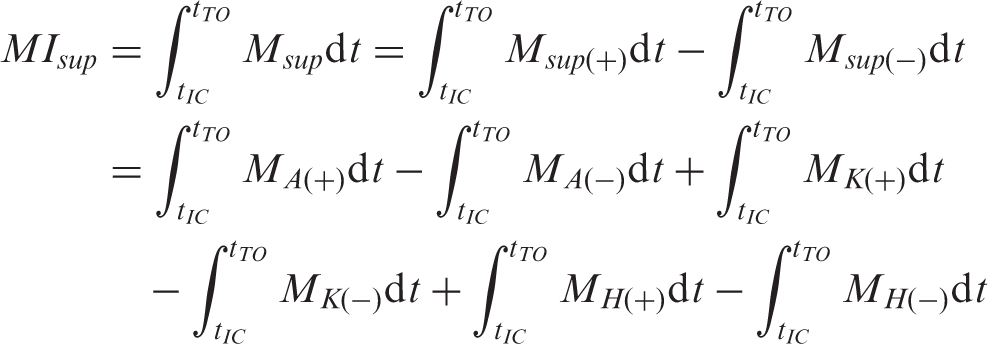

In the original support moment calculation (equation 2), the constituent moments for the individual joints have defined positive and negative directions.13,14 As a result, in order for the constituent moment integrals to determine
Statistical analysis
Shapiro-Wilk tests were used to investigate the normality of the data and paired t-tests were employed to identify statistically significant differences between the prosthetic interventions for each participant. Additionally, effect size differences were calculated to equate the changes between foot conditions. An effect size where Cohen's
The statistical analyses were applied to comparisons between
Results
Ramp descent
Figure 1 illustrates the mean prosthetic/residual joint moment curves over stance phase during ramp descent, for each participant, for both of the MPF-off and MPF-on conditions. The largest changes were observed at the prosthetic ankle joint (Figure 1, bottom row). Although the peak dorsiflexion and peak plantarflexion moments were approximately the same for both prosthetic feet conditions, the transition from dorsiflexion to plantarflexion moment occurred at approximately 10–20% of stance with the MPF-on, compared to approximately 20–26% of stance with the MPF-off. This led to a general trend of a lower mean The mean curves for prosthetic/residual support moment (top row), hip moment (second row), knee moment (third row) and ankle moment (bottom row), when microprocessor-control was active (MPF-on – solid line) and inactive (MPF-off – dashed line) for TT1, TT2, TT3 and TT4 during ramp descent. The shaded areas under the curves illustrate the positive and negative integrals for each joint, and their resultants as the support moment integrals, for each of the MPF-off (striped area) and MPF-on (filled area) conditions.
Figure 2(a) shows the net (a) The net support moment integrals for the prosthetic (black) and sound (grey) limbs of each participant during ramp descent, for both MPF-off(striped) and MPF-on (solid) foot conditions. The white triangle of the annotation indicates a statistically significant change (p < 0.05) and the black triangle indicates a ‘medium’ effect size change (
For TT1, the net
Other gait parameters were calculated for the purposes of comparison with a previous, similar study
21
in which a passive hydraulic ankle-foot was compared to a microprocessor hydraulic during ramp descent. Time to foot flat (TTFF) after initial contact was found to decrease by Struchkov and Buckley
21
when a microprocessor ankle-foot was compared to non-microprocessor ankle-feet. Of the participants in this study, all four showed a reduced mean TTFF, three of which were significant changes (p < 0.001 for TT1, TT2 and TT4). Furthermore, Struchkov and Buckley
21
observed that with the ‘braking’ effect of the MPF, the mean angular velocity of the shank was reduced during the single support period of gait. The same effect was observed for all participants in this study, of which two were statistically significant (TT1 p = 0.003; TT2 p = 0.005), and three presented an effect size of ‘medium’ or larger (TT1
Ramp ascent
Figure 3 illustrates the mean prosthetic/residual joint moment curves over stance phase during ramp ascent, for each participant, for both of the MPF-off and MPF-on conditions. Also shown are the changes to The mean curves for prosthetic/residual support moment (top row), hip moment (second row), knee moment (third row) and ankle moment (bottom row), when microprocessor-control was active (MPF-on – solid line) and inactive (MPF-off – dashed line) for TT1, TT2, TT3 and TT4 during ramp ascent. The shaded areas under the curves illustrate the positive and negative integrals for each joint, and their resultants as the support moment integrals, for each of the MPF-off (striped area) and MPF-on (filled area) conditions.
The effect of the microprocessor-control was most apparent at the ankle. As was observed during ramp descent, the peak dorsiflexion and plantarflexion moments were very close but there was a distinction difference in the timing of the transition between dorsiflexion moment and plantarflexion moment. This time, for ramp ascent, the transition tended to occur slightly later for the MPF-on (25–33% of stance phase), compared to the MPF-off (25–27% of stance phase). The one exception was TT3, who presented no dorsiflexion moment with either prosthetic condition. The rate of increase of plantarflexion moment in early stance was higher for the MPF-off condition.
These changes meant that there was a tendency for
Figure 4(a) shows the net (a) The net support moment integrals for the prosthetic (black) and sound (grey) limbs of each participant during ramp ascent, for both MPF-off (striped) and MPF-on (solid) foot conditions. The white triangle of the annotation indicates a statistically significant change (p < 0.05) and the black triangle indicates a ‘medium’ effect size change (
For all participants, the
On the prosthetic side,
To further investigate the causes of this change in behaviour, Figure 5 shows the The positive and negative moment integrals by joint and for the prosthetic support moment during ramp ascent for (a) TT2 and (b) TT3. Data are shown for both MPF-off (striped) and MPF-on (solid) foot conditions. The white triangle of the annotation indicates a statistically significant change (p < 0.05) and the black triangle indicates a ‘medium’ effect size change (
Further to these kinetic observations, other gait parameters highlighted the change in prosthetic ankle biomechanics and indicated improved walking performance. The mean shank angular velocity during single support was a measure evaluated during ramp descent in a study comparing a passive hydraulic ankle-foot to a microprocessor hydraulic.
21
When evaluated for the ramp ascent gait data in this study, it was shown to increase for three of the four amputees by 3–18%. These changes were all of a medium effect size; two were statistically significant (TT2, p = 0.05,
Discussion
This research sought to investigate the biomechanical efficacy of microprocessor-control at the prosthetic ankle-foot complex, with respect to ramp walking. The particular focus was to investigate the impact on inter-limb loading symmetry during the stance phase of gait, according to Winter's support moment analysis.13,14 A case series analysis was selected to minimise compounding factors, such as alignment variation and user-specific MPF settings, and highlighted meaningful increases in prosthetic limb loading, particularly during ramp descent, and universal meaningful decreases in loading of the sound limb.
Ramp descent
During ramp descent, the microprocessor-control reduced the hydraulic damping resistance to plantarflexion movement and increasing the damping resistance to dorsiflexion movement. By reducing the damping coefficient, there is less resistance to plantarflexion motion. This is apparent by the lower
The impact of the earlier ankle moment transition could be observed in the support moment, particularly during early stance (Figure 1, top row). The MPF-on support moment curve begins to increase from approximately 5% of stance, while the MPF-off curve does not increase until approximately 10% of stance, increasing
With respect to
Ramp ascent
When ascending a slope, the MPF-on increases the plantarflexion damping coefficient and decreases the dorsiflexion damping coefficient. Increasing the resistance to plantarflexion provides support and allows the heel spring to store and return more energy, providing an added ‘assist’ effect. The plots in Figure 3 (bottom row) show
However,
Further work
The concept of investigating support moment during ramp walking is not novel. Past research has evaluated this measure during for level, downhill and uphill walking, with able-bodied participants, and highlighted changes in the contribution of the individual joints between level and slope conditions. 26 The authors observed that during downhill walking, the largest contribution to the greater support moment, compared to level walking, was the increase in knee extensor moment, while for uphill walking, it was increased hip extensor moment. The current study did not measure level walking and, in terms of the contributions of individual joints, focused on the prosthetic ankle between prosthetic conditions. An area of future investigation will be to analyse the changing kinetic behaviour of other individual joints, to compare the effects of changing prosthetic ankle control.
Another recent study performed an energy flow analysis of trans-tibial amputee walking and showed that at the ‘push-off’ gait event, on the sound limb, the energy flows proximally, while on the prosthetic limb, it flows distally from the hip. 27 While this study examined level walking, logic dictates that for uphill walking, where the push-off action plays a more substantial role, changing work done at the hip joint would highlight a benefit of one prosthetic condition over another. This is also in-keeping with the findings of Lay et al., 26 indicating that the hip is a key joint during slope ascent. This may be of particular relevance to trans-femoral amputees, who rely on the residual hip joint for prosthetic propulsion. Further analysis of the current study data may be advised to look at the hips during ramp ascent and the knees during ramp descent. Expanding the data set to include trans-femoral amputees may highlight different benefits of MPF-on for groups with different levels of amputation.
While the current study reported exclusively sagittal plane mechanics, a number of researchers have postulated that the mechanisms that contribute to joint health degradation and osteoarthritis act in the frontal plane. 28 Specifically, the peak external knee abduction moment on the sound limb has been under focus as a potential determining factor.29–33 While this is yet to be proven conclusively, it may very well be an area of interest for future work in assessing the performance of microprocessor-control prosthetic ankles.
The limited number of participants in the current study, when approached as a case series, has the benefit of eliminating compounding factors from the outcomes, such as different physiologies between amputees. While a significant result for the individual is still a valid finding, stronger evidence of the effects of variable-resistance MPF technology would come from a cohort study with a larger number of amputees.
It could be argued that common characteristics shared by the participants in this group may influence how translatable these results are to a wider amputee population. For example, all of the participants were deemed to be of a K3 activity level. Whether or not this technology would be of equal benefit to higher or lower mobility walkers is not addressed in this study (although it is worth noting that the manufacturer's documentation for this particular device a recommends its usage for K3 walkers). Additionally, since the participants in the current study were relatively well experienced with both passive and microprocessor-controlled hydraulic ankles, it is not clear how long it would take for these measurable benefits to become apparent for someone with less or no prior experience of advanced prosthetic ankle technology. With the current study as a foundation, future work could address these questions and more, expanding the dataset to see if the reduction in sound limb loading is consistent for a larger, more varied sample of amputees.
Conclusion
There are biomechanical benefits of MPF compared to passive, articulating ankle-feet and rigidly attached, ESR devices.21,22 This work has shown that regardless of the individual's preferred prosthetic ankle-foot setting, microprocessor-control (MPF-on) reduced the reliance on the sound limb for bodyweight support. This finding held true for ramp descent, when the momentum build-up of the body's centre-of-mass must be controlled, and for ramp ascent, when the body's centre-of-mass must be moved against gravity. It is envisaged that the changes in ankle control may be beneficial for negotiating terrain variations which occurs in everyday life, as well as mitigating the risk of long-term joint health issues such as osteoarthritis, which is related to imbalances in inter-limb loading in amputees.
Footnotes
Declaration of conflicting interests
The author(s) declared following potential conflicts of interest with respect to the research, authorship, and/or publication of this article: The authors are full time employees of the manufacturer of the prosthetic device examined in this study.
Funding
The author(s) received no financial support for the research, authorship, and/or publication of this article.
Guarantor
MM
Contributorship
MM helped to conceptualise the study, review the literature, collect and analyse the data and prepare the manuscript. PL helped to collect and analyse the data and prepare the manuscript. SZ supervised the study design, reviewed and edited the manuscript. DM supervised and reviewed the data analysis, reviewed and edited the manuscript. All authors approved the final version of the manuscript.