




Abstract
Introduction
Functional electrical stimulation cycling has various health benefits, but the mechanical power output and efficiency are very low compared to volitional muscle activation. Stimulation with variable frequency showed significantly higher power output values in experiments with a knee dynamometer. The aim of the present work was to compare stochastic modulation of inter-pulse interval to constant inter-pulse interval stimulation during functional electrical stimulation cycling.
Methods
Seventeen able-bodied subjects participated (n = 17). Quadriceps and hamstring muscle groups were stimulated with two activation patterns: P1-constant frequency, P2-stochastic inter-pulse interval. Power output was measured on functional electrical stimulation ergometer.
Results
Overall, mean power output with the stochastically modulated pattern P2 was lower than with P1 (12.57 ± 3.74 W vs. 11.44 ± 3.81 W, P1 vs. P2, p = 0.022), but no significant differences during the first 30 s and the last 30 s were observed.
Conclusions
This study showed that stimulation strategies that use randomized modulation of inter-pulse intervals can negatively affect power output generation during functional electrical stimulation cycling. To minimise voluntary contractions, power measurement and assessment should be focused on the periods where only the quadriceps are stimulated.
Keywords
Introduction
With functional electrical stimulation (FES), paralysed skeletal muscles can be activated by applying low-level electrical stimulus. FES is successfully used in various applications like grasping, standing, foot drop and also for cycling. Functional electrical stimulation of the paralysed leg muscles to achieve cycling motion is effective for cardiopulmonary 1 and musculoskeletal2–4 conditioning after spinal cord injury. These health benefits are dependent on limitations of this technology: mechanical power output and efficiency are very low5–9 and endurance is limited due to early onset of muscle fatigue. 10 Stimulation and physiological parameters play a crucial role in addressing these limitations.
Modulation of stimulation parameters (pulse amplitude, pulse width and frequency), as well as electrode positioning, affects the muscle response to stimulation. Contemporary stimulation patterns (initial doublet or triplet trains, doublet trains, and variable-frequency trains) have been studied11–14 in order to increase the efficiency of neuromuscular stimulation by increasing the force generated and offsetting muscle fatigue.
Various studies were conducted to investigate the performance of different muscle activation strategies applied to single muscle group during knee extension on a non-isometric dynamometer. Variable-frequency trains increased force production in non-fatigued and fatigued muscle, compared to constant-frequency trains. 15 Other studies16–18 examined the effects of stochastic modulation of inter-pulse interval, which is equivalent to stochastically modulating the pulse frequency. 17 It was reported that the time span in which a leg could be extended against gravity by stimulating the quadriceps was significantly increased when the inter-pulse interval (IPI) was varied (compared to constant frequency stimulation), but random modulation of other parameters (amplitude and pulse width) did not appear to have a significant influence on the fatigue rate and the force response of isometric contractions of the quadriceps. 18 In a previous study with a knee extension ergometer, 19 it was concluded that stimulation strategies that use randomized modulation of IPIs can improve the ability of functional electrical stimulation applications to perform repetitive non-isometric contractions with significantly higher power output in short-term tasks. It was hypothesised 19 that alternative stimulation strategies like variable frequency stimulation trains and development of optimal stimulation protocols for muscle reconditioning may bring better FES-cycling performance and more effective FES-cycle training.
EMG responses during voluntary muscle contractions show that trains of action potentials are asynchronous in time and some stochastic modulation of the spacing between the action potentials exists. 20 FES, in contrast, usually employs synchronous stimulation and causes the muscle fibres to contract simultaneously.21–23 Hence, the idea of stochastically modulating the IPI deserves more attention. The aim of this work was to compare stochastic modulation of the IPI to constant IPI stimulation during stationary FES cycling with respect to mechanical power output and fatiguability.
Methods
Short-term performance of two activation patterns (P1: Constant frequency, 35 Hz; P2: stimulation pattern with stochastically-varied IPI) was compared using repeated, randomised application of different trains during a single experimental session. In order to eliminate the possible confounding effects of stimulation timing and possible unwanted co-contraction of other muscle groups, stimulation trains were applied repetitively to quadriceps and hamstrings only.
Subjects
Twenty-one able-bodied male subjects were recruited (age 23–36 years). Subjects were required to abstain from intense physical activity involving the lower limbs during the 24 h prior to each test. All of the subjects were instructed to remain as passive as possible to reduce voluntary muscle activity during experiments. Four subjects were not included in the data analysis because no observable response could be elicited from the stimulated muscle groups because very low maximum tolerated pulse-width values were set during familiarization phase. Thus, data were analysed for an equivalent of 17 subjects (n = 17) during 34 sessions. The study was approved by the Ethics Committee of the Canton of Bern, Switzerland (KEK-Nr. 128/14). All participants gave written informed consent.
Experimental setup
A recumbent tricycle (ICE Trike, ICE Ltd, UK) was modified and equipped with sensors/actuators to perform as a stationary FES test bed (Figure 1). The connecting chain was removed from the pedal sprocket and rear wheel, and the pedals were connected instead to a brushless motor drive system (EC45, Maxon Motor AG, Switzerland) in order to ensure constant-cadence cycling independent of applied muscle forces. Subjects were seated on the trike with legs attached to the pedals using custom-made ankle orthoses. A power measurement device (SRAM S975 GXP 170 mm, Schoberer Rad Messtechnik GmbH, Germany) was used to cross-calibrate the shaft torque sensor (X-Cell RT, Alfred Thun Co. KG, Germany) and the motor current values that were used to sense the generated torque. Cross-calibration of the sensors was done by attaching constant weights to the pedal. As a result, power output measurement was possible with an accuracy of 10 mW.
FES cycling test bed with motor assist. FES: functional electrical stimulation.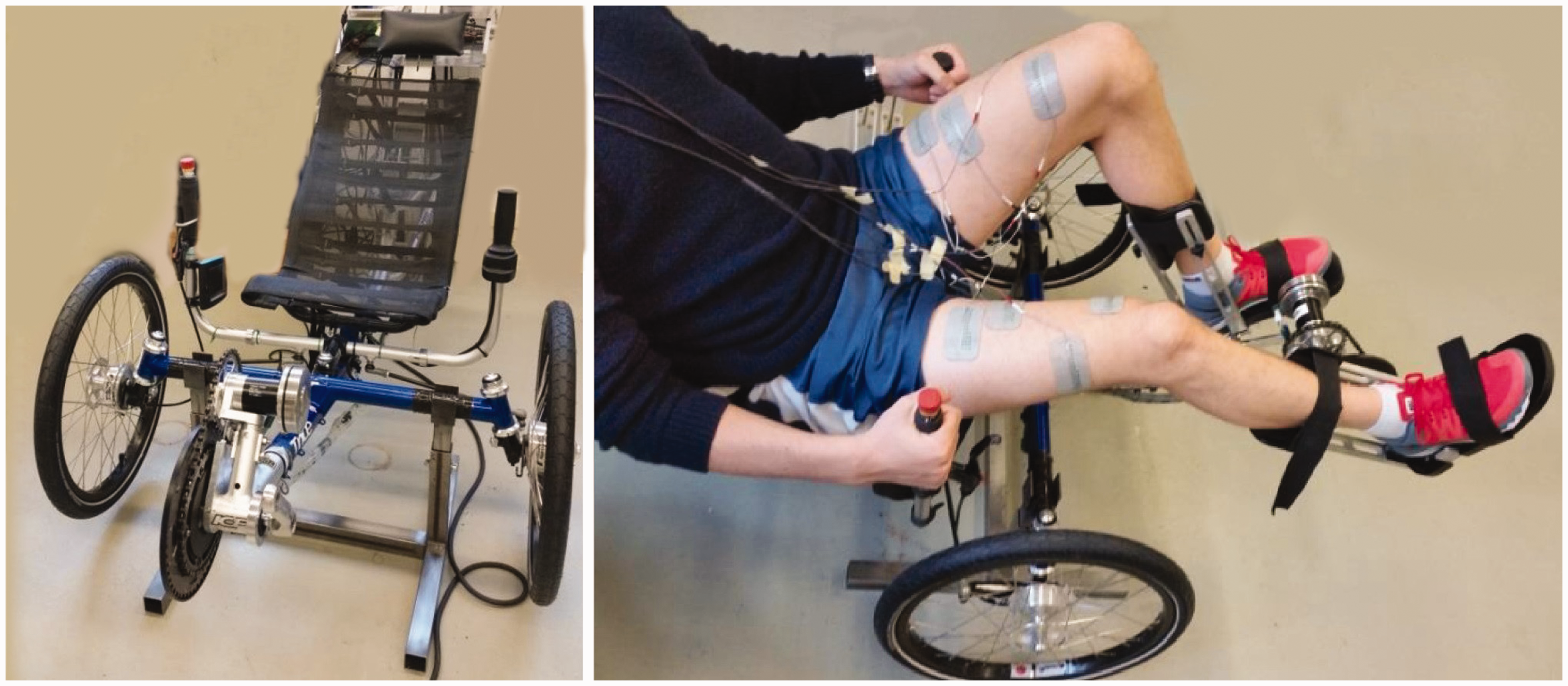
A PC-controlled stimulator was used (Rehastim, Hasomed GmbH) which delivers biphasic current-controlled rectangular pulses through surface electrodes (Axelgaard, Pals Platinum, USA). Sensor data were fed into a data acquisition card (PCI-6221, National Instruments, USA) at 1 kHz sampling rate. Device control and data acquisition were implemented with Matlab/Simulink and the Real-Time Workshop (Mathworks, USA). A graphical user interface was also implemented to set the desired values of stimulation parameters, trains and angles.
Experimental protocol
For each subject, the experiment consisted of two sessions on two different days. The quadriceps and hamstring muscle groups of both legs were stimulated for a total of 6 min: 3 min with a constant frequency pattern denoted as P1 and 3 min with a stochastically varied IPI denoted as pattern P2; there were short periods of non-stimulated motion before, between and after the stimulation phases (Figure 2). The study design was counterbalanced by randomizing the order of presentation of P1 and P2, i.e. P1 then P2 vs. P2 then P1. Cadence was set to 50 r/min for each session.
Test protocol and stimulation angles for the left leg. The order of presentation of P1 and P2 was randomly selected for each leg.
The maximum stimulation pulse width was found for each subject before the first formal measurement session in a familiarization phase by gradually increasing the pulse width until the pain threshold and the maximally tolerated pain were reached. Then, 80% of this pulse width was used for the individual’s pulse width during the experiments (70–145 µs, mean: 95.3 µs). For each stimulation pattern (P1 and P2), pulse amplitude was kept constant at 50 mA for the quadriceps and 40 mA for the hamstrings. The quadriceps were stimulated with two channels where the electrodes were placed on the vastus lateralis muscle motor point (MPvl) and vastus medialis motor point (MPvm) to improve the effectiveness of stimulation. 24 Only one channel was used to stimulate the hamstrings. Muscle motor points for the quadriceps were detected with a stimulation pen (Motor Point Pen, Compex, Switzerland).
Each experiment started with a rest phase (2 min) where actuator system moved the pedals and the subject’s legs at a constant angular velocity without any stimulation. After the rest phase, stimulation started with P1 or P2. If the subject was stimulated first with P1 during the first session, the second session was started with P2. It has been stated that even 10 min of rest is insufficient,
17
but in order to examine the recovery effect compared with voluntary activation in a short-term protocol, a 3-min rest time was administered between each activation pattern.
25
For P2, the inter-pulse interval was stochastically modulated by setting the stimulation frequency as a normal distribution,
Data evaluation
Power output (P) was assessed as the product of angular velocity and torque during stimulated cycling. The mean power output in the first (PF30) and last (PL30) 30 s as well as total mean power (Pm) of each phase was evaluated. Differences between mean values of these outcomes between P1 and P2 were examined using paired, two-sided t-tests (data normality was checked using a Kolmogorov–Smirnov test). The significance level was set to α = 0.05. Mean differences (MD) and 95% confidence intervals were also calculated.
Fatigue
4
was measured for power output values for each stimulation pattern and is shown as the percentage power output loss:
Results
Primary outcomes for paired comparisons and p-values for comparison of means.

Note: n = 17.
MD: mean difference; SD: standard deviation; CI: confidence interval.

Power output samples for P1 and P2, sample differences (D = P2–P1), mean difference (MD) and 95% confidence intervals. (a) First 30 s, PF30. (b) Last 30 s, PL30. (c) Overall, Pm. The red horizontal bars are mean values.
Discussion
The aim of this work was to compare power output and fatigue properties of stochastically modulated IPI to constant IPI stimulation during stationary FES cycling.
The efficiency of FES cycling is much lower compared to normal cycling, and the efficiency is dependent upon the parameters of muscle stimulation. 26 Crude control of muscle groups is one of the main factors responsible for the low power output achieved with FES. 8 In this study, power output during the first and last 30 s of stimulation showed no differences between the two patterns compared. But constant frequency stimulation showed significantly higher overall power output compared to stochastically modulated IPI. This result was unexpected, since previous measurements with the same protocol on a knee dynamometer demonstrated higher power output for randomized IPI. 19 Compared to the dynamometer, where only knee-extensors were stimulated (i.e. quadriceps), the hamstrings were also stimulated on the FES-cycling ergometer system. This more complex motion makes it more difficult to stimulate accurately. Activation angles and multiple stimulated muscle groups could have affected the present observations. Electrode placement for the quadriceps was carried out by motor point detection, but for the hamstrings, the electrodes were placed by trial and error as motor point detection for hamstrings is not possible with a motor point pen. As the surface electrode positions are crucial for effective muscular stimulation, the overall power output values might have been negatively impacted by ineffective stimulation of the hamstrings.
Although the mean power output for constant-frequency stimulation was significantly higher than for stochastic modulation (p = 0.022), the absolute power difference is quite small. Whether or not any differences should be considered clinically or practically, as opposed to statistically, significant depends very much on the application scenario: very small power differences are not likely to be important during stationary cycle ergometer, but could provide functional advantage during mobile cycling.
The results showed no overall effect on fatiguability (Ploss) when stimulation frequency was randomly modulated. Further investigation should be carried out using progressive randomized modulation of IPIs (40 Hz < f < 60 Hz and 20 Hz < f < 30 Hz). Significantly lower rates of muscle fatigue observed in a previous study 16 could have been the result of recruiting more muscle fibres at higher frequencies (f > 50 Hz). Although previous studies indicate that repeatable results have been achieved using at least 10-min rest time,17,27–29 in the experiments reported here, a 3-min rest time did not show any layover effect. This could be due to the short-term (2 × 3 min) stimulation protocol and multiple channel stimulation strategy for the quadriceps.
These observations motivate further examination of different randomization strategies for maximum mechanical advantage in an ergometer system which prevents voluntary contractions as well as possible: in contrast to constant-frequency stimulation, where motor units of different type are recruited in a non-selective, spatially fixed, and temporally synchronous manner, 30 stochastic modulation of IPI is more akin to natural stimulation which has varying discharge patterns employing non-synchronous, selective recruitment and which exploits high-frequency bursts and the catch-like property. 31
One limitation of this study is that the measurements were conducted with able-bodied subjects. Although the stimulation was at a tolerable intensity, voluntary contractions cannot be discounted and may have affected the outcomes. In a previous study using a knee dynamometer, voluntary contractions are minimized as only one muscle group (quadriceps) was stimulated and the performance was measured during only the knee extension phase. The FES-cycling ergometer system is more susceptible to voluntary contractions as one more muscle group (hamstrings) is stimulated for pedalling. In addition to these factors, voluntary contractions in a familiar movement (cycling) can be higher than during knee extension.
Conclusion
This study showed that stimulation strategies that use randomized modulation of IPIs can negatively affect power output generation during FES cycling. To minimise voluntary contractions, power measurement and assessment should be focused on the periods where only the quadriceps are stimulated to better observe the effect of pattern modulation in functional electrical stimulation applications which perform repetitive, non-isometric contractions in short-term tasks.
Footnotes
Acknowledgements
The findings of this paper were previously presented at the 21st Annual Conference of the International Functional Electrical Stimulation Society, IFESS, London 2017.
Declaration of conflicting interests
The author(s) declared no potential conflicts of interest with respect to the research, authorship, and/or publication of this article.
Funding
This work was supported by Swiss National Science Foundation (grant number: 320030_150128/1).
Guarantor
KJH.
Contributorship
All authors contributed to the design of the study. EAA and ML did the data acquisition. All authors contributed to the analysis and interpretation of the data. EAA wrote the manuscript. All authors reviewed and revised it critically for important intellectual content. All authors read and approved the final manuscript.