



Abstract
Modern contracts allocate material powers to contractants to take major decisions which affect the interests of counterparties. Empirical evidence, from studies and from litigated cases, tends to show that those responsible for taking decisions using powers granted to them under contracts take those decisions seriously. They give the decision some thought, and they try to be reasonable. The law, however, does not generally insist on high standards of conduct. I explore the law and the social psychology of decision making, System 1 or System 2 as Kahnemann classified it, and how to align them, as well as discuss, from legal theory, how one might define a reasonable decision. Legal argument is underpinned by an analysis which suggests that control of decision-making powers should be a matter of contract construction, the Court's question to be directed at the likely intention of the parties.
‘You’ve got a feel?’, Mahmoud laughed. ‘So have I. I am just being a good boy and checking out all the possibilities. Like they taught me in college’. 1
Introduction
The research question can be broken down into three components
Is it theoretically possible to require that those who take decisions under powers conferred to them by contract should be required to utilise (and perhaps evidence) mental and managerial processes recognisably those described as the late Daniel Kahnemann's System 2? If so is this a practicable and legally appropriate requirement? Is there evidence that decision-makers operate this way in many cases and does this result in ‘better’ decisions? Do parties who agree to confer one party with such decision-making powers generally intend that such decisions should be reasonable? If so what does reasonable mean and how can judges and decision-makers determine whether a decision is reasonable? Is it time for Adam Smith's impartial spectator to enter the arena? System 1, the fast and automatic system.
4
This system is our cognitive auto-pilot, it works intuitive, unconscious and draws on prior experience. It is responsible for everyday decisions. ‘System 2’ decisions as using, ‘the slow and analytic system. This system is controlled and effortful, it works deliberate, conscious and reliable. It is responsible for complex decisions’.
6
Sometime during the day procurement specialists, contract managers, project managers, in-house counsel and engineers will wake up. Usually. Decisions must be made. Television or Radio or iPod. Which channel. Shower first or breakfast first. Muesli or cornflakes or bacon or dried fruit. Coffee or tea or orange juice. Bubble’n’squeak. Kasha, butterbrots, bread and cheese, croissants, fatty pork and rice, noodles, pancakes and maple syrup. String or plain hoppers, miso soup, porridge (maybe rice maybe oats), and so on. Black pudding? Steak and eggs. Eggs sunny side up. Or scrambled. You get the idea about what Keith Stanovich calls ‘quick and dirty’ decisions,
2
and David Hull characterises as engaging ‘the brain only when all else fails – and usually not even then’,
3
and in a Tweet on 14 May 2020, Daniel Kahneman describes as:
These procurement specialists spend the more lucid parts of their days deciding from amongst qualified contractors to which to send a request for quotation and they will use some hard metrics, some experience, some market knowledge (who's overloaded, who needs work, etc.). In commercial departments, contract managers will assess claims for extensions of time and/or extra money and make valuation decisions. Currently, there will still be debate about whether problems are pandemic related and whether force majeure provisions cover them; and someone must make decisions regarding commercial consequences. Project managers make daily multi-dimensional decisions based on priorities, with possibly severe cost, time, and resource dimensions, which have foreseeable and unforeseeable consequences (risky choices).
5
Engineers engaged in projects will review submissions of drawings or specifications from consultants or subcontractors and make decisions on whether to approve them, comment on them or send them back. In-house Counsel may well be consulted on these decisions.
Keith Stanovich and Richard West created the System 1 and System 2
7
shorthand for these modes. Most of us will recognise them and that we use both the experiential,
8
or System 1 and the ‘slow, rule based’,
9
or System 2 (nicknames, says Kahneman
10
). As Elke Weber and Patricia Lindeman put it: People are well aware of possessing a repertoire of decision modes ranging from quick intuitive responses … to the effortful calculation of relative costs and benefits.
11
In the commentary to Stanovich and West, James Friedrich warned that treating Systems 1 and 2 as a dichotomy might involve too crude an analysis – ‘the interaction of the two systems is likely to be far more subtle and complicated than is typically implied by most dichotomies’. 14 Indeed, two of social psychology's interesting avatars, the Cognitive Miser 15 and the Motivated Tactician, 16 seem to inhabit this twilight zone. We will all recognise the Cognitive Miser, the rogue who uses ‘short-cuts’, favours ‘limited mental resources, [relies] on irrelevant cues (perhaps “pre-existing” – see Russo below), and [evades] the difficulties of effortful correction’, 17 conserving mental energy by avoiding engaging System 2 too frequently. The Motivated Tactician, a class of ‘pragmatic perceivers who process information and act according to their motives and goals’ 18 may also appear to shoot from the hip, often seem impatient for results, and may not listen (me in some situations) or consider things in the round.
Typical contract decision-making powers
In this subsection, I emphasise the ubiquity and the reach of decisions made unilaterally in contract settings. Decision-making powers lurk in many, usually medium/long-term contracts, in differing contexts, commercial and consumer, sometimes affecting the interests of thousands even hundreds of thousands of people, and with different possibilities. Sometimes the decision is in a range, in other cases it is binary. The linking factor is that one party holds the power to make decisions even where these affect both parties. Typical decisions include:
A reinsurer's decision to approve or not approve an insurer's settlement.
19
In construction contracts ‘a Certifier [decides] matters such as value, quality of work or extension of time as part of an administrative function ….’.
20
In, for example, the RIBA form of contract the architect ‘decides whether the contractor should be reimbursed for loss under clause 11 (variation), clause 24 (disturbance) or clause 34 (antiquities), whether he should be allowed extra time (clause 23); or when work ought reasonably to have been completed (clause 22)’.
21
A mortgage lender may alter mortgage rates.
22
A marina owner may be asked to approve a sub-licence
23
or a landlord to approve sub-letting.
24
A commercial lender may decide whether to provide further interim loans.
25
Whether a situation constitutes force majeure.
26
A master of a ship may have to decide whether a port to which he has been ordered to sail is dangerous.
27
A merchant may decide whether to continue credit facilities to a customer.
28
Contracts often allow for deduction of monies for performance failures and an officer will be tasked with making the decision.
29
Sometimes disciplinary hearing rules allow participants to choose someone to accompany them and the rules might require institutional approval of their choice.
30
Contracts usually include termination machinery, for convenience and usually for cause and someone has to decide whether or not to terminate.
31
A pub's freeholder may decide under powers in the lease to install sales monitoring equipment.
32
Employers may decide whether or not to award bonuses or discretionary payments.
33
Directors may decide whether conditions allowing a share option package to be triggered have crystallised.
34
A cursory reading of that list shows that these are serious decisions. In the construction industry, payments are critical to contractor cash flow and ‘poor’ decision-making in the past broke many businesses, Keith Pickavance describing the situation before Parliament stepped in – ‘Commercial intimidation was rife, with the result that thousands of firms were forced out of business’.
35
Similarly erroneous or irrational decision making in the matter of deducting monies for alleged breaches of contract squeezes the lifeblood of cash from facilities management contractors, likely to be thinly capitalised and therefore vulnerable. This also causes suspicion and is almost certain to end in serious disputes.
36
In the case of a franchisee plumber the franchisor refused to agree that his need to self-isolate during the pandemic constituted force majeure, providing the franchisor with the opportunity to terminate the relationship.
37
The decision-maker in Nash would have been aware that, as the Paragon business model involved finding pricey finance for niche or stressed borrowers, decisions necessitated by market conditions might well have a considerable downside for the already financially stressed borrower. Credit card providers are another quotidian example, holding rights to change interest rates if the Bank of England Base Rate changes, and also, usually, where they determine that your creditworthiness has changed or ‘any other change that affects us, if it is fair to pass on its impact to you’!
38
In the Lymington Marina case, the holder of a berth licence wanted to sub-license to his brothers as a mechanism for sharing the licence left to him by their father. A refusal without good reason obviously caused anger and upset.
In my day-to-day I am responsible for setting Service Charges in a 25-flat block, and I know that my tenants and my neighbours have varying means. I make decisions on maintenance priorities which have effects across the block. I made regulations post-Grenfell which resulted in tenants having to spend significant sums upgrading flats. I hold powers to enter and inspect flats, and to discontinue services. Misusing my entry powers, for example, would clearly cause distress, annoyance, inconvenience, or suspicion.
In research I conducted for my PhD contract professionals offered a case study in which they had absolute discretion in a time-poor situation, asked how they would allocate accommodation space on a multi-contractor fracking site, overwhelmingly elected consultation with those affected as opposed to getting on with it, chiefly because fairness (‘fair and equitable’, ‘establish commonality’, and ‘treat each group fairly’) was important. They said (or wrote) that one should ‘make time’, ‘find time’, ‘walk the site’, and don’t ‘apply rules dogmatically’, that it is ‘critical’ that people are happy, in one case asserting ‘it's their home!’, and another that ‘it's worth the effort’. 39
The law in relation to ‘discretionary’ decisions under unilateral powers
The law applicable to decision-makers blessed with unilateral powers is decently encapsulated in Chitty on Contracts saying that it requires ‘… the power to be exercised honestly, rationally and in good faith’.
40
Unfortunately, in general, these grand sounding words do not create a high bar for decision makers; the Supreme Court having concluded that Lord Greene's two-limb test from Associated Provincial Picture Houses Ltd v Wednesbury Corporation
41
‘usually’ applies to contractual decision making; Lady Hale SCJ recapitulating that test: The first limb focusses on the decision-making process – whether the right matters have been taken into account … The second focusses upon its outcome – whether … the result is so outrageous [my italics] that no reasonable decision-maker could have reached it.
42
The final determination could not be so unreasonable – so outrageous in its defiance of logic – that no reasonable person could have reached it. The process of decision-making
This appears, to this writer at least, to fall below a threshold of what Karl Llewellyn referred to as ‘minimum decencies’
44
and the Scottish Government's official commentary on administrative decision making says that ‘These definitions of unreasonableness (or “irrationality”) seem quite extreme’.
45
As Professor Daintith describes these ‘limbs’
46
, the first connotes genuineness, meaning ‘not with reference to considerations wholly extraneous to the subject-matter’,
47
and the second reasonable, meaning not too ‘outrageous’. Neither limb, the first sometimes called the relevancy review and the second the rationality review,
48
creates onerous controls, one commentator describing it as a ‘relatively low standard’
49
and the circumstances in which a Court will interfere are ‘extremely limited’.
50
Richard Hooley says that the limitations are ‘at the lower end of the [good faith] scale’
51
and Michael Bridge that the ‘standard is not particularly demanding’.
52
Showing how limited the controls are, Dyson LJ, in Nash v Paragon Finance plc (Nash), reached for a breathtakingly unlikely scenario: Where the lender decided to raise the rate of interest because its manager did not like the colour of the borrower's hair.
53
Mance LJ was clear that any decision ‘must reflect the context ... and purpose’ of the power and that it should not be used ‘for reasons extraneous to the claim’, such as ‘an attempt to influence an insurer's attitude in relation to a matter arising under another quite separate reinsurance or to harm an insurer as a competitor’. 54
Arden LJ (now Arden SCJ) was more realistic than Dyson LJ, in Lymington Marina Ltd v Macnamara (Lymington): It would not be enough that the proposed sub-licensee, say, has in the past lived outside the United Kingdom…
55
If asked at the time … whether it accepted that the discretion …could be exercised dishonestly, for an improper purpose, capriciously or arbitrarily, I have no doubt that the claimant would have said ‘of course not’.
56
Rix J provided detail on limb two saying that decision-making powers were limited ‘… by concepts of honesty, good faith, and genuineness, and … the absence of arbitrariness, capriciousness, perversity and irrationality’. 57
In Esso v Addison in which Esso held the right to adjust the amounts payable/receivable by its licensees, Tuckey LJ said, referring to the ‘construction’ of the contract at first instance: The question is whether the adjustments …. were based on a genuine examination by Esso of the commercial factors affecting its retailing business in general and a rational response to the conclusions it reached.
58
the product of a thorough review of Esso's retail operations involving Esso's own staff and specialist consultants over a period of many months … attempt to identify the reasons for a gradual loss of market share and the means by which that could be reversed and the retailing of motor fuel to the public made profitable
also allowing Esso to take into account ‘the broader picture’ including the ‘financial balance’ and changes in commercial circumstances generally,
59
the final legal outcome was that Esso's obligations bottomed out in the general principle that It was not entitled to make adjustments arbitrarily, capriciously or irrationally and it was not entitled to make adjustments the combined effect of which was to render the operation of the service station commercially impossible.
60
Other outcomes are possible. In construction cases, judges are apt to enforce standards which appear to be higher. Where decisions arise regarding the sort of things which, says Zoe Ollerenshaw, are ‘heavily planned for’,
61
such as variations and extensions of time and which provide fertile grounds for disputes,
62
judges are fairly strict on the duties of decision-makers. They will observe that asking for perfect information is not reasonable; noting that architects, for example ‘are not strangers to the project’,
63
or that architects should not adopt a ‘passive’ attitude to problems.
64
In addition, architects must act lawfully, fairly, and even somewhat scientifically; making assessments of time in a ‘logical and calculated’ manner which should not be ‘impressionistic’.
65
As Akenhead J ruled of loss and expense claims: It is necessary to construe the words in a sensible and commercial way that would resonate with commercial parties in the real world.
66
Although, for example, the test in Australia seems to ask more of decision-makers, reasonableness of an insurer's decision being defined as to ‘whether the opinion formed by the insurer was not open to an insurer acting reasonably and fairly in the consideration of the claim’ Macfarlan JA, commenting that application of the two different formulations referred to above, unreasonableness in the Wednesbury sense and determination of whether the opinion formed was open to an insurer acting reasonably and fairly, would lead to different results in few, if any, cases’. 67 Even in Canada, where good faith may now be a general organising principle 68 the Courts still reach very similar conclusions to the Supreme Court in Braganza. 69 Although the law is variable in the United States the implied covenant of good faith and fair dealing may simply mean that the decision-maker must not act capriciously or arbitrarily, 70 Gillian Hadfield remarking that where a franchisor makes a business decision which does not appear ‘vindictive’ or the product of ‘improper motive’ is a legitimate business judgment. 71 In one case, however, Gilson v Rainin Instrument, LLC, for example, the court held that in exercising a contracting party's discretion, it must act in a manner that is ‘consistent with the reasonable expectations of the other party’, which forces the decision-maker to consider the interests or expectations of the counterparty. 72
In a recent very high-profile case, in what now seems to be a truly epic scandal, likely to cost the UK taxpayer over £1 billion and existential for the Post Office, Sir Peter Fraser considered the actions of Post Office decision-makers.
73
Apparent shortfalls in receipts at sub-Post Offices required decisions to be made as to who was responsible for the shortfalls, how to make them good, whether to suspend or terminate SubPostMasters (SPMs) contracts, and whether to prosecute them. Such decisions were made by various Post Office officials, apparently ‘arbitrarily’.
74
Sir Peter Fraser set out the Post Office's contractual obligations in stark terms, terms which, I suggest, ring true to anyone who might be the subject of such decisions: (e) To co-operate in seeking to identify the possible or likely causes of any apparent or alleged shortfalls …. (h) To make reasonable enquiry, undertake reasonable analysis and even-handed investigation, and give fair consideration to the facts and information available as to the possible causes of the appearance of alleged or apparent shortfalls (m) Not to seek recovery from [SPMs] unless and until: … (iii) the [Post Office] had carried out a reasonable and fair investigation as to the cause and reason for the alleged shortfall …
75
The PO, as the SPMs’ paymaster, was responsible for calculating their remuneration – largely determined by the computerised ‘Horizon’ system. The PO was, arguably, obliged to operate analogously to a construction industry certifier acting ‘in a fair and unbiased manner … reach such decisions fairly, holding the balance between his client and the contractor’ 77 which requires a proper and reasonable assessment of the SPMs’ and PO's entitlements examining all the relevant evidence. There are, however, countervailing cases in which so-called discretion to operate payment (or non-payment) machinery was held not to be subject to any controls. 78 There are also multiple cases in which the power is the protection of one party's commercial interests; a more lenient view is usually taken allowing that party, for example, to ‘have regard to such pricing sources and methods… as it considers appropriate’. 79 In that case, which arose out of the implosion of Lehman Brothers, Blair J said that the decision-maker was entitled to have regard to its commercial interests. 80 Jason Varuhas describes the phenomenon, kindly, of context-specific decisions as ‘variable’ application or intensity but does not consider why the question of what the parties have agreed is not front and centre. 81
In Braganza the Supreme Court was very critical of BP's decision-making process, the decision having been ‘formed without taking relevant matters into account’ and failing to appreciate the need for ‘cogent’ evidence. 82 This was despite there having been two levels of activity in BP, first an in-depth investigation (thorough according to Lord Hodge and ‘carefully considered’ and ‘impressive’ according to Lord Neuberger 83 ) and secondly a decision by a senior officer, BP's General Manager, based on the investigation and who carried out a second review after an appeal by Mrs Braganza. The Supreme Court found that BP's reliance on the investigation was not enough, the decision-maker had to form a view based on the evidence, and the evidence of suicide was based on ‘straws in the wind’ (Lord Neuberger strenuously dissenting).
In Nash the evidence in front of the Court was that the interest rate decisions had been made for purely commercial reasons, Paragon's Counsel having submitted that Paragon was in serious financial difficulties because many of its borrowers had defaulted, the money markets charged higher rates for lending to the [Paragon] because it was perceived to be a greater risk than other mortgage lenders, and these higher costs had been passed on to borrowers.
84
In fair comment on the strangely negative wordsmithing above Jonathan Morgan says that ‘it is quite impossible to define a “capricious” or “thoroughly unreasonable” decision in the abstract’.
85
Lord Reed was equally puzzled by the recherche language: … I am not sure that I understand …. the statement that there should be ‘an absence of arbitrariness, of capriciousness or of reasoning so outrageous in its defiance of logic as to be perverse’, but that the court is not referring to ‘a decision lying beyond the furthest reaches of objective reasonableness’; or how that test is related to the causal connection between the purpose and the conduct.
86
To ask one's typical commercial actor to avoid being capricious feels ridiculous – I can imagine that the reaction of at least one former colleague would be a Frankie Howerdish ‘ooh Missus’. The question asked by Dyson J reflects the most famous formulation of one test of implication of terms, a theatrical creation of MacKinnon LJ: … so that, if, while the parties were making their bargain, an officious bystander were to suggest some express provision for it …, they would testily suppress him with a common ‘Oh, of course!’
92
The question Dyson J asks is irrationally narrow and unnecessarily negative. It is almost a System 1 question. Back in 1889 Bowen LJ's formulation of the test was wider and more persuasive since he makes inquiry into what the parties thought: … what the law desires … is to give such business efficacy to the transaction as must have been intended at all events by both parties …
95
The gap between the law and conventional ideas of rational judgement
The key point for this section of the paper is that rational decision-making, including reaching reasonable decisions requires alertness, intellectual activity or ‘engagement’ such as deploying attention and deliberate checking and searching, 99 using Keith Stanovich's ‘reflective mind’. The OED defines rational as exercising one's reason in a proper manner, having sound judgement, and, as we have seen in the preceding section, the Courts define rational as requiring a certain amount of that process but then allow decision-makers to make decisions which are just above unreasonable. It appears slightly bizarre to demand that cogent evidence be considered, the right matters taken into account, and then to validate decisions which rise millimetres above a bar marked ‘completely outrageous, devoid of reason’. This is a large gap. Stanovich subdivides System 2 processing into the algorithmic mind and the reflective mind. 100 The algorithmic mind provides the essential ‘computational machinery’ for type 2 thinking. The reflective mind ‘includes the goals, disposition, and strategies that people adopt in their type 2 processing’ 101 which Stanovich refers to as ‘mindware’ such as mathematics, and logic which transforms information. Cathal Woods describes this as including tendencies to collect information before making up one's mind, to seek different viewpoints, seeking nuance and avoiding absolutism. 102 Stanovich suggests that rational decision-making is preceded by ‘critical thinking’ 103 including the collection of information, consideration of different viewpoints and future consequences plus ‘open-minded thinking, need for cognition’. 104 One technique he describes is ‘think the opposite’, which, in contract terms, should extend to include consideration of the interests of the decision-taker. 105 There is research which suggests that this is critical because pre-existing preferences are apt to cause distortions. 106
The law provides cover for both our avatars – the closely related Cognitive Miser and the Motivated Tactician. It makes few demands on process, it makes no demands that the decision-maker engages in critical thinking or considers all reasonably likely outcomes or the effect of the decision on the counterparty. In other words, the law requires at a maximum that the algorithmic mind be engaged and not the reflective mind.
Motivated, tactical, operators ‘who pragmatically adapt their reasoning strategies to the requirements at hand’ 107 may still reach a legally valid decision. They may well understand their instant targets and desired outcomes but overuse heuristics. Many of these contracts are long-term and the short-term exigencies of the pragmatic tactician are not a good basis for decision-making – a strategic approach is often needed.
Former colleagues reading this might well recognise me under pressure! It is not laziness that makes us miserly. Long on workload and short on time, the executive contract manager knows they must think things through and consider the effect of their decisions on others. 108 In that sense, the term ‘Cognitive Miser’ feels unfair, and the term ‘Motivated Tactician’ appears to paint the CM as mildly cynical. In my opinion, the executive under pressure, allowed to lean on heuristics, will often do so, sometimes using ‘educated’ heuristics. In short this is a ‘Hunchmeister’ at work (or guessworker?). It is shortness of time, overload, the next meeting, pressure for results, a need to ‘lead’ or appear decisive, conviction that we know best (sometimes we do). This misunderstood individual, likely to be rational but overloaded, is not idle but time limited, one survey revealing that ‘Interestingly, the more upper-level managers tended more toward intuition’. 109 My essential criticism of the law is that it lets this quasi-rogue off the hook so long as the right things have been taken into account and the decision is not wholly unreasonable. The law is capable of asking for engagement or for the employment of the reflective mind, as we have seen, judges in construction cases requiring decision-makers to operate somewhat scientifically; making assessments of time in a ‘logical and calculated’ manner and rejecting ‘impressionistic’ methods. 110 And some jurists understand this idea, Neil MacCormick saying that ‘bringing one's reflections beyond raw feeling and into the realm of the reasonable calls for something like Adam Smith's “impartial spectator” procedure’. 111
As a generality it can be taken that System 2 decision-making outperforms ‘tacit’ 112 System 1 decision-making save in limited circumstances which do not apply to contractants, namely where decision-makers hold ‘implicit knowledge that goes beyond their explicit knowledge’. 113 Henning Plessner and Sabine Czenna tabulate the results of many experiments which directly compare spontaneous and deliberate judgements. In some cases, intuition works but tasks which include anchoring, conceptual expertise, quantity estimation or probability judgements, deliberation ‘wins’ also noting that ‘for intuition to prove superior people must possess knowledge based on prior experience with the relevant options and their implicit knowledge must match the demands of the task’. 114
How might a judge evaluate a decision to determine whether it is ‘reasonable’
Although it is, as Jonathan Morgan notes, impossible to describe a reasonable decision in the abstract, I shall endeavour to demonstrate that it is possible to provide guidelines or principles which would provide a Judge the mindware to determine whether a particular decision is or is not objectively reasonable.
Robert Alexy notes that ‘rationality is concerned with efficiency, whereas reasonableness is concerned with the right and the good’. 115 Jurists, however, use the terms interchangeably, Neil MacCormick, curiously citing only a US case, 116 using ‘reasonableness’ to describe limb 1 decision-making. 117 I use the term rationality or rational to connote Rawls’ ‘merely rational’ or process, limb 1 rationality and reasonable or reasonableness to connote ‘practical rationality’, 118 or limb 2 ‘outcome’. Outcome should be the ‘subset of rational determinations’ 119 so rationality will not always be reasonable whereas reasonable will always be rational. As John Rawls (cited by Alexy) rightly says ‘merely rational agents lack a sense of justice’. As I indicated earlier, however, I do not regard limb 2, the reasoning limb, to be a moral issue or a question of the ‘good’, but rather as a question of party intention, despite Rawls’ reference to reasonableness as a ‘form of moral sensibility’. 120
As the Scottish Government notes, ‘Courts have recognised that when different reasonable people are given the same set of facts, it is perfectly possible for them to come to different conclusions’, which brings into play Alexy's idea that in reasonable decision-making scope must be allowed for ‘reasonable disagreement’. 121 Adam Smith's impartial spectator seeks ‘to abstract from their own position to see and feel the situation as it looks and feels to others involved, and they weigh impartially their own interests and commitments in comparison with those of others’, 122 and in a ‘discourse-theoretical’ (noting that the discourse will often be ‘virtual’), version of the impartial spectator Robert Alexy captures the point I will make in more detail below by saying that the decision-maker should be able to accept the consequences of a decision ‘even in the hypothetical situation where he or she is in the position’ of the decision-taker. 123 In a modern context, a well-known neuroscientist, Donald W Pfaff, describes empathy as generally meaning ‘the capacity to perceive and share feelings as experienced by others’. 124 Interestingly, discussing ‘meta-cognition others’, a less poetical form of the impartial spectator, Grazioli, Smith and Johnson say that ‘ascription of beliefs and goals to others is a major determinant of success in managing risk in social exchange’, citing Daniel C Dennett who argues that ascription ability creates an evolutionary advantage and Sir Richard Baron-Cohen supporting Dennett arguing that competent management of social risk derives ‘some of its power from the cognitive ability to ascribe goals and beliefs to others’. 125
The reasonable reader we have met above is, in my opinion, a close relative of the reasonable person, described by Arthur Ripstein as ‘an embodiment of an idea of fair terms of interaction’, 126 although it is fair to say that this paragon does not always attract admiration, Alan P Herbert expressing some disapproval of the ‘excellent but odious’ Reasonable Man, who is ‘ … Devoid of any human weakness … [and] vainly [appeals] to his fellow-citizens’ to follow his example’. 127 Cardinal Newman observed of the ‘English Gentleman’ that one of his characteristics was that he should be ‘too clear-headed to be unjust’. 128
MacCormick notes that Courts can, and normally do make decisions on objective reasonableness saying ‘On grounds that were classically expressed by Holmes J and by Lord Reid, the ordinary presumption is that the test of reasonableness is, in the sense indicated, an objective test’. 129 Jason Varahus points to ‘hints of objective balancing’ in non-commercial contexts, but points to decisions in which Courts take the view that in the commercial world such an approach would be too ‘onerous’ citing Socimer. 130 However, when judges make comments such as that of Longmore LJ saying that Barclays could not demand ‘a price which is way above what he can reasonably anticipate would have been a reasonable return’, 131 the Court must have possessed an appreciation of the boundaries of that ‘reasonable return’ somewhere within which there must be an objectively reasonable return.
It might help to examine a few cases to consider whether this self-recusal on the part of Courts is essential. In Socimer at first instance Gloster J showed that such an approach is possible, and her key error appears to have been that she gave insufficient weight to the unchallenged evidence of the defendant's expert. 132
In Lymington the marina owner had, apparently, ‘absolute discretion’ when faced with an application to sub-licence a berth licence. How might such a decision be taken reasonably? It seems to me that a Court should be extremely wary of interfering in such a decision, unless there is evidence that the decision has taken into account what one might circumscribe as protected characteristics. Otherwise, it seems to me that the business owner may decide without fear to exercise discretion as he or she wishes, capriciously if they so wish. 133 It's their business. I suggest that most people, whether they agreed with the marina owner's decisions or not would take that view, which is a slightly narrower position than that taken by Jonathan Morgan who, in an excellent commentary on Lymington suggests that Courts should ‘disclaim any jurisdiction to review the exercise of contractual discretions’. 134
However, the exercise is more likely to face difficulties in disputes where a range, say of values or interest rates, of outcomes is possible. In another case descending from the implosion of Lehmann Brothers, Robin Knowles J was faced with a disputed valuation made by a decision-maker, the Defendant claiming that it owed US$10,778,943 and the Claimant US$12,826,887. 135 The contract required the parties, post a Termination, to ‘provide to the other party a statement showing, in reasonable detail’ their calculations … and for the decision-maker to reach a ‘commercially reasonable result’. The judge noted that ‘rationality and (wholly objective) “reasonableness” allow for a result that falls within a range’. Despite expert evidence which the judge rather dismissed as providing only ‘context’, the factual evidence was more persuasive to the judge, who also reviewed decision-making processes, calculations, various valuations and hypotheticals, plus timing to find that reliance on a particular ‘Transaction’ to reach a valuation decision was proper. 136 This case differs from Socimer since in that case the unchallenged expert evidence of Ian Beckman was that ‘the only definitive measure of value was the price for which assets could actually be sold’, making a scale inappropriate. 137 Given the availability of factual and expert evidence it seems improbable that a judge cannot reach a decision as to whether a particular result is objectively reasonable.
In Nash the Court was provided with evidence of the difference between Paragon's mortgage rates and those of the Halifax (the Paragon?), showing that the basic Paragon rate differed from that of the Halifax by between 4% in 1997 to 5.14% in 1999. 138 In cases like this I would be drawn to considering something along the lines of a scale as described by Alexy to assign ‘weight’ to various potential decisions. 139 In this case one can envisage that one might consider how to produce sufficiently reasonable determinations, good enough, satisficing, but not necessarily ‘optimal’, 140 and would fit Neil MacCormick's suggestion that one might ‘review … possible objections’ to the decision. 141
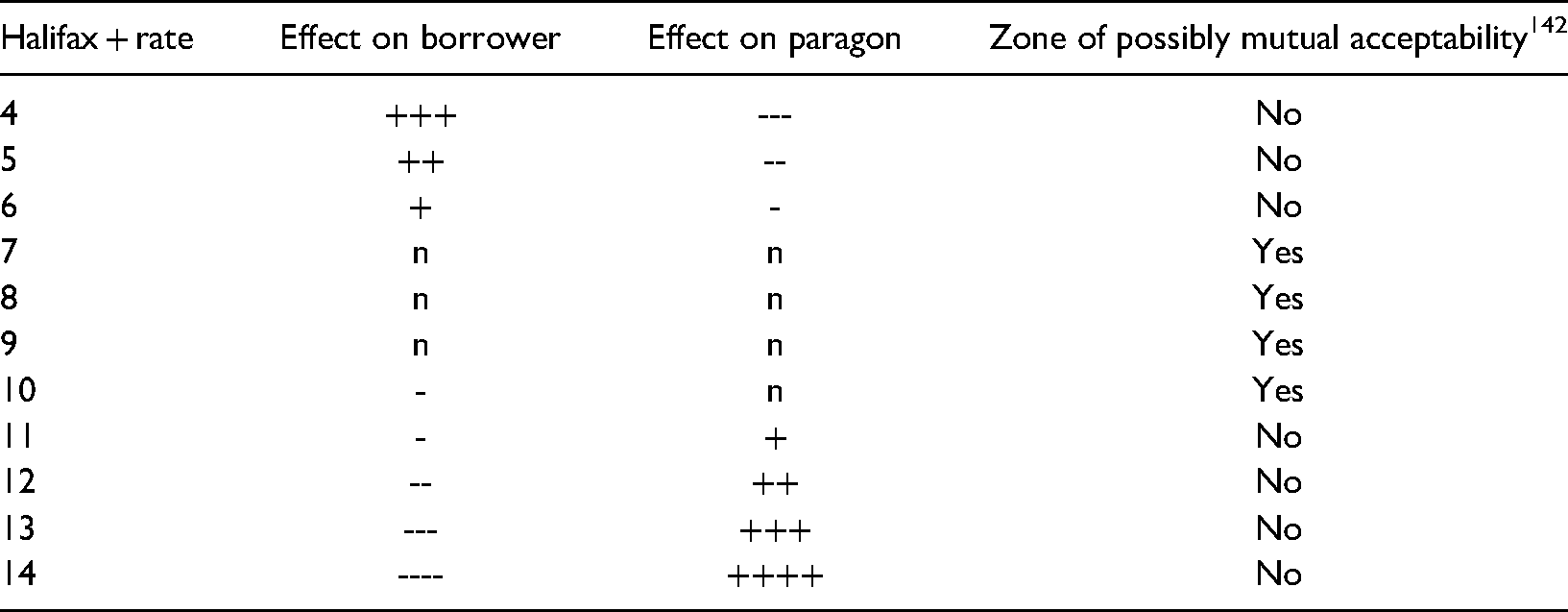
Putting a table like this together is, of course, no substitute for real evidence but it does show that one might be able to construct something which would help a Court determine whether both parties acting reasonably might agree that a particular result, while sub-optimal for one or both, could be described as reasonable. Similarly, in BHL v Leumi ABL Ltd, in which the defendant was entitled to charge ‘collection fees’ on certain receivables and, rather than charge a cost, simply charged a fee of 15% of the receivable received, it cannot have beyond the competence of the Court to determine what a reasonable collection fee would have been, especially given that expert evidence was proffered on that very topic. 143
Turning to drafting issues, considering how one might persuade a judge that the contract requirement is an objectively reasonable decision, matters are far from simple. We can say with some certainty that guidance from the Courts is less than helpful. In Lehmann, Knowles J appeared (apologies for the pun) to hedge. On the one hand, he ruled that ‘the fact that there is a range does not mean that the Determining Party can simply take the result that suits it best at one end of the range’
144
but he does not say how he would determine how far from the end of the range one has to go. He concludes, however, that ‘if contracting parties want objective criteria of reasonableness to apply, they may need to do more than
One general principle, necessary but not sufficient to encourage reasonable decision-making is to require as part of limb 2 that the decision-maker asks themselves whether, were they the counterparty, they would regard the decision as fair and reasonable. This has some echoes with the more complex principle set out by Scanlon that An action is wrong if any principle that permitted it would be one that, just by reason of its permitting such an action, could be reasonably rejected by any person whose aim was to find principles for the general regulation of behaviour that others, similarly motivated, could not reasonably reject.
147
In one commercial example, the MF/1 form, published by the Institution of Mechanical Engineers, provides that: ‘Wherever … the Engineer is required to exercise his discretion: he shall exercise such discretion fairly within the terms of the Contract and having regard to all the circumstances’. 150 One could clarify this by adding ‘including the legitimate interests of the Contractor. Decisions taken by the Engineer shall be fair, meaning that both parties would, acting reasonably, regard them as impartial, balanced, fair and commercially reasonable’.
Discussion
The English spy, Daniel Defoe, observed that ‘there is a Court of Chancery in every man's breast’, from which I infer he meant some innate sense of fairness. 151 Elinor Ostrom won the Nobel Prize in Economics for work which suggested that groups of people can manage common resources successfully if certain core design principles were present. One of those features is that decision-making should be by consensus or by a process regarded as fair. Later work appears to have validated Ostrom's eight core design principles. 152 In contract the decision-maker does, I think, deal with a resource, the contract, which can be regarded as common.
Asked, for example, to make a decision in the ‘Ultimatum Game’, a thought experiment much enjoyed by economists where one player is given some money – say £100 – and asked to divide it between himself and the other player: The key result … is that most proposers offer between 40% and 50% of the [£100], and that this split is almost always accepted by responders. When the proposal falls to 20% … it is rejected about half of the time, and rejection rates increase as the proposal falls to 10% and lower.
153
In other Tweets, Kahneman says that ‘Mistakes occur if we allow System 1 to process a cognitive decision while we should have really passed this decision over to our slow logical System 2’. Keith Stanovich has suggested that System 1 decision-making or ‘heuristic’ works well only in ‘benign environments. In hostile environments, it can be costly’. 154 Benign and hostile are too extreme as terms to use generically of contracting environments, but we can say that when a decision-maker carries some responsibility for decisions the environment should not be regarded as benign. One important piece of field research revealed ‘Rational [as opposed to intuitive] decision-making was associated with good performance’ when participants had looked ‘extensively’ for information, 155 and it is possible that this finding can be read across to judicial deliberations. 156 It is possible, as Weber and Lindeman find that personality and cultural differences will affect decision-making, that ‘standardising’ processes or insisting on bias-reducing mechanisms will strengthen decision-making. 157 It is also clear from research that different stimuli can change decision-makers' approaches to decision-making. 158 Such ‘stimuli’, in these cases include the collection of evidence and the consideration of the wider effects of the decision especially how it affects the decision-taker. Studying audit practices, an area ‘ripe with conflicting accountabilities’, 159 Cynthia Williams Turner found, for example, that junior auditors supervised by a senior whose focus was profitability examined less evidence than auditors who did not know their senior's preferences. 160
If we are to avoid or avoid encouraging ‘the intellectual sin of sloth’ 161 we should require reflective, evidence-based and evidence-collecting, System 2 decision-making which is both conventional and likely to be the expectation of the honest or reasonable contractant; extremely unlikely to have agreed that decision-makers must only aim to stumble over a hurdle marked ‘this decision is not outrageous’. But this is what judges assert that those who allow another to make contractual decisions have agreed to. In that sense I entirely disagree with Mayo Moran's (who also cites Fardell v Potts) claim, as it might be applied to this area of contract law, that ‘the reasonable person often turns out to bear a rather suspicious similarity to the judge’. 162 One limitation worth mentioning on my various claims for System 2 decision-making is perhaps that the differences between Systems 1 and 2 may be quantitative rather than qualitative. 163 Another is that there is not enough real-world or empirical research on this particular issue; although studies cited tend to suggest that well-considered decisions produce better outcomes. It needs significant qualitative research.
Jeffrey J Rachlinski claims that ‘…lawmakers are, at best, intuitive psychologists…They operate in ignorance of the latest work in the psychology of decision making’, 164 and, in the context of unilateral decision-making in contract, this animadversion does not seem unfair.
On the other hand, I suggest that decision-makers in the real world take things very seriously. Three cases cited above, Esso, Braganza and Nash, illustrate that it is possible and possibly even usual for decision-makers to consider the matrix, the landscape carefully and to set out terms of reference for their decisions, to collect or, at least consider, evidence, and to take the interests of others into account. 165 Decision-makers do not do, I suggest, this for fun. They do this because they either feel that it is right to do so or because they believe that this reflects their obligations under the contract. Research suggests both as a possibility. 166 Another possibility is that they realise that rational decision-making requires engagement and reflective thinking, 167 and, as my research shows, they do tend to consider the needs of the decision-taker. Michael Laver suggests that adherence to norms will decline as the cost of discovery decreases, which suggests that in decision-making the more room for manoeuvre one provides the Motivated Opportunist or the Cognitive Miser, the more they will take advantage. 168
Jeffrey Rachlinsky posits that a society must design its legal institutions so as to respect the strengths and the limitations of human cognition 169 and that is what I suggest for contract decision-makers, not that they aim for an optimal decision, but that they aim for one which would be regarded as reasonable by both parties, using something along the lines of ascription, perhaps wondering how Adam Smith’s impartial spectator would consider their actions, as discussed above. This is neither a normative principle nor a default. I argue that in most cases this is what the parties intend. I do not say that it would be impermissible for contracts to say that decisions made under them will be considered reasonable so long as they are not capricious, irrational or arbitrary; I would, however, argue for something like a ‘red hand’ obstacle which ‘… would need to be printed in red ink on the face of the document with a red hand pointing to it before the notice could be held to be sufficient’. 170
I see that difficulty with my argument is the counter that one can write in my suggested drafting. To those making that I argument I offer the Johnsonian riposte ‘try it!’. 171 You will be met with the unanswerable challenge that ‘we are always reasonable’. And that, as we know, is not something one can tell a judge once a dispute arises. 172
Footnotes
Declaration of conflicting interests
The author declared no potential conflicts of interest with respect to the research, authorship, and/or publication of this article.
Funding
The author received no financial support for the research, authorship, and/or publication of this article.
