




Abstract
Previous research linked late, underpaid, and non-paid contractors to various performance issues. However, the degree to which these differences in practices enable the problem under design-bid-build contracting is unknown. To address this gap, expert interviews were used to rate 11 incompatible practices. One-mode matrices were computed by utilizing social network analysis methods. Using metrics like structural equivalence and Euclidean distance, the study established that different indexes have different connections to the payment problem. The most significant index suggests the issue is a low-cost acquisition strategy. The strategy's misaligned interests were also corroborated by the hierarchical clustering and block modelling results. The study contributes to the methodology of assessing the efficacy of existing payment default remedies, rationalization of intermediary roles, and illustrates deviations from the general contracting principles.
Keywords
Introduction
The integration of independently owned resources across pre- and post-contract phases is a critical component of the construction project realization process (On Cheung et al., 2018). Even though other contracting systems are available, the design-bid-build (D-B-B) system is the most commonly used (Chakra and Ashi, 2019). As a result, it allows for the pursuit of competing interests by different units, such as the project owner, consultants, and contractors, all at the same time. Notable is the similarity between the integration process and the manufacturing process (Skitmore et al., 2006). However, certain D-B-B practices are incompatible with one another unless they are used in speculative building (SB), where the site, design, and construction are all controlled by the same firm (Skitmore and Smyth, 2007). Setting the product's price prior to construction, for example, is more in line with SB than D-B-B. Manufacturers are responsible for establishing production functions in terms of site, design, and construction input and output rather than the market buyers. In order to imply that the contractor is selling a finished product that includes all of its components, practices such as not paying in advance (Fawzy et al., 2019) and payment upon satisfactory performance (Malatesta and Smith, 2011) are used.
However, the resulting incompatibility allows for late payments, underpayments, and non-payment difficulties, which contribute to the underperformance of various economies (Peters et al., 2019). This is because commitments made between parties can only be fulfilled in exchange for payment. Indeed, Abdul-Rahman et al. (2014) find that in the absence of payments, suppliers, such as contractors, commonly experience non-payment, late payment, or incomplete payment. This has a knock-on effect on the performance of the remaining contractual elements. Other performance factors such as cost-time quality are also influenced as a result of this interconnection (On Cheung et al., 2018). However, if the interactions between incompatible practices and their connections to payments are better understood, the problem can be mitigated.
According to Crespin-Mazet and Ghauri (2007), Hobday (2000), and Skitmore and Smyth (2007), a holistic application of manufacturing practices in the construction industry results in several incompatibilities. As a result, adverse outcomes such as payment-related disputes are more likely to spread (Fellows and Liu, 2012). However, these concerns are more prominent with the D-B-B system than with the other realization options (Rajeh et al., 2015). As a result, it is vital to investigate the extent of their incompatibility and their relationship to the payment issue. Despite its significance, extant payment literature pays scant attention to the concept of interconnectedness and the incompatibility of its entities. Although determining the structure of interconnection needs an interdependent rather than an independent perspective (Freeman, 2004), the degree of incompatibility across practices is also a critical strategic choice tool (Qazi et al., 2020).
Hou et al. (2011) demonstrate that among the few payment studies that take into account the interconnectedness of entities, system dynamic modelling (SDM) may be a viable alternative. They used SDM as a method for describing multiple relations in a non-linear context to determine the root causes of the payment problem in terms of lateness, incompleteness, and non-payment altogether. As a result, they were able to establish connections between causes and their impact on the company's cash flow. Although the causes used to construct the SDM model are connected, no attempt was made to determine their compatibility. As a result, it is presumed that the payment default problem is coincidental. On the other hand, Wu et al. (2011b) demonstrate that it can also be strategically initiated.
As a result of failing to pay enough attention to deliberate payment concerns, boundary drivers are not properly aligned with existing payment default remedies. For example, Chang and Ive (2007b) explain how the uncertainty of interim payments to contractors foreshadows the irreversibility of the work done. This is owing, among other things, to the fact that the owner legally owns the property on which the work is incorporated. Aside from the irreversibility consequences, the site also refers to the owner-determined procurement rules (Skitmore and Smyth, 2007), which permit doubling in both production and selling and buying. As a result, it creates a skewed exchange structure in favour of the owner (Abdul-Malak et al., 2019). Although the skewness is related to payment issues, it also aids in the desire to obtain the project at the lowest possible cost (Chang and Ive, 2002). However, remedies such as those proposed by El-adaway et al. (2017a) overlook the network of connections that exist between incompatible practices. As a result, there is no way of knowing why existing interventions fall short of their intended outcomes.
Another drawback is that the non-neutrality of the payment satisfier conflicts with existing payment default remedies. Indeed, Ndekugri et al. (2007) confirm that their primary role as owner's agents is to protect the owner's interests, even if those interests conflict with those of the contractor. For instance, the agency's involvement in design, supervision, contract administration, and dispute resolution is exemplified in the FIDIC red book based on the D-B-B option (Besaiso et al., 2018). Similarly, Winch (2001) describes intermediary roles as ensuring the contractor's satisfactory performance, mediating negotiations, and serving as the initial point of contact for dispute resolution. When agency and neutral roles are combined, one of the outcomes is a contractor who is less informed (Xiang et al., 2012). As a result, payment certification can be tailored to the owner's specific requirements. This manifests itself in a variety of ways, including disagreements over the value of completed work, deliberate under-certification, and failure to satisfy (Abdul-Rahman et al., 2014). Although this type of misalignment allows for one-sided decisions, the link to payment default remedies is frequently overlooked.
Taken together, there is a need to consider an approach that is cognizant of the context of interconnectedness. Indeed, Lee et al. (2016) demonstrate that the social network analysis (SNA) perspective not only is capable of analyzing interconnected elements but also overcomes the SDM's limitations. As a result, the purpose of this study is to demonstrate that SNA is a feasible method for establishing indexes between connections of dissimilar practices, which in turn illuminates connections to construction contractor payment problems. The study's objective is to provide answers to the following questions:
What is the extent of dissimilarities between practices borrowed from manufacturing and applied in realizing construction projects under the D-B-B contracting structure? How do the dissimilarity indices contribute to late, underpayments, and non-payment problems? How can the misalignments be profiled?
As a result of addressing the research objective, at least four contributions are made by this study. To begin with, it allows the profiling of associated strategies by determining the degree of incompatibility between practices. It is within this context that current payment default remedies can be evaluated. Indeed, Skaik (2017) suggests that various policy objectives remain unachieved despite prior interventions. The second benefit of this study is that it illuminates the rationale for contract negotiations, which can be used to assess current contract practices. Although parties are free to contract according to their terms (Hughes, 2006), it asserts that role separation can help alleviate the problem (Besaiso et al., 2018). It also serves as an example of how contracting principles can deviate from the norm. For example, contractual privity is undermined by the FIDIC red book (Ndekugri et al., 2007), in which the engineer acts as the owner's agent and an impartial role holder. Finally, this study demonstrates that, in contrast to the procurement side's proactive posture, the contractor's reactive posture facilitates exploitation through payment defaults under D-B-B contracting. Both sides can use this information when making decisions.
Theoretical background
It is critical to employ appropriate theoretical interpretations when describing the study's fundamental concepts. However, because such explanations encompass multiple concepts, they require some degree of synthesis. In particular, the concepts of transaction cost economics (TCE) demonstrate that it is an appropriate framework because the payment issue can occasionally reflect the consequences of contracting-related cost-cutting. Indeed, the issue of late payments, reduced payments, or non-payment has been linked to the owner's practices for acquiring the constructed facility at the lowest possible price (Chang and Ive, 2002). Thus, economizing takes the form of a desire to spend less than reality dictates. Apart from the obvious cost savings, the TCE defines a transaction as occurring when a good or service passes through a technologically separable interface (Winch, 2001). This premise is critical because it provides context for certain boundary drivers that have been used to demonstrate the comparative benefits of various resource exchange models. Rajeh et al. (2015), for example, compare D-B-B and design-build contracting structures using TCE drivers. The TCE-based drivers are advantageous for this purpose because they allow for the analysis of the practices associated with a given contracting structure.
Similarly, an examination of the interfaces between mass-market and D-B-B models (Skitmore and Smyth, 2007) reveals a variety of incompatibilities. It is emphasized, in particular, that the characteristics of the former are consistent with a number of generic contract law provisions. Using them in the latter context without regard to their distinctions, on the other hand, portends numerous variations. Indeed, Maher (1997) establishes a link between common market interactions and established contracting procedures. The producer obtains inputs from market vendors, manufactures the products internally, and then distributes the products to prospective purchasers external to the producing organization. These interactions, however, are quite different from those of construction contracting under the D-B-B, owing to the latter's comparatively greater degree of transactional and behavioural characteristics (Rajeh et al., 2015). Thus, the degree of variability is determined by the interaction of transaction frequency, asset specificity, and transaction uncertainty on the one hand, and bounded rationality and opportunism on the other (You et al., 2018). Indeed, Maher (1997) emphasizes the importance of aligning these transactions with their relative boundary drivers, noting that they exhibit neoclassical and relational contracting characteristics. As a result, applying traditional legal principles to construction contracts without regard to contextual factors contributes to payment difficulties.
Additionally, the payment dilemma reflects competing interests brought about by the concept of information asymmetry. It recognizes a central tenet of principal-agency theory: adverse selection and moral hazard (Xiang et al., 2012), the hold-up (Chang and Ive, 2007a), and contractual incompleteness (Chang and Ive, 2002). Thus, it is applicable in instances where one of the contracting parties possesses superior knowledge. Although the payment problem has been associated with various information disadvantages (Xiang et al., 2015), the concept reaffirms that the problem is multi-relational in nature, rather than dyadic, as the TCE assumes. For instance, in addition to the economic interests at stake between the owner and their contractors, the consultant's interests in terms of design provision and payment administration may also be in conflict. Although the absence of contract between the consultant and the contractor has been linked to payment issues (Chakra and Ashi, 2019), a critical point is that it presupposes contractual privity, which allows for manipulation. Indeed, Abdul-Malak et al. (2019) attribute payment difficulties to an inability to act impartially. As a result, combining multiple theoretical explanations provides a more complete picture of the interface drivers (Table 1) and, thus, the extent to which structural imbalances enable payment problems.
A description of boundary drivers.
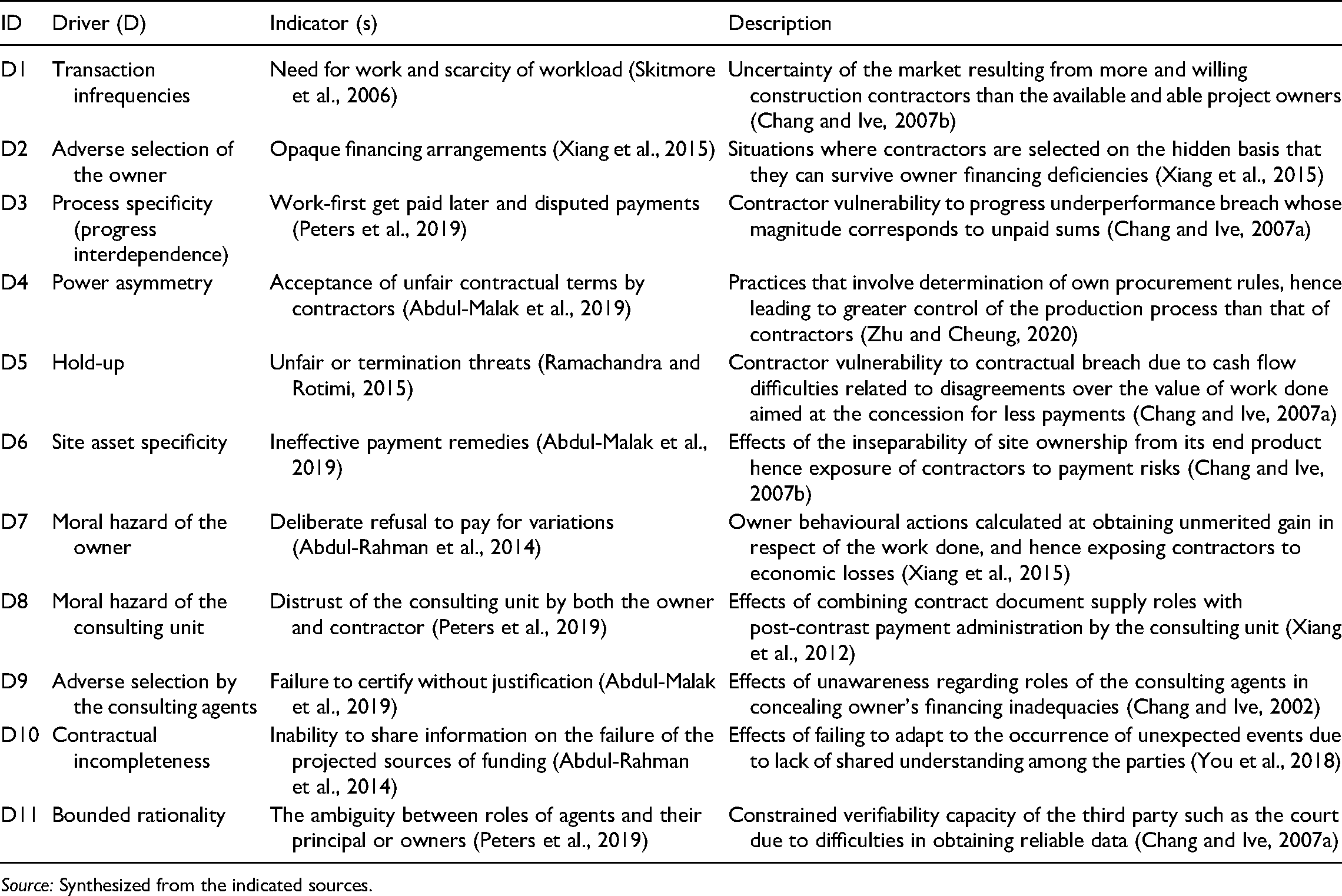
Source: Synthesized from the indicated sources.
Identification of incompatible practices
Column D of Table 2 lists the eleven incompatibilities between the D-B-B structure for procuring construction projects (column A) and manufacturing practices (column B). Moreover, Table 1 shows that the incompatibilities are mediated by their boundary drivers. However, interconnectedness, rather than simple dyadic connections, is the primary cause of incompatibility. The result is that, at the very least, four distinct yet interconnected ideas are discernible.
A framework of incompatible practices.
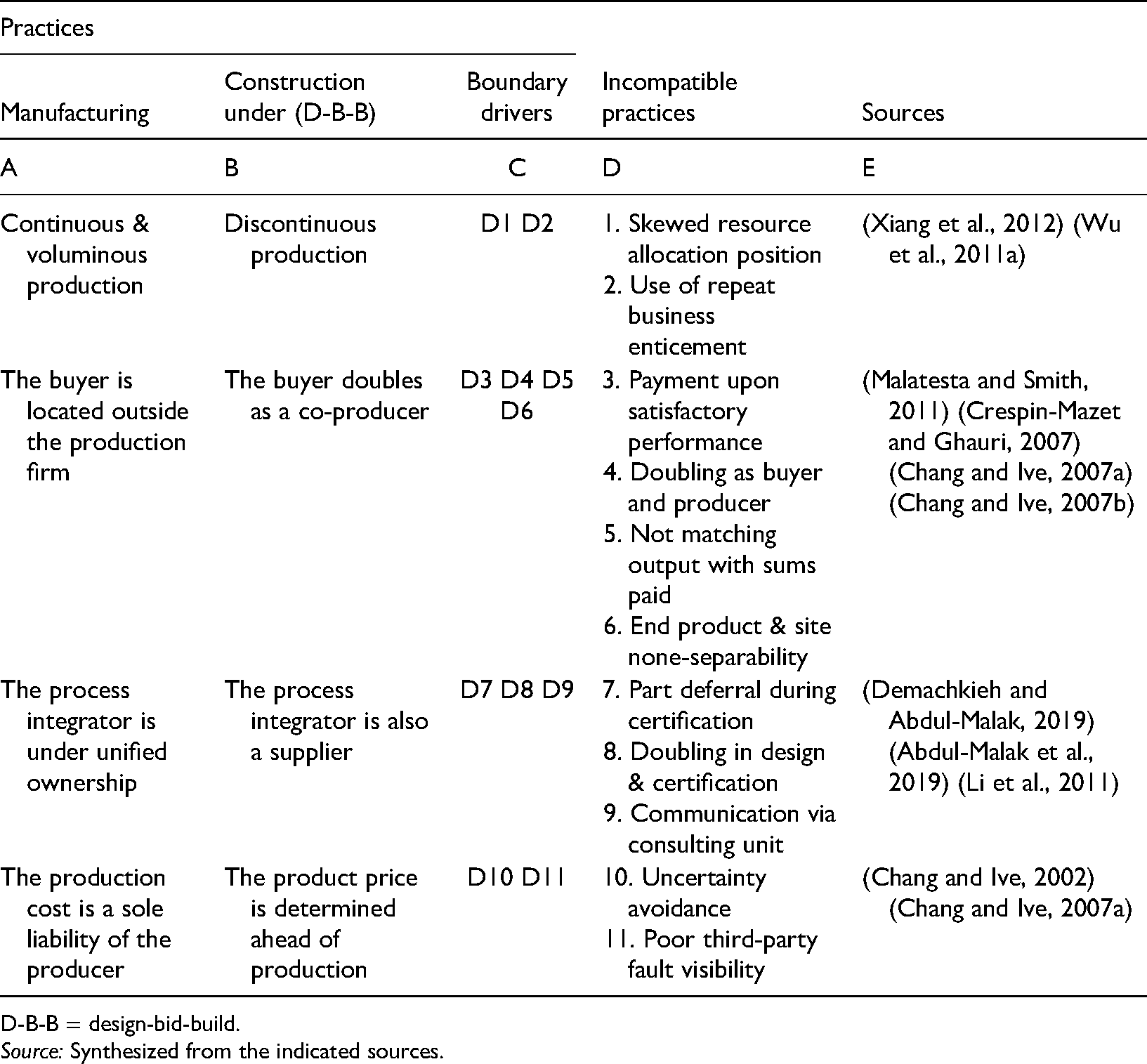
D-B-B = design-bid-build.
Source: Synthesized from the indicated sources.
A 2-mode practice-expert multivalued matrix.
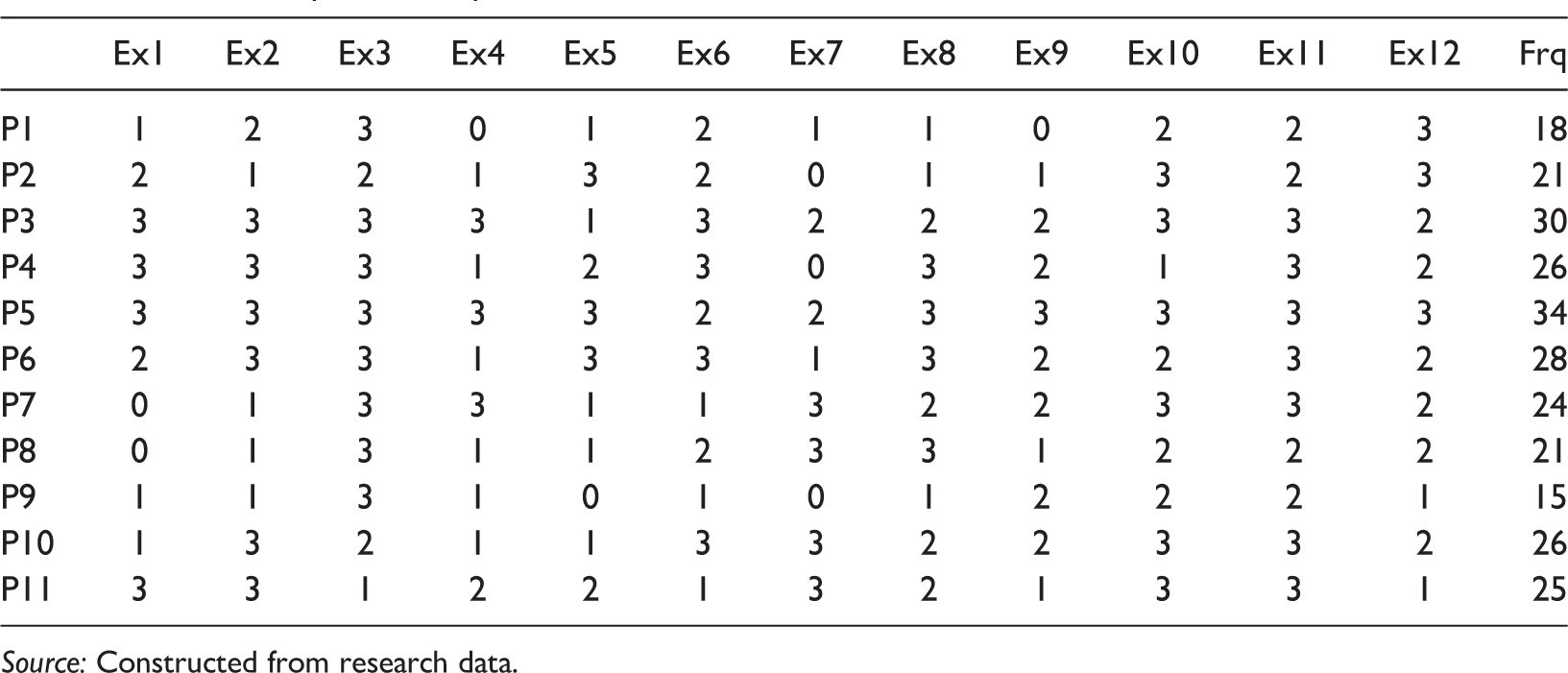
Source: Constructed from research data.
The continuous versus discontinuous dichotomy
When looking at Table 2, the first thing that stands out is the contrast between the continuous and discontinuous structure as reflected by P1 and P2. As a result of this one-off nature, the construction market has more sellers, or bidders, than buyers (Skitmore et al., 2006). In addition to this disparity, the contractor's offers are subject to the buyer's inequitable contractual terms (Abdul-Malak et al., 2019). Again, their resource constraints are deepened by their reliance on repeat business commitments (Wu et al., 2011a). As a result, there is a correlation between payment difficulties and the buyer's (owner's) proactive versus seller's (contractor's) reactive position.
Among other things, the foregoing point demonstrates that the offer and acceptance principles applicable to D-B-B contracting are not entirely consistent with those applicable to generic contracting. For example, in the D-B-B model, the seller/contractor submits an offer in the form of a bid price, which the buyer/owner either accepts or rejects (Skitmore et al., 2006). However, in a standard market, the interaction between demand and supply determines the exchange rate. As a result, the market can protect itself from unfair terms and monopolistic tendencies. However, in construction contracting, the roles are reversed. Consequently, the construction buyer can impose its own acceptance conditions, such as the prohibition of advance payments and opposition to escrow accounts. As a result of the interactions between the reversed roles, contractors may be exposed to unfair working conditions and, as a result, payment default exploitation.
The misalignment between owner/contractor roles with the structure
The second cluster demonstrates the irreversible effect of integrating the contractor's resources into the owner's site. As a result, the payment procedures of the D-B-B are not always consistent with the output. Underpaying for construction work produces an uneven control in favour of the construction buyer/owner with the presence of drivers D3-D6 (Turner, 2004). As a result, Table 2 incompatibilities 3–6 are expected.
The misalignment between intermediary roles and the structure
Thirdly, practices 7–9 illustrate the consequences of being unaware of the behaviour of other project actors (You et al., 2018), as well as the opportunism inherent in seeking profit at the expense of others (Xiang et al., 2015). As is the case with drivers D7–D9, the payment certifier's presumed impartiality is thus unrealistic. This is demonstrated by the observed inconsistency in contract administration and payment disputes (Abdul-Malak et al., 2019). As a result, contractors face payment issues.
There is thus an exception to the privity contracting principle because of the incompatibilities caused by practices 7–9. Engineers in FIDIC contracts, for example, perform both contract administration and certification tasks (Abdul-Malak et al., 2019). However, the combination tends to undermine contractual privity because obligations and liabilities can only be restricted to contract parties, in this case, the owner/employer and the primary contractor (Hughes, 2006). Because of this, Besaiso et al. (2018) revealed that the engineering agent's independence as an arbiter of payments was compromised when the owner delegated his tasks to the engineering agent. As a result, contractors are, for example, coerced into taking on the owners’ financial obligations and are unlikely to discover how they are related to late, partial, or non-payment defaults. Therefore, the privity assumption in the D-B-B-based FIDIC form does not adequately reflect the engineer's position.
Additionally, the duplication of agency and payment certification also demonstrates an inappropriate application of the forbearance law. The principle emphasizes tight administrative control and internal dispute resolution within a hierarchically structured organization (Williamson, 2002). However, these interactions are distinct from those that occur when merging separately held resources, as in the D-B-B option. In other words, the contractor's commercial interests are distinct from the owners. Thus, their control functions from the perspective of the DBB require inter-firm linkages (Winch, 2001). As a result, using an agent who is also a certifier to adjudicate payment disputes between the owner and the contractor has tended to exacerbate things (Zhu and Cheung, 2020). Therefore, the forbearance principle should be reconciled with the contractor's interests.
The deviations between price certainty and uncertainty
Finally, drivers D10 and D11 indicate a lack of compatibility with existing contract pricing practices. As a result, it suggests an attempt to replicate the market's certainty. Construction owners, on the other hand, are only able to acquire a promise of the future rather than a finished product (Malatesta and Smith, 2011). As can be seen from incompatibilities 10 and 11 in Table 2, failing to, for example, reconcile with post-contract variations results in an incorrect flow of payments to contractors.
As a result, it is crucial to realize that the general contracting principle of complete performance, which implies completeness and certainty, is not in line with construction contractual processes. Indeed, the performance is a partial and futuristic example of an exception to the rule of a whole performance. As a result of these arguments, Zhu and Cheung (2020) state that the construction sector is replete with disagreements about cost variances. Consequently, customized dispute resolution procedures are needed when basic contract conflict concepts don’t apply in such contexts (Chang and Ive, 2007a). This helps to explain, among other things, the typical construction contract practice that a dispute referral to a general commercial court is a last resort (Barman and Charoenngam, 2017).
The SNA perspective to the misaligned practices
With the aforementioned theoretical framework in mind, there is a need for a perspective that takes into account the interconnected nature of aspects such as payments, the outcome of which is contingent on the alignment or misalignment of their contextual drivers. In particular, SNA is considered a suitable perspective because it provides quantitative techniques for observing interconnected structures (Freeman, 2004), while the underpinning theoretical framework explains the functional aspects. SNA is based on graph theory (Loosemore, 1998), and uses data to model and analyze physical systems such as traffic networks (El-adaway et al., 2017b) as well as non-physical ones such as contractual networks (Pryke, 2005). Certainly, SNA is relevant for examining the structure of interactions between incompatible practices and their connections to an inappropriate flow of payments. Indeed, Lee et al. (2017) emphasize the suitability of SNA in such contexts.
A network, in its simplest form, is composed of a collection of points conceptualized as vertices or nodes that are connected by specified lines designated as edges, ties, or connections (Pryke, 2005). Ideally, the network can be represented as a matrix object, a graph, or both. Through the use of standardized metrics and concepts (Lee et al., 2017), SNA can explain the consequences and properties of a networked system (Chowdhury et al., 2011). In the construction domain, nodes have been used to represent entities such as people (Loosemore, 1998), firms (West, 2014), contractual risks (Yang et al., 2020), and project management practices (Pishdad-Bozorgi et al., 2017), just to name a few. Several of these studies have in common that they use interactions between entities to reveal connections or paths between clusters or groups involved in construction projects. To this end, SNA is critical for analyzing the interaction of disparate practices and their relationship to payment flows.
Methodology
The research questions posed in the introduction require descriptions and explanations. As a result, both qualitatively derived and quantitative SNA methods are adopted. Numerous construction management SNA-based studies, including Lee et al. (2016) and Pishdad-Bozorgi et al. (2017), highlight five commonly used steps. Using these examples, this study follows the following steps: (a) boundary specification, (b) sampling and data collection, (c) data matrix construction, (d) quantification metrics, (e) analysis and discussion, and (f) conclusions.
Boundary specification
In the first step, the entities to be used to construct the network were specified. Since this was informed by the research goal, those entities reflect the data sources. In this study, the output from Table 2 was used to develop a structured interview schedule based on a numerical scale and sought to find the extent of connections between the incompatible practices and the payment problem. The scale used ranged from 1) do not agree (0) to (1) slightly agree (1), (2) agree (2), and (3) strongly agree.
Sampling and data from the subject matter experts
In the second step, a sampling of respondents was conducted. In SNA surveys, a rooster as a register and/or a name generator (also known as snowballing) are the common data collection approaches (Yang et al., 2020). In Kenya, there is currently no register of experts in construction payment disputes. As a result, the snowballing method was used. In this case, an initial construction dispute resolver was contacted, whose name appears in a number of payment dispute cases (KLR, 2010). This contact was interviewed using a structured interview schedule developed in the preceding step and was also asked to nominate and provide contact information for practitioners meeting similar criteria. The criterion is as follows: (i) possession of a degree in the construction domain, specifically architecture, civil engineering, quantity surveying, and construction management; (ii) accreditation as a dispute resolver in the construction field; and (iii) experience resolving payment-related disputes of at least 8 years. The initial expert identified five contacts, four of whom were contactable, who in turn identified four, five, six, and six additional contacts. Although this process resulted in a total of 22 participants, it was discovered that seven had been nominated multiple times. As a result, the final list included 15 experts.
Although 15 potential participants were scheduled for interviews, only 12 were interviewed due to the inability of the remaining three to keep their promise to participate, despite repeated follow-ups; 75% were quantity surveyors, while 25% were civil engineers with proportionately corresponding experience in building and civil works. Approximately 67 per cent indicated that they were involved in approximately 50/50 public and private dispute cases, while 25 and 8% indicated that they were involved in both the private and public sectors. As illustrated in Figure 1, the number of disputes resolved ranged from 6 to 61, with an average of 29, and 91 per cent involving more than 10 cases. The average number of years of experience in payment-related disputes is 20, with 67 per cent having more than 10 years of experience. Although there is no correlation between the two demographic characteristics, their relative magnitude indicates in-depth knowledge of the subject and thus suffices to define the second network boundary. To collect data from the 12 experts, a structured interview schedule was created using the incompatible practices listed in Table 2. As a result of this step, a matrix with two modes was created (Table 3).
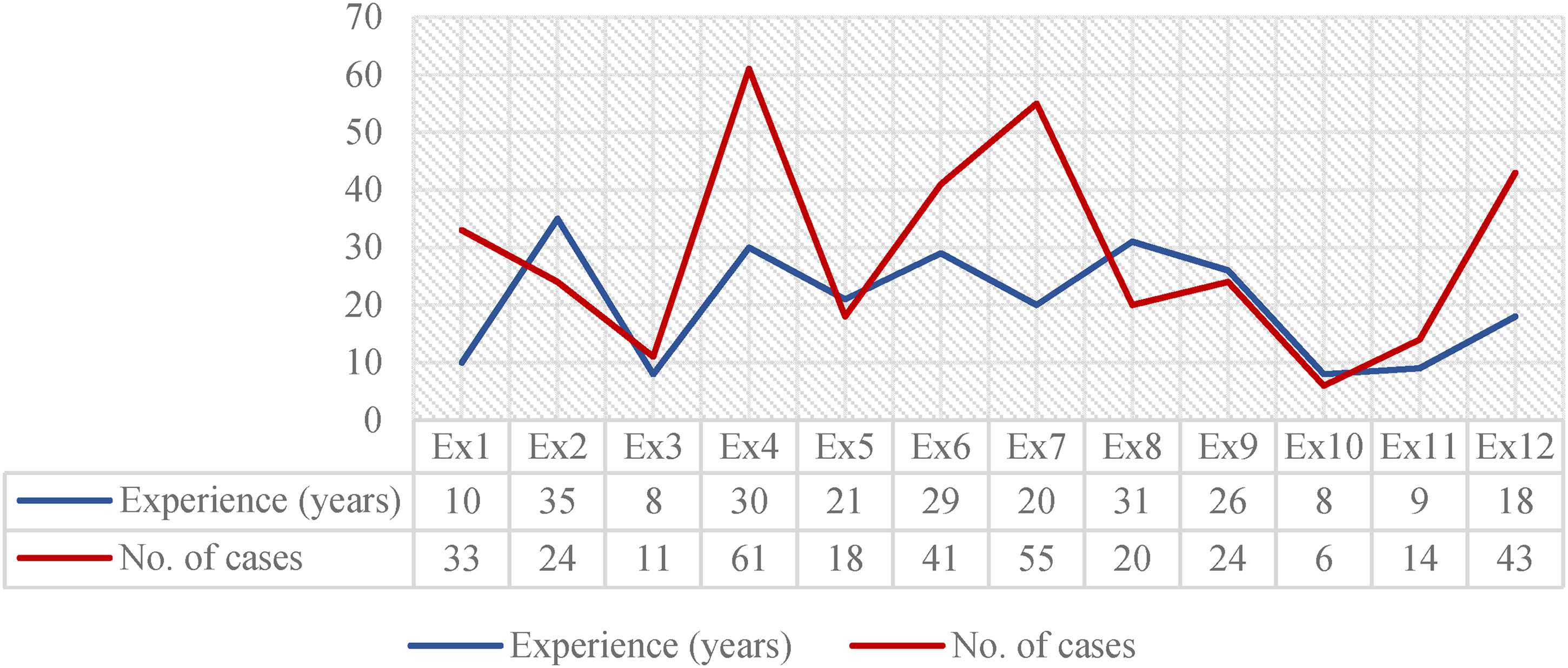
Expert experience and number of cases. Source: Constructed from research data.
Construction of data matrices
Two-mode data matrix
Table 3 illustrates the outcome of this step. It demonstrates that there are 11 rows labelled as practices, namely P1–P11, and 12 columns labelled as experts, namely Ex1–Ex12. The column is immediately adjacent to Ex12 and displays the frequencies (Frq). The cells in the matrix represent a rating score for each of the practices. However, neither the rows nor the columns demonstrate any connections between incompatible practices. As a result, connections and their patterns cannot be identified and analyzed. However, Chowdhury et al. (2011) demonstrate that one way to resolve this is to convert the two-mode matrix to a one-mode adjacency matrix.
One-mode adjacency matrix
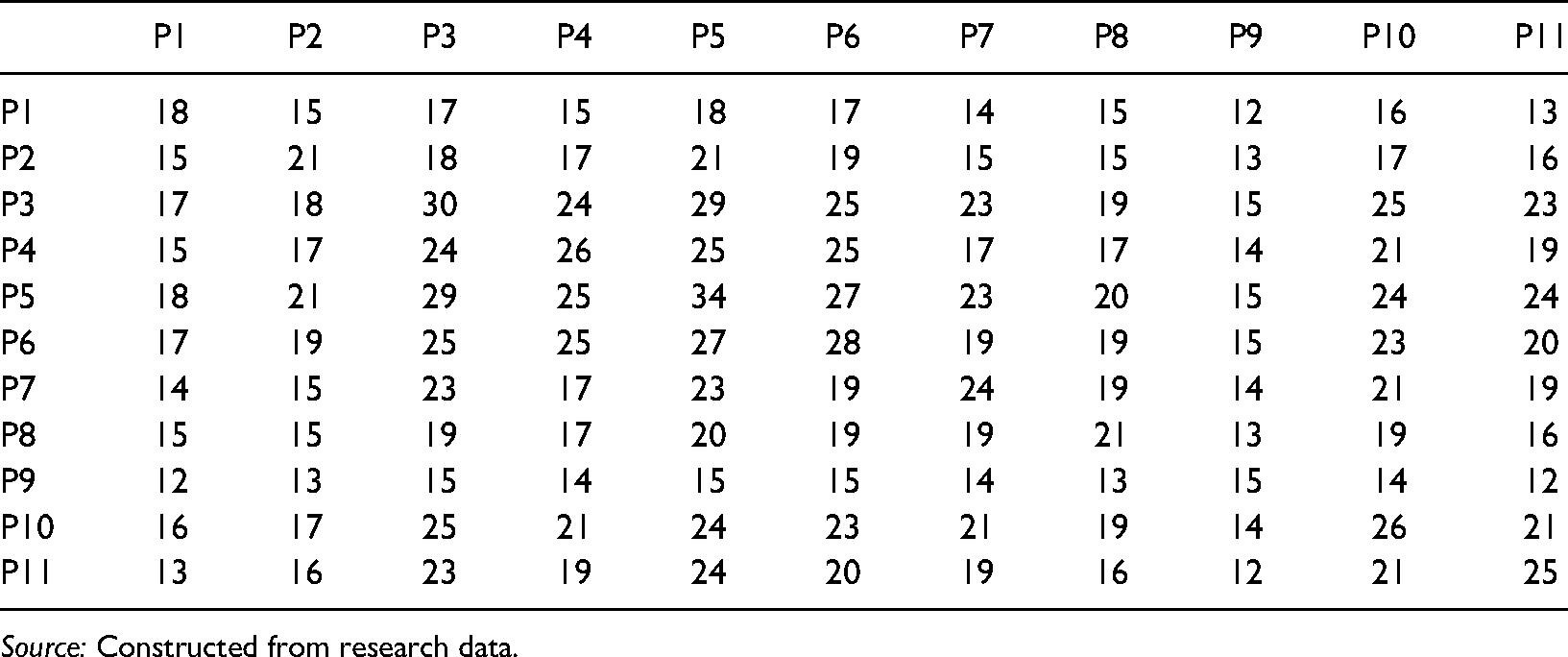
As a result, Table 4 contains a matrix with a single mode adjacency computed by multiplying the matrix in Table 3 by its transpose. The score assigned to each cell indicates whether or not connections exist and their relative weights. In comparison to Pishdad-Bozorgi et al. (2017)'s binary matrix structure, the weighted data demonstrate that connection (P1, P3) is stronger than (P1, P2), as indicated by scores of 17 and 15. Furthermore, the adjacency matrix is asymmetric and undirected. As a result, the source of enabling and the recipient are irrelevant, as the score for incoming and outgoing connections are identical. This property specifies the equality of values above and below the diagonal. Additionally, the diagonal values are consistent with the frequencies listed in Table 3. Therefore, confirming that the transformation from two-mode to one-mode did alter the data structure.
One-mode practice-practice multivalued adjacency matrix.
Source: Constructed from research data.
Quantification metrics and concepts
In the construction engineering and management-related SNA literature such as El-adaway et al. (2017b), Lee et al. (2017), and Lee et al. (2016), systematic reviews and contextualization of various metrics are offered. With this context in mind, a sample that is considered relevant is inherited and adapted into the current study. Therefore, these are briefly discussed.
Constructing connections based on flow betweenness
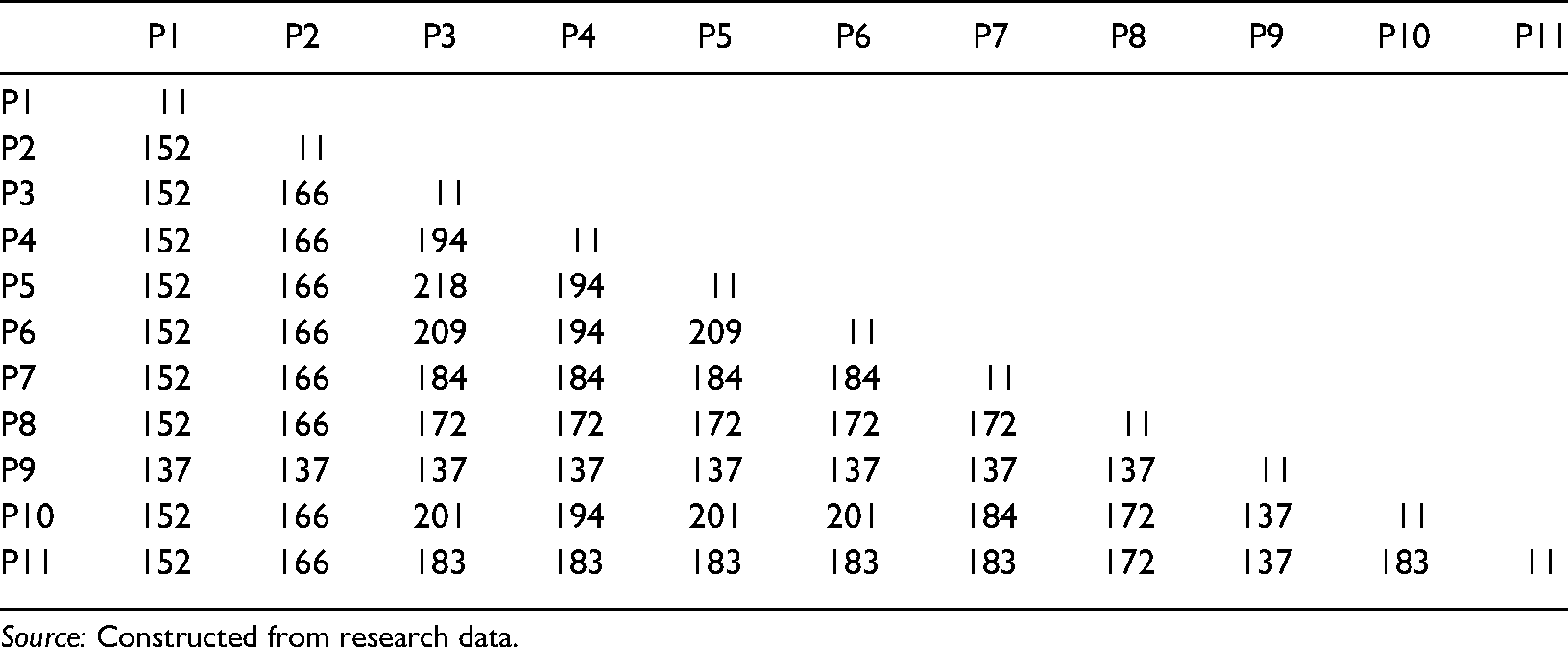
After constructing a one-mode adjacency matrix, the research objective suggests a focus on connections. As a result, a flow betweenness metric is used to establish links between incompatible practices and the enablers of those practices. The metric, developed by Freeman et al. (1991), takes both weighted and unweighted data into account in proportion to the paths of the entire network, rather than the shortest path (geodesic). The geodesic distance technique presupposes the presence of a few intermediaries, which results in faster transmissions (Aljassmi et al., 2014). However, to determine the relatively higher degree of dissimilar connections between the boundaries associated with the D-B-B in comparison to other structures (Skitmore and Smyth, 2007), all possible network connections must be considered. For example, Li et al. (2011) use the flow betweenness metric to assess the influence of intermediary roles on contractual relationships, and Eteifa and El-Adaway (2018) use it to determine the rate at which a connection between unrelated construction accidents causes enables or disenables accident occurrences. With these examples, it appears that adopting a networked perspective of unrelated roles can help reveal the associated conflicting interests and strategies (Table 4). Following that, this output is used as an input for constructing a matrix of structural equivalence (Table 6).
Maximum flow betweenness matrix.
Source: Constructed from research data.
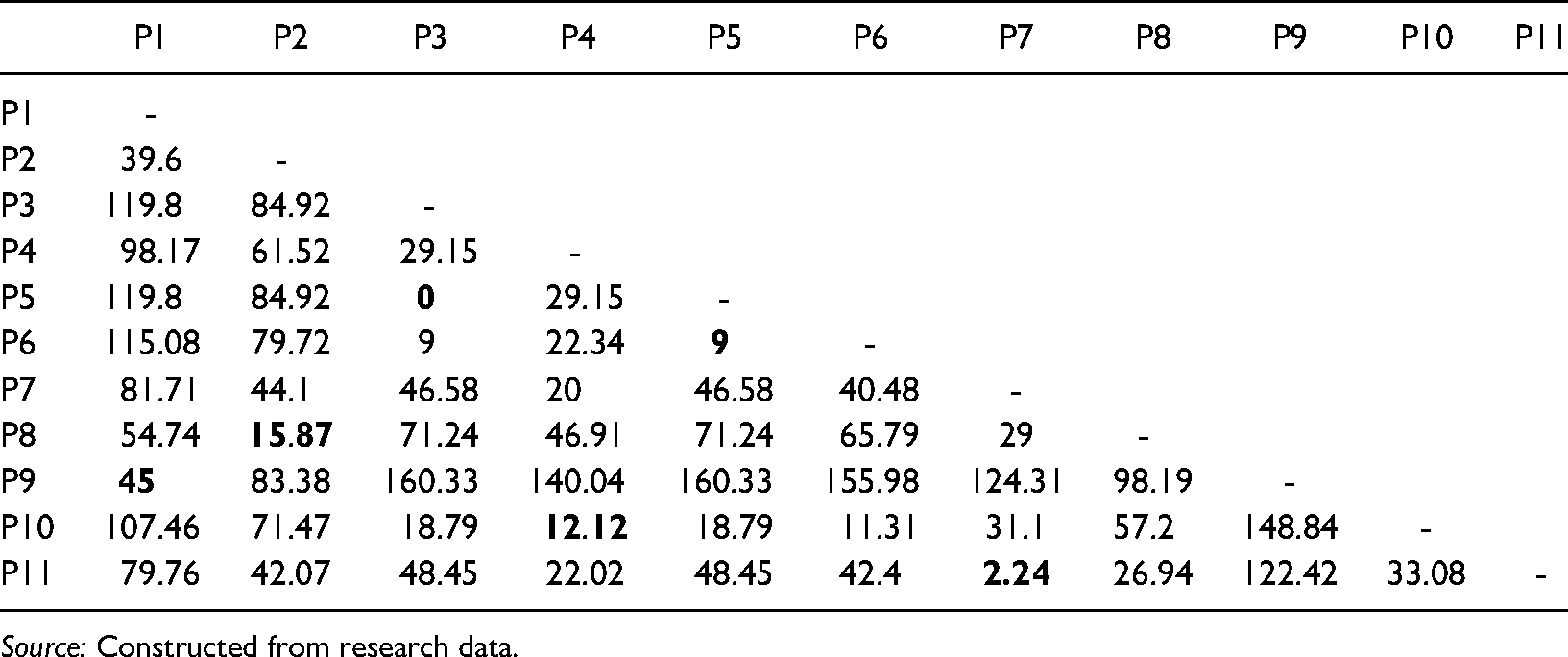
Structural equivalence matrix of Euclidean distances.
Source: Constructed from research data.
Measuring dissimilar connections and clustering
One method for partitioning an interconnected data structure is to use a structural equivalence metric. Consequently, it is possible to measure similarities (Li et al., 2011) or dissimilarities (Solis et al., 2013). As an illustration, connections within clusters, such as the consulting unit, frequently exhibit similar interests, and thus their degree of similarity can be quantified. Clusters with competing interests, on the other hand, exhibit weaker points and thus indicate separation interfaces, as there are more economic differences between clusters than within (Chang and Ive, 2002). Thus, the extent of the differences reflects payment-related challenges and is thus quantifiable using techniques such as the structural equivalence matrix (Loosemore, 1998). Although other techniques, such as hierarchical clustering (Solis et al., 2013), can accomplish the same thing, the Euclidean distance method enables the profiling of roles based on their dissimilarities (Table 5).
Measuring distances between connections
To index dissimilar connections and their patterns, one method considered relevant for this study is the Euclidean distance. In comparison to other methods, it is optimized for non-linear and weighted relationships. Due to these capabilities, its score can be greater than one, in contrast to similarity measures, which have a range of scores between 0 and 1. For example, when the lowest score is zero, the connections are more similar in terms of their utility-maximizing interests. On the other hand, the closer the score is to zero, the less dissimilar the connections are. Lee et al. (2016), in particular, employ the Euclidean distance method to deduce the strategies that distinguish the performance of firms bidding on construction projects for the same client. The application of the Euclidean distance method to this conceptualization reveals how the degree of dissimilarity enables payment problems.
Results and discussion
Following an overview of the methods, this section presents the findings, analysis, and discussion within the highlighted subsections.
The connections between practices
Table 5 shows the results of connections between incompatible practices based on the maximum flow betweenness method. Diagonal scores are not particularly relevant, but they do indicate how much influence each practice's connections have. This case, in particular, has an equal score of 11, which indicates that the roles are similar. Moreover, the scores above or below the diagonal show that the influence of connections across clusters varies, and hence roles are therefore dissimilar. However, to determine their extent, further analysis is required.
The extent of dissimilarity between practices
To compute dissimilarity indices, the result of Table 5 is transformed into a structural equivalence matrix, as illustrated in Table 6. Furthermore, that computation is predicated on the premise that the closer the Euclidean distance to zero is, the greater the conflict of interest between the practices. As a result of the symmetry of that matrix, only the result below or above the matrix is required. This demonstrates that, as indicated by their respective indexes, the varying dissimilarities between practices have varying connections. Above all, only six indexes, highlighted in bold, are associated with the payment issue. The most significant link among the six is (P3, P5), which has a score of zero. This demonstrates that paying for satisfactory performance and failing to match progressive payments to the amount of work completed have a similar but opposite effect on the contactor cluster. As a result, P3 implies a proactive strategy, whereas P5 implies a reactionary one.
To illustrate the impact of strategy differences, consider that under the D-B-B structure, the related roles are performed on behalf of the construction owner by the consulting cluster. This, however, has the effect of shifting the owner's control over the realization process to his or her advantage. As a result, the shifting of control compares with the bargaining power in Chang and Ive (2007a). As a result of the interaction between P3 and P5, it appears that the owner's strategy is more effective than the contractor's reactionary strategy. Furthermore, such efficacy assumes utility-maximizing owner capacity, as evidenced by late, under-, and non-payment strategies. As a result, this finding implies that the payment problem is not a coincidental occurrence but rather highlights the importance of strategic actions.
To further explain the second finding, Table 6 indicates that the second most significant connection, as indicated by a score of 2.24, is (P7, P11). It exemplifies the interaction between the practice of deferring certification of certain aspects of work performed and the less effective third-party dispute resolution mechanism. For example, certification is frequently delayed due to a discrepancy between the actual output and the contract price (Abdul-Rahman et al., 2014). However, this practice limits the contractor's ability to complete the project on time. Indeed, for an owner whose primary objective is to acquire the constructed facility at the lowest possible price (Chang and Ive, 2002), the cost of completion compared to the amount owed dictates whether to terminate and switch to another contractor. Arbitration or court mechanisms frequently prove ineffective for the contractor (Ive and Chang, 2007), as the information necessary to prove its case is held by the consulting cluster. As a result, the duty of the owner-information custodian (Sha, 2011) is to safeguard the construction owner's interests first under these circumstances, information likely to benefit the claimant (contractor) is rarely disclosed (Xiang et al., 2012). Again, the practice of duplicating contract documents and certification enables certification functions to be manipulated in a way that compensates for the owner's financing inadequacy. However, these tactics are difficult to detect through arbitration or court mechanisms.
To illustrate the third finding, Table 6 demonstrates the significance of connections (P5, P6), which has an index score of 9. It illustrates the interaction between the failure to match progressive payments to the amount of work completed and the end product's inseparability from its site. Indeed, this entails the owner's reactive strategy being combined with the irreversibility of the construction site. In the latter case, the buyer/owner establishes its own procurement rules, allowing the contractual site possession element to be separated from its legal ownership. As a result, this also enables the doubling of buying and production roles, as is commonly demonstrated when paying for work performed by a contractor while also supplying their own site input that becomes part of the output. With this advantage, the buyer or owner can determine their utility. As a result of this chain of events, payment remedies such as those outlined in Wu et al. (2011b) become less effective.
The disintegration and integration profile
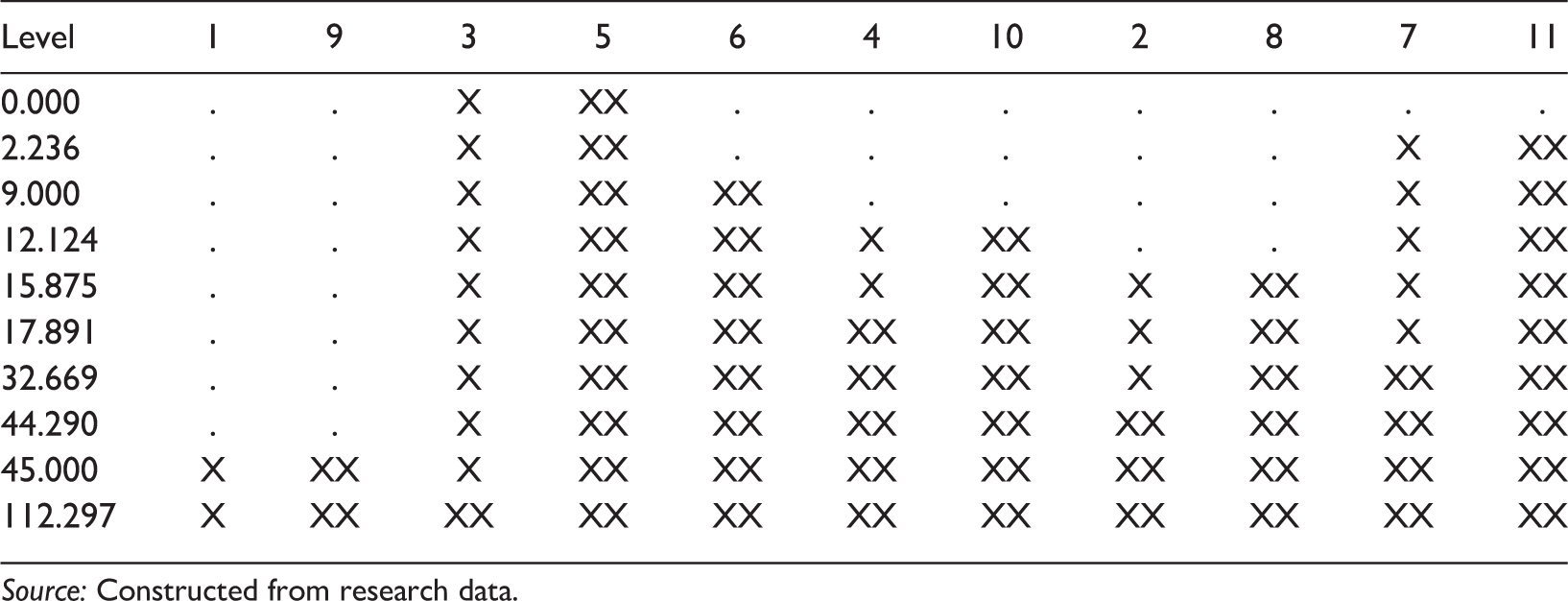
Table 7 and Figure 2 were used to profile the observed connections. They demonstrate a profile in which 11 disintegrated practices integrate to varying degrees on 10 levels. Notably, connection (P3, P5), 0.000 initiates the pattern of integration, connection (P1, P9), 0.000 is the last connection to integrate, and index (112.297) is the point at which all 11 practices fully integrate. At least two significant observations can be made in light of these results.
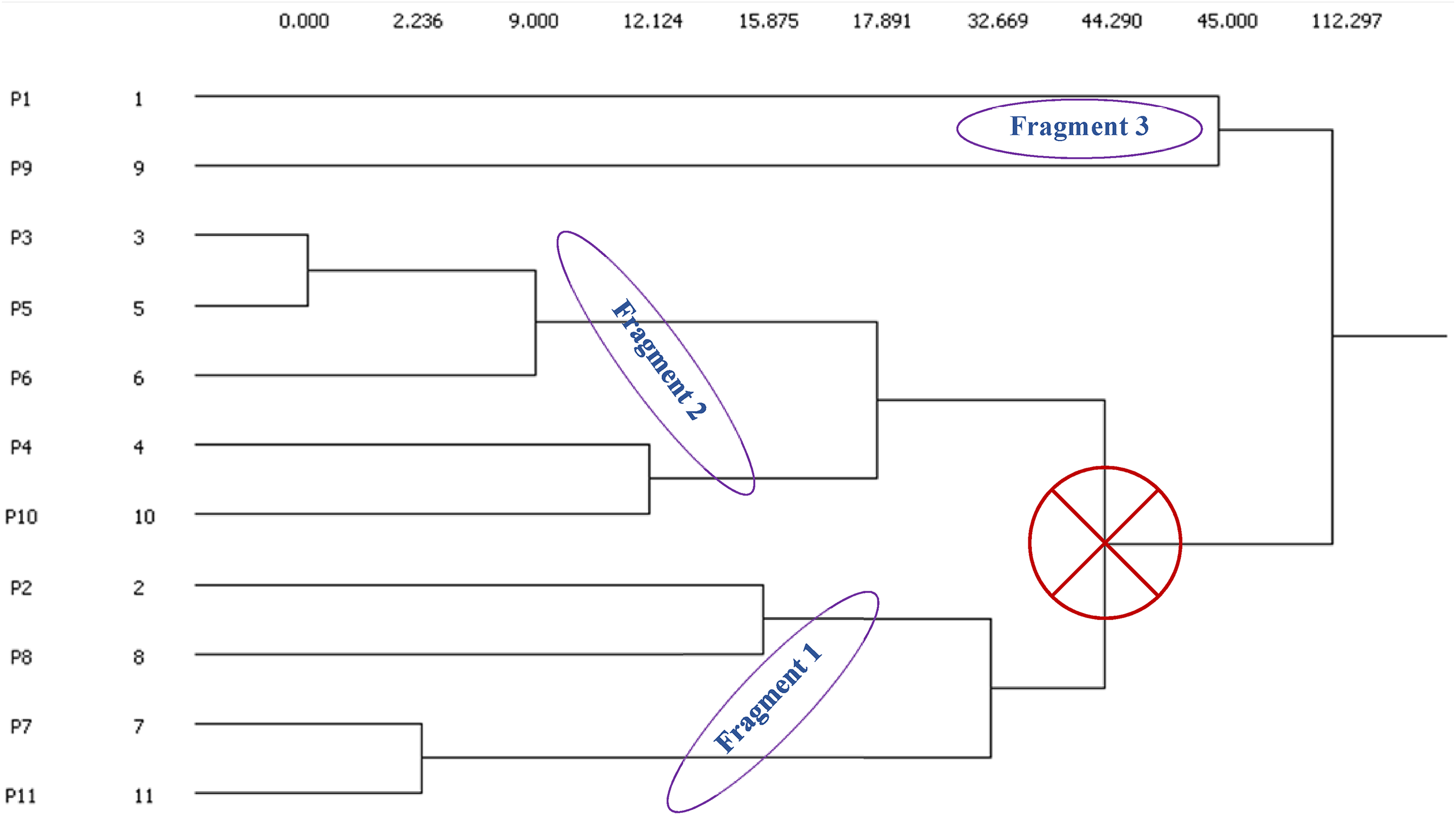
Clustering dendrogram according to the Euclidean method. Source: Constructed from research data.
Hierarchical clustering of structural equivalence matrix.
Source: Constructed from research data.
To begin with, it is demonstrated that the initiating index, 0.000, and the last to integrate, 45.000, are adjacent. They are, however, dissimilar to the extent of a 45.000-dimension distance. This reflects the locational proximity, which is consistent with the representative nature of the consulting cluster's certification functions on behalf of the construction owner. Indeed, the same consultant performs the functions denoted by index 45.000 (P1, P9), where P1 entails resource allocation functions such as tender document preparation and contractor selection on behalf of the owner. Simultaneously, P9 entails information coordination between the owner and the contractor. Although P1 and P3 and P5 belong to two distinct sub-clusters, they are carried out on behalf of the construction owner by the consulting cluster and thus correspond to the site and financing roles. However, as Skitmore and Smyth (2007) note, the site reflects the owner-determined procurement structure, which includes design, specifications, and cost estimates. For this reason, roles are close to one another and overlap. Consequently, the consulting and construction owner clusters appear to be more informed than the contractor cluster. Thus, they can conspire to initiate the construction process without sufficient funding (Peters et al., 2019). As a result, late, under, and non-payments will be used as a means of transferring owner financing obligations to the contractor.
Second, index 44.290 and its y-axis intercept (Figure 2) represent a position that is also represented by a T-junction and a gate valve. That point underpins the consulting cluster's intermediary functions in the D-B-B structure. A disconnection, on the other hand, disintegrates three fragments. Indeed, each fragment exhibits a distinct pattern, as indicated by its slope, implying the presence of three conflicting interests. As a result, they depict the interactions between the buyer/owner of the construction, the designer, the contract administrator, and the contractor. They must, however, be integrated to realize a constructed facility. Accordingly, practices 2, P4, and 6 are related to the site but have an immobile character. As a result, this feature distinguishes the end product's ownership rights from the construction contractor's temporary site possession. Additionally, the consulting unit's roles in terms of design, associated plans, and tendering processes are distributed across the three fragments, namely P1, P2, P8, and P10. Simultaneously, this cluster is accountable for the roles associated with P3, P5, P7, P9, and P11. Although these roles are associated with the payment certification process, as illustrated in Figure 2, they are also distributed across the three fragments. As a result of this overlap, the matching of roles and interests is reduced. Consequently, these constraints impair the contractor cluster's ability to strike a balance between the work performed and the timeliness, completeness, and certainty of payment. In summary, the extent to which practices overlap enables conflicted interests and, consequently, payment problems.
The block model results
Although Table 7 and Figure 2 demonstrate that the overlap of dissimilar interests and roles facilitates payment problems, the result does not reveal the underlying causes of variation within and across practices. However, being aware of these variations can serve as a springboard for realignment. Additional analysis is required to bridge this gap. In this regard, the most frequently used method is the block modelling approach based on CONCOR or Tabu optimization (Yang et al., 2020). Both algorithms are based on a rule that correlates the elements of an equivalence matrix according to a predefined number of clusters. This is in contrast to Figure 2 prior hierarchical clustering and similar methods, which produce the result from the data. With the three fragments obtained in Figure 2 as the desired number of blocks, the Tabu method was used, which groups matrix entities with fewer dissimilarities together and those with more dissimilarities apart. In comparison to the CONCOR method (Yang et al., 2020), the Tabu technique was chosen because the input data from Table 5 is weighted or valued.
Although the number of fragments in Figure 2 was used to partition the structurally equivalent matrix in Table 7, the resulting model solution in Figure 3 shows a realignment. The first thing to notice in Figure 2 is that fragment 1 contains P2, P7, P8, and P11. However, Table 8 block 1 contains P1, P2, and P3. Second, P11 has been moved from fragment 1 to block 2 from fragment 1. Thirdly, P1 has been moved from fragment 3 to block 1 from fragment 3. As a result of this reassignment, the goodness-of-fit correlation coefficient is 0.77 out of a maximum of 1. That coefficient is derived from a comparison between the model depicted in Figure 3 and one in which all elements with a score greater than 1 are ones and those with a score less than 1 are zeros. A level of agreement of at least ¾ is typically considered to be a good fit and thus indicates the reliability of the block assignments in Table 8 and their densities in Table 9.
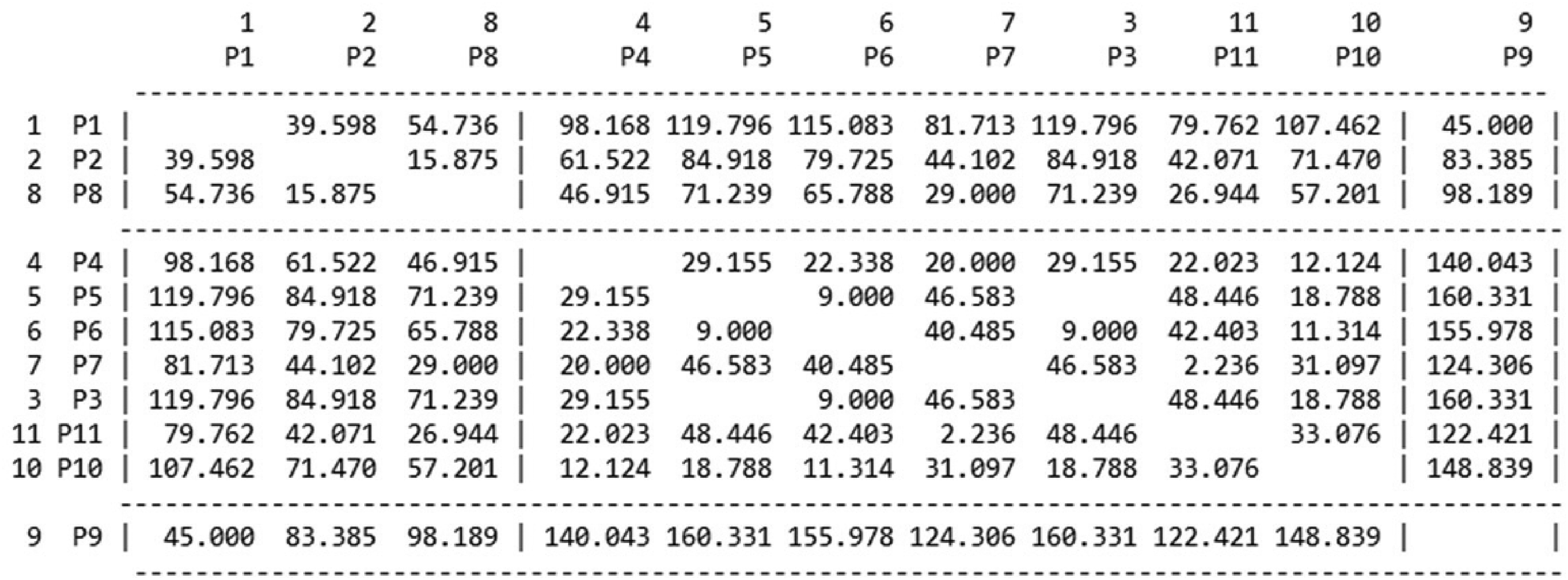
Optimized 3-block solution for structurally dissimilar practices. Source: Constructed from research data.
Block assignments.
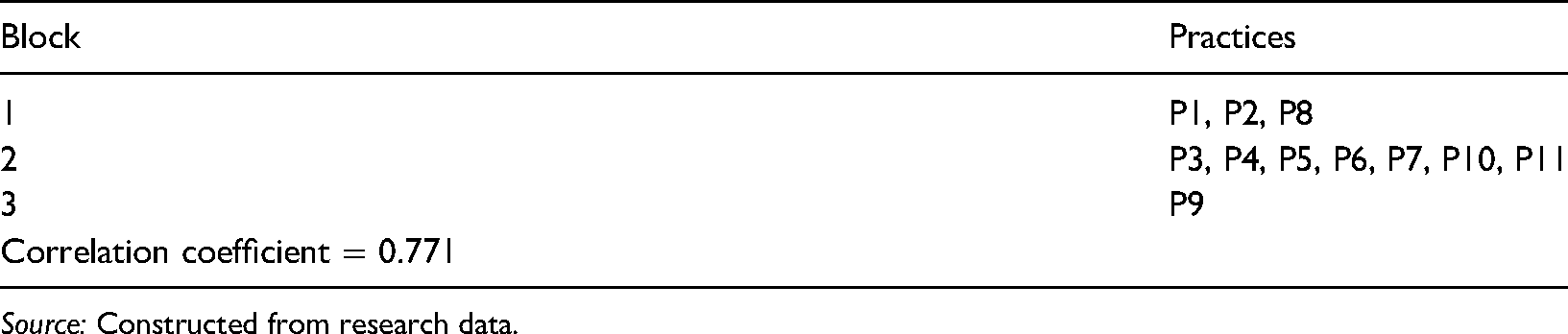
Source: Constructed from research data.
Density indexes of the block models.

Source: Constructed from research data.
As a result, the density matrix in Table 9 indicates the sources of variation within and across blocks. For instance, although block 3 contains only P9, it receives more than it sends to the other blocks. Indeed, the D-B-B structure emphasizes the consulting unit as the intermediary between the construction owner and the contractor cluster. This data relates to the interaction between pre-contract design, cost, specification data, and performance. As a result, such a misalignment runs counter to the presumed partiality associated with the effectiveness of the mediator in mediating the flow of resources between the owner and the contractor. According to Abdul-Malak et al. (2019), this role plays a significant role in the majority of payment problems. As a result, it is necessary to pay closer attention to how this role interacts with the others.
Conclusion and future work
Using a SNA perspective, the study sought to determine how the differences between practices borrowed from manufacturing sectors such as automotive and applied to the realization of construction projects under the D-B-B contracting structure enable late, underpayment, and non-payment to construction contractors. Using Euclidean distance indices, this study was able to show that the differences have varying connections to the payment problem as opposed to previous payment-related research. The most significant index illustrates the relationship between the practice of payment upon satisfactory performance and the inability to reconcile the sums paid with the work done. However, this connection acts as a veil, concealing, for example, the owner's strategy of acquiring the constructed facility at the lowest possible price. As a result, the payment issue rarely arises by chance, but rather as a result of a combination of predetermined and reactive strategies. According to Crespin-Mazet and Ghauri's (2007) reactive characterization, it is not uncommon for contractors to fall victim to a trap set up to drain them of their resources, as evidenced by the payment issues.
More importantly, a successful strategy for the owner relies on the interplay of three opposing interests and the role of the consulting cluster as an intermediary in this interplay. As a result of this embeddedness, the opposing interests are thus enabled. Due to this ambiguity, late, underpayment, and non-payment tactics can often be masked to hide, for example, owner budgetary deficiencies. As a result, it is not unusual for the contractor cluster to be coerced into taking on financing obligations without clear mechanisms for reimbursement.
Because of this, the study has at least four outcomes. As a starting point, it shows how existing payment default remedies can be evaluated for feasibility by linking contracting strategies with indexed interactions between incompatible practices. Second, it reveals the rationale for contract negotiations, which can be used to evaluate current contract practices. In particular, it provides a rationale for rationalizing the dual role of the engineer in the FIDIC red book into four roles as outlined in (Besaiso et al., 2018). Third, it shows scenarios that can deviate from some of the standard contractual principles. Finally, it dichotomizes the owner's market position as both proactive and reactive, whereas the contractor's market position is solely reactive. As a result, both sides are better equipped to make an informed decision.
Although the data from the expert interviews was sufficient for computing dissimilarity indices, links to the payment problem were established and block models were developed. If this study is used as a basis in the academic community, it can be used to evaluate, for example, the construction project case studies that have reported payment issues and structural alignment issues. The authors of this paper are investigating these issues in greater depth, and the results of that investigation will be published in the future.
Footnotes
Declaration of conflicting interests
The author(s) declared no potential conflicts of interest with respect to the research, authorship, and/or publication of this article.
Funding
The author(s) received no financial support for the research, authorship, and/or publication of this article.
