




Abstract
This article compares and contrasts two classical decision-making approaches used in outsourcing specific public services. We perform content analysis of semi-structured interviews with public managers who are engaged in contracting for different public services, and find that incremental or small step-by-step decision-making is more likely to be observed in the outsourcing of “soft” or human services. Rational decision-making on the hand is more likely for “hard” services including janitorial services, public works, bridge design, street striping, parks maintenance, strategic planning, refrigeration experts, and food services. Our findings also indicate that some services can be outsourced using both decision-making approaches in certain cases. Using comparative analysis, we identify three factors associated with incremental decision-making across the organizations in our sample. All organizations that outsourced services using incremental models of decision-making had a for-profit business partner, experienced managers, and exhibited desire for cooperation and coordination.
Introduction
Over the last two decades, public managers’ attention has been drawn to contracting out as a potential panacea against inefficiency, unresponsiveness to clients’ needs, and overpolitization of service delivery. Numerous articles have been published in scientific magazines and journals in efforts to provide guidance for public managers, as well as to advance theoretical scholarship in the field. Decision-making models, however, were not part of academic discussions on understanding the process of effective contracting out. Public organizations operate in complex and often uncertain environments where the effects of globalization and resource scarcity among other factors can be more pronounced. Yet demands for more and different forms of accountability by citizens are unwavering. As a result, public managers increasingly bear the burden of making various decisions, including those associated with the process of contracting out service delivery. And we often see that public managers are getting more skilful in managing contracting transactions (Kakabadse and Kakabadse, 2001), though many problems still remain.
Some persistent difficulties can be attributed to principal-agent dynamics in the exchanges, and potential use of cumbersome rules and regulations that guide government–vendor interactions. Notably, power imbalances in partnerships may result in lower than expected mutual gains (Grimshaw et al., 2002). And even when there are efforts to reduce rigid regulation and red tape as well as desires to incentivise cooperative partnerships, we are not assured positive outcomes (Brown et al., 2013). As contracting becomes more complex and nuanced, we need further examination of how decisions are made to assure effective outsourcing of public services.
The purpose of this paper is to examine the connection between the classic approaches to organizational decision-making and the phases of contracting for different types of services. We begin by reviewing the public services contracting out literature and the pursuit of cost-effective, high-quality service delivery. In particular, we outline the use of Transaction Cost Theory (TCT) in explaining why public services are contracted out. Theoretical developments have been vast in explaining the “why” questions of contracting out: why outsource, why rely on different types of vendors, why structure various coordinating (monitoring) arrangements (Brown and Potoski, 2003)? The scholarly efforts in this arena depict why a range of decisions are made when contracting out; however, we have neglected to explore “how” are the decisions made. To fill this gap in the literature, we explore how contracting decisions are made. In particular, is the decision-making different in the outsourcing of different types of services?
In our review of organizational decision-making approaches, we begin with the central tenets of the rational decision-making model and outline its main steps in reference to contracting for different types of services. We then explore the connection between incremental models of decision-making and contracting. Subsequently, we lay out propositions to suggest that rational decision-making models should be most applicable when outsourcing hard services, while incremental decision-making may be more likely for soft services with difficult-to-measure outputs (Lamothe and Lamothe, 2012). We conduct semi-structured interviews with managers from five organizations responsible for outsourcing decisions of twenty-six services in Washington State. We summarize the results of content analysis of the interviews by contrasting and comparing the two decision-making approaches used in the outsourcing of the specific services. Subsequently, the study provides a more in-depth view on decision-making across organizations. To do this, we rely on comparative analysis to examine common factors across our cases. Finally, we discuss the implications of using two decision-making approaches to contracting out.
Public services contracting out: seeking high quality at a lower cost
Since cost saving is a major objective for contracting out, transaction cost theory (TCT) is commonly used to explain outsourcing decisions in both business and public sector settings (Böhm et al., 2016; Girth et al., 2012; Greer et al., 1999; Ngwenyama and Bryson, 1999; Thiem and Dusa, 2012). Theoretically, Tjader and coauthors (2014) posit that “A primary objective of outsourcing is to free up internal manpower and resources, and to reduce the need for management oversight, thus improving cash flows and reducing costs” (p. 617). Contracting out is essentially a transaction, or a sequence of transactions, that entail information searching, bargaining and writing agreements, monitoring and enforcing contracts (Tjader et al., 2014). All of these steps in the outsourcing process can be costly for a contracting agency; however, internal production can also be costly since public managers would have to hire and train personnel for the specific requirements.
Decisions to contract out public services are multistep processes where in-house production is weighted versus using vendors from a market place. Similarly to businesses, the classic question frequently is: should an agency produce services in-house or buy them from the market? (Tjader et al., 2014). A key assumption in the leading theoretical approaches (TCT and agency theory in particular) is that parties engaged in contracting out are rational and opportunistic, and function in uncertain environments with incomplete information (Ngwenyama and Bryson, 1999; Tjader et al., 2014). As a result, it is suggested that public managers make production choices to minimize risks associated with services characteristics, state of the market place, and potential goal incongruence with vendors (Böhm et al., 2016; Brown and Potoski, 2003; Carr et al., 2009).
From a public manager’s perspective, the contracting out process consists of the following steps: governments resolve (a) a make or buy dilemma; then public managers (b) engage in vendor selection; after a vendor is selected (c) the preparation and implementation of the contract follows; subsequently we have (d) monitoring of the contract performance; and (e) the process concludes with auditing and post-contract assessment (Brown and Potoski, 2003; Yang et al., 2009).
Managers make decisions at every step of the aforementioned process. Arguably, these decisions are rooted in the desire to minimize costs associated with the delivery of services as outlined by the transaction cost literature. Essentially, public managers must decide whether to outsource all or some of the service components, decide what type of vendor to work with (for profit, nonprofit, another public agency), how the contract will be structured, how vendor(s) will be monitored to assure quality service performance, and whether the contract will be renewed at the end of its terms. These decisions are not necessarily independent of each other, and might be made collectively to minimize the total costs associated with contracting out. TCT logic can be used to derive explanations throughout the entire contracting process. Ngwenyama and Bryson (1999) outline how the theory can be used to provide guiding principles to help analyze buyer–vendor exchanges, as well as guidance in determining efficient structure and management of exchanges.
TCT is commonly used to explain when governments should rely on contracting out to reduce costs of public service delivery. The theory pivots on the fact that contracting out opens up public agencies to risks and public managers must be able to reduce costs associated with these risks. Opportunistic behavior of exchange partners, and shirking are two frequently cited potential risks. In order to minimize these risks, managers can invest in monitoring strategies and/or can develop coordinating mechanisms (Böhm et al., 2016; Ngwenyama and Bryson, 1999).
The theory often outlines service characteristics, competitiveness of the market, and vendor type as important factors to explain the “why” of contracting out. We know when (why) to buy: contract out services that do not require specialized investments, have easy-to-measure outputs, and there is vendor competition. We know why governments should chose nonprofits or other governments as vendors: reduce potential costs of opportunistic behavior and shirking resulting from potential goal incongruence. And we know why investing in monitoring and developing coordinating mechanisms is important: minimize risks, improve accountability.
Technically TCT can provide guidance and can help explain why a contracting out decision is made. We can easily observe if a service has been outsourced, who the vendor is, and how oversight mechanisms are structured. However, we don’t know what explains the decision-making: are the decisions made rationally or in incremental fashion? How contracting decisions are made is equally as important as why they are made. It is our hope that incorporating decision-making models with TCT can help scholars advance theoretical propositions for cases that do not fit neatly with TCT, or other logic of other theories. In this article, we focus on the “how” question of contracting out. In particular, how are outsourcing decisions made when public managers contract out government services?
Rational model of decision-making and contracting
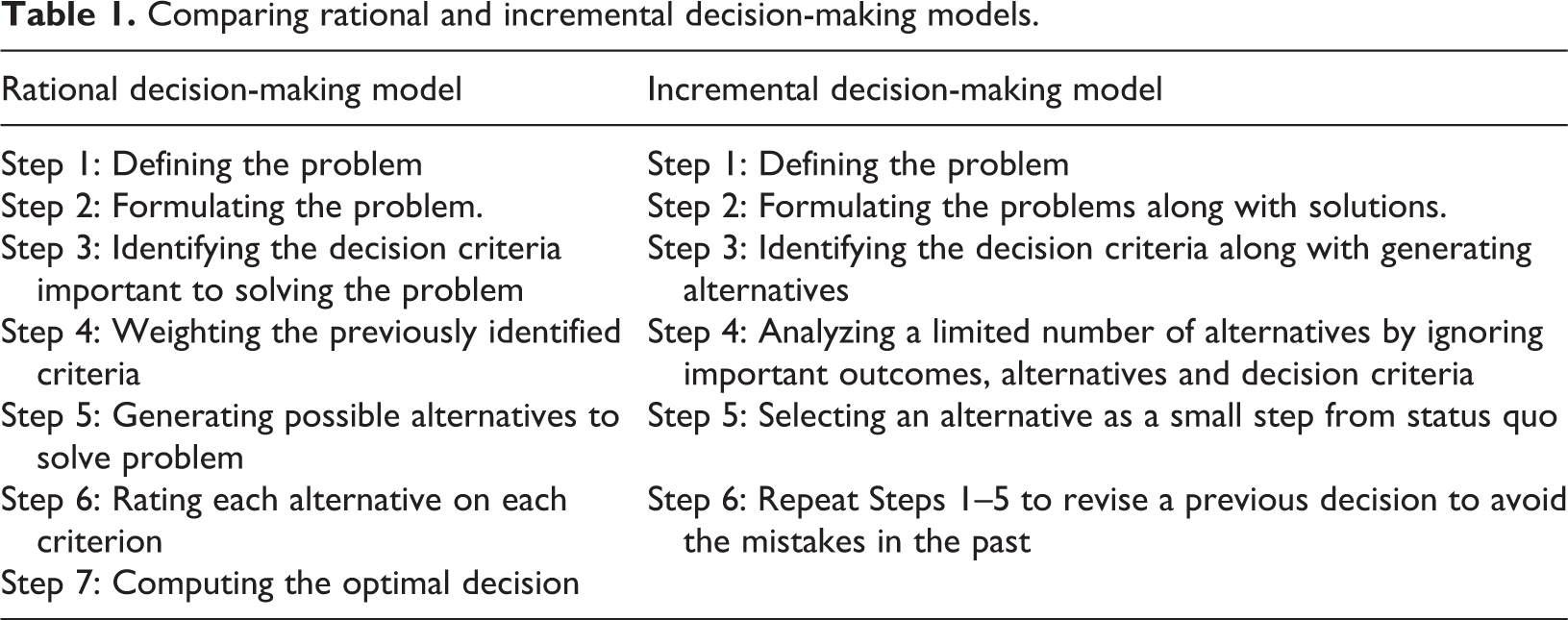
The rational model of decision-making is based on the assumption that people are “homo economicus” and tend to optimize their behavior outcome using cost–benefit calculus. According to this approach, the decision maker is aware of the problem, develops the particular goals and criteria according to which alternative solutions to the problem will be evaluated, assigns the weights to these criteria, develops the alternatives and chooses the alternatives that minimize the costs and maximize the outcomes for the decision maker (Simon, 1976, 1997). Many public administration scholars such as Allison (1969) treat governments as unitary, rational decision makers who weigh the costs and benefits of alternatives and select the option that best achieves objectives and creates policy decisions. Public managers who outsource services delivery can resort to this model when it comes to contracting processes. Essentially they can adopt the typical seven-step model (Harrison, 1999) which is described in Table 1.
Comparing rational and incremental decision-making models.
Incremental model of decision-making and contracting
The incremental decision-making model was developed by Charles Lindblom (1959) to incorporate the problem of limited cognitive capacity. Essentially, decision makers have to deal with overload of information relevant for decision-making. Lindblom (1959) argues that sometimes social problems are too difficult to resolve by using the prescribed seven-step rational decision-making model. Instead, he offers step-by-step approach by developing decisions that differ incrementally from the status quo. As shown in Table 1, a fast-moving sequence of small changes can more speedily accomplish a drastic alteration of the status quo than can an infrequent major decision (DeYoung and Conner, 1982; Nilsson and Dalkmann, 2001; Sullivan and Siegel, 1972).
Incremental decision-making prescribes a sequence of small steps in the “right direction” and if it has been proved to be the “wrong” direction, you have to move in the right direction (Lindblom, 1959, 1979). This can be best understood in the situation of contract modification. When a contract is awarded for development of a new technology and the government agency has no prior knowledge of this area, the contract specifications can be quite vague, and yet contract execution proceeds.
Relational contracts are based on the principle of small-step experimentation and allowing for errors in the course of developing innovative solutions. Decision-making in these cases consists of a sequence of trials, errors, and revised trials. The best example of this particular aspect of incremental decision-making is performance-based contracting where vendors are given full discretion over the process of the work provided they can deliver particular outcomes with required levels of quality that has been agreed upon (Martin, 2003). This type of contracting is end-oriented, instead of mean-oriented and envisages lower transactional costs since the contractor should not be monitored so closely, which could substantially lower public agencies’ transactional costs.
Constantly redefining the problem is another feature of incremental decision-making. Its rational counterpart requires an initial definition of problems to be so clear and concise that it is virtually impossible for subsequent redefinition later on in the process. The incremental decision maker on the other hand changes the definition of the problem. This occurs through interactions with the problem by numerous ends-means and means-end adjustments, thus making this problem more manageable (Lindblom, 1979). This holds true in the negotiations for the soft or human services where the exact measurement of performance standards is difficult, and the environment tends to be unstable. Therefore continuous re-definition of problems is required.
Data and methods
To examine the connection between the classic approaches to organizational decision-making and the phases of contracting for different types of service, we interviewed public managers who are directly involved in the contracting out of services. We utilize descriptive methods by summarizing the information from the interviews into a summary matrix in order to contrast and compare which approaches were used in the outsourcing of the specific services.
We conducted semi-structured interviews with managers directly involved in the administration of contracted out services. In our research we focus on individual services rather than jurisdictions as, broadly speaking, individual services lend themselves to different decision-making processes. Even if services are provided by the same public agency, and the same manager makes the decision, their production characteristics might require different decision-making and implementation. For this reason, the service itself is our unit of analyses. In order to acquire a detailed account of the decision-making process used in the outsourcing of a range of public services, we conducted phone interviews with five city managers as well the purchasing and contracts manager at a Washington State agency. 1
The municipalities included in our sample are small to medium sized ranging from 8500 to 51, 609 residents 2 . All public managers that were interviewed were male with average public service tenure of twenty-two years. The interviewees’ average experience in contracting out was 15.8 years. The interviews were recorded and transcribed. Subsequently the transcripts were reviewed to identify common themes in the decision-making processes used to outsource public services using classic content analysis (Bauer, 2000). A codebook was developed to categorize decisions and guide the data analysis. We relied on projective pattern content analyses, and deduced coding schema from theoretical reasoning on contracting out. The interviews lasted about an hour on average.
In total, the decision-making processes for twenty-six services were described by the interviewees. Public managers were asked to explain the contracting out process, beginning with how a decision was made to outsource a service, and what steps were taken subsequently throughout the length of the contract. Using their answers, we operationalized what type of decision-making was used in the outsourcing of the services. We also codified the level of competition for the services, and what type of vendor was used.
Findings
In this paper we stipulate that on average, rational decision-making models are likely to be used more frequently for contracting out in the area of “hard” services. To assess our claims, we first evaluate which steps of the rational decision-making model are present in the outsourcing of the twenty-six services. This coding separates services into two categories: (a) service was contracted out using incremental decision-making; (b) service was contracted out using rational decision-making approach.
To tabulate the services into the two categories we note which steps of the typical seven-step rational decision-making model are present. Similarly we examine whether the six steps of the incremental decision-making model are evident (Table 1). Services where more than one of the steps of rational decision-making are observed are coded as outsourced using rational decision-making. This is the case since the rational approach requires problem formulation (Step 2), development and weighting of goals or criteria (Step 3 and 4) and development of alternatives (Step 5) (Lindblom, 1959).Identification of Step 1 in both models of decision-making along with other steps of incremental decision-making places a service in the category of incremental decision-making since the decision for outsourcing does not require separation of problem analysis from identification of goals/criteria and development of decision alternatives (Lindblom, 1959). We denote services where no steps (as outlined by the two decision-making models) are identifiable to be outsourced using incremental decision-making. We associate these with the presence of bounded rationality which in essence preempts incrementalism (Lindblom, 1959; Simon, 1976, 1997). Table 2 depicts the categorization of services into ones outsourced using the steps of incremental, and rational decision-making approaches.
Contracted out services and decision-making approaches.
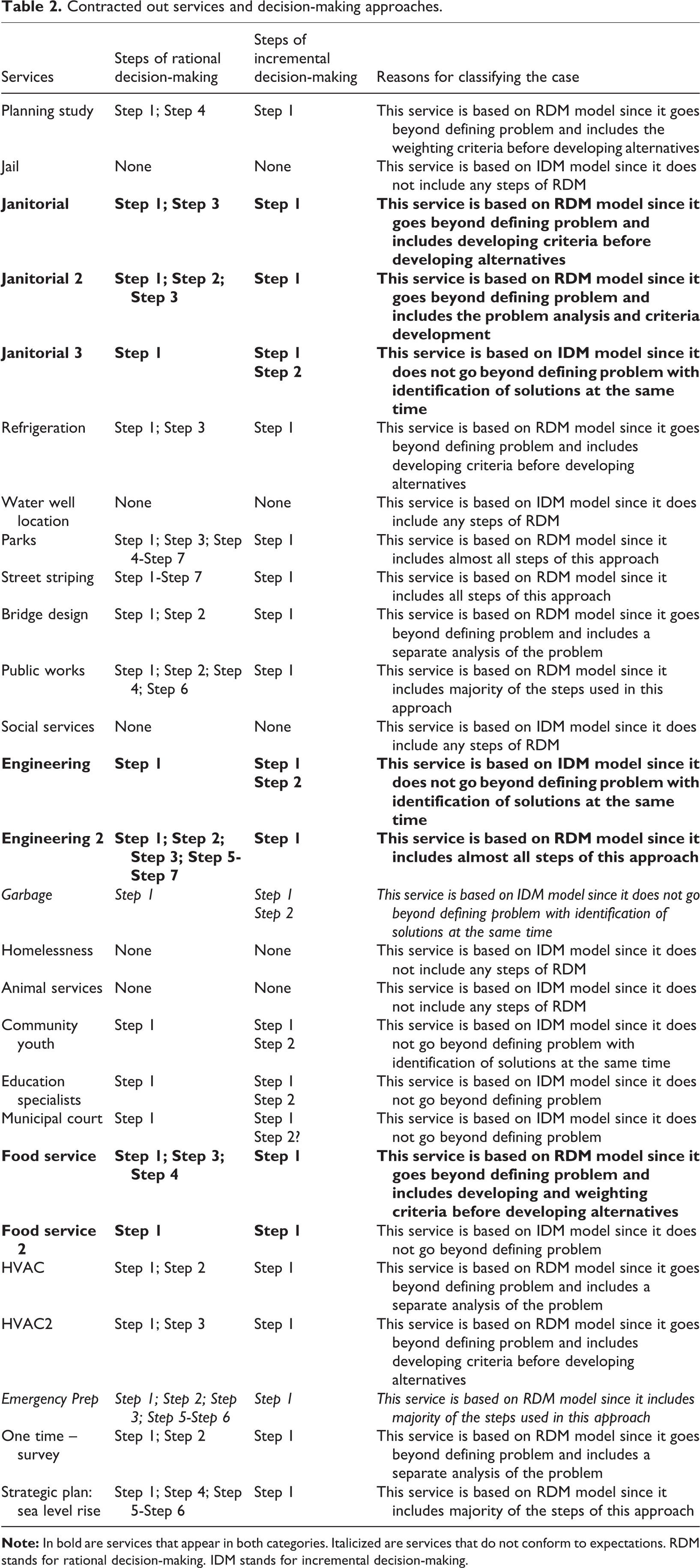
We will begin by outlining the outsourcing of services where incremental decision-making was used, and then do the same for services where rational decision-making was evident. We will also discuss the contracting out of services that do not confirm our expectations (italicized in Table 2), and lastly we will discuss services that appear to be contracted out using both decision-making models in different jurisdictions (services in bold in Table 2).
Service areas where contracting out relies on incremental decision-making models
Overall the results of our analyses support our propositions. The findings indicate that most of the human and professional services are outsourced using incremental decision-making. The outsourcing of services that adopts incremental decision-making logic appears most pronounced for (a) social services, (b) homelessness; (c) animal services; (d) water well location, and (e) jail. The outsourcing in these cases does not start with a problem definition nor problem formulation, but rather with a solution: desire for partnership. A couple of the public managers interviewed for the study outlined that their desire for partnership was the main goal. Not surprisingly, for these five services all vendors are other public agencies: two nonprofits, a local government, an interlocal agreement between three local governments, and a first nation tribe. None of the partners are for-profit organizations representing businesses.
The remaining cases where incremental decision-making was used to outsource service delivery, only outline problem definition or formulation (either Step 1 or Step 2 in a seven-step rational model). All other steps required for rational decision-making are absent in the outsourcing of these services. In five of these cases the vendor is a for-profit business: (a) garbage collection, (b) engineering, (c) education specialists, (d) janitorial, and (e) food services. Table 3 depicts our categorization of services into those that we consider “hard” and those that can reasonably be labeled “soft” in addition to the number of steps clearly outlined in their outsourcing. The top twelve services (in bold) are predominantly “soft” services and at most one step of the rational decision-making model was present when deciding to contract them out. These are services where we can expect greater reliance on interpersonal attributes when it comes to negotiating contractual arrangements (Driver and Johnston, 2001).
Classification of services and steps used in contracting out decision-making (0-7 denoting incremental to rational).
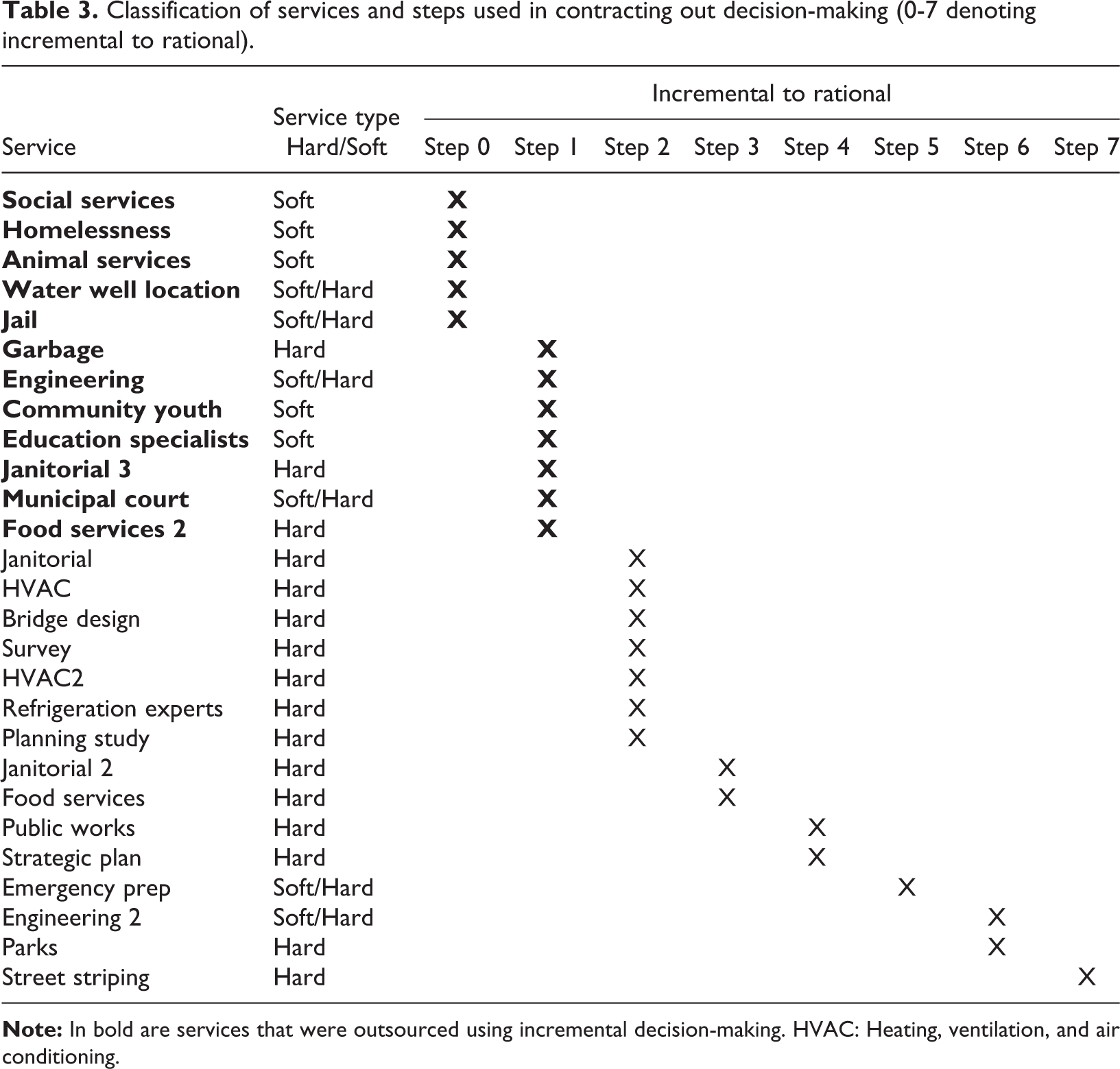
The first five services (where no steps of the rational decision-making model were used) also share a common theme: none of the vendors for these services are for-profit businesses. Rather the preferred contracting partners are one local government, two nonprofits, one Tribal Nation, and an interlocal agreement. As we move further down (and to the right) in Table 3 we see an increase in the use of for-profit contracting partners. As more steps are included in the decision to outsource a service, we also see an increase in the number of private sector vendors used for public service delivery. Column four in Table 3 (Step 1) includes seven additional services. Out of these five rely on private sector contracting partners.
Our categorization shows that four of the services could be considered as either hard or soft and we label them as such. It is also evident that there are services that do not meet our expectations: garbage collection, engineering, janitorial, and food services appear to be outsourced in an incremental fashion in this study. These particular services appear to have been outsourced in different ways in different jurisdictions and are discussed in greater detail further below.
Service areas where contracting out relies on rational decision-making models
An exemplary case of rational decision-making when it comes to the outsourcing of a public services was a decision to keep garbage collection and management in-house. Though the service was not outsourced, the decision-making process follows the rational decision-making model much more closely, as we propose in this paper. The process started with government officials asking whether the function is core to its mission. Then, the process outlines decision criteria that are important for solving the problem (Step 3), previously identified criteria were weighted (Step 4), possible alternatives that could succeed in resolving the problem were generated (Step 5), alternatives were rated on criteria – efficiency, equity, and legitimacy – and an optimal decision was computed (Steps 6 & 7). In this case, the rational model of decision-making was used to justify keeping the service in-house. Thus, it appears that the rational decision-making model can also be used to explain why services are produced in-house rather having them contracted out.
The contracting out of the remaining services in our sample supports our proposition regarding the type of service to be outsourced and the decision-making logic. All of the services in the rational category employ multiple steps from the seven-step rational model. These are all services that have easy-to-measure outputs and are often classified as “hard” services. In Table 3, these services and their associated steps can be located on the right side of the table: from Step 2 to Step 7. It must also be noted that two of the vendors for these services (emergency preparedness and street striping) were local governments; the remaining partners for this group of services were for-profit businesses.
Service areas where both decision-making models are used
In our sample, three categories of services were outsourced using the two different decision-making approaches: janitorial, engineering, and food services. We typically expect janitorial services to be outsourced using a more rational approach to contracting. In our sample, one case used an incremental decision-making approach when outsourcing janitorial services, and in two cases the approach was more rational. In the case where the approach was more incremental, the interviewee outlined how the jurisdiction has used the same vendor for three years and just rolls the contract over. It appears that as long as both parties are satisfied, there is no need to revisit the agreement. Originally, the decision to outsource the service was not made through any of the seven steps of the rational decision-making model, aside from defining the problem.
In the two cases where the rational model was observed, both jurisdictions evaluated whether the service was core to the city’s mission. One interviewee expressed that: “We used to have janitorial in-house…part of the criteria for switching to contract was that we were trying to maintain more highly skilled workforce, and our janitorial staff really did not fit that. There was a lot of turnover with janitorial staff, a lot of work hiring, we were also moving to green products and did not want to invest in that. So we went out and contracted, very successful for over 15 years, because it was the type of service that was not core to our mission.”
Engineering services was another category that was observed in both decision-making models. Interviewees outline that, when hiring engineers, they rely on qualifications. In one of our cases, the approach is clearly more incremental as outlined by the city manager: “…we have used the same engineering firm for at least ten years as our primary engineer. Sometimes when we receive a grant, they will require that you do a specific request for qualifications for those funds, and we have fired different engineers on occasion, but for the most part we have used the same engineer for a long time.”
In the other case where engineering services were outsourced, we can clearly see a more rational approach using most of the seven steps. Expertise is outlined as a main reason. The interviewee clearly depicts the decision-making process that necessitates contracting out the service: “So when you are talking about doing a pressure study within your water system, and we have four zones in our water distribution system you need to hire an expert in the distribution of water, water systems, pumps and reservoirs. That’s not something you will always have on staff.”
Food services are another category that appears in both rational and incremental decision-making models. In the first case, the process begins with knowledge/skills gaps assessment “who can fill it or fix it for us”. Subsequently, decision criteria important for solving the problem are identified and weighted using cost–benefit logic (Steps 3 & 4): “…what is the cost benefit ratio there as far as do we need that service often enough to justify having a full time position”. Decision-making criteria where different values are used are observed prominently in this particular case (Step 3): “…it’s a really complicated conversation. But basically the cost is so much higher for an institution like this to manage and that’s a hard conversation to have with the community when it’s values versus cost…” “And that’s a thing where you think, oh gosh, it’s running a restaurant, here’s the space, but only one person wanted to do it…I think when you get to bigger communities there’s probably more opportunities and more robust competition. At this community, I’d say it’s a hit or miss.”
Service areas where contracting out decision-making did not support propositions: the exceptions
We also have findings that do not neatly fit our expectations. One outcome that is inconsistent with our expectations is the use of incremental decision-making in contracting out garbage collection. In the course of the interview the reasoning was clearly outlined. Even though, the jurisdiction had “defined” a problem (Step 1) it was not associated with the service itself. The manager explained that “The city was in a total financial crisis and was looking for ways to increase revenue…went through a competitive process and chose one of three bidders”. No other steps from the seven-step rational decision-making model are exhibited in the outsourcing of this service. There is no evidence of clear decision-making criteria, nor weighting previously identified criteria that lead to the outsourcing of the service. No alternatives have been considered, nor rated in order to compute an optimal decision. Instead, the contract has been renewed consistently and new functions added: “…the original contract with them was for 10 years, but the city did a couple of different extensions and added more time…they added recycling services which didn’t exist before. So as a part of the deal to add recycling, they got an extension on their contract so you know they’ve done a couple of things like that where they basically created a twenty-year contract for themselves.”
“Another one when we would contract out would be something in the same vein (emergency preparedness), because we don’t have enough work for the type of individual, then we will look to partner with neighboring cities, or actually look for a contractor to do the work.”
In this case, the approach was to partner with another city, though currently the jurisdiction is weighting the option of producing emergency preparedness in-house. The growth of jurisdiction was outlined as a reason to justify the costs associated with the development of the technical abilities that are needed. Though, the partner in this case is another local government, the decision-making calculus includes multiple steps from the seven-step rational decision-making model.
Decision-making across organizations: a comparative analysis
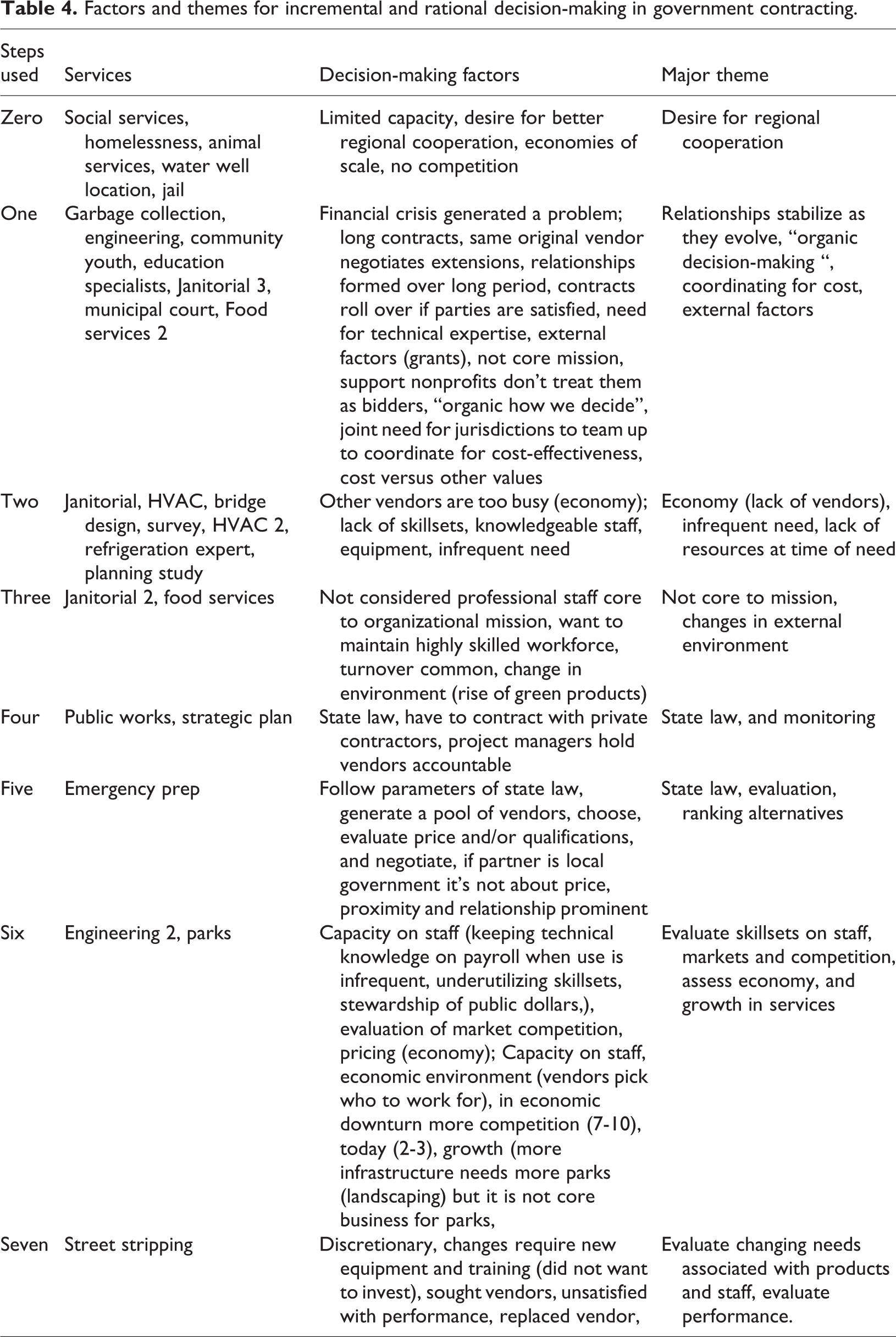
In this section, we provide a more in-depth view on the decision-making across the organizations in our study. First, we group services by the number of steps from a rational decision-making model that were exhibited in their outsourcing. Table 4 depicts the services grouped into the number of steps we can confidently observe. We also present an abbreviated account of decision-making factors that were outlined by the interviewees (column three). Then we construct (distill) what we perceive to be major themes associated with these factors (column four).
Factors and themes for incremental and rational decision-making in government contracting.
After tabulating the services, we focus on the ones that were outsourced with an incremental decision-making approach. We focus on these as they are common to all public organizations in our sample: in all cases at least one service in each organization was present in the first two rows. Our reasoning here is two-fold.
First, all services outsourced with incremental decision-making appear to have a common theme. For services that were contracted out by not using any steps (Zero Steps Used in Table 4) there was a desire for regional cooperation. Similarly, for those services that were contracted out by using one step (Table 4), relationship-building and coordinating efforts were important. These two major themes, emergent from our content analyses, seem to share a common subject. The services that were contracted out using rational decision-making (Steps 2–7 in Table 4) on the other hand, do not appear to share a common theme. For services that were outsourced using multiple steps from the rational decision-making model we can identify at least four major themes: (a) the economy and competition, (b) organizational mission, (c) prevailing laws, (d) need for evaluation and oversight.
Secondly, in the incremental decision-making cases (first two rows) we have services that appear in both decision-making categories, as well as ones that do not conform to our expectations in addition to the ones that support our propositions (Table 2). In other words, while every jurisdiction is represented in the rational decision-making category of Table 4, a common theme does not emerge from the interview analyses. For the services where incremental decision-making was used, however, there is a common theme, all organizations are represented, and we can observe a range of services.
A desire for cooperation appears to be a common theme for services that were contracted out using incremental decision-making (first two rows in Table 4: no steps, or one step from the rational decision-making model were used). It appears that cooperation could be the result of relationships that evolve and stabilize over a long period of time. Similarly, cooperation can be the product of “organic decision-making” when addressing external factors (grants, growth), or attempting to coordinate for cost-savings. The desire for cooperation was evident in all of the services outsourced using incremental decision-making (accounting for five organizations and fourteen outsourced services).
To assess whether the desire for cooperation is a potential antecedent for incremental decision-making in public services outsourcing, we rely on comparative analysis. In other words, by comparing cases where the outcome (incremental decision-making) and antecedent (desire for cooperation) are the same we might be able to identify desire for cooperation as a necessary condition for incremental decision-making in government contracting. By comparing the organizations in our sample, we examine the factors that are common across our cases where incremental decision-making was used to contract out public services. In other words, we examine cases that are different, except for the outcome of interest. In our study, this outcome is the outsourcing of services by incremental decision-making approach. By examining different cases, we attempt to control for alternative explanations, and factors that are the same across the cases can be viewed as probable causes for the outcome.
Our cases are fairly diverse, consisting of four cities and one state agency. Our cities can be classified as small, medium, and large. We must point out that these are classifications based on the characteristics of the cities in our sample, not generally accepted classifications for cities based on size. Two of our cities are fairly large and have council-manager form of government (population sizes of 51,270 and 52,770). One of our cities is fairly small, population of only 8540; and one is what we refer to as medium size for our sample, population of 24,060. The form of government for both of these cities is mayor-council. Table 5 presents an overview of the cases, and outlines the presence of common factors.
Comparative analysis or public agencies that outsourced services by using incremental decision-making.
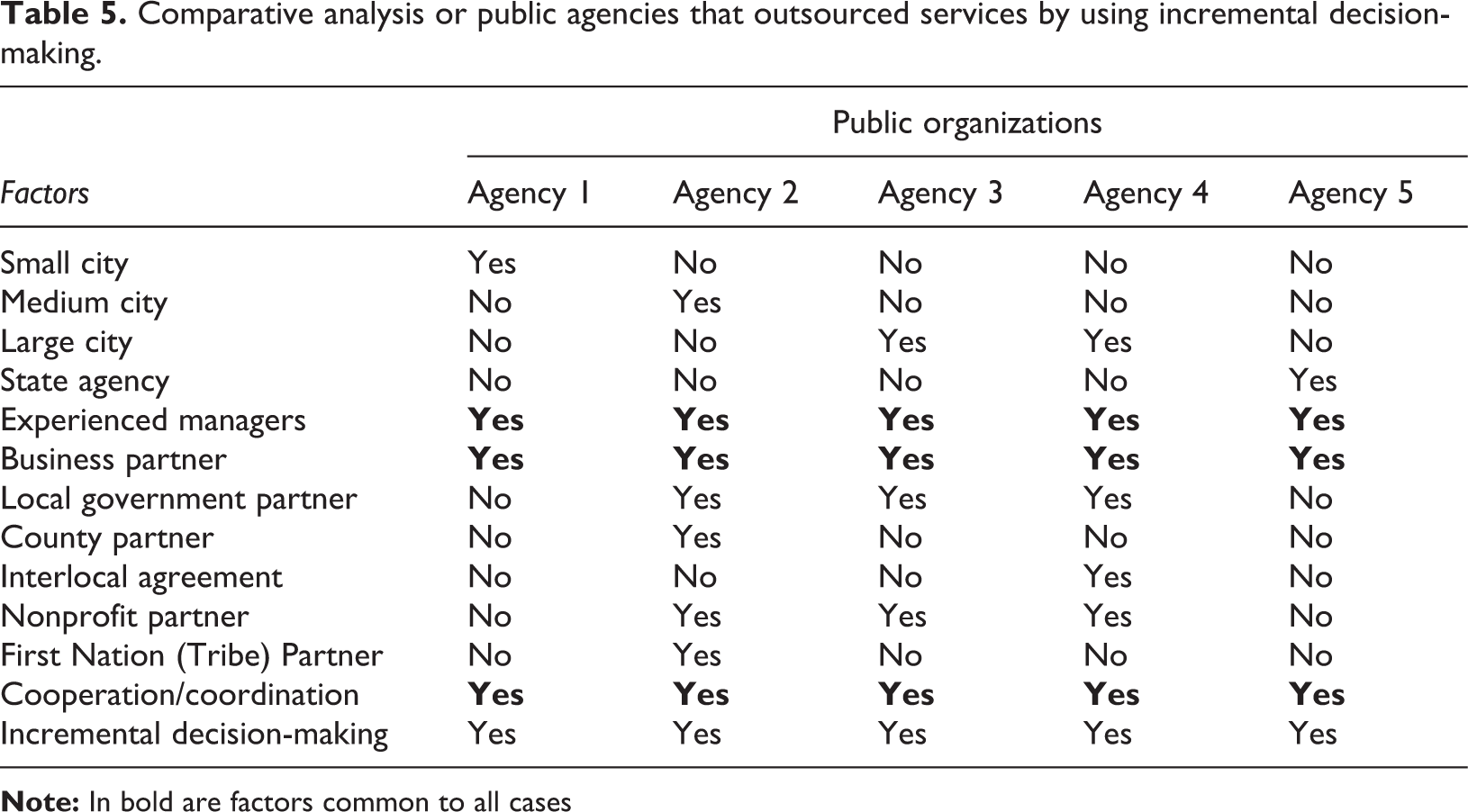
When comparing rather different public agencies who have collectively outsourced fourteen services by relying on incremental decision-making, we see three common factors across the cases. First, all of the managers involved in the outsourcing decisions were considered to be experienced. Second, in all cases (agencies) at least one of the partners for services that were contracted out using incremental decision-making was a business. Other partners such as local governments, first nation (tribe), and nonprofits were noted, though only the business partners were common across all agencies. As outlined in our analyses earlier, this is not surprising. Some of the services were outsourced without any competition and the contract has just been “rolled over” in incremental fashion rather than rationally having it reexamined. Similarly, relationships with businesses stabilized as they evolved over time, giving them the appearance of the relationship one would expect between a government agency and nonprofit service provider. And last, but not least, the desire for cooperation is also common to all agencies who have outsourced services by relying on incremental decision-making.
Discussion and conclusions
Overall, our proposition that rational decision-making models are on average more likely to be present in the outsourcing of what the literature considers “hard” services is supported by our data. In our sample, rational decision-making models were used for: janitorial services, HVAC (heating, ventilation, and air conditioning), public works, bridge design, street striping, parks maintenance, strategic planning, refrigeration experts, and food services. Following the tenets of rational decision-making model, firstly, the subject of contract for such services was well specified and well-structured. Secondly, these services were easy to measure, and no goal ambiguity was detected. Thirdly, the environment where such services are provided was more or less stable. Finally, the various alternatives for contracting out particular service to make the optimal decision were present in the form of competition among different providers and it does not matter whether this competition was theoretical or practical at the time of the decision.
As it was proposed in our article, incremental decision-making was exhibited for social services, homelessness services, animal services, community youth services, municipal courts, water well location, engineering, and jails – services that are often categorized as “soft” (human) services in the public services contracting literature. As we proposed in this article the incremental approach is also more likely when the development of new technology and contracting out of professional services is needed (e.g. architectural, legal, or engineering). Contracting out of such services requires enough organizational resources such as time, skilled in the negotiations with personnel, and general organizational support to be engaged in the negotiations with providers.
Three types of services appear in both categories of decision-making approaches. In our sample, engineering, janitorial, and food services had been contracted out using rational and incremental decision-making models in different jurisdictions (cases). Context-specific factors in these locations contribute to the decision-making associated with their outsourcing. At the same time, jurisdictional factors appear to be independent of the decision-making used to outsource most services. The distribution of services into rational or incremental decision-making approaches used (Table 2) does not reveal any noticeable patterns. Though we do not have formal measure of professionalism in our study, it is reasonable to expect that some organizations have greater contracting out capacity and that could influence the type of decision-making more than service characteristics. The inquiry into capacity of local governments to pursue successful contracting out is a fruitful area for future research and beyond the scope of the present study.
This study also takes a deeper look into contracting out decision-making in general and its comparability across organizations. For services that were outsourced with a more incremental decision-making approach, two major themes emerge. It appears that desire for regional cooperation and coordinating within stable, organic, relationships is common across all services. In addition, this theme is common to all five of our organizations. We had expected to find this cooperative relational type of contracting more frequently between public and nonprofit organizations. In our analyses, however, it appears that business partners were common across of our organizations – in every setting at least one incrementally outsourced service was with a business vendor. Typically, it is expected to have businesses compete for government contracts in order to have public agencies reap the benefits of outsourcing. However, it appears that relationships could be more valuable to public agencies when compared to a competitive bidding environment (Brunjes, 2019). In other words, the theoretical importance of competition might not be necessary for practice. It is possible that individual attributes that strengthen relational exchanges friendly relationships, courtesy, and demonstrating commitment might be of great importance when outsourcing services regardless of who the partner is (Driver and Johnston, 2001). As our examples indicate, many of the contracts had evolved and the vendor performance appears to be satisfactory in most cases. However, there was also an example where unrealized competition had produced a low performing relationship – though the outsourcing in this case was more rational than incremental. Examining how public agencies navigate relationships and competition with for-profit vendors as they seek high contracting performance is an important arena for future research.
Footnotes
Declaration of Conflicting Interests
The author(s) declared no potential conflicts of interest with respect to the research, authorship, and/or publication of this article.
Funding
The author(s) received no financial support for the research, authorship, and/or publication of this article

Notes
References
Supplementary Material
Please find the following supplemental material available below.
For Open Access articles published under a Creative Commons License, all supplemental material carries the same license as the article it is associated with.
For non-Open Access articles published, all supplemental material carries a non-exclusive license, and permission requests for re-use of supplemental material or any part of supplemental material shall be sent directly to the copyright owner as specified in the copyright notice associated with the article.
