



Abstract
Starting from transaction costs (and new institutional economic approaches, this study sought to understand the influence of the regulatory structure and incentives on the performance of public–private partnerships in Portugal. The findings of this case study show that agency participation in the mediation process between parties is time consuming and improper from a technical perspective; in addition, the agency is captured by political interests, which does not favor users’ interests or the sustainability of water services. Thus, the regulatory structure and incentives cannot be dependent on political nominations, and existing contractual rules need to be reassigned.
Keywords
Introduction
The knowledge of the institutional environment (understood as the rules that define behaviors such as laws and politics) and institutional governance (the analysis of organizations and all actions attached to entrepreneurship) (North, 1998), are keystones for transaction costs (TC) and the new institutional economics (NIE) approaches (Williamson, 1985). This economic view aims to understand which governance arrangement is preferable when facing the negotiation of existing scarce resources. Ménard (2005) reports that transactions, those agreements involving at least two agents in order to sell and buy a particular asset or service, are formalized through contracts that are incomplete in nature. Incomplete contracts can be a result of several sources, for example, they can arise with the economic agents’ actions during the bargaining process, where opportunistic behaviors can occur due to the existing bounded rationality from an intervenient (Williamson, 1985). In order to overcome opportunistic behaviors and raising TC, Williamson (1985) identifies three possible governance structures: markets; hierarchy; and hybrids.
Ménard (2004) reports that hybrids became a solution to markets and hierarchies since they are based on joint coordination. Cooperative agreements can result in mutual gains, thus decreasing those inefficiencies that have been identified for the other governance structures. Nevertheless, it is critical to understand that all governance structures are attached to particular regulatory marks (Williamson, 1991). Regulation, understood as the setting of specific legislation for the functioning of certain sectors based on the public interest (Marques, 2005), requires a well-defined structure when contractual disputes between partners need to be solved (Williamson, 1991). Such regulatory structure clearly influences governance performance (Spiller and Tommasi, 2005). 1
When it comes to public services delivery, public–private partnership (PPP) or concession contracts such as hybrids, originally became fashionable approximately two decades ago. Since then, they have become an alternative to the contracting out and full privatization of public service delivery (Bovaird, 2004). In theory, the involvement of a private party can lead to improved outputs, efficiency gains, and lower operational costs while raising service quality and allowing for the by-pass of public budgets (Steijn et al., 2011). Such positive outcomes are possible since public sector organizations share commercial and operational risks with private partners. Sharing risks provides incentives to the private partner to be even more efficient since customer prices are defined at the very early stage of the partnership, and there is limited negotiation in the long run (Peda et al., 2013). When more efficient, organizational costs decrease (Chong et al., 2006) and, if correctly managed, PPP schemes can be effective tools for achieving financial goals for the private partner along with social goals for the public side (Andrews et al., 2015).
Several studies have been conducted on PPP projects and they present mixed results for performance achievements (Boardman and Vining, 2012). However, few studies focus on the regulatory incentives category, even when assuming that regulatory structure influences governance performance (Spiller and Tommasi, 2005); 1 for this reason, our study asks the following question: how do regulatory structures and incentives relate to PPPs’ performance for public services delivery
Based on a case-study research design (Yin, 2015), this study aims to understand the influence of the regulatory structure and incentives on PPPs’ performance for the Portuguese water sector. There are several reasons for this selection. First, a large part of the studies regarding PPP arrangements have been developed around the principal–agent theory approach (Kort and Klijn, 2013). This study is innovative since it applies TC and the NIE approaches (see Brown et al., 2015), which we believe complement the existing literature by addressing an understudied topic. Such complementarity is due to the systematic analysis of this social phenomenon through the clear definition of the institutional environment and the institutional governance, and the identification of the regulatory structure. Such regulatory structure will influence the agency action and PPP performance (Jensen, 2017).
Second, a special emphasis is here placed on the auditing carried out by the national regulatory agency, the Water and Waste Services Regulation Authority (ERSAR). It is justifiable that contracting between public and private partners must be in accordance with public interests and expectations, something that is a prime responsibility of the regulatory activity. Improving this understanding is important not only for academics and practitioners, but also for political decision-making since effective, good design and performance monitoring still need to be improved regarding PPP arrangements (Pongsiri, 2002). Third, public interest and expectations include both financial and social dimensions and must be encompassed in public–private contractual schemes under political governance guidance (Hodge and Greve, 2010).
This paper is organized as follows: first, the literature concerning the introduction of PPPs for public service provision is presented; thereafter, the concept and dimensions are discussed, highlighting the TC approach to establish a contract; the paper continues with a discussion of the regulatory models – between the Anglo-Saxon and French experiences – regarding the role of the regulatory agency; then, the methodological options are described, focusing on the regulation of Portuguese PPPs; and after presenting and discussing the research results, the study ends by highlighting the concluding remarks.
The institutional environment and governance of hybrids: PPPs
The transaction cost approach and the NIE
The NIE is an economic approach that aims to understand which solution is preferable for making better use of existing scarce resources, focusing on the institutional environment and the institutional governance (North, 1998). Williamson (1991) reports the latter to be “microanalytic” and whose central point aims to understand which form of governance is more effective regarding TC existence. Ménard (2005) details that TC is a tool to analyze existing organizational arrangements while identifying their characteristics. Adding TC as a unit of analysis, TC does not exclude external conditions or even internal power games. While covering multi-disciplinary and interdisciplinary approaches, this theory also makes use of organizational and legal theoretical developments (Williamson, 1985).
Transactions, the agreement that involves at least two agents in order to sell and buy a particular asset or service, are formalized through contracts, which are (in)complete. Contracts, attached to TC, are keystones in NIE (Ménard, 2005). Incomplete contracts can be a result of economic agents’ actions during the bargaining process, where opportunistic behaviors can occur due to existing bounded rationality from one of the involved actors (Williamson, 1985). Opportunistic behaviors are those that guide personal interests and rely on the transfer of incomplete or even distorted information (Williamson, 1985). Opportunism can arise when contractualizing with external partners and where negotiation power is involved. This negotiation is attached to organizations where each organizational member tries to surplus its own group negotiation supremacy with a self-interest attitude (Williamson, 1985). It must be assumed that human agents can succumb to opportunism and these intentions can jeopardize mutual gains (Williamson, 1998). Ménard (2006) discusses the environment and existing uncertainties as a second source for TC. These uncertainties can originate from agents’ conducts or organizational insufficiencies. In any of the cases, TC and contracts cannot be separated from the institutional and/or governance existing environment (Williamson, 1991).
Firms exist due to the main goal of avoiding TC, but contracts are not eliminated; instead, they are lessened (Coase, 1993). Williamson (1985) defines firms as organizational structures, which are associated with particular governance structures: markets; hierarchy; and hybrid forms. These arrangement types are alternative ways of organizing transactions, and before decision-making, attention should be given to the following characteristics: (1) frequency, which refers to the number of times the organization needs to trade a particular good; (2) uncertainty, which assesses the changes that occur in the market and which may change the need and/or type of the goods to be traded and that can lead to higher TC; and (3) the specification of assets, which are attached to the cost of opportunity to be engaged in one agreement in detriment of others (Williamson, 1985).
When the market is an option, there are several procedures to be followed, such as negotiation between involved actors, contractualization based on legal/juridical regulation, the assessment and control of what has been previously assigned, and dispute resolutions. The latter under a market approach differ from the other arrangements due to the contract existence. In this case, courts are the mechanism to resolve such a dispute, which is costly (Williamson, 1991). It may be originated from one of the agent’s incentives, that is, after the contract assignment, ex-ante incentives can change due to ongoing organizational performance assessment. In such cases, ex-post incentives can lead to a renegotiation of the contract that might need dispute resolution (Hadfield, 2005). Williamson (1991) outlines that ex-post bargaining is an indication of ex-ante inefficiency bargaining, especially with respect to the agents' analysis of the environment. According to Coase (1993), such procedures involve organizational costs; thus, an alternative mechanism is available and must be equated: in-house or hierarchy production.
Nevertheless, in-house production is based on a hierarchy that demands coordination between inside parties. Such a mechanism is also imperfect and can be quite expensive.
Williamson (1991) details the hybrid as another possible arrangement to mitigate the previous identified arrangements hazards. Hybrids stand between the market and hierarchies regarding incentives, adaptability, and operational costs. In a comparison with the first, hybrids demand a tighter coordination between agents although incentives for improved performance can be jeopardized. Compared with the latter, hybrids privilege incentives at cooperation expense. Ménard (2006) points out that coordination and sharing resources are the main motivation to be engaged under this arrangement, since rents will favor engaged agents. This arrangement emerged as an alternative to the former, because markets are not able to deal with the necessary resources and capabilities while managerial flexibility and performance incentives would be lost under hierarchies (Ménard, 2004).
However, some disadvantages can be found under a hybrid arrangement. Regarding (a) pooling, a friction can exist due to the need for joint coordination and planning that will lead to mutual rent gains. Ménard (2004) outlines the non-existence of information asymmetries for a successful cooperation. However, contracts are usually incomplete, which places a great weight on the governance structure in order to avoid constant renegotiations and, consequently, transaction costs rise (Ménard, 2006). Possible friction problems can arise with inputs (e.g., resources coordination); outputs (e.g., the product or services that need to be in accordance with the contract); and during the transformation process (e.g., human resources management). For (b) contracting, it is well known that contracts are incomplete due to existing uncertainties (Williamson, 1985). Such uncertainties can lead to rising TC, which are possible to overcome through the governance structure. Under hybrids, such governance structure needs to be settled to allow the dialogue between partners in order to overcome existing contractual blanks, monitoring, and problems’ resolutions (Ménard, 2004). However, hybrids are more permeable to disturbances in a comparison with the other arrangements, especially when they become more consequential (Williamson, 1991). Higher frequency disturbances demand adaptations that need to be negotiated between agents, which can lead to upper TC. For such reasons, adaptation (or adjustments), control (e.g., of inputs), and safeguards (to avoid opportunistic behavior) are crucial for a successful cooperative agreement (Ménard, 2006).
By the description herein, it can be concluded that different ways exist to organize transactions and all of them are costly (Ménard, 2005). For such reason and before making decisions regarding the organizational arrangement to be adopted, it is important to understand which factors determine transactions and concomitantly how prices are settled (Coase, 1998). This will be possible once the legal, political, social, educational, and cultural dimensions of each society in which the contract will be signed are known. By considering the relationship between existing rules and the prevailing economic system, it is feasible to improve the decision about which mechanism is better.
Hybrids in public services delivery: PPPs
For a TC perspective, major criticisms of public hierarchies’ involvement in services delivery have been noted, such as the influence of interest groups for political decisions; the lack of incentives to public sector organizations, which do not allow operational efficiency gains; and asymmetric information, which prevents governments from properly controlling and regulating services (Araral and Wang, 2013). Due to existing criticism of hierarchies, contracting out and the selling of public assets to private firms, through a market-based approach, were encouraged and carried out for public services delivery under the new public management (NPM) and reinventing government approaches. Later, and in view of mixed financial and nonfinancial results (Hodge, 2000), NPM was declared dead (Dunleavy et al., 2006). In reality, NPM and private sector involvement in public services delivery or infrastructure building and maintenance continue but with the dawn of different arrangements (Wettenhall and Aulich, 2009), that is, the adoption of PPP arrangements.
Public–private partnership projects have been a strategy undertaken by governments to introduce private sector investments and knowledge for public infrastructure building and maintenance (Pongsiri, 2002). This strategy is grounded on the belief that private organizations perform better than their public counterparts, namely, presenting higher efficiency levels, which, as a consequence, do not demand increasing public financing or customer charges (Klijn and Koppenjan, 2016). Specifically, fiscal constraints seem to be a major reason for public sector organizations to be engaged in partnerships with private organizations (Bovaird, 2004). Under a partnership, governments will lower their organization costs, while sharing and transferring investments and operational risks (Albalate et al., 2013).
Based on theoretical grounds, the concept of PPP is generally assumed to entail “the working arrangements based on a mutual commitment (over and above that implied in any contract) between a public-sector organization with any organization outside of the public sector” (Bovaird, 2004: 200). It is worth mentioning that PPPs can be categorized as contractual or institutional (Marques and Berg, 2011). Contractual PPPs (cPPPs) are based on an agreement, from which the production is run by the private partner, whereas public organizations share the management risk but do not share ownership with the private organization (Monteduro, 2014). For institutional PPPs (iPPPs), the ownership is shared between public and private partners (Bel et al., 2013). For the purpose of this study, we are mainly interested in “contractual PPPs.”
In this sense, this arrangement involves at least two parties, a public one and a private one (Steijn et al., 2011). A second element is the cooperative nature of the parties, who seek mutual gains. From a commercial perspective, private partners engage in relationships for which a return on investment exists (Silvestre and Gomes, 2016). Nevertheless, the share of commercial risk is crucial for the development of this arrangement (Hodge and Greve, 2007). When thinking about the project lifecycle, it is usually assumed that initial investments are essential. Moreover, consumer prices must be fair; thus, an abrupt rise of prices should be avoided. In this sense, operational efficiency gains are demanded under this arrangement, something that is possible when making use of private organizations’ skills (Reynaers and De Graaf, 2014).
Once in the presence of cPPP arrangements, governments do not set themselves aside since property rights and disputes resolutions must be safeguarded. As mentioned by Pongsiri (2002), a critical dimension is partners’ behavior, which might need an institutional resolution. Note that commitment is demanded for both sides, where public social goals need to be aligned with financial aims of the private firms (Bovaird, 2004). Ménard (2005) reports that some limits to cooperation exist, especially when agent behaviors change ex-post to the contract assignment.
Such events can lead to negotiations between politicians and private partners (Campos-Alba et al., 2017), which might not safeguard citizens’ rights. In such circumstances, it is necessary to require an active “public attorney” that can safeguard public interests while reducing vested interests (Van Marrewijk et al., 2008). For these reasons, regulatory agencies are seen as essential players.
Regulation performance of hybrids: PPPs for water utilities
Overall
Williamson (1985) ascertains that governance structures – markets, hierarchy, and hybrid forms – are attached to a particular regulatory institutional environment. Such institutional environment, in its turn, will influence the regulatory structure (Spiller and Tommasi, 2005). A well-established regulatory structure has an effect on regulatory performance or regulatory incentives, the one that rules “utility pricing, cross- or direct-subsidies, entry, interconnection, etc.” (Spiller and Tommasi, 2005: 516). The regulatory mark is crucial when cooperative agreements face disturbances and from where disputes between partners need to be solved (Williamson, 1991),
reminding us that contracts are incomplete in nature (Williamson, 1985), and that regulation becomes a tool to avoid political opportunism, while safeguarding agents’ interests (Spiller and Tommasi, 2005). Spiller and Tomassi (2005) argue that regulation is crucial to solve disputes when cooperative agreements exist between public and private agents for public services delivery. Nevertheless, the regulatory agency action is dependent on specific legislation, the one that has been proposed and approved by politicians. In this context, politicians can promote changes to legislation that will influence the agency’s way of acting. Hence, “contract-based regulation is, however, particularly appealing to politicians with few veto players and with high rates of turnover” (Spiller and Tomassi, 2005: 537). According to Ménard (2004, 2006), opportunism can arise and jeopardize mutual gains for partners.
Regulation performance of contracts for water utilities
Once a cPPP scheme has been chosen, regulation is an element to be considered to maintain sustainability and a value for money approach to public services delivery (Pongsiri, 2002). Associated with the governmental decision to engage with private firms is the extent and nature of the regulation to be followed (Wettenhall and Aulich, 2009). This is due to the assumption for assigning such contracts, that is, risk transfer between public and private parties (Albalate et al., 2017). Therefore, regulatory agencies can be a positive actor for purposes of efficiency gains (De Witte and Marques, 2010). In fact, contracts are important (McCann et al., 2015), but they might not be the crucial element in these arrangements (Klijn and Koppenjan, 2016).
Regulation is a key aspect for utilities, but sometimes it is dependent on the government perspective and on the decision-making about the role that regulatory agencies will perform. In that sense, governments need to decide in which way services will be delivered. Once the decision is made, the regulatory framework, which is associated with political and temporal aspects, will be selected (House, 2016). Furthermore, the policy process engages several stakeholders and regulation at its final stage and needs to be consensual to avoid contractual ambiguity and uncertainty between parties (Jensen and Wu, 2016). Consensus allows the selection of critical dimensions for service delivery. For example, in the water sector, due to its specific characteristics, the economic sustainability of operators must be guaranteed (Marques et al., 2015). This economic stability will allow continuous delivery of the service while assuring the quality of goods and service. Furthermore, environmental impacts must be reduced to safeguard people’s wellbeing (Foster, 2005).
As far as PPP arrangements in the United Kingdom (UK) are concerned, the British National Audit Office is a reference from which several studies have been conducted to understand whether private financing effectively safeguards citizens’ money (Hodge and Greve, 2017). For the national water industry, after the privatization of water utilities, which sensu stricto did not involve PPP arrangements, the UK government decided to create the Office of Water Services (Ofwat) to monitor private organizations’ performance while safeguarding consumer interests (Organization for Economic Co-operation and Development Observer, 2003: 2). In that sense, valuing citizens’ money through efficiency gains while raising users’ satisfaction was a primary regulatory goal (Secretary to the Treasury, 1999). In addition, Ofwat became responsible for making sure that water quality was effective when safeguarding the environment, continuously revising water tariffs, and ensuring that monopolistic operators would not take advantage of their market position (Secretary to the Treasury, 1999).
In France, a different regulatory regime was adopted. The French water industry was initially attached to private sector involvement. This trend was due to a lack of skills in local government. Since municipalities are politically independent, they have the power to decide which arrangement for the water industry they prefer. When engaging in a concession agreement with a private partner, French local government officials are the ones who monitor contract fulfillment (Marques, 2005). From a regulatory approach, the premises are as follows: consumer prices are attached to an agreement between the public and private partners at the negotiation phase and thus flexibility is restricted; the regulatory lag is smaller (usually for one year), which allows possible adjustments between cost/investments versus profits on a comparative basis; and price sensibilities are high, setting aside organizational corrections on deviances in operational costs (Armstrong and Sappington, 2007). Consequently, concessionaries cannot overcome initial investments while consumer prices increase unbearably. Marques (2005) argues that such a regulatory model can increase productive efficiency and innovate operational designs, since tariffs are established in the long run – ex ante. The only way those firms can quickly recover their investment is to make better use of available resources. However, according to Armstrong and Sappington (2007), there are unfair incentives based on cost reductions because concessionaries know that costs must be covered due to the initial financial investments.
Overall, regulatory agencies follow NPM principles, and the split between politicians and operational decisions needs to be effective. In that matter, making better use of scarce resources is one of the chief goals in order to increase efficiency while facing a competitive environment (Hood, 1991). In this way, regulatory agencies become responsible for monitoring cPPPs under an economic and social approach while avoiding political interference (Foster, 2005). Even if political interference is avoided, their action still influences regulatory bodies. For example, under a cPPP agreement, the private operator’s return on investment must be safeguarded. In that sense, long contract periods are assigned (e.g., 30 years contract). Facing long-term contracts means that politicians make sure that costs are not immediate, transferring them to the future (Boardman and Vining, 2012), and contract renegotiations are common since both internal and external circumstances occur (Ross and Yan, 2015).
Due to this claim, regulatory agencies should act as harmonious actors at all stages of the contractual agreement (House, 2016). When negotiating contractual clauses, politicians must be aware of the immediate political implications. They surely search for an agreement where public acceptance can be effective (Smith and Thomasson, 2018), but “if you absolutely need the contract, you are already in trouble” (Steijn et al., 2011: 1249). Overall, asymmetric information can jeopardize the agreement, which is the reason why regulatory agencies need to act as “public attorneys” to safeguard citizens’ main interests. In this context, tariff revision and control are the most visible and prominent outcome (Foster, 2005) and must be supervised ex-post or ex-ante or defined by regulatory agencies.
Regulation and regulatory agencies are important institutional settings concerning PPPs. This is due to two particular aspects: the negotiation between public and private partners; and the monitoring of the agreement execution, namely, the financial and operational goals (Marques, 2017a).
Design and method
Research design and method
To achieve the research goal of this study, a case study was selected as the research strategy. Case studies can be defined as “an intensive study of a single unit for the purpose of understanding a larger class of (similar) units” (Gerring, 2004: 342). Therefore, they are useful for theoretical verification. According to Gerring (2004), case studies are based on in-depth research planning, which makes it possible to capitalize on descriptive inferences based on a single unit. For those reasons, it is feasible to apply this particular research design to theory, rather than to universes/populations (Yin, 2015).
Thematic analysis has been selected as a research method in this study. This option was intended to match the theory supporting this study with the research aim (Braun and Clarke, 2006). Thus, this method is useful to identify, analyze, organize, describe, and report on themes from existing data (Nowell et al., 2017) in an accurate fashion (Braun and Clarke, 2006). Moreover, it is a suitable method to be used when facing diverse experiences and meanings, from several interviewees and from where differences and similarities need to be reported (Nowell et al., 2017). Its main purpose is to identify patterns of meaning in data (Braun and Clarke, 2006) that lead to themes’ identification (Fereday and Muir-Cochrane, 2006). Although it focuses on theme and pattern identification, this method describes and interprets social phenomena relating to the data and the study research question (Clarke and Braun, 2014).
Data collection and sampling
Through thematic analysis, a deductive approach became the basis for this study. Based on the analytical framework – TC and the NIE, and the performance of regulation of PPPs as hybrids – a code manual was initially developed under a variable-oriented approach (Nowell et al., 2017). Using a code manual is advisable in order to allow a better organization of data (Fereday and Muir-Cochrane, 2006), which later aids data interpretation through the adopted framework lenses (Clarke and Braun, 2014). Just like Fereday and Muir-Cochrane (2006), the code manual in this study was developed a priori to allow a realistic and thematic analysis of data (Nowell et al., 2017).
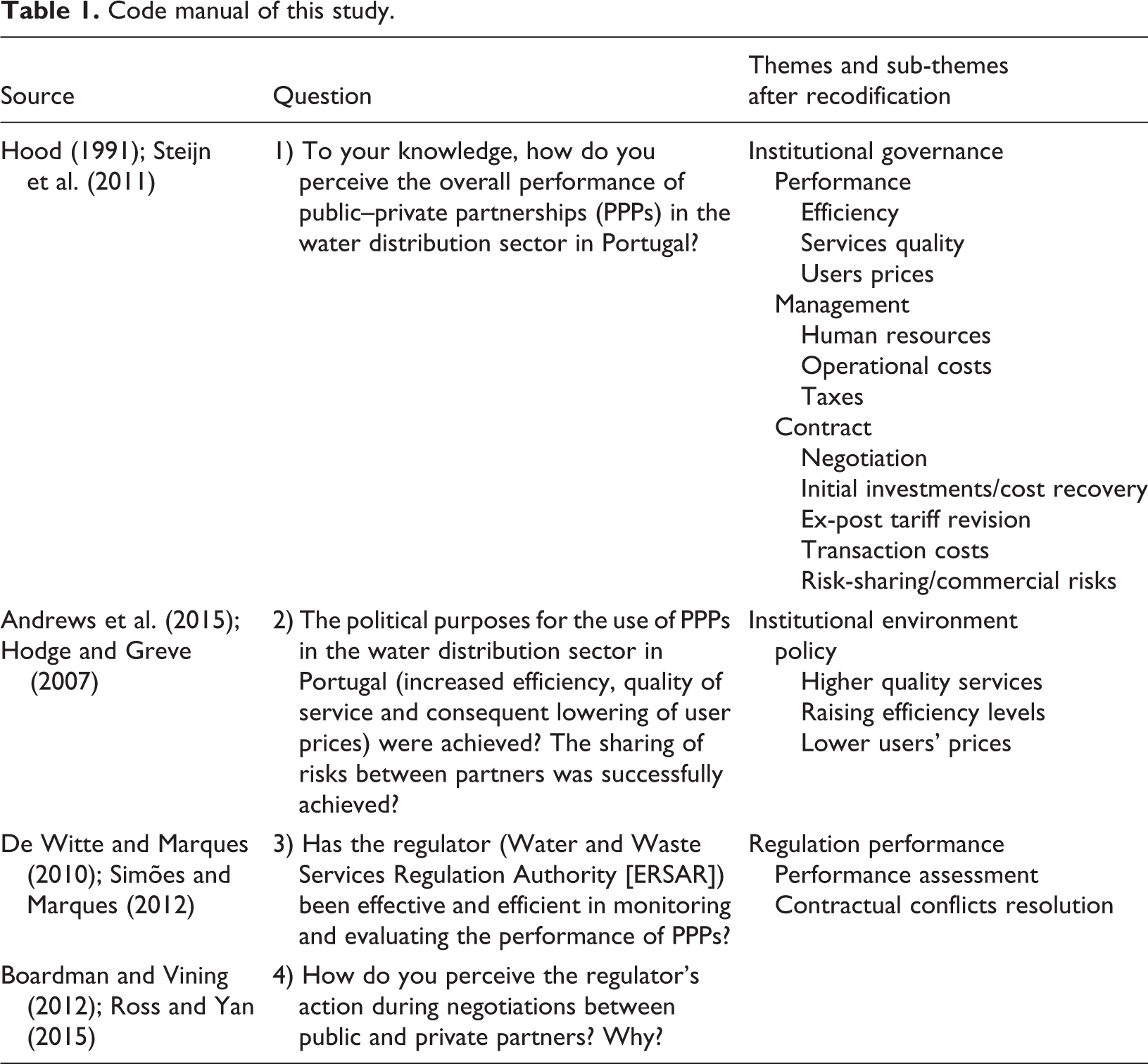
After the code manual definition, questions were divided into two categories: institutional governance and environment, for questions 1 and 2, respectively; and performance of regulation for questions 3 and 4 (see Table 1). To finish and to highlight improved and effective regulation, we asked for future directions for the national water regulatory agency.
Code manual of this study.
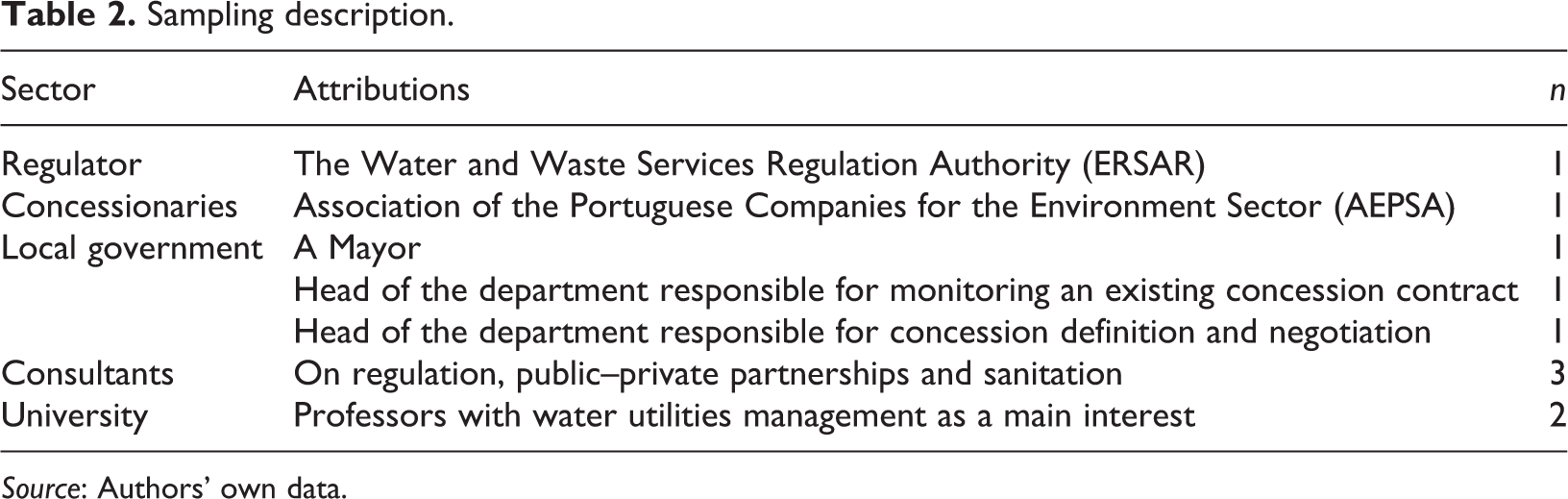
Ten semi-structured interviews were held in October, November, and December of 2017, with renowned national actors in the water industry. According to Sabatier (1998), policy-making involves an assembly of actors. Their behavior is a critical input of the policy process and, for this reason, studies making use of the strategy must be limited to a particular subset of particular players (Sabatier, 1998). In this context, purposive sampling was selected since we aimed to understand the national regulation of cPPPs in light of different views and interests (Jooste and Scott, 2012). For those reasons, academics and practitioners (from the public, private, and the audit office sectors) in the water industry were chosen to be interviewed (see Table 2).
Sampling description.
Source: Authors’ own data.
Data treatment
After data collection, themes and subthemes were defined – “a theme captures something important about the data in relation to the research question, and represents some level of patterned response or meaning within the data set” (Braun and Clarke, 2006: 10). The identification of a theme surpasses the description of the social phenomenon being analyzed (Green et al., 2007). An interpretation of data is expected to be based on the adopted theoretical framework (Braun and Clarke, 2006).
Finally, in order to safeguard the finding of this study as reliable (due to the consistency application of the method) and valid (attached to the representation of data), quotations from original data and from different interviewees will be included (Lacey and Luff, 2007). Furthermore, data triangulation from different sources will also be presented to avoid researchers’ mismanagement of judgments (Tuckett, 2005).
Results and discussion
The Portuguese regulatory framework context
Like its Organization for Economic Co-operation and Development counterparts, NPM spread in Portugal, and the Portuguese parliament decided to open a “privatization” wave of utilities and other public services during the 1990s (Framework law for privatizations, decree-law no. 11/90). This political decision aimed to: modernize national economic units through competitive biddings; reduce public sector organizations’ involvement in the economy; and decrease the public sector’s organizational costs. Privatization could be carried out through asset selling or concession contracts (cPPP) with private partners. In the water sector, decree-law no. 372/93 allowed private sector participation in the national water industry, where universality, service quality, continuity, equality and prices equity must be fulfilled (The Audit Office, 2007). Additionally, decree-law no. 379/93 ruled that concessions are a way water services can be delivered by private sector companies. Such concessions have incorporated the management of municipal water services, including abstraction, treatment and, distribution when the systems are vertically integrated or only distribution when they are not. Upstream systems could be managed by municipalities or by the state directly.
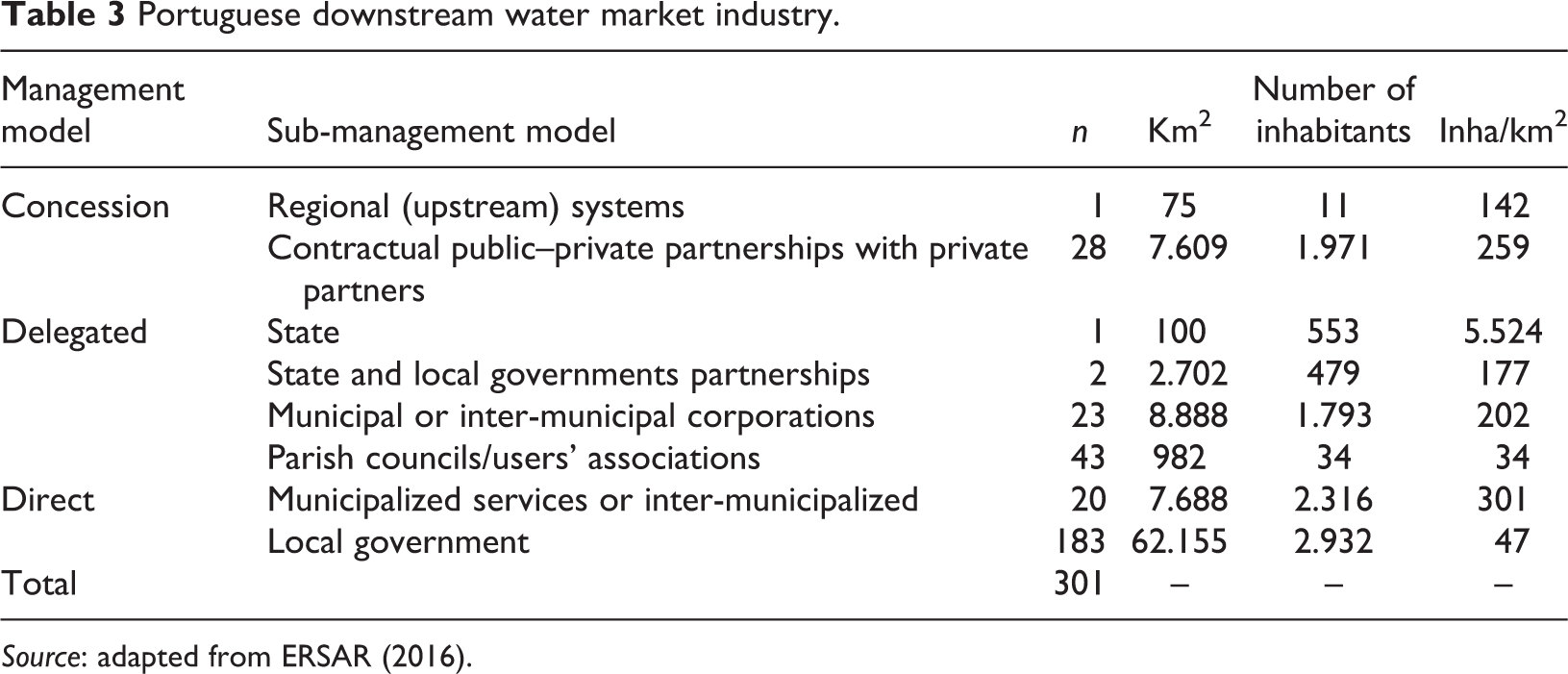
Once established, the Portuguese water industry downstream can be conducted under: the local government department itself (where water delivery is the responsibility of the municipalities); municipal services with autonomy (which enjoy administrative and financial autonomy to improve financial and managerial performance; however, they are not a legal entity since it continues to be controlled by the local bureaucracy); municipal corporations (where administrative, financial and asset independence in relation to local political bodies does exist even though executive boards are appointed by local government politicians); private firms operating the facility through a municipal concession contract – cPPP; or regional upstream systems (where the central government, not the local government, establishes a concession contract with a public company) (Silvestre and Gomes, 2016). Currently, only 9.3% of the water organizations have adopted cPPP arrangements. Table 3 illustrates the Portuguese water market structure.
Portuguese downstream water market industry.
Source: adapted from ERSAR (2016).
Since the private sector has started participating in the water delivery industry, the Portuguese regulatory framework has followed the British (with the creation of an independent regulatory agency) and French (using a contract to define rights and duties) models. In that sense, PPPs are regulated by a national regulatory agency, where the concession contract determines the regulatory framework (The Audit Office, 2007). As mentioned earlier, the ERSAR was created in 1997, following the UK experience. ERSAR’s regulatory power has focused on concessionaries, especially regarding service quality (Da Cruz and Marques, 2012). The regulator aims to guide, monitor, and supervise water services provision, but it mostly focuses directly on financial sustainability and service quality. However, the National Audit Office (2007) argues that the national regulatory agency lacks power; for example, when facing the discussion of tariffs, its actions are weak, especially given that no sanctions can be proposed; in addition, its opinions are only guidelines for action, which can be adopted, or not, by the regulated entities. Even though the agency has independence through administrative and financial freedom, it lacks some decision autonomy, which compromises its mission.
The institutional governance for cPPP in Portugal
In the questionnaire carried out, the first question aimed to understand the interviewees’ perception about national cPPP performance in comparison with other arrangements for water delivery. In general, their perception was positive (except for respondent numbers1 and 7, who had a neutral perception and a negative perception, respectively). For the representative of the association of concessionaries (respondent number1), cPPP presents higher efficiency and service quality levels in comparison with public provision. For respondent number 3, a major driver for performance is the initial stage of service; that is, it has to do with system requirements since major initial investments are dependent on the infrastructure lifecycle, which can influence performance and, consequently, user prices. However, for respondent number 4, private sector involvement in water service delivery is professional in nature since it utilizes specialized human resources, which is a possible explanation for improved performance results. Nevertheless, it is not possible to determine which arrangement is superior since “the experience of contract-based PPPs in Portugal is heterogeneous and of ambiguous appreciation because often, ‘the devil was in the detail’” (respondent number 4).
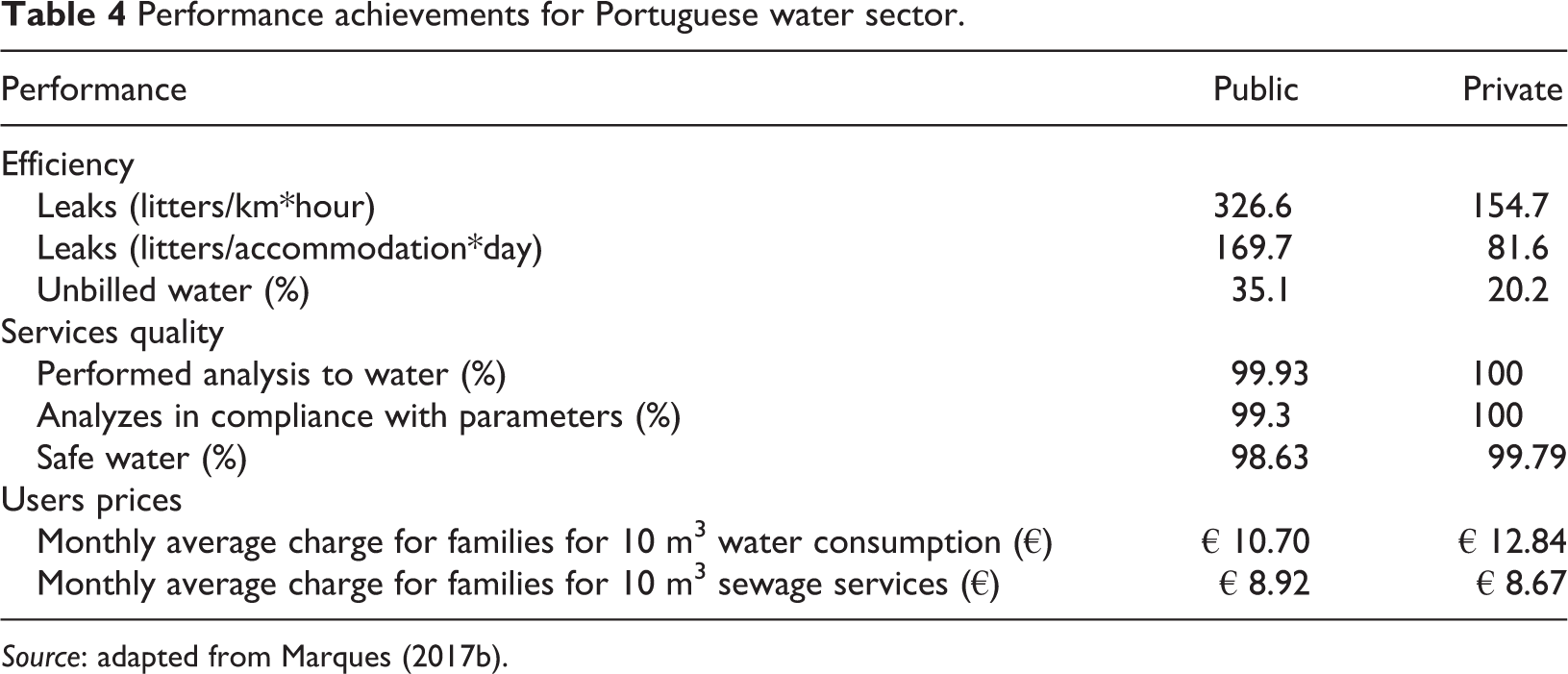
From a local government representative’s perspective, cPPP values citizens’ well-being, either qualitatively and quantitatively (respondent number 6), even though user prices are higher (respondent number 5). This can be explained by existing contracts: private operators sign an agreement where major investments and levels of service should be accomplished. Such investments demand higher user prices in order to cover operational costs and to pay back total investments during the concession period (respondent number 8). For this reason, it is generally accepted that performance between operators needs to be carefully analyzed, since several variables can influence operators’ performance, namely, user prices. For example, taxes on private operators are much higher in comparison with public arrangements (respondent number 8). Ultimately, it seems that there are no performance differences between arrangements and it is difficult to argue which arrangement is the best (respondent number 10). In sum, private sector involvement in the national water sector through cPPP presents mixed results. When doing the analysis of cPPP, interviewees focus on different approaches. Some highlight services quality, others privilege user prices, and so on, but without making a relationship with private management skills and contracts implications for institutional governance (see Table 4).
Performance achievements for Portuguese water sector.
Source: adapted from Marques (2017b).
In the second question, we aimed to understand if political and managerial objectives were accomplished through the application of a cPPP. The results show that for four respondents, political and managerial goals were not accomplished (respondent numbers 1, 7, 8, and 10), whereas for respondent numbers 2, 3, 4, 5, 6, and 9 some of those goals were accomplished while others were not. For respondent number 1, the quality grew but user prices increased. Overall, it is accepted that it is difficult to “promote efficiency, services quality, and cost recovery without increasing tariffs (even if efficiency gains occur)” (respondent number 3). Once again, some reasons can be identified, which have been summarized by respondent number 6: “(…) the reasons are several, among them, the previous management systems were deficient, not reflecting the actual costs of the systems in the consumer; increase of the quality can and almost always implies a cost increase and the gains of efficiency are not reflected in the final price but in effective gains for PPPs.” “However, in an ex-post perspective, once the mechanism of extension of the contract term is exhausted, the tariff revision (typically aggravation) has been the most used mechanism of replacement of contractual equilibrium.” (respondent number 4)
For such reasons, we have asked if risk sharing, the crucial aspect of a cPPP, has been accomplished in the national water delivery industry. According to respondent number 6, a local government representative, risk sharing and transfer exist in cPPP for water delivery in Portugal, but it is not equally balanced between parties. Respondent number 3, a consultant, highlighted that private partners became responsible for undertaking large initial investments; thus, “in general, the greater the risk attributed to the partner, the greater the return.” For the other interviewees, risk sharing and transfer between the public and private partners are not a reality, especially when the existence of multi-players increases TC (respondent number 1). According to respondent number 9, local government representatives are responsible for the lack of information sharing between partners. First, there is evidence that private partners have higher expertise when engaging in a negotiation with public partner representatives (respondent number 8). In this particular aspect, contractual terms become “too large”, thus allowing the private partner to take on renegotiations to improve profit, for example (respondent number 1). In addition, when the public partner is open to making a concession, it already starts from a weak position (see Steijn et al., 2011: 1249), since it needs to be engaged in an arrangement that favors the private investor: “It is enough to mention clauses that point out that the restoring of financial equilibrium has to be reached in order to keep the shareholder IRR (internal rate of return) unaltered to realize that the effective sharing of risks that has been observed has been fragile, incipient and “amateur” and with little to do with the letter of the contract and more with the relative negotiating position of the parties at each moment.” (Respondent number 4, the regulator representative)
The ERSAR, its regulatory performance, and cPPP
The fourth question focuses on how PPPs have performed in the presence of a regulatory agency. The results are mixed, with respondent numbers 2, 3, 5, and 10 having a positive perspective on the regulators’ performance, in contrast to respondent numbers 1, 4, 6, and 8, whose views are negative. Respondent numbers 7 and 9 are neutral in this context. From the positive side, it is mentioned that cPPP performance is very important, especially for users who have no consumption alternatives (almost all), the reason why private operators need to be monitored to avoid market power (respondent number 10). Thus, it is believed that the regulator is raising its effectiveness. This effectiveness results in a balanced business between parties, from which users can benefit from a better service with controlled tariffs (respondent number 5). Recall that tariffs revision and control are the most visible and prominent outcome, the reason why the regulator agency needs to be quite active (Foster, 2005). Spiller and Tomassi (2005) support a well-established regulatory structure, since regulatory performance and incentives are dependent on the former. When dealing with cooperative agreements under hybrids, regulatory performance assumes an even greater role due to disturbances and the possible existing disputes between agents (Williamson, 1991).
Although respondent number 9 has some positive views on the effectiveness of service and water quality regulation (including the sunshine regulation and performance indicators), he argues that in contract regulation, value-for-money is jeopardized since “the regulator leaves much to be desired”. That can be explained as follows: “(…) a little more competitive intelligence is missing in the agency to get the information it holds. A good performance from the regulator (…) (demands) knowing the rules of the game, but also playing it with the appropriate tools. The implications, within its role of regulator (…) has implied in the dissatisfaction of the parties involved. This, therefore, may require a need for a ‘regulatory intervention’ to rearrange the interests and restore performance and maintain it minimally.” (respondent number 1) “The regulator puts himself in a position, in my opinion, innocuous, with opinions without objectivity and without a focused position, in what seems to be the most important, i.e. the final consumer. Indeed, an effective regulation of the business, where the gains prove to be fair and reasonable for the effective quality and quantity of the water services do not exist.” (respondent number 6)
Still, the regulator’s action is also negatively perceived concerning its positioning in negotiations. For example, according to respondent number 7, ERSAR does not assume impartiality, which is due to politics and decision power. Thus, for respondent number 6, a local government representative, the regulator privileges the private side. In opposition to this point of view, respondent number 2 feels that contract renegotiation is becoming more difficult since the regulator issues opinions on an indiscriminate basis and “it cannot give a positive opinion”.
Political interference occurs, in this case, from two different perspectives. First, it is the local government’s political decision to undertake a concession contract with a private partner. In this context, local government decision-makers can transfer the costs to the future without immediate political risk (Boardman and Vining, 2012). Second, it is the central government’s interference in the regulatory agency. Ultimately, the regulatory agency could interfere in the contract negotiation based on political concerns and not on managerial ones. Furthermore, politics will become part of the negotiation.
The results of the interviews show that ERSAR needs to improve its processes; otherwise, it will be disliked by multiple actors and will not comply with its statutory obligations. More importantly, it really does not protect the public interest or the sustainability of water services. For example, regarding the final question, ERSAR is labeled a governmental tool, the reason why the office needs to be “more positive and less political” (respondent number 9). In fact, the Portuguese water delivery sector is not separated from politics, and the regulator’s decisions and opinions are ideological in nature (respondent number 2); thus, it is “politically (…) perverse” (respondent number 3). From the TC and the NIE perspectives, regulatory performance is dependent on the institutional environment. In this particular aspect, policy and politics will define the legislation to be followed by the regulatory agency and, thus, will jeopardize an effective monitoring of the contracts (Spiller and Tomassi, 2005).
Conclusions
Starting from the TC and NIE approaches, this study sought to understand the regulatory performance for the (re)negotiation of contracts between public and private partners and its implications for PPP performance in Portugal. A case study was selected as the research design, whereby semi-structured interviews were conducted with purposive sampling, with academics and practitioners (from the public, private, and the audit office sectors) chosen as sources. Based on a deductive approach, questions were selected considering theoretical/practical concerns and divided into two categories: institutional governance performance; and environment and regulation performance. Data analysis was carried out through thematic analysis.
Firstly, the study findings show that national cPPP projects are positively perceived regarding their performance. In this particular aspect, efficiency gains and improved service quality are the most common arguments. However, from a public side perspective, user prices are higher in comparison with other arrangements. Higher user prices led to a negative perception regarding the political objectives to undertake PPP arrangements; that is, half of the interviewees claimed that such goals had not been achieved, whereas the other half supported that such goals had been partially accomplished. Lastly, for this dimension, appropriate risk sharing and transfer between public and private partners was not found. The findings demonstrate that commercial and operation risk transfer is a public partner major issue, which contradicts the major reason to apply for PPP agreements (see McCann, 2017; Peda et al., 2013). According to Albalate et al. (2013), private partners will become involved in PPP arrangements when the contractual conditions allow them return on investment. Since a contract needs to be signed, local governments “are already in trouble” (Steijn et al., 2011: 1249) since this allows for private partners opportunistic behaviors, leading to high TC. Endowed with negotiating power and holding accurate organizational skills (see Reynaers and De Graaf, 2014), contracts will be defined during the renegotiation. At this stage, tariffs will be redefined to cover private partners’ initial investments, something that will not provide incentives for further efforts from their side to become more efficient (see Armstrong and Sappington, 2007).
Secondly, we focus on the accomplishments of the Portuguese water regulatory agency. The findings are mixed regarding the effectiveness and efficiency of the regulatory agency regarding cPPP. Concerning its participation at the mediation stage, the study findings are unequivocally negative. Several examples have been identified. In particular, the regulatory agency usually focuses on quality and user price indicators, thereby not including other dimensions, such as the existence of asymmetric information between parties that does not favor users; in addition, the ERSAR interventions are political in nature, which creates several obstacles in the renegotiation of contracts between public and private parties.
With the results, we are now able to answer the research question of this study: how do regulatory structures and incentives relate to PPPs’ performance for public services delivery? PPP arrangements present mixed results; and the regulatory incentives could do better if changes were feasible. Two sets of implications can be drawn from this study. The first regards cPPP performance. It has been demonstrated that private sector participation in water services delivery does present positive aspects, such as efficiency gains and service quality. However, it has not been perceived that public sector arrangements are inferior in nature to their private counterparts. This could be a consequence of the contractual scheme and asymmetric information between partners, as precluded by TC theory and the NIE (Ménard, 2005; Williamson, 1991). In this specific aspect, commercial and operational risk sharing is low for private partners (McCann, 2017), and their economic sustainability is guaranteed from the very beginning. Even if economic sustainability needs to be accomplished, social goals, such as affordable water tariffs, are also demanded for the public interest (Silvestre and Gomes, 2016).
The second implication regards the regulatory agency. In the Portuguese water sector industry, the ERSAR seems to have been politically captured. Therefore, ideology guides the agency’s actions, which does not serve the public interest. Thus, regulation needs to be participatory and separate from governmental coercion. For these reasons, changes in the regulatory regime are demanded. First, the institutional settings need to change; for example, the regulatory agency cannot be dependent on political nominations or influence. Furthermore, existing rules need to be reassigned; for example, simpler contractual demands will facilitate the agency’s regulatory actions, resolving disputes and simplifying renegotiation processes if necessary. Once these changes are made, the national water regulatory agency can be a shadow for good governance.
Finally, the method used permits a just plausible explanation that is offered for the research problem proposed, thus propositions are not definitive and must be tested in future works.
Footnotes
Author Note
Hugo Consciência Silvestre is also affiliated with Civil Engineering Research and Innovation for Sustainability of IST (CERIS / CESUR), University of Lisbon.
Declaration of Conflicting Interests
The author(s) declared no potential conflicts of interest with respect to the research, authorship, and/or publication of this article.
Funding
The author(s) received no financial support for the research, authorship, and/or publication of this article.
