



Abstract
Public-nonprofit contracting for human services is complicated by the difficulty of fully specifying contracts in the face of complex human service delivery issues. To understand how public and nonprofit agencies resolve these complications while serving client populations effectively and meeting public accountability requirements, this article examines the following research question: given the complexity of human service delivery, how do public and nonprofit managers address the challenges of contract management? The study analyzes qualitative data from interviews and focus groups with managers from three San Francisco Bay Area county human service agencies and three nonprofit agencies contracting with these public agencies to deliver human services. Findings uncover the deeply relational and collaborative nature of human service contracting amidst technical challenges that reflect the underlying complexity of human service delivery. The results also show how public and nonprofit managers address these dynamics to inform the task of organizing and delivering human services.
Keywords
The delivery of human services has been organized historically through contracts between public agencies and nonprofit service providers. Private provision of public human services has expanded over recent decades through calls for privatization, devolution initiatives such as the New Federalism, and the New Public Management, and as of 2012 stands at roughly US$81 billion in publicly funded and contracted services (Pettijohn and Boris, 2014). As a result, services across the major human service domains – including child welfare, mental health and substance abuse treatment, income assistance, and aging and disability services – are commonly provided by nonprofit agencies under contractual arrangements organized and overseen by public managers (Smith, 2012).
The contractual relationship between public and nonprofit human service agencies has received considerable attention over the past several decades. This scholarship reflects different theories to inform the development of governance tools to improve contract outcomes and promote public–private collaboration (Lynn et al., 2001). Studies drawing on resource dependency and institutional theories have suggested that nonprofit agencies face many challenges in managing the different goals and requirements of public and private funding sources (Gronbjerg, 1993; Smith and Lipsky, 1993). Network-based models have emphasized the role of clear principal–agent relationships, resources, and stability for supporting multi-agency service systems (Milward and Provan, 2000). The research informed by principal–agent theory features the importance of goal alignment, monitoring, and targeted incentives for managing contractors and attaining desired public outcomes (Dubnick and Frederickson, 2010; Koning and Heinrich, 2014). The relational contracting literature has drawn insights from game theory related to the effects of repeated interaction and norms on contract collaboration (Davis et al., 1997; Poppo and Zenger, 2002).
These studies have helped clarify the interconnected yet different roles of public and nonprofit managers in organizing contract-based human services (Gazley, 2008; Romzek et al., 2012; Romzek et al., 2014; Van Slyke, 2007). The public management role often includes contract planning and community needs assessment, contract development and solicitation, and contract execution, monitoring, and evaluation. The nonprofit management role focuses on program development, program implementation, and performance measurement and program reporting. These spheres of managerial activity overlap substantially through the nexus of the human service contract and are contingent upon one another.
In contrast, the underlying nature of human service delivery has received less attention from organizationally focused human service scholars. The scholarship on human service delivery generally focuses on the users of publicly-funded services, the processes associated with the delivery of these services, service providers, and the outcomes of service provision. Some studies of human service provision have relied on a street-level bureaucracy framework to identify the challenges facing frontline human service workers in serving diverse client populations, and in implementing policy and program requirements (Carnochan and Austin, 2015; Sandfort, 2010). Other studies have examined the manner in which human service delivery is informed by managerial and organizational factors (for reviews of this literature, see Marsh et al., 2012; and McBeath et al., 2014). Overall, this literature has sought to explain how clients progress through human service programs; whether public services are effective in addressing client needs; and how frontline workers serve clients amidst competing professional and organizational demands and variable discretion and autonomy (Goldman and Foldy, 2015).
It is important to note that the literature on human service delivery has emerged separately from the broader research on human service contracting. For example, studies of human service contracting have generally paid little attention to the specific services being contracted out, or to how public and nonprofit managers respond to different challenges in the direct delivery, organization, and administration of human services. The limited attention given in the contracting literature to the products and services being delivered by nonprofit agencies is understandable when taking into consideration that studies of human service contracting often focus on organizations and contract-based interorganizational networks as units of analysis in order to draw inferences for managers; whereas studies of human service delivery often focus on frontline staff and service users as units of analysis to draw inferences for managers, organizations, and networks. The lack of attention in contracting studies to human service delivery may also reflect normative expectations of the public and nonprofit sectors. From a New Public Management perspective, contracting allows public agencies to ‘steer but not row’, and provides nonprofit agencies with the opportunity to develop and implement innovative, community-based approaches to service delivery (‘where they row in the directions that they are being steered’). This basic logic is also reflected in the scholarship on the co-production of human services (Kettl, 2015).
Research on the co-production of human service delivery can help illuminate the complex challenges associated with developing and managing human service contracts effectively. The human services are a classic example of a complex product in which the means of production (i.e., the transformation of inputs into outputs and outcomes) may be unknown, highly variable, and/or dependent on factors beyond the control of the public or nonprofit agency (Hasenfeld, 1982, 2010). For example, public managers may struggle to estimate changes in the population requiring services prior to contract development; and nonprofit managers may not know in advance which clients will be referred to their human service programs. Nor may it be possible for public or nonprofit managers to develop and implement programs that fully address the diverse and often changing needs of clients. In the face of these dynamic contingencies, managers may find it difficult to establish accurate prices and forecast supply and demand, resulting in incomplete contracts that can increase both the risk assumed by public and nonprofit agencies and the complexity of developing rigorous performance systems. These management and governance challenges cannot be ignored if public and nonprofit agencies are to serve client populations well and meet public accountability requirements and performance expectations.
In an effort to strengthen the connection between these literatures on human service contracting and human service delivery, our descriptive study is organized regarding the following research question: given the complexity of human service delivery, how do public and nonprofit managers address the challenges of contract management? We first situate our inquiry in the literature on human service delivery, in order to deepen our understanding of what is complex about human service delivery. We then introduce a theoretical framework – the Managing Complex Contracts (MCC) model (Brown et al., 2010, 2013, 2015) – which is focused explicitly on the issue of contracting amidst complex products. Informed by the MCC model, we examine qualitative data from interviews and focus groups with managers from three human service agencies and three nonprofit agencies, located in the San Francisco Bay Area county area and contracting with these public agencies to deliver human services. Our findings reveal the deeply relational and collaborative nature of human service contracting amidst technical and interorganizational challenges that reflect the underlying complexity of human service delivery. Our results also show how public and nonprofit managers address these dynamics to inform the task of organizing and delivering human services effectively. These findings support the development of a set of implications for the design of future research studies as well as a series of implications for practice for public and nonprofit human service managers.
Contracting for human services under conditions of complexity
In principle, contracting would be simple if full information were available to the involved parties as to the requisite frontline, managerial and organizational processes through which capital and human resources are transformed into goods and services, and if managers could control these production processes. In the human services, however, uncertainty and variety make it difficult to link, effectively, efficiently and reliably, means (e.g., client engagement and service delivery) and ends (e.g., desired program and/or policy outcomes) (Hasenfeld, 1982, 2010). Programmatically, it may not be possible to identify with precision the client needs requiring redress, the order in which needs are to be addressed, and service outcomes (with respect to modality, intensity and timing) that are to be achieved. For example, users of human service programs are diverse in their racial/ethnic, family and community backgrounds; prior experiences in human service programs; and current service needs. These needs may overlap in complex ways (e.g., needs reflecting the co-occurrence of poverty, mental health and substance abuse), may differ substantially within and across particular demographic groups and community settings, and may change over time at the level of the individual and the population. As a result, clients may differ significantly in their pathways into services and their responses to them (Novins et al., 2012). These program dynamics may be affected in unanticipated ways by changes in staff and resources, and demands from funders, policymakers, and local agencies (Sandfort, 2010; Smith and Lipsky, 1993).
Program complexity places significant demands on human service managers who may be asked to develop, implement and monitor programs in the absence of knowledge either that program staff are being trained and deployed optimally or that frontline work is calibrated to enhance program performance. In situations where agencies invest in new service technologies such as evidence-based practices (i.e., manualized frontline interventions that have been found through experimental research to be associated with net improvements in specific outcomes), managers may struggle to adapt models to the specific client population and ensure treatment fidelity in the face of changing workforce demands and resource levels (Barth et al., 2012). Similar challenges may arise in response to investments in evidence-based management and performance measurement. For example, managers charged with the development of multi-dimensional program dashboards may face difficulties in selecting appropriate performance indicators, developing technological platforms that promote reliable data input and ease of use by practitioners and managers, and modifying programmatic emphases in response to new information (Carnochan et al., 2013; Campbell DA and Lambright KT, 2016). Thus, specialized investments in staff development, service delivery, and technology – which are designed to reduce uncertainty and variability – may add to the complexity of human service delivery (Smith and Phillips, 2016).
This condition of complexity is not unique to public or nonprofit agencies but may affect each differently. It challenges nonprofit agencies to organize resources effectively and efficiently (i.e., to achieve program performance goals while reducing the use of suboptimal service strategies). It also results in human service contracts that are fundamentally incomplete. Public and nonprofit agencies may be unable to identify needed services and anticipated costs in relation to expected program gains and thus may be challenged to accurately price services and specify timeframes for contract deliverables. Complexity may also challenge public managers seeking to use contracting and other institutional tools (e.g., performance management systems) to promote accountability. Despite the growing use in the human services of performance contracting, rate setting, and other approaches that link financing, service delivery and program outcomes, it may be difficult to identify and implement appropriate incentives and penalties to achieve performance milestones (Koning and Heinrich, 2014; McBeath and Meezan, 2010).
Situating human service contracting in relation to complex human service delivery
Models of human service contracting have generally paid little attention to the complexity underlying human service delivery. However, attention to complex services can be seen in studies which find that nonprofit human service agencies that are dependent on specific public funding streams may be challenged to tailor services to the preferences of service users (Gronbjerg, 1993; Smith and Lipsky, 1993). The condition of complex services serves to anchor questions of whether human service providers in performance contracting environments distinguish between easier to serve and more difficult to serve clients, and whether they serve them differently (Dubnick and Frederickson, 2010; Koning and Heinrich, 2014). Recognition of the complexity of human service delivery has also informed the development of relational models of informal contract accountability emphasizing the importance of repeated interactions, communication and social norms for facilitating collaboration (Bertelli and Smith, 2010; Gazley, 2008). For example, Romzek and colleagues found that norms of trust and reciprocity, and frequent communication and information sharing, support the development of social networks across human service collaboratives (Romzek et al., 2012; Romzek et al., 2014). While these studies indirectly capture some of the complexity of human service delivery, there has been insufficient attention given to describing how complexity shapes the operational context of contract management for public and nonprofit managers.
As compared to these studies, the MCC model develops a generic framework to understand contracting in relation to complex products and services. 1 The MCC model focuses on the unfolding of the contracting process within an environment of product complexity, emphasizes contract incompleteness, and captures the importance of funder-provider interdependency. The MCC model distinguishes between simple products and complex products where production processes are complicated by uncertainty and asset specificity. Due to these underlying conditions, contracts are specified incompletely along product and/or exchange dimensions. With respect to the former, products cannot be specified with sufficient specificity regarding production processes (i.e., techniques that turn inputs into outputs and outcomes) and costs. With regard to the latter, compensation and the timing of payment in relation to desired goals cannot be defined fully. In the presence of complexity and incomplete contracts, simple contract exchanges are transformed into interdependent relationships that involve shared risk.
In this situation, public managers may use different strategies to promote desired program outcomes. They may apply institutional tools (e.g., contract performance monitoring, ex ante stipulations against cost overruns, and performance incentives) to promote mutual understanding and a structuring of incentives and sanctions to dissuade contract shirking, although the model raises questions about the extent to which these techniques are effective within the context of product complexity and contract incompleteness. Managers may engage in repeated contract exchanges to make contract renewal contingent on past performance. They may also incorporate reputational considerations so that past poor performance threatens future contract rewards. These strategies are designed to reduce uncertainty, increase mutual understanding, and promote credible commitment.
To some extent, the MCC model can be viewed as expanding upon the central concerns of Johnston and Romzek (1999) who, through their analysis of Medicaid privatization in the state of Kansas, provided a useful typology of the complexity of human services. Notably, Johnston and Romzek argued that contract management becomes more difficult as the nature of human services becomes more that of a public benefit, as service outcomes become less tangible and more difficult to measure, as timeframes for outcome measurement increase, and as the pool of potential providers shrinks. 2 In these situations, the authors suggested, the public management solution is to implement strong governance structures to increase contract oversight and prevent shirking by providers (Johnston and Romzek, 1999). In contrast, the MCC model explicitly links the complexity of human service delivery with asset specificity and contract incompleteness, and derives implications for contract management that go beyond the use of formal contract-based accountability tools.
More specifically, empirical investigation informed by the MCC model might enhance understanding of the managerial dimensions of human service contracting in at least two ways. First, the model suggests that a core managerial task is addressing the complexity of human service delivery. At base, the model proposes that public and nonprofit managers may not have the requisite information and know-how to navigate complex human service delivery situations effectively. Public managers may be challenged to locate needed information to inform make-or-buy decisions or evaluate provider performance, and may not have sufficient technical knowledge to specify contracts fully. Furthermore, nonprofit managers may not have control over essential inputs (such as client flows), and may have invested substantially in existing service approaches, thereby limiting their ability to make strategic adaptations. The model proposes that these dynamics must be managed effectively for public and nonprofit agencies to attain desired contract performance outcomes. Previous contracting studies have not explored adequately the formal and informal strategies undertaken by public and nonprofit managers to manage the complexity of human service delivery. Clarifying the links between human service complexity and human service contracting represents an important contribution to the literature.
Second, the model implies that public managers may face challenges in selecting appropriate tools to assess contract effectiveness when working with nonprofit organizations. For example, public managers may face few oversight and accountability challenges with high-performing providers with which they have had stable contractual relationships. However, it is not clear how public managers work with less effective nonprofits, particularly in situations involving markets with a limited number of providers where it may not be possible to abandon non-performing agencies. The MCC model joins with current research in suggesting that the presence of explicit performance incentives/disincentives within contracts may not change contractor performance substantially (Girth, 2014). However, it is not clear how public managers use informal accountability mechanisms to support poorly performing providers; nor is it obvious that these mechanisms are sufficiently powerful to shape the behavior of these nonprofit agencies, particularly in the context of complex human services. Research on this front would also be valuable.
Methodology
Our empirical study is guided by these two considerations (reflecting the premises and propositions of the MCC model) and our research question concerning how public and nonprofit managers address the challenges of contract management in the context of complex human service delivery. The study centers upon a set of case studies of contractual relationships involving public and nonprofit human service agencies in three California counties in the San Francisco Bay Area region. In California, county governments administer human service delivery including child welfare, public assistance, employment and training, and adult and aging services. Federal and state human service funding is directed to counties, which also have an obligation to provide local funding. Every county delivers human services through a combination of county-delivered services and contracted services. The current study was conducted in partnership with two human service agency consortia. The Bay Area Social Services Consortium (BASSC) is a consortium involving 11 county human service agencies, five university social work educational programs, and a local foundation. The Bay Area Network of Nonprofit Human Service Agencies is a consortium of eight nonprofit human service agencies in four counties that contract extensively with multiple public agencies.
The data supporting the case studies included: (a) quantitative information about contracts held by three BASSC county human service agencies in Fiscal Year 2013–2014 (hereafter FY 13–14); and (b) qualitative data drawn from interviews and focus groups over this time period held with senior and mid-level managers from the three public agencies and three nonprofit agencies contracting with the county to deliver human services (one public agency–nonprofit agency dyad per county).
Agency sample
Public-nonprofit human service agency dyads were selected using a purposive sampling strategy designed to maximize variation across counties with respect to contracting processes, organizational size, and underlying county demographic characteristics. The three counties were selected to represent the Bay Area’s urban, suburban and rural communities and also because of their involvement in contract improvement initiatives. 3 The three nonprofit agencies were selected for their extensive contracting relationship with each county human services agency and because they delivered a full range of contracted services.
Table 1 provides descriptive information on the public and nonprofit agencies in the study. The degree of human service contracting with nonprofits by the public county agencies ranged from 27% of the budget of the large, urban county (County A) to 5% for the smaller, rural county (County C). In comparison, the three nonprofit agencies were reliant on service contracts from various public sources for the majority of their revenue, ranging from 78% in the case of Nonprofit Agency B to 59% for Nonprofit Agency A. Each nonprofit agency had multiple contracts with their respective county human service agency: Nonprofit Agency A had a total of 16 contracts across four different service areas; Nonprofit Agency B had three contracts, all in the area of child welfare; and Nonprofit Agency C had five contracts across three service areas. These contracts constituted only a small proportion of each nonprofit agency’s overall revenue, ranging from 20% in the case of Nonprofit Agency B to 11% for Nonprofit Agency C. Thus, while nonprofit agencies were reliant on public service contracts for most of their revenue, their financial dependence on specific contracts with their county human service agency was small. 4
County and nonprofit human service agency dyads and study participants.
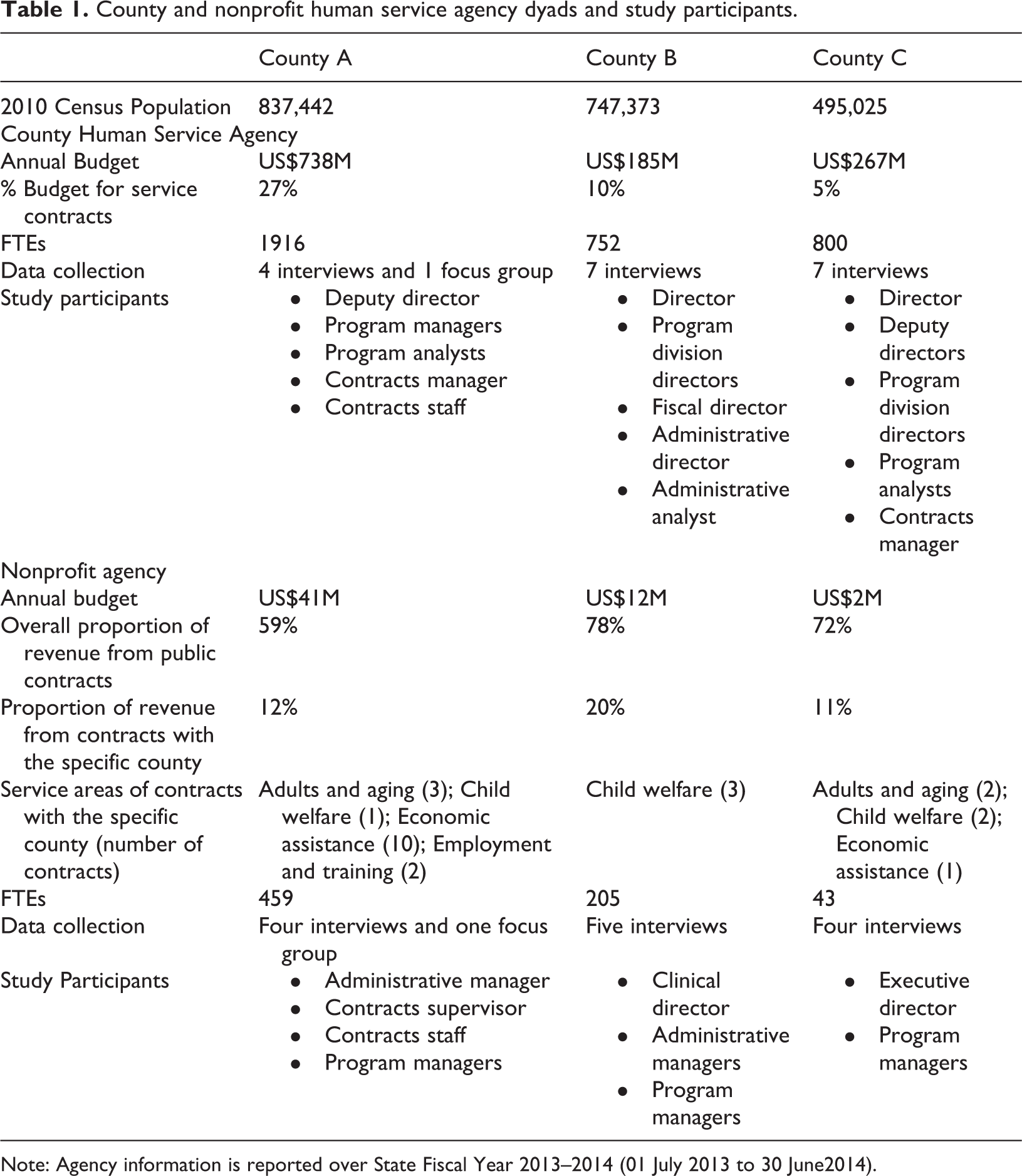
Note: Agency information is reported over State Fiscal Year 2013–2014 (01 July 2013 to 30 June2014).
Data collection
Each county provided information on its private sector human service contracts in FY 13–14. The contract data included identifying vendor information; contract service area and description; and contract terms and values. Because this study focused on the services provided via purchase of service contracts with private agencies, the contract data were limited to contracts with nonprofit or for-profit organizations. They excluded contracts for services with individual providers such as individual therapists, contracts or memorandums of agreement for services with other government entities such as cities or school districts, and administrative contracts such as leases, building security, employee training, or technology. This information about the scope of service contracting provided context for the findings from the focus groups and interviews.
In each county and nonprofit agency, in-depth qualitative interviews were conducted with executives, senior and mid-level managers, and program managers who had extensive involvement in the contracting process. The participating individuals were selected by their own agency and represented different service areas. As can be seen in Table 1, interviewees represented a range of organizational roles involved in contract oversight and management.
The study research team (consisting of four PhD-level researchers, two doctoral fellows, and one MSW fellow) collaborated to develop the interview and focus group protocols, conduct 31 in-person interviews and two focus groups, and analyze the resulting qualitative data. The focus groups were conducted first in order to develop a general portrait of the human service contracting process. Individual interviews were then completed to examine contracting experiences within and across agencies in each county public–nonprofit dyad. In total, 40 individuals participated, in two, two-hour focus groups and/or 31 60–90 minute interviews. The interview and focus group instruments were semi-structured to elicit the observations of expert informants. Primary topics included: (1) respondent role in the contracting process; (2) inter- and intra-organizational relationships that the respondent was involved in as part of the contracting process; (3) performance measurement, including major challenges and efforts relating to achieving desired program and service goals and/or delivering high-quality services; and (4) the complexity of human service delivery and its relationship to contract processes and outcomes.
The interviews and focus groups were designed to support the development of rich case studies for each of the six organizations, and thus enabled interviewers to pursue unique topics that might emerge for individual organizations (Stake, 2005a). A responsive interview approach was used, in which interviewers did not ask a uniform set of questions, but instead were able to focus each interview on the respondent’s specific expertise with respect to organizational contracting procedures (Charmaz, 2005; Yin, 2003). The focus groups and interviews were audiotaped, transcribed professionally, and then corrected by the interviewer. Transcripts were then uploaded to Dedoose, a cloud-based qualitative analysis software platform.
Analytic method
To provide a description of the contracted human service in the three counties, simple descriptive statistics were calculated using the contract data. The qualitative coding and analysis process for the focus groups and interviews was informed by the case study approach of Yin (2003) and Stake (2005a), the grounded theory approach of Oktay (2013) and Charmaz (2005), and the qualitative analysis approach of Miles et al. (2014).
First-cycle coding was iteratively deductive and inductive, with four original deductive codes derived from the literature on human service contracting (i.e., complexity, inter- and intra-organizational relations, and performance measurement) and additional inductive codes identified from the data. The three researchers who collected and coded the data communicated during first-cycle coding to strengthen the reliability of code creation and application. First-cycle coding resulted in 62 codes. Two of the three researchers coded in Dedoose, which provided for a cross-researcher comparison of coding application (which was found to be similar). 5
Using the first-cycle codes, the three researchers independently developed case studies for each study agency. This decision to forgo collaboration during this second stage ensured that each case study drew from the same set of 62 codes but represented the unique themes of each participating agency. Stake (2005b) referred to this process as ‘teaming’ in which different researchers are assigned different sites and, although they collaborate on activities such as design and coding, each produces an independent, in-depth study. The case studies produced for this study were the first phase of a multi-stage research agenda and were therefore descriptive in nature and intended to explore the range of variation in managerial perspectives on human service contracting in these counties. The case studies also included chronologies of the contracting process to help understand managerial experiences over time. 6
The scope of county human services contracting
The contract data provided by the three county human service agencies illustrate the scope of human services contracting in the three Bay Area counties, and provide context for the analysis of the MCC model using the focus groups and interview data. In FY13–14 rhe three county agencies held a total of 589 human service contracts with 248 unique private agencies, for a total value of US$229m. Contracting out was greatest in the areas of economic assistance (US$99m) and employment and training (US$75m). In these areas, contracts supported community-based anti-poverty programming via the provision of housing supports, medical insurance, nutrition benefits, cash assistance, and employment supports. Service contracts in the areas of adult and aging services (US$28m) and child welfare services (US$28m) included support for these basic needs and also focused on the delivery of services for at-risk and/or maltreated children, seniors, and adults. Across all three counties, the number of service contracts being administered was larger than the number of private vendor agencies. This was particularly the case in County A, which had 416 contracts being delivered by 134 private agencies.
With respect to the distribution of contracts by agency, 149 of 248 private agencies (60.1%) had only one contract with their respective county human service agency over FY13–14. In contrast, 74 private agencies (29.8%) had 2–5 contracts with their county agency; 19 private agencies (7.7%) had 6–10 contracts with their county agency; and 6 private agencies (2.4%) had from 11–22 separate contracts with their county agency. Therefore, the three study nonprofit agencies were likely most similar to those Bay Area private human service agencies with multiple contracts with any particular county human service agency. Overall, study generalizability may have been limited by the characteristics of Bay Area county agencies and their nonprofit partners; the specific nature of the contracting innovations being undertaken in the three counties; and the specific focus of the study on identifying stable, strong contract-based dyads. These factors may have distinguished the purposive study sample from other counties and agencies in the Bay Area and nationally.
Findings
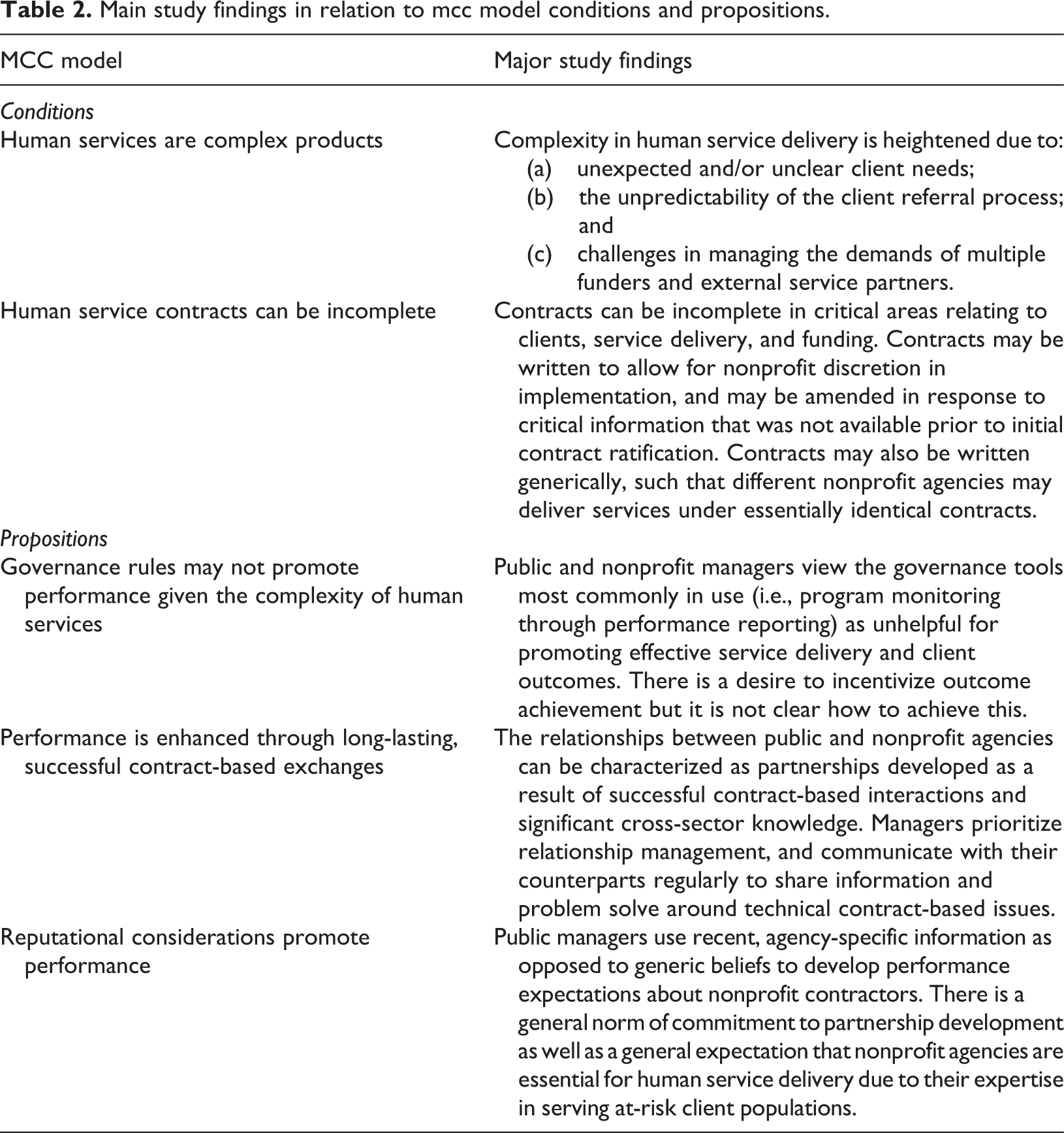
Review of the six case studies from the three county agency-nonprofit agency dyads identified themes of relevance to the question of how public and nonprofit managers address the challenges of contract management amidst the complexity of human service delivery. The main findings are summarized in Table 2, using the MCC model as an organizing framework. We describe these findings in this section, with care taken to assess the representativeness of study findings by organization and sector. 7
Main study findings in relation to mcc model conditions and propositions.
The complexity of human service delivery
Public and nonprofit managers uniformly regarded human service delivery as complex. In this section, we describe the major factors that public and nonprofit managers understood to contribute to the complexity of human services, including: (1) challenges associated with serving at-risk clients with unexpected, changing, and/or unknown needs; (2) the uncertainty of the client referral process impacting client flow into programs; and (3) difficulties in organizing services to suit the demands of multiple funders and service partners. These findings constitute the first description of the dimensions of complexity of human service delivery in contracted out settings.
Changing, conflicting and/or unknown client needs
In principle, human service programs exist to respond to the presenting conditions of at-risk populations and, in particular, to address the needs of clients who are deemed appropriate for treatment (Hasenfeld, 1982, 2010). Program goals, service technology and frontline caseworker efforts are organized to maximize responsiveness to clients. However, this normative or rational planning approach to human services is challenged by situations where client needs are different to what was expected or where client needs are unknown, ambiguous, or changing. In this situation, which was noted as being common by managers in all public agencies and nonprofit agencies, contracts are developed and programs are implemented amidst considerable uncertainty. This theme was registered by managers as: (a) client populations with needs that were different from what was anticipated by managers or noted in contract specifications; (b) in situations involving family groups, difficulties determining whether to serve a single client alone or with others; (c) variation in the level and type of client needs within any program, which complicated staff deployment and program planning; and (d) needs that were in excess of what the program could support. Although managers across the public and nonprofit agencies consistently registered this theme of changing needs and difficult-to-serve clients, there was no consensus among managers as to how best to serve such client populations. Managers in two public agencies and one nonprofit agency noted that they tried to coordinate with other programs and professionals to develop a profile of clients who might be expected to need services and then forecast how many eligible clients might be expected over time. However, as noted by a public manager, this process of collaborative needs assessment is ‘less of a hard science than you would think, and [involves] a certain amount of essentially guess work’.
Unpredictable flow of client referrals
Clients are the critical input in human service agencies: service delivery, the attainment of desired outcomes, contract-based payment and the financial position of the agency are all dependent on them. Managing the flow of clients into, within and out of programs is therefore an essential task of human service managers (Sandfort, 2010). Yet managers in all agencies but for one nonprofit agency noted difficulties associated with the unpredictability of the client referral process, particularly insufficient numbers of referrals and inappropriate referrals. This unpredictability was understood to be problematic for financial, administrative and performance-related reasons. Financially, because many service contracts reimburse nonprofit agencies per client served or require that a minimum number of clients are served, managers suggested that nonprofit agencies could be affected if county staff did not refer sufficient numbers of eligible clients to receive services. Administratively, managers noted that referring staff could be unfamiliar with program eligibility criteria, leading to the referral of ineligible (and thus non-reimbursable) or inappropriate clients to nonprofit providers. Finally, public and nonprofit managers suggested that agencies serving inappropriately referred clients might be challenged to serve them effectively and attain desired program outcomes. As one public manager stated, ‘Service providers can receive referrals for families where the family is…not in the best place to take advantage of the services. It really would be unfair of us to hold the service provider responsible for that mismatch’. Managers from two public agencies and two nonprofit agencies noted that their agencies used several strategies to gain some control over the client referral process, including: tracking client referral numbers and the sources of those referrals; nonprofit managerial outreach to line staff of public agencies referring with large numbers of clients who might be potential referrals; and developing systematic referral procedures in partnership with private providers.
Managing the demands of multiple funders and external service partners
A final theme concerned the complexity involved in delivering services while responding to (1) different and sometimes contradictory demands of funders and (2) coordination demands embedded in multi-agency service consortia. This theme arose among managers in all public and nonprofit agencies as contributing to the institutional complexity of human service delivery, by requiring managers to meet contract goals amidst complicated funding and interorganizational service arrangements, and by limiting the overall autonomy of nonprofit agencies in serving clients.
First, managers in each public agency noted that it was common for counties to integrate different streams of federal and state funding to support human service programs serving a common client population. Managers in each nonprofit agency also noted that their agency and other nonprofit providers routinely supplemented their county human service contract funding with revenue from other public and private sources, including: other county departments such as the health department and criminal justice system; other governmental entities including school, city, state, and federal agencies; and local philanthropic foundations, individual donors, and service user fees.
Nonprofit managers described being challenged to blend funding from multiple sources to support single programs, where each funding source may have come with disparate program eligibility, service delivery, and evaluation requirements. This often required managers to be aware of and manage different expectations while administering the program to suit each funder/contract. For example, respondents from two of the three nonprofit agencies noted that this braiding together of funding challenged managers to determine which funding stream to use in connection with the needs of clients, the level of service provided through a particular funding stream, and program eligibility requirements. Public managers in each county noted their awareness of the challenges facing their nonprofit counterparts. A public manager stated, Part of the difficulty on the provider’s part is they’re the ones in charge of enrolling people into the program and deciding what funding stream they’re being paid out of. That’s a very difficult thing for the community-based organization to do.
Second, managers in two public agencies and two nonprofit agencies noted that service delivery could be organized through formal consortia involving nonprofit agencies supported by different funders. These service initiatives were described as being organized through explicit contract requirements for multiple agencies, including the use of lead contractors and subcontractors, often in response to an RFP (request for proposal) prioritizing community collaborations. Public managers justified the use of a service consortium model by referring to the expected benefits of service coordination for providing a continuum of services to client populations, and for promoting nonprofit specialization in particular service areas. However, these contracts were also viewed as increasing managerial demands related to interorganizational coordination: public managers noted having to monitor resource levels for consortium partners in relation to community needs; and nonprofit managers identified challenges associated with developing program policies, service delivery procedures, and funding agreements spanning multiple agencies. Thus, while managers highlighted the benefits of service coordination, there was a general belief that these initiatives made the delivery of human services more complex.
The incompleteness of human service contracts
Given the complexity of human service delivery described earlier, it is not surprising that public managers in each of the three county human service agencies suggested that service contracts were regularly developed and implemented in a way that can be considered ‘incomplete’, although managers did not use this word specifically to describe their contracting procedures or describe the prevalence of incomplete contracts. 8 Rather, contract incompleteness was described primarily in relationship to product and exchange rules. With respect to product rules, public managers in each county described contracts sometimes being developed without requirements concerning specific numbers of service units to be provided or specific types of clients to be served. Equally, contracts did not always specify the full set of service-related activities through which program outputs were to be achieved and for which reimbursement could be requested. A public manager stated, ‘We don’t need to tell the contractor how to do the work (aside from regulatory guidelines)’. Regarding exchange rules, contracts were generally specified for preset time periods (often in one-year increments, with the possibility of renewal for up to an additional two years). These contract time parameters were generally arranged without a clear connection to expectations regarding output or outcome achievement; and no nonprofit agency noted that they were currently providing services under a performance-based contract.
Although contracts could be written quite simply and non-specifically in relation to product and exchange rules, managers at each of the public agencies suggested that amendments to the contractual scope of work could later be made as the public and nonprofit agencies gathered information on client numbers and emerging client needs, service costs and program outputs that was not available during initial contract development. For example, a public manager noted, ‘We look at the data and if something’s not working, or we have set the goal too high or low, we adjust’. A public manager in another county stated, One thing that has happened is that nonprofit agencies [now] go through their contract funding much more quickly than they were allocated for just because of the complexity of the cases. Let’s say that you got a contract three years ago and now you are seeing more complex problems; in order to provide the same level of quality services, you may have to go through more money. Suddenly [the nonprofit agency] comes back and says, ‘We are projecting that we are going to run out of money’. We have to basically understand whether…it has truly become so complex in some areas that we have to increase the contract.
Public managers justified initial contract incompleteness as (1) a practical response to the difficulty of fully specifying the contract in relation to the complexity of human services; they also viewed it as (2) a strategy to introduce needed flexibility into contract implementation. Non-specific contract language provided nonprofit agencies with discretion as they began program implementation and service delivery. A public manager suggested, ‘Sometimes you don’t want everything detailed. You want to be able to have a little gray to give some flexibility…you don’t want me to provide you a checklist’. Embedding this ‘gray space’ into contracts – through initial under-specification – was intentional and was designed to provide public and nonprofit managers with the ability to respond (through subsequent contract amendment) to the complex and/or unforeseen client and service delivery scenarios noted previously.
Formal governance through program reporting
In the presence of complex products and incomplete contracts, the MCC model suggests that governance tools may have little effect on contract outcomes. Our findings suggested that managers across public and nonprofit agencies were challenged by the governance structures most common to them, which primarily concerned performance monitoring and reporting. From the perspective of public and nonprofit managers across all three counties, performance was generally understood in relationship to the delivery of contracted services (outputs) rather than improvements in client wellbeing or reductions in client need (outcomes). Managers described performance monitoring as involving the reporting of nonprofit program information concerning service units provided and clients served.
Public and nonprofit managers generally viewed contract-required performance reporting as an exercise in activity-based auditing and generally unhelpful for the attainment of outcomes. A nonprofit manager stated, All [my clinical staff and I] really care about…is connecting with that teen, learning what their world is about. Where do they have challenges? What do they hope for themselves? That’s what we want to do, but we have to do all this other stuff. I am just being honest with you, I don’t really care about what’s in that paperwork.
While public and nonprofit managers understood that performance indicators were often required (particularly for programs using federal and state funds), they were not convinced that their reporting would be helpful for improving contract performance or to make decisions about contractor selection. For example, public and nonprofit managers were doubtful that public agencies had the knowledge and/or resources to use agency program data to compare agencies and programs, identify top performers, and forecast service needs.
Managers from each public and nonprofit agency noted that their agencies were interested in developing performance tracking systems and using these to incentivize performance, including outcome evaluation and performance contracting. As noted by one public manager, ‘We should be less invested in [tracking] objectives and how contractors produce those outcomes, and more invested in clear measurable outcomes so that we can see the results of our services – that clients’ lives are better’. However, there was a general awareness that developing such evaluative systems was beyond the technical and fiscal capacities of county or nonprofit agencies. A public manager from a different county noted, We typically don’t have the bandwidth to do 60-day, 90-day, six-month, one-year follow-ups, and it’s often very difficult to track people down. None of these populations is necessarily very stable or stationary, and follow up is challenging and generally not funded. We generally rely on people coming back to us rather than us seeking them out. But when people come back to us, it is generally not a good thing. So we know when people are failing; we just don’t know when people are succeeding.
Relational contracting is common and is viewed as important
As proposed by the MCC model, public-nonprofit human service contracting is more likely to lead to positive outcomes if it has been preceded by prior successful contract exchanges. Public and nonprofit managers commonly understood contracting from a relational viewpoint, and emphasized strongly the importance of regular interchanges with their counterparts, active professional networks, and collaborative problem solving. Cooperation was identified as an essential aspect of contract-based program implementation given the complexity of human service delivery. Moreover, public and nonprofit managers uniformly described their contractual work as collaborative and building on prior contract successes, defined generally as providing effective services in response to client needs.
Findings also highlighted the iterative and interactive processes at the heart of contract management. Specifically, a theme of relationship management was strongly noted by managers in every agency. Their contract-based relationships were often described as partnerships; nonprofit agencies were rarely described as contractors or vendors, and never as competitors. Public managers used this terminology to suggest that their collaborations with nonprofit agencies helped to extend the public sector mission. Managers in each county also identified dialogue and regular, open communication as essential in supporting contract-based relationships. Managers perceived their counterparts as accessible and their relationships as personal. More broadly, managers noted the importance of interpersonal relationships in facilitating interorganizational, contractual processes. For example, a public manager suggested, Relationship is ninety-five percent of the game. When you get to my level of the organization, it really comes down to mostly relationships and relationship building…Pick up the phone and call the executive director of [nonprofit agency] and say, ‘Hey, we have this issue coming up. What can we do to get around that?’ Boom – you can cut through the emails and all that stuff.
These relationships were described as longstanding, often evolving over decades of successful contracts with one another. Some county managers noted having led nonprofit service programs; similarly, some nonprofit managers noted having been employed in state or county settings. This level of cross-sector familiarity was accompanied by considerable technical knowledge of current and past contracting practices as well as one another’s agencies. As stated by one nonprofit manager, The majority of our contracts are renewed contracts, meaning that we have had them for 10, 20, 30 years. I know [county managers] understand what we’re doing. They know inside and out what our contracts are on the services side and the financial side.
However, public managers did not characterize all their contractual relationships as equally successful. Public managers in all three counties noted that they had experienced difficulties with some nonprofit agencies, particularly if theagencies were undercapitalized, recently established, and/or contracting to deliver unfamiliar services. In this situation, public managers noted the importance of monitoring and communicating with agencies more frequently during the early stages of contract monitoring.
9
In addition, public managers from two of the three counties suggested that in these infrequent situations they would broaden their role beyond contract monitoring, to include the provision of technical assistance and even consultation around organizational development. In these two counties, it was noted that this assistance might go beyond the individual contract to sustain the viability of an essential agency. A public manager noted, I am giving them direction and advice on anything and everything. Like some of their internal decisions, internal processes, their personnel issues, how they are structuring things, and how it’s being delivered out into their partnership.
What does it mean to be a partner? We’re only partners with you when you’re doing well? But if there is a problem that comes up, well, you’re on your own? We could say, ‘You failed’, but if there is some intervention we can do, then it’s better.
Agency-specific and general beliefs structure expectations about performance
Finally, the MCC model proposes that nonprofit agencies behave consummately when they are aware that a reputation for perfunctory behavior threatens future contract rewards. Managers in all three nonprofit agencies generally understood their agency reputation as service partners to reflect recent experiences as well as older beliefs. Nonprofit managers spoke in general terms of the longstanding reputations of their agencies for delivering services effectively, and suggested that their success in contracting reflected many years of diligent contract partnership. They also noted the importance of continuing to deliver on the promise of their past successes in order to avoid weakening the relationships they had developed with public agencies and other funders. It was in this context that nonprofit managers noted the importance of demonstrating their trustworthiness for effective service delivery through continual attentiveness to county contract managers.
Public managers did not mention being influenced by these broad, general considerations in their selection of nonprofit contracts or their interactions with nonprofit agencies. Rather, managers in each of the three counties suggested that they developed expectations concerning future nonprofit performance based on their review of available information from contract documents and their consideration of current experiences with nonprofit agencies. We start with the assumption that every contracted provider is going to have an annual in-person monitoring visit. But in reality we don’t review one hundred percent of our contracts every year. We have waivers or exemptions for those contractors that have demonstrated solid performance in the past.
These agency-specific methods of developing performance expectations were undergirded by a general belief that nonprofit agencies are essential for human service delivery because of their expertise in serving at-risk client populations. This belief was noted by managers in all public and nonprofit agencies in the following ways:
Nonprofit agencies have expertise developed through decades of service delivery; Being generally small in size, nonprofit agencies are agile and able to respond to changing community and client dynamics; As compared with public bureaucracies, nonprofit agencies have stronger connections to community groups and are thus able to deliver services in a more accessible, desired manner; and Because of differences in public versus private workforce and administration, nonprofit agencies are able to provide a lower cost per unit of service than public agencies.
A public manager stated, We recognize that we are not always the best direct provider of services. We do have programs that we administer directly, but we can’t do that for the entire array of services we offer communities. Nonprofits provide a community and cultural and language competency that we don’t have.
Discussion
Overall, the tenor of our qualitative interviews and focus groups with public and nonprofit human service managers across the three San Francisco Bay Area county–nonprofit dyads suggests close, longstanding relationships facilitating information exchange and collaborative problem solving in an environment of structured complexity. Despite the fact that our data reflect a purposive sample of highly involved contract partners, the current study highlights the stability of the contracting network and the interpersonal, organizational, and interorganizational foundations of contract development and implementation. These findings sit comfortably alongside studies drawn from stewardship theory and the relational contracting literature (Davis et al., 1997; Van Slyke, 2007). Our results also suggest multiple places where complex human service delivery challenges impact human service contract management. In this final section, we review major study findings in relation to the MCC model and identify implications for future research and theorizing. We then propose a set of recommendations for practice that bridge strategies for improving human service delivery and human service contracting.
Managing complexity in the human services
Human service contracting across the three county dyads can be characterized as dynamic, often uncertain, and complex. Managers at public and nonprofit agencies uniformly noted being challenged to deliver services in the face of changing and unpredictable client needs and referral levels. Other factors identified as adding complexity to human service delivery include conflicting client eligibility and funding requirements and coordination difficulties involved in interagency service delivery and program reporting. Managers noted some common strategies for addressing these challenges, including: (a) gathering information from providers to develop profiles of client needs, and coordinating to prepare for changes in service demand; (b) identifying the major sources of client referrals, conducting outreach to strengthen referral flows, and formalizing referral procedures; (c) and being knowledgeable of different program eligibility criteria and funding requirements, and their impacts on staff and clients.
These findings concerning the dimensions of human service complexity and the strategies managers use to address them add nuance to the results of previous studies (Johnston and Romzek, 1999; Van Slyke, 2007) and enhance our understanding of product complexity within the MCC model. Our findings suggest that managers concentrate upon supply-chain issues relating to the adequate, appropriate and timely provision of clients who are able to meet program eligibility criteria and therefore receive services (thus triggering agency reimbursement), and to changes in these supply functions over time. This attention to program inputs helps to focus discussion on how managers address the complexity of human service contracting around the task and technical environment of frontline human service delivery (Hasenfeld, 1982, 2010). It also suggests that managers actively manage those interorganizational relationships on which human service supply chains depend.
A separate dimension of the complexity of human service delivery is the sheer volume of contracts (with their associated eligibility policies and reporting schedules) and different contract partners in play for any single public or nonprofit agency. In the multi-contract environment, the task of the manager is to organize service delivery within potentially different institutional settings (e.g., multiple contracts supporting a single service program, with each contract potentially having different service delivery, performance, and reporting expectations) while attending to client flow, frontline service quality, and inter-organizational coordination with partner agencies. In this regard, our study adds necessary context to the MCC model, which does not consider the influence of multiple contract partners; and recalls findings from classic studies of nonprofit human service contracting (Gronbjerg, 1993; Smith and Lipsky, 1993).
Although the strategies used by public and nonprofit managers to address the complexity of human service delivery are important to understand, research on the topic is rare. We see benefit in the development of studies focused on the following descriptive questions.
Which client population(s) is our program suited to serve? Under what conditions can the program secure an optimal supply of needed resources, including clients? How does the program respond to the challenges of adapting to different contract partners to serve clients in the manner to which it is suited? How can the program gather information from and collaborate with other public and nonprofit agencies to prepare for future changes on these questions?
These questions are concerned with the design of human service programs, their delivery under diverse organizational and institutional conditions, issues of programmatic reform amidst organizational change, and the roles and efforts of public and nonprofit managers in facilitating planned change and responding to unplanned change. Developing a literature base organized with regard to these topics should inform the development of more advanced studies focused upon contracting amidst the complexity of human service delivery.
Such studies might provide opportunities for theory development and refinement on the management of complex human service delivery systems. For example, if, as found in the current study, human service contracting involves strong and perhaps stable interdependencies that link public and nonprofit organizations in order to manage the underlying complexity of human service delivery, then it is important to examine whether contract management may under some conditions take on a more cross-sector and distributed character. Prior research on service contracting, including the MCC model, has been informed by theories of the firm and has tended to assume strict organizational boundaries and the autonomy of actors within service delivery networks. In contrast, we wonder if, when, and how boundary-spanning managers may collaborate across organizations in order to build networks of accountability that span individual principals and agents (Quick and Feldman, 2014; Campbell and Lambright, 2016). This possibility is seen perhaps most vividly in our findings that public managers can take an active role in providing technical assistance and organizational development to valued but at-risk nonprofit agencies, and that nonprofit managers can make suggestions to public managers about program needs which may result in contract modifications.
These possibilities may reflect the nature of our study sample, and the well-developed and stable interorganizational relationships between public and nonprofit agencies. They also recall Milward and Provan’s admonition that, Stability is a function of principals allowing agents to learn from their mistakes. It does not imply that principals should not intervene or help agents cope with problems. It does mean that principals should play a positive role in allowing agents to solve social dilemmas. (Milward and Provan, 2000: 377)
Adapting strategically to incomplete contracts
As anticipated by the MCC model, we find that human service delivery is occurring through broadly defined contracts. But, whereas the MCC model suggests that incomplete contracting is an inevitable result of complex products, which complicates the efforts of public managers in devising effective governance systems to promote contract enforcement, our findings suggest that contract incompleteness may be a practical and strategic response to managing human service delivery. The complex nature of human service delivery illuminates an essential paradox in contracting for complex products: namely, while managers are challenged by the indeterminacy of incomplete contracts, the very incompleteness in contracts may provide helpful flexibility for managers to engage in program implementation in complex, interdependent and possibly financially risky service settings without threat of immediate sanction for contract non-compliance. Engaging in course correction through contract amendment is the solution to this paradox, because it allows for negotiation around program objectives and performance goals as public managers gain new knowledge through interaction with their nonprofit contract counterparts and are able to develop more precise service and performance expectations. For example, managers from public and nonprofit agencies in our study suggested that while initial contracts provide a foundation for human service delivery the unanticipated program implementation challenges which threaten the ability of nonprofit agencies to deliver services effectively (e.g., unexpected program costs, greater than anticipated client needs) can spur discussion of program adjustment and serve as the basis for contract amendment requests.
We thus agree with the conclusion of a recent study of public child welfare agencies contracting for nonprofit mental health services: ‘Contracts that are cooperative and flexible are likely to be higher performing since discretion is important in human services, where tasks, services, and outcomes are often uncertain’ (Bunger et al., 2015: 9). We see value in research assessing the extent, as well as its benefits and costs, of contract incompleteness in the human service sector. One hypothesis that can be drawn from our findings is that contracts are written intentionally to be simple and broad so as to create space for managers to develop service strategies that address emerging human service delivery issues without significant financial liability. An alternative hypothesis is that public agencies purposely draft incomplete contracts in order eventually to tighten reimbursement schedules, alter reimbursement schedules, and reduce overall payments through contract amendment (Pettijohn and Boris, 2014). Each possibility reflects a strategic orientation to contracting amidst complexity, although the logics underlying the hypotheses are contradictory and the outcomes of each can be expected to differ.
Relational contracting to bolster weak institutional rules
In the presence of complexity and incomplete contracts, the MCC model proposes that (1) repeated collaboration and (2) reputational considerations may help promote shared positive outcomes for public agencies and nonprofit agencies, but that (3) it may be difficult to develop performance-promoting institutional rules (e.g., effective performance measurement systems). Our findings mirrored these expectations. More broadly, our general finding that public and nonprofit human service managers rely on structured informal interactions and strong informal norms to supplement weak governance systems is supportive of current research (Romzek et al., 2012; Romzek et al., 2014).
There appears to be a shared understanding among managers that partnership through regular dialogue is the most effective method of resolving service and contracting dilemmas. This is where we may see most clearly the protective effects of the collaborative contract management noted by managers from all public and nonprofit agencies. Within these enduring and active networks, communication and a familiarity with one another’s programs and agencies may facilitate problem solving on fundamental challenges that cannot be addressed through ex ante contract specification.
The language that public and nonprofit managers use to describe their contract-based interactions is profoundly relational and familiar, and supports the use of a relational contracting lens. References to goal conflict, methods for guarding against moral hazard and shirking, competition, or calculated cooperation were largely absent from the manager interviews. In contrast, our findings support a portrait of managers with substantial shared experience and cross-sector knowledge engaging in problem solving in a way that promotes dialogue. We also find that these ongoing conversations are supported by a norm of commitment to being a good contract partner. Managers across public and nonprofit agencies emphasized the importance of relationship development, partnership cultivation, cross-sector knowledge (i.e., learning the perspectives of their contract counterparts), and active communication.
It is not clear that public managers always lead this conversation, since in our results public managers expressed the beliefs that nonprofit managers have significant service delivery expertise, and that nonprofit agencies are better equipped than public bureaucracies to respond to community-based social needs. Moreover, our study provides some evidence that public and nonprofit managers may partner to identify emergent needs and promising service approaches, and that nonprofit managers may initiate critical service delivery and contract improvement processes (e.g., to improve referral pathways, to amend contract scopes of work).
While researchers have begun to identify the behavioral and institutional dimensions of relational contracting, its interpersonal context requires elaboration. If relational forms of contract management might be powerful tools for shaping contract outcomes in situations of service complexity, interdependency, and contract incompleteness, then research is needed to enhance our understanding of what exactly is relational (i.e., social and psychological) about relational contracting. Future studies might examine the behavior of managers within and between agencies, to explore the characteristics and formation of intra-organizational and inter-organizational social networks. Such inquiries might focus attention on how contract-based groups and teams develop to support problem solving related to ongoing and emerging issues.
We see value in additional research on the evolution of norms of trust and reciprocity as a foundation for collective action. We also see opportunities for the development of studies on the following questions.
How do public and nonprofit managers engage in problem solving around complex contract-based issues? To what extent do managers within and across public and nonprofit agencies share common perceptions and worldviews with respect to contract-based goals, objectives, and strategies? Do the quality and consistency of public managerial relationships with their nonprofit counterparts inform contract management activities? How do answers to these questions vary by managerial factors (e.g., experience), organizational factors (e.g., sector, degree of nonprofit dependency on contract-based revenue), and institutional factors (e.g., performance-based contracting)? Do the answers to these questions affect contract outcomes?
These questions anticipate the development of dyadic studies of public and nonprofit agencies linked by specific human service contracts, and in which the perceptions of public managers are compared to those of their nonprofit managerial counterparts. If managers working together make contracts work better, then it is important to study how they do it.
Implications for practice
Public and nonprofit managers interested in improving human service delivery and contract performance amidst complexity may consider the following implications for practice from our study.
Effective human service contracting depends on managerial knowledge and control of the services themselves. Human service contracting can be enhanced through improved understanding of how to: (a) meet the needs of clients effectively, efficiently, and equitably; (b) help clients access appropriate programs; (c) coordinate across funders and agencies to serve a common clientele; and (d) evaluate and incentivize program outcomes as opposed to outputs. These technical activities support managerial efforts to control essential elements of the human service supply chain, and thus outcome achievement. Because the complexity associated with human service contracting creates opportunities for interorganizational interdependence, there is every reason to expect public and nonprofit managers to interact regularly. Interorganizational collaboration in human service contracting is enhanced when public and nonprofit managers share common commitments, engage in dialogue and exchange of critical information, and have cross-sector service delivery expertise. These interactions serve as the basis for joint problem solving. Performance measurement and program monitoring complement but are not substitutes for evidence-based management, in which performance information is used to support organizational learning. For managers to benefit fully from performance measurement, both sectors must continue to invest in the transformation of program reporting systems into knowledge sharing systems (Lee and Austin, 2012). Contracting for human services is as interpersonal as it is technical. Governance models for human service delivery should attend to the fundamentally relational nature of contracting amidst complexity. Contract and program developers should (a) provide opportunities for cross-agency dialogue and technical assistance to promote service refinement over the life of a contract and across contracts and (b) provide incentives and resources to facilitate their use by managers. If these opportunities are not structured formally, then they will most likely continue to exist informally for experienced, networked managers but less so for new managers who need them most.
Conclusions
While the contract supplies the legal and fiscal framework for human service organizational activity, it is simply the institutional vessel within which public and nonprofit managers engage in dialogue and problem solving on longstanding as well as emerging service issues. Understanding this requires extending our focus beyond organizations and contracts to include managers as critical units of analysis. It requires examining how managers make decisions, develop partnerships within and across agencies, and organize human service delivery amidst uncertainty and complexity resulting in incomplete contracts and governance tools of limited capacity.
For scholars, the challenge to date has been to reconcile attention to these multiple units of analysis (i.e., funder–fundee dyads, organizations, and managers) with theoretical frameworks that accommodate questions of how public and nonprofit human service organizations address issues of complexity and incompleteness. Our examination of the MCC model using Bay Area case study data provided the first opportunity to describe how public and nonprofit managers understand and address the complexity of human service delivery, and how complexity and incomplete contracts impact human service contracting. In so doing, we sought to draw a linkage between the previously unconnected scholarship on complexity in the delivery of human services and the literature on formal and informal governance approaches to the management of human service contracts.
Footnotes
Declaration of Conflicting Interests
The author(s) declared no potential conflicts of interest with respect to the research, authorship, and/or publication of this article.
Funding
The author(s) received no financial support for the research, authorship, and/or publication of this article.