




Abstract

Overview
This special issue of the Journal of Strategic Contracting and Negotiation (JSCAN) is devoted to “contracting for innovation and innovating contracts.” From the inception of planning for the issue, the co-editors hoped to attract contributions from a full range of professionals engaged in contract theory and practice: research academics, contract managers, corporate executives, and legal counsel, plus what JSCAN Editor-in-Chief Tyrone Pitsis told us are called “pracademics:” those who straddle research and commercial environments, making concrete contributions through collaborative projects, experiments, interviews, software development, or theory-building. JSCAN is a natural publication outlet for such partnerships, since so many of the 40,000 worldwide members of the International Association of Contract and Commercial Management (JSCAN’s parent organization) are thought-leaders in every aspect of commercial contracting.
The outreach to a diversity of potential authors was rewarded with a rich array of articles, research reports, essays, and a book review from a broad cross-section of professionals. The collected works of this special issue come from legal and business academics, information designers, practicing attorneys, and contract consultants. The works span theory development, project description, software analysis, and suggestions for yet further innovation.
Although the works display an especially broad range of structures and writing styles, they share some common features: an emphasis on clarity and accessibility; novel uses of visualization or narrative style; and a commitment to addressing contracting practice as well as theory. Their style and sense of mission toward reaching out to broader audiences reflect the substantive themes echoing throughout the collected works: seeking to make contracts more meaningful, attractive, and useful through stronger intelligibility and relationship-building. For each author, clear, strong, mutually respectful communication seems foundational for those who use contracts, as well as for those who create and study them. We hope that each of the offerings in this special issue is broadly informative, and trust also that each welcomes further collaboration between academics and commercial professionals.
Summary of the contributions
In that spirit, we can summarize the trends in contracting innovation that emerge from this JSCAN special issue. More than one article assumes a similar starting point: the need for improvements in virtually every aspect of the process, and resulting product, of contracting. For example, here is how Adrian Keating and Camilla Andersen described the graphic image depicted in Figure 1, designed by visualization pioneer Colette Brunschwig: “While most lawyers can spend a long time explaining the finer points of offer and acceptance and meeting of the minds with legal language, this illustration does a beautiful, swift, and even emotive job of the task. The green belt binding the parties together conjures an image of a constructive (if constrictive) positive relationship. The outstretched hands of the parties associate with collaboration and partnership, and openness to ideas and exchange. This illustration conveys a contract in ways that legal linguistics cannot do (at least swiftly).”
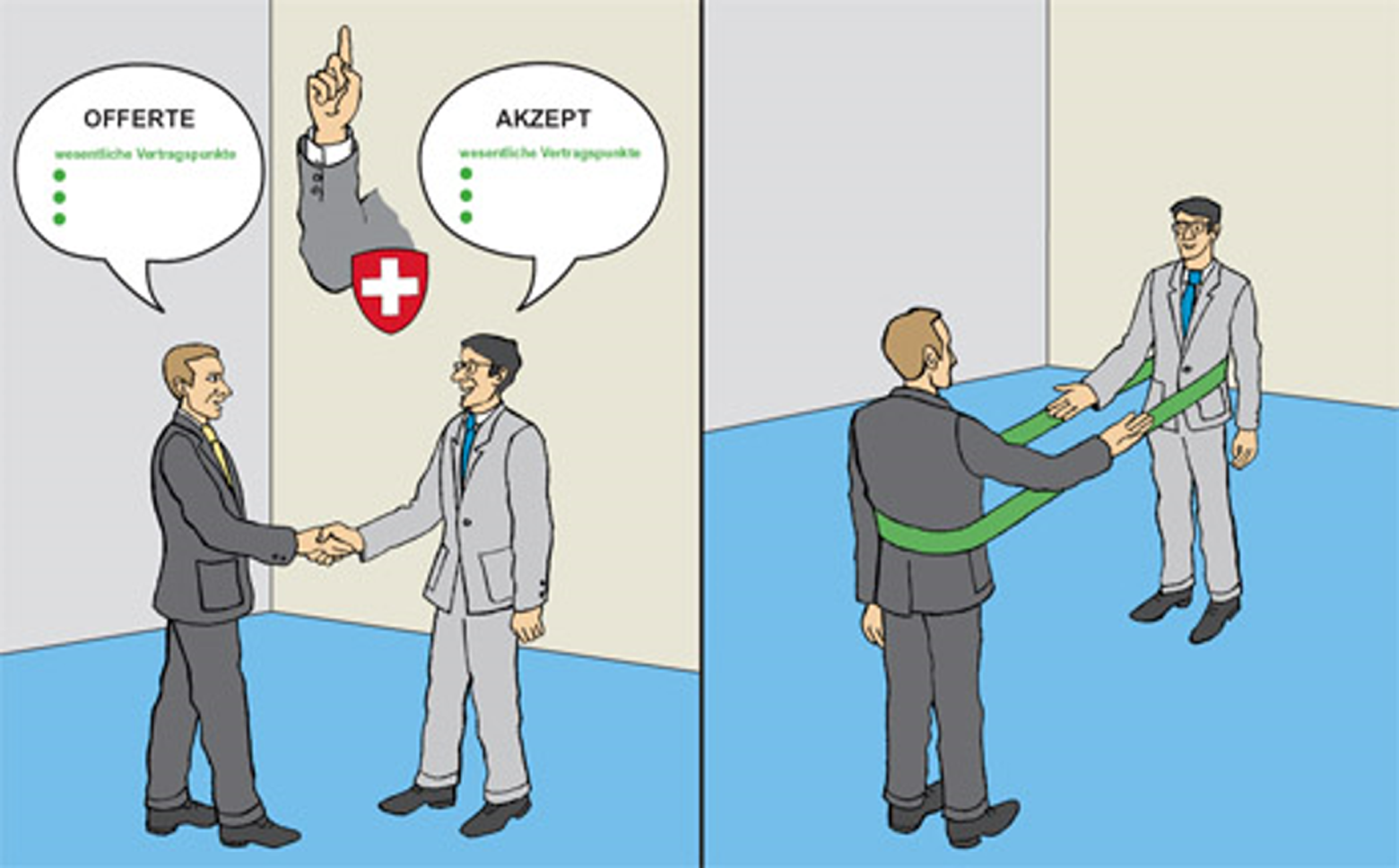
OR Article 1 Section 1 For a contract to be concluded, a manifestation of the parties' mutual assent is required.
But given that ideal of more strongly communicative contracts that build better commercial and personal relationships, how can that be done? And done effectively, combining both cognitive accessibility and financial efficiency?
Four goals of contracting—cognitive accessibility, legal effectiveness, relationship-building, and cost—may seem potentially to fight one another. Indeed, some of the creativity ahead will be in finding ways to enhance a broad range of contract functionality in cost-effective ways. At what financial cost, for example, can information designers be brought into projects to help create contracting documents? And what benefits can be expected, that would justify such investments? David Orozco’s review of Victor Goldberg’s book Rethinking contract law and contract design

Robert De Rooy—example of comic contracts (used with permission).
Toward that end, three articles in this special issue describe actual projects involving collaboration among information designers, lawyers, and commercial managers: the research and analysis of Stefania Passera, Anssi Smedlund, and Marja Liinasuo with a Finnish company; the work of Robert Waller, Jenny Waller, Helena Haapio, Gary Crag, and Sandi Morrisseau bridging cultural, information, and trust barriers between an energy company and Aboriginal persons in Alberta, Canada; and Andersen and Keating's work within an Australian University department of mechanical and chemical engineering. Each article describes success through careful, empathic listening combined with documents tailored specifically to informational needs of their users. Importantly, each article also identifies that the process of finding appropriate, effective contract design involves the kind of collaboration that builds better relationships between contracting parties, and also within the organization of one contracting entity.
The Waller et al. work begins by describing the Aurora project—an oil sands joint venture involving lands owned by Aboriginal People in British Columbia. As with any potential contract, both parties are poised to benefit from the exchange. And as with many complex, long-term agreements, the relationship of the parties was deemed crucial to the formation and successful implementation of the contract. As they write: “An important aspect of its success is obtaining social license—the development of a trusted relationship with local and Aboriginal communities, who want to share benefits from employment and business opportunities.” And yet this social license was an obstacle rather than a potential asset in winning agreement. The reason, say the authors, was in part that “the complexity of the current contract documents is seen as a barrier by smaller companies from local and Aboriginal communities.” To overcome this barrier—turning human relationship into a tool for success rather than a source of confusion and suspicion—“[t]he Aurora LNG team [sought] to accomplish this through collaboration and a commitment to developing strong, mutually respectful relationships.” Building this collaboration required documents that were intelligible and useful. The Waller et al. article describes the collaborative process not only among the contracting parties, but within the Aurora joint venture team, to design and communicate an effective request for proposals.
Similarly, Passera, Smedlund, and Liinasuo note that “Research about the psychological effects of contracts on relationship quality hints that effective contract design is not only a matter of selecting the right clauses, but also of communicating them in the right way.” They set out to research the benefits of using contract visualization to advance clarity and exchange relationships. Their path-breaking empirical field research at a Finnish company is enhanced by the power and imagination of their analysis.
Passera et al. begins by identifying uncertainty as a “hindrance to coordination and relational mechanisms between the parties.” Their work shows convincingly how “visualizations [can be] used to reduce the uncertainty arising by three knowledge gaps in the contracting process—inter-firm, cross-professional, and between contracting phases.” As borne out through their field research and responses to vignettes, visualization can bridge these gaps or boundaries through its multiple potentials: (1) “encode interdependencies and relationships between parts and wholes – of a product, a group, a process”; (2) “elicit and externalize tacit knowledge,” with potential for “improv[ing] the quality, quantity and retention of ideas generated in meetings”; and (3) “act as organizational memories, aiding synchronization by capturing and systematizing knowledge – which can be later shared and applied in new settings, at a later stage of a process, or executed throughout the organization” [citations omitted]. The promising results of the research by Passera et al. will hopefully be replicated in other cultural and organizational settings: they explicitly call for further research to solidify and broaden our understanding of the potential for contract visualization.
If stronger communication, simplification, and visualization are effective responses to the less-than-optimal functionality that afflicts much modern contracting, can these processes be scaled up, or be somehow automated so as to be efficient for a broader range of contracts? The hope is that emergent techniques can justify their use, with lesser or greater intensity, in most commercial transactions.
Three articles describe important possibilities for finding efficiencies in visualizing or customizing contracts through stronger use of technology. Daniela Alina Plewe and Robert de Rooy, for example, describe how “Otto”—imaginative, useful software created by Dr Plewe—can help parties identify goals in negotiating the terms of their contracts, and then aligning those goals into the terms of the formal contract and its ultimate implementation. Otto “stimulates and facilitates the articulation of high level goals allowing the pre-negotiation considerations to be aligned to these goals. It also facilitates the pre-negotiation work informing the negotiation, and importantly, the seamless translation of the deal into a [contract] through Formal Contracting.”
Plewe and de Rooy suggest Otto's future expansion toward computer generation of visual images, or even comic strip characters and stories, to explain contracts. De Rooy has used these techniques successfully in the context of domestic and agricultural workers in South Africa to create one of the world's first “comic book contracts,” as depicted in Figure 2.
In a similar vein, Keating and Andersen were able to adapt general use software for creating comic strips—the “Pixton” software—to generate an engaging comic book contract depicting various aspects of their University engineering department contract and its communication underpinnings. An example frame from their work is shown in Figure 3.
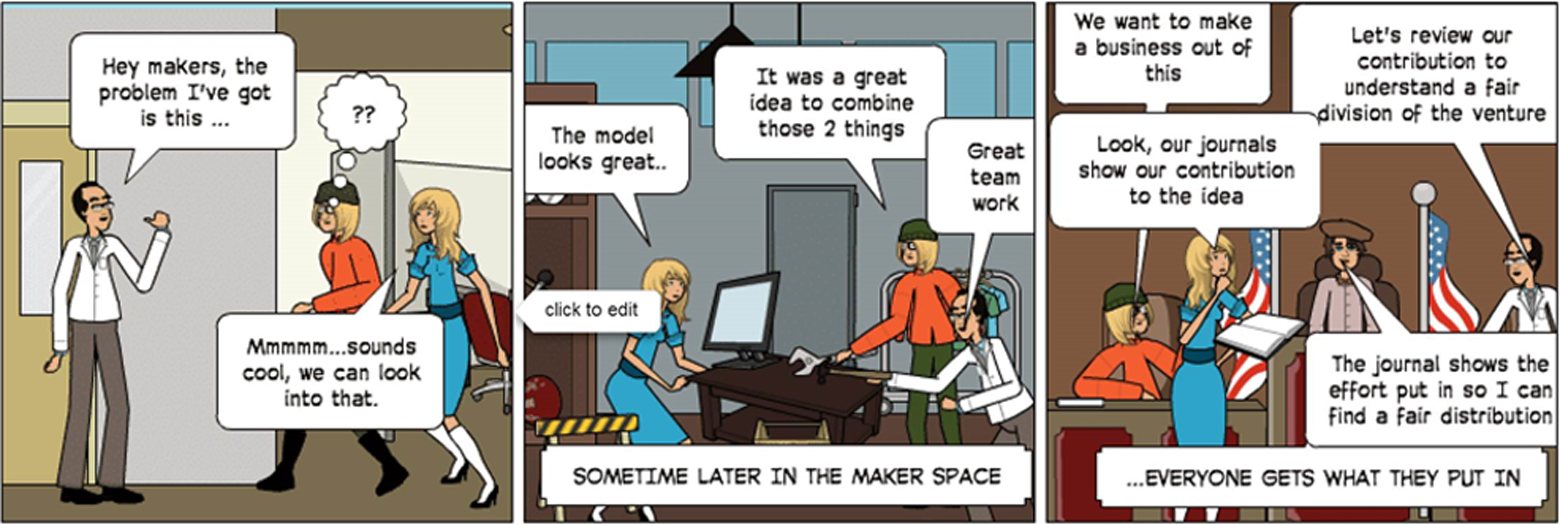
Keating and Andersen—Comic strip example (used with permission of Pixton Comics Inc.).
Moving away from visualization, Rory Unsworth describes an innovation he has developed in his practice to confront the problem of “scale,” and harness it toward an efficiency advantage. Unsworth shows how the hundreds of contracts that often pose an administrative nightmare could be used effectively as a data repository that could be “mined” electronically to create intricately customized agreements for new transactions. Through Unsworth’s data-mining software, contract creation could be personalized within seconds, bringing stronger accuracy and relationship potential to contracts which traditionally may have been relegated to a de-personalized commodity status.
But Unsworth goes further, seeing how mining and recombining aspects of the database can help to bring together a team of diverse professionals within a large company (the “XFT” or “cross functional team”). He writes: “With often dozens (if not hundreds) of engineers, actuaries, risk managers in various categories, contracts experts, lawyers and implementation specialists around a large organization, how can the organization make sure that all its experts are remaining consistent with each other across the XFTs and providing a blended corporate view to the client, rather than a single expert view?”
Typical cross-functional teams produce essentially a patchwork of individual expert assessments because the non-experts have no basis on which to challenge and re-examine the work of other members of the team. In part that is because expert determinations are often judgments based on a number of highly interactive variables. “A typical expert answer to most questions is that ‘It depends on the context.’” But data mining permits the viewing of multiple contexts almost simultaneously. By permitting experts to “record their views in the various contexts in which they could appear, exhaustively” it “opens…up [the experts] to the scrutiny of their peers.” The ultimate goal, says Unsworth, is to create “flexperts” to transform a typical XFT grouping into a body that will produce expert, but also self-reflective and integrated, corporate views.
The internal as well as external transformative potential of better contracting processes is also suggested by the interviews conducted by Ivar Timmer with a variety of managers and lawyers inside Dutch corporate and legal-office settings. Timmer offers an important snap-shot of the technological evolution of contracting: the features and acceptance of contact management and contract assembly software, plus a longer horizon report of the arrival of legal design techniques.
Within the relatively conservative environment of legal practice, the Timmer interviews find contract management tools to be furthest advanced, and steadily progressing. “Integrating or linking contract management and enterprise resource management software will be standard practice in large organizations in the near future. Executed well, this could raise internal customer satisfaction, while improving the overall state of the legal function of organizations, through helping legal departments to better fulfil their role in monitoring and managing the risks that organizations face.”
Equally valuable is the author’s analysis about the internal organizational impacts of contract assembly software, i.e. tools for “creating or assembling bespoke contracts through the use of questionnaires and decision-making trees.” Such software can substantially reduce “transaction cycle” time, or the time delays entailed while contracts are being constructed and reviewed by the legal departments. By reducing this transactional “noise,” managers within companies are far more likely to submit agreements to lawyers—an important quality control. As Timmer summarizes, “it is not uncommon that business people, like sales managers, tend to try to avoid the legal department because of long response times and noise that may enter their negotiations.” Almost astonishingly, in one large Dutch technology company, the transition to automated contract assembly software increased the number of contracts submitted to the legal department by forty-fold. Even with such a staggering increase in the number of contracts to be processed, however, the legal department was able to cope since the software permitted “most of these contracts [to] be handled by the standard questionnaire that the legal department used, while a small percentage required more bespoke work.” The pay-offs for using the technology, Timmer concludes, were high—unhelpful, generic boilerplate could be replaced by more precise language relevant to the particular transaction: “For the legal department this meant that routine work disappeared and was replaced by a greater volume of more bespoke work. In the process, contractual risk was reduced because the business no longer relied on general terms and conditions, improving the legal function.”
Finally, Timmer speculates on the eventual arrival of visualization and legal design, though still at its infancy: “Currently, visualization does not play a large role in contracting practices, other than in the preparatory stages.” Like Passera et al., Timmer calls for more field research on its use, especially since “[a]pplying design principles can make digitalized contracting process lean and user-centered. The possibility of combining automation and visualization offers interesting possibilities in this respect.”
Conclusion
We hope that these introductory words for the special issue may guide or enhance the reader’s experience of the fine works collected here. The contracting world has entered an exciting period of innovation and research, seeking new methods for improving the intelligibility and functionality of contracts as well as stronger methods for building exchange and organizational relationships. In the diversity of presentation styles and author backgrounds, we hope this special issue will inspire greater understanding and collaboration throughout the contracting world. The authors wish to thank Editor-in-Chief Tyrone Pitsis for his unflagging support and help to the co-editors, as well as to thank visionary leader Tim Cummins and the IACCM organization generally, and finally Sage Publications for their sponsorship and production of the Journal of Strategic Contracting and Negotiation.
Footnotes
Declaration of Conflicting Interests
The author(s) declared no potential conflicts of interest with respect to the research, authorship, and/or publication of this editorial.
Funding
The author(s) received no financial support for the research, authorship, and/or publication of this editorial.