



Abstract
The purpose of this paper is to highlight difficulties currently facing cross-disciplinary experts attempting to collaborate around commercial contracts in large businesses, and to suggest a means of addressing this in order to ease the process and enhance the client experience. The paper tells the story of a deal in short chapters, intercut with background explanations and reflections on the challenges and the solutions. This unusual approach in an academic essay allows the author to share a vision within a little-known commercial sector – reinsurance – which serves as a paradigm for complex cross-border contracting. This vision intends to provoke thinking and does not have the ambition of proving one approach over another. The author’s recommendation is an investment in a backbone technology allowing knowledge sharing, and a change in mindset which the author refers to as ‘Flexpertise’ to align the views of individuals to the view of the company.
Keywords
Introduction
The characters in this story and the companies referred to are based on real people and companies, though the names and some of the details have been changed. The business scenario referred to is a realistic one.
Meet the client
Patricia is the CFO of a UK insurance company, Gilded Life Insurance UK (‘Gilded Life UK’) 100% owned by an American health insurer, Gilded Life. The parent company is a household name in the US, known for its well-loved television ads featuring an endearing dog called Tony and the three-generation family which Tony is a part of. Still to this day the company group is family owned. Patricia is a faithful and long-term employee of the Gilded Life group, and was promoted to her current position six months ago. Her family remained in the US and she lives in the City of London, mid-way between the airport and the office.
When we first met her she was still defining her priorities, and bore the look of a woman who is full of enthusiasm, but doesn’t really know where to start. Our first chance meeting took place in Berlin a year ago at a Contracts Management conference. For legacy reasons this aspect of the company’s activities fell within her responsibility. For this she had an allocation of three people – all being long on experience, short on ideas and keen to sell her the importance of continuity in a field as heavily regulated as insurance contracts. She secretly harboured a desire to do something quite radical in the Contracts space for her company, but admitted she would probably get round to it at an undefined ‘later’. The conference was about ideas gathering. In the meantime, her first priorities were: Legal entity reorganisation; Introduce a new ledger system to improve risk transparency; Root-and-branch reform of the reporting platforms; Implementation of a Treasury compliance framework including guidelines beyond ‘apply good sense’; Etc.
Patricia’s principal challenges at this point in time were resources, priorities and time management. Unbeknownst to her at the time of the conference in Berlin, another job was about to fall into her lap which would re-order her priority list and make her life even more challenging!
From cross-functional teams to ‘Flexpertise’
Patricia’s Contracts problems in her large family-owned company were mostly around a lack of diversity and ideas in the current staffing, and a lack of strategic vision. Most Fortune 2000 companies have a different set of problems in the Contracts space. Typically in such companies, processes for handling core business are already up and running, and the more common challenge is bringing in the various experts around the more complex commercial contracts in a manner that appears smooth to the end-customer.
A commercial or ‘core business’ contract is a document containing many different classes of terms: Commercial; Boilerplate; Legal; Compliance; IT (for data management issues); Treasury (payments in and out); Etc.
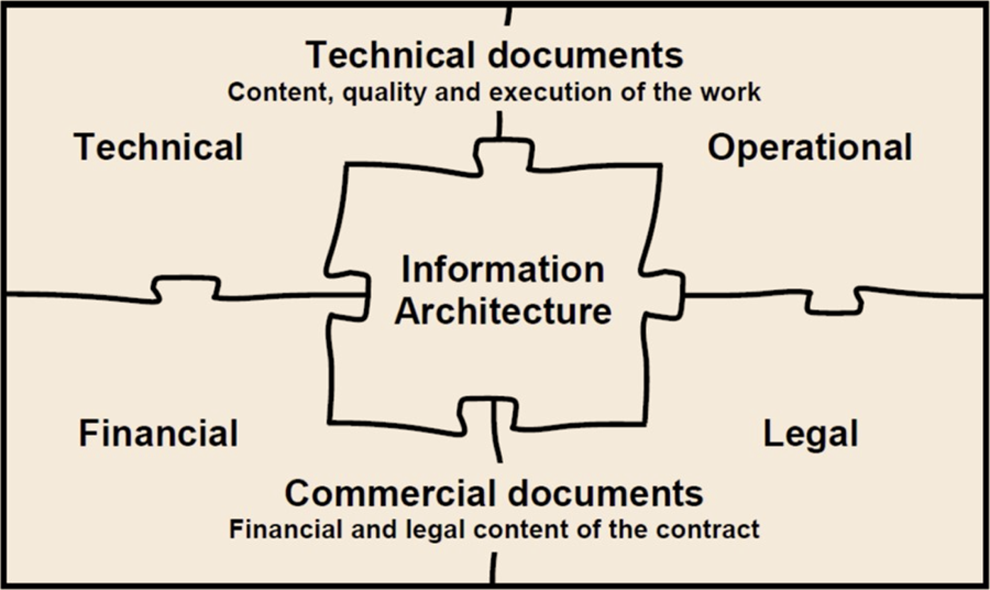
“Puzzle – Information Architecture” from The Contract Puzzle: Contract Documents and their Contents (Haapio, 2013: 37).
In a large company context, the expert resources to support the work around each of these knowledge categories already exist. The challenge is not around the existence of motivated and diverse resources; often, it is about how the experts in the various fields identified above can come out of their silos and work together on the contract without disagreements and internal blockages emerging which interfere with the client relationship. An expert ‘turf war’ is a frequent occurrence in larger companies. Clients feel these blockages when the Account Manager apologises for the delay and confides that the contract is ‘Stuck with our Credit Risk guys’ for some exotic reason which the Account Manager finds hard to identify with, let alone to explain. For clients this is a frequent source of frustration. It can lead to a red flag against the supplier, and to internal brow-beating within the supplier company about bringing ‘one voice to the customer’.
Helena Haapio of Lexpert makes the point about the multidisciplinary nature of contracting by analogy with a jigsaw puzzle.
1
She points out that a commercial contract fits together from pieces which are in nature ‘technical, implementation, financial and legal’. Her point is that the legal aspect is just one piece of the contract and that contract planning has to include people who are expert in the other parts too: People with knowledge about the scope, requirements, milestones, payments, dependencies and so on are required to contribute to contract planning; otherwise there is a real danger that some pieces of the contract puzzle will be missing, other pieces are not aligned and glued together properly, and when it comes to implementing the contract, the pieces will fall apart.
A number of Fortune 2000 companies attempt to deal with this challenge by creating a system of permissions, submissions or referrals to various departments, which are verified by internal audit. Certain types of business documents triaged, say, for size or complexity of the business at hand are given a ‘firm’ treatment, as opposed to a ‘factory’ treatment, the latter term denoting a business concluded without much – or any – expert time investment. The more sophisticated companies go one step further and apply a ‘Cross-Functional Team’ or ‘XFT’ concept. This posits that the various experts are brought together into a single team, usually around the person principally responsible for delivery, for example the Client or Key Account Manager. XFT goals are set in addition to personal goals in order to motivate a sense of co-ownership in the relationship/project. It is then for the XFT to decide which deals to push through towards permission. As well as aligning the experts upfront, the XFT approach also acts as a useful filter mechanism to exclude undesirable business.

“The Flexpert” by Annie Wu, Swiss Reinsurance Company Ltd.
This paper argues that an XFT approach alone is not enough to create a fully cooperative model, or to resolve expertise battles between the various stakeholders. Whilst it is a great first step towards client-centric delivery, the multiple experts involved in deal creation can create silos of their own. In addition, the ideas, findings and recommendations of one XFT may not be cross-fertilised with the ideas of another XFT within the same company. Alternatively, a person or department can take too much importance within the XFT and bring too much emphasis on their topics in the overall context of the transaction.
With often dozens (if not hundreds) of engineers, actuaries, risk managers in various categories, contracts experts, lawyers and implementation specialists around a large organisation, how can the organisation make sure that all its experts are remaining consistent with each other across the XFTs and providing a blended corporate view to the client, rather than a single expert view?
Anyone with a strong sense of ownership, an aversion to risk, a high regard for his own talents and qualifications, and a mind closed to peer feedback can, with the best of intentions, derail a deal. Such an employee – often intelligent and well-meaning – undermines the brand of a company in the sincerest attempt to apply principles of good governance and company protection. He can have this unintended effect simply because he is not yet familiar with a certain market convention or with the risk appetite of his new company, or because he doesn’t know how to find the right kind of support – affirming, trusted support which he won’t perceive as a criticism. Whilst guidelines across corporate groups are often set centrally by a small team of flame-keepers, the interpretation and application of those guidelines is done through fleets of intelligent and well-meaning individuals with a functional affiliation with the issue at hand, but without always very much experience or alignment with the official corporate view, which can get ‘lost in translation’ as they are applied in real-life cases.
This paper explains how a company can improve its XFT approach and harmonise the views of experts with the views of the company, balancing commercial interests and good governance. This paper will advocate for the application of preventive principles throughout the expert processes of a company, including ‘big data’ knowledge management platforms to capture and amplify internal company knowledge prior to it actually being needed to assess an opportunity. It will provide some ideas as to how these expert processes can be brought smoothly to the client. Finally, it will argue for the development of a new breed of experts with open minds and cooperative attitudes.
Meet the Flexperts!
The client’s challenge
The challenge Patricia was about to be handed came from the family dynamics of the dynasty owning her company group. Marcus, the oldest son of the current majority shareholders, had celebrated his 30th birthday and more or less simultaneously completed both his MBA and his ‘apprenticeship’ at Gilded Life, of which he was Head of Strategy. He now came with a new idea which his parents had approved, and which they would support him to put into action. The idea was to invest in and run hospitals and care homes of the highest quality as an adjunct to the family health insurance business. Many of the buildings would be located in exotic locations in Latin America. The business plan was to buy a number of existing premises throughout Latin America, and to provide US insureds with cheaper access to high-quality care at these locations. This was a classic win–win, with lowered claims costs for the insurance company and improved care for insureds in attractive settings.
The first phase of the business plan foresaw the purchase of two large health centres in Mexico, and for that Gilded Life needed cash. The properties were both owned by a Mexican entrepreneur who wanted to divest himself of the assets by the end of the year; that is, the purchase had to take place within 4 months. The purchase price, plus acquisition costs, was about USD75m.
Following a review of their business, the shareholder family members determined that the most logical option would be for the UK subsidiary, Gilded Life UK – one of the jewels in their corporate crown – to pay a dividend back to the US Holding Company. As local CFO, Patricia was tasked with organising the dividend from the UK subsidiary to the US parent company.
The UK business consisted mostly of Hospital Cash. As it was entirely unreinsured, a retrospective reinsurance cover (i.e. reinsurance on the existing book of business, rather than on new policies written in the future) would be a good instrument to release the significant value trapped in the reserves. There were valid risk management reasons to take reinsurance protection on this book, and the UK company itself had tried this before, but had not gone through with it for various reasons. What they knew was that reinsurers were keen to acquire a slice of their business, and that the move would help the UK company by spreading risk away from itself. The means for providing a dividend payment to the parent company could therefore be justified from the UK legal entity perspective, as appropriate risk management.
Hospital Cash is a relatively simple insurance product. In return for a modest annual premium payment (annual average being roughly £50) insureds are given a payout averaging around £100 per day for every day they spend in hospital. This allows them to pay for life’s daily necessities like TV/internet access and renting movies, or little luxuries like a room upgrade. The existing (or ‘in-force’) book of business had been built up over a decade and counted about two million insureds, meaning an income of roughly £100m per annum. Such a large book becomes exposed to trends, for instance the risk of an ageing population – the older the demographic, the more likely the policies are to be triggered by claims (i.e. stays in hospital). In addition, it is quite heavily exposed to technological or legal risk: the risk, for example, that as home care technologies improve, the UK government could expand the legal definition of a ‘hospital’ to include private homes adapted for care, precipitating an unanticipated sea-change in claims patterns (£100 is a reasonable income, particularly when it is paid – in the event of long-term illness – 7 days per week!). Reinsurance can help to spread these risks away from the insurer – in this case, from the UK company. In that sense, taking reinsurance was also a win–win likely to receive the approval of the UK Regulator.
Reserves held for the entire book of business were equal, more or less, to the annual premium income. A reinsurance of 50% on the in-force book would thus liberate about £50m, which would enable the UK company to pay a dividend large enough to free up cash for the Mexican purchases. The plan was to find the right reinsurer who would be able to do the deal quickly, on reasonable economic terms, and who would provide security to the UK company over the longer term, meaning a requirement for a rating of S&P A+ or higher.
Patricia, as CFO of Gilded Life UK, was given two months to agree a reinsurance contract. She was also given the names of two reinsurers who were likely to be able to conclude the deal in the tight timescale. The first – Health Reinsurance Company (‘Health Re’) – was a large company specialising in Health business, with a reputation for providing good value for money. The other panel, Lake Re, was a large company working in both the Life & Health and the Property & Casualty segments. Gilded Life, the corporate parent of the UK company, indicated that Lake Re had pitched for the reinsurance business several years before, and that they had appeared rather big and clumsy in their approach. Nevertheless, the rumour was that they had put a lot of work into improving customer interfaces in the meantime, moving to an XFT approach and then apparently moving beyond it. Market views about their responsiveness were currently good, with NPS 2 results improving significantly in the last three years. Patricia produced a Request to Quote, in which she explained the reinsurance requirement of Gilded Life UK, and asked for a formal quotation of terms and conditions. She emailed it simultaneously to Health Re and Lake Re. Within 1 hour she received an acknowledgement letter from the Key Account Managers at both companies. And then she waited.
How big companies currently work out the business they want, and the importance of harmony between experts in the deal team
The type of business a financial services company pursues is determined centrally in the planning process, which usually takes place annually. When pursuing that strategy during the course of the year, power and company reputation are to a certain extent devolved to the deal-making teams, who exercise a key practical influence in terms of which issues to spend negotiating capital on during the deal-making process. How those deal-making teams are constituted, and how they operate, is thus crucial to ensuring the execution of company strategy. Harmony amongst the various experts in the XFT is of critical importance, and excessive influence by one or other expert in the deal team can blur the focus which is needed on the bigger picture.
Left entirely to Treasury (which handles payments) or to Credit Risk Management (which advises on counterparty credit exposures), issues like payment patterns, off-set and collateral would be the focus. If the contract were left entirely to Compliance, the issues referred to above would have virtually no importance and other risks would be in the foreground – for example Sanctions and Anti Money Laundering, rather than support for a client and bringing in valuable income. The natural tendency of a commercial or client-facing team – those in charge of bringing the product to market – would be to view the contract in terms of the financials (in the reinsurance context, this would be topline premium) and be less bothered about Compliance or technical aspects of the contract, which would be left to other team members. Left to Underwriters, whose job is to create the product to meet the client demand, and (crucially) to price it, the focus would be on ‘technical’ provisions relating to the scope of cover. The latter might better align with the bigger strategic picture than, say, Credit Risk Management’s concerns, but would still not cover all the pieces of Helena Haapio’s jigsaw puzzle. 3 How all these parties come together around the deal and protect the contractual provisions which interest them is key to both effective governance, and to the customer experience.
How Health Re and Lake Re manage their experts in the deal team
The two reinsurance companies in our story, Health Re and Lake Re, operate a different alignment of personnel around the client.
Health Re ensures expert harmony towards the ‘bigger picture’ by operating a standard XFT approach. The expertise in a classic XFT remains decentralised, even though the model calls for that expertise to be brought together around the client. Upon receipt of Patricia’s Request to Quote, the Client Manager of Health Re therefore forwarded it to all XFT members simply requesting their views. His focus was on the internal business case assessment, since every aspect of the quote would need to be thought through from scratch, most importantly the price and the first draft of the contract terms to be contained in the quote. The XFT member representing Compliance, Christina, felt a strong tutelary responsibility for the XFT but had the least practical experience. She responded immediately ‘to all’, saying that the request could not have come at a worse time given her involvement in a project on Data Protection. Nevertheless, she wrote, ‘given the importance of the deal and its size I would expect to review the draft quote before it goes out to the client, and would like to be given the chance to express a view on behalf of Compliance.’ With a slightly jaded sense of déjà-vu, the Client Manager put a marker in his calendar to chase after two working days.
Lake Re had a different set-up to Health Re, resulting in a different reaction following receipt of the Request to Quote. The set-up was a product of history and experience, and is worth a brief detour.
Three years prior to receiving Patricia’s Request to Quote, the sort of expert disconnection which Health Re’s Client Manager was experiencing had been exactly the kind of challenge which Lake Re, for their part, had continuously stumbled over. This explained the experience of Gilded Life UK, who had found them rather clumsy in their pitch a few years ago. Sources of such snagging were the various expert departments:
Legal;
Compliance;
Contracts;
Treasury;
Actuarial;
Underwriting;
Risk Management.
On one occasion, in the context of a fairly simple but unsuccessful reinsurance transaction, the Head of Client Services at Lake Re was handed an eight-page letter one of his teams had sent to an important client explaining the contract changes Lake Re would need in order to do the (valuable) business in question. This clumsy example of communication with a client had been the turning point at the company. An investigation into this unfortunate incident resulted in three findings: The client response in question was excessively defensive. The expertise process would have benefited from peer review and quality challenge. The process in point 2 could have been done upfront, given that it was predictable that (core) business of this kind would one day be on the XFT’s table.
The Head of Contracts at Lake Re, Miranda, was tasked with providing a solution to points 2 and 3 above, within a three-year timeframe. By the time of the Request to Quote, the solution had been delivered. So how did she improve the balance of the expert team around the contract, and improve the client experience?
Building a new landscape for Flexpertise
In evaluating the challenge of expert cooperation, Miranda had studied a number of options. The most direct would have been a so-called top-down approach, involving identifying best practice behaviour and mindset, and creating a system of management overview and reward to ensure that experts were tending towards the identified best practices. The disadvantages of this approach on its own are that it: is reactive; needs to be constantly policed; and contains a large of amount of subjective interpretation which can lead to bad feeling from experts who typically insist on a fact-based, rather than an interpretative, approach both in their work and in their performance evaluation.
These disadvantages raise questions of take-up and of sustainability. In the end, she decided to take a different route, involving offering solutions to everyday problems, rather than playing the ‘Management Says’ game.
Key to this solution-based approach was to leverage the power of Text Mining Analytics, 4 and to create something with a value-adding functionality for all the experts around the contract. If, she thought, she could store expert-reviewed clauses in a database, software could detect those clauses in an incoming document, and show the expert’s pre-entered views next to the clause. This would save time currently spent reading and analysing those clauses. If she could store all clauses in the book, then expert reading could in theory be focused on new clauses only, or new versions of old clauses. Text Mining Analytics could also be used to understand which clauses were contained in the book of contracts, or in individual chapters of that book or indeed in individual contracts. Her initial vision for a solution looked like the illustration at Figure 3.
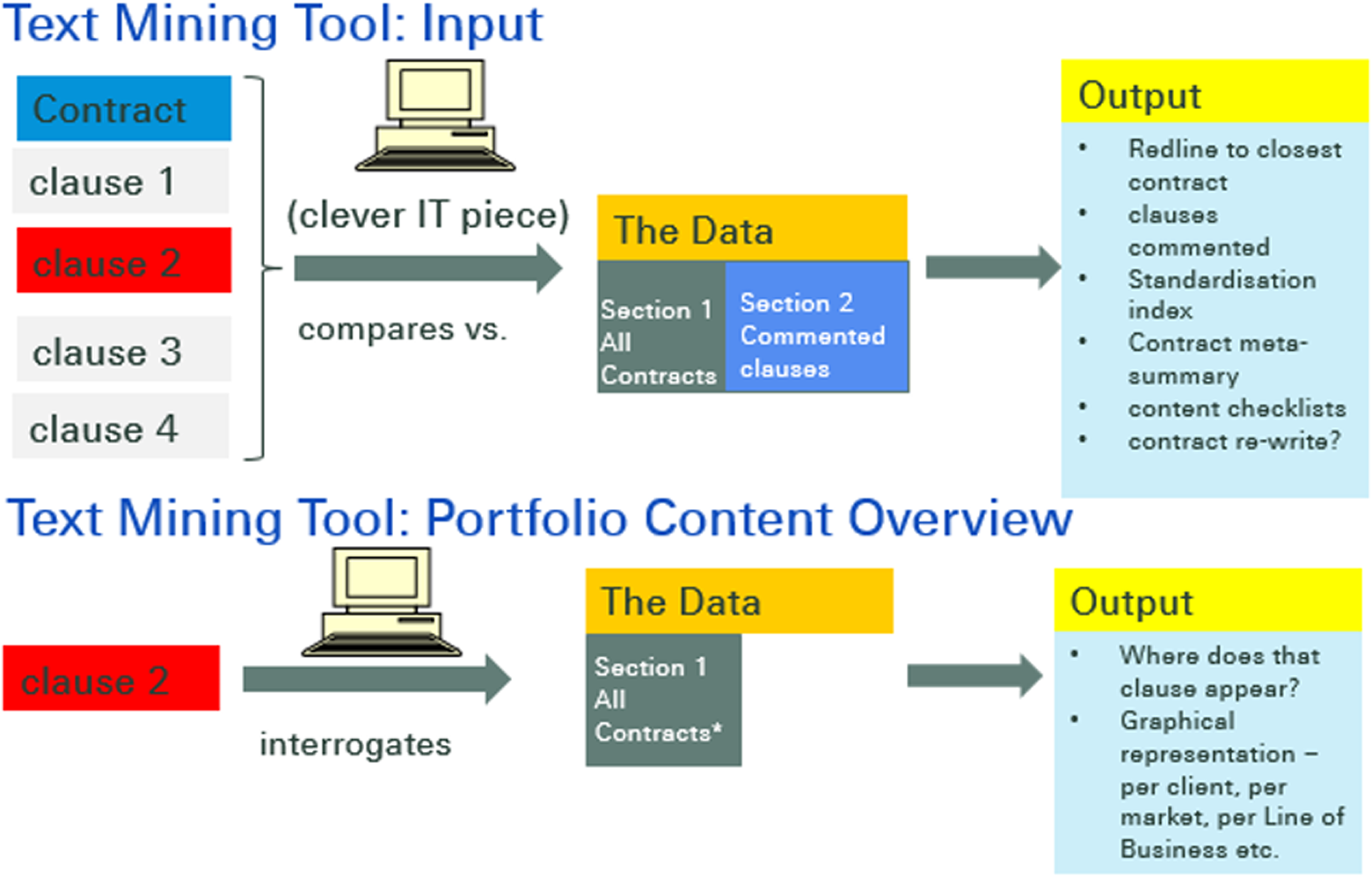
Contract Text Mining Concept.
Miranda immediately set up a project to create the ‘Data’ referred to in the illustration above. As well as making all contracts available, she had to gather and to make available all the clauses of all the core business contracts in which Lake Re participated, in all languages. These had to be analysed and described by the most senior experts in the company. Whilst this may sound like a tall order, all relevant experts had been reviewing these contracts for many years. In doing so, they had applied an exception-based approach which means producing a list of all the problem areas in the contract. Many of the contract reviews had been stored in basic process tools which were capable of extraction and recycling.
Naturally, some of the reviews made over the years presented quality challenges. Some were old and out of date, no longer reflecting the company’s views or the market or legal reality. The issues raised in the reviews were not always consistent and sometimes the advice was poor, either because it misrepresented the corporate risk appetite, or because it was badly formulated – frequently where the drafter was not entirely fluent in the language in which the review was presented. In rare cases, the review was incomprehensible. Generally speaking, however, output of the review process was of good enough quality to be capable of being recycled as a ‘first stab’ at an official position. Given the exception-based nature of the reviews, all the comments were labelled with the perceived levels of risk, and all the rest of the contract was deemed to be considered no risk, as the experts had not commented on them. This ‘recycling’ approach was an initial attempt at accelerating the process. Transfer of the expert views was done by non-technical staff under quality supervision of experts. A first cut of expert views on all the pieces of the contract jigsaw was loaded in a large reference database – about 30,000 commented clauses in 11 different languages.
Text Mining Analytics software was developed to allow an incoming third party-produced contract to be scanned, recognised clauses to be identified and critical comments to be imported from the clause collection. This allowed automated reviews of most external documents, as well as the reverse-engineering of tailored wordings, where Lake Re was the appointed drafting party.
After that, Miranda’s idea was that the advantages procured by the tool – knowledge accessibility, reduced reading time, improved content knowledge – would induce experts to fill in the gaps by entering new clauses as they came in and keeping views on existing clauses up to date. The vision was clear, but now the hard work really started, which was to assess the clause reviews themselves, to distribute the clauses to the appropriate experts, and to create a peer-review system focused on improving quality. The ultimate objective was to have each review of each clause certified as the corporate view on a specific subject. There were many challenges to overcome in implementing this objective. The one all lawyers focused on was multiplicity – how to take into account the various laws that could be applied to the interpretation of each clause, in the various contexts (e.g. differing lines of business) in which each could appear.
The more interesting and difficult challenge – which is the subject of this paper – was convincing experts to work together to define their views upfront in an agreed manner, and to allow their own views to be challenged, both within their functional silos (‘peer review’) and from outside (‘crowd review’). A typical lawyer’s answer to most questions is that ‘It depends on the context’. The new approach took such experts at their word and required them to go one step further than just defining the problem of contextual multiplicity – to actually help the company record and deal with it. The challenge, therefore, was to create assessments of individual clauses in all their potential contexts. In practical terms, Miranda, as Head of Contracts at Lake Re, had to convince all the experts working around the contract to record their views in the various contexts in which they could appear, exhaustively, and to open themselves up to the scrutiny of their peers. Expressed in ‘corporate speak’, experts needed to be both more cooperative and more proactive, meaning taking more ownership and accountability. This is a mind-set change aimed at changing the set-up of the XFT as illustrated in Figure 4.
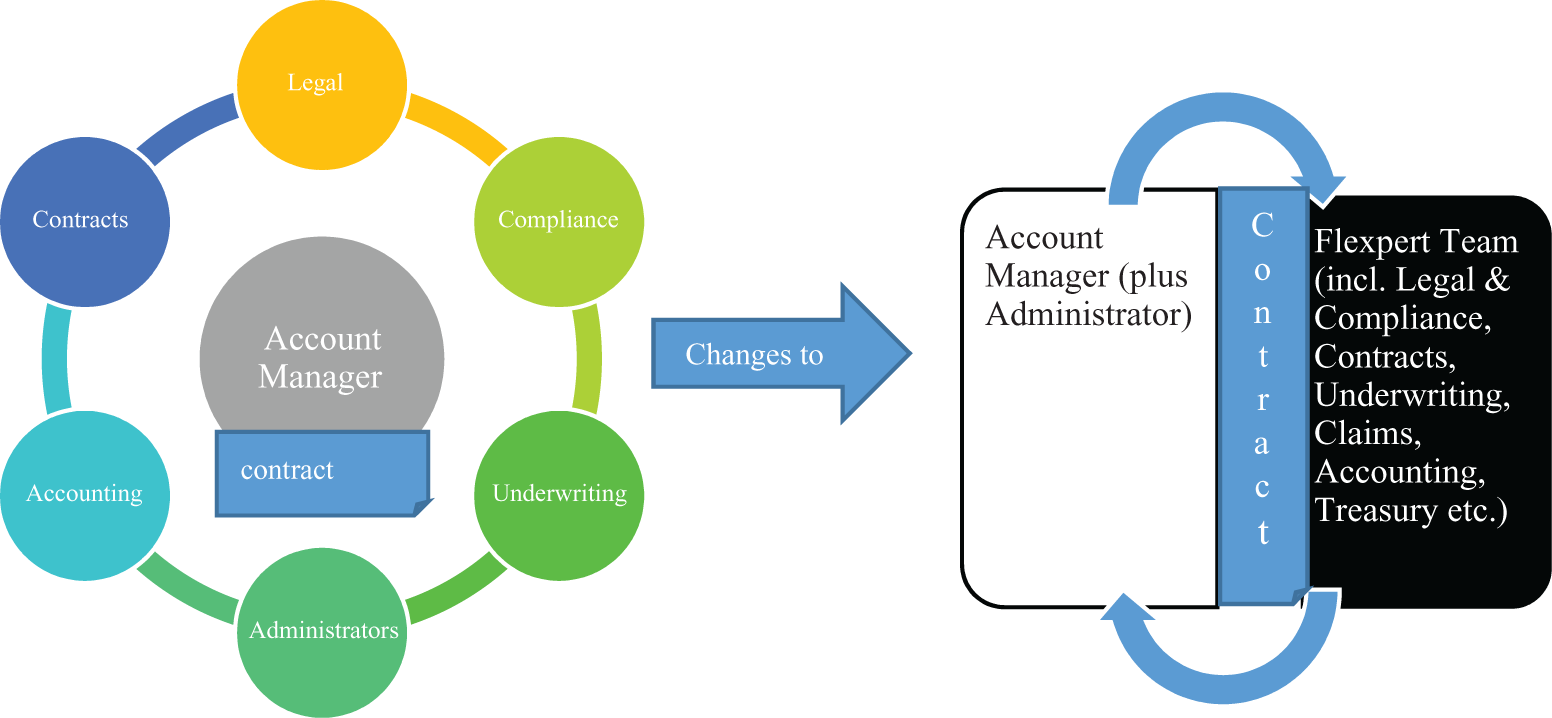
Classic XFT Structure vs XFT-integrated Flexpertise.
By the time Gilded Life UK sent its Request for Quote, the mindset required for this approach, which we will describe as ‘XFT-integrated Flexpertise’, had been fully implemented. This allowed Lake Re to give Patricia, as CFO of the UK company, the full benefit of their new quotation approach, which is more fully described below.
The client’s first supplier contact
Two days after her Request to Quote went out, Patricia received a telephone call from the Client Manager of Lake Re, Jacqueline. She clearly expressed the excitement of Lake Re at being considered in the quotation process and moved rapidly and confidently on to the next steps: We need some more data, I guess that won’t be a surprise. If it’s alright for you we will set up a data room where you can put the data, and we will just send you a list of what we need. In the meantime, we would like your support to formulate an offer that works for you. We have therefore booked our Quote Room in London for Friday. We will set aside the whole day, including a lunch if you can be physically present and if your time can stretch to that. We will have the benefit in the room of one of our Strategic Contract Negotiators who is a contract expert in our field and knows how to manage our quotation tool, QuoteNow. Basically, QuoteNow is a software tool which allows us to change the parameters of a business according to client requirements. It allows us to work with our clients to scope out their needs and to formulate an offer in the form of a draft contract wording to take back to the office. It is a proprietary tool we are very proud of. So far, it has never failed to produce an indicative offer at the end of a day of discussion, and there has never been an occasion when a client was of the view that the solution it provided was not what they had ordered – of course, it can happen that we cannot come to a landing on price but that is another matter. So far 94% of the indicative offers we have made following a session in one of our Quote Rooms have been confirmed by our Executive Committee, and 76% have been accepted by clients. We consider it a way of increasing confidence for our clients and making the quotation process more cooperative and more agile.
On the same day as the phone call with Lake Re, Health Re for their part sent a lengthy email asking for more data on the underlying book of business. The data requested by Health Re was more or less the same as that requested by Lake Re, so Patricia spent the rest of her morning setting up a duplicate data room. In terms of customer experience, there was so far no competition between the two rival suppliers.
How science and business discovered that cross-functional teams are not enough
It is not only in corporate organisations where the limitations of a traditional cross-functional team approach have been noted.
Science and academia – other heavily expert-dominated fields – came across this challenge a while ago, with some institutions now revising their approach to cross-disciplinary team work. The traditional academic or research institution is divided by department, each jealously managing its own separate budgets and distributing down to each work group, lab or sub-department. This kind of silo often makes cross-disciplinary work challenging, with awkward conversations around power, ownership, budget investment and share of the credit for successes. At the Francis Crick Institute, in a building in Central London which will soon be one of the world’s largest biomedical research facilities, they have come to a radical solution involving removing departments entirely. Instead the scientists move between ‘interest groups’. There is an agile collaboration style akin to the ‘SCRUM’ 5 Project Management approach, with experts handing over work to each other in regular meetings. By frequent changes in collaborative teams, experts are encouraged to help translate findings from one area into another.
This cultural change is underscored by physical changes which seemed important to the Francis Crick Institute as a way of reinforcing the mindset change it expects of its scientists. Researchers at the Crick are allocated working premises such as offices and laboratories with great precision to encourage collaboration and cross-fertilisation of ideas between teams. Laboratories are generally open-plan, and there are more than 4 km of bench workspace to ensure a certain flexibility amongst the experts. 6
Similar practices have been inherent to the success of New York’s Rockefeller University and the European Molecular Biology Laboratory. The idea is that scientists are empowered to ‘follow the science’ wherever it leads.
Changing seating plans and office layouts is also a noticeable trend amongst some forward-looking corporates. ‘Going to see Legal’ was a chore often associated with the need to make a trip to a certain part of a building, clutching papers and a downcast expression. This is less and less the case. The tech industry is generally well known for more flexible working approaches, but the trend is now being joined by more conservative sectors. Following a move in 2013/2014, Swiss Re’s new premises in Munich were remodelled to fit appropriate modern styles, with experts sitting in places of their own choosing in a variety of contexts. Out is the one-person-one desk policy. In is a variety of office contexts which the employee chooses at the beginning of the day by reference to the projects she is currently working on. There are business gardens, silent areas, one-on-one meeting cubicles, rooms with doors, 2-on-2 units, larger meeting areas including a juice-bar setting, formal meeting rooms and brainstorming rooms where everyone hooks up their computers to a central screen and takes it in turns to have presentation rights. Everywhere there are whiteboards for the scribbling of ideas and the development of future collaborations. The building has a careful colour selection to encourage pleasure and well-being, particularly aimed at attracting young new talent to feed the company’s digital strategy.
The experiment has been a great success and is being replicated at the Swiss Re’s Headquarters in a new building known as Swiss Re Next, providing the physical backdrop for Flexpert cooperation. Transparency is a key feature of the building, with a frontage composed entirely of glass, helping to demystify and remove barriers.
All of this leads to improved cooperation between experts in and around the client and their needs, ensuring that the experts are all working together to achieve a single result in the form of a final contract of risk. A feedback culture allows experts to challenge each others’ views in a safe environment and to break down the expertise silos in order to come to a landing point capable of being communicated to a client.
The client is in the Quote Room
The Quote Room has a circular screen in front and comfortable armchairs in front arranged in a semi-circle. Each armchair has a foldable table attached to the armrest, containing a touch-screen tablet, as well as space for refreshments. When Patricia was shown into the room, with her Chief Actuary and with the Head of Underwriting at Gilded Life UK, the screen was covered with a black curtain.
One of the Lake Re people in the room was the Strategic Contract Negotiator, Daphne. The client had various questions on the reinsurer’s standard wording, which Daphne answered, and then the usual silence that precedes a negotiation descended on the room. Daphne started by pressing a button which opened the curtain to reveal the screen underneath. Then she began.
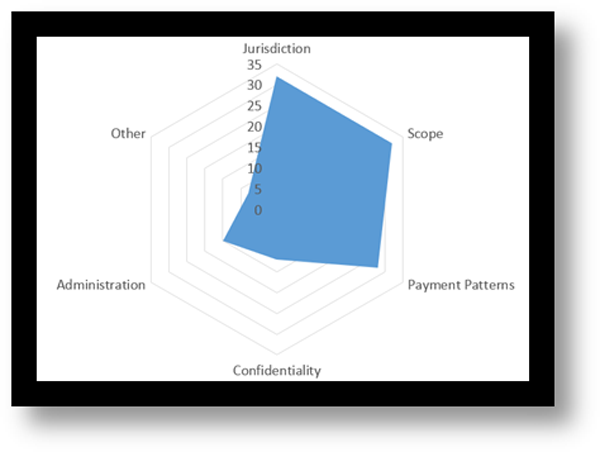
Contract Scope Visualisation 1.
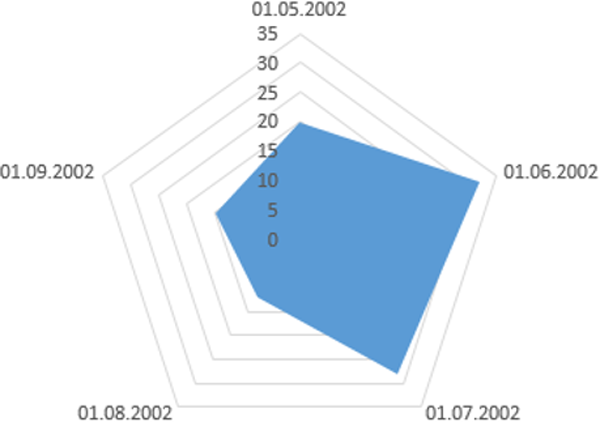
Daphne touched the screen and moved a slider up, and the spider web contracted to reflect the change:
Contract Scope Visualisation 2.
‘So what do you need that is different from our model?’ she asked. ‘You are our client and we should be giving you the cover you need. We should now work through your requirements and move to agree them. Our tool will guide us through this process.’
The tool, QuoteNow was projected on the screen. At first view, it looked like the kind of thing you see on a DJ’s high-end mixing desk: a series of dials, buttons and sliders. This had its usual effect – everyone burst out laughing!
The virtual buttons were clustered into groups: Scope, Expenses, Payment Patterns, Confidentiality, Jurisdiction, etc. They were also colour coded, the ones without a costing impact being a neutral green, the ones with a high costing impact being red, with amber for impacts in between the two extremes. The buttons were also mirrored on the touch-screen tablets on each of the tables.
‘You can have a broad range of adaptations to our model, but for some of them there will be a cost impact,’ explained Daphne.
At the bottom of the screen was a visualisation of the contract’s scope in the form of a spider web:
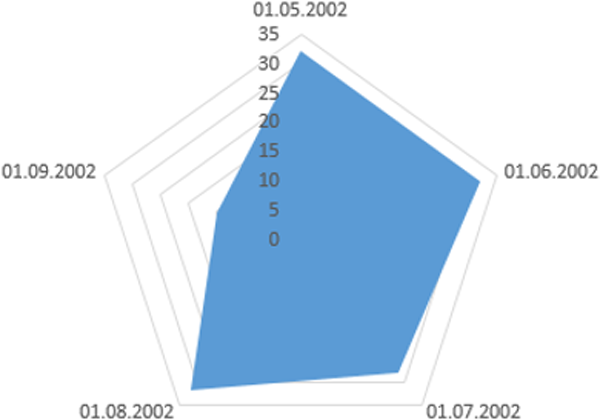
She touched the screen again and the spider web expanded:
‘Think of the blue area as the scope of the contract which you will be paying for. The broader the blue area, the broader the scope and therefore – usually – the higher the price. QuoteNow ensures you get good value for money because you only pay for what you order.’
Contract Scope Visualisation 3.
The rest of the day was spent going through each of the categories of coverage and clauses, and coming to an agreed scope which represented what the client wanted. Most of the time, Patricia or her Chief Actuary would describe what they wanted and then be instructed to make the adjustment themselves using the touch-pad on their trays. During the course of the discussion, the client was uncertain about whether she wanted collaterals or not. These expanded the scope considerably but, she felt, would give her greater credit protection over time. This issue she wanted to take back to the office to think about further with her credit manager. She therefore asked for split quotes, one with collateral provision and one without. By capturing the two options in two separate spider webs, Daphne was able to print out two draft wordings, and a redline showing the difference between each. By the time they adjourned at 5.30 pm, three documents had been delivered to Patricia in paper form and in electronic form, via email.
The prices arrived over the phone, two days later, and were confirmed by email.
Flexpertise – building a new mindset
Above we referred to the new mindset that was created to enable Flexpertise – the open-minded application of expert knowledge, frequently challenged to ensure that it converges towards an ‘official’ view on contract clauses – reflecting the multiplicity required because of the real-life application of expert knowledge in multiple contexts.
Miranda, the Head of Contracts at reinsurance company Lake Re, had started off by studying the existing expert landscape. Naturally, there was a hierarchy of expertise, dividing into two main categories of experts – the ordinary ‘working’ experts and the ‘flame-keepers’, whose mission was to ensure integrity within product lines. These were the categories she preserved. She set up a series of access rights within the tool, allowing the ‘working’ experts to enter reviews with status ‘Single Reviewer’, and the ‘flame-keepers’ to enter views on behalf of the company with status ‘Corporate View’. In between the two, she wanted to encourage working experts to talk to each other, so created a category ‘Peer Reviewed’. The hierarchy of review statuses therefore started at ‘Single Expert’, went via ‘Peer Reviewed’, and ended up following central validation as the ‘Corporate View’. The path of a clause from ‘Single Expert’ status to ‘Peer Reviewed’ was the backbone of a Quality Assurance Protocol which she published.
She received challenges around making a review with ‘Single Reviewer’ status review broadly available across the company, but pointed out that those views were currently going to clients on a regular basis – in that sense, that the tool was not creating the challenge of mixed-quality reviews, which existed already. Also, she pointed out, working-level reviews remained the bedrock of the application of company protection.
In order to convince people to challenge each others’ views she created a series of metrics allowing tracking of the path of the clauses, including addition of new clauses, and created an expert status within the tool. Major contributors were referred to as ‘Expert’ and first-time reviewers were known as ‘Novice’, with many grades in between. In order to maintain use of the tool in daily working life, she also launched the additional text-mining functionalities consistent with her initial sketch.
As planned, these value-adding functionalities drew the participation of the experts, who could receive a full information service about contracts-related matters. She added these approaches to the traditional gamut of change management tools which included awareness sessions, training, competitions and confirmation. The name ‘Flexpert’ was created following such a competition. For that reason it was rapidly adopted within Lake Re and became a mantra which the CEO herself took up as a benchmark for expert collaboration. Once she had collected all the clauses in the book, with all necessary expert data, she was able to create two further knowledge dimensions.
These dimensions created the basis for and enabled QuoteNow, a technology allowing an understanding through visualisation of the link between an individual clause and the scope or behaviour of a contract over time. Miranda was able to implement these ideas and to link the contracting process to the costing process. In this way, using technology and an expert mindset change, she was not only able to solve the initial problem statement, but also to enrich the lives of her contracts experts, who from then on could focus their review work on more complex and interesting contracts, and could become Strategic Contracts Negotiators, known throughout the company for the valuable application of their knowledge. QuoteNow was the ultimate realisation of an attempt to smooth the client experience by harnessing the power of experts in an inclusive and preventive manner. The reader is invited to appreciate the inclusiveness by means of the illustration of the Quote Room at Figure 8 shows how the knowledge of experts from all over the company are essentially brought into the Quote Room.
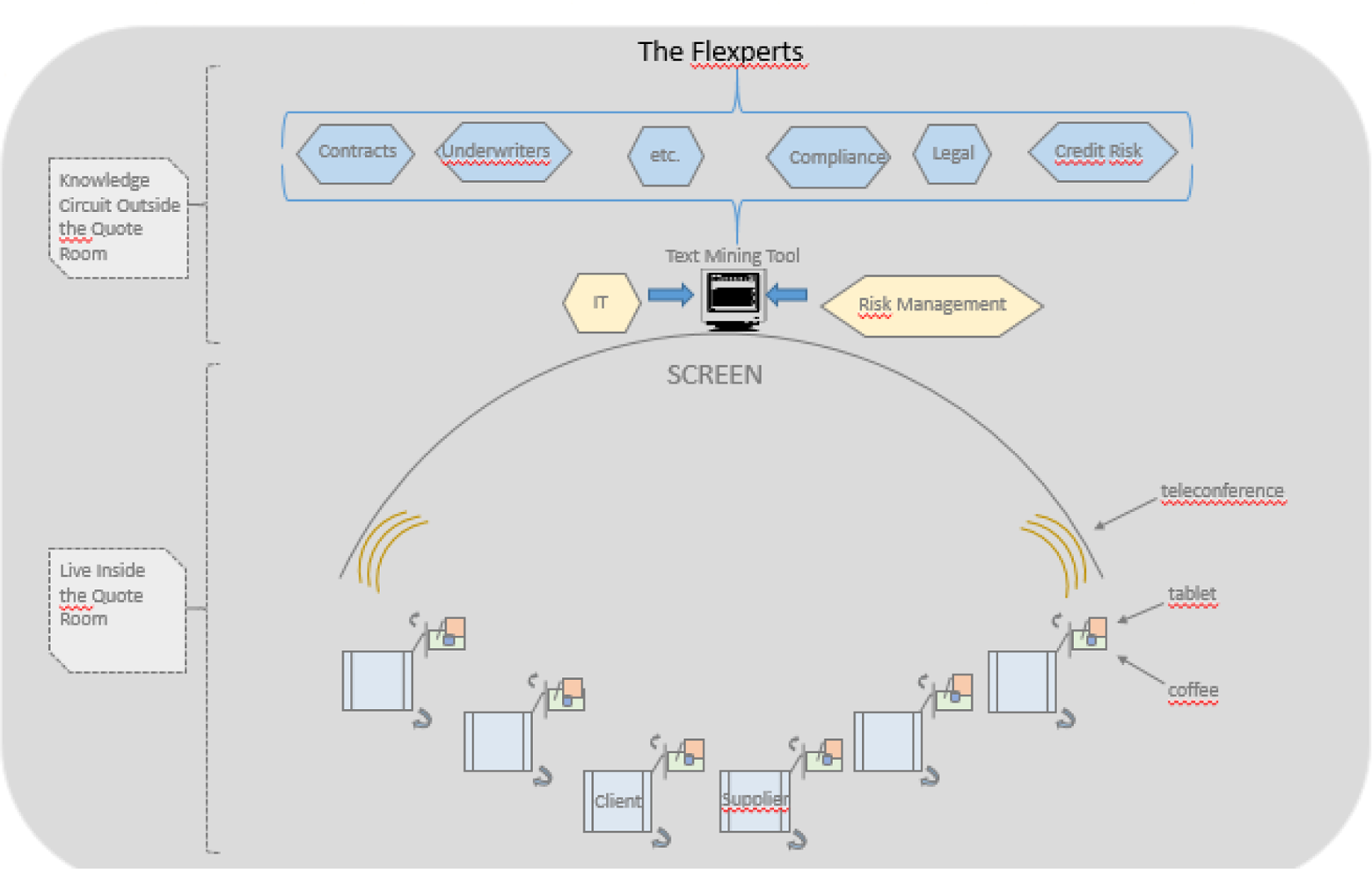
The Quote Room: A Vessel for Contract Co-creation by the author and Müge Cöteli.
As experts outside the room change their views on clauses and the relationships between clauses and costing, that information is live-fed into the software which thus reflects company views to the client, in real time. The same applies in terms of IT upgrades, Risk Management approvals over the system itself, and so forth.
Being able to quote company views in a transparent manner to the client improved the latter’s experience, leading to an improved NPS. It also supported expert knowledge transfer within the company.
The quote is won!
Lake Re and Health Re quoted on the same day. Naturally, both quotations achieved the strategic objective of freeing up £50m of reserves. They both offered that the reinsurer would pay a 50% share of all claims on existing policies until all expired, in return for a one-off payment by Gilded Life UK to the reinsurer.
In net economic terms Lake Re’s price for the reinsurance was 7% higher than Health Re’s. The cover letter mentioned that some of the requests made by Patricia in the Quote Room, and subsequently confirmed – particularly the request for collaterals – had expanded the cover and that this was taken into account in the price. The draft contract offered by Health Re was not tailored to Patricia’s requirement the way Lake Re’s had been, and there would be more negotiation required with Health Re to reach a final agreement.
A reinsurance contract of this kind can create a 50-year relationship. The reinsurer only ceases to pay when there are no more claims on any policy in the book of business. In addition to paying claims, the reinsurers will spend the next 50 years of potentially giving other value-adding services such as risk management and claims-handling advice. In that sense, the relationship is a very active one, and its quality of interaction is crucial. It was this element of longevity which convinced Patricia to pay the higher price, and to confirm her acceptance of Lake Re’s quotation. The value she perceived for her company lay in the greater confidence she had derived in Lake Re’s quoting process. Over the longer term, and assuming the confidence and the Ease of Doing Business shown in the quotation could be maintained throughout the life cycle of the business, she felt that the higher price was fully justified. She also felt that her company – and particularly the ‘Three Wise Contracts people’ in her own staff – had a great deal to learn from Lake Re. She made a mental note to send one of them on a rotation to Lake Re within the next 12 months.
From Health Re, the rival bidder, Patricia had not felt the same level of Ease of Doing Business. The constant requests for information and the Client Manager’s apparent inability to control his expert team had done nothing to reassure her on this front. As current CFO of the UK company, she could naturally have ‘sold’ her success in achieving a ‘saving’ of 7% by taking the cheaper quote. However, as a faithful employee of the Gilded group, she felt that she would be doing herself and her successors at the company no favours by binding them to a long-term relationship where the reinsurer struggled with its internal processes, and as a result the client did not always feel central to the partnership.
The final nail in the coffin for Health Re was actually a subjectivity imposed by Christina, Health Re’s Compliance officer, and listed in the offer letter as follows: ‘This offer is subject to there being no known litigation proceedings currently, or at any time prior to binding against Gilded Life Insurance Company UK’. It must have been part of a standard template and had been left in the quotation sent to the UK company. With over 300 coverage disputes of which 15 were in actual litigation, this was a subjectivity which – Patricia pointed out with some irony – Gilded Life UK could not currently, and would be unlikely ever to satisfy! In written feedback to Health Re, Patricia said that the company winning the business ‘had shown extraordinary teamwork’, and recommended that Health Re look into that aspect of their own business processes.
A postscript
A Text Mining Analytics tool of the type described is a technological possibility; a similar tool has been developed by the author and colleagues at Swiss Re (Patent Pending).
QuoteNow is an idea based on the concept of Dynagrams (www.dynagrams.org).
The Quote Room is an idea of the author, who believes it would be a very civilised way to do business with clients!
Footnotes
Acknowledgements
The Quote Room referred to in the article was designed by the author and by Müge Cöteli. ‘Flexpertise’ and ‘Flexperts’ are terms first used in the expert cooperation process by Müge Cöteli of Swiss Re to describe the new mindset described in this paper.
Declaration of Conflicting Interests
The author(s) declared no potential conflicts of interest with respect to the research, authorship, and/or publication of this article.
Funding
The author(s) received no financial support for the research, authorship, and/or publication of this article.