




Abstract
This article highlights several of the most impactful challenges that have plagued IT acquisitions over the last two decades and describes transformative initiatives that the Obama Administration's Office of Federal Procurement Policy (OFPP) announced last December to help agencies overcome long-standing obstacles and get better results for the taxpayer. The discussion looks separately at IT commodity spend and IT systems investments, as smarter IT buying requires an understanding of these differences and solutions that are targeted to change long-standing cultural and structural assumptions that have prevented real and sustained progress in the past.
Introduction
A core part of President Obama’s management agenda is improving the value we deliver to citizens through Federal information technology (IT), with a focus on improving IT acquisitions (The White House, 2015). Each year, the Federal Government spends approximately US$50b through contracts for IT, from common commodities, like hardware and software, to complex systems. IT acquisitions are conducted by virtually every one of the more than 100 departments and agencies that comprise the executive branch and the more than 3000 contracting offices that support them. Figuring out the best way to organize and manage Federal IT contract spending has been the focus of many statutes, regulations, and studies dating back at least 50 years when Congress enacted the Brooks Act in 1965 to “coordinate and provide for the economic and efficient purchase, lease and maintenance” of IT (Brooks Act, 1965). Despite this attention, the history of Federal IT procurement has been fraught with overspending, underperformance, and missed opportunities – actions which have recently landed IT acquisition on the Government Accountability Office’s (GAO) High Risk List (Government Accountability Office, 2015). Reversing this trend requires the government to undertake transformative initiatives that create a new and more effective paradigm for smarter IT buying as well as a clear understanding of the key cultural challenges that have plagued IT acquisitions.
This article highlights several of the most impactful challenges that have plagued IT acquisitions over the last two decades and describes a focused set of transformative initiatives that the Obama Administration’s Office of Federal Procurement Policy (OFPP) announced last December to help agencies overcome these long-standing obstacles and get better results for the taxpayer. The article separately examines both IT commodity spend and IT systems investments. While each of these investment areas represent roughly equal amounts of annual Federal spending, their challenges are different in several important respects. As the article explains, smarter IT buying requires an understanding of these differences and the adoption of solutions that are tailored and targeted to change a number of long-standing cultural and structural assumptions that have historically prevented real and sustained progress.
Buying IT commodities
Collaborative procurement, where customer requirements are standardized to allow the government to aggregate demand and compare unit costs, has long been recognized as a way to save money when buying commodities, including IT products. Savings may occur in a number of ways, including economies of scale from leveraged buying, stronger competition, especially when buyers are armed with pricing information from prior purchases made by their colleagues, and administrative cost reductions through fewer duplicative contracting actions. The OFPP, which was created by Congress in 1974 to promote “economy, efficiency, and effectiveness” (Office of Federal Procurement Policy, 1974) in Federal buying practices and clean up “duplicative agency spending practices that have kept the taxpayer from getting his dollars’ worth” 1 , has repeatedly endorsed collaborative buying practices, typically through volume purchasing, for the better part of two decades. 2 Yet moving agencies towards greater sharing of information and collaboration among procurement offices has been slow. For example, with respect to collaboration through economies of scale, GAO found that agencies leverage only a small fraction of the government’s buying power (Government Accountability Office, 2012).
Public entities that have found success in adopting collaborative buying practices for commodities, such as the UK and the State of Pennsylvania, have embraced at least three important practices: management of common spend by category, leveraged buying, and governance. 3 While it seems difficult to question the merits of these practices, they have been elusive in the Federal procurement system. The Federal procurement landscape – including IT procurement – is highly fragmented, with no overall governance and little sharing and collaboration among acquisition units. Almost every one of the more than 3000 buying offices across government make IT purchases, spending over US$24b for goods and commoditized services that are common to most, if not all, agencies. Yet there is no single place a government contracting officer can go to find out important details regarding existing contract vehicles for any particular commodity area. Far too often, Federal acquisition professionals are left to make purchases with very little insight into what their counterparts across the government are buying, who they are buying it from, what they are paying, and how they are buying it.
Moving agencies away from the sheer complexity of this organizational framework, with little transparency and collaboration, has been especially challenging in the IT commodity space. For more than two decades, the Federal acquisition system has been plagued by an unhealthy distrust of any real form of centralized governance. In the early 1990s, Federal IT acquisition was governed by the Brooks Act, a statute enacted in the mid-1960s that represented the Government’s first, and last, serious attempt to centralize IT buying. The Act required agencies to obtain a delegation of procurement authority from the General Services Administration (GSA) before acquiring IT. However, as the IT industry exploded and Federal spending on IT skyrocketed, the Brooks Act was perceived as a time-consuming and bureaucratic exercise that contributed to agencies’ inability to keep up with the rapid evolution of technology. In 1993, as part of the National Partnership for Reinventing Government (formerly the National Performance Review), Vice President Gore called for an end to government service monopolies and freedom for agencies to choose whether to purchase IT through the GSA (Gore, 1993). The Clinger-Cohen Act of 1996 ended GSA’s monopoly authority over IT and created Chief Information Officers in the agencies to address agency IT needs (see National Defense Authorization Act, 1996).
In the midst of this IT transformation that saw the dispersion of IT buying authority from the GSA to agencies, other critical reforms were made to the acquisition system at large that enabled agencies to more easily purchase IT and other commodities on their own in the open market. These actions were fueled by a belief that the most pressing priority for procurement reform was to “allow the government to move toward the kind of streamlined, value-oriented competition that exists in the commercial marketplace” (see HR 1670, The Federal Acquisition Reform Act of 1995, 1996). At least one tool, the multiple award contract, which allowed agencies to prequalify a cadre of contractors, became an attractive conduit for interagency acquisition because multiple contractors could meet the shared needs of multiple agencies (Government Accountability Office, 2005). By the early part of the century, an increasing number of contracting officers were piggy-backing off of other agency multiple award contracts to avoid the time and cost of awarding their own new contracts. 4 Unfortunately, a general lack of regulatory and management guidance to accompany the burgeoning workforce interest in interagency contracting resulted in a number of significant missteps and GAO placing interagency contracting on its High Risk List in 2005 (Government Accountability Office, 2005: 24–28). GAO acknowledged the benefits of collaborative procurement, but the negative stigma of its high risk designation created a clear impediment to agencies’ willingness to work together to buy common goods and services outside of their own agency. 5
Between 2008 and 2012, OFPP orchestrated a series of actions to strengthen interagency acquisition, recognizing its continued presence on the High Risk List would be an albatross on meaningful collaboration. First, in 2008, OFPP issued a model interagency agreement form along with a step-by-step guide to help agencies map out the respective roles and responsibilities played by servicing and customer agencies in awarding and managing interagency contracts (Dennett, 2008). Then, in 2011, OFPP spearheaded comprehensive changes to the Federal Acquisition Regulation to replace coverage that had become badly outdated with a framework to help agencies effectively evaluate the suitability of interagency acquisitions (see Federal Acquisition Regulation, 2015). The same year, OFPP issued guidance requiring agencies to develop and share business cases with one another when contemplating a vehicle that might duplicate an existing government-wide acquisition contract, a multi-agency contract or an interagency schedule Blanket Purchase Agreement (see Gordon, 2011). Finally, in 2012, OFPP established the Strategic Sourcing Leadership Council (SSLC) to bring together, for the first time, officials from the seven largest procuring agencies to identify opportunities for real-time analysis and coordination on leveraged buys (see Zients, 2012). Prior to this time, efforts to leverage the government’s buying power were left largely to agency acquisition officials who came together voluntarily to create vehicles that could meet multiple agency needs, but lacked authority to compel agency consideration of them once created.
These actions paid off. In 2013, GAO removed interagency acquisition from the High Risk List and recognized that a stronger foundation was now in place to support the strategic use of interagency acquisition (Government Accountability Office, 2013). Despite this progress, the Federal procurement system fundamentally remained a fragmented system of thousands of buying units acting without insight into what their counterparts were doing. To overcome these systemic obstacles, and follow the course used by public entities that have successfully made collaborative buying a focal point of their procurement system, OFPP’s most recent call for collaboration has been accompanied by several critical actions, including: (1) design of a new and broader vision of collaboration; (2) recruitment of the government’s first IT Category Executive; and (3) issuance of tailored policies to change how government buys and manages the various subcategories of IT commodities.
A new and broader vision for collaboration
In December 2014, OFPP took a major step forward in transforming the Federal acquisition landscape by creating a new government-wide framework for procurement centered on coordination and collaboration (Rung, 2014). OFPP explained “there is a critical need for a new paradigm for purchasing that moves from managing purchases and price individually across thousands of procurement units to managing entire categories of common spend and total cost through category management” (Rung, 2014, p. 2). It broadened the SSLC’s charter from just strategic sourcing to category management and renamed the group the Category Management Leadership Council (CMLC). OFPP specifically directed the CMLC to: approve government-wide categories of spend; prioritize categories for management and set timelines for key milestones; establish guiding principles to define “best in class” criteria that will be used by category managers to identify the best contracts and practices within their category; and validate performance metrics for category management. 6
Creation of an IT category executive
As directed by OFPP, the CMLC identified IT as the first of 10 super categories of commonly purchased items. The new framework dictates that the IT category be led by a senior government executive, recruited from government or industry, who is a true expert in the category. The IT Category Executive will undertake activities like a government-wide spend analysis, market research and analysis, financial and supply chain risk analysis, a strategic approach to the supply base, and supplier outreach. The Office of the Chief Information Officer in the Office of Management and Budget (OMB) will serve as the Center of IT Category Excellence and is currently recruiting the IT Category Executive to lead the effort. A Program Management Office within the GSA will support the IT Category Executive. As a second step, the CMLC published guidelines for executing category management in IT. These guidelines address how to independently validate cost savings, create the right performance metrics, and review and compare contract solutions to identify the “best in class” contracts. 7 In developing these guidelines, OFPP must carefully consider the appropriate balance between central governance and agency autonomy, performance and cost savings, social outcomes and competition, and several other significant policy issues.
Issuance of tailored IT category management policies
The ability to reduce duplication, avoid paying a wide range of prices for the same commodities and achieve value using category management recognizes that, even within a category, there is a broad range of spend that have different characteristics. In IT, the CMLC identified six subcategories:
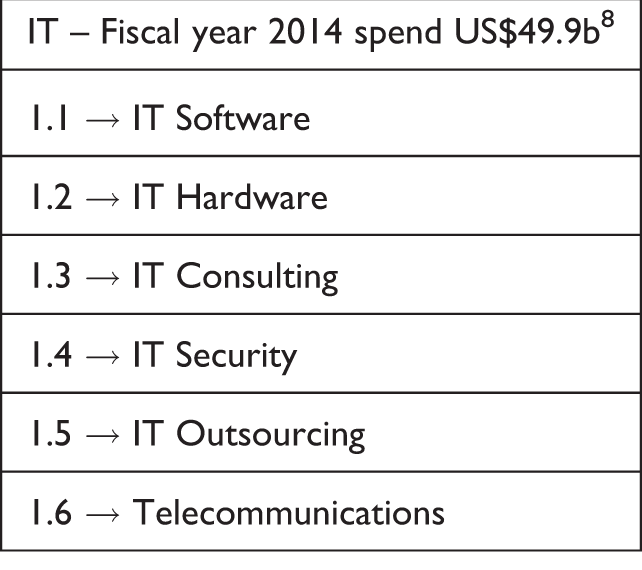
Each subcategory requires its own tailored management approach based on consideration of volume, risks, complexity, strategic importance, and other characteristics that could dictate different acquisition strategies. Taking these considerations into account, OFPP, in partnership with the Federal Chief Information Officer, has developed ground-breaking guidance that, for the first time, offers agencies specific and customized direction to help them reduce duplication and improve the value received from their acquisitions of desktops and laptops, mobile devices, and software licenses.
Desktop and laptops
A comprehensive analysis of the Federal marketplace and agency buying practices, conducted by a cross-agency team of acquisition experts led by the National Space and Aeronautics Agency, revealed that agencies awarded approximately 14,000 contracts and delivery orders for laptops and desktops, totaling about US$1.1b in the fiscal year 2014. These purchases showed a 300% price variation between the lowest and highest prices paid for similar laptops, with prices ranging from about US$450 to US$1300 for the same configuration and few constraints on brand or specifications.
Equally important, their analysis revealed that approximately 80% of agency users rely on one of five standard configurations, which, as previously stated, are acquired through thousands of vehicles, even though a small handful of government-wide contracts can accommodate the needs of agencies across government. Based on this analysis and extensive discussion with agencies, new guidance requires agencies to: immediately begin standardizing laptop and desktop configurations for common requirements; reduce the number of contracts for laptops and desktops by consolidating purchasing and using a fewer number of high-performing (or “best in class“) contracts; and develop and modify demand management processes to optimize price and performance (Rung and Scott, 2015).
Software
The level of duplicative activity for software products is even more dramatic than for desktops and laptops. Each year, the Federal Government spends more than US$9b on software through more than 50,000 acquisition-related transactions – transactions that often support the purchase of identical software. A recent GAO report (Government Accountability Office, 2014) indicates that, because agencies buy and manage software licenses in a decentralized manner, they struggle to create accurate inventories, often purchase unneeded capabilities, and generally do not share pricing, terms, and conditions across government to allow for better purchasing. The GAO further noted that most agencies do not have a designated central oversight authority to manage software agreements, and agency personnel often lack sufficient expertise to effectively negotiate and manage these agreements.
To address these challenges, OFPP established an enterprise-wide software category team for software and will soon issue guidance that requires agencies to move towards more centralized management of software licenses and increase use of government-wide solutions.
Beginning in the fiscal year 2016, agencies will be held accountable for reporting their progress on conforming to the new desktops and laptop policies through an established portfolio management process driven by the Office of the Federal Chief Information Officer (FCIO) in partnership with OFPP. 9 While these are just first steps, they are paving the way for the many other areas of common commodity spend that will similarly benefit from the discipline of category management.
Buying common IT services
In the systems acquisition space, weak results can be traced, in part, to a lack of expertise in buying complex IT products and services, including the ability to break work into useable and affordable modules, or increments, as called for by the Clinger-Cohen Act. The push for modular systems development and contracting grew out of a 1994 Congressional report that chronicled the runaway IT project costs caused by lengthy acquisition and IT development efforts that sought to deliver massive new systems over years, instead of sizing projects to manageable levels (Cohen, 1994).
By the early 2000s, private sector companies, whose own projects were not immune from these types of problems, started applying modular principles through the use of agile software development techniques, where digital services are delivered through iterative, customer-driven processes. Despite this trend, Federal agencies largely remained resistant, reflective of their lack of expertise as well as a fear of failure that makes agencies avoid rather than drive new innovative practices, such as agile software development. A recent study examining the government’s development projects over the past decade puts the impact of this experience gap into perspective (The Standish Group, 2014). Of more than 3500 IT projects from 2003 to 2012, which had labor costs of at least US$10m, the report found that only 6% were successful. Over half were over budget, behind schedule, or did not meet user expectations, and more than 40% had to be abandoned or restarted.
OFPP’s December 2014 roadmap announcing category management and a new direction for Federal procurement also included a set of strategic actions to drive greater innovation in the Federal marketplace. The steps that OFPP is taking to drive innovation in IT procurement, in partnership with other key stakeholders, are focused on moving the acquisition workforce from generalists to technology specialists, providing them with the tools they need to deliver better outcomes, and creating a pathway for innovation and success. The steps include the following:
Talent development
OFPP is working with OMB’s US Digital Services Team (USDS) to create the government’s first certified team of IT acquisition specialists. More than 30 agency career contracting officers are immersed in a new experiential training drawn from industry best practices to create a cadre of certified digital IT acquisition professionals to assist agencies with IT software and systems development initiatives. In addition, the Chief Acquisition Officers Council is supporting the Chief Information Officers Council in its first IT Solutions Challenge, where rising mid-level IT and acquisition professionals have been tapped to identify issues and develop innovative solutions based on their fresh perspectives.
Tools
To support acquisition and technology professionals, a team of government digital experts created the Digital Services Playbook, aimed at leveraging best practices that already exist to build effective digital services. It contains 13 key “plays” drawn from both the private and public sector that, if followed together, will help agencies deliver services that work well for users and require less time and less money to develop and operate. Key plays include “keeping it simple and intuitive,” and “understand what people need.” Complementing the playbook is the TechFAR Handbook, a guide that explains how agencies can execute the “plays” in the Digital Service Playbook while still complying with the Federal Acquisition Regulations. It shows how existing authorities can be used to procure development services in ways that more closely match the development techniques of the private sector.
With the help of the GSA, the Office of Science and Technology Policy and OFPP have launched a TechFAR Hub on the Acquisition Gateway as a follow-on to the TechFAR, which is designed to help agencies utilize regulatory flexibilities to produce better results for IT acquisitions. The goal of the Hub is to make the TechFAR handbook a dynamic resource that captures lessons learned and helpful experiences as well as new and emerging thinking on IT acquisition topics.
Agency Buyers Clubs
OFPP will soon issue guidance to create agency “Innovation Labs” or “Buyers Clubs” to drive improvements in IT acquisitions. Twenty years ago, the Federal Acquisition Regulatory Council developed guiding principles for the Federal Acquisition System, which included empowering members of the acquisition team to use innovative practices not specifically addressed in the Federal Acquisition Regulation, where such practice is not prohibited by law, executive order, or other regulation. 10 While tools like the TechFAR and talent development will help agencies leverage this flexibility, the greatest catalyst for innovation rests inside the agency and its willingness to embrace a culture that continuously encourages new ideas as well as rethinking of existing practices. Such an environment can be enhanced by providing express support and a clear pathway to test and document new ideas, to scale 21st-century policies and practices as they are adopted by agencies, and to facilitate fresh perspectives on existing practices.
Last year, the Department of Health and Human Services stood up a “Buyers Club” to help its workforce formulate, test, measure, and scale innovative ideas. Within months, its Buyers Club helped one of its organizations take advantage of key plays from the Digital Services Playbook and TechFAR to successfully merge multiple legacy systems into a central web content management system. Through the use of agile and iterative practices combined with prototyping, bidders were able to demonstrate how well they were likely to perform. Through this approach, end-users are able to gain a much better sense of a bidder’s likelihood to succeed. A number of other agencies are taking steps to provide similar types of support for the workforce.
OFPP’s guidance, which will outline the principles an agency should carefully consider in standing up or reviewing the effectiveness of existing innovation programs and approaches, is designed to encourage agencies to sponsor a “Buyers Club,” or a similar program if their agency does not already have mechanisms in place to expressly encourage testing of innovative ideas.
Looking ahead
While OFPP has laid out a vision for a new approach to driving greater performance in IT acquisitions and created the governance and tools to support the effort, we recognize that the hard work begins with implementation. As we move forward, there are several key questions we must address as leaders of such a significant transformation of the IT acquisition landscape. Those questions include, but are not limited to, the following.
How do we know if we are successful?
To help measure the progress and impact of our acquisition improvement efforts, OFPP created key IT metrics and targets. For example, one of the key metrics for category management is increasing “spend under management” (SUM). 11 Other targets include savings, a reduction in contract duplication, the number of agency Buyers Clubs established, and the percent of IT projects that deliver functionality in six months. 12 Yet we are acutely aware that there are limitations in measuring success through traditional numeric metrics, which are not always a complete indicator of true performance success, particularly in driving greater innovation in IT acquisitions.
How do you create a shared sense of responsibility?
The Federal Government operates in silos, rarely collaborating across functional areas. In acquisitions, where it is critical that a team of legal, acquisition, program, financial, and other experts, work together throughout the acquisition life-cycle, a lack of cooperation and meaningful communication among team members can hinder performance. While the creation of specialized IT acquisition teams is a good start, greater attention will need to be given to how one builds true accountability among all team members into the DNA of the acquisition process, perhaps by developing a set of common employee performance ratings tied to the team’s level of success (e.g., were the stated acquisition/project milestones met on time and within budget?). 13
How do you encourage responsible risk-taking in the Federal acquisition workforce?
The Federal acquisition workforce is risk-averse, often with good reason. Today, there is limited recognition of success, and an intense spotlight on acquisition failures. Calling for greater innovation and directing agencies to provide a pathway to test new ideas through a Buyers Club is a good start, but has its own implementation challenges (e.g., finding the right internal champions and communicating with a fragmented workforce) as well as sustainability issues (e.g., defining a clear role for the organization that institutional stakeholders view as beneficial and not threatening; coming up with an appropriate funding model).
What are the most effective tools to help drive change across the Federal acquisition workforce?
We must arm our workforce with the right tools to drive improved performance. With OFPP’s support and management direction, the GSA has started to collect and display important IT contract and pricing information in a central location called the Acquisition Gateway. The Gateway is an online portal where government employees can find contract information for a range of IT categories, including software and hardware. 14 Early efforts to arm agencies with this information already show its promise in achieving better pricing and reduced price variability. When the GSA initiated a dynamic pricing model, where prices are adjusted based on transactional data on its strategically sourced vehicle for office supplies, it helped its customers secure savings of approximately 18%, roughly 4.5% higher than pre-dynamic pricing (General Services Administration, 2015).
While there is much to be done, important progress has been made to understand the challenges of the past and put in place new and better approaches that help to avoid the same missteps in the future. With continued effort and senior management support, these initiatives promise to deliver better results for the taxpayer and help the government work better.
Footnotes
*This is a work of the U.S. Government and is not subject to copyright protection in the United States. Foreign copyrights may apply.
Funding
This research received no specific grant from any funding agency in the public, commercial or not-for-profit sectors.