




Abstract
Cross-cultural cooperation in joint ventures does not take place in a power-free context but is threatened by struggles between partners over cultural differences and conflicting interests. All project partners have their own perspectives, interpretations, intentions and practices, which challenge the undertakings of cross-cultural collaboration. Therefore, it is the aim of this paper to study how employees make sense of their cultural differences in a multinational joint venture. To do so, the cross-cultural collaboration between joint-venture partners Gazprom and Shell is studied over three months of fieldwork during the Sakhalin Energy II megaproject in Siberia. The contribution of this paper is the theorization of culture as socially constructed and the exhibition of how cultural differences are negotiated to create a system which is a cultural hybrid, securing Shell-based management practices and values while simultaneously localizing the project in the Russian framework. As such, hybridization can represent an antidote to power struggles and cultural discrepancies.
Keywords
Introduction
In December 2011 BP announced its withdrawal from its 13-year joint venture contract with Russian state-owned oil company Rosneft (Flynn, 2011). Their problematic cooperation was heavily influenced by cross-cultural differences and struggles over power, which was covered by various newspapers and websites (Flynn, 2011). A joint venture such as BP–Rosneft is a cooperation in which two or more independent partners equally participate, benefit, control and support one another in one or more strategic key areas (Lorange and Roos, 1992). According to Glaister and Buckley (1996), the two key motives of international joint venture formation are linking to fast changing markets and geographical expansion into previously inaccessible local markets.
Scholars frequently mention laborious cross-cultural cooperation as a cause of joint venture failure (Brannen and Salk, 2000; Lorange and Roos, 1992) as exogenously induced management practices may collide with the ongoing formation of a repertoire of management routines (Bresnen et al., 2005). According to Søderberg and Holden (2002), there is a large risk of misjudgments, misperceptions and mistakes in handling the complexity of cultural relationships in joint ventures. Therefore, joint venture partners must negotiate or make certain compromises concerning cultural differences, thereby allowing various cultural values and practices, both foreign and local, to be integrated (Brannen and Salk, 2000). However, issues of negotiation and power are frequently left out of cross-cultural studies (Ailon-Souday and Kunda, 2003; Brannen and Salk, 2000; Van Marrewijk, 2010; Ybema and Byun, 2009).
Cross-cultural cooperation does not take place in a power-free context as joint venture partners have varying perspectives, interpretations and interests which may undermine collaborative success (Brannen and Salk, 2000; Primecz et al., 2011). Therefore, scientists argue for including culture as a negotiated and socially constructed phenomenon in cross-cultural management (Busch, 2012; Vallaster, 2005; Van Marrewijk 2010). For example, Busch (2012) explains that cooperating members will have their own constructions of culture and of its influence on practice. As Jabri (2005: 349) states, in the field of cross-cultural management “there is an increasing awareness of the variability of the spoken word and of the context-dependence of thought and action.” Therefore, this research focuses on understanding the social constructions of cross-cultural differences by joint venture members, studied within context.
Bearing in mind the power-laden context of cross-cultural cooperation in joint ventures, the central research question in this paper is: How do employees make sense of cross-cultural differences in a multinational joint venture? In order to answer this question we studied daily cooperation in Sakhalin II, Russia’s largest and most influential oil and gas megaproject. In this study, megaprojects are understood as cultural phenomena (Van Marrewijk, 2015) via a focus upon cross-cultural differences in the struggle for control over Sakhalin II between Gazprom and Shell, the two main joint venture partners. This megaproject was studied by the first author for a period of three months in the winter of 2010 from an interpretive approach, with qualitative research methods including observation, participant-observation, and in-depth interviewing (Ybema et al., 2009).
The contribution of the paper to the academic debate on cross-cultural collaboration in joint ventures is threefold. Firstly, the paper illustrates how in the daily collaboration in a joint venture, culture is a socially and situationally constructed phenomenon which transforms over time. Secondly, it emphasizes the relevance of adopting a power-sensitive comprehension of cultural differences by revealing, at the micro level, a culturally hybridized system securing Shell-based management practices and values while simultaneously localizing the project within the Russian framework. Thirdly, it demonstrates that cross-cultural hybridization can represent an antidote to power struggles, cultural tensions and essentialist notions of culture.
The structure of the paper is as follows. First, the theoretical framework will be provided, where the debate on cross-cultural cooperation in joint venture projects will be discussed. Second, the research methodologies implemented will be described and explained, for example the research strategy taken, sampling, and the research techniques used. Subsequently, the findings will be revealed, first by portraying the case of the Sakhalin II megaproject within context, and second by describing the results found on a national, organizational and individual level using a multilayered approach. In the following section the discussion is presented, where we analyze and theorize the most important findings. Finally, conclusions are drawn by answering the research question and providing research contributions to the field of cross-cultural management as well as implications for managers and practitioners.
Cross-cultural collaboration
It has been argued that previously developed concepts, theories and models of cross-cultural studies no longer suit the contemporary internationalizing business environment (Søderberg and Holden, 2002). For example, reductionist cultural value models are often overvalued while particularistic cultural identifications are undervalued (Jackson and Aycan, 2006; Include Pollack, (2007)). There are three important issues concerning cross-cultural literature that are vital to take into account for this research.
One important issue is that cooperation between different cultures not only comprises national cultures (having been the dominant level of analysis for the last two decades in cross-cultural studies, see Jabri, 2005) but rather multiple cultures, including regional, organizational, departmental, and professional cultures (Chanlat, 1994; Chanlat et al., 2013). In this sense, most cultural value models are considered to be too universalistic, “with little practical value” (Jacob, 2005: 520), viewing nations or cultures as homogenous entities, and comparing them along reductionist criteria (d’Iribarne, 2009; Jabri, 2005; Jackson and Aycan, 2006; Søderberg and Holden, 2002; Tipton, 2009). Thus, there is a growing consensus that cultures and nations are too complicated and heterogeneous to be explained in terms of unilinear dimensions.
In a globalizing business world, cross-cultural interactions and interfaces are accelerating, creating more issues and new cultural formations that cross-cultural research and literature have yet to incorporate (Chanlat et al., 2013; Jackson and Aycan, 2006). Therefore, cross-cultural studies should be contextual and historical, focused on social interactions and constructions developing over time (Jacob, 2005). Accordingly, contextual and historical issues such as power relations, conflict abnormalities and ethnical tensions should also be identified and dealt with, having been largely neglected by previous models (Van Marrewijk, 2004, 2010).
A second issue in cross-cultural literature is that culture has frequently been perceived as a barrier to cross-cultural cooperation, as cultural differences were expected solely to create clashes and conflicts. Conversely, Søderberg and Holden (2002: 105) argue, with the support of several other studies, that culture should not be seen as a cause for corporate undoing but rather as a resource or an asset: “Some scholars thus argue that the judicious handling of cultural differences can lead to competitive advantage and even organizational health.” The authors therefore believe that cultural differences should be acknowledged and incorporated, not as obstacles to be overcome but rather as enriching sources of knowledge. They explain that in a globalizing business environment “cultural differences are manifesting themselves in new ways” (Søderberg and Holden, 2002: 108). Therefore, it is up to cross-cultural researchers to discover how cultural differences are manifesting themselves and, more importantly, how one can exploit this knowledge to make way for a new collaborative mentality and for the revival of cooperative practices (Jackson and Aycan, 2006; Smits and Van Marrewijk, 2012; Søderberg and Holden, 2002).
Relating to this issue is that cross-cultural practices are likely to become hybridized or mixed over time, providing that culturally diverse practices are integrated rather than discounted (Shimoni, 2008; Shimoni and Bergmann, 2006). According to Jacob (2005: 515), hybridization is a “useful point of departure from traditional approaches to viewing cultural consequences,” especially since the hybridization of organizational practices has become more widespread due to increased cross-cultural interfaces. Jacob (2005) explains that there are no homogenous entities as even people themselves are hybrids, having multiple identities. In this way, hybrid practices reflect the culturally heterogeneous context and composition of countries, regions, projects, organizations and so forth. For public or private megaprojects instigated in foreign locations, this signifies that hybridization is the key to creating “practices that are efficient, while simultaneously aligned to the local culture” (Jacob, 2005: 522); a synthesis that is deemed necessary for successful cross-cultural cooperation (Shimoni, 2008). Perhaps, hybridization may even help defuse the academic debate around cross-cultural cooperation in general, owing to its ability neutralize various cultural contradictions, paradoxes and dichotomies via the fusion of cross-cultural practices (Shimoni, 2008; Shimoni and Bergmann, 2006).
A third issue is that as we move away from essentialist conceptions of culture, culture should rather be seen as a negotiated and socially constructed phenomenon (Brannen and Salk, 2000; Clausen, 2007; Sackmann and Phillips, 2004; Van Marrewijk, 2010; Ybema and Byun, 2009). Within a given context, members will make sense of and ascribe meaning to cultural differences (Søderberg, 2003), thereby constructing culture as they see fit (Van Marrewijk, 2010; Ybema and Byun, 2009). Simultaneously, in collaborative relationships culture is (re)negotiated and (re)constructed to suit the existing, culturally heterogeneous business environment that is typified and shaped by cross-cultural interactions and interfaces (Clausen, 2007; Jackson and Aycan, 2006; Søderberg and Holden, 2002). We therefore adopt a “negotiated” culture perspective (Brannen and Salk, 2000; Clausen, 2007) with a close consideration for the situational construction of cultural forms (Van Marrewijk, 2010; Ybema and Byun, 2009). This entails that we must understand culture from the interpretations and perspectives of individual project members and as an entity that is not fixed but constantly being shaped and transformed by employees and the internationalizing business environment.
This negotiated culture perspective includes a power sensitive understanding of cross-cultural differences. Nicholson and Sahay (2001) studied cross-cultural cooperation in a British–Indian software outsourcing alliance and found that British managers enforced narrow economic issues at the cost of the loyalty, emotions, and aspirations held by the Indian employees. The control over software outsourcing remained firmly rooted in the British organization. Looking at such dynamics led Ybema and Byun (2009) to underline the context-dependent and constructed nature of cultural differences in intercultural interactions. They draw attention to the particular relevance of a power-sensitive understanding of claims concerning cultural differences. A number of other studies on cross-cultural cooperation has emphasized the use of cultural differences as a strategic source of power in cooperation practices (Ailon-Souday and Kunda, 2003; Brannen and Salk, 2000; Van Marrewijk, 2004). Ailon-Souday and Kunda (2003), for example, studied cross-cultural cooperation in an Israeli–American merger in a high-tech industry. They observed Israeli employees using the Hebrew language to exclude their American colleagues in meetings and secure the implementation of an Israeli IT platform for the merger. It is clear that exploring the use of cultural differences as a strategic source in the cross-cultural cooperation of project teams is vital for efficient global IT projects (Ybema and Byun, 2009).
Cultural boundaries can thus be created and maintained for strategic purposes as employees distinguish themselves from others by using symbols, language, rituals, signs, and other outward appearances that signal their “uniqueness” (Van Marrewijk, 2004). In line with these findings, Ybema and Byun (2009) found that in their everyday practices, Japanese and Dutch employees draw on their respective cultures as a rich symbolic resource and strategic weapon to gain more leverage in their power relations. Employees can emphasize (Van Marrewijk, 2010) or diminish (Ybema et al., 2012) their national and/or organization culture for social or political purposes. Therefore, cultural differences should be understood not as coherent, stable entities, but as shifting social constructs that are contextually dependent on the specific interests at stake.
This brief review of three debates on cross-cultural differences shows the importance of adopting a perspective on cross-cultural cooperation in joint venture megaprojects that includes the situated and constructed nature of cultural differences. To understand how cultural boundaries are drawn, cultural differences have to be approached from a sense-making perspective (Søderberg and Vaara, 2003; Vaara, 2000). Based upon the work of Weick (1995) we are interested in how the acquired companies’ members actively reflect upon their own norms and values and those of the acquiring firm in creating cultural boundaries.
Research methodologies
We have chosen to take a multilayered approach which focuses on studying a multinational megaproject on a national, organizational, and individual level, as well as analyzing their interrelatedness (Chanlat, 1994; Chanlat et al., 2013). This mode of observation and analysis helps unravel the complex, multilayered social dynamics that take place in such a project. According to Jabri (2005), ethnography and cultural studies promise to be useful in expanding cross-cultural management scholarship. In line with this, we have engaged in this research with an ethnographic focus involving the thorough study of a particular group (Sakhalin II employees) in a particular setting (Siberia, Russia). This was necessary to become truly familiarized with the project employees, their cultural narratives, values and their practices (Jabri, 2005). To do so a qualitative–interpretative approach has been taken that is integral to organizational ethnographic research by carrying out observation, participant-observation and conducting intensive interviews (Yanow and Schwartz-Shea, 2006). In order to “be there all around” and learn about the project from the inside out, meetings, workshops, and presentations were attended, birthdays and holidays were celebrated, lunch was eaten together in the cafeteria, and regular conversations and social interactions were held with project members during both formal and informal gatherings. This, in addition to the participation in the local and expatriate communities, has given us an insider’s perspective deemed essential in qualitative, ethnographic field research (Pader, 2006; Ybema et al., 2009).
Additionally, in-depth interviews were held with a total of 26 individuals: half of them Russian project employees and the other half foreign (see Table 1). All interviews were held in English as this was the official language of the company. Most foreign respondents were western expatriates from Shell (the majority with an English, Dutch, Australian, or Scottish nationality) while the Russian respondents comprised a more diverse sample coming straight out of college or university, from other companies and organizations, sometimes from Shell, and in rare cases from Gazprom. All interviews were conducted with a tape recorder via face-to-face dialogue and took approximately one and a half hours. Most of the interviews were open-ended or semi-structured based on a list of research topics prepared beforehand, while maintaining a considerable degree of flexibility, active listening, and interviewee rapport to increase respondents’ willingness to speak (Silverman, 2006). In this way, interviews were kept “intense” and “in-depth,” more like an in-depth conversation rather than an interview, generating an abundance of data.
Interview sample and details.
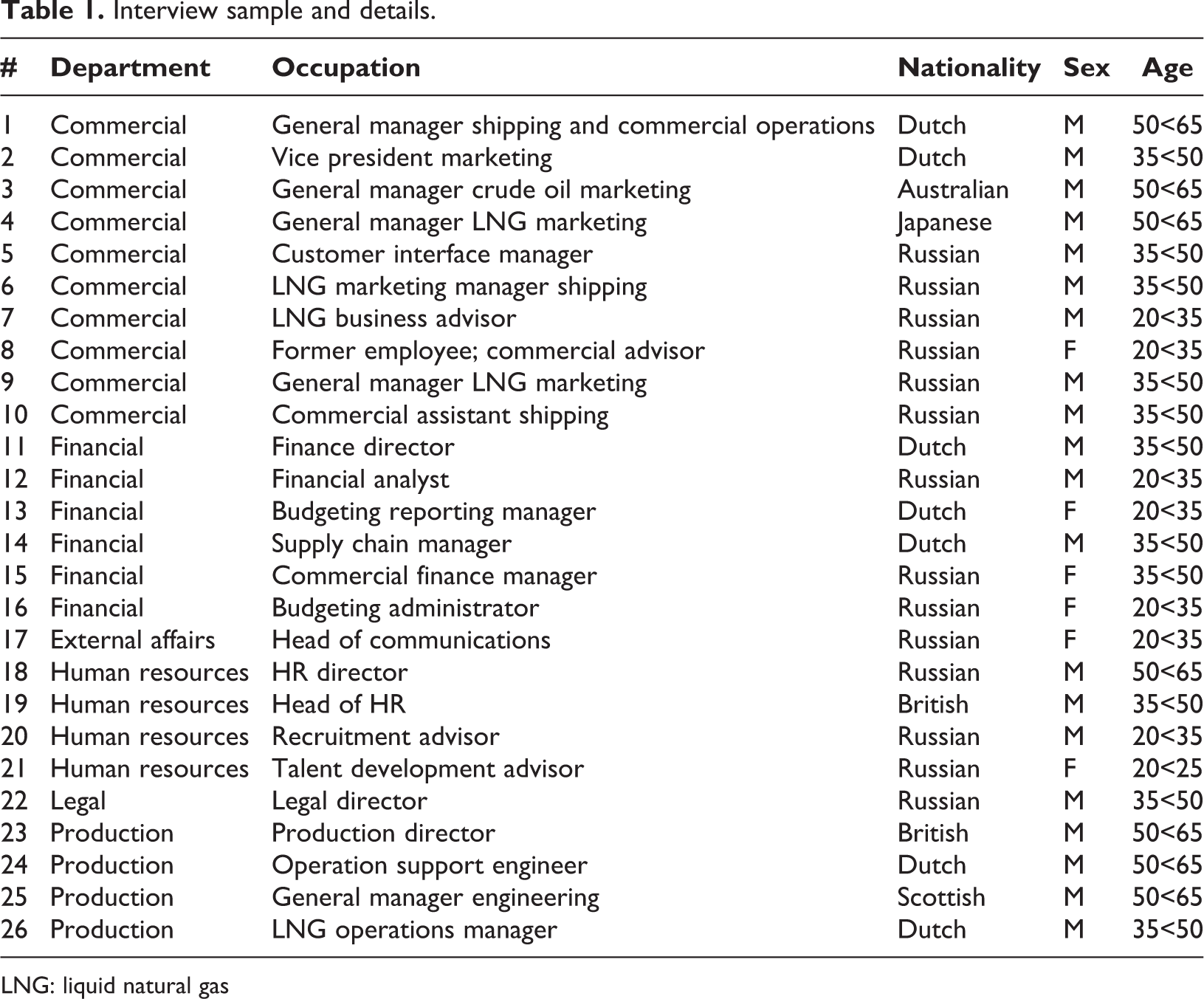
LNG: liquid natural gas
Purposeful sampling was chosen as the method for selecting our respondents, meaning that deliberate interaction was sought with certain people or groups who could contribute to our study in a meaningful way (Baily, 2007). Thus, we aimed for exposure rather than sampling per se in order to find and accumulate multiple interpretations revolving around our themes: power dynamics, cross-cultural differences, cooperation, and hybridization. Hence, because a multilayered analysis (Chanlat, 1994; Chanlat et al., 2013) was used on a national, organizational, and individual level, respondents were selected on the basis of nationality (Russian and foreign), organization, or company (Russian State Party, Shell, Gazprom, or other), and individual position (upper, middle, and lower level employees). Respondents were also chosen on the basis of age and gender to obtain a more diverse sample. Further, it is important to note that shareholders Mitsui and Mitsubishi were of less interest for this research because they are the customers of oil and gas companies and not the operators or producers.
Moreover, it is strongly advised with purposeful sampling that the researcher should carefully consider the parameters of the population and choose a sample on those grounds (Silverman, 2006). Therefore, because the project was so large and complex, most of the fieldwork research was conducted in the corporate building (Sakhalin Energy Building 1) because, out of all the project buildings, it contained the most assorted workforce in terms of individual, cultural, departmental, and occupational diversity. Specifically, in this building reside the commercial, legal, external affairs, human resources, and financial departments, representing a diversified workforce. Additionally, this building was chosen because it is regarded by employees as the project’s main headquarters, acting as a medium between oil and gas production and exportation.
Ultimately, by making use of these particular research methods in a systematic way, we were able to give meaning to organizational behavior and activities in the workplace by discovering how the organizational actors themselves contributed to this meaning-making process within the context of a cross-cultural work environment (Yanow and Schwartz-Shea, 2006).
Case: Sakhalin II project
To Russia, Sakhalin II is the first offshore oil and gas project, the first and largest project-financing contract, and the first liquid natural gas (LNG) plant, making it a very important endeavor recognized from both a national and international standpoint. Since 2000, the project has been operated by Sakhalin Energy Investment Company Ltd (SEIC), under a production-sharing agreement with the Russian Federation. The stakeholders are four major oil and gas companies: Gazprom, the world’s largest gas company, 50% of which is owned by the Russian Federation, holds 50% plus one share of SEIC; Shell, one of the world’s largest oil companies, holds 27.5% minus one share; Mitsui, a Japanese investment conglomerate holds 12.5% and Mitsubishi, also a Japanese company, holds 10% of the share. In 2007, Shell was forced to halve its ownership in the project, cutting its stake from 55% to 27.5%, and Gazprom, the biggest Russian state-controlled gas corporation, stepped in, buying Shell’s share plus half the stakes owned by Japanese partners Mitsui and Mitsubishi. The revenues and profits are divided amongst the Russian Federation and the partners of the joint venture.
Shell and Gazprom have struggled for power and control over the project. In 2008 the localization plan was accelerated, concerning the replacement of foreign, mostly western, expatriates with Russian experts. Respondents and official documents referred to this process as “Russianization.” Handing over the project to the permanent Russian operational team became the main objective for foreign managers, which brought about many cross-cultural interfaces and adaptation processes. To unravel the complex social and cultural dynamics in this megaproject, the social construction of cultural differences will be analyzed on a national, organizational, and individual level below.
National level: the construction of “Russian” and “western” cultural differences
The social construction of a clear distinction between “Russian” and “western” practices at the workplace was evident (see Table 2). The majority of respondents perceived there to be such a dichotomy mainly because Gazprom (Russian) and Shell (western) are the two major shareholders and because both Russian and western management styles could be distinguished at the workplace. Many respondents often associated “Russian” practices at the workplace with concepts like nationalization and traditionalism. Herein, the Russian State and national interests are claimed to dominate business. Despite the changes in the Soviet Union (Hann, 2002; Humphrey, 2002), the state still plays a very influential role concerning manifold national and regional decisions and arrangements (Kets de Vries et al., 2004). For example, a Russian employee stated: “In Russia it’s a bit different. The mentality is still that the government should care about the people so the business is subordinate to the government.”
Social construction of cultural differences at the national level.
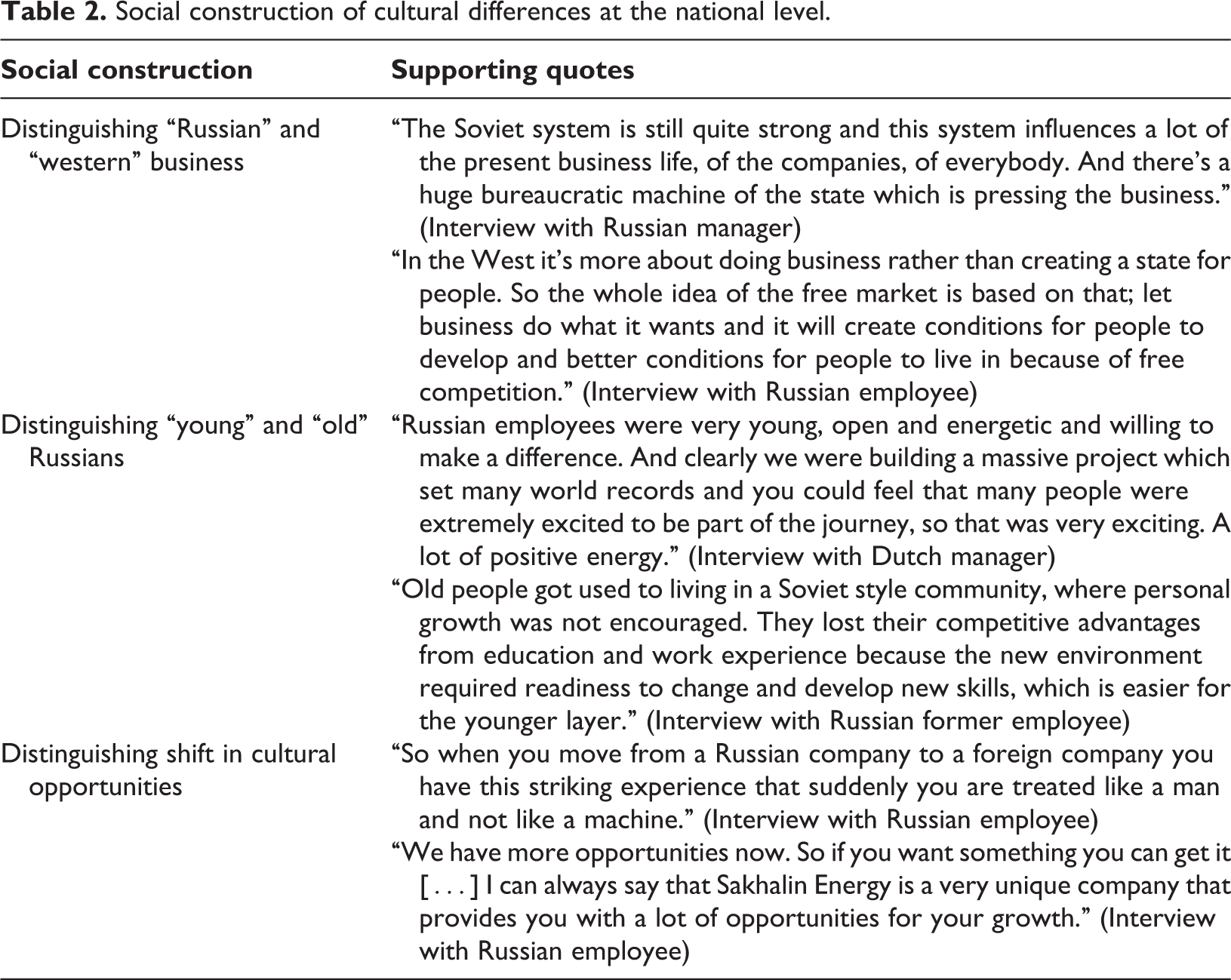
Conversely, the majority of respondents, both Russian and foreign, associated “western” management practices with concepts such as internationalization and innovation, while Russian practices include less room for lateral thinking and personal freedom regarding work. Additionally, Shell offered considerable benefits and appraisals to its employees to uphold employee loyalty, satisfaction and productivity, whereas these kinds of incentives are rare if not absent in Russian companies. One Russian employee shared his experience when moving from a Russian company to SEIC when Shell was still the main shareholder: So when you move from a Russian company to a foreign company you have this striking experience that suddenly you are treated like a man and not like a machine. And suddenly you are entitled to some things like relocation for your family, medical insurance also for your family, access to certain facilities and you are allowed to take part in some nice training and good benefits. (Interview with Russian employee)
Organizational level: Russianization or Gazpromization?
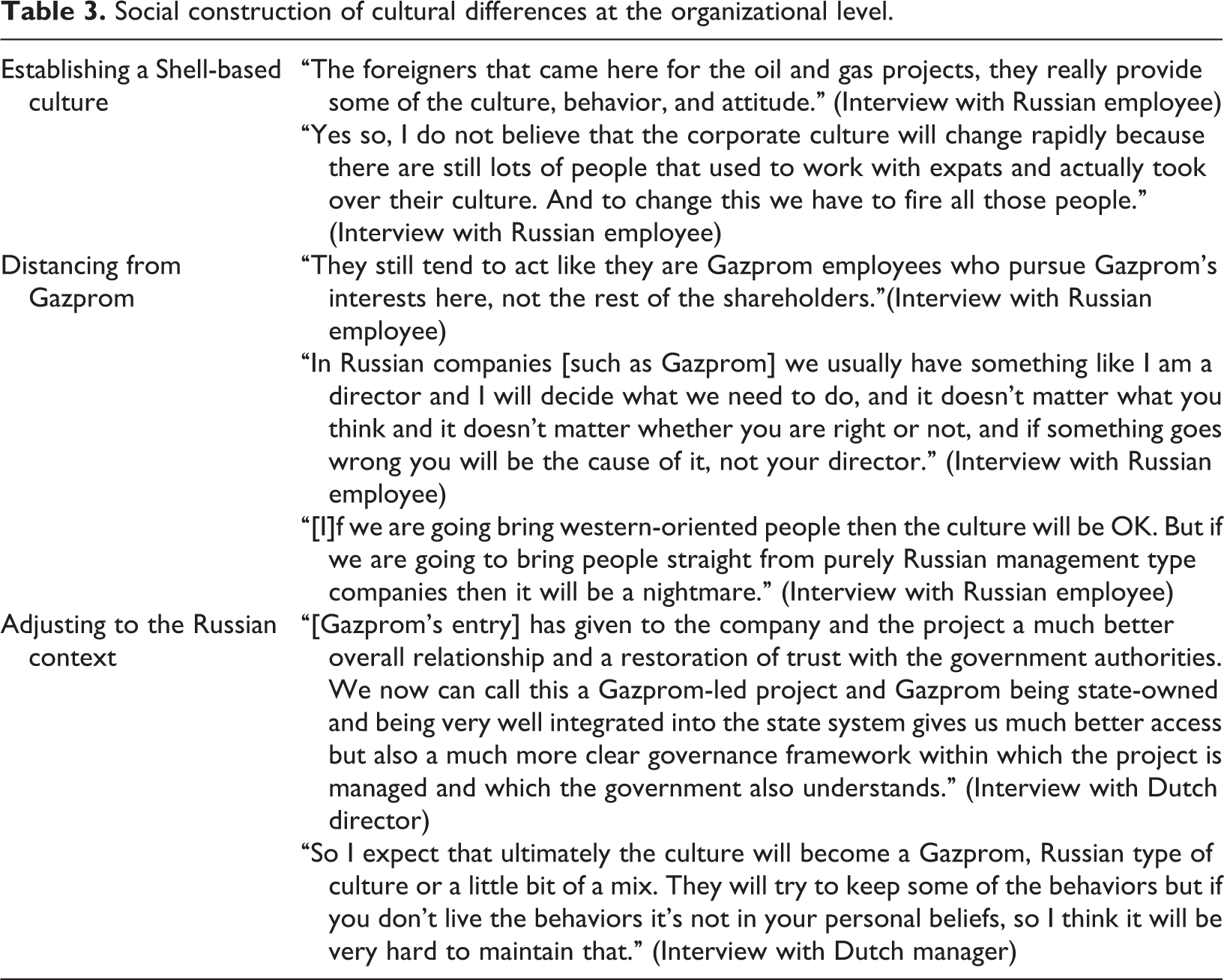
At an organizational level, different social constructions of cultural differences have been found in this study (see Table 3). First, at the beginning of the project, shortly after it entered the construction phase, executives mainly from Shell started to build SEIC organically:
Social construction of cultural differences at the organizational level.
When I first came here [in 2000] there were other Shell people coming in at the same time as me and taking over some of the key roles so it was quite an immature organization and one of the nice things about it was that we could make the rules up as we went and develop procedures and the culture. (Interview with Australian manager)
Although Gazprom has gained most of the legal control since 2007, they need the operational knowledge of Shell’s executives who occupied key managerial positions to continue to manage and operate the LNG megaproject. Furthermore, Shell executives hired young Russian employees who could speak fluent English and would fit the international, western-based orientation, trained them, and provided them with the appropriate skills. Consequently, young Russian employees under the age of 35 comprise 70% of the company’s staff. These Russian employees had gradually adapted their ways of thinking and doing in order to meet Shell’s cultural and behavioral norms. Therefore, according to respondents, the values and practices that have been implemented in the Sakhalin II megaproject are largely Shell-based. And in such a way, in operating both laws at the same time or blend both I think they developed expertise that is not there in Russian companies because they have these western tools, systems and processes and at the same time they are compliant with Russian legislation. (Interview with Russian employee) And I like it personally, under western style management. Only half a year I worked for a Russian style management company and I ran away from that company because I didn’t like very much this style. It’s very autocratic. (Interview with Russian manager) When they announced that Gazprom would take over everybody was like “oh my god everything is going to change, we are going to work like in Gazprom!” because everyone knew how they work in Gazprom and nobody wanted to be in such an environment. (Interview with Russian employee)
Contrary to the possible consequences of “Gazpromization,” the acceleration of Russianization brought inevitable consequences in order to meet local demands. Project members perceive Russianization as necessary and “good business,” given that expats are expensive and temporarily based. Therefore, expats had to hand over the project to the permanent Russian operational team at a fast pace. Given that both expats and Russian employees realize that they must cooperate for the success of the project despite cultural discrepancies, efforts and negotiations are made to adapt to and/or cope with the structural changes and ensuing cultural influences. For example, directors and managers are claiming to select those practices which work best in a certain situation, for certain individuals, or in a particular project stage, and to avoid choosing practices on the basis of their home company, such as Shell or Gazprom. In this way, over time, different practices will not only be used together and interchangeably but they will also hybridize – a process understood as the fusing together or blending of culturally diverse practices. When asked what the consequence would be of implementing culturally diverse practices, a Dutch director described this process: It’s a bit like mixing coffee with milk so you will see different colors in your glass at different levels and it will change over time, so it’s an evolving blend […] I think what we’re really trying to do is blend some Russian aspects into a western management style or in some cases certain western aspects into a Russian management style depending on the situation. (Interview with Dutch director)
Individual level: personal orientations towards a cross-cultural work environment
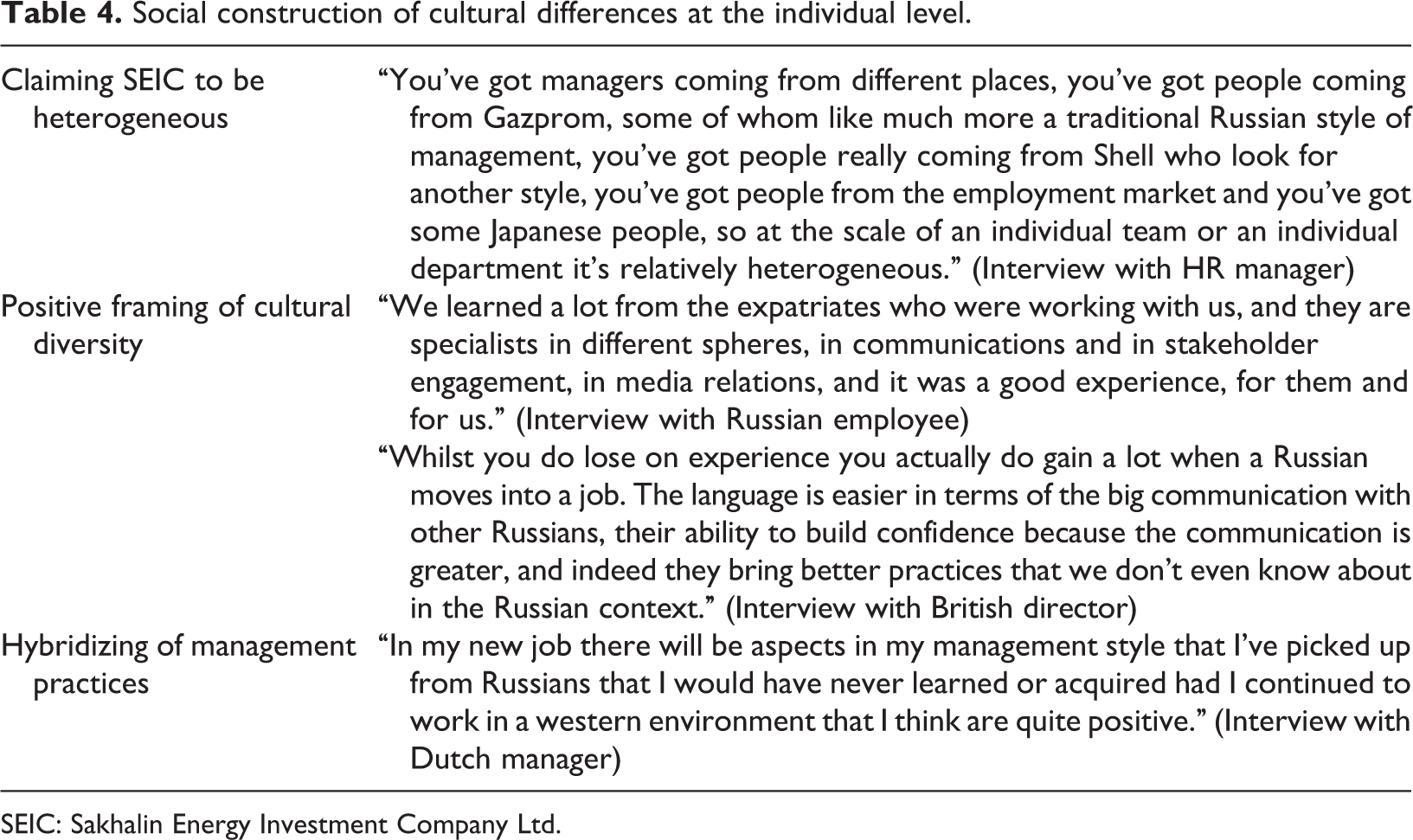
On an individual level, the Sakhalin managers and employees are heterogeneous in terms of nationality, place of origin, background, experience, age, gender, level of occupation, and so forth (see Table 4). To adapt to the heterogeneous environment and to work and interact with culturally diverse “others,” SEIC conveyed that cultural differences should be acknowledged and included rather than disregarded. Therefore, they incorporated the strategic organizational concept of “diversity and inclusiveness” and provided training sessions in “cultural awareness.” Since Shell managers in SEIC have been managing predominately Russian teams, they had to adapt their management style and familiarize themselves with Russian culture (Puffer and McCarthy, 2011). These managers make an effort to recognize, adjust to and/or adopt certain facets of the Russian culture in order to manage the cross-cultural environment successfully:
Social construction of cultural differences at the individual level.
SEIC: Sakhalin Energy Investment Company Ltd.
It was very clear that the Russian staff expected from me far less of a consultative management style, they expected very clear steer and clear decisions, whereas in a western company you’re sometimes more used to truly delegate and tell people “look, you’re experienced so sort it out yourself.” Here they expect clear direction sometimes even in written form. (Interview with Dutch Shell manager)
Expat managers also needed to adjust to Russian formalistic and bureaucratic procedures. Once the project was being Russianized, practices such as handling administrative paperwork and providing signatures became important organizational requirements. From a Russian point of view these practices are necessary to maintain organizational control. However, western managers disagreed about this, as one Dutch manager expressed: “I’m not particularly fond of writing everything down and putting my signature everywhere, but this is something I needed to start to do.” However, there were not only difficulties or disagreements with Russian practices. In some cases expat managers found the hybridization of work practices to be beneficial.
Adaptation was a mutual process for both foreigners and Russians. Working with foreign managers and experts was a new experience for many young Russian professionals. Both western and Russian managers or employees made strategic use of cultural knowledge by asking each other for guidance or advice. For example, in the commercial department foreign managers would often ask their Russian colleagues about certain procedural requirements such as filling out administrative forms for the local labor authorities or cooperating with Russian auditors, contractors or customers. In turn, Russian employees frequently asked their foreign associates for guidance and instruction during their daily work practices, especially when dealing with international relations such as the foreign shareholders Mitsubishi and Mitsui.
The use of language is another aspect manifesting hybridization. As English is the official business language at SEIC, Russians are required to take English lessons when necessary to improve communication and understanding. In turn, foreigners are required to take Russian lessons. With the Russianization of SEIC, English was no longer the only dominant language in practice. Even so, all important texts, booklets and manuals are printed in both Russian and English which makes this a bilingual company where both languages can be used successfully and interchangeably, not to mention that the Russians who have mastered the English language can also act as translators. In the communication within SEIC, which was supported by translators, both Russian and English languages were now used jointly and interchangeably. Even though this resulted in misunderstandings at times, it shows that language reflected the culturally heterogeneous composition of the workforce.
Finally, hybridization of cultural practices could be observed during social gatherings. For example, the Russian festivity of Defender’s Day took place on February 23, which is celebrated in the name of the Russian Civil War veterans from 1918. Colloquially, this day is also referred to as Men’s Day, when men receive gifts from their female counterparts. This day is also celebrated as part of the work culture in Russia, which was indeed apparent in the commercial department comprising of 15 individuals, male and female, including Russian, English, Dutch, Australian, Japanese, and Korean employees. During this event, food and drinks were provided, speeches and individual compliments were given, the men received gifts from the women, and everyone participated in fun, interactive games. All respondents found it crucial to socialize with one another through informal activities in order to break cultural boundaries: What you need to consciously do on a regular basis is have team events, do all sorts of things, have a beer together, simple things like having a beer at a bar or celebrating somebody’s birthday, just these simple things. (Interview with Dutch manager)
Based upon the findings discussed above, an overview can be given of how cultural differences were socially constructed in the Shakalin II megaproject at an individual level (see Table 4).
Discussion
One of the most striking findings when studying the cross-cultural cooperation at the studied megaproject is that “Russia” and “the West” are not well-defined homogenous, cultural entities but are rather socially and situationally constructed as such. Research findings have shown how respondents would dichotomize culture, for example by associating western business practices with internationalization while associating Russian business practices with nationalization, thereby portraying a cultural duality. This is in line with the earlier findings of Ailon-Souday and Kunda (2003), Ybema and Byun (2009) and Van Marrewijk (2010), who all claim the social construction of cultural differences.
Though categorizing culture as “Russian” and “western” makes it easier to identify, daily practices in Sakhalin II reflected a great deal of complexity, diversity, and heterogeneity. Respondents acknowledged the emergence of new cultural forms and practices via the blending of existing ones. Here, selected parts of the Russian legislation and management system are being grafted onto western operational processes and procedures. This is precisely what hybridization entails (Jacob, 2005) and what Shimoni and Bergmann (2006) have observed in other joint ventures. This causes new cultural forms and practices to emerge and creates a new management system that is rooted in both cultures (i.e. Russian and western). Even the language used at SEIC started to change, as both English and Russian came to be used interchangeably over time. As a result, dichotomies of western and local practices are replaced by new hybrid ones because the overall project culture can then no longer be defined as strictly western or foreign or as strictly Russian or local. The social construction of cultural differences in the Sakhalin II case can thus be identified as fabricates of cross-cultural hybridization or the fusing together of diverse cultural entities. As such, hybridity can be perceived as the antidote to essentialist notions of culture identifications (Shimoni, 2008). This implies that while some employees at SEIC dichotomize culture in order to cope with the insecurities and fears of a culturally transforming business environment, once practices are increasingly becoming hybridized on the work floor, members are shifting their perceptions of the cross-cultural work environment from it being culturally divergent (western versus Russian practices) to it being culturally crossvergent (the combination of western and Russian practices). Therefore, cultural differences should not be simplified into stable categories but be perceived as “an emergent and negotiated phenomenon” (Sackmann and Phillips, 2004: 375).
As Russia has been undergoing a profound socio-economic transition since the fall of communism (Holden et al., 1998), socialism is gradually being displaced by capitalism where business is increasingly becoming privatized and internationalized (Hann, 2002). After Gazprom’s entry and an acceleration of the Russianization process, Shell became concerned with how to secure their investment and influence in the Sakhalin II megaproject while simultaneously localizing the project to the Russian context. Therefore, Shell strategically translated their management practices to suit the local environment and Russian framework, thereby securing its influence on the project. Additionally, because both foreign and Russian respondents are wary of the possibility of “Gazpromization,” they strategically devalue Gazprom’s, and in some cases even Russia’s, cultural capacity to manage and run the Sakhalin II project. This is in line with Barinaga (2007), who stressed the negotiated nature of culture in project teams. In our view, this phenomenon stems from the transforming business context, typified by the backstage power struggle between Shell and Gazprom, where employees feel the need to give meaning to and make sense of divergent cultural categories (Søderberg, 2003) and construct cultural differences that they regard as salient in that specific context (Vallaster, 2005).
SEIC did incorporate the philosophy of “diversity and inclusiveness” to convey that cultural differences should be recognized and included rather than disregarded, and this could be observed on the work floor as well. The data of this research reveal that SEIC members are gradually learning how to cooperate with one another and manage the cultural diversity encountered in the workplace. This motivated project partners to find a common ground, negotiate and cooperate, allowing various cultural practices to be integrated from both Gazprom and Shell, in turn, creating a hybrid, multicultural project organization. These findings are in line with Søderberg and Holden (2002), who state that cultural differences should not be seen as obstacles to be overcome but rather as valuable, enriching sources of knowledge. Moreover, power conflicts can have the effect of breaking boundaries, enhancing group solidarity, signaling commitment, and solidifying relationships (Smith and Stewart, 2011). This, in turn, is likely to endorse teamwork and identification with the group, as well as cross-cultural cooperation.
Conclusion
Turning back to our research question, this paper focused on the reflection of joint-venture partners on cross-cultural differences in the Sakhalin II megaproject in the context of the power struggle between Gazprom and Shell. In order to study how cultural differences were constructed and how they emerged within SEIC, we have focused on the interfaces between the joint-venture partners (Jacob, 2005; Sackmann and Phillips, 2004; Søderberg and Holden, 2002). We argue that it was Gazprom’s entry, the acceleration of the Russianization and the fear of a cultural “takeover” or “Gazpromization” which impelled SEIC and particularly Shell to strategically construct cultural practices to suit the local environment and Russian framework, thereby securing its influence over the project. While Shell has technical experience and international know-how on operating LNG plants and dominates the daily management practices, Gazprom is the powerful Russian shareholder dominating the legal framework and local procedures of the joint venture. In this mutually dependent relationship, cultural differences at SEIC are socially constructed at national, organizational, and individual levels.
Consequently, the cross-cultural forms and practices involve the combination of “western” and “Russian,” or the implementation of principles in the form of both global standardized and localized practices which are aligned to hybrid and multicultural realities within the project (Søderberg and Holden, 2002). Cultural differences can thus be manifested in new ways and varieties that are better suited to the temporally specific, organizational context (Jackson and Aycan, 2006), thereby enhancing cooperation between the culturally diverse partners and members. Ultimately, it is important to recognize that in a dynamic environment such as Sakhalin II, culture is never stable but continuously being (re)constructed and (re)negotiated depending on the current situation and context (Clausen, 2007; Sackmann and Phillips, 2004; Van Marrewijk, 2010; Ybema and Byun, 2009).
The research contribution of the article is threefold. Firstly, the study demonstrates how, in the power struggle between project partners in a joint venture, cultural differences are socially constructed. This confirms that simplistic cultural value models are often overvalued while particularistic cultural identifications are undervalued, just as the academic debate around cross-cultural cooperation clarifies (Sackmann and Phillips, 2004; Van Marrewijk, 2010). Therefore, essentialist cultural identifications must be avoided in studies of multinational joint ventures and more time and effort should be invested in the alternative conceptualizations of cultural differences as a constructed and negotiated phenomenon (Brannen and Salk, 2000; Clausen, 2007; Jacob, 2005).
Secondly, this study highlights the particular relevance of adopting a power-sensitive understanding of claims of cultural difference (Ybema et al., 2012) by revealing a culturally hybridized system securing Shell-based management practices and at the same time localizing the project within the Russian context. In this way, a partner’s influence in a joint venture can be maintained, not through cultural domination, but rather through cultural negotiation, by making certain compromises concerning cultural differences. This, in turn, makes way for cultural synergy, allowing various cultural values and practices to be integrated, both foreign and local. Such a strategic negotiation of cultural differences in joint ventures needs further study (Brannen and Salk, 2000).
Most importantly, this research has brought to light the importance of hybridization and that it can represent an antidote to power struggles, cultural tensions and difficulties, and essentialist notions of culture. Though cultural differences are socially constructed and used strategically by project partners, at the micro level culture is an emergent and negotiated phenomenon allowing cultural differences to become integrated and hybridized (Shimoni and Bergmann, 2006). This finding can help managers and practitioners to better anticipate and manage cross-cultural interfaces brought about by collaborative relationships, by allowing practices to translate into culturally hybridized forms. These hybrid formations, rooted in both foreign and local cultural realities, will in turn help overcome the essentialist conceptions of culture that often typify power struggles. Hybridization may even help defuse the academic debate around cross-cultural cooperation in general, revolving around the various cultural contradictions, paradoxes and dichotomies that often emerge in a cross-cultural environment.
The findings of this case study offer research implications concerning applied strategy implementation for multinational joint ventures. Strategy implementation typically consists of implementing and developing the best practices, policies, and procedures needed for optimal organizational performance and to carry out strategy successfully (Glaister and Buckley, 1996). Our research has shown that strategy implementation is culturally and situationally dependent and negotiated among heterogeneous managers and employees on the work floor. Namely, practices, policies, and procedures are not only selected but also tailored to suit the local context and the culturally diverse environment, which transforms over time. In that sense, strategy implementation depends on what works best in a given situation and point in time. Consequently, partners of a joint venture must realize that they need to respond and adapt to each other’s needs and demands to complete the project successfully, allowing culturally diverse practices to become mutually integrated. This creates a hybrid system that is contingently fine-tuned, unique, and different from all the sub-cultures it is comprised of.
Footnotes
Funding
This research received no specific grant from any funding agency in the public, commercial, or not-for-profit sectors.
References
Supplementary Material
Please find the following supplemental material available below.
For Open Access articles published under a Creative Commons License, all supplemental material carries the same license as the article it is associated with.
For non-Open Access articles published, all supplemental material carries a non-exclusive license, and permission requests for re-use of supplemental material or any part of supplemental material shall be sent directly to the copyright owner as specified in the copyright notice associated with the article.
