



Abstract
Public transit (bus) operators in many jurisdictions throughout the world currently deliver regular public transport services under a negotiated contract, typically between five and ten years, with renegotiation commonly assumed. In the last 20 years, however, there has been a move to competitively tendered service supply or a dialogue as a pre-phase to considering competitive tendering. Despite the growing interest in competitive tendering in the belief (almost ideological in many situations) that it will deliver value for taxpayers’ money in contrast to negotiated contracts, accumulating evidence suggests that negotiated performance-based contracts associated with a well-designed and effective actionable benchmarking programme with high quality incumbent service providers, can provide as good if not better value for money to government and society. Much of the evidence is now well documented in the literature; however there is one feature of the contracting environment that has not been given sufficient consideration, namely the complementary role that non-contracted services such as charter activity can play in improving the cost efficiency of contracted services. This paper investigates this phenomenon in the context of Sydney (Australia) bus service provision, aligned to the literature on output-based incentives, and shows that operators who participate in greater non-contracted services, while also delivering contracted services, have higher cost efficiency (in terms of cost per contracted in-service kilometres). While this can be explained in part by the quality of such operators, who are often more entrepreneurial and better managers, the evidence suggests that if operators can be encouraged (or allowed) to use contract assets to gain supplementary revenue (without incurring the same unit rate of costs per kilometre), then the negotiated (or tendered) prices are likely to be lower than they would otherwise be. Making this opportunity explicit is equivalent to adding an element of increased incentive compatibility.
Introduction and background
The provision of route bus services in many developed economies has changed considerably over the years. Following an initial situation that typically involved private sector provision until about the 1970s, as is still common among developing economies, public sector monopolies became the norm. A substantial swing back to private sector service provision then began in the 1980s, largely driven by a desire to reduce the growing call of services on the public purse and to provide scope for private sector innovation, which was thought likely to improve customer services and reduce costs (Hensher and Wallis, 2005).
In the developed world there has been a growing interest in creating a competitive environment in which to deliver bus services. With the exception of the UK outside London and in New Zealand where economic deregulation was the major way in which private sector involvement was achieved, in most other locations where competition is deemed suitable, the rights to provide service have been increasingly achieved through competitive tender. The enthusiasm for private delivery of route bus services through competitive tender has varied between countries, with negotiated contracts still popular in mainland Europe with a few exceptions such as Norway, Sweden and the Netherlands; however, the winds of change have begun to revise the agenda as a result of European Union competition policy. Australia has always had a significant private sector presence in bus service provision (for example, in Melbourne and parts of Sydney) and the role of the private sector was increased through tendering out of services in Adelaide and Perth in the 1990s (Wallis and Hensher, 2007). Sydney has since moved in 2013 from negotiated contracts to competitive tender, but only for private operators, protecting the less efficient public operator (see Hensher, 2015a for full details). Singapore in early 2015 put all of its bus services out to tender, with 11 bidders. In the US we mainly see management contracts that involve another party running services under contract that are owned by the state.
Changes in ownership, and their impacts, have been of such interest to various stakeholders, that a biennial international conference, known as the Competition and Ownership in Land Passenger Transport conference, or the Thredbo Conference series (Thredbo, n.d.), has been established to review progress, problems and achievements and suggest directions for improvement. This series, held every second year for the past 2 decades, is now in its 25th year, having held 13 very influential meetings throughout the world (see Hensher, 2015b).
As experience with both negotiation and tendering under a performance-based contract regime has accumulated in a growing number of geographical jurisdictions, there has evolved the presence of non-contracted services, especially charter and tours, which take advantage of the assets funded under a contract designed to deliver regular passenger transport services. Such assets, especially capital and maintenance, can be used in the delivery of additional non-contracted services that produce a revenue stream with a lower cost outlay than would be the case if such services were offered by a separate business. The shared cost outcome (typically funded by government) might initially be seen as a cross-subsidy to the operator, of which society receives no benefit; however, in this paper we show that operators who take advantage of such an opportunity in asset utilisation typically deliver contracted services at a lower cost (i.e. higher cost efficiency). This outcome is not well-known and not documented through evidence. The implications for policy and management of contracted services are significant in both practical and regulatory terms.
In this paper we briefly set out the theoretical context with a focus on the relationship between principal and agent in contract specification, and then review the evidence for competitive tender and negotiated contracts as a way of setting the context in which opportunities for improving cost efficiency associated with contracted services, whether negotiated or tendered, might be enhanced through complementary non-contracted services. We also discuss the crucial role of actionable benchmarking, which is essential if we are to identify the comparative gains in cost efficiency in the presence of non-contracted services such as charter activity. We then investigate, in the context of Sydney (Australia) bus service provision, how participation in non-contracted services, while also delivering contracted services, results in greater cost efficiency (in terms of cost per contracted in-service kilometres). Such evidence is relevant to both negotiated and tendered contracted services, and is something that our research suggests should be encouraged through the specification of the contract.
An overview of contract regimes
The research in this article draws on a literature that emphasises the incentive problem between a principal and an agent. The theoretical antecedents recognise the possibility of the existence of positive externalities from contracting, drawn from the larger literature on institutional economics, and especially transaction cost economics and the neoclassical paradigm, a branch of enquiry that has a focus on incentive systems (see Holmstrom and Milgrom, 1987). Cheung (1969) and Stiglitz (1974) were among the first to apply what we now recognise as the classical principal–agent framework with risk aversion attitude. Gibbons (2005) shows the relationship between incentive theory and other branches of the theory of the firm: rent seeking theory (e.g. Klein et al., 1978; Williamson, 1979, 1985), property-rights theory (e.g. Grossman and Hart, 1983; Hart and Moore, 1990) and adaptation theory (e.g. Simon, 1951; Williamson, 1991).
When a contract regime offers the opportunity to do more with the specific assets under contract (i.e. a bus fleet) than obligations under a contract requires, this signals an opportunity for an agent to use spare capacity to extract additional benefits (commercial gains) to themselves and society. Such a circumstance displays incentive-compatible virtues. Furthermore, where an agent has considerable discretion to use contract-specific assets to undertake non-contract activity (such as bus charter services), output-based incentives are more likely to be observed. The contrast is when inputs are monitored resulting in little need to base rewards on output (Prendergast, 2002).
In the classification of contracts proposed by Bajari and Tadelis (2001), a bus service is a relatively simple project, with somewhat low uncertainty, a high level of completeness and a low probability of adaptation, suggesting that it should be procured using a fixed-price contract (i.e. an agreed cost including a fixed margin), either under competitive tender or negotiation. The intuition for this result stems from the trade-off between providing ex ante incentives and avoiding ex post transaction costs due to costly renegotiation. In fixed-price contracts, risk is allocated mainly on the principal (compared to cost-plus contracts where the principal bears very little risk). High incentives of fixed-price contracts typically reduce costs, but also dissipate ex post surplus due to renegotiation. In contrast, low incentives of cost-plus contracts do not erode ex post surplus, but provide no incentive for cost-saving effort. What we are seeing, however, in the context of bus service contracts in Sydney, is a fixed-price contract with operator access to (underutilised) assets for use outside of the contract, which is a way of recognising ex post an opportunity to extract additional rents without having to pay any more for the use of such assets. What is of special interest is whether this extended use on contracted assets has a feedback into the cost efficiency of the fixed-price contract.
Before we illustrate in a case study the impact that incentives to utilise contract resources to grow non-contract output has on overall cost efficiency, stemming from temporally-specific (i.e. off peak) spare asset capacity, there is value in summarising the role that competitive tendering and negotiation have played in service delivery, both of which might be appropriate contractual regimes within which to support incentives that make better use of contracted assets in ways that are value adding for both operators and the community at large.
Competitive tendering
Under competitive tendering it is assumed that competition is important to ensure improvements in economic efficiency, broadly interpreted as a value-for-money regime for taxpaying dollars. Many cities have introduced competition for the market through competitive tendering of licences to operate public transport services for a specified duration, for example, 15 years to operate a rail line or 5 years to operate a package of bus services. Cherry-picking of profitable routes could be prevented by packaging unprofitable routes with profitable ones or by provision of government subsidies. Licences could be awarded based on a number of criteria, e.g. track record, proposed fares and services, or required amount of government subsidies.
Interested operators would submit competitive bids proposing high levels of service, low fares and low level of government subsidies in order to win the tenders. If there is intense competition for the tender, the winning bid would be close to the outcome with market competition. The transport regulator would enter into a contract with the winning operator based on the proposed terms. The operator has the incentive to be as efficient as possible to maximise profits for the limited duration of the licence. Extension of the licence could be contingent on the incumbent operator’s performance. The threat of replacement after expiry of the licence incentivises the incumbent to maintain good performance.
Due to the durable, immobile nature of transport investments and the essential service nature of public transport, both parties – the operator and the regulator acting on behalf of commuters – are vulnerable to opportunistic behaviour by the other party. A long-term contract could protect both parties from opportunism by establishing clear commitments. The level of commitment depends on the completeness of the contract – a more complete contract is able to cover more contingencies (Hensher, 2010). However, it is undesirable and impossible to write a complete contract with a long duration if the environment is changing rapidly. A contract that is overly prescriptive may be inflexible to changing circumstances. Drafting a relatively complete contract may be too difficult and the transactions costs too high (Gomez-Ibanez, 2003; Hensher, 2007).
London’s bus system is the oft-cited example of how one of the world’s largest urban bus systems has benefited from competitive tender at the route level. London began privatising its government-run bus operator and tendering bus services in 1985 and the conversion was completed by 1999. Cox (2004) compared the situation in London before and after the conversion and found significant productivity improvement and cost reductions. Prior to privatisation and competitive tender, bus costs per vehicle kilometre had risen by 79% between 1970 and 1985. This trend was reversed with costs per vehicle kilometre falling by 48% between 1985 and 2001. Annual capital and operating expenditures dropped 26%, despite service expansion of a similar magnitude in the same period. Unit costs fell by 48% and productivity measured by level of service per unit of currency increased by 91%. Government subsidies were reduced substantially and reached a low of zero subsidies in 1997/98. Similar benefits were observed for Copenhagen, Stockholm, San Diego, Denver and Las Vegas after competitive tendering was introduced (Cox, 2004).
These cost savings, however, were often one-offs, a windfall gain and influenced by the ex ante state of operator performance. Many of the cities which experienced cost savings after introducing competitive tender saw unit costs rising in subsequent tenders, for example, in London, Copenhagen and Stockholm (Hensher and Wallis, 2005), despite the primary focus of competitive tendering being to lower costs, subject to prescribed service levels. This has stimulated discussion on alternatives to competitive tender, such as negotiated performance-based contracts between regulators and operators, where there is greater emphasis on service improvement and developing long-term relationships built on a trusting partnership.
Negotiated performance-based contracts
The evidence that savings from competitive tendering diminish beyond first round tenders, together with dissatisfaction with what competitive tendering has delivered for service improvements in some jurisdictions, has encouraged consideration of alternative awarding mechanisms that can sustain performance pressure (Wallis and Hensher, 2007). An important development has been the focus on the theory and practice of negotiated performance-based contracts, particularly as an alternative to competitive tendering, as a means to award the right to provide service (see, for example, Hensher and Stanley, 2008, 2010; Stanley et al., 2007; Yvrande-Billon, 2006, 2007).
A common rationale for negotiated performance-based contracts is to deal with the inevitable uncertainty that creates difficulty for ex ante contract specification and tender bidding, by adopting an awarding mechanism that can be adaptive and sustain performance pressure during the course of the contract. These areas of uncertainty relate, in particular, to questions concerning service quality, which have proven to be much more difficult to specify in tender requirements than price, but which are increasingly recognised as the key to desired policy outcomes. By focusing on performance pressure during the contract, negotiated performance-based contracts reflect alliance contracting as used in such areas as building and construction and infrastructure public–private partnerships more broadly. Competitive tendering remains a fallback mechanism in the event that service providers operating under negotiated performance-based contracts do not measure up adequately against their key performance indicators (KPIs).
A further important rationale seen by some proponents of negotiated performance-based contracts is the belief that this contract form is most likely to support a trusting partnership between purchaser and provider, particularly for system planning, and that, given scarce skills on both sides, such a relationship is more likely to maximise goal achievement through service provision than an awarding mechanism based on competitive tender (Stanley et al., 2007). Australian bus contracts have been pioneers in the development of negotiated performance-based contracts, founded on trusting partnerships, whereby contracts are renegotiated with existing operators, subject to meeting certain conditions. Melbourne and more recently Sydney are examples of this approach (Hensher and Stanley, 2010).
Wallis et al. (2010) review the Adelaide experience with three rounds of tendering bus services and conclude that there is little to gain in terms of cost efficiency and quality enhancement by going to a fourth round of tendering. They argue that a move to negotiated performance-based contracts can not only reduce transactions costs (associated with tendering) but also offers the opportunity to work closely with efficient incumbents to grow trust and build patronage (mindful of the realities of the market for public transport services). It also reduces the uncertainty associated with renewal through tendering, where a very efficient incumbent operator can still lose the right to provide services. Under tendering, there is a real and observed risk of incumbents tending to not commit to longer-term investment in the industry (both physical and human resources) where contract continuity is uncertain, even when all the boxes are ticked on performance. Similar experiences have arisen elsewhere such as in The Netherlands. Wallis et al. (2010) state: A key attribute of competitive tendering for the periodic selection of operators of subsidised public transport services is to secure the provision of specified services at efficient cost levels. This has proved particularly effective where services were previously provided by an inefficient monopoly operator. The arguments for the adoption of competitive tendering in preference to negotiation with the incumbent operator may be less clear-cut in other cases…(Wallis et al., 2010
: 89–98). …The conclusions drawn from the assessment against relevant SA [South Australia] Government objectives are that the [negotiated contract] NC strategy is clearly preferred against the group of “quality” criteria, and also on balance preferred against the group of “supplier market and cost” criteria. These conclusions are essentially supported by the assessment against international differentiating factors, which concludes that the current Adelaide situation has a number of features which indicate that an NC strategy is likely to be more appropriate in this case. These two assessments together lead to the conclusion that, given the Adelaide situation at the time of the assessment, there was a strong case for adopting an NC-based strategy (with competitive tender as the fallback) rather than competitive tender as the primary strategy (Wallis et al., 2010: 96).
Provisions to guard against regulatory capture are critical in a negotiated performance-based contractual process. Australian experience suggests that, under negotiated performance-based contracts, transparency and accountability can be achieved if the following four conditions are in place (Hensher and Stanley, 2010): Performance benchmarking to ensure that operator performance is efficient and effective. This benchmarking needs to be subjected to independent verification. KPIs and the threat of competition (through tendering), in the event of inadequate performance, assists the maintenance of competitive pressure and efficient performance. An open book approach to costs, achieved through an independent auditor. Operators whose costs appear to be high through this analysis must justify their numbers or face a cut in remuneration.
1
Those whose costs appear low have the opportunity to argue for an increase. The appointment of a probity auditor to oversee the negotiation process. Public disclosure of the contract.
Australian experience across jurisdictions that tender and those that negotiate is that there is a tendency for cost convergence. A number of operators who provide services under each regime have noted this trend. This result underlines the importance of negotiation as an alternative approach to competitive tender.
Under a negotiated approach, benchmarking plays an important role designed to monitor and ensure efficiency and effectiveness through the life of a contract and not just at the point of contract completion. Incentives built into a negotiated contract, conditioned on market-linked benchmarks and the ultimate sanction of tendering if non-compliant, enable the incumbent operator to at least prove their worth initially and then, provided the regulator does their job, would deliver true value for money at minimum transaction cost, even after allowing for the regulatory costs that should be common to all regimes, be they competitive tendering or negotiation.
There is a growing body of theoretical and empirical evidence to support the promotion of awarding mechanisms with formal and informal devices, aimed at economic efficiency and effectiveness through the life of the contract, i.e. ex ante and ex post coordination. Building on growing arguments to support negotiated performance-based contracts instead of competitive tender, Bajari et al. (2002) suggest that competitive tender performs poorly when ‘projects’ are complex and contractual design is incomplete. Area-wide metropolitan bus contracts fit this circumstance. This literature argues that competitive tendering can stifle communication between buyers (i.e. the regulator) and sellers (i.e. the service provider), preventing the buyer from utilising the contractor’s expertise when designing the project (which could be a network in the public transport setting).
Authors such as Yvrande-Billon (2007), drawing on the French experience, promote the case for greater emphasis on establishing a credible regulatory scheme able to govern the procurement of public services ex post, arguing that focusing on introducing market mechanisms via competitive tendering per se ex ante does not guarantee better value for money. Implicit in her arguments is the need to develop trusting partnerships and (incomplete) commercial contracts with unambiguous incentive and penalty structures throughout the life of a contract, with market mechanisms such as competitive tendering always present as a way forward when operators fail to comply under reasonable notice.
This focus may well enable a greater emphasis on achieving social objectives in contrast to commercial objectives; some might say the tendering ‘paranoia’ may have taken governments away from the real objectives of social obligation and maximising net social benefit per dollar of subsidy, as recognised by Preston (2007), to a disproportionate and over-zealous focus on cost containment and reduction. We would argue that the key issue is not: ‘applying the wrong kind of competitive tender to the wrong market’ (Preston, 2007), but the inappropriateness of any form of competitive tender where the transaction costs are so high as to nullify any financial gains at the expense of the relative neglect of broader social obligations, which place as much emphasis on benefits as on costs. The exception is typically a first round tender when moving from an historically entrenched publicly provided public transport service. The latter usually delivers huge windfall financial gains (Hensher and Wallis, 2005; Wallis and Hensher, 2007).
Through negotiations and performance incentives, negotiated performance-based contracts may better enable the regulator to tap an operator’s expertise to facilitate innovation, patronage growth and service improvement. In addition, transactions costs of negotiated performance-based contracts are likely to be lower than competitive tenders as operators do not have to spend significant sums of money to prepare tender proposals. Efficient incumbent operators also face less uncertainty associated with renewal of licences, thus encouraging them to make long-term investments. Importantly, negotiation increases trust between the regulators and the operators, which enables better communication and quicker resolution of issues arising from the inevitable incompleteness and lack of clarity in contracts, thus saving time and money (Hensher and Stanley, 2010). Critics point out that there are risks of regulatory capture and collusion by operators with negotiated performance-based contracts. However, these risks are also present in competitive tendering. Negotiated performance-based contracts could complement competitive tenders, with competitive tendering as a last resort when incumbent operators fail to meet their contractual obligations.
Analysis of a survey of bus contracts throughout the world confirmed the effects of increased trust in improving operators’ perceived clarity and completeness of contract obligations, which in turn would improve the effectiveness of negotiated performance-based contracts and reduce the uncertainty with negotiations (Hensher, 2010).
Hensher (2015a) investigated competitive tendering and negotiated performance-based contracts in five cities in Australia. Using data to link competitive tender prices of successful bids to negotiated performance-based contract outcomes, the evidence suggests that the gains from competitive tendering are generally illusory or overstated (outside of the situation of an incumbent public operator). It appears from the evidence presented in this paper, in the Australian setting, that testing the market for value for money through competitive tendering, in situations where incumbent contract holders are from the private sector, is not consistent with the well-held view that such a procurement plan is looking after the interests of society, compared to benchmarked actioned negotiated performance-based contracts.
Establishing a setting in which to compare the performance of operators as a basis of revealing the influence of non-contracted services on cost efficiency
When there is an interest in comparing the performance of bus contracts (or operators), it is essential that this is undertaken in such a way that clear and valid statements can be made about how one contract performs relative to one or more other contracts. It is often the case that individuals, be they operators, associations or the government regulator, make comments on how efficient one operator is compared to another operator. I am often asked how such individuals can make such comments. A common concern is that ‘surely they are not comparing like with like’?
While one can never be sure what a specific person actually does to form a view (factual or otherwise) as to how well one operator compares with another operator (or indeed an entire sector), there are nevertheless some good practical and meaningful principles to adhere to so that sensible debate can occur. The great majority of commentary appears to be based on a simple comparison of the gross cost per in-service kilometre (which excludes the margin and removes dead running kilometres). While the exclusion of the operator’s margin and dead running time is permissible, as long as the margin is eventually revealed and included as a cost to those who pay for the contract services (notably the government and through them the taxpayers), the failure to recognise sources of influence on cost efficiency that are not under the control of the operator and which vary by contract location is very poor analysis, resulting in nothing more than a comparison of ‘apples with oranges’.
So what should we do? As a start we need to identify those features of service provision that incur a disproportionate cost impact across contract areas, which the operator has effectively no control over, and are a recognition of the reality of operating in a specific jurisdiction. To make a valid comparison these differences must be recognised and accounted for. We call this ‘normalisation’, although some people often talk of ‘standardisation’.
In the context of metropolitan bus operations in Australia, the main influences that are outside of the control of an operator are (Hensher, 2015a): (i) the speed on the road (the result often of traffic congestion, but also road alignments including traffic lights; (ii) the amount of in-service kilometres out of each bus each year (called bus utilisation), which impacts on the amount of capital and hence capital cost; and (iii) the spread of service hours, which can be defined to describe the proportion of service hours on evenings and weekends when higher labour costs associated with penalty rates are typically incurred. 2
If there is a desire to compare any combination of contract situations, one must control through normalisation those influences that explain differences that are due to the local situation and which cannot and should not be the basis for making comments on whether one operator (or contract) is more or less cost efficient than another operator (or contract).
How does normalisation work? The most popular method involves replacing the impact of a specific influence not under the control of the operator (but essentially under the control of the operating environment), such as average or median 3 speed of a specific location, with the average speed associated with all locations in a comparison. The same rule would apply to all selected influences that need to be ‘normalised’ as a way of removing the influence of these factors on the comparison of operator performance. However, the story does not stop there. Before we can normalise the gross cost per in-service kilometre (GC/ISKm), we need to find out what role these normalisation criteria play in explaining differences in GC/INSKm, so that we can then ensure that this role is used as a weight to allow for the replacement of the contract-specific level of, say, speed with the average or median speed of the sample of all contracts being compared. These weights are obtained using a regression model that assures that all influences on differences in GC/INSKm are accounted for (which includes those influences under the control of the operator).
Intuitively, the formula for NC/INSKm can be illustrated as follows using only two influences, one being under the control of the operator (call it influence X) and one not under the control of the operator, call it influence Y. w is the weight attached to the influence of variables X and Y. The formula for two operators, 1 and 2 is:
NC/INSKm for operator 1= wx*X1 +wy*(average or median of Y across all contracts)
NC/INSKm for operator 2= wx*X2 +wy*(average or median of Y across all contracts)
We now have two very useful measures of cost efficiency: the initial GC/INSKm and NC/INSKm. What do we do with this extra information? The most meaningful role for NC/INSKm is in assisting in deciding how cost efficient an operator is relative to other operators after controlling, through normalisation, for the influences that they have no control over, which are effectively what comes with the territory when you operate there.
A comparison of an operator’s GC/INSKm with their NC/INSKm is not really very informative, since it only tells us whether the real costs of service provision are higher or lower than the normalised cost; however, this does not help in understanding whether an operator is relatively cost efficient or not. That requires a comparison of NC/INSKm with an agreed benchmark level. The focus should thus be on NC/INSKm. As interesting as direct comparisons of NC/INSKm are between any pair of operators or across the entire set of contracts (possibly ranking operators on NC/INSKm), a more useful exercise is to benchmark each operator relative to an agreed benchmark. Using this information to benchmark operators against some reasonable level that most operators are able to achieve provides a very positive way forward in providing the right incentives to ensure improvements in cost efficiency over time.
For example, we might obtain the average or median level of NC/INSKm from the entire set of contracts being assessed and then see which contracts have a NC/INSKm which is lower than this average or median. A contract or operator who has a lower NC/INSKm will be deemed to have satisfied the performance benchmark. An operator with a higher NC/INSKm will be deemed to have not satisfied the performance benchmark and may be required to explain their current situation prior to the imposition (if deemed appropriate) of a target adjustment in cost efficiency gain over an agreed period. This is the basis of effective benchmarking 4 and should be used in any procurement regime that involves negotiation or in monitoring the performance of operators who were initially awarded a contract through competitive tendering.
A final comment is a question for all analysts – are you using valid methods to undertake a comparative assessment of performance? You cannot and never should simply take, for example, the gross cost per in-service kilometre and use it to make statements about whether one operator is more or less cost efficient than another operator (in situations that are potentially so different). Our real fear and concern is that this is exactly what is happening in many sectors, including the bus transport sector.
In linking the discussion on alternative contracting regimes (i.e. competitive tender versus negotiated performance-based contracts) to opportunities to utilise contracted assets in delivering non-contracted services that can result in improvements in contract cost efficiency, we suggest that both contract regimes are capable of supporting such additional initiatives; however, that it is likely to require an explicit statement in the contract that such activities are permissible and encouraged. Whether the take up is aligned to a greater extent with competitive tender or negotiated performance-based contracts is unclear; however, this paper suggests that this is an issue that has not to date been articulated or even observed in the majority of contracted situations, and through the case study we show the potential gains in contract cost efficiency that might be achieved and are worth making explicit in a formal contractual sense as a way of encouraging such non-contractual obligations.
Use of contracted assets in non-contracted services to deliver improved cost efficiency under negotiated performance-based contracts: A case study
In this section we use data from the financial year 2008–2009 to investigate the role of non-contracted charter activity on the cost-efficient performance of 15 Sydney metropolitan bus service contracts, which commenced during 2005–2006 for an initial term of 7 years up to 2013. Figure 1 shows the metropolitan contract regions in Sydney.
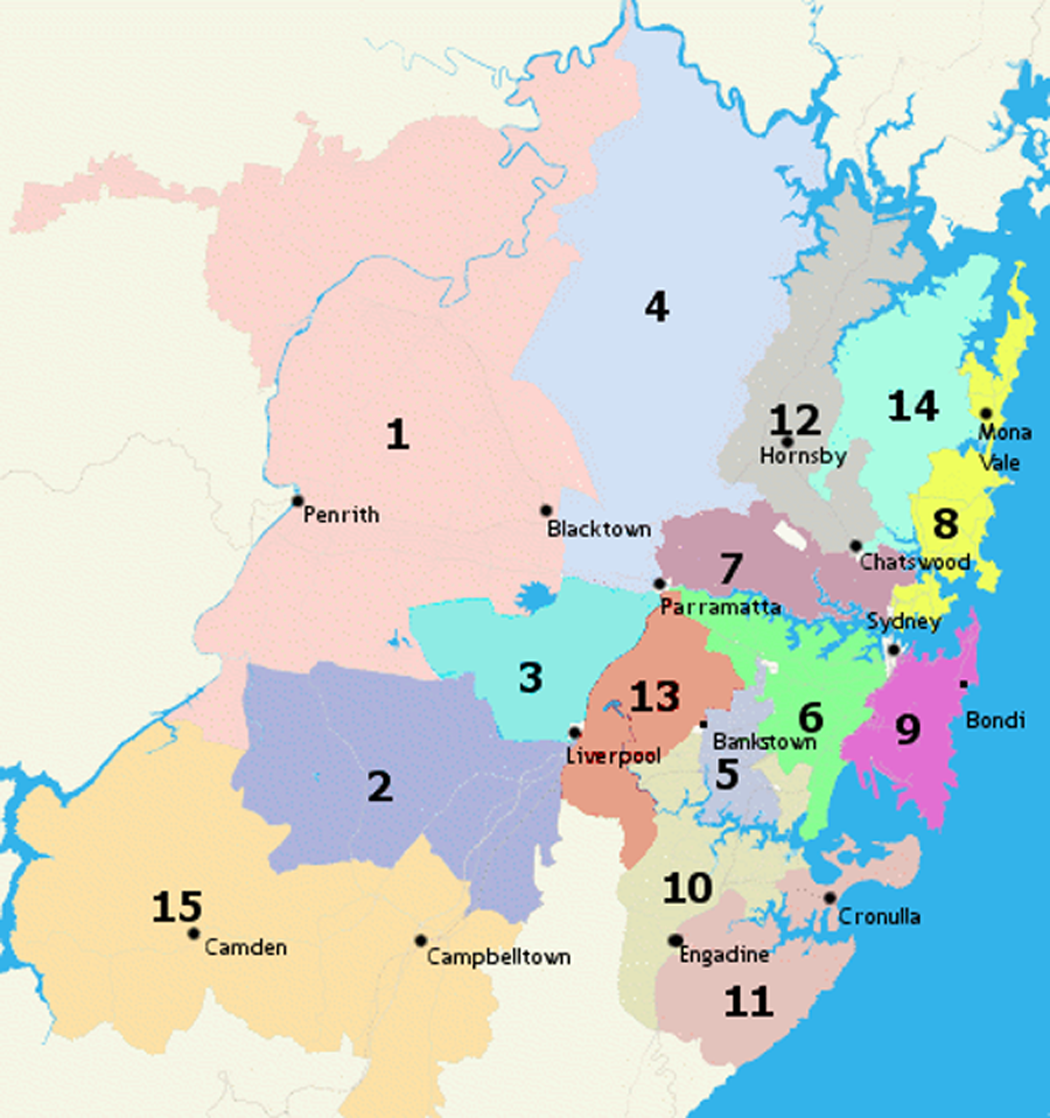
Metropolitan contract regions in Sydney.
Contracts between the regulator (the principal) and each bus operator (the agent) are negotiated with agreed levels of service performance monitored through a performance benchmarking regime. One of the KPIs is cost efficiency, the focus of this paper.
In order to compare the operators, we undertook the analysis required to obtain the net cost measures, given the gross cost measures and the normalisation criteria presented in the previous section. The focus of this paper is not on establishing the net cost per in-service km (presented in Hensher, 2015a), but on the role that non-contracted charter services play in the performance of contracted services. 5 Since charter services use the contracted service assets such as buses and depots, and only incur additional costs primarily related to fuel and labour, this is an example of economies of scope; however, we need to undertake a test to establish if, in fact, such economies are present. The profile of the key data items is given in Figure 2, where we see an interesting closeness between net cost per in-service km and charter activity.
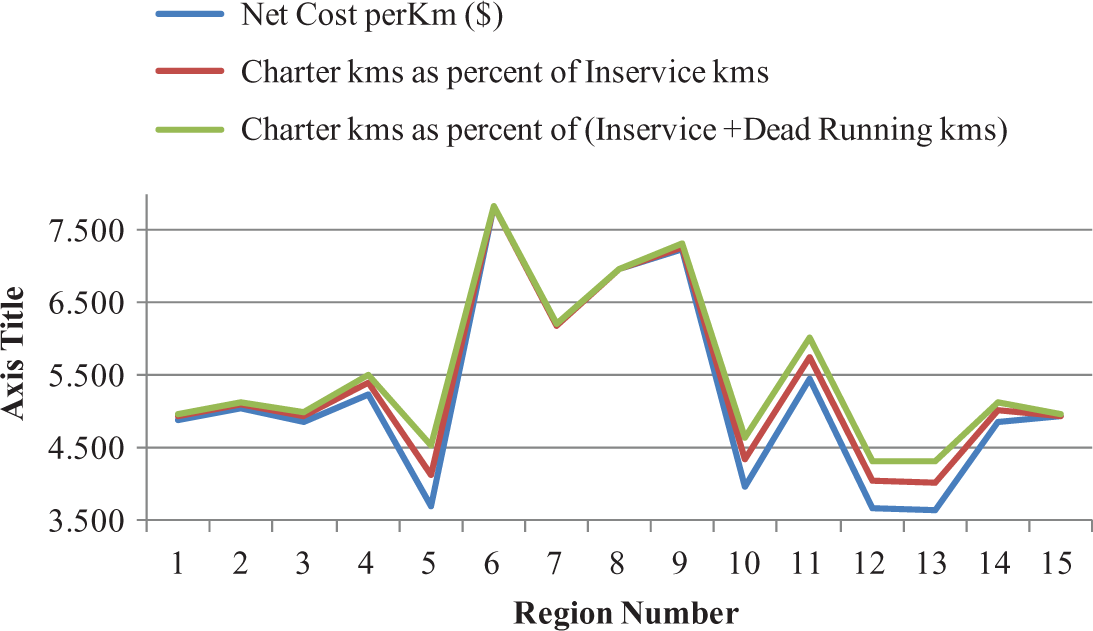
Profile of key data items.
Charter activity is defined as the number of annual kilometres of service. To investigate the role of these additional service kilometres above the contracted services, we ran a series of regression models of net cost per in-service kilometre against candidate definitions of charter activity. We tested charter kilometres as a percentage of in-service contracted kilometres, as well as a percentage of the sum of in-service kilometres and dead running kilometres (the latter being kilometres required to position vehicles that are not passenger revenue generating). We also controlled for the presence of a public operator in three regions, as well as investigated possible non-linear effects. The preferred model is given below as non-linear in the explanatory variables. The model overall statistical fit is 0.866, hence 86.6% of the variance in net cost per in-service km can be explained by the constant and three explanatory variables.
Net cost per in-service km = 4.689 + 2.271(public operator (1,0)) + 6.722(charter kms as a percentage of in-service kms) − 22.844(charter kms as a percentage of in-service kms)2.
The three sources of explanation are statistically significant at the 95% level of confidence. The t-values for the 4 variables (including the constant) are respectively 26.2, 8.13, 1.98 and −2.90. We plot in Figure 3 the relationship between charter kms as a proportion of in-service kms against net cost per in-service km.
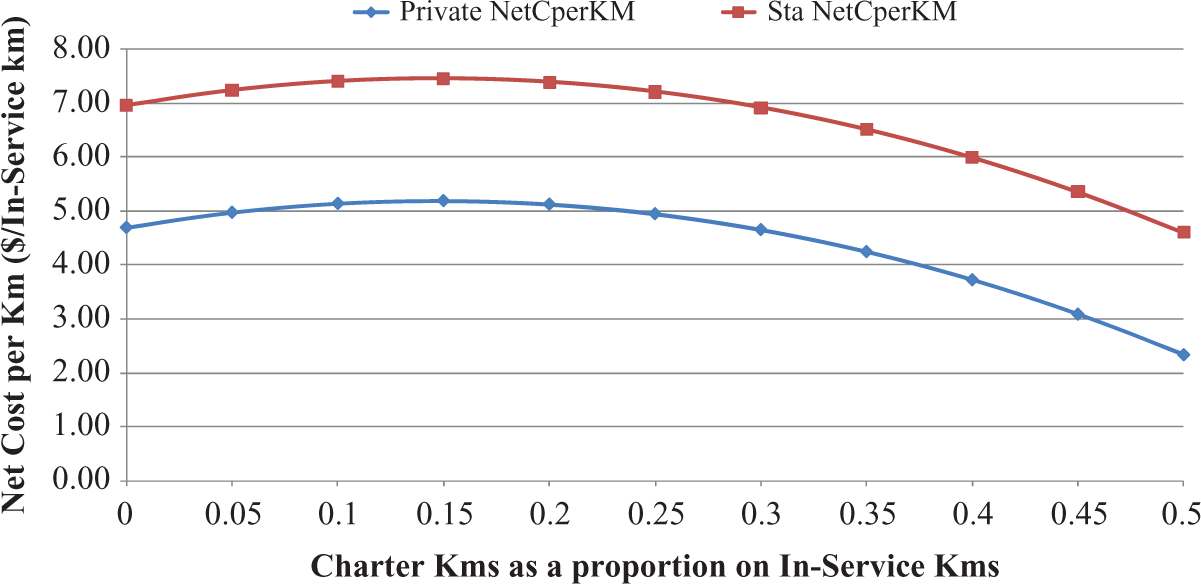
Relationship between incidence of charter kms and net cost per km.
The evidence suggests that operators who participate in non-contracted services, especially above 15% of contracted service kms, while also delivering contracted services, have higher cost efficiency (in terms of cost per contracted in-service kilometres). While this can be explained in part by the quality of such operators, who are often more entrepreneurial and better managers, the evidence suggests that if operators can be encouraged (or allowed) to use contract assets to gain supplementary revenue (without incurring the same unit rate of costs per kilometre), then the negotiated (or tendered) prices are likely to be lower than they would otherwise be. This is an example of effective output-based incentives, illustrating how to incentivise contracts through opportunities to obtain additional non-contract revenue.
Another way of illustrating how a contract that supports output-based incentives can deliver greater cost efficiency is given in Figure 4 as the direct elasticity of net cost per km with respect to the proportion of kms that are charter excluding dead running contract kms for each region.
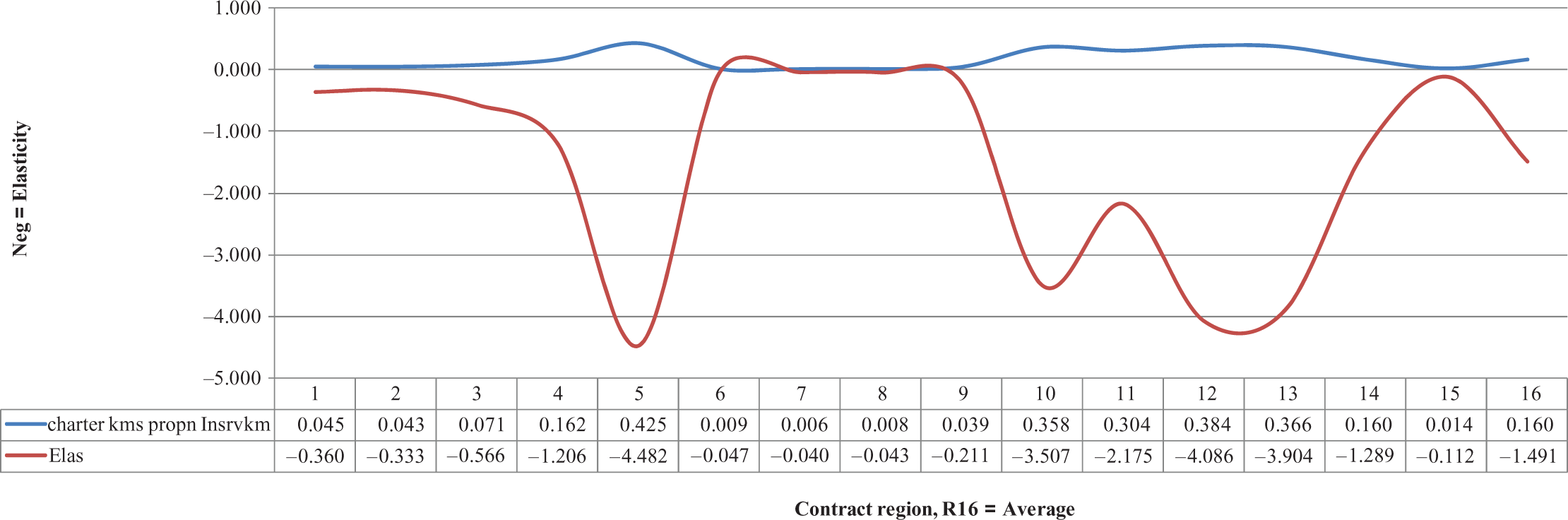
Relationship between direct elasticity of net cost per km with respect to proportion of kms that are charter excluding dead running contract kms.
If, for example, we increase charter kms as a percentage of in-service kms by 10% for Region 1, we get a 3.6% reduction in net cost per km; if we increase charter kms as a percentage of in-service kms by 10% for Region 13, we get a 39.04% reduction in net cost per km. On average, if we increase charter kms as a percentage of in-service kms by 10% (the evidence related to all regions called Region 16), we get a 14.91% reduction in net cost per km. Thus, given that the average net cost per km = $5.233, then a 10% increase in charter kms as a percentage of contracted in-service kms will reduce net cost per km to (5.233*(1−0.1491)) = $4.452 per km. This is a significant improvement.
To identify the sensitivity of the evidence overall to changes in the incidence of charter activity, we undertook scenario analysis as summarised in Table 1.
Scenario analysis on incidence of charter activity.
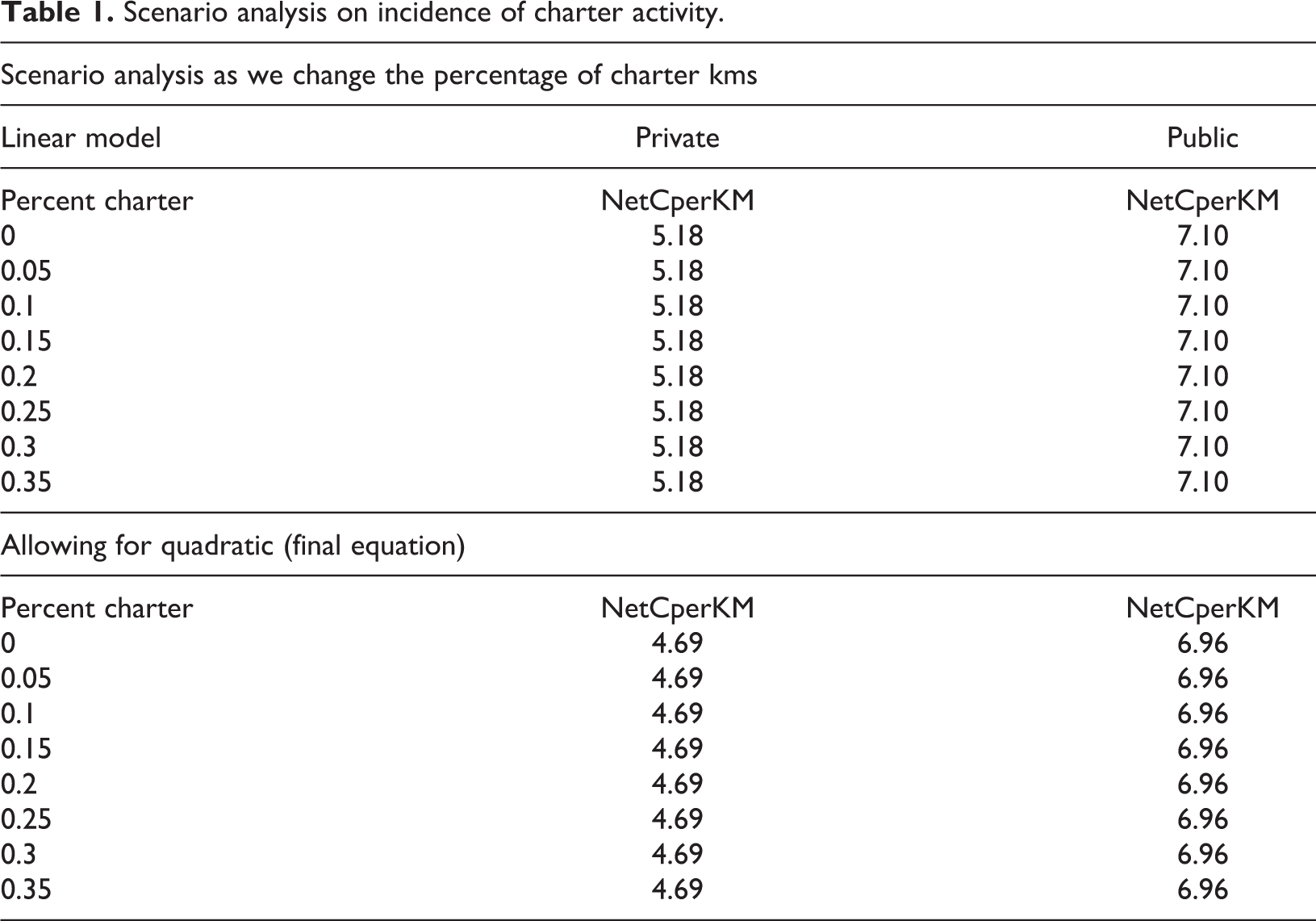
We distinguished the private and public operator regions. Increasing the incidence of charter activity from 0% to 35% of contracted in-service plus dead running kilometres, we see that the net cost per km trends downwards for private operators under both a linear and quadratic model form; however, for the public operator regions the direction is somewhat unclear for the quadratic form, while for a linear specification whose goodness of fit was not quite as good (i.e. an r-squared of 0.843 for the linear equation: net cost per in-service km = 51.78 + 1.917(public operator (1,0)) − 3.418(charter kms as a percentage of in-service kms), the trend for net cost per km trends downwards, but to a lesser extent over the assessed range than for the private operator.
Conclusions
This paper considers the role that non-contracted services under a negotiated contract regime subject to benchmarking for the mainstream regular public transport obligations play in contributing to the delivery of cost-efficient services. The evidence suggests that a contract regime, aligned with output-based incentives (in a scenario of consequent shared costs under a contracted and a non-contracted circumstance), can deliver greater cost efficiencies for contracted services which would otherwise have been denied if the non-contracted services were provided by another agent. This economy of scope is worth capturing.
Although one cannot attribute the mere engagement in charter activity to greater relative cost efficiency, in a situation where contracted assets are available to be used in non-contracted services that result in increased revenue with much lower costs per km given the sunken nature of many of the costs, one can surmise that the type of operator who sees a business opportunity in charter activity is also the type of operator who is able to run a bus business much more cost efficiently than operators less interested in charter income opportunities.
This finding, which has significant policy and management implications, is of interest for a number of reasons, including its role in anticipating opportunities to obtain greater cost efficiency in renegotiating contracts with incumbents, as well as the situation of competitive tendering. It is noteworthy that prior to competitive tendering of private bus operators in 2013 in Sydney, the negotiated contracts required a proportion (privately negotiated by each operator 6 ) of charter revenue to be returned to the government as a recognition of the role that contracted assets played in securing such revenue; however, the 2013 competitively tendered services contract has a very explicit clause that allows the charter revenue using contracted assets to be retained in full by the operator. The evidence in this paper suggests that this is a wise move, since it aligns well with bid prices that are lower than one might anticipate in the absence of this incentive clause. Specifically, both society through the regulator and the provider of contracted bus services can gain from complementing contracted services with non-contracted services, as a way of extracting the benefits of shared costs from these two service regimes. This is an example of how imaginative incentive-based regulatory reform involving asset sharing can yield very practical benefits to the key stakeholders.
What does this mean for research and practice? Specifically, the empirical case study and the cross-reference to the larger body of contract theory promotes, for relatively ‘simple’ or unambiguous service provision such as an urban bus service, a fixed-price contract (which assigns risk to the principal or in our case the regulator) with output-based incentives that enable assets that are not used to full capacity to be used to encourage additional service activity outside of the contracted obligations by the agent, as a means of improving the cost efficiency of contracted services, and in this way cushioning part of the (financial) risk to the principal.
This is an issue that has not to date been articulated or even observed in the majority of contracted situations, and through the case study we have shown the potential gains in contract cost efficiency that might be achieved and worth making explicit in a formal contractual sense as a way of encouraging such non-contractual obligations. This is an interesting and important finding, which suggests that opportunities to enhance the performance of contracts should be sought beyond the responsibilities under the contract. Whether such opportunities exist will vary from one context to another.
Footnotes
Acknowledgments
I thank the Transport NSW for allowing me access to data on charter kilometres in the period prior to competitive tendering from Sydney Metropolitan Operators. The comments of two referees have been useful in positioning the main focus of the paper. The suggestions of Tyrone Pitsis and a referee are appreciated.
Funding
This paper contributes to the research program of, and has been funded by, the Volvo Research and Education Foundation Bus Rapid Transit Centre of Excellence.
Notes
References
Supplementary Material
Please find the following supplemental material available below.
For Open Access articles published under a Creative Commons License, all supplemental material carries the same license as the article it is associated with.
For non-Open Access articles published, all supplemental material carries a non-exclusive license, and permission requests for re-use of supplemental material or any part of supplemental material shall be sent directly to the copyright owner as specified in the copyright notice associated with the article.
