




Abstract
Background
Word-finding deficits are common in persons with relapsing-remitting multiple sclerosis (pwRRMS); this may be related to the inefficient organization of semantic information.
Objective
To understand whether the semantic organization and semantic retrieval are impacted in pwRRMS.
Methods
Semantic fluency data from 64 pwRRMS and 73 controls was utilized to (1) derive standard verbal fluency measures using the Semantic Network and Fluency Utility R package and (2) build semantic networks via the correlation-based network approach in the SemNet R package. Subjective word-finding concerns were assessed in a subgroup of the sample. Group differences were evaluated.
Results
PwRRMS endorsed more frequent word-finding concerns. There were no differences between pwRRMS and controls on standard measures of semantic fluency. PwRRMS semantic networks exhibited differences in topology. Specifically, RRMS networks exhibited reduced efficiency, reduced interconnectivity, and reduced flexibility relative to control networks.
Conclusion
Word-finding concerns are prevalent in pwRRMS; it is important to screen for and address these concerns in clinical settings. Semantic network analysis appears more sensitive in detecting semantic retrieval deficits in pwRRMS relative to standard semantic fluency metrics. Semantic network disorganization and inflexibility may partially underlie word-finding difficulty in pwRRMS. Strategies aimed at improving network structure may assist in managing these deficits.
Keywords
Introduction
Persons with multiple sclerosis (MS) commonly report difficulty with word-finding1,2; however, this cognitive concern is under investigated in the MS research literature. Approximately 24% of participants with early MS (CIS/RRMS; ≤5 years since diagnosis) reported frequent word-finding concerns. 2 In a mixed-phenotype sample with wide-ranging disease durations, 20% of MS patients reported language concerns, with half reporting concerns about cognitive functioning. Considering those with cognitive concerns, 39% reported language difficulty. 3 Less is known about the factors that underlie word-finding concerns, especially in persons with relapsing-remitting MS (pwRRMS) with longer disease durations.
Semantic retrieval processes are involved in word-finding. Conceptual information is represented in the semantic store. This store is assumed to be organized with concepts represented as nodes in a network that are connected by edges. Edges signify the strength of association between two concepts.4–7 The store is organized into subnetworks, in which nodes are unified by shared attributes (e.g., “robin,” “canary,” and “has wings”) or shared categories (e.g., “birds”). 8 During retrieval, a target concept becomes activated, with activation spreading to closely associated neighboring nodes.5,9 Semantic store organization is relevant to understanding semantic retrieval processes and errors. For example, semantic-associative errors on naming tasks may arise due to a large amount of activation spreading to a target word's network neighbor resulting in misspeaking.
Neurally, the Word-form Encoding and Verification model (WEAVER++) shows that the anterior/ventral temporal cortex and the left middle medial temporal gyrus as critical brain regions that underlie semantic retrieval.10,11 The WEAVER++ model may have implications for the impact of RRMS pathology on semantic retrieval processes. Specifically, bilateral temporal pole atrophy observed in pwRRMS 12 may impact semantic retrieval in pwRRMS and underlie word-finding deficits.
Behavioral evidence shows some support for semantic retrieval deficits in pwMS in general, and specifically in pwRRMS. PwMS exhibits reduced performance on naming and semantic fluency tasks.13–19 PwRRMS performs 26% slower than controls on a picture naming task. 20 Furthermore, semantic-associative responses are the most common, representing 55% of errors. These findings may indicate that semantic retrieval difficulty in pwRRMS arises from imprecise search and selection of concepts during retrieval from the semantic store.
Semantic fluency, a measure of semantic retrieval ability, provides additional insight into word-finding difficulty in pwRRMS, however, findings are mixed, with one study reporting similar performance 21 and another reporting reduced performance 22 in pwRRMS compared to controls. Furthermore, only one study examined differences in semantic fluency strategies, which found reduced cluster-switching and similar cluster size in pwRRMS relative to controls. 22 These mixed results warrant further investigation.
Semantic network analysis
Semantic network analysis may provide nuanced information about the structure of semantic information and retrieval in pwRRMS. Semantic fluency data can be used to estimate the organization of the conceptual/semantic store, and network metrics quantify network structure. Nodes (network vertices) represent semantic concepts in the semantic store. Edges connect nodes that are meaningfully associated with each other; edge weight represents the degree of associative strength. Various, valid methods can be used to estimate semantic networks. 23 Commonly used indices to characterize the network structure include the average shortest path length, clustering coefficient, and modularity. The average shortest path length indicates the efficiency of search and retrieval from the network. The clustering coefficient indicates the degree to which a nodes’ neighbors are connected to each other (network interconnectivity). Finally, the network modularity describes the degree to which a network is organized into densely-connected subgraphs, which provides information relevant to the flexibility of retrieval processes.23,24
Two previous studies investigated network differences in mixed-phenotype MS samples. In one investigation, Spanish-speaking MS participants’ semantic networks were more sparsely connected (i.e., fewer nodes and edges; lower node degree), and had a greater amount of nodes that, if removed, would lead to network collapse (i.e., higher node-betweenness centrality). 14 pwMS and cognitive impairment were excluded (30%) from this investigation, limiting generalizability. Additionally, nodes were not equated between the two groups’ networks 14 which limits network results. 25
Using a different network estimation technique, another group reported lower efficiency of information transfer (i.e., average shortest path length), higher modularity, and lower interconnectivity (i.e., clustering coefficient) in English-speaking MS compared to healthy control networks. 16 The MS and healthy control data were combined from two separate investigations/testing sites and sample differences, protocol administration, education and ethnicity may limit the generalizability of findings.26,27
Across MS phenotypes, there are heterogeneous brain pathology patterns and cognitive disability profiles. Both prior investigations included mixed-phenotype samples making it unclear whether findings generalize to RRMS semantic networks or if findings are driven by advanced progressive disease. To date, no investigation has examined semantic network differences in pwRRMS and long disease duration.
Present study
The present investigation sought to examine self-reported word-finding and semantic retrieval abilities in a large monolingual English-speaking RRMS sample, thus avoiding MS phenotype and linguistic confounds. We evaluate the prevalence of word-finding deficits and traditional measures of semantic ability, and utilize the graph theory to evaluate semantic network structure. Consistent with the literature, pwRRMS are expected to report greater word-finding concerns and exhibit reduced semantic fluency performance (i.e., total score, cluster-switching) relative to controls. Given previous findings of decreased speed and accuracy of semantic retrieval, 20 we expect the RRMS semantic network to exhibit less efficient organization for retrieval as evidenced by higher average shortest path length (efficiency of search/retrieval) and lower clustering coefficient (network interconnectivity). Finally, given prior findings of reduced cluster-switching, 22 the network is expected to display higher modularity, representing decreased flexibility of search/retrieval processes.
Methods
Participants
Sixty-four pwRRMS and 73 controls from the community aged 18–80 were recruited through a larger investigation studying memory dysfunction (National MS Society RG-1907-34364 and RG-1901-33304; NJ Commission on Brain Injury Research CBIR201RG027). Inclusion criteria did not require subjective or objective memory concerns. All participants reporting a history of psychiatric or neurological conditions (other than MS) were excluded from the study. Controls were recruited into the study based on the absence of health conditions that impact learning or memory. It is common for healthy individuals to exhibit subjective word-finding concerns (e.g., <3 or <2 on a subjective measure 2 ; 1–2× for every 100,000 words produced 9 ) and exclusion would be misleading and not an appropriate comparison to the general/healthy population. PwRRMS were required to have had no symptom exacerbation or corticosteroid use within the past month. Disease duration was not an inclusion criterion. Finally, only monolingual English-speaking participants were included in the present analysis (Table 1). Data collection received Institutional Review Board approval and all participants gave informed consent.
Sample demographics.

Note. Significant group differences exist with regard to sex. Groups were not different in age, education, or ethnicity. Symbols: *p ≤ 0.01 versus control. pwRRMS: persons with relapsing remitting MS; PDDS: patient-determined disease steps questionnaire.
Measures
Patient-Determined disease steps (PDDS)
The level of MS disability was evaluated using the PDDS questionnaire,28–30 reflecting a self-report assessment similar to the Expanded Disability Status Scale.
Semantic fluency task
Participants named animals for 60 seconds. Responses were independently coded by two research assistants and the first author resolved inconsistencies.
Subjective word-finding difficulty item
Subjective word-finding difficulty was assessed in a subset of the groups (pwRRMS N = 31, control N = 39). Participants rated the frequency of “having a word on the tip of your tongue but having difficulty getting it out” in the last four weeks, using the scale: 0 = “never,” 1 = “rarely,” 2 = “sometimes,” 3 = “often,” and 4 = “almost always”.2,3
Data analysis
Semantic fluency preprocessing & scoring
Semantic fluency structural characteristics were assessed using the Semantic Network and Fluency Utility (SNAFU) program. 31 Semi-automated spell check was followed by manual inspection and correction of spelling errors, homogenizing responses, and updating the program dictionary. The total score, average cluster size, cluster switches, intrusions, and perseverations were computed. The total score was calculated by subtracting the intrusions and perseverations from total responses.
Statistical analysis
Analyses were run in RStudio, version 1.4.1106. Parametric and nonparametric independent t-tests were utilized to evaluate group differences. Cohen's d or the Wilcoxon effect size (r) was calculated to measure the effect size. Pearson's chi-square was used to detect sample differences in sex. Ethnicity was analyzed using Fischer's exact test due to low sample sizes in some groups.
Semantic network analysis
Briefly, SemNet 23 was used to preprocess semantic fluency responses and remove repetitions/intrusions. Binary response matrices from the group were generated, and nodes were equated across groups to reduce confounds. 25 Exemplars not produced by at least two participants were removed. Semantic networks were generated using correlation-based network estimation (Nodes: animal exemplars, Edges: cosine-similarity of word pairs). Half of the nodes in each group network were randomly sampled to generate 1000 partial networks. Network indices (i.e., average shortest path length, clustering coefficient, modularity) were computed for each partial network. Independent samples t-tests examined index differences. 32 Network graphs were generated using the igraph R package, 33 utilizing category information from the SNAFU dictionary. 31
Results
Demographics
PwRRMS did not differ from the control group regarding age (W = 2116.5, p = .34), education (W = 2557, p = .32), or ethnicity (Fisher's exact test; p = .41, Table 1). PwRRMS had higher female representation relative to controls [χ2 (1, N = 135) = 11.44, p = .0007]. Sex does not significantly affect semantic fluency performance 34 ; as such, this was not expected to influence results.
Subjective word-finding difficulty
PwRRMS reported a greater severity of word-finding concerns compared to controls (W = 273.5, p = .00003, r = .49). Specifically, 58% of pwRRMS (18/31) reported having word-finding concerns as “Often” or “Almost Always”. Whereas only 8% of controls (3/39) endorsed concerns at the same frequencies (Figure 1).

Subjective word-finding concerns in pwRRMS versus controls.
Semantic fluency task
PwRRMS produced a lower semantic fluency total score (MRRMS = 22.64) on average compared to controls (MC = 24.53), with a small effect size (d = 0.33); however, this was not statistically different [t(135) = 1.93, p = .06]. Neither use of semantic clustering (cluster size; MRRMS = 1.86, MC = 1.90, W = 2408.5, p = .76, r = .03), nor cluster-switching strategy [switches; MRRMS = 11.98, MC = 12.60, t(135) = 1.00, p = .32, d = 0.17] was different between groups (Figure 2).

Semantic fluency performance in pwRRMS versus controls.
Network analysis
The pwRRMS network had a longer average shortest path length [MRRMS = 2.569, MC = 2.467; t(1998) = 16.344, p < .001, d = 0.73], reduced clustering coefficient [MRRMS = 0.744, MC = 0.753; t(1998) = −20.974, p < .001, d = 0.94], and higher modularity [MRRMS = 0.526, MC = 0.506; t(1998) = 17.722, p < .001, d = 0.79] relative to the control network (Figure 3). Network differences were present with large effect sizes. Figure 4 shows a visualization of the RRMS and control networks, with nodes color-coded by animal category. Visually, the RRMS network has higher modularity as depicted by more within categorical group connections. Differences in average shortest path length and clustering coefficient are visually represented in Figure 3.

Visualization of network index data generated by bootstrap analyses involving 1000 samples. Boxplot and dots in teal correspond to RRMS network indices; those in orange correspond to control network indices.
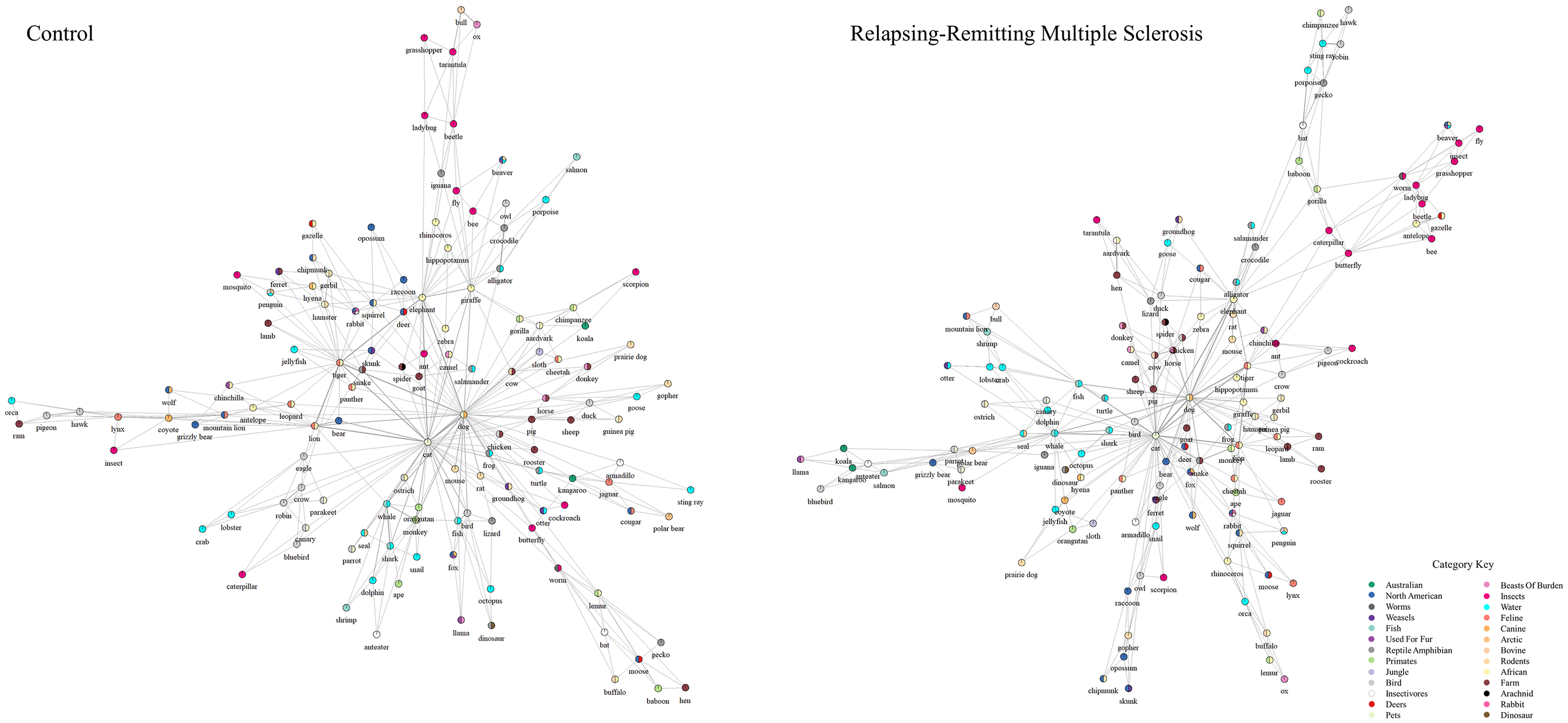
Semantic networks by group.
Discussion
This investigation found that pwRRMS, in a sample characterized by having a long disease duration (average: 17 years), reports more frequent word-finding concerns relative to controls. Despite this, pwRRMS displayed similar semantic fluency performance and use of clustering/switching strategies as controls. Consistent with significant word-finding concerns, RRMS semantic networks were less efficiently structured for search and retrieval processes from the mental lexicon.
Subjective word-finding and traditional indices of semantic fluency
Subjective word-finding concerns could be more prevalent in pwRRMS with longer disease durations. Previous studies with large samples using the same item as the present study reported 20% (mixed-phenotype, median disease duration = 5.5 years) 3 and 24% (early RRMS, disease duration ≤5 years) 2 of samples endorsing frequent word-finding concerns. In the present investigation, slightly more than half of pwRRMS endorsed word-finding concerns with longer disease duration. Other investigations using different self-reported measures of word-finding difficulty found that approximately 60–70% reported having word retrieval difficulties in samples with an average disease duration of 10–13 years.35,36 Given the limited sample size of pwRRMS who were administered the subjective word-finding difficulty item in this investigation, we were unable to statistically evaluate this relationship. Cross-sectional and longitudinal replication in larger samples is necessary to understand whether word-finding concerns increase in prevalence in pwRRMS with longer disease durations.
Semantic fluency total score and switching strategy use were not reduced in pwRRMS in the present investigation. This pattern is congruent with a small sample (n = 15) investigation reporting no reduction in semantic fluency performance in pwRRMS relative to controls. 21 In contrast to the current findings, another small sample study reported reduced total score and cluster-switching in pwRRMS. 22 While several differences exist between the present investigation and this investigation 22 (i.e., smaller sample size, linguistic differences, lower age, and lower average disease duration), these differences do not appear to explain the contrasting results. Given these mixed findings in RRMS, additional research is needed to understand how semantic fluency task performance is differentially impacted within RRMS phenotypes.
Network analysis of semantic fluency
The present findings demonstrate the RRMS semantic networks had comparatively less efficient organization for conceptual search and retrieval processes. Specifically, RRMS networks exhibited a higher average shortest path length (i.e., reduced efficiency), this finding suggests that more paths need to be traversed in the network to search for and retrieve a target concept. Second, the RRMS network exhibited a smaller clustering coefficient, which indicated that a given node's neighbors were less likely to be connected to each other (i.e., reduced network interconnectivity).23,24 This may indicate fewer redundant paths to travel from one node to another, reducing the probability of traversing a more efficient path (e.g., path with three edges versus six). Finally, the RRMS network had higher modularity relative to the control network, suggesting a network organization comprising of subgraphs with fewer connections between subgraphs.23,24 This may indicate less flexible conceptual search and retrieval processes, with less switching between subgraphs (i.e., animal categories).
Traditional approaches versus network analyses
The present data patterns imply semantic network analysis may be more sensitive in detecting semantic retrieval concerns in pwRRMS relative to standard semantic fluency metrics. RRMS semantic networks displayed reduced interconnectivity, efficiency, and flexibility relative to control networks, suggesting reduced semantic retrieval capabilities. In contrast, there were no differences between pwRRMS and controls on semantic fluency total score and switching. A previous semantic network investigation found a similar pattern of semantic network structural differences in past mixed-phenotype MS samples (with a long average disease duration; ∼18 years); however, they also reported reduced semantic fluency performance. 16 Another study similarly 14 reported semantic network organization differences and reduced semantic fluency in their mixed-phenotype MS sample. It is possible that both investigations were able to detect reductions in semantic fluency due to the inclusion of persons with progressive MS into their sample. Although findings have been mixed, 18 evidence supports the idea that semantic fluency performance may be worse in progressive MS relative to RRMS. 37 Therefore, it is possible that semantic retrieval deficits could present more subtly in an RRMS-only sample relative to an MS mixed-phenotype sample, explaining why differences were not found in the present study. Self-reported word-finding difficulty was reported in more than half the present sample but traditional semantic fluency did not capture these differences, while the network analysis findings were more closely aligned with the self-report finding. This may suggest the discrepancy between the patient-report and standard measures is due to low sensitivity of available assessments rather than patients being inaccurate in their metacognition.
Network analysis findings in relation to RRMS brain pathology
Network findings from the present investigation appear to be congruent with expected patterns of brain atrophy in an RRMS sample characterized by long disease duration. Several areas of the temporal lobe are impacted in MS samples with long disease duration including the left superior/middle gyri 38 and bilateral temporal poles in an RRMS sample, specifically. 12 While the brain regions that underlie specific semantic network metrics are unknown, previous studies implicate the anterior and middle temporal lobe for semantic retrieval functions.10,11
Clinical implications of findings
Language concerns, including word-finding difficulty, can have negative impacts on quality of life, work, and social activities for pwMS.35,36 A substantial care gap was identified concerning access to speech-therapy services for pwMS, 36 with only 11% having seen speech-therapy services. Thus, it is critical to identify pwMS, and specifically pwRRMS with word-finding concerns to receive language-focused interventions. Network results show that RRMS semantic networks are less flexible, have reduced interconnectivity, and are less efficiently organized relative to control networks. Consistent with psycholinguistic models of semantic organization and retrieval,6,7 and the observed network structure differences in this study, treatments that strengthen associative connections between semantic concepts and increase cognitive flexibility in retrieval may be helpful in treating word finding difficulty in pwRRMS.
Limitations and future directions
This investigation represents a secondary analysis of data collected for a different research question, as such, our data have some limitations in answering questions surrounding word-finding and semantic retrieval in pwRRMS. First, subjective word-finding difficulty was only assessed in approximately half of the sample, as this question was added after study recruitment began. Second, we administered only one semantic fluency trial, which limited semantic network analysis to a specific toolbox. While correlation-based network estimation techniques 23 are commonly used in the literature, the Hierarchical U-INVITE technique uses a different approach to detect network edges, and can generate both individual and group networks. 39 Individual semantic network estimates are crucial to examine the relationship between functional brain regions that underlie aspects of the semantic network architecture. Future investigations should include at least three semantic fluency trials to utilize the Hierarchical U-INVITE technique. Finally, to control for linguistic confounds, this study was limited to monolingual English-speakers, which may reduce the generalizability of our findings to bilingual/multilingual persons and non-English speakers.
Conclusion
Consistent with previous literature on semantic retrieval deficits,20,22 and brain pathology patterns in pwRRMS, (i.e., temporal pole atrophy), 12 the present results supported the premise that semantic retrieval abilities are impacted to some degree in pwRRMS. This investigation also showed that while word-finding concerns are prevalent in pwRRMS, semantic retrieval concerns may be subtle, thus they may not be detected with standard neuropsychological measures. Conversely, network results indicated that the structure of the conceptual store in pwRRMS was less efficiently structured for semantic search and retrieval processes. Therefore, it is possible that semantic network metrics, as well as subjective measures of word-finding, may be more apt than standard measures to detect word-finding concerns in pwRRMS. Findings underscore the importance of screening for word-finding difficulty in pwRRMS to identify those in need of speech-language therapy or cognitive remediation of word-finding concerns.
Footnotes
Acknowledgements
We would like to thank members of the Cognition and Neurocognitive Disorders Research Lab for their assistance in data collection and data entry for this project. This project was part of the first author's dissertation and she appreciates the feedback of Drs. James F. Sumowski, Daniel Simonet, and Michael Bixter at different stages.
Author contributions
Sophia Lall contributed to conceptualization, methodology, data curation, formal analysis, visualization, writing–original draft, reviewing, and editing. Jennifer Pardo contributed to conceptualization, and writing–reviewing and editing. Joshua Sandry contributed to conceptualization, funding acquisition, supervision, and writing–reviewing and editing.
Data availability statement
Data is available from the last author upon reasonable request, with proper data-sharing agreements in place.
Declaration of conflicting interests
The authors declared no potential conflicts of interest with respect to the research, authorship, and/or publication of this article.
Funding
This work was supported by the National MS Society [RG-1907-34364 and RG-1901-33304] to JS; the NJ Commission on Brain Injury Research [CBIR201RG027] to JS.
Ethical approval statement
This study was approved by the Montclair State University Institutional Review Board.
