



Abstract
Objective
Keloids are benign fibrous dermal tumors that typically result in excessive scar tissue formation, affecting appearance and potentially causing discomfort. As social media platforms like TikTok become important sources of health information, the number of keloid-related videos has increased. However, the quality and reliability of these videos remain unclear. This study aims to evaluate the content, quality, and reliability of keloid-related videos on TikTok.
Methods
A total of 85 keloid-related videos on TikTok were analyzed. Video characteristics, uploader types, and content themes were extracted. The Global Quality Score and modified DISCERN tool were used to assess video quality and reliability. Correlation analysis was conducted between video metrics and quality scores.
Results
Videos were generally short (median: 48 s) with high engagement (median likes: 166, saves: 44). Common topics included treatment (87.06%), clinical manifestations (55.29%), and diagnosis (51.76%), while prevention, precipitating factors, and recurrence were less frequently discussed. Videos uploaded by healthcare professionals had significantly higher quality than those from individual users. Positive correlations were found among engagement metrics (likes, comments, saves), but no correlation was observed between engagement and video quality.
Conclusions
While keloid-related TikTok videos show high engagement, their overall quality and reliability are low. Increasing healthcare professional involvement and improving platform content regulation are essential to enhance the educational value of health information.
Introduction
Keloid is an abnormal skin healing response characterized by excessive fibroblast proliferation, leading to raised and thickened scars that often extend beyond the original wound site.1,2 Clinical manifestations include itching, tenderness, and functional limitations.3,4 The pathophysiology of keloids is complex, involving interactions of genetic, immunologic, and environmental factors.5–7 Despite the availability of various treatment options, including topical medications, laser therapy, surgical excision, and radiation therapy,8–11 the recurrence rate of keloids remains high, which complicates treatment and affects patients’ quality of life.
Traditional health education methods, such as printed materials and in-person counseling, have been widely used but are limited in terms of reach and interactivity. With the rise of social media and short video platforms, platforms like TikTok have become important sources of health information for the public.12–14 These platforms allow users to easily access knowledge on keloids and other diseases through short videos.15,16 TikTok's vast user base and interactive nature make it an important tool for health education.17,18 However, the quality and reliability of health content posted on these platforms remain a concern. The videos are often created by contributors from diverse backgrounds, including healthcare professionals, social media influencers, and individual users, resulting in varying levels of accuracy, depth, and medical reliability. Previous studies have shown that short videos related to diseases such as hypertension, cervical cancer, vitiligo, and lupus on TikTok tend to have low-content accuracy and reliability.19–22
Although the number of keloid-related videos on TikTok is gradually increasing, there has been no specific assessment of their quality. Given the importance of public understanding of keloids in influencing preventive behaviors and decisions to seek medical assistance, it is crucial to evaluate the quality of these videos. This study aims to analyze keloid-related short videos on TikTok, assess their content quality and reliability, and provide recommendations for improving future health communication strategies.
Methods
Study design and data collection
This study is a cross-sectional analysis aimed at evaluating the basic characteristics, quality, and reliability of videos related to keloids on the TikTok platform. All data were collected from the TikTok platform between July 28 and July 30, 2025, using the keyword “瘢痕疙瘩” (Keloid) in the TikTok Chinese interface. To minimize algorithmic interference, data collectors used a new account with no browsing history and cleared the cache to standardize search results. The top 100 videos were selected for initial screening according to TikTok's default sorting method (comprehensive recommendation), as previous studies suggest that viewers predominantly watch highly ranked videos and that including videos beyond the top 100 has limited impact on the overall findings.23–25
Inclusion and exclusion criteria
Inclusion criteria were (1) video content focused primarily on keloid-related information, such as etiology, clinical manifestations, diagnosis, treatment, or prevention; (2) videos in Chinese. Exclusion criteria were (1) Duplicate videos; (2) Irrelevant content such as advertisements, entertainment, or content not clearly related to keloids; (3) News videos. A total of 85 videos were included. The detailed inclusion and exclusion process is shown in Figure 1.

Flowchart of video selection and analysis process.
Video information extraction
Researchers manually extracted the following information for each video: uploader type (e.g. plastic surgeons, dermatologists, individual users), video duration (in seconds), number of likes, comments, shares, saves, and the content categories addressed in the video (e.g. etiology, clinical manifestations, diagnosis, treatment, prevention, recurrence).
Quality and reliability assessment tools
Video quality was assessed using the Global Quality Score (GQS), 26 which ranges from 1 (poor quality) to 5 (excellent quality) and evaluates the overall usability and educational value of health information. Video reliability was assessed using the modified DISCERN (mDISCERN) score, 27 consisting of five items, each rated on a scale from 1 point, with a total score of 5 points, to assess the transparency of the video source and content reliability. The specific details of these two scoring systems are shown in Tables 1 and 2.
The global quality score (GQS) quality criteria.

The modified DISCERN (mDISCERN) quality criteria.

Scoring procedure
Two medically trained assessors independently rated all videos using the GQS and the mDISCERN instrument. Given that uploader-related information was visible on the platform interface, the assessors were not blinded to the uploader's identity or uploader type. However, the two assessors conducted the assessments independently and were blinded to each other's scores. When discrepancies occurred in the ratings, a third medically trained assessors re-evaluated the video and made the final determination.
Statistical analysis
Descriptive statistics were used to summarize video characteristics. For continuous variables that did not follow a normal distribution, data were expressed as medians and interquartile ranges (IQR), while categorical variables were presented as frequencies and percentages. The Kruskal–Wallis test was applied to compare video quality among different uploader groups. When statistically significant differences were detected, post hoc pairwise comparisons were conducted using Dunn's test, with p-values adjusted according to the Bonferroni correction to account for multiple comparisons. Spearman rank correlation analysis was performed to evaluate the associations between video engagement metrics (such as likes and comments) and quality or reliability scores. Bonferroni correction was also applied to adjust for multiple comparisons within the correlation matrix. All statistical analyses were conducted using R software (version 4.3.2), and a two-tailed p < 0.05 was considered statistically significant.
Results
General characteristics, quality, and reliability of keloid-related videos
A total of 85 keloid-related videos were included in this study. The video duration was short, with a median of 48.00 s (IQR 36.00–76.00). The median number of likes was 166.00 (IQR 68.00–397.00), and the median number of saves was 44.00 (IQR 14.00–158.00). The video quality was relatively low, with a median GQS of 2.00 (IQR 2.00–3.00) and a median mDISCERN score of 2.00 (IQR 2.00–3.00). Additional parameters are shown in Table 3.
General information, quality, and reliability scores of keloid-related videos on TikTok.

GQS: Global Quality Score; mDISCERN: modified DISCERN.
Distribution of uploaders for keloid-related videos
The majority of keloid-related videos were uploaded by plastic surgeons, followed by dermatologists and individual users (Figure 2).

Distribution of video uploaders.
Content distribution of keloid-related videos
The content of keloid-related videos mainly focused on treatment (87.06%), clinical manifestations (55.29%), and diagnosis (51.76%). The content distribution of keloid-related videos is shown in Figure 3.
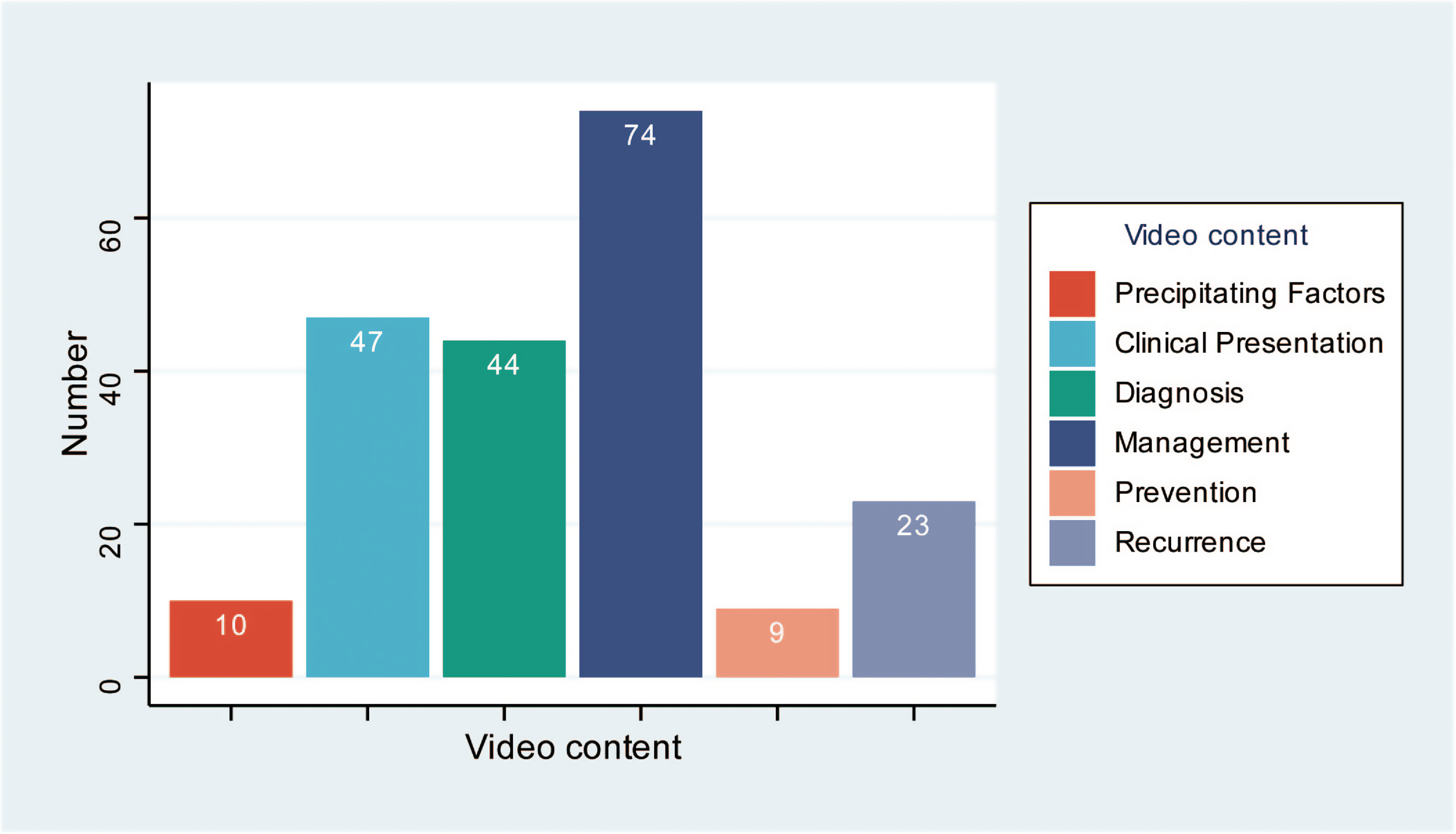
Distribution of video content themes.
Differences in quality and reliability of keloid videos across different uploaders
We also analyzed the differences in quality and reliability of keloid videos across different uploaders. The specific parameters for quality and reliability across different uploaders are shown in Table 4. There was no difference in GQS scores between plastic surgeons and dermatologists (p>0.05, Figure 4(a)). Videos uploaded by plastic surgeons and dermatologists had higher GQS scores than those uploaded by individual users (p < 0.05, Figure 4(a)). Additionally, there was no difference in mDISCERN scores between plastic surgeons and dermatologists (p > 0.05, Figure 4(b)). Similarly, videos uploaded by plastic surgeons and dermatologists had higher mDISCERN scores than those uploaded by individual users (p < 0.05, Figure 4(b)). The distribution of GQS and mDISCERN scores for videos uploaded by different uploaders is shown in Figure 5(a) and (b).
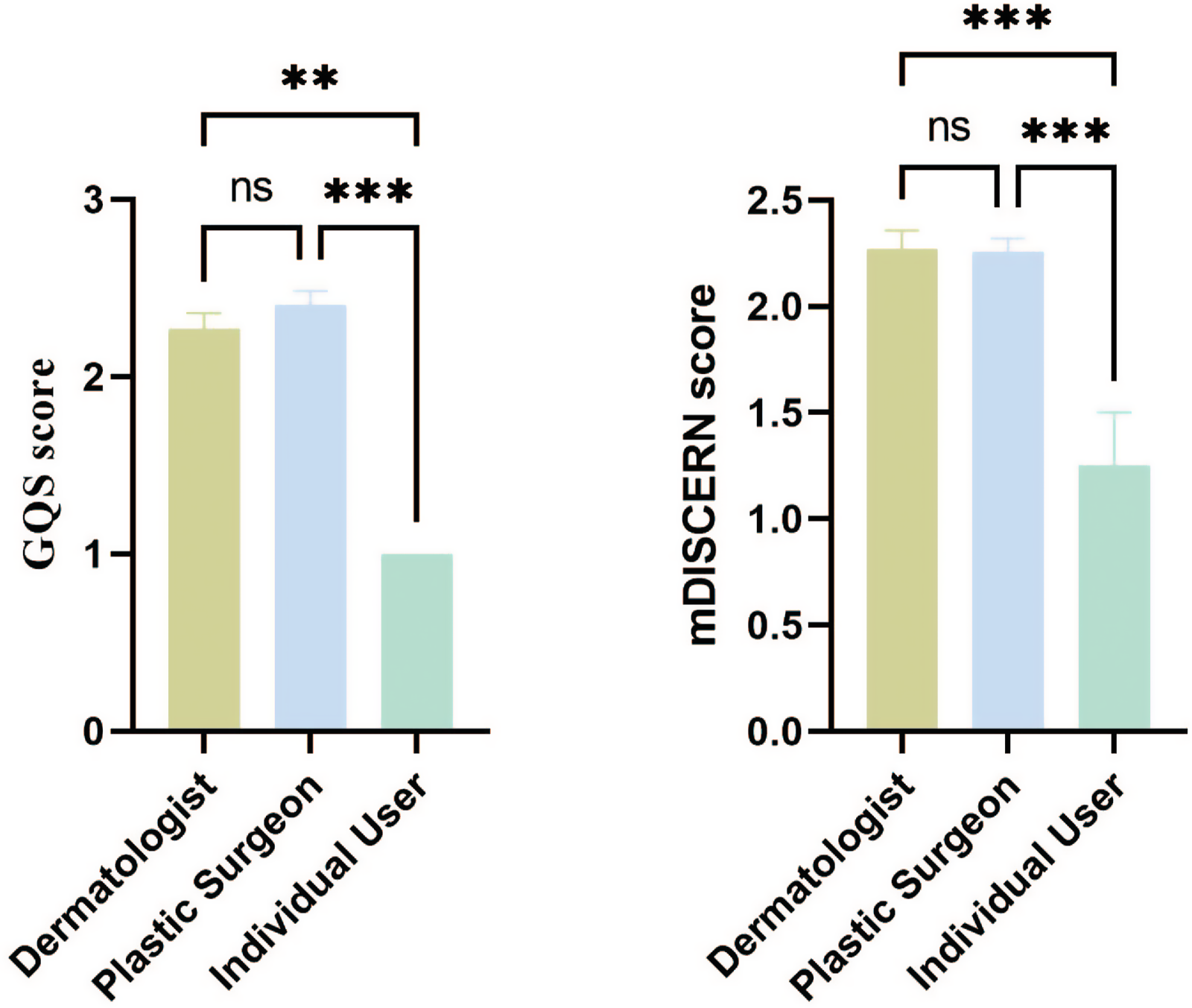
Comparison of GQS and mDISCERN scores across different uploaders. (a) Comparison of GQS across different uploaders. (b) Comparison of mDISCERN scores across different uploaders. (**p < 0.01, ***p < 0.001, ns, not significant). GQS: Global Quality Score; mDISCERN: modified DISCERN.

Distribution of GQS and mDISCERN scores across different uploaders. (a) Distribution of GQS across different uploaders. (b) Distribution of mDISCERN scores across different uploaders. GQS: Global Quality Score; mDISCERN: modified DISCERN.
Differences in video characteristics and quality among dermatologists, plastic surgeons, and individual users.

Note: M: Median; Q1:1st Quartile; Q3:3st Quartile; D: Dermatologist; I: Individual User; P: Plastic Surgeon; ε2 represents the effect size.
GQS: Global Quality Score; mDISCERN: modified DISCERN.
Correlation between video duration, engagement metrics, and Global Quality Score and modified DISCERN scores
The analysis showed no significant correlations between video duration and interaction metrics, including likes (ρ = −0.074, p = 0.500), favorites (ρ = 0.033, p = 0.761), comments (ρ = −0.103, p = 0.349), or shares (ρ = −0.092, p = 0.405). In contrast, a significant positive correlation was observed between video duration and GQS scores (ρ = 0.35, p < 0.05). Significant positive correlations were also observed among the interaction metrics. Specifically, likes were positively correlated with comments (ρ = 0.966, p < 0.05), shares (ρ = 0.881, p < 0.05), and favorites (ρ = 0.949, p < 0.05). Comments were also positively correlated with shares (ρ = 0.880, p < 0.05) and favorites (ρ = 0.826, p < 0.05). Similarly, shares showed a significant positive correlation with favorites (ρ = 0.923, p < 0.05). Finally, GQS scores and mDISCERN scores also demonstrated a significant positive correlation (ρ = 0.371, p < 0.05) (Table 5).
Correlation between video duration, engagement metrics, and GQS and mDISCERN scores.

GQS: Global Quality Score; mDISCERN: modified DISCERN.
Discussion
This study analyzed 85 keloid-related TikTok short videos, evaluating their basic characteristics, quality, and reliability. The results indicated that although the videos were relatively short (with a median duration of 48 s), they effectively attracted viewers’ attention and generally received a certain level of interaction (such as likes and saves). Treatment for keloids was the most commonly discussed topic (87.06%), whereas prevention of keloids was rarely mentioned (10.59%). The overall quality of the videos was low, with both the GQS and mDISCERN scores indicating that the quality was average. These findings emphasize the urgent need for increased professional involvement and content oversight when disseminating information about keloids on social media platforms. This study provides new insights into the content quality and thematic distribution of keloid-related TikTok videos, offering support for health communication strategies and content optimization.
Video content, quality, and reliability
In terms of video content, this study found that treatment (87.06%), clinical manifestations (55.29%), and diagnosis (51.76%) were the main topics covered in keloid-related videos. The high proportion of treatment-related content reflects the public's strong interest in treatment methods. However, despite these videos including treatment information, the overall quality was low. Based on the GQS and mDISCERN scores, the quality of the videos was generally poor, with scores of 2.00 (IQR 2.00–3.00) for both. This indicates that most of the videos provided information that lacked depth and completeness, which could negatively impact the health decisions of viewers, especially patients. This finding is consistent with previous studies on the quality and reliability of medical education videos.28,29 A study on ankle sprain videos found that the quality and reliability scores for TikTok and Bilibili videos were low. 30 Similarly, another study on chronic pancreatitis videos showed the same trend, with low quality and reliability. 31 Furthermore, it is noteworthy that the prevention of keloids was rarely mentioned (10.59%), as were precipitating factors (11.76%), and the coverage of recurrence was also low (27.06%). Currently, various treatment modalities for keloids are available, including intralesional corticosteroid injections, 32 isotopic therapy, 33 surgical excision, 34 and radiation therapy.35,36 However, a definitive cure remains elusive, and recurrence after treatment remains a significant challenge. 37 Therefore, this study suggests that future educational videos should focus more on the prevention, precipitating factors, and recurrence of keloids in order to help reduce the disease burden for patients.
Differences in quality and reliability across different uploaders
Further analysis revealed that videos uploaded by plastic surgeons and dermatologists had higher GQS and mDISCERN scores compared to those uploaded by individual users. This indicates that videos from professional uploaders generally have higher quality, while videos from individual users tend to be of lower quality. Although there was little difference in scores between plastic surgeons and dermatologists, videos uploaded by healthcare professionals were generally more reliable and scientifically grounded. This finding is consistent with previous studies. A study on the quality assessment of short videos on pediatric pneumonia indicated that videos created by healthcare professionals received significantly higher quality and reliability scores compared to content made by non-healthcare professionals. 38 Similarly, another study on short videos for dry eye care education showed that videos uploaded by healthcare professionals were more reliable than those from non-healthcare individuals or commercial entities. 39 This result underscores the crucial role of healthcare professionals in health education and information dissemination.
Correlation analysis between video engagement metrics and video quality and reliability
The correlation analysis showed positive correlations among video engagement metrics, suggesting that different forms of user interaction may mutually reinforce one another, thereby facilitating the rapid dissemination of videos. However, this mechanism may also accelerate the spread of misleading, inaccurate, erroneous, or emotionally charged health-related content. 40 In addition, no significant correlations were observed between engagement metrics and GQS or mDISCERN. This indicates that videos receiving higher numbers of likes or comments do not necessarily provide high-quality or reliable health information. Therefore, the public should not rely solely on engagement metrics to judge video quality, as this may lead to misinterpretation of content quality. Consistent with our findings, a study on short videos related to thyroid eye disease treatment also reported no significant association between engagement metrics and video quality or reliability. 21 Similarly, research on videos concerning ovarian insufficiency found no significant correlation between engagement metrics and video quality or reliability. 41 Furthermore, a moderate positive correlation was observed between video duration and GQS scores, suggesting that longer videos may be associated with higher content quality. Longer videos allow for more comprehensive explanations, provide additional background information, present illustrative examples, or reference scientific evidence, thereby potentially enhancing video quality and reliability. 20 Nevertheless, it is important to note that longer video duration does not automatically guarantee improved quality. Although longer videos offer greater opportunities to present information, the additional content is not necessarily accurate or effective. In fact, video quality depends not only on duration but also on whether content creators provide accurate, well-structured, and relevant information. 42 Future research and practice should consider appropriately extending video duration while optimizing dissemination strategies for keloid-related videos to promote the spread of high-quality content.
Contributions of the study
The findings of this study have significant contributions to the application of short video platforms, particularly TikTok, in the dissemination of health information. As social media platforms play an increasingly vital role in public health education, it is critical to ensure that the health information shared on these platforms is scientifically accurate, reliable, and credible. By evaluating the quality and reliability of keloid-related videos, this study identifies the gaps in health-related content on short video platforms and highlights the role of professional uploaders in maintaining content accuracy. Healthcare professionals, due to their expertise, are better positioned to provide trustworthy and reliable information. Additionally, a moderate positive correlation was observed between video duration and video quality, suggesting that longer videos often provide more detailed and comprehensive content. However, it is important to note that while video length can enhance quality, it does not automatically ensure the accuracy or effectiveness of the information presented. Future health communication strategies should focus on enhancing professionalism, increasing interactivity, addressing underrepresented topics (such as prevention and recurrence), and optimizing video quality to enhance the effectiveness of health education dissemination.
Limitations of the study
Although this study provides valuable insights into the quality and reliability of keloid-related videos, there are some limitations. First, the study is limited to Chinese-language videos on the TikTok platform and does not cover videos in other languages, which may not fully represent the global quality of these videos. Second, assessors were not blinded to the uploader's identity or uploader type during video quality assessment, which may have introduced information bias (observer-expectancy bias) and influenced the subjective scoring based on the GQS and mDISCERN instruments. In addition, this study adopted a cross-sectional design and therefore cannot capture dynamic changes in the quality and reliability of keloid-related videos over time. Furthermore, although validated assessment instruments were used, a degree of subjectivity in the scoring process was unavoidable. Finally, although the sampling strategy and sample size in this study were informed by previous literature, the adopted sampling frame may still limit the broader generalizability of our findings. Future studies are warranted using larger sample sizes, multiple platforms, and video content from diverse cultural contexts to further improve generalizability and external validity.
Conclusion
This study analyzed the quality and reliability of keloid-related videos on TikTok, highlighting the platform's role in public health education. While TikTok effectively engages viewers, the overall quality of health-related content remains low. Videos uploaded by healthcare professionals were found to have higher quality and reliability, emphasizing the importance of professional involvement in content creation. The study also revealed gaps in coverage of key topics such as prevention, precipitating factors, and recurrence of keloids. Future health communication strategies should focus on enhancing professionalism, increasing viewer engagement, and optimizing video content quality to better educate the public and promote healthier behaviors.
Footnotes
Acknowledgements
The authors express their gratitude to the Dermatology Department of the Second Affiliated Hospital of Xi'an Jiaotong University and its leadership for their support.

Ethical considerations
This study did not involve human participants, clinical data, laboratory animals, or histological procedures. All data were obtained exclusively from publicly accessible TikTok videos, and data collection complied with TikTok's Terms of Service. No private or personally identifiable information was collected or processed, no user interaction occurred, and individual informed consent was not required. Therefore, the study qualifies for an ethics exemption and does not require ethics committee approval.
Patient and public involvement
Patients and/or the public were not involved in the design, or conduct, or reporting, or dissemination plans of this research.
Patient consent for publication
Not applicable.
Author contributorship
LR and ZW jointly conceptualized the study and contributed equally as co-first authors. KZ was responsible for methodology design, data analysis, and drafting the original manuscript. ZW also contributed to data analysis. LR participated in the review and revision of the manuscript. KZ supervised the overall study, managed the project, and served as the corresponding author. All authors have read and approved the final version of the manuscript.
Funding
The authors received no financial support for the research, authorship, and/or publication of this article.
Declaration of conflicting interests
The authors declared no potential conflicts of interest with respect to the research, authorship, and/or publication of this article.
Guarantor
Kaidi Zhao is the guarantor of this article. He takes full responsibility for the integrity of the research and data, has full access to all data, and had the final decision-making authority regarding publication.
Data availability statement
The data supporting the findings of this study are available from the corresponding author upon reasonable request.
Statement
The authors declare that no artificial intelligence (AI) tools were used in the preparation, writing, or editing of this manuscript.
Supporting information
None.