




Abstract
Objective
The Tuberculin Skin Test (TST) remains an important tool for the diagnosis of tuberculosis infection (TBI), including in patients receiving immunomodulatory therapies. However, conventional in-person TST reading requires repeated hospital visits, which may pose logistical challenges and limit accessibility to care. This study aimed to evaluate the reliability of patient self-assessment of TST reactions under real-time telemedicine supervision.
Methods
This prospective observational study included 100 adult patients with an indication for TST. After purified protein derivative (PPD) administration, all participants received standardized educational materials and a uniform measurement protocol. At 72 h, patients performed self-measurement of TST induration during real-time video consultations under physician guidance. Immediately thereafter, TST measurements were repeated in the outpatient clinic by a pulmonologist for comparison.
Results
A statistically significant moderate agreement was observed between patient- and physician-measured induration diameters (κ = 0.535, p < 0.001). Among patients with physician-assessed TST-negative results, concordance with self-assessment was high, including 97% of patients receiving immunomodulatory treatment. Clinically relevant discordance requiring protocol modification was observed in 8% of cases and occurred predominantly among patients reporting measurable induration.
Conclusions
Telemedicine-supported TST assessment demonstrates acceptable reliability and may serve as a practical alternative to conventional in-person evaluation, particularly for patients with TST-negative results. This approach has the potential to reduce unnecessary hospital visits and optimize healthcare resource utilization. Further studies are warranted to better define patient subgroups that may benefit from in-person confirmation.
Keywords
Introduction
Tuberculosis infection (TBI), previously known as latent tuberculosis infection (LTBI), is defined by the WHO as a persistent immune response to Mycobacterium tuberculosis antigens without active disease. 1 Identifying TBI is crucial for initiating preventive therapy, a key component of TB control. While no gold standard exists, either a tuberculin skin test (TST) or an interferon-γ release assay (IGRA) may be used for diagnosis.1,2 The TST involves intradermal injection of purified protein derivative (PPD) and a follow-up reading after 48–72 h, requiring at least two healthcare visits. 3 This may be challenging for patients with limited access to care. Moreover, TST results may be influenced by prior BCG vaccination and the booster effect, and it requires trained personnel conditions. Despite these limitations, the TST remains widely used due to its affordability and accessibility, particularly in low-resource settings.1,4,5
The latest WHO guidelines recommend ensuring follow-up for TST reading by enabling home evaluations or funding patient travel or healthcare worker visits. 1 However, travel funding may be impractical for many settings. As an alternative, remote TST reading via telemedicine especially through video consultations (VCs) offers a feasible approach. High-resolution images or real-time VCs can be used to observe the injection site, with providers guiding patients or caregivers to measure induration. This approach could be especially useful in identifying nonreactive (anergic) responses, eliminating unnecessary hospital visits. Reducing face-to-face visits may ease healthcare system burdens, lower patient costs, improve adherence, and reduce transmission risk.
In our clinic, telemedicine via VCs was voluntarily introduced during the COVID-19 pandemic. Published data have shown promising outcomes across various fields,8,9 supporting its continued use for follow-ups, second opinions, smoking cessation support, and telehealth services in rural areas. This study was driven by practical challenges such as the need for repeated hospital visits for TST readings, difficulty scheduling follow-up appointments within working hours, the limited availability of expert readers, and travel restrictions due to health or geography issues.
The adoption of telemedicine in tuberculosis care has shown outcomes comparable or superior to traditional approaches.6,7 Despite strategic calls for digital integration in preventive treatment and contact tracing, 1 implementation data remain scarce. For tele-TST reading to be integrated into TB control programs, it must be proven at least noninferior in accuracy and reliability to in-person, directly observed readings via real-time video consultation under supervision. This study aims to assess the feasibility and consistency of video-based remote TST evaluation.
Method
This prospective, cohort study evaluated TST results through both virtual consultation (VC) and in-person assessments. Patients who presented to the pulmonary outpatient clinic of a tertiary care hospital between August 1, 2024, and January 1, 2025, and were evaluated by the study physician for any indication requiring TST were included. None of the participants met the exclusion criteria including having dermatologic conditions or cognitive/technical limitations that could interfere with remote assessment. A written informed consent was obtained from all patients, and the study received ethical approval from the Pamukkale University Ethics Committee (E-60116787-020-532913). This study was conducted in accordance with the Declaration of Helsinki of 1975 (as revised in 2013).
At our university hospital, TST indications, administration of Purified Protein Derviative (PPD), and result interpretation are managed by pulmonologists. Senior registrars, regularly involved in outpatient care, are being trained by academic staff for all TST procedures, in line with the department's postgraduate curriculum. While experienced nurses often handle TSTs in TB dispensaries, this is not the case in the tertiary health facilities. Given that training remains essential for TB prevention programs, educating future pulmonologists in the full TST process is crucial, as they may later be responsible for training team members in their institutions.
Study design
Data collection
Data were collected from consecutive patients who agreed to participate in the study among those requiring LTBI screening in our outpatient clinic and who had internet access, either themselves or through a close relative. As all the patients were recruited from the adult pulmonology outpatient clinic, they were over 18 years of age. A detailed medical history was obtained, and demographic and clinical data, including age, sex, marital status, educational level, place of residence, distance to the nearest healthcare facility, presence of chronic diseases, and prior use of telemedicine services, were systematically recorded.
TST was administered by injecting 0.1 mL of PPD intradermally into the volar surface of the patient's forearm. Patients were then educated simultaneously and via an instructional video (https://youtu.be/mH6h7Nam1×4) on how to measure the induration diameter at the injection site. Consecutively, patients performed self-assessment of the test reaction at home under real-time video supervision. To ensure standardization of patient self-measurements, all participants were provided with the same scaled ruler made of rigid cardboard. Prior to measurement, patients were instructed to identify the borders of the induration by marking the anterior, posterior, right, and left margins of the indurated area with a pen. Following this marking process, patients were asked to measure the widest diameter between the marked points using the provided ruler. The measurement procedure was conducted under real-time video consultation, during which the physician provided step-by-step guidance and verified the measurements. This structured approach was implemented to achieve consistency in measurement technique across patients. All remote assessments were conducted by the same investigator, ensuring a uniform approach to patient guidance and measurement procedures. By having a single researcher perform all video-supervised evaluations, interobserver variability was minimized and methodological consistency across all assessments was maintained. Following this, patients visited the pulmonary outpatient clinic for an in-person evaluation. All TST readings, both remote and in-person, were independently assessed by a single physician to maintain consistency and reliability. TST procedure and remote assessment protocol is illustrated in Figure 1.
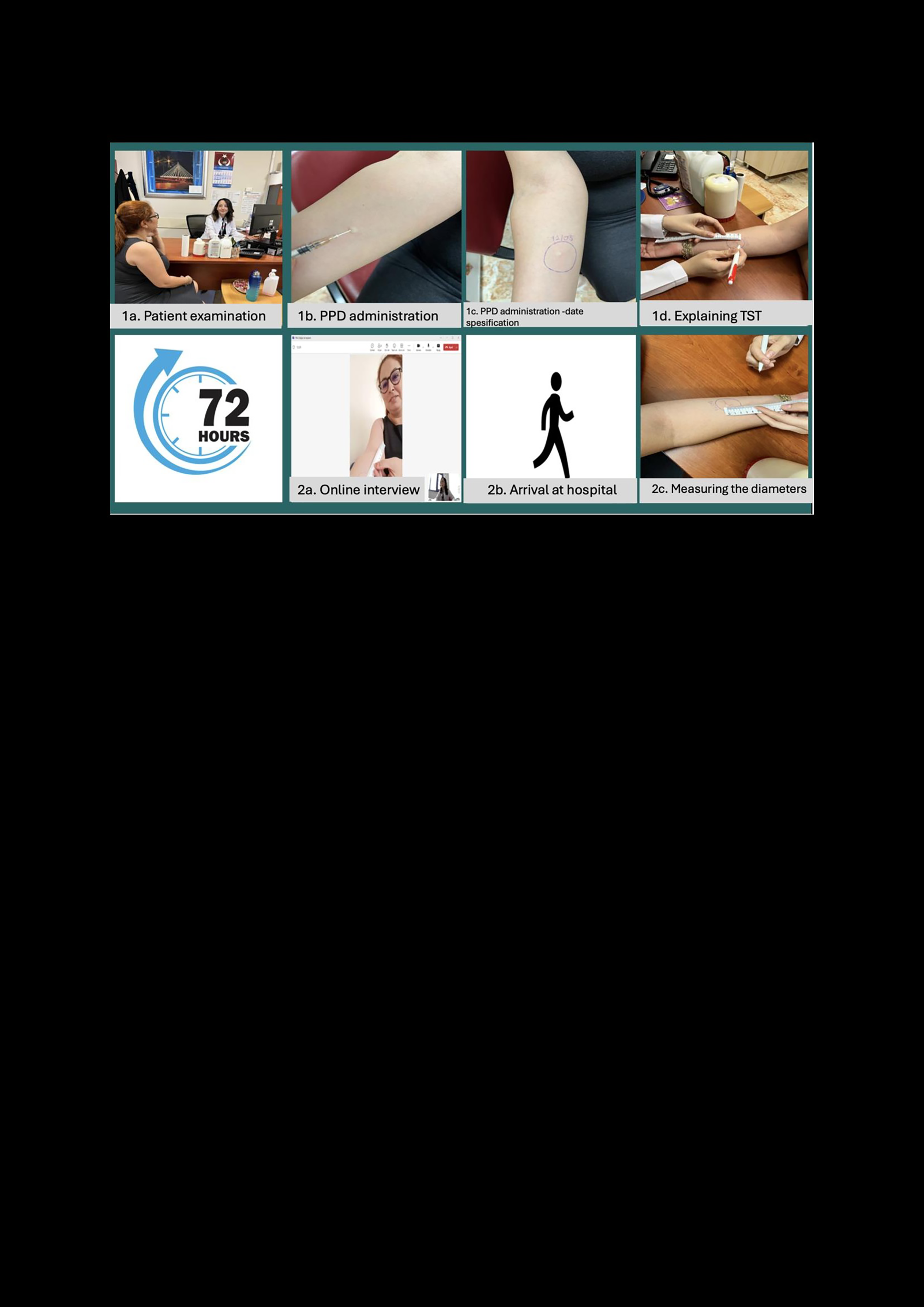
Illustration of the tuberculin skin test (TST) self-assessment procedure under real-time telemedicine supervision. *The image was taken during a demonstrative procedure performed on a healthcare worker as a simulation for illustrative purposes, with written informed consent obtained.
Data grouping and classification
Patients were categorized into immunosuppressed and nonimmunosuppressed groups. None of the patients were receiving systemic corticosteroids at the time of TST administration. Immunosuppression in the study population was related to underlying rheumatologic diseases treated with conventional DMARDs rather than corticosteroids or biologic agents. A positivity threshold of 5 mm was used for immunosuppressed patients, and 10 mm for nonimmunosuppressed. Measurements above these thresholds were deemed positive; those below were negative.
Statistical analyses
Data were analyzed using SPSS Version 25.0 software. Continuous variables were expressed as mean, standard deviation. Categorical variables were expressed as frequencies and percentages. The χ2 test was used to compare the categorical variables. Frequencies-percentages of people who are compatible and kappa coefficient were used for demonstrating the compatibility of pulmonologist and patient examinations. In all analyses, p < 0.05 was considered statistically significant.
Results
During the study period, 103 patients applied for LTBI evaluation. Three of these patients were excluded from the study due to lack of internet access at the time of video call via smartphone. Thus, 100 patients met the inclusion criteria. Most patients were female, with a mean age of 47.44 years. Demographic data, including age groups, gender, and residency, are shown in Table 1. Most patients (64%) had previous TST experience, and 52% attended the clinic unaccompanied.
Flow diagram of included patients.


The reasons for medical evaluation matched those expected in a tertiary university hospital. Most patients visited the pulmonary outpatient clinic for immunosuppressive drug approval (62%) or pre-transplant solid organ assessment (20%). Other reasons are given in Table 2: The most common comorbidities were rheumatologic diseases (52%), chronic kidney disease (10%), and dermatological issues (8%), while 20% of patients had no chronic diseases.
Demographic features of the patients.

In patients requiring immunosuppressive therapy, TST was considered “negative” if induration was under 5 mm and “positive” if 5 mm or more. Since a 1 mm difference between patient and pulmonologist measurements could affect treatment, especially near borderline results, outcomes were assessed based on whether isoniazid chemoprophylaxis was indicated for LTBI.
Patient-physician concordance was defined as identical measurements by both. The agreement between patient and pulmonologist measurements was significant (p = 0.000; κ=0.535). Discrepancies leading to changes in treatment or follow-up were labeled as discordance. For example, if an immunosuppressed patient measured 2 mm but the physician measured 8 mm, this discrepancy would result in starting prophylactic therapy and be considered discordant. Overall, 16 patients showed measurement differences over 5 mm. Among them, only eight cases had discrepancies that impacted treatment or follow-up, with six of these in immunosuppressed patients affecting decisions on LTBI chemoprophylaxis initiation.
In our study population consisting of 100 individuals, physician evaluations classified 21 cases as positive (>5 mm) and 79 as negative (<5 mm). Among the 21 cases assessed as positive by the physician, 16 were also rated as positive by the patients, resulting in a sensitivity of 76.2%. Of the 79 cases classified as negative by the physician, 76 were likewise considered negative by the patients, while only three were assessed as positive, yielding a specificity of 96.2%.
A total of 81 patients rated their results as negative. In this group, 76 cases were also considered negative by the physician, while five were evaluated as positive. Based on these findings, the negative predictive value (NPV) was calculated as 93.8%.
Among the 19 patients who evaluated their results as positive, 16 were also rated positive by the physician, while three were evaluated as negative. Accordingly, the positive predictive value (PPV) was determined to be 84.2%. Overall, the accuracy of the test was found to be 92%.
Among the 79 patients classified as anergic (nonreactive) by the pulmonologist, 76 accurately identified this in their self-assessment (Table 3). In the immunosuppressed group of 84 patients, 67 were determined to be TST-negative by pulmonologist, with only two patients misclassifying their results. This corresponds to a 97% concordance rate in TST-negative immunosuppressed patients. The self-measurements of four patients with prior telemedicine experience via VC fully matched the pulmonologist's results. Factors such as gender (p = 1), marital status (p = 0.27), educational level (p = 0.52), presence of chronic disease (p = 0.2), and previous TST experience (p = 0.13) were found to have no statistically significant effect on patient-physician discordance.
Patient–physician concordance.

Interobserver agreement for TST measurements was higher among patients living in urban areas compared to those in rural regions (p = 0.05). No significant decline in agreement was observed with increasing age. However, elderly patients accompanied by children or grandchildren during VCs showed more accurate TST measurements. High levels of agreement were observed in specific patient subgroups. In all eight patients (100%) with dermatological disease requiring immunosuppressive treatment, complete agreement was observed between their self-test measurements and those taken by the pulmonologist. Similarly, in none of the six patients (0%) with a history of lung disease was a treatment change required due to measurement discrepancies. In contrast, in all eight patients (100%) requiring protocol modification, there was no prior history of diagnosed lung disease.
Among 11 patients evaluated for mediastinal lymphadenopathy or pre-placement procedures, only one (9%) showed disagreement. Of the 64 patients with previous TST experience, three (5%) had discrepancies affecting treatment choice. In contrast, five out of 36 (8%) patients with no previous TST experience showed such differences (p = 0.54). Among four patients with prior telemedicine experience, complete concordance was observed between patient and pulmonologist measurements
Discussion
This study shows that telemedicine is a promising tool for TST evaluation. It compared self-measurement under real-time supervision with traditional in-person assessment by a pulmonologist. The statistically significant agreement between patient and physician measurements supports telemedicine as a reliable alternative. Although an in-person visit was needed for comparison, the results suggest remote TST reading can be accurate without requiring hospital visits.
In 2023, 38,993 tuberculosis cases were reported across 29 EU/EEA countries, with a notification rate of 8.6 per 100,000 population. While the overall trend has decreased over the past five years, a slight increase was noted in 2022 and 2023 in most countries. 10 The lack of significant decline suggests the need for new diagnostic and treatment approaches. Effective treatment of latent tuberculosis is crucial for preventing active disease, and recent guidelines highlight the role of digital tools in improving management. 1
Telemedicine has become widely used, especially for managing chronic diseases, revolutionizing healthcare delivery. 5 It connects patients and healthcare professionals through information and communication technologies, improving access for those with limited healthcare and supporting self-management. The European Respiratory Society defines telemedicine as a method enabling healthcare delivery by exchanging information when distance is critical. 11 Beyond access, telemedicine supports health research and patient-centered treatments. By overcoming geographic, economic, and social barriers, it promotes equity and offers cost-effective, continuous patient follow-up solutions.12–15
Although TST assessment via telemedicine is not yet validated, telemedicine has proven effective in tuberculosis treatment monitoring, especially in directly observed therapy (DOT) and video observed therapy (VOT). 16 VOT shows better patient adherence, dose monitoring, and bacteriological outcomes than DOT. 17 Telemedicine has also successfully supported isoniazid prophylaxis in latent TB infection (LTBI) patients. 6 Even severe conditions like tuberculous meningitis have been managed through telemedicine for follow-up and treatment. 18 These examples highlight telemedicine's potential to improve care access and aid clinical decisions in tuberculosis control.
Despite challenges in TST reading, the traditional method has remained essential in TB prevention and LTBI management for over a century. Issues include manual measurement, variability between 48- and 72-h readings in the same patient, and interoperator differences linked to healthcare providers’ expertise. Although no significant difference exists between 48- and 72-h readings, positive results at 72 h are more common in immunosuppressed patients. 19 In our study, measurement at 72 h used due to many immunosuppressed patients, aiming to reduce false negatives. Moreover the interpretation of TST results in immunosuppressed patients requires particular caution, as the effect on TST reactivity depends largely on the type of immunosuppressive therapy. Systemic corticosteroids have consistently been associated with reduced TST reactivity and an increased risk of false-negative results, particularly at higher doses or with recent exposure. 20 In contrast, several studies have shown that conventional disease-modifying antirheumatic drugs (DMARDs), including methotrexate, do not significantly impair TST responses. 21
In our study, patients classified as immunosuppressed were not receiving systemic corticosteroids at the time of TST administration; immunosuppression was related to underlying rheumatologic disease managed with conventional DMARD therapy. Therefore, the potential impact of corticosteroid-induced TST suppression does not apply to our cohort. Nevertheless, previous studies in rheumatoid arthritis populations suggest that disease-related immune dysregulation itself, independent of treatment, may contribute to variability in TST responses. 20 This underscores the importance of careful clinical interpretation of TST results in immunosuppressed patients, particularly when values are close to diagnostic thresholds or when decisions regarding biologic therapy initiation are being made.
Faria et al. reported significant measurement differences among nurses, affecting treatment decisions. 22 Therefore, all measurements in our study were done by a single operator. While operator variability is notable, patient self-measurements may also vary widely. Conducting measurements under the supervision of a healthcare professional via VC enhances accuracy and reliability. This controlled, expert-guided remote process is crucial for implementing digital tools in TB control programs, ensuring measurements are not left solely to patients.
Optimizing patient selection for remote versus in-person TST reading may improve outcomes. In our study, 8% of patients showed discordance between remote and in-person assessments that altered treatment. Among these, five had rheumatologic diseases causing immunosuppression or were candidates for immunosuppressive therapy, and two were on the kidney transplant list. Treatment alterations were not related to marital status. Patients with prior pulmonary health issues, previous TST experience, or telemedicine use had better agreement, likely due to established patient–physician communication. Discordance rates affecting treatment differed between patients with and without previous TST experience (5% vs. 8%). These results suggest that prior exposure to TST improves concordance between patient and physician measurements, highlighting the importance of patient history in determining suitability for remote TST evaluation.
Among 84 immunosuppressed patients, 17 tested positive on the TST and were considered for TB prophylaxis. In this group, three cases showed significant patient-physician measurement discrepancies that led to treatment alterations, resulting in an 82% agreement rate among TST-positive patients. Of the 67 TST-negative patients, only two reported indurations ≥5 mm not confirmed by pulmonologist, yielding a 97% agreement rate. These results indicate that telemedicine TST evaluations under professional supervision achieve high concordance, especially when no induration is present. However, agreement decreases when induration is detected, likely due to the subjective nature of self-measurement. Therefore, telemedicine is reliable for remote monitoring of patients without induration, but any reported induration should prompt referral for in-person reassessment to ensure diagnostic accuracy and appropriate management.
Maoyedi-Nisa et al. (2019) tested a digital method called “mTST,” which involves the remote evaluation of induration photographs taken via mobile phone for interpreting TST (Tuberculin Skin Test) results. In their study, excellent agreement between patients and healthcare providers was reported, particularly in cases with negative results or clearly positive reactions measuring ≥15 mm. However, in intermediate values ranging from 5 to 14 mm, they noted that two-dimensional (2D) images may be insufficient for accurate measurement. The authors suggested that three-dimensional (3D) evaluation techniques may offer more reliable results, highlighting the potential of advanced digital tools in improving diagnostic accuracy. 23 Naraghi et al. demonstrated in their study using 3D measurement techniques that patient-physician agreement remained high even in intermediate values, indicating that this method is reliable for obtaining accurate results. 24
Our study focuses on improving TST accuracy by boosting patient health literacy and integrating telemedicine with real-time remote supervision, actively involving patients in the measurement process. Unlike prior studies using specialized devices, this interactive approach empowers patients while maintaining test accuracy without requiring physical presence or advanced tools. This practical method offers an accessible alternative that enhances patient engagement and clinical oversight. The higher agreement among patients with prior telemedicine experience suggests better patient–physician interaction and confidence in measurements. Although telemedicine implementation remains limited, this finding highlights a promising area for further research to optimize TB screening and care.
Conclusion
Telemedicine-supported TST evaluation offers a reliable and practical alternative to traditional in-person assessment, especially for patients without induration indicates positive result. The high concordance between patient self-measurements and physician/nurse evaluations under remote expert supervision demonstrates its clinical applicability. This approach can reduce unnecessary hospital visits, lower healthcare burdens, and improve patient access, particularly for those with prior TST experience or chronic health conditions. However, patients reporting any induration would better undergo face-to-face reassessment to ensure diagnostic accuracy and appropriate management. Overall, integrating telemedicine into TST evaluation can enhance tuberculosis control strategies and healthcare efficiency while maintaining patient safety.
Footnotes
Acknowledgments
We would like to sincerely thank all patients and their families for their valuable participation in this study. We are also grateful to a nurse from our institution for her kind assistance in preparing illustrative material used in the manuscript.

Ethical considerations
This study was approved by the Pamukkale University Ethics Committee (E-60116787-020-532913), and written informed consent was obtained from all participants.
Consent to participate
All participants provided written informed consent before enrollment in the study.
Consent for publication
Not applicable, as no patient images or identifiable information are included in this manuscript. A nurse from our institution kindly assisted in creating illustrative material, for which we express our gratitude.
Author contributions
Conceptualization: NY and GA; data curation: NY and MS; formal analysis: HS; investigation: NY and MS; methodology: NY, NC, and GA; project administration: NY, MS, and GA; resources: NY, NC, and GA; visualization: NY and MS; writing—original draft: NY, NC, and MS; and writing—review and editing: HS and GA.
Funding
The authors received no financial support for the research, authorship, and/or publication of this article.
Declaration of conflicting interests
The authors declared no potential conflicts of interest with respect to the research, authorship, and/or publication of this article.
Data availability
The datasets generated and/or analyzed during the current study are available from the corresponding author on reasonable request.