




Abstract
Objectives
This study investigates how sentiments in depression self-disclosures by everyday users on Chinese social media influence audience engagement behaviors and discourse themes, specifically examining the role of cultural context and platform affordances in non-Western mental health communication.
Methods
Adopting a mixed-methods approach, the study analyzed 535 posts and 17,301 comments from Xiaohongshu (a prominent lifestyle-sharing platform in China). A fine-tuned BERT model quantified sentiment, while multilevel regression models assessed the impact of sentiment on likes, favorites, shares, and comments. Semantic network analysis was employed to map thematic structures within audience responses.
Results
Less positive sentiments significantly predicted higher engagement in likes and comments, indicating a community preference for authentic vulnerability over positivity. Sentiment did not predict favorites or shares, a finding attributed to cultural norms discouraging the publicization of “family ugliness”. Notably, neutral posts generated higher engagement than positive ones, serving as safe grounds for advice-seeking. Thematic analysis revealed consistent clusters across sentiment categories: coping/resilience, emotional struggles, and health-related concerns.
Conclusion
Challenging the assumption that positivity drives support, this study demonstrates that negative self-disclosure fosters deeper engagement and validation in Chinese online communities. While cultural stigma suppresses public sharing, audiences actively utilize comments to provide a stabilized “protocol of care”, suggesting that authentic vulnerability is a potent driver of stigma reduction and peer support.
Keywords
Introduction
Depression is a widespread mental health condition with profound societal and individual impacts. Globally, it affects approximately 280 million people, 1 but recent epidemiological data underscores a particularly critical public burden in China. According to the “China Mental Health Survey”, 2 the weighted lifetime prevalence of adult depressive disorders in China is 6.8%, ranking as the leading cause of disease burden among mental disorders. Despite this high prevalence, mental health service utilization in China remains alarmingly low; only 9.5% of individuals diagnosed with depressive disorders receive medical treatment, and a mere 0.5% receive adequate care. 2 This substantial treatment gap is exacerbated by the scarcity of professional psychiatric resources and persistent harmful stereotypes, such as the notion that individuals can simply “snap out of it”, which trivialize the condition and hinder help-seeking.3,4 Consequently, there is an urgent need to explore alternative support mechanisms, such as social media platforms, to reach the vast majority of the population currently lacking professional help.
The digital era has revolutionized health communication, disrupting the traditional paradigm where mainstream media served as the dominant source of information. 5 Social media has emerged as a vital space for this discourse, offering anonymity and accessibility that lower stigma-related barriers.6–8 In this context, “self-disclosure” transcends the mere verbal communication of personally relevant information 9 ; it functions as a communicative act of vulnerability. For everyday users, posting about depression involves revealing a stigmatized identity, transforming the interaction from a simple topic discussion into a reciprocal exchange of support. While extensive research has examined how traditional media and celebrity disclosures influence public perceptions,10–12 the role of self-disclosures by everyday users remains underexplored.13,14 Given that everyday interactions constitute the bulk of online discourse, understanding how these users engage their audiences is essential for a comprehensive view of mental health communication.
Furthermore, existing literature often overlooks the distinct ecosystem of Chinese social media. While studies have explored platforms like Weibo and Douyin (e.g.,15,16), they frequently focus on micro-celebrities or rely on text-only analysis. The distinct affordances of Xiaohongshu (“Little Red Book”), particularly its algorithmically driven content discovery and emphasis on community-based interaction, merit specific investigation. To address these gaps, this study adopts a mixed-methods approach to empirically determine how the sentiment of depression self-disclosures impacts audience engagement behaviors and to identify the thematic structures of the resulting community discourse. Specifically, we aim to test the relationship between emotional valence and engagement metrics while mapping the semantic structure of the interaction, providing valuable insights for content creators, mental health advocates, and platform designers to foster constructive mental health discussions online.
Literature review
Conceptualizing mental health stigma
Goffman 17 conceptualized stigma as a “spoiled identity”, emphasizing how individuals are devalued and marginalized for not conforming to societal norms. Building on this foundational work, Link and Phelan 18 described stigma as a systemic process which involves labeling, stereotyping, separation, status loss, and discrimination, highlighting the structural and power-driven dimensions of stigma. Smith 19 further refined the concept by focusing on how stigma (particularly in the context of mental health) is created and reinforced through language and public narratives. This approach underscores the communicative nature of stigma. Moving beyond definitions, the action-oriented framework20,21 categorizes mental health stigma into three types. Structural stigma encompasses institutionalized biases that disadvantage individuals with mental health conditions. In contrast, public stigma reflects the broader societal attitudes and prejudices directed towards people with mental illness. At a personal level, self-stigma arises when individuals internalize these negative perceptions, leading to feelings of devaluation and diminished self-worth.
This study adopts Smith’s 19 communicative definition of stigma and integrates the action-oriented framework to examine how mental health self-disclosures on social media influence audience responses. Crucially, in this study, we conceptualize “self-disclosure” not merely as the act of posting content, but as a communicative act of vulnerability. Drawing on Cozby 22 and Jourard, 23 self-disclosure involves revealing personally relevant information that is otherwise private. In the context of mental health in China, this takes on added significance; posting about depression is not simply discussing a health topic, but a disclosure of a stigmatized identity. Therefore, we posit that the audience engagement observed in this study is a response to this specific vulnerability: a negotiation of support in a digital space where admitting to mental health struggles carries social risk.
Media communication about mental health
Media content plays a significant role in shaping public perceptions, attitudes, and behaviors regarding public health.11,12 Historically, media have played a pivotal role in shaping attitudes toward mental health, though the effects are often dual-edged (see10,24 for a review). On one hand, positive media coverage promotes awareness, normalizes mental illness, and encourages help-seeking. For example, framing mental illness as manageable or integrating empathetic and recovery-focused narratives effectively lowers public and internalized stigma.25–27 Conversely, negative media portrayals perpetuate stereotypes, linking mental illness to unpredictability, dangerousness, and criminality. For instance, findings suggest that stigmatizing depictions increase social distance and hinder treatment-seeking.28–30
Most insights into mental health communication have been derived from studies focusing on traditional media outlets like newspapers, television, videos, and opera (see 5 for a review 31 ). These studies reveal that traditional media often portrays depression in a one-dimensional manner, emphasizing extreme cases and framing individuals as dangerous or violent.5,10 Consequently, such narratives perpetuate stigma and fail to capture the complexity of lived experiences. In contrast, the rise of social media has disrupted this paradigm, yet the impact of self-disclosure of mental illness in these digital spaces remains comparatively underexplored. 16 Social media offers a space for more interactive and nuanced discussions, where self-disclosure can play a key role in reducing stigma and fostering understanding.32,33 Therefore, it is essential to explore how content and sentiments function within social media platforms and how these mechanisms generate dynamics distinct from those of traditional media.
Self-disclosure of depression on social media
The role of self-disclosure across different social media users
Self-disclosure on social media allows individuals to share personal experiences, creating engagement as audiences relate to their stories. 34 In the context of mental health, three main groups contribute to these disclosures: celebrities, social media influencers (SMIs), and everyday users. Celebrities have often used their platforms to openly share mental health struggles, helping to reduce stigma, raise public health awareness, and foster information-seeking behaviors.32,35–37 However, while celebrity disclosures have broad reach and authenticity, they often lack relatability, making them less interactive with general audiences. 33
In contrast, social media influencers and everyday users offer more relatable narratives, which can drive deeper engagement.14,38 Recent research highlights the impact of disclosures by microcelebrities and streamers. Lee, Yuan 14 found that streamers who shared their struggles with depression helped viewers better understand the prevalence and severity of the condition, boosting confidence in help-seeking. Similarly, Reed 38 found that positive posts by influencers about therapy outcomes increased optimism and self-efficacy. However, influencers remain a smaller group compared to everyday users, whose authentic and highly relatable disclosures resonate more broadly with general audiences.
This distinction is particularly vital in non-Western contexts, where cultural norms shape support-seeking.39,40 In Chinese culture, shaped by Confucianism and collectivism, values like harmony, family reputation, and “face” (面子) often discourage open discussions of mental health due to fears of shame.41,42 Consequently, the anonymity and accessibility of social media provide a crucial outlet for everyday Chinese users to bypass these cultural barriers. 43 Recent studies on everyday users in Asian settings (e.g.,16,44,45) reveal that online communities allow users to express complaints about external pressures, reconcile with emotions, and find support from online peers. Such disclosures might otherwise be suppressed in offline settings. These studies highlight how cultural norms necessitate the use of online spaces for expression, making the study of everyday users in China critical.
The role of self-disclosure on audience engagement
Despite growing attention to depression self-disclosures, there is limited research on how these narratives influence audience responses. A central debate concerns how sentiment shapes engagement.46,47 One strand of research suggests that positive content, such as messages of hope and encouragement, consistently fosters higher levels of interaction and contributes to stigma reduction by encouraging constructive dialogue.35,48–51
Conversely, other studies indicate a “negativity bias”, 52 where individuals pay more attention to negative information. Li, Tang 16 reported that negative content tends to generate higher levels of engagement, particularly in likes and comments, due to its perceived authenticity. While some argue that negative content risks emotional contagion 53 or amplifying distress, 54 others find it can provoke counterarguments or stigma-challenging debates.6,15,55 Furthermore, certain types of negative content, such as sorrow appeals, may elicit deep emotional engagement and empathy.46,56,57
Significantly, the effects of neutral content remain underexplored. Previous frameworks often categorize content strictly as positive or negative, potentially overlooking the utility of neutral exchanges. Some studies suggest neutral posts lack emotional appeal,35,49 while others posit they may foster factual or informational exchanges.48,50 To address these inconsistencies and the limitations of categorical approaches, this study proposes adopting a continuous scale for sentiments (ranging from −1 to 1) to offer a more nuanced representation of emotions expressed in social media content.
Platform-specific differences and audience engagement
Audience engagement is not monolithic; it varies by cognitive effort and platform architecture. Affective evaluation, such as “likes” or “favorites”, reflects immediate emotional responses.58,59 Viral reach (sharing) extends visibility,60,61 while message deliberation (commenting) involves deeper cognitive processing.62,63 Research highlights that platform design dictates these behaviors; for instance, Twitter users predominantly retweet, while Facebook users favor “liking”. 64
Chinese social media platforms similarly cater to diverse needs. Weibo focuses on viral dissemination and trending topics, 65 while video platforms like Douyin and Bilibili prioritize visual content. 66 Among these, Xiaohongshu stands out as a unique ecosystem for mental health research. Its integration of visual and textual storytelling encourages authentic, long-form narratives,67,68 and its user base (predominantly urban, educated, and female) aligns with demographics highly relevant to mental health discourse.69,70 Furthermore, Xiaohongshu’s specific “favoriting” feature allows for a distinction between public endorsement and private saving, offering a nuanced metric for cognitive interaction. 71 These features position Xiaohongshu as an ideal platform for examining how depression self-disclosures impact audience engagement.
Gaps and conflicts in existing research
Despite previous research, significant gaps persist. First, the specific impact of everyday users in non-Western contexts remains under-researched compared to celebrity-focused studies. Second, the influence of neutral sentiments is often obscured by binary analytical frameworks. Finally, conflicting findings regarding whether positivity or negativity drives engagement suggest that platform-specific dynamics and cultural context play a decisive role.
The present study
Given the identified gaps and conflicts, this study aims to investigate how everyday users self-disclose their experiences with depression on Chinese social media platforms and analyze the behavioral, sentimental, and content-based reactions of their audiences. Accordingly, the study addresses two key research questions:
Research Question 1 (RQ1): How does the sentiment (ranging from −1 to 1) expressed in depression self-disclosures by everyday users influence audience engagement behaviors (likes, favorites, shares, comments) and emotional reactions on Chinese social media platforms?
Research Question 2 (RQ2): Based on the positive, neutral, and negative sentiments of depression self-disclosures by everyday users on Chinese social media platforms, what themes emerge in associated audience comments?
Method
Research design
This study employs a mixed-methods design to provide a comprehensive analysis of depression self-disclosure on social media. We utilized quantitative multilevel regression modeling to analyze engagement behaviors (RQ1) and computational qualitative methods via semantic network analysis to explore the thematic content of the discourse (RQ2). This approach ensures that both statistical engagement trends and the underlying semantic context are adequately explored.
Data collection
Data was collected from Xiaohongshu using custom Python scripts to identify posts containing specific depression-related hashtags, including #depression (抑郁), #depressive disorder (抑郁症), #depression symptoms (抑郁症的症状), #managing depressive mood (抑郁情绪怎么调节), #somatized depression (抑郁躯体化), #depression medication (抑郁症药物), #depression to bipolar (抑郁转双相), #depression self-assessment (抑郁症自测), and #self-help for depression (抑郁症自救方法). The initial dataset comprised 2182 posts and 122,212 associated comments published between March 22, 2021, and November 11, 2024. The collected data included: (1) textual content (titles, posts, comments); (2) engagement metrics (likes, shares, comments, favorites); and (3) metadata (creator ID, post ID, timestamps, follower counts).
Data preprocessing and coding
To ensure ecological validity, the dataset underwent a rigorous multi-stage filtering process. First, duplicate entries and posts containing video content were removed. Second, textual content was cleaned by retaining Chinese characters, English words, and numerals, while removing elements unlikely to contribute to semantic analysis (e.g., hashtags, mentions, special characters). To ensure sufficient depth, posts with fewer than 100 characters and comments with fewer than 30 characters were excluded (cf. 72 ).
Third, we implemented a manual verification process to isolate genuine self-disclosures. Two graduate-level psychology students, familiar with DSM-5 criteria for Major Depressive Disorder, independently reviewed the posts. They applied strict inclusion criteria to retain only first-person accounts of specific depressive symptoms or diagnoses, excluding advertisements, bot-generated content, and general complaints. Following a pilot coding session with 100 posts (inter-rater reliability > 0.80), the annotators reviewed the full dataset, achieving substantial agreement (Cohen’s Kappa = 0.78 73 ). Discrepancies were resolved through discussion. Finally, comments were filtered to exclude those authored by the post creators or directed at other audience members, focusing solely on direct audience responses. The final analytical dataset included 535 posts and 17,301 comments.
Additional variables, such as “time since posting” (days between post publication and data download), “post length” (total characters, words, numerals), and “comment length” (measured similarly to post length), were computed. Descriptive statistics (Table 1) revealed potential heteroscedasticity in most metrics except for post and comment lengths. To address this, natural log transformations (ln(X + 1)) were applied to affected variables. 74
Descriptive statistics for key variables.

Data analysis
Sentiment analysis
To generate sentiment scores for RQ1 and RQ2, we employed BERT-base Chinese, a pre-trained transformer model optimized for contextualized text representation. 75 To capture the specific linguistic nuances and slang used within the Xiaohongshu mental health community, we fine-tuned the model using a randomly sampled subset of 3000 posts and comments from our collected Xiaohongshu mental health dataset (cf.7,8). Ground truth labels were established by two psychology graduate students (Cohen’s Kappa = 0.80). The dataset was split into training (80%), validation (10%), and testing (10%) sets. Fine-tuning was conducted over 4 epochs with a batch size of 32 and a learning rate of 2e-5 using the AdamW optimizer; these hyperparameters were selected to maximize stability and minimize overfitting. The model predicted sentiment on a continuous scale from −1 (negative) to 1 (positive). Performance was validated using mean squared error (MSE), mean absolute error (MAE), and R-squared (R2).
Engagement analysis
To address RQ1, we developed five multilevel regression models to examine the influence of post sentiment on engagement metrics (likes, favorites, shares, comments) and comment sentiment (see Table S1). Control variables included post length, time since posting, and follower count. To account for the hierarchical nature of social media data, we incorporated random intercepts for creators, posts, and audience members (cf.34,48,72). Random slopes for post sentiment were added iteratively based on model fit improvements (AIC/BIC) (cf.76,77).
Although count data is often modeled using Poisson or Negative Binomial regression, the current dependent variables exhibited long right tails. Diagnostic checks confirmed that log-transforming the outcome variables (ln(Y + 1)) successfully normalized residuals, satisfying linear regression assumptions and facilitating the interpretation of coefficients as elasticity. Additionally, robustness checks using Negative Binomial models on raw count data yielded consistent results. For this study, analyses were performed using jamovi 78 and the GAMLj module.
Semantic network analysis
To address RQ2, we applied semantic network analysis (SNA) to examine thematic structures within comments (cf.79,80). Post sentiments were categorized into positive (scores > 0.3), neutral (−0.15 to 0.15), and negative (<−0.79) groups. This categorization was data-driven, corresponding to density clusters observed in the sentiment distribution (approx. 75th and 25th percentiles) to ensure the “neutral” category captured the true middle ground.
We utilized VOSviewer 81 to construct co-occurrence matrices for the most frequent words in each sentiment category. Text was tokenized using a custom dictionary; while standard stopwords were removed (using the stopword lists provided by Harbin Institute of Technology), we adopted a context-sensitive approach for high-frequency terms like “now” (现在) and “one” (一个). Qualitative inspection revealed that these terms carried significant semantic weight in this context. The word “one” frequently denoted isolation (for example, “alone”), while “now” was used to distinguish acute distress from past history. Metrics such as Link (L) and Total Link Strength (TLS) quantified these connections (cf.82,83), providing a robust framework for uncovering nuanced relationships often missed by topic modeling in short texts (cf. 84 ).
Results
Sentiment analysis
The sentiment analysis model demonstrated high accuracy, with a mean squared error (MSE) of 0.047, a mean absolute error (MAE) of 0.038, and an R2 of 0.953, confirming its reliability in predicting sentiments for both posts and comments. Sentiments for posts ranged from −0.97 to 0.97 (M = −0.19, SD = 0.57), indicating a slight negative bias. Similarly, comment sentiments ranged from −1.00 to 0.99 (M = −0.20, SD = 0.49), reflecting a comparable trend.
Engagement analysis
The final mixed-effects models (Models 1 to 4), incorporating random intercepts to account for user-level variability, examined the role of average sentiments in predicting engagement metrics while controlling for post length, time since posting, and follower count (see Table S2 in the Supplementary Materials for detailed results). For likes (Model 1), average post sentiment was a significant negative predictor (β = −0.36, SE = 0.13, t = −2.78, p = 0.006), indicating that posts with less positive sentiment tended to attract more likes. This effect remained robust after accounting for the contributions of covariates, including post length (β = 0.35, SE = 0.12, t = 2.97, p = 0.003), time since posting (β = 0.22, SE = 0.06, t = 3.61, p < 0.001), and follower count (β = 0.35, SE = 0.04, t = 8.89, p < 0.001). For favorites (Model 2), average post sentiment was not a significant predictor (β = −0.12, SE = 0.13, t = −0.89, p = 0.373), suggesting that post sentiment had no substantial influence on favorite counts. However, covariates such as post length (β = 0.53, SE = 0.12, t = 4.41, p < 0.001), time since posting (β = 0.29, SE = 0.06, t = 4.65, p < 0.001), and follower count (β = 0.33, SE = 0.04, t = 8.15, p < 0.001) had strong positive effects on favorites.
Similarly, for shares (Model 3), average post sentiment was not a significant predictor (β = −0.06, SE = 0.12, t = −0.45, p = 0.656), suggesting that post sentiment plays a negligible role in sharing behavior. In contrast, the covariates remained significant predictors of shares, with post length (β = 0.58, SE = 0.11, t = 5.17, p < 0.001), time since posting (β = 0.22, SE = 0.06, t = 3.78, p < 0.001), and follower count (β = 0.29, SE = 0.04, t = 7.73, p < 0.001) all contributing strongly. For comments (Model 4), average post sentiment was a significant negative predictor (β = −0.34, SE = 0.11, t = −3.12, p = 0.002), indicating that posts with less positive post sentiment elicited more audience responses in the form of comments. However, post length (β = −0.02, SE = 0.10, t = −0.23, p = 0.821) and time since posting (β = 0.06, SE = 0.05, t = 1.22, p = 0.224) were not significant predictors, while follower count (β = 0.22, SE = 0.03, t = 6.60, p < 0.001) showed a strong positive effect.
The final mixed-effects model (Model 5), incorporating random intercepts for creators, posts, and audience members, revealed that average post sentiment significantly predicted comment sentiment (β = 0.04, SE = 0.02, t = 2.00, p = 0.046), indicating that posts with higher post sentiments elicited more positive comment sentiments. However, the small effect size suggests a limited influence of post sentiment on comment sentiment, with additional factors likely contributing to variability. Among the covariates, follower count was a significant positive predictor (β = 0.02, SE = 0.01, t = 2.73, p = 0.007), while post length (β = −0.03, SE = 0.02, t = −1.78, p = 0.075) and time since posting (β = −0.02, SE = 0.01, t = −1.83, p = 0.068) exhibited marginal negative effects that were not statistically significant.
Semantic network analysis
The sentiment categorization revealed 114 negative (21.3%), 120 neutral (22.4%), 97 positive (18.1%), and 204 uncategorized (38.1%) posts, reflecting a balanced distribution among the primary sentiment categories. Correspondingly, comments were predominantly linked to negative posts (7543; 43.6%), followed by neutral posts (3181; 18.4%), positive posts (1601; 9.3%), and uncategorized posts (4976; 28.8%). VOSviewer then generated three clustering figures based on comments associated with each sentiment category of the posts (see Figures 1–3). Despite the figures’ Chinese labels, the study provided literate translations of the displayed keywords to enhance international accessibility (see Table S3–S5 in the Supplementary Materials).

Clustering for comments on positive posts.

Clustering for comments on neutral posts.
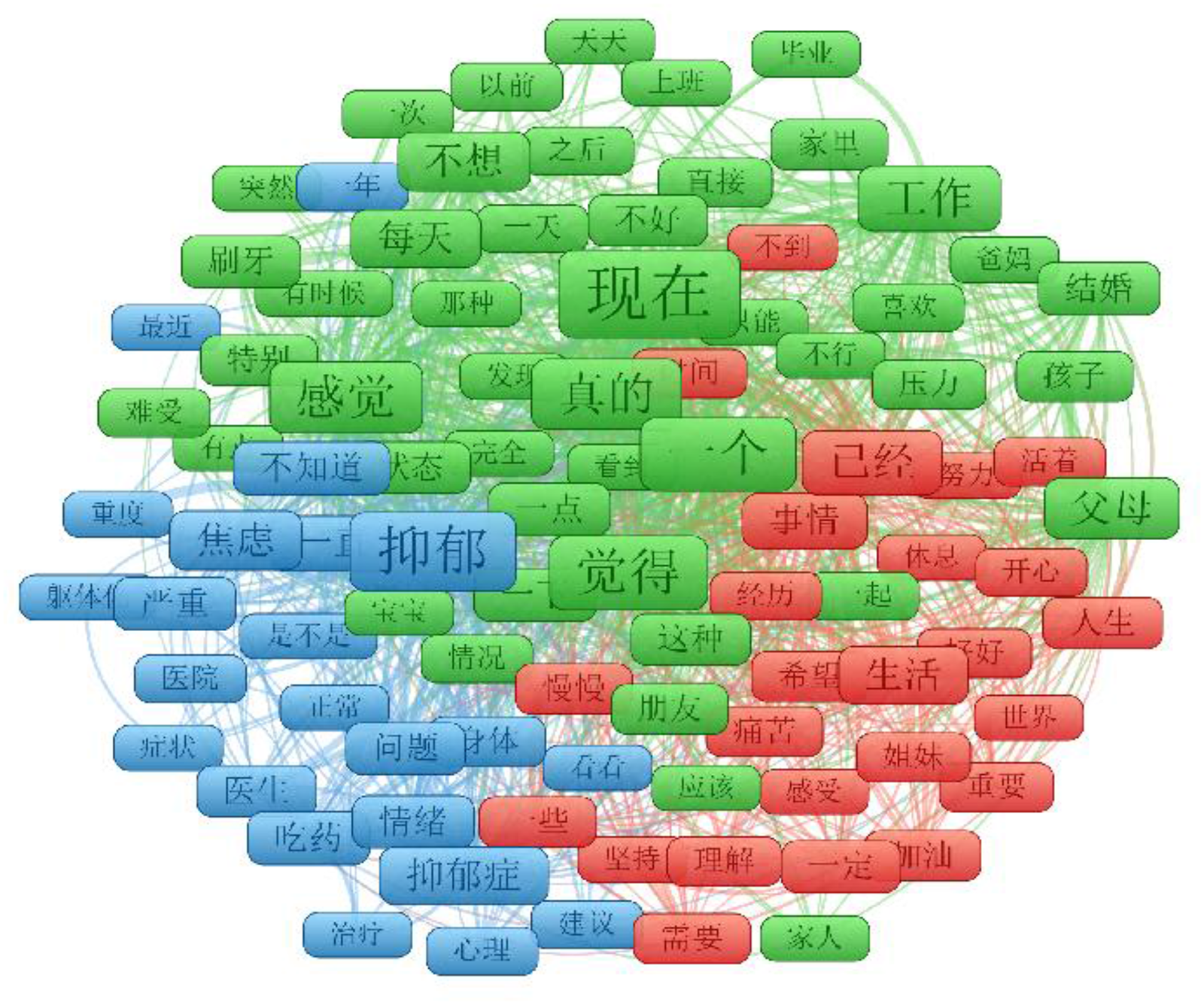
Clustering for comments on negative posts.
Firstly, as shown in Figure 1 and Table S3, comments associated with positive posts are grouped into three distinct clusters (L = 4,386, LTS = 3969). The “Red” cluster centers on themes of life, relationships, and personal growth, with representative keywords such as “life”, “pressure”, “hope”, “friends”, “parents”, “pain”, and “discover”, reflecting the dynamics of navigating challenges, seeking support, and fostering resilience. Meanwhile, the “Green” cluster delves into emotional struggles, portraying negative feelings such as “not happy”, “not joyful”, “lonely”, and “afraid”, intertwined with physical discomforts like “insomnia”. In contrast, the “Blue” cluster shifts focus toward clinical and health-related discussions, with terms like “doctor”, “hospital”, “symptoms”, and “diagnosis” reflecting an emphasis on seeking professional care and addressing health challenges. Interpretively, Table S3 suggests that engagement with positive posts is grounded in realism rather than toxic positivity. The coexistence of “hope” with “pain” and “insomnia” indicates that Chinese users view recovery as a non-linear process, where acknowledging past suffering is essential to validating current progress.
Secondly, as illustrated in Figure 2 and Table S4, comments associated with neutral posts are also divided into three clusters (L = 4,847, LTS = 7617). The “Red” cluster captures themes of navigating life’s challenges, with keywords like “pressure”, “hope”, “treatment”, and “parents” emphasizing efforts to maintain balance during difficult times. It also includes introspective reflections, highlighted by terms such as “understand”, “pretend”, and “experience”. The “Green” cluster paints a vivid picture of emotional turbulence, featuring terms like “not good”, “afraid”, “uncomfortable”, and “can’t sleep”, which highlight difficulties in emotional regulation and physical well-being. The “Blue” cluster, on the other hand, centers on matters of health and treatment, with keywords such as “doctor”, “hospital”, “diagnosis”, and “psychological counseling” reflecting concerns about medical care and the management of mental health symptoms. As clarified in Table S4, the vocabulary here serves a pragmatic function. The juxtaposition of emotional terms like “afraid” with clinical terms like “diagnosis” suggests that users rely on these neutral threads to demystify the medical process, utilizing the comment sections to assess the physical and emotional toll of treatment before engaging with it.
Thirdly, as depicted in Figure 3 and Table S5, comments on negative posts are categorized into three clusters (L = 4,846, LTS = 17,795). The “Red” cluster focuses on resilience and determination, with terms like “rest”, “cheer up”, “persist”, and “hope” capturing the spirit of enduring challenges, while “pain”, “life”, and “experience” shed light on deeper emotional and existential struggles. The “Green” cluster offers insights into the complexity of daily life and interpersonal relationships, using keywords like “don’t want”, “uncomfortable”, “pressure”, “family members”, and “work” to highlight how personal difficulties intersect with social and practical obligations. Finally, the “Blue” cluster delves into health-related concerns, with terms like “doctor”, “hospital”, “treatment”, “depressive disorder”, and “symptoms” highlighting medical challenges, alongside terms such as “anxiety”, “severe”, and “somatization”, which underscore ongoing mental health struggles. Table S5 reveals a strong cultural emphasis on collective encouragement. The prominence of terms like “persist” and “cheer up” in the “Red” cluster counters the despair of the “Blue” cluster’s “severe” symptoms, while the “Green” cluster explicitly ties distress to “family”, “work”, and “graduate”, highlighting how mental health in this context is deeply intertwined with fulfilling social and familial roles.
Discussion
Overview of key findings
This study investigated how everyday users’ self-disclosures about depression on Xiaohongshu influence audience behavioral, sentimental, and content-based reactions. The results indicate that posts expressing less positive sentiment receive higher levels of engagement, particularly through likes and comments, while posts with more positive sentiment prompt a modest increase in overall audience positivity. Additionally, the semantic network analysis of audience comments reveals three pervasive themes: coping and resilience, emotional struggles, and health-related concerns. Collectively, these findings deepen our understanding of how sentiment in user-generated self-disclosures shapes mental health discourse and engagement within a distinct cultural and online environment.
Additionally, our findings regarding sentiment and engagement highlight the complex role of vulnerability in self-disclosure. The data suggests that audiences are not passively consuming content about depression but are actively responding to the level of risk the disclosure undertakes. For instance, the high engagement with negative posts indicates that the community validates specific forms of vulnerability. By publicly disclosing their struggles, users are breaking the cultural silence surrounding mental health, and the audience’s engagement serves as a signal of acceptance, countering the traditional stigma that views such disclosures as “losing face”.
Engagement dynamics: Preference for less positive sentiment
The present study reveals that audiences are more inclined to engage with negative content than positive content, as indicated by statistically significant negative regression coefficients for likes and comments and a higher volume of comments on negative posts. This phenomenon cannot be fully explained by emotional contagion, 53 which suggests that similar sentiments resonate with the audience in mental health communication (cf.35,50). Instead, negativity bias, 52 which posits that negative content evokes stronger emotional reactions (e.g., empathy, curiosity, or outrage), may provide a more compelling explanation. Posts detailing personal suffering and challenges with depression may be perceived as more authentic and relatable, whereas positive posts may be seen as unrealistic or superficial. As a result, audiences are more likely to engage with posts that validate their own feelings or struggles.
Beyond the binary of positive and negative sentiments, the current findings address a critical research gap regarding neutral content. Interestingly, neutral posts, often characterized by factual descriptions of symptoms, generated significantly higher engagement (18.4%) than positive posts (9.3%). Contrary to Western findings that often categorize neutral sentiment as low-engagement, our results suggest these posts serve as a “safe ground” for community advice-seeking. They represent a lower-risk form of disclosure, allowing users to “test the waters” of vulnerability without triggering the cultural stigma or “family ugliness” associated with high-arousal negative emotions. Consequently, neutral posts prompt not only factual discussions (cf.48,50) but also elicit supportive responses comparable to those inspired by positive content (cf.35,49).
These patterns align with findings by Wang, Tian 85 regarding Chinese online depression communities (such as the “Depression Super Topic” on Weibo), which exhibit intense needs for peer support. Our results similarly suggest that less positive posts serve as a rallying point for community interaction, where high engagement levels reflect a collective effort to provide validation. Moreover, Xiaohongshu’s algorithms may potentially amplify this effect, as higher levels of interaction (e.g., likes, comments) in turn increase the visibility of such posts and further boost audience engagement. 71 Altogether, these findings offer a nuanced perspective that resolves the ongoing debate in prior research, demonstrating that in this cultural context, authenticity and safety drive engagement more effectively than positivity.
Explaining the lack of influence on favorites and shares
The sentiment of depression self-disclosure posts does not significantly predict the number of favorites, an unexpected finding given the low cognitive and emotional effort required for favoriting compared to commenting. While sentiments influence behaviors like liking, this result suggests that users may save posts for reasons unrelated to emotional tone. Specifically, favorites likely reflect the perceived value or relevance of the content, such as its relatability, informational utility, or uniqueness. This indicates that users may prioritize the practical or personal significance of a post over its emotional valence when deciding to favorite it.
Additionally, the low number of shares for depression self-disclosure posts on social media can be attributed to the interplay of public stigma, cultural norms, and platform dynamics. Public stigma surrounding mental illness discourages users from sharing these posts, as they seek to avoid judgment, cyberbullying, or being associated with mental health struggles. 86 Our findings regarding the suppression of sharing behavior diverge significantly from Western social media contexts. While Western studies often suggest that high-arousal negative content triggers advocacy and sharing, our data indicates a lower sharing rate for severe depression disclosures. This can be interpreted through the lens of the Chinese cultural norm of “family ugliness should not be publicized” (家丑不可外扬).
Unlike individualistic cultures where public advocacy is common, the users in this study may engage deeply via likes and comments (support) but refrain from sharing the content to their own feeds to avoid associating their public persona with stigmatized topics. In Chinese culture, openly discussing personal challenges is often perceived as a sign of vulnerability or weakness.41,42 This reluctance is deeply rooted in the Chinese concept of “face” (面子). Consequently, while users may privately consume or favorite the content, they avoid public-facing actions like sharing. Moreover, fear of negative feedback or exacerbating emotional distress creates an additional barrier to sharing, undermining efforts to seek or provide support. 43
Moderate impact of positive sentiment on comment tone
Unlike less positive sentiment which predicts audience behaviors such as likes and comments, the limited predictive power of post sentiment on comment sentiment suggests that the emotional contagion effect and negativity bias are relatively weak in this context and underscores the complexity of audience engagement on social media. While the emotional tone of a post may potentially influence comment sentiments (cf. 54 ), its impact is often diluted by individual differences in interpretation, shaped by personal experiences, emotional states, and motivations. Evidence further supporting this stance includes the observation that a significant portion of comments (43.6%) cluster around negative posts, indicating that audiences are less likely to focus on the overall sentiment or directly mirror the emotional tone of the post. Instead, users tend to engage with content that resonates with their own struggles or emotional challenges, prioritizing the relatability and relevance of the post.85,87 In particular, narrative styles and story content may play a stronger role in shaping the sentimental tone of comments, further diminishing the direct effect of post sentiment.
Consistency across sentiment categories
Remarkably, the thematic structure of audience comments remains consistent regardless of the sentiment expressed in the original post. Whether a disclosure is positive, neutral, or negative, the ensuing discourse uniformly clusters around coping strategies, emotional resonance, and medical validation. This alignment with previous research on Chinese online depression communities44,45 suggests that audiences are not reacting to the transient mood of a specific disclosure, but rather to the shared identity of the illness itself. Theoretically, this indicates that the depression community on Xiaohongshu operates on a stabilized “protocol of care” that transcends individual emotional valence. By consistently addressing medical, emotional, and motivational needs, the community demonstrates a high degree of resilience and a holistic support ecosystem. However, these findings should be interpreted with a degree of caution; the observed thematic uniformity may also be partially a byproduct of Xiaohongshu’s strict moderation policies, which actively filter out stigmatizing content to maintain a supportive environment. 88
Mental health stigma reduction reflected in thematic structures
Despite the slight negative bias in posts, the thematic content of the associated comments reduces stigma towards mental disorders by fostering empathy, understanding, and normalization of mental health challenges.44,45 Firstly, discussions on coping and resilience frame mental health struggles as shared human experiences, promoting hope and collective support rather than individual weakness. Secondly, themes addressing emotional struggles create a safe space for open expression, validating lived experiences and reducing the stigma of vulnerability. Thirdly, conversations about health-related concerns normalize seeking professional help and encourage proactive attitudes, challenging misconceptions and fear surrounding mental health care.
However, as Naslund, Bondre 89 highlight, the nature of these interactions is complex. On one hand, the high engagement reflects the positive impact of peer support in reducing isolation. On the other hand, there are inherent risks in unregulated online spaces, including the potential for hostile comments or the spread of misinformation. While the emphasis on personal emotional experiences and health-related concerns in our study fosters inclusive dialogue and reframes mental health issues as manageable, the slight negativity bias in comments suggests that vigilance is required to ensure these spaces remain supportive rather than distressing.
Conclusion
This study elucidates the complex interplay between sentiment, cultural context, and platform features in shaping mental health discourse. By shifting the analytical focus from celebrities on Western platforms to everyday users on Xiaohongshu, our findings demonstrate that negative self-disclosure is a potent driver of meaningful engagement. This challenges the prevailing assumption that positivity is the primary catalyst for supportive online environments and advances the theoretical understanding of how emotional valence interacts with platform affordances.
Beyond theoretical contributions, these findings offer immediate, actionable insights for key stakeholders. For patients, the results validate the utility of authentic, including negative, disclosure in eliciting social support, countering the pressure for “toxic positivity” often prevalent in online communities. For clinicians, the semantic network analysis uncovers specific patient anxieties regarding medication side effects that are frequently discussed online but withheld in therapy, suggesting areas for proactive clinical inquiry. Finally, for platform designers, the study indicates that algorithms prioritizing positive, high-arousal content may inadvertently suppress supportive mental health communities, advocating for the implementation of sentiment-neutral recommendation systems for health-related topics.
Limitations of the current study and suggestions for future research
First, the generalizability of the findings is limited by the specific demographic and algorithmic context of Xiaohongshu. The platform’s user base is predominantly young, urban, and female; while this demographic is central to current mental health discourse, the observed engagement patterns reflect a specific digital sub-culture. Consequently, these results may not extend to male-dominated demographics or platforms with different information diffusion mechanisms, such as Weibo or Twitter (X). Future research should validate these findings across platforms with more diverse user profiles to test the broader applicability of the model.
Second, methodological constraints regarding platform architecture warrant caution. Although we controlled for follower counts, the cross-sectional nature of the data prevents the full isolation of organic engagement from algorithmic amplification, potentially creating a feedback loop that observational data cannot disentangle. Furthermore, Xiaohongshu’s moderation policies may filter overly stigmatizing content. While this fosters a safer environment, it may inadvertently exclude valuable data on how audiences respond to severe stigma. Future comparative studies involving platforms with varying moderation practices would help elucidate how platform governance influences the reception of self-disclosure.
Third, this study focused on metadata and engagement metrics rather than the semantic or visual content of the posts. We did not examine narrative styles or multimodal elements, which prior research (e.g., 90 ) suggests are critical drivers of engagement. The substantial unexplained variance in our models (see Table S2) underscores the influence of these unobserved factors. Future research should incorporate detailed content analysis, such as examining narrative length, survivor perspectives, and visual richness, to better understand the specific content features that drive audience interactions.
Supplemental Material
sj-docx-1-dhj-10.1177_20552076261425518 - Supplemental material for How depression self-disclosure shapes engagement and discourse on Chinese social media
Supplemental material, sj-docx-1-dhj-10.1177_20552076261425518 for How depression self-disclosure shapes engagement and discourse on Chinese social media by Hongyan Du and Lei Gu in DIGITAL HEALTH
Footnotes
Acknowledgments
We express our gratitude to Mr Ma Shukui from Xidian University for providing technical assistance in developing the Python crawler scripts that aided our study.

Ethical approval
This study exclusively utilized data sourced responsibly from publicly available posts on the Xiaohongshu platform; therefore, formal ethical approval from the institution was not required. Nevertheless, all procedures strictly adhered to the ethical principles specified in the Declaration of Helsinki. To ensure user privacy and regulatory compliance, all personally identifiable information was anonymized prior to analysis, and data collection methods fully aligned with Xiaohongshu’s Terms of Use.
Author contribution
Both authors equally contributed to the drafting, revising, and reviewing of this paper.
Funding
The author(s) disclosed receipt of the following financial support for the research, authorship, and/or publication of this article: This research was funded by Postdoctoral Research Foundation of China (2023M742303).
Declaration of conflicting interests
The authors declared no potential conflicts of interest with respect to the research, authorship, and/or publication of this article.
Data availability
The raw data supporting the conclusions of this article are available from the authors upon reasonable request.
Supplemental material
Supplemental material for this article is available online.
References
Supplementary Material
Please find the following supplemental material available below.
For Open Access articles published under a Creative Commons License, all supplemental material carries the same license as the article it is associated with.
For non-Open Access articles published, all supplemental material carries a non-exclusive license, and permission requests for re-use of supplemental material or any part of supplemental material shall be sent directly to the copyright owner as specified in the copyright notice associated with the article.
