



Abstract
Background
Short videos on platforms such as Douyin (the Chinese counterpart of TikTok) and RedNote have rapidly expanded, including growing palliative care-related content. This study evaluated the content and quality of such videos in China.
Methods
A cross-sectional analysis of the top 100 palliative care videos on Douyin and RedNote (February 2025) was conducted. Baseline characteristics, content features, and quality indicators were assessed. Spearman correlation examined factors associated with video quality and engagement.
Results
Videos on Douyin demonstrated higher popularity (all p < 0.001 except for that of comment counts) and quality (all p < 0.01 except for that of modified DISCERN scale and Patient Education Materials Assessment Tool for Audiovisual Content-Actionability) than those on RedNote. Both platforms exhibited generally moderate content quality (median score of 3, 3, 53.8%, 25%, and 12 for Global Quality Scale, modified DISCERN scale, Patient Education Materials Assessment Tool for Audiovisual Content-Understandability and Actionability, and Video Information and Quality Index, respectively). Video quality is related to both the video interactivity index (all p < 0.05 except for that of comment count) and the uploader's follower count (all p < 0.01). It is also influenced by the uploader's identity type and the video's purpose (all p < 0.05 except for that of Patient Education Materials Assessment Tool for Audiovisual Content-Actionability).
Conclusion
The quality of palliative care-related short videos on Douyin and RedNote is moderate, and there is considerable room for improvement in terms of reliability and accuracy. Platforms should prioritize the recruitment and certification of qualified palliative care professionals, systematically improve content quality, and encourage the contribution of user-generated content from individuals with firsthand palliative care experience.
Patient or Public Contribution
Publicly shared content from registered social media users, including self-media creators, patients, and family members, was analyzed to evaluate video quality and characteristics.
Introduction
Palliative care is an approach dedicated to improving the quality of life for patients and their families facing challenges associated with life-threatening illness. It involves comprehensive efforts to relieve pain and other physical, psychosocial, and spiritual problems through early identification, assessment, and treatment. 1 The World Health Organization (WHO) estimates that approximately 56.8 million people worldwide require palliative care annually. 2 Integrated palliative care has demonstrated benefits of decreased depressive symptoms, improved quality of life for both patients and caregivers, and even increased survival.3,4 However, the uptake of palliative care in clinical practice remains slow, with the majority of adults either having never heard of it or harboring biased fears about its meaning. 5 This issue is particularly pronounced in Eastern countries influenced by traditional Confucian values, such as China. 6 In China, the development of palliative care is still in its early stages, with limited public education on end-of-life care, and only 10% of the population has access to palliative care services. 7 In recent years, the Chinese government has begun to place greater emphasis on the development of palliative care, actively promoting its principles. 6 Effective strategies of enhancing public awareness and understanding of palliative care is crucial for advancing human health and alleviating the disease burden.
Video-based social media platforms such as TikTok (formerly known as Douyin in China) and RedNote have increasingly replaced traditional text-based information sources, emerging as the important channels for disseminating and accessing health information and concepts. Based on data up to the end of 2024, the Douyin and RedNote platforms have garnered substantial global user bases, with 750 million and 339 million active users, respectively. 8 These platforms are distinguished from other social media (e.g. YouTube and Facebook) by their short-video format. This format not only facilitates the sharing of insights and experiences among media practitioners but also supports public acquisition, learning, and exchange of knowledge. Its inherent conciseness enhances accessibility and engagement, making it particularly suited to modern, fast-paced lifestyles.
Although a trend highlighting the influence of short-video social platform in palliative healthcare communication, 9 healthcare experts have raised concerns over the quality and veracity of easily available short videos on social media. 10 The content and quality of short videos on TikTok related to other diseases such as colorectal polyps, lung cancer, liver diseases, and obesity have been assessed, which showed an uneven, mixed, and often unsatisfactory information.11–14 Nevertheless, there is a clear gap in the literature that lacks of research specifically evaluating the quality of palliative care-related short videos. A previous cross-sectional study examined the content characteristics of palliative care videos on the US version of TikTok. 15 However, this study did not employ specialized medical video quality assessment tools. Moreover, videos uploaded to the Chinese TikTok platform (i.e. Douyin) may differ from those on the US TikTok in cultural context and information quality, and substantial variations in content and quality exist across short-video platforms.
Therefore, this study adopted a cross-sectional design to assess the characteristics and quality of palliative care-related videos on the Douyin and RedNote platforms. The findings are expected to contribute to the advancement of social media as a means for delivering more comprehensive, culturally sensitive, and easily accessible palliative care information to the general public.
Methods
A conceptual framework diagram has been developed to outline the key components of our study (Figure 1).

Conceptual framework diagram for the study.
Ethical considerations
This cross-sectional study utilized publicly accessible and downloadable data sourced exclusively from Douyin and RedNote videos. Data was sourced responsibly, contains no identifiable personal information, and complies with the platform's terms of use and relevant ethical guidelines. No clinical trials, human tissue samples, or identifiable information related to individual users or IDs were involved in this research, and therefore, ethical approval was not required.
Search strategy and data collection
The search was conducted on Douyin and RedNote by the first and third authors. Short videos included in the retrieval process were those published from the respective platform's launch date up to 4 February 2025. To collect the videos, the authors created new Douyin and RedNote accounts on an iOS device located in Shandong, China. The videos were retrieved based on the platform's default algorithm, without the application of filters, ensuring an unbiased selection for preliminary analysis. All videos were collected within 3 days to minimize errors introduced by the platform's algorithmic recommendations and updates. Only publicly available videos were analyzed to protect users’ privacy. The retrieved videos were subsequently assessed according to predefined inclusion and exclusion criteria.
In line with previous social media content analysis studies, the “top 100 videos,” defined as the first 100 videos displayed by default for search term on each social media platform, were downloaded for potential inclusion.12,16 It has been established that the top 100 videos are sufficiently representative of the broader video pool in the Douyin, and excluding videos beyond this ranking threshold does not significantly impact the overall analysis. 17 Inclusion criteria required that videos focus primarily on palliative care and either be in Chinese or feature no audio. The exclusion criteria aimed to eliminate duplicate videos within each platform as well as advertisements. Notably, duplicate videos across platforms (n = 9) were retained to reflect real-user exposure patterns. The selection process continued until a dataset of the top 100 videos for each social media platform was compiled.
For the included videos, the following characteristics were recorded: titles, audience interactivity index (including number of thumps up, comments, collections, and shares), days since upload, video seconds, type of uploader (categorized as professional medical personnel, nonprofit organization, for-profit organization, official media, self-media and caregivers), number of uploader's followers, uploader's gender, uploader's region (categorized as North China, Northeast China, East China, Central South China, Southwest China, and Northwest China), number of works published by the uploader, video presentation format (categorized as solo narration, dialogue, text and image presentation, and documentary-style), video purpose (categorized as providing information and knowledge, sharing experience as medical personnels, sharing experience as caregivers, and entertainment), background setting (categorized as ward, hospital, office, private room, outdoors, and virtual background), and video topics (categorized as what is palliative care, why palliative care, what does palliative care entail, and the experience of palliative care). The classification criteria for video presentation format, background setting, and video purpose were adapted from established literature.15,18,19 For video topics, however, existing studies have employed divergent categorization schemes based on thematic content. Informed by subthemes prevalent in social media literature on palliative care, 15 and incorporating a preliminary analysis of the video content in this study, a tailored classification framework was developed as outlined above. Videos featuring individuals labeled as professional medical personnel, or hospitals were required to display official certification or accreditation marks.
Video assessment
Two team members independently and concurrently evaluated the videos across four dimensions: quality, reliability, interpretability and practicality, and educational value. The selection of these specific dimensions and their corresponding measurement tools was evidence-based.13,20 Discrepancies in the assessments were resolved by consulting an additional palliative care nurse specialist, which facilitated consensus among all evaluators on the content scores. The reliability of the ratings was determined using the intraclass correlation coefficient (ICC), with classifications as follows: poor (ICC < 0.50), moderate (ICC = 0.50–0.75), good (ICC = 0.75–0.90), or excellent (ICC > 0.90). 21
The quality of the video refers to the overall production standard and organizational flow of the video, which was assessed using the Global Quality Scale (GQS). The GQS contains 1 items, specifically assessing the overall quality, flow, and usability of the content for the target audience. 22 Videos were rated on a scale from 1 to 5, with those scoring 3 or above deemed to provide high-quality health information. This instrument has been applied to assess the quality of palliative care-related content generated by artificial intelligence tools. 23
The dimension of video reliability assesses the trustworthiness, factual accuracy, and objectivity of the information presented. It was measured using a modified version of the DISCERN instrument, which focuses on information clarity, source reliability, information balance, and transparency about uncertainties. 24 Videos were rated on a scale from 1 to 5, and a higher mDISCERN score indicates greater reliability. This instrument has been applied to assess the quality of palliative care-related content generated by artificial intelligence tools. 23
The interpretability and practicality of the video evaluate the clarity, understandability, and actionable nature of the information for a public audience. It was assessed using the Patient Education Materials Assessment Tool for Audiovisual Content (PEMAT-A/U). 25 This tool includes 17 items evaluating content understandability (items 1–13) and actionability (items 14–17), which measures content clarity, word choice and style, organization, layout, use of visual aids, and the extent to which the material describes specific steps and allows the operational steps to be broken down. Higher percentages indicate content that is more understandable and/or actionable. This instrument has been applied to assess the quality of palliative care-related content generated by artificial intelligence tools. 26
The educational quality gauges the video's effectiveness as a pedagogical resource, which was assessed using the four-item Video Information and Quality Index (VIQI). The VIQI assesses critical dimensions including information flow, accuracy, production quality, and coherence between title and content, using a five-point rating system. 25 While the VIQI has not yet been specifically applied to evaluate the quality of educational videos on palliative care, its use in assessing short video quality has been relatively extensive in other disease areas.20,27
Statistical analysis
Data analysis was conducted using SPSS (version 24.0, IBM) and GraphPad Prism (version 9.0). Categorical variables were reported as frequencies and percentages. Normally distributed data were presented as means with standard deviations (SD), while non-normally distributed data were expressed as medians and interquartile ranges (IQR). Comparisons between two groups were made using the Student's t-test, the Mann–Whitney U test, the Kruskal–Wallis test or one-way analysis of variance (ANOVA), according to the distribution type of data. Spearman correlation analysis and univariate analysis were used to evaluate relationships between variables. A p-value of <0.05 (p < 0.05) was considered statistically significant.
Results
General information of online videos
A total of 488 palliative care videos were retrieved from the two platforms Douyin and RedNote. After removing 7 duplicates and 13 advertisements, the top 100 videos for each platform, and totally 200 videos were selected for data extraction and analysis (Figure 2).

Search strategy for videos on palliative care.
The selected videos were uploaded between 2 December 2014 and 4 February 2025 (Figure 3). During the time span from 2014 to 2025, videos uploaded on the social networking platform Douyin included three videos (3%) uploaded in 2020, 10 videos (10%) in 2021, 11 videos (11%) in 2022, 23 videos (23%) in 2023, 52 videos (52%) in 2024, 1 video (1%) in 2025. For the social media platform RedNote, 1 video (1%) were uploaded in 2014, 7 videos (7%) were uploaded in 2022, 28 videos (28%) were uploaded in 2023, 48 videos (48%) were uploaded in 2024, and 16 videos (16%) were uploaded in 2025. The median duration of 100 palliative care videos on Douyin was 161.5 (84.3, 278.3) seconds. In comparison, the median duration of 100 videos on RedNote was 120.5 (60.0, 225.3) seconds, without reaching the statistical significance (p = 0.051). In terms of user interaction metrics on social media, most videos received more thumbs up (median: 131.0; IQR: 30.8, 908.5 for Douyin and median: 15.0; IQR: 7.3, 53.8 for RedNote) compared to comments (median: 9.0; IQR: 2.3, 38.3 for Douyin and median: 8.0; IQR: 3.0, 33.8 for RedNote), collections (median: 24.5; IQR: 9.0, 134.3 for Douyin and median: 1.0; IQR: 0.0, 5.8 for RedNote), or shares (median: 43.0; IQR: 13.3, 227.3 for Douyin and median: 1.0; IQR: 4.0, 18.0 for RedNote). Douyin showed higher audience interactivity than RedNote across all metrics but for number of comments. The detailed characteristics of videos have been displayed in Table 1.
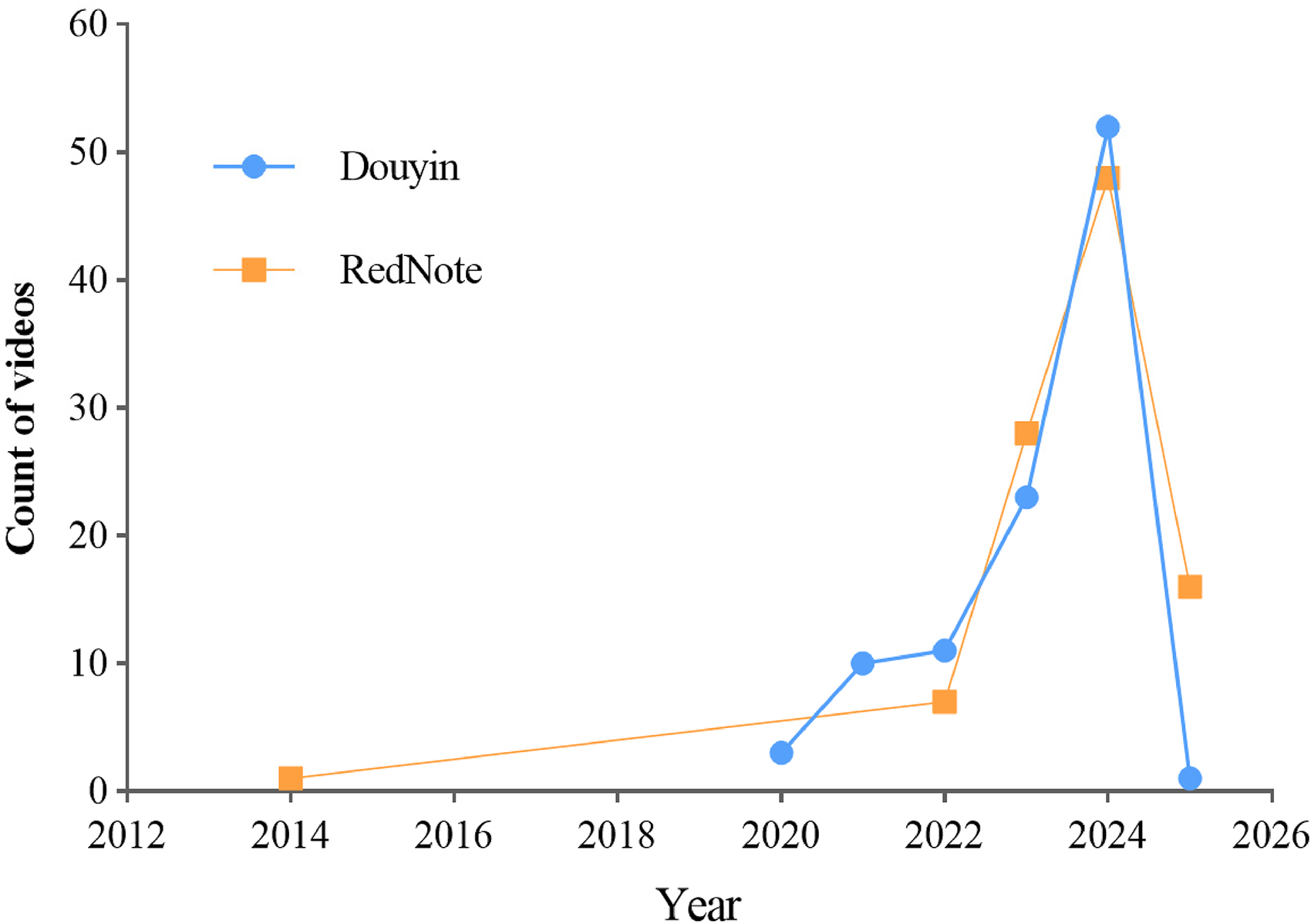
Line chart showing 200 eligible videos on palliative care released between 2014 and 2025 that met the inclusion criteria.
Palliative care video characteristics on social media.
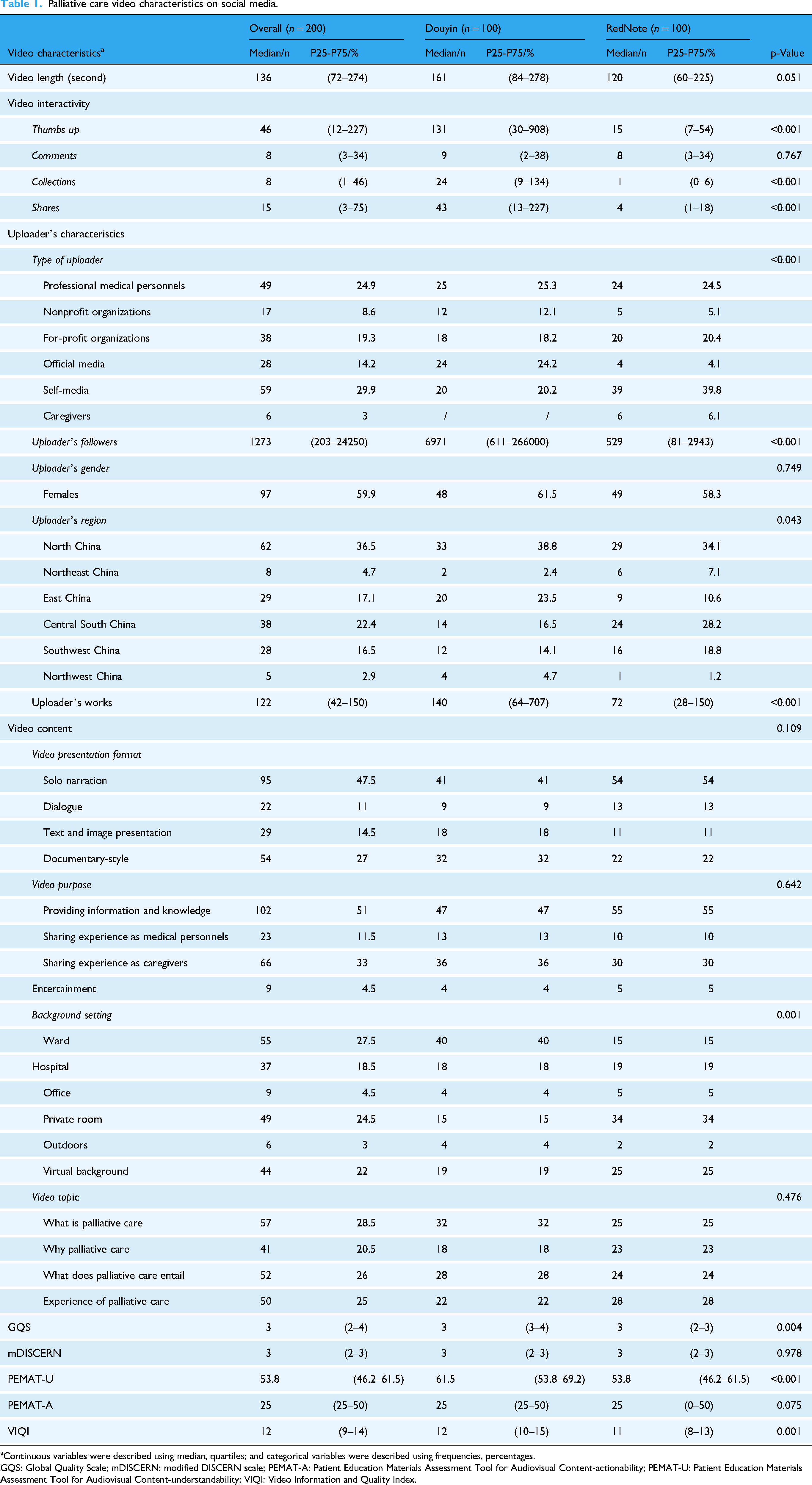
Continuous variables were described using median, quartiles; and categorical variables were described using frequencies, percentages.
GQS: Global Quality Scale; mDISCERN: modified DISCERN scale; PEMAT-A: Patient Education Materials Assessment Tool for Audiovisual Content-actionability; PEMAT-U: Patient Education Materials Assessment Tool for Audiovisual Content-understandability; VIQI: Video Information and Quality Index.
Uploader characteristics
There were 82 uploaders on Douyin, 67 on RedNote. Regarding the type of uploader on Douyin, a quarter of the uploaders are professional medical personnels (25.3%), with approximately another quarter being official media (24.2%), followed by self-media authors (20.2%). As for the palliative care videos uploaded on RedNote, the largest group comprises nonprofessional self-media (39.8%), followed by professional medical personnels (24.5%) and for-profit organizations (20.4%). The proportion of caregivers posting palliative care videos on social media is minimal, with only six RedNote uploaders being caregivers who have received palliative care (6.1%). In terms of the geographic distribution of uploaders, on the Douyin social media platform, most uploaders are from North China, followed by East China. On RedNote, the majority of uploaders are from North China and Central-South China. In addition, uploaders on Douyin owned significantly larger number of followers and uploaded videos more frequently (all p < 0.001).
Contents of videos
After reviewing 200 videos, the data indicates that on the Douyin platform, the most common presentation style for palliative care videos is the solo narration format (41.0%), followed by documentary-style videos (32.0%). RedNote exhibits a similar pattern, with a higher proportion of videos using the solitary narration format (54.0%). In terms of video purpose, both the Douyin and RedNote platforms have generated more videos focused on knowledge and information dissemination (47.0% and 55.0%, respectively), as well as videos sharing the palliative care experiences of patients and caregivers (36.0% and 30.0%, respectively). Additionally, some healthcare professionals and palliative care volunteers shared their experiences of providing services (13.0% and 10.0%, respectively). Additionally, a further analysis of the differences in the video creation purposes by different identities of uploaders reveals that professional medical personnel, regardless of the platforms, tend to share more knowledge and information (n = 17, 68% and n = 15, 62.5% for Douyin and RedNote, respectively). In contrast, public media are more inclined to share experiences related to palliative care (n = 16, 66.7% and n = 3, 75% for Douyin and RedNote, respectively). Furthermore, self-media creators on RedNote also produce a significant amount of knowledge transmission videos (n = 28, 71.8%), despite the absence of clear palliative care certification labels on the video interface (Figure 4).

Video purposes by different identities of video uploaders about palliative care on Douyin (a) and RedNote (b).
There are differences in the visual background characteristics of videos across platforms. On the Douyin platform, the majority of videos feature hospital ward backgrounds (40.0%), with virtual backgrounds (19.0%) and hospital settings (18.0%) also being relatively common. In contrast, videos on the RedNote platform predominantly feature private room settings (34.0%), followed by virtual backgrounds (25.0%) and hospital environments (19.0%). Furthermore, on the Douyin platform, the most common videos topics are those that introduce what palliative care is and those that share experiences of palliative care practice. In contrast, on the RedNote platform, the four palliative care themes appear more evenly distributed.
Quality analysis of videos
The consistency between the two reviewers for GQS scores, mDISCERN scores, PEMAT-U scores, PEMAT-A scores, and VIQI scores were good, with ICC of 0.95, 0.93, 0.86, 0.88, and 0.91, respectively. The cross-platform analysis resulted in an overall GQS score of 3 (2, 4), mDISCERN score of 3 (2, 3), PEMAT-U score of 53.8% (46.1, 61.5), PEMAT-A score of 25% (25%, 50%), and VIQI score of 12 (9, 14) for the included videos. Statistical analyses revealed that videos on Douyin tended to obtain higher GQS, PEMAT-U, and VIQI scores compared to those shared on RedNote (all p < 0.01).
Correlation and univariate analysis
Since all variables do not meet the normal distribution, we used Spearman correlation analysis to assess the correlation between continuous variables (Figure 5) and univariate analysis for categorical variables (Table 2). Data analysis reveals that the video rank is negatively correlated with the number of likes (p < 0.001), collections (p < 0.001), comments (p < 0.001), shares (p < 0.001), and the number of followers of the uploader (p = 0.015). In other words, videos with higher audience interactivity (likes, collections, comments, shares, and followers) are more likely to be viewed earlier. The video interactivity index is generally positively correlated with the uploader's number of followers (all p < 0.001), the number of uploaded works (all p < 0.01), and the duration of the video, while also being influenced by the type of uploader (all p < 0.05), presentation format (all p < 0.05), video purpose (all p < 0.05 except for that of share count), and background setting (all p < 0.05 except for that of comment counts). Video quality is related to both the video interactivity index (all p < 0.05 except for that of comment count) and the uploader's follower count (all p < 0.01), but also influenced by the uploader's identity type (all p < 0.05) and the video's purpose (all p < 0.05 except for that for PEMAT-U scores). Further univariate analysis shows that videos uploaded by official media, with a documentary presentation format, a purpose of sharing or receiving palliative care experiences, and a hospital ward background, received higher viewer interaction indices (all p < 0.05). Additionally, videos uploaded by official media and with the purpose of sharing palliative care experiences received higher quality ratings (all p < 0.05). Given potential false positives and issues of reliability and validity, we did not perform multiple comparison analyses. We either did not perform linear regression to adjust for confounding effects, given that data did not follow a normal distribution.
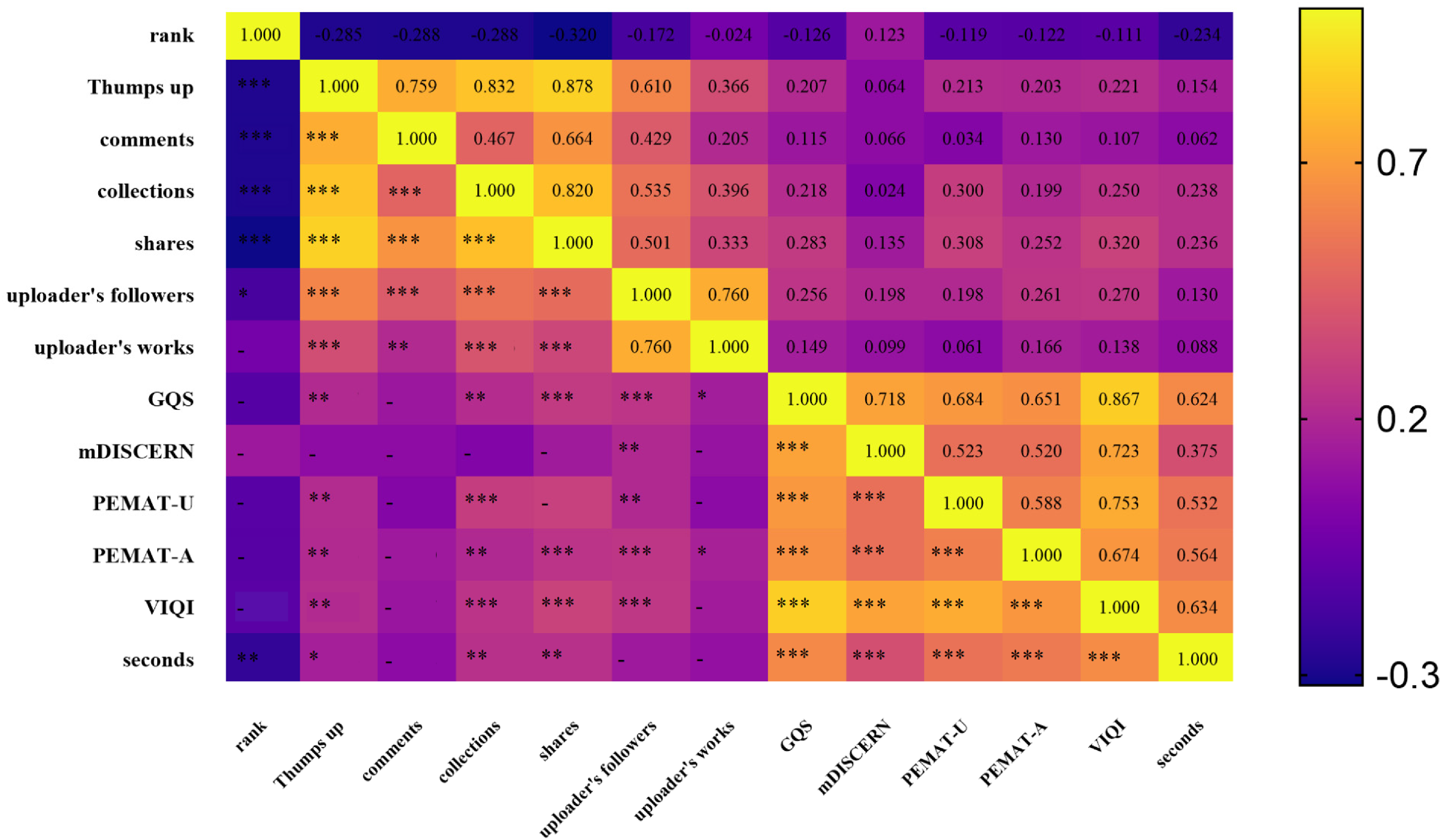
Spearman analysis for continuous characteristics about palliative care videos.
Univariate analysis of video interactivity index and quality scores.

GQS: Global Quality Scale; mDISCERN: modified DISCERN scale; PEMAT-A: Patient Education Materials Assessment Tool for Audiovisual Content-actionability; PEMAT-U: Patient Education Materials Assessment Tool for Audiovisual Content-understandability; VIQI: Video Information and Quality Index.
Discussion
This cross-sectional study systematically evaluated the characteristics and multifaceted quality of palliative care-related short videos on two leading Chinese social media platforms, Douyin (the Chinese counterpart of TikTok) and RedNote. The analysis revealed distinct publication trends, with most videos uploaded since 2022, coinciding with national policy initiatives to expand palliative care services. Videos on Douyin demonstrated significantly higher audience engagement across most interactivity metrics (likes, collections, shares) and received higher overall quality scores compared to those on RedNote, although the median quality across both platforms remained moderate. Content analysis indicated that solo narration was the predominant presentation format, primarily aimed at knowledge dissemination, while documentary-style and experience-sharing videos, though less common, were associated with higher user engagement. Furthermore, video quality and interactivity were significantly influenced by uploader identity and video purpose, with official media and experience-sharing content generally achieving better performance.
The diversity of uploader identities was a notable finding, with professional healthcare providers accounting for only a quarter of palliative care video uploads. In contrast, self-media influencers and for-profit organizations have emerged as significant contributors, holding a proportion comparable to that of healthcare professionals and nonprofit organizations. This contrasts with studies in other specialized medical fields, where professionals often dominate content creation.12,28 This discrepancy may be attributed to the still-developing status of palliative care as a specialized discipline in China, a relative lack of formal certification for social media content creation in this field, and potential institutional restrictions on healthcare professionals’ public communications.29–31 As for the results about audience engagement, the significant disparity between the number of likes and shares suggests that users are more inclined to passively consume information rather than actively disseminate it. It reflects a nascent stage of public engagement with palliative care topics. Geographically, uploaders were concentrated in more developed regions, mirroring disparities in clinical palliative care resources 32 and highlighting the need for strategies to promote content creation in underserved areas. Furthermore, most videos use a solo narrative format to provide basic palliative care education. This contrasts with findings from Western contexts 15 but aligns with patterns observed in Chinese short-video health content.12,18 The difference likely reflects cultural variations in physician–patient relationships. Western models emphasize shared decision making,33,34 whereas China's physician-directed model may lead to passive information seeking, contributing to more expert-driven narrative videos. 35 These findings suggest that short-video social media platforms can further promote palliative care by improving the registration and management of healthcare professionals and balancing regional access to palliative care services. At the same time, the use of corresponding evaluation tools may enhance the quality control of knowledge dissemination videos produced by nonprofessionals.
A critical contribution of this study is its detailed, multidimensional quality assessment. The quality dimension (assessed via GQS) was moderate (median = 3), indicating acceptable production standards but a lack of excellence in flow and usability. Besides, the terminology used to describe palliative care in Chinese videos was inconsistent. Some videos labeled as palliative care but focused on terminal care, end-of-life nursing, or death education. Similar issues have been reported in the literature, highlighting that palliative care professionals still lack sufficient competency in such areas. 36 The reliability dimension (assessed via mDISCERN) was also moderate (median = 3), primarily undermined by the infrequent citation of credible sources. Only two videos referenced academic literature, and a minority mentioned national policies. The majority of the videos lacked scientific or credible sources to support their content. Furthermore, very few videos addressed the legal and ethical aspects of palliative care. This finding aligns with studies on other health topics, which also report inconsistent sourcing and potential ethical issues on social media. 37 The comprehensiveness of information within palliative care short videos was assessed based on the inclusion of several key informational domains deemed essential for public understanding. The interpretability and practicality dimension (assessed via PEMAT-A/U) revealed a significant weakness in actionability. While information was often understandable, videos frequently failed to provide clear, actionable steps for viewers, limiting their practical utility. Finally, the educational quality (assessed via VIQI) was modest, suffering from suboptimal information flow and a lack of depth in covering nuanced aspects of care, such as specific palliative therapies (e.g. music therapy, aromatherapy) or ethical considerations. The overall moderate scores across these dimensions are consistent with analyses of health information on short-video platforms globally, suggesting a common challenge in balancing brevity and engagement with informational depth and accuracy. 13 Given China's social and cultural context, where death is often a taboo subject and families may face moral pressure during end-of-life decision making, it is essential to address both the promotion of a dignified death and the establishment of a robust medical information and legal support system for palliative care services.
Our analysis revealed significant relationships between specific content characteristics and video quality metrics. Videos employing a documentary-style format and those sharing personal experiences consistently demonstrated higher scores across multiple quality dimensions. This finding aligns with previous research on health communication through social media, which indicates that narrative-based content tends to enhance viewer engagement and information retention.38,39 The positive correlation between experience-sharing content and quality metrics may be attributed to the practical insights and emotional resonance that standardized educational content lacks. Conversely, videos utilizing solo narration format, while predominant in our sample (47.5%), showed relatively lower actionability scores. This pattern has been observed in similar studies evaluating patient education materials, where passive information delivery formats often fail to provide concrete guidance for self-management. 40 The significant association between uploader identity and video quality further emphasizes the importance of content source credibility. Official media accounts consistently produced higher-quality content, likely due to their access to professional resources and institutional review processes, echoing findings from studies on health information dissemination in other medical domains. 18 Notably, we observed that videos with hospital ward settings received higher engagement metrics but did not necessarily achieve superior quality scores. This discrepancy suggests that while clinical environments may enhance perceived credibility and attract viewer attention, they do not automatically ensure content quality. 41 The weak correlation between video duration and quality indicators further reinforces that content quality depends more on substantive factors than production length, consistent with best practices in digital health communication. 42
There are some limitations to this study. First, we limited our analysis to two social media platforms in China, without examining other platforms such as YouTube. However, the primary focus of this study was to analyze short video platforms within the context of Chinese culture, which are more accessible to diverse cultural levels. Additionally, during the data collection process, it was inevitable that information about video uploaders and featured individuals was presented to the authors, which may introduce potential bias in the evaluation. Furthermore, this study analyzed the top 100 videos from each platform, which may limit the generalizability of the findings to other platforms. Finally, some videos inevitably appeared on multiple platforms. However, as these videos were part of the content loaded onto the platforms, they were included in the quality analysis.
Conclusion
This cross-sectional analysis reveals that short videos on palliative care on the Douyin platform have higher popularity and credibility compared to those on the RedNote platform. However, the quality of videos on both platforms remains generally moderate, necessitating viewers to critically assess the accuracy of the information presented. Future short-video platforms should enhance the certification of professional palliative care healthcare providers and improve the comprehensiveness of information (e.g. core principles, misconception clarification). It is also important to note the broader, well-documented shortage of palliative care specialists within the healthcare system. Therefore, while platform-level certification initiatives are encouraged, they should be viewed as one component of a larger strategy addressing systemic workforce gaps. Additionally, it is crucial to encourage the public, particularly those with firsthand palliative care experience, to actively share their subjective experiences. Official media and healthcare professionals should also focus on enhancing the practical and detailed aspects of palliative care education, ultimately promoting greater public access to and understanding of palliative care.
Footnotes
List of abbreviations

Ethics approval and consent to participate
This cross-sectional study utilized publicly accessible and downloadable data sourced exclusively from TikTok and RedNote videos. The social media data was sourced responsibly, contains no identifiable personal information, and complies with the platform's terms of use and relevant ethical guidelines. No clinical trials, human tissue samples, or identifiable information related to individual users or IDs were involved in this research, and therefore, ethical approval was not required.
Guarantor
Zeyi Zhang, as the guarantor of this work, assumes full responsibility for the integrity of the research and the accuracy of the data.
Consent for publication
Not applicable.
Contributorship
ZZ and XC contributed to video search and data collection. XC and HC contributed to quality assessment and data analysis. ZZ was the major contributor in writing the manuscript. MD is responsible for review and modification of the manuscript. All authors read and approved the final manuscript.
Funding
The authors received no financial support for the research, authorship, and/or publication of this article.
Declaration of conflicting interests
The authors declared no potential conflicts of interest with respect to the research, authorship, and/or publication of this article.
Data availability statement
The data used and analyzed during the current study are presented in the manuscript.