



Abstract
Objectives
Social media use has expanded rapidly across healthcare, creating opportunities for professional networking, patient engagement, and education. However, difficulties have arisen in workplace support of social media use as opinions on professionalism differ among generations. There is no consensus on how social media professionalism is defined and enforced. Our objective is to examine healthcare professionals’ perceptions of professional versus unprofessional social media behaviors, explore generational differences, and identify gaps in training and institutional guidelines.
Methods
We conducted a cross-sectional, quantitative survey at a large academic medical center. The survey, developed and pilot-tested for clarity and content validity, was distributed via institutional listservs to medical students, nurses, advanced practice providers, and physicians across multiple specialties. Respondents reported demographics, social media usage patterns, account types, and views on appropriateness of specific content for private versus public accounts. Bivariate analyses using chi-square and Fisher's exact tests were carried out to compare responses across age groups.
Results
Of 389 consenting participants, 260 (67%) completed the survey. Most respondents were female (75.4%) and White (75.2%). Facebook and Instagram were the most common platforms (51.5% each). Generational differences emerged: younger participants (18–40 years) were more permissive of personal and lifestyle posts, while older groups (41–60 and 60+) were more restrictive. Most participants (84%) reported never receiving formal training on social media professionalism, though 69.8% endorsed its value, particularly at the medical school level. Awareness of standardized institutional guidelines was limited (43%).
Conclusions
Generational differences influence perceptions of social media professionalism in healthcare. Despite widespread social media use, formal training and guideline awareness remain limited. These findings support the need for structured education on digital professionalism and clearer institutional policies to balance personal expression with professional standards.
Background
The advent of social media and its growth over the last several decades have enhanced interconnectedness across communities and created a foundation for sharing information and experiences. For the medical community, this has provided a multitude of benefits including professional networking, patient engagement, and dissemination of health-related information. However, challenges have also arisen around confidentiality, professionalism, and the distinction between evidence-based content and misinformation. Although guidelines exist,1–3 there is no consensus on what constitutes professionalism in online behavior. Prior literature has highlighted both benefits and risks of social media in healthcare,4–13 but there remains limited understanding of how generational perspectives shape views of professionalism in healthcare social media use.
This study aimed to determine the purposes for which healthcare professionals use social media, their perceptions of what constitutes professional or unprofessional behavior, and whether generational differences contribute to these perceptions. Additionally, we sought to explore gaps in training and guideline awareness regarding social media professionalism.
Methods
After obtaining institutional review board approval, we conducted a cross-sectional, quantitative survey study at a large academic medical center. The survey was created in REDCap and distributed via institutional email listservs to medical students, nurses, advanced practice providers, residents, fellows, and attending physicians across multiple specialties, and responses were anonymized. The instrument underwent multidisciplinary review for content validity and pilot testing for clarity. The survey remained open for 12 weeks, with one reminder at 8 weeks. Completion implied consent. No incentives were offered upon distribution.
The survey was disseminated to the following departments within our institution: general surgery, pediatric surgery, urology, orthopedic surgery, pediatrics, psychiatry, ophthalmology, family medicine, internal medicine and all subspecialties, anesthesia, otolaryngology, neurosurgery, obstetrics and gynecology, radiology, radiation oncology, emergency department, medical, neurologic, trauma and surgical critical care units. Demographic information was collected, including age, gender identity, sexual orientation, race/ethnicity, credentials (e.g. RN, MD, PA, NP, and PT) and the department or specialty in which they work. Age groups were set to reflect current generational age ranges. Participants were asked a series of questions regarding their own social media use and which types of social media platforms they utilize from the following selection of choices: Facebook, Instagram, X (formerly known as Twitter), TikTok, Threads, Snapchat, and LinkedIn, along with the option of “other” for free response.
The survey then prompted respondents to indicate the nature of their social media and if they primarily used public or private accounts on those platforms. This was followed by an identical series of questions regarding their perceptions on sharing specific content under the two hypothetical scenarios of using a private or public account. This method was to distinguish whether or not the context in which a social media account was being used affected what was deemed as professional or appropriate social media behavior. We then asked respondents about how these views had changed over time, if they had ever received training on professional social media use and, if so, at what stage in their career. Finally, we inquired about awareness of institutional social media standards and if guidelines should be implemented where absent.
Data from the surveys were stored in a secure, password-protected REDCap database during analysis. Categorical variables were summarized by frequencies and proportions while continuous variables were summarized by mean, median, range, and standard deviations. Bivariate analyses using chi-square or Fisher's exact tests examined associations across age groups. Statistical significance was set at a p-value <0.05. All analyses were performed using SAS 9.4 (SAS Institute, Cary, NC).
Results
Participant demographics
The survey was disseminated to approximately 500 healthcare professionals and was concluded at approximately a 52% response rate. At survey closure, 389 participants had consented, with 260 completing the survey (completion rate 66.8%). Among respondents, 75.4% identified as female. The majority identified as White (75.2%), with 8.0% identifying as Asian/Pacific Islander, 3.4% African American, and 4.6% Hispanic. Age groups were as follows: 29.7% was aged 18–29, 41.7% 30–40, 19.7% 41–60, and 8.9% 60+. Physicians and nurses comprised 64.3% of the sample, with physician assistants (13.3%), nurse practitioners (14.5%), and medical students (2.2%) also represented (Table 1).
Participant demographics.

Characterization of social media use
Facebook and Instagram were the most commonly used platforms (51.5% each), followed by TikTok (26.7%) and Twitter (17.2%). Daily time spent on social media was evenly distributed: 21% reported 0–30 min, 24.5% 30–60 min, 29.2% 60–120 min, and 25.3% >2 h. Most used social media to connect with family/friends (55.1%) and share/receive news (39.2%), while professional uses such as networking (18.5%) or continued medical education (10.5%) were less common (Table 2).
Characterization of participant social media use.

Proportions do not add up to 100% as respondents were able to choose all options that applied.
Public versus private accounts
There were 23.9% who reported personal, public accounts; 43.3% reported personal, private accounts; and only 6.4% of participants indicated using professional accounts of any kind.
If participants had separate private and public social media accounts, they were then asked to express their reasoning. Of these participants, 43.3% signified that they do not have separate private and public accounts while 23.9% participants expressed the opposite. The most commonly indicated reason for maintaining separate accounts was concern for patients being able to find and follow the account (7.2%), while 4.4% were concerned about violating professional norms and negatively impacting their own reputation or the reputation of the healthcare profession in general, and 1% and 1.3% demonstrated concern for receiving or sharing inaccurate medical information and for patient confidentiality, respectively (Table 3).
Participant attitudes toward public versus private social media accounts and content.

Proportions do not add up to 100% as respondents were able to choose all options that applied or no options.
Perceptions of appropriate content
Overall, the majority of older (60+ years) participants expressed that healthcare professionals generally should not post any content they desire regardless of using a private (61%) versus public (87%) social media account. Meanwhile, participants aged 18–40 indicated healthcare professionals should be able to post any content they prefer whether using a private (71%) or public (55%) account. The 41–60-year-old age group differed in that respondents said healthcare professionals should be allowed to post whatever content they desired if using a private social media account (75%), but not if using a public account (60%).
Younger participants (18–40) were more permissive about posting personal, political, or religious content and profanity while older groups were more restrictive. The majority of participants in each age group agreed that posting medical information and education topics is acceptable regardless of whether or not one is using a private or public account. However, the 60+ age group was more likely to disagree that medical information and education should be freely posted in the setting of a public social media use (48% and 35%, respectively). Of those aged 18–29, 79% considered alcohol-related posts acceptable on private accounts, versus 22% of those 60+. Regarding partial nudity (i.e. wearing a bathing suit), 65% of 18–29-year-olds, 58% of 30–40-year-olds, and 53% of 31–60-year-olds agreed that these posts were appropriate for healthcare professionals to post on private accounts with these percentages decreasing to 40%, 31%, and 34%, respectively, when using public accounts. Across all ages, illicit drug use and full nudity were deemed unprofessional regardless of account type. The majority in all age groups agreed that healthcare professionals should be allowed to designate the institution at which they are employed if they wish, regardless of account type. The majority of all respondents indicated that their aforementioned opinions would not change if the healthcare professional, either with a private or public account, had a target audience in which these topics were widely accepted in that community. Generational differences are summarized in Tables 4 and 5.
Ratings based on age group of specific types of social media content and whether or not participants agree they are appropriate for posting when using a

*p-value for Fisher’s exact test.
Ratings based on age group of specific types of social media content and whether or not participants agree they are appropriate for posting when using a

*p-value for Fisher’s exact test.
Training and awareness
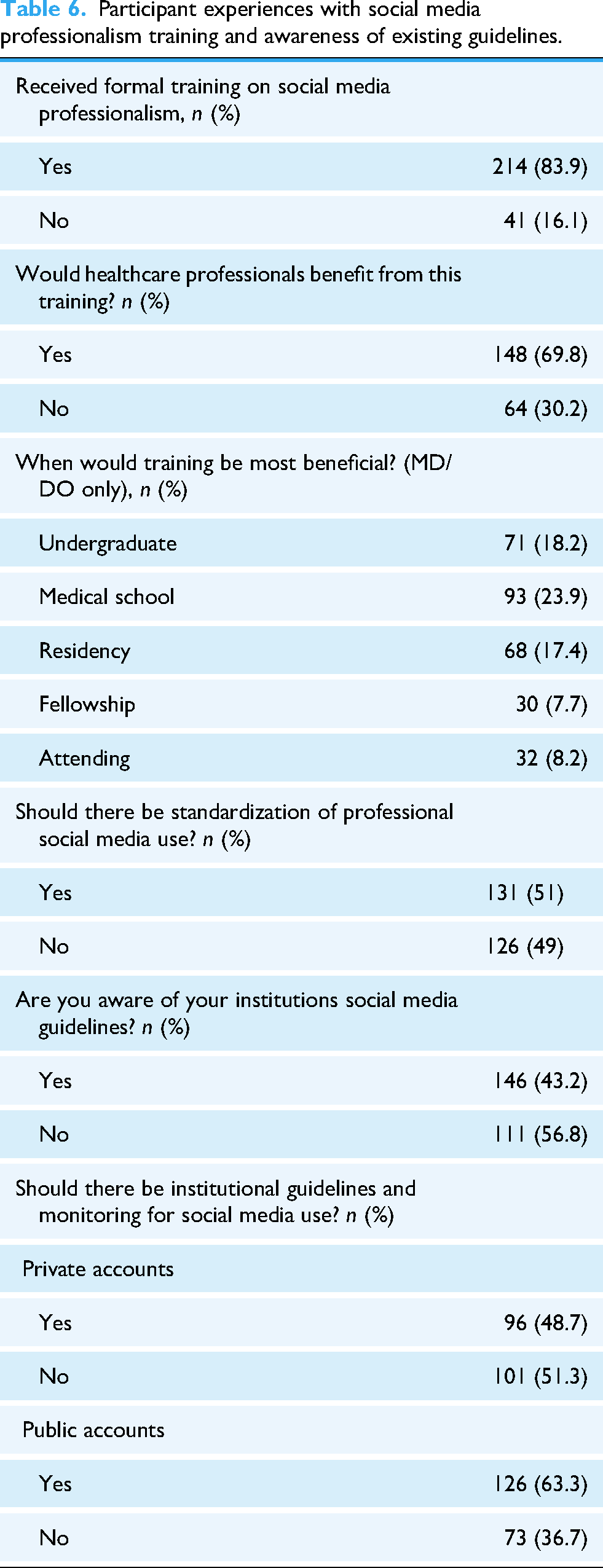
The majority of all respondents (84%) reported never receiving formal training on professional social media use, yet 70% believed training would be valuable. Among physicians, medical school was most often selected as the appropriate stage for training (24%). Only 43% were aware of institutional social media guidelines, and opinions were split on whether standardized guidelines should exist (51% in favor and 49% opposed) (Table 6).
Participant experiences with social media professionalism training and awareness of existing guidelines.
Discussion
The rise of social media has increased interconnectedness and provided the ability to share and receive information with increasing ease. Social media in healthcare has become a prominent tool for enhancing the dissemination of health-related topics such as vaccines, illicit drugs, mental health, and clinical trials to name a few. Social media has provided a platform for patients and providers to join support groups centered around a shared disease process. 6 Expanding globalization through social media platforms has also created unprecedented ethical issues in all spheres of professionalism. As individuals’ lives are progressively more in the public eye, they are also under more scrutiny than ever before. The issue at hand is ensuring that employees accurately portray the interests of the organization while allowing them to retain their individuality. Determining what should be permitted on social media and what should be prohibited is difficult without a generalized consensus and standardized guidelines. Social media in the medical community has produced its own set of ethical considerations.8–13 Although social media can allow healthcare professionals to more efficiently engage with colleagues, connect with patients, and share or receive health-related information, there is growing apprehensiveness centered around patient confidentiality and workplace support of social media use.4,7 Ease of access to an increasing amount of information presents the challenge of discerning what is truly evidence based and accurate. 4 Additionally, there are potential dangers of legal issues and disciplinary action for those who may cross these poorly defined boundaries. 7 Various guidelines have been published in an effort to establish professional norms and considerations for healthcare workers when using social media.1–3 However, these guidelines differ greatly and provide no official consensus on the definition of professional social media use.
There are also important generational differences to take note of when assessing what should be considered professionalism on social media. Faculty physicians typically belong to the Boomer and Generation X generations with increasingly more Millennials beginning to enter into the attending sphere. On the other end of the spectrum, members of Generation Z and Alpha are entering the medical field as new residents, interns, and medical students. The younger the healthcare professionals are, the more likely they are to have grown up completely immersed in the digital age. There are known stereotypes that not only do individuals from older generations not know how to use technology as efficiently but also that their views on topics like professionalism and social media use are typically more conservative. Discordantly, younger generations are familiar with posting about their personal lives posted on the internet and seeing their peers follow suit. 14 Older generations are not as accustomed to networking, receiving news, or engaging with medical information online, 14 whereas younger generations have been sharing their opinions, experiences, and knowledge on social media websites for most of their lives. 14
This generational phenomenon is highlighted by a recent study that, although retracted for issues involving bias and unethical experimental design, evaluated the publicly accessed social media accounts of young vascular surgery trainees for professionalism. Unprofessional behavior included, but was not limited to, photos of intoxication, posts disparaging colleagues or employers, or posts regarding controversial religious and political topics. This article expressed that 40% of adults searched for their physician online and warned that young surgeons should be more aware of the content being easily accessed by patients and peers. The paper was perceived by many young healthcare professionals as severely outdated and misogynistic. Although not the intention, it did ultimately reflect generational differences in what is considered appropriate online behavior for healthcare professionals.15,16
We wanted to assess the purposes for which healthcare workers are using social media and what behaviors they personally consider to be professional or unprofessional. We also aimed to delineate the differences in opinion on social media professionalism that exist between generations. Our survey had 260 participants consisting mostly of physicians or nurses with some medical students, physician assistants, and nurse practitioners and a wide variety of medical and surgical specialties represented. Facebook and Instagram were the most commonly used social media platforms, and the average time participants spent daily using social media ranged from 0 to 30 min to 2+ h. The majority of respondents stated that they use social media for connecting with family and friends or sharing and receiving news. In fact, very few participants indicated using social media to connect with colleagues, share medical information, or engage with patients.
It is increasingly more common for social media users either to create all private accounts or to have separate private and public accounts.17–19 As the digital age advances and people are chronically online, there is a growing sentiment that our lives should not be publicly on display at all times. There is a movement toward social media users employing more discretion for what content is appropriate for the public eye and what should be kept to oneself. Additionally, generational differences are thought to play a role in this as older generations tend to be more hesitant to post about personal matters online. In our study, we saw this phenomenon reflected in the fact that participants most frequently stated they used personal, private social media accounts regardless of age group. However, clear generational differences did arise later in the survey as participants were asked to rate whether or not they agreed, disagreed, or were neutral on specific types of content being appropriate for healthcare professionals to post. Participants rated the same content type under the two different hypothetical scenarios of using a private account and using a public account. Overall, participants in the older age groups were more likely to indicate that healthcare workers should not be allowed to post freely what they desire on social media regardless of what type of account is being used. It was the opposite for the younger age groups who were more likely to believe that healthcare workers should be able to post freely what they desire on either a public or private account. This trend remained consistent for posts about personal life, religious beliefs, political views, and medical information/education. However, the oldest age group was less likely to agree that posts about personal life were appropriate for public social media accounts. Furthermore, they disagreed that religious beliefs, political views, medical information, and education should be posted about on public social media accounts. The other topics that rendered generational differences were photos insinuating alcohol use, partial nudity, and profanity. All age groups agreed photos containing alcohol use were appropriate to post on private accounts, with the youngest age group disagreeing for public accounts and the oldest age disagreeing for both public and private. Also, the oldest age group was more likely to disagree that partial nudity and profanity should be posted privately or publicly. Very few participants agreed that photos insinuating illicit drug use or full nudity were acceptable for either type of social media account. The disparities that were revealed in responses among the various age groups certainly support the hypothesis that individuals in older generations tend to be more conservative not only in their use of social media but also in what they deem as suitable online content. This is contrasted with individuals in younger generations having more of an online presence with more lenient views on what content is and is not satisfactory for posting. It is possible, however, that these opinions about what is and is not professional social media behavior can change. This can be justified by half of the participants in each age group indicating that they had experienced a change in their opinions on professional social media use over time.
A key aim of our study was also to elucidate what gaps exist in the education and training of healthcare workers on professionalism with social media use. Our overarching goal is to further identify the need for training on professional social media use within the healthcare community. It was apparent that the consensus from our respondents was that most had never received any type of training on social media use as a healthcare professional. When participants did have training, they described it as mostly via mandatory Health Insurance Portability and Accountability Act (HIPAA) training and how not to violate a patient's privacy. Rarely was there a description of a lecture or modules specifically on professional online behavior. It can also be concluded that most believe social media training would be beneficial at some point throughout medical training. Additionally, there was no consensus on whether or not there should be a general standardization, at any level (i.e. institutional, state, or national), of guidelines for how healthcare professionals should use social media. This was followed by approximately half of respondents denoting not being aware of any specific guidelines for social media use set forth by their employer, but over half stating that institutions should establish clear guidelines. O’Connor et al. supported this with a literature review that concluded that a key recommendation in social media professionalism training is setting clear boundaries and pedagogical instructions. 20 Although there have been some examples of rigorous and impactful social media professionalism training like that of Gomes et al., there remains a massive gap for healthcare professionals in this realm. 21 While the goal is certainly not to constantly police what each employee is posting on their accounts or encroach on an individual's rights through censorship, being able to provide some amount of structure may be helpful. Comparative fields such as law, education, and business have already integrated digital ethics into curricula, suggesting healthcare could benefit from similar approaches. It is important to be aware that, for better or worse, opinions on what is professional and appropriate content for social media will always vary by different demographic groups and can impact one's impression of the person posting. These opinions are also flexible and can change over time. The variations in perceptions of social media professionalism impedes the ability to inform best practices and label specific topics as either acceptable or not for posting. 22 Instead, it should prompt training healthcare professionals to engage in more educated and informed posting on social media.
The medical community has experienced many benefits from the advent of social media. It has also created challenges, especially along the lines of how healthcare professionals should portray themselves and their profession online. Our study has demonstrated that generational differences do exist in what is considered professional social media behavior. We also saw that what is considered acceptable social media content can depend on the context of using a private or public account. These conclusions point to a need for improved training and standardization of guidelines on professional social media use for healthcare professionals.
Implications
Structured education and clearer institutional guidelines are needed to balance personal expression with professional standards. Case-based teaching and role-play exercises may help clinicians navigate gray areas.
Limitations
Conducted at a single institution, this study may not generalize broadly. Reliance on self-report may introduce bias, and descriptive analyses limit deeper inferences. Future studies should include multi-institutional samples, validated survey tools, and inferential analyses.
Future directions
Comparative research with other professions and longitudinal studies of clinicians across their careers may clarify whether generational differences persist or converge over time.
Conclusion
Social media has created an unprecedented global interconnectedness within the last decades since its inception. Although social media can allow healthcare professionals to engage with colleagues more efficiently, connect with patients, and share or receive health-related information, there is growing apprehensiveness centered around patient confidentiality and workplace support of social media use. This is further challenged by the lack of comprehensive and universal guidelines on what content is appropriate for posting as a medical professional. Often, the rules that guide social media professionalism vary by demographic subgroups. Our survey study has shown evidence of these differences specifically among generational age groups. Overall, participants in the older age groups were more likely to indicate that healthcare workers should not be allowed to freely post what they desire on social media, specifically on the topics of personal life, religious beliefs, political views, and medical information/education. Younger generations considered that posting photos insinuating alcohol use or partial nudity (i.e. bathing suit) was appropriate while the older generations disagreed. All generations agreed that photos insinuating illicit drug use or full nudity were not appropriate or professional. Additionally, healthcare professionals scarcely receive adequate education and training on social media professionalism. Thus, our study has demonstrated that generational differences do exist in what is considered professional social media behavior. These conclusions point to a need for improved training and standardization of guidelines on professional social media use for healthcare professionals.
Footnotes
Acknowledgements
The authors thank Rachel Davis, MD, for proofreading and language assistance.

Ethical approval
This study received ethical approval from the University of Oklahoma Health Sciences Center IRB (IRB #16517).
Informed consent
Written informed consent was obtained by each participant at the beginning of the survey for anonymized participant information to be published in this article.
Funding
This research did not receive any specific grant from funding agencies in the public, commercial, or not-for-profit sectors.
Declaration of conflicting interests
The authors declared no potential conflicts of interest with respect to the research, authorship, and/or publication of this article.