




Abstract
Background
Monitoring of inhaler use in high-risk children has the potential to reduce asthma attacks and asthma-related deaths. We, therefore, undertook the first UK primary care study to identify high-risk children and young people by searching primary care health records and provided the Hailie® smart inhaler to monitor their asthma medication usage. In this article, we present data from the nested qualitative study, conducted with key stakeholders.
Methods
This qualitative interview-based study explored a range of topics relating to the experiences of paediatric asthma care and management, including the use of the Hailie® smart inhaler, from the perspectives of the children, their parents/carers and healthcare professionals. Interview transcripts were generated and thematically analysed.
Results
Six parent–child dyads and one parent were interviewed, either online or face-to-face. Additionally, three healthcare professionals (1 Nurse, 1 Pharmacist and 1 Practice Manager) involved in paediatric asthma care and/or management were also interviewed. Two specific themes were identified: Firstly, app-based monitoring was generally viewed positively and was reassuring to parents. Children also appreciated learning about using their inhalers. Secondly, challenges with synching were identified and users had some practical suggestions for improvement. Healthcare professionals also observed that monitoring should not replace clinical support for self-management.
Conclusion
Our findings support the acceptability and usefulness of the Hailie® smart inhaler amongst children with high-risk asthma, although some technical difficulties need to be addressed. Further research is needed to assess effectiveness in clinical care management.
Introduction
Around one million children and young people (CYP) in the United Kingdom (UK) live with chronic asthma, the most common non-communicable long-term medical condition in UK CYP. 1 On average, one child dies from asthma every 4 weeks in the UK. 2 The death rate for children living in the most deprived neighbourhoods of England is four times higher compared to the least deprived and it was identified that the majority of children who died had experienced at least one severe asthma attack in the year prior to their death. 2 These children are also less adherent to their preventer inhaler and collect excessive prescriptions for salbutamol rescue inhaler. 2
Deaths associated with asthma are considered to be largely preventable with improved management and early intervention. 3 Smart inhalers can improve adherence to preventer medication and clinical outcomes, and it has been shown that electronic monitoring of inhaler use in high-risk populations has the potential to reduce asthma attacks and asthma-related deaths.3,4,5,6 Studies involving CYP with asthma managed in primary care are lacking and this is important because the majority of CYP dying from asthma have never been seen in specialist care. 7
In recent years, there have been several technological developments which aim to support patients with asthma. 8 The Hailie® smart inhaler is an example of one such development (see Figure 1).
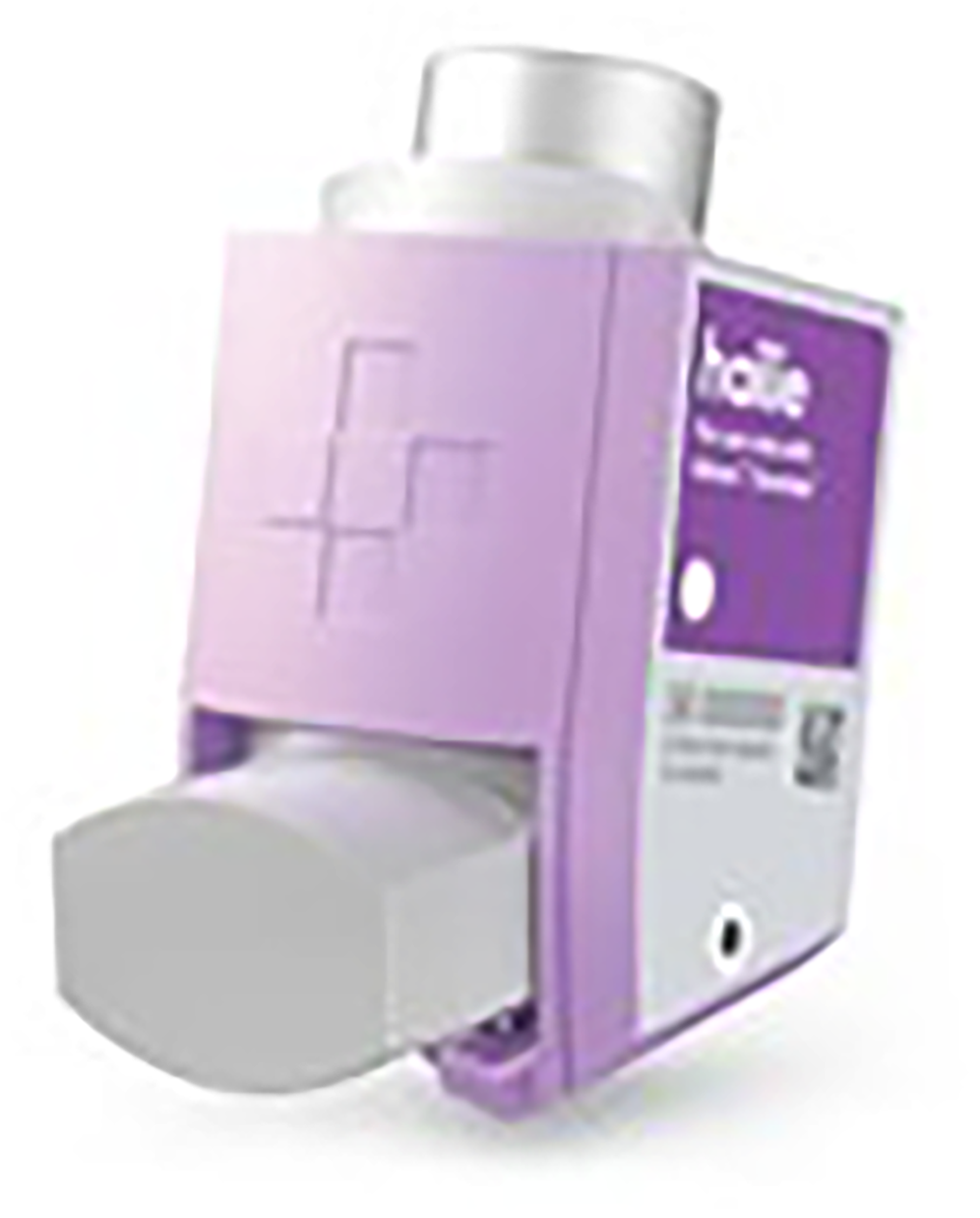
The Hallie® smart inhaler.
The Hailie® smart inhaler attaches onto the CYP's usual inhaler and provides audible reminders to facilitate adherence. It monitors inhaler use and technique and provides feedback to the child and/or their family via a smartphone app. Simultaneously, the child's medical team can access the data online, enabling them to monitor and support families in improving adherence and inhaler technique, with the aim of enhancing symptom control and reducing the risk of exacerbations.
Our study is the first in UK primary care to deploy the Hailie® smart inhaler device to CYP living in Leicestershire with poorly controlled asthma and at high risk of an acute attack. The overarching objective of the study was to test the acceptability and feasibility of remote digital smart inhaler monitoring in high-risk children treated for asthma in primary care. In this paper, we present findings from the nested qualitative study, where we interviewed parents (For parents please read parent and or carer), young people and healthcare providers (HCPs), who were involved in the main study, about their perceptions and experiences of digital smart inhaler monitoring.
Methods
We conducted a prospective observational cohort study in children aged 5–16 years with high-risk asthma managed in Leicestershire/UK primary care between November 2023 and December 2024. For the main study, high risk patients in participating practices were identified from their primary care records, and defined as those with poor asthma control (multiple reliever prescriptions) or recent asthma attacks. Participating practices were selected to represent inner city and rural practices and practices serving affluent and less affluent populations in line with convenience sampling. The children and their carer(s) were invited for an asthma review by their practice by text message or by telephone call and offered the opportunity to take part in the study. After obtaining written informed consent, participating children were issued with a Hailie® smart inhaler by the Study Nurse who conducted a 3-month phone call to check asthma control and feed-back on the adherence data based on information available on the Hailie online platform. All families and CYPs were invited for a face-to-face review including lung function testing at 6 months. The total time that a child remained in the study was 6 months from the issue date of the digital smart inhaler.
All the parents of children who had participated in the main study were subsequently approached by the study research nurse or technical support team (either in person, through email or telephone) to confirm willingness to take part in the qualitative study. Interested participants were given the Participant Information Sheet (PIS) which set out the researcher objectives and interest for the study, and linked up with the qualitative researchers, IQ and MG, who then obtained informed consent. Children (>11 years) and parents were offered the option take part in individual or joint interviews. Healthcare providers from the participating primary care surgeries were invited by the trial team and interested HCPs were linked to the qualitative researchers who followed a similar procedure to formally recruit them into the study.
We had planned to recruit approximately 30 participants (10% of the proposed sample in the main study) which we believed would enable us to achieve data saturation and also give our sample sufficient ‘information power’ to answer the research questions, as suggested in the literature.9,10,11
Interviews were conducted between July and December 2024 with parents, children and HCPs either online using Microsoft Teams or face-to-face depending on participant preference. Interviews were conducted in English by either IQ or MG (who both hold relevant PhDs and interests in health services as professional researchers) using separate topic guides for parents, children and healthcare professionals. Topic guides were developed in consultation with members of an existing paediatric asthma Public and Patient Involvement and Engagement (PPIE) group and key topics covered relate to experiences of paediatric asthma care and management broadly and digital technology and the experience specifically with the use of the Hailie® smart inhaler. Discussions took approximately 45 min. Following their participation, a £20 gift voucher was given to each participant in recognition of their contribution to the research. Interviews were recorded with permission and transcribed verbatim. Anonymised transcripts were checked for accuracy by the research team prior to analysis. The data were subsequently thematically analysed by IQ and MG. 12 We aimed for and achieved thematic saturation at the analysis stage wherein no new codes and themes emerged from the collected data. 9
Results
Of the total of 72 children who participated in the smart inhaler study six parent–child dyads and one parent took part in the interviews. Demographic details of patient participants are provided in Table 1. Additionally, three HCPs (1 Nurse, 1 Pharmacist and 1 Practice Manager) involved in paediatric asthma care and/or management were also interviewed (see Table 2). A ‘practice manager’ is usually a non-clinical member of the staff and is responsible for operational and business matters in primary care settings. We included non-clinical staff, who had been involved in setting up the study, into the nested qualitative study to understand what service (re)arrangements are needed to implement digital smart inhaler monitoring in primary care.
Parent and child participants’ demographic data.

Healthcare worker demographic data.

Two specific themes regarding the use of the Hailie® smart inhaler technology were identified. The first theme is the positive responses to the smart inhaler and its related technology and the second theme relates to technical aspects and areas for improvement.
Positive responses to the inhaler and its related technology
This theme demonstrated participants’ positive responses in their experience of using the Hailie® smart inhaler and its potential acceptability. Several relevant subthemes were identified, as follows:
Accepting the concept
Participants appreciated the idea of using digital technology and a Hailie® smart inhaler and were supportive of its development: I think it is a really good idea. It's really helpful and useful to be able to track it and make sure, you know, I go to work quite early, to be able to look at my app and know she's had it [the dose of medication] in the morning, that would be really good peace of mind for me just to know she's had it. (P5) So I think when it comes to children, most of the kids are much more smarter than I was when I was five or seven years old. I had no idea what was going on. And these kids nowadays they have iPhones and iPads and everything so they are much more savvy, they know what's going on. (HCW2) Yeah, all of them, because I could see how frequent I was using it, I could see how much I was using it and that actually it made me realise a few things that I didn’t know, that I didn’t understand before about how inhalers work. (P4) Obviously it's useful for them because I think they get reminders, the app, so they can track it. So it's a bit better for parents to work with their kids to see if they’re adhering. (HCW1)
Utility
Participants also commented on the usefulness of the smart inhaler and described how easy it was to use and its effectiveness in enabling them to monitor their children's inhaler usage: Obviously the new inhaler device is good because it will monitor it [their asthma] for them. Inhalers that have the counters on, particularly the newer inhalers where it counts down every one puff is useful. Because if they’re like “Oh I’m not sure” it's visually going to tell them “your count has gone down”. (HCW1) Yeah, no, they’ve been good in the fact that it enables me to see that she's been taking them, because sometimes I trust her and I say ‘right, I'm going to go downstairs and, I don’t know, get lunch or whatever, you take your inhaler’ and then I could check on the app that she was taking them. (P1) I think it's just quite interesting to see my patterns of taking it and not taking it and maybe certain times in say a month that you can see whether I've had to take my blue inhaler more and whether that's because I've been to someone's house or there's more triggers, or whether it's just that I've maybe dropped off a bit on my brown inhaler. (CYP2) For me as a parent it's a really good way of making sure that you are on top of it because although we keep the inhalers by the sink so in the morning he brushes his teeth, the inhalers are there…. So if there's any sort of thing where I say ‘have you brushed your teeth and done your inhaler’ and if he says ‘yes’ I can check on the app. And that is quite a useful tool!. (P3)
Areas for improvement
This theme captured the experience with the technology encountered by the participants’ whilst using the Hailie® smart inhaler as well as their suggestions for improving the overall experience for future users. Within this theme, two subthemes were detailed, as follows:
Synching challenges
Some parents reported that the devices were not always synchronising accurately with the amount of dosage that had actually been taken by the child in relation to what was showing on the app: They (the Hailie® smart inhaler) weren't always synching up properly, so sometimes I would watch her do two, but it would only read as one on the app and I'm like oh OK, sometimes it would take a while to synch. (P4) It wouldn’t always register that he’d taken it and there was a few days went past and it was saying he wasn’t having it and then I got some calls from the company just saying ‘it looks like [Name 2]'s not taking his inhaler’ and I kept saying ‘I can assure you he is, it's not registering’. (P3) They didn’t work too well for me unfortunately. They didn’t sync properly. We did have to manually sync them a lot it didn’t seem to go through. It didn’t record unfortunately really on the app either when she’d used the inhalers, it never really showed. (P5) If the person on whose phone the app was installed was not home at the time when the doses are taken, this would not register. Remote syncing was a challenge. (P7)
Suggestions for improvement
Participants suggested ways in which the device and its related technology may be improved for future users: Perhaps if there was something where you could earn rewards on an app or you get a character that you could customise or something like that. I think there's ways that you could definitely make it more appealing to children. (P3) If it gave you any indication of how long you should be holding your breath for or when to take a puff. (P2) I guess perhaps from an app point of view, yeah, identifying if she hadn’t taken any doses in a particular day, if you got a notification to say, you know, maybe just check that. (P2) Digital inhaler only beeped once during the day, would have been helpful to get two reminders. (P6) I’ve been involved in digital inhaler monitoring for two or three years now, before this study. And I do see adherence improve for the first few weeks. But I think you need to keep on top of it. You need to support them [families] by not just, it's almost like we’re putting these devices on these inhalers to monitor them but also to encourage adherence. So I think you can’t just send them away with it and expect them to do it on a day to day basis for weeks on end. You need to support them with calls, with support, with assurance, things like that. And also it's updating asthma action plans, encouraging them to re-address it in clinics and things like that. (HCW3)
Discussion
Findings from this qualitative study highlight the benefits of using digital inhaler technology from the perspective of carers looking after children and young people with asthma and from the CYP themselves. A considerable amount of literature on technology supported asthma management exists 3 but the views of carers and CYP are rarely represented in the asthma literature. The digital inhaler technology in the management of asthma includes helping carers/CYP to self-manage the inhalation quality and adherence by providing them with feedback on inhalation parameters and controller medication usage in real time on their smartphone App (13). This is the first study considering the use of the Hailie® smart inhaler in CYP and parents/carers identified in primary care were the majority of patients with asthma are managed. 9 Participants were from a diverse range of socioeconomic backgrounds. Parents and carers in our study reported high user acceptability and increased adherence to medication following the use of the Hailie® smart inhaler. It is likely that the growing use of telemedicine after the pandemic has led to increased willingness of parents/carers and CYP to use digital tools for asthma management. 13 Most participants in this study did see the positive potential in this area.
Digital monitoring can be empowering for families and CYPs to manage their/their child's condition and improve adherence. 3 Furthermore, preliminary randomised studies also suggest that patients using such devices have greater odds of clinically meaningful asthma control improvements. 14 However, as suggested by one of our HCP participants and also emphasised in other studies, offering patient support and education is critical for the effectiveness and sustainability of these digital interventions.13,15 Further research on the Hailie® smart inhaler usefulness in clinical management of paediatric asthma care in primary care should be conducted. Our findings also call for greater collaboration between HCPs and industry professionals to develop a wider offer of support, education and efficient technologies for asthma patient utilisation.
Digital smart inhalers are currently not in routine use in primary or secondary asthma care in the UK but they are occasionally available in severe asthma services. The reason for this is that there is no National Health Service (NHS) reimbursement for these devices because their cost-effectiveness has not been conclusively demonstrated. There are also technical issues that require resolving, requiring more robust research in this area. Nevertheless, clinical improvements have frequently been shown in studies using digital smart inhaler monitoring and it is likely that as part of the digital transformation in the NHS this type of technology will become part of routine care. Integration of digital smart inhaler data into General Practice (GP) computer systems for seamless access to the data could also boost HCP enthusiasm for this technology.
Our study has limitations; firstly, as it was a self-selected sample, there is a likelihood of response bias. However, we have tried to limit this bias during the interviews by probing both positive and negative views and experiences of our participants. Secondly, our HCP sample was small which made it challenging to analyse fully the service aspects of implementing digital asthma monitoring in primary care and will need further exploration to understand the providers’ perception.
Conclusion
Our study demonstrates that there is acceptance of digital asthma monitoring among patients, their families and HCPs involved in paediatric asthma care in primary care in the UK. Digital monitoring has been particularly appreciated by patients and families for its utility in providing medication reminders which has helped with adherence. Successful integration relies on addressing challenges such as embedding the technology into clinical workflows, ensuring adequate education for both clinicians and patients, and providing accessible user support. Empathetic communication and guidance from the clinical team can also help build confidence and encourage uptake of digital asthma monitoring. Embedding a continuous improvement process – where technology evolves in response to user feedback, clinical needs, and real-world use – can further support sustained adoption and effective integration into routine care.
Footnotes

Ethical approval
Ethical approval for this study was given by the NHS Heath Research Authority, East Midlands – Nottingham 1 Research Ethics Committee. IRAS project ID: 325172. REC reference: 23/EM/0147.
Consent to participate and publication
All participants provided informed consent in writing for this study.
Contributorship
IQ and MG: review and editing (equal); Conceptualisation (equal); writing – original draft (equal); formal analysis (equal). EG and MP: conceptualisation (supporting); writing – original draft (supporting); HP, DL, TB, STV and JM: writing – review and editing (equal).
Funding
The authors disclosed receipt of the following financial support for the research, authorship, and/or publication of this article: Adherium Limited manufactures the Hailie® smart inhaler. For this study, Helicon Health Ltd deployed and supported Adherium's Hailie® smart inhaler in collaboration with the University of Leicester team. This study was supported by the Leicester, Leicestershire and Rutland Integrated Care Board (ICB), the Asthma UK Centre for Applied Research Patient and Public Involvement group, Health Innovation East Midlands and Asthma + Lung UK, and has received funding from the Small Business Research Initiative Healthcare (SBRI Healthcare), an Accelerated Access Collaborative Initiative.
Declaration of conflicting interests
The authors declared no potential conflicts of interest with respect to the research, authorship, and/or publication of this article.
Data availability
Due to commercial sensitivities the data cannot be shared.
Limitations
This study has several strengths including reporting novel findings relating to trialling a new digital inhaler. However, this is a relatively small qualitative study, reporting the views and experiences of parents who may have volunteered to participate in the light of positive or negative experiences.
Appendix A
Digital smart inhaler asthma management in children and young people
Appendix B
Digital Smart Inhaler Asthma Management in Children and Young People
Appendix C
Digital Smart Inhaler Asthma Management in Children and Young People