



Abstract
Introduction
The application of technology to healthcare is becoming increasingly common. Apps designed for health monitoring among nursing students are currently under development. In this study, we used various health-monitoring devices available in the nursing college of a university to provide students with a means of monitoring their health. The health data collected for each student were uploaded to their account in the application (app), enabling them to monitor and record their own health using their smartphones.
Aims
To describe the process of the health management app developed for nursing students and evaluate their user experience.
Methods
This is a descriptive cross-sectional study discussing the process of app design and using an online questionnaire to investigate nursing students’ experience of using the health management app. It ran from July 1, 2020, to May 31, 2023, and a total of 283 valid questionnaires were collected.
Results
The app collects the user's physical data and analyzes this data to provide health recommendations. Positive feedback on the app was received via the questionnaire. Part 1 of the questionnaire evaluated the usability of the app and contained two questions, which yielded scores of 3.67 (± 0.93) and 3.70 (± 0.89) out of 5. Part 2 related to user experience and contained eight questions, yielding scores ranging from 3.63 (± 0.91) to 3.70 (± 0.98) out of 5.
Conclusion
This study offers valuable insights into the design process, effectiveness, and user experience of a health management app tailored for nursing students.
Introduction
In recent years, the development of health management applications (apps) has become increasingly popular due to the growing emphasis on self-health management. 1 These apps assist individuals in monitoring and managing their health conditions, offering personalized advice and guidance for a healthy lifestyle.2,3 Factors driving the development of these apps include changes in modern lifestyles, a rise in the prevalence of chronic diseases such as cardiovascular diseases, diabetes mellitus, and hypertension—driven by aging populations and unhealthy habits—widespread use of mobile devices, and advancements in technology.4–7 Health management apps provide real-time health data, monitoring features, and personalized advice, facilitating early detection of health problems.8,9 The digital transformation in the healthcare industry, including the digitization and sharing of medical records and real-time monitoring data, has further propelled the development of these apps, enhancing the accessibility and utilization of medical information for effective tracking and management of health data.10,11
As a result of these advances, health management apps have the potential to revolutionize healthcare by empowering individuals to take an active role in ensuring their well-being. 12 These apps enable users to track their daily activities, monitor vital signs, set health goals, and receive personalized recommendations based on their unique health profiles.13,14 By promoting proactive health management and preventive measures, these apps contribute to reducing healthcare costs and improving overall health outcomes. 15 Further, the integration of artificial intelligence and machine learning algorithms into these apps holds promise for the development of predictive analytics and the early detection of health conditions, further enhancing their impact on individual health management.16,17
Implementing a health management app tailored specifically for nursing students is important for several reasons. First, the rigorous academic environment, coupled with demanding schedules, frequently results in the inadvertent neglect of personal health. 18 The provision of a dedicated app serves as a pivotal tool, granting students convenient access to a plethora of resources and utilities that enable them to prioritize their overall well-being and embrace healthier lifestyle habits. Second, the university experience presents an array of unique challenges, including heightened levels of stress and the temptation to adopt suboptimal eating habits.19,20 In this context, a carefully designed app has the potential to offer personalized recommendations, including stress management techniques and nutritional guidance. By providing students with personalized tools and knowledge, the app empowers them to make well-informed decisions regarding their health. By promoting self-care, actively encouraging exercise, and nurturing psychological well-being, a well-designed health management app could contribute substantially to the holistic development and overall success of university students.
Given the research background and the current lack of health management applications specifically designed for nursing students, this study aims to describe the development process of our app and evaluate user experiences through online surveys. The objective is to gather insights into the specific health management needs and preferences of nursing students. This evaluation process will help identify areas for improvement and refinement in the application to better align with these needs. We hypothesize that nursing students can utilize this app to acquire healthcare knowledge while simultaneously enhancing their self-care practices. Ultimately, the goal is to assess the overall utility of the app and its impact on nursing students’ health management behaviors. Specifically, we seek to evaluate the app's effectiveness in promoting healthy lifestyles, improving self-care, and supporting the overall well-being of nursing students on campus. Our findings may contribute to the development of tailored health management solutions for nursing students and could potentially be applicable to other student populations as well.
Methods
Study design and ethics approval
This was a descriptive cross-sectional study, and we conducted an online survey using an app usage questionnaire to understand nursing students’ experience of using our health management app. The study was approved by the institutional review board of Tainan Municipal Hospital (TMH_IRB No: 1130204).
Design process of health management app
In this study, we adopted a systematic design process tailored to meet the specific needs and requirements of nursing students within the campus environment. The app concept was developed using user-centered design (UCD) principles, which emphasize active involvement of the target users throughout the design process to ensure the app is both effective and user-friendly. Specifically, we conducted usability testing to gather input from nursing students and faculties, which informed the iterative development of the app. These methods allowed us to align the app's features with users’ expectations and preferences. The health management app we developed in this study was integrated into a campus app and was available to anyone on campus (students and staff), without any specific exclusions, to use. Please note that this app does not involve medical practices and is not a medical device; it only provides health promotion suggestions, which are offered by experts in the field. The development process for the application utilized Kotlin and Java as the primary programming languages for Android, while Xcode was employed for iOS development. To facilitate data collection from Internet of Things (IoT) devices, an intermediary online platform was implemented. This platform acted as a bridge, transmitting real-time data from IoT sensors and devices to a centralized system. The collected data was then structured and stored in a structured query language (SQL) database, enabling efficient querying and management of the health-related information. This integration of IoT devices with a robust SQL database enhances the app’s capability to process, analyze, and deliver personalized health management insights based on real-time data. The architecture of the campus-based health management app is shown in Figure 1. We used a retrospective data collection method, collecting information on user engagement with the app through the survey. We aimed to investigate the users’ usage patterns and explore the app's impact on aspects of their health. Further, we aimed to document the developmental processes and ideation involved in constructing the app.

Architecture of the campus-based health management app.
Composition of health-monitoring devices utilized in the app
The health-monitoring devices used in this study were provided by the university's Healthcare Information Technology Education Center. All devices incorporated into the app were noninvasive health-monitoring instruments, and they included precision body composition analyzers, arterial stiffness assessment instruments, blood pressure monitors, devices for testing autonomic nervous system function, stationary bicycles, and treadmills. Based on the health-monitoring data collected by the app, individually tailored health-promoting recommendations were provided, alongside suggestions for the institution to organize health-promoting activities. The health-monitoring instruments were used to take measurements, with the consent of students and staff members. Relevant health data were then uploaded to the user's account in the app. The center could thereby gather post-engagement health data on the students to improve their understanding of the students’ health status, offer health-promoting recommendations, and develop associated health-promoting initiatives.
Pilot survey questionnaire for evaluating the health management app
This questionnaire was designed by us to investigate usage experience and has not been published or used elsewhere. All students and staff members who used the app voluntarily signed a data usage and authorization agreement accessible on the app's homepage. Each user created an individual account to monitor their health status. To ensure privacy and data security, all data extracted from the app underwent a rigorous de-identification process, whereby personally identifiable information (PII) was removed or replaced with unique anonymized codes. This ensured that no user could be directly identified during data analysis. In addition, in the feedback collected through the user opinion survey conducted by the Healthcare Information Technology Education Center, no personal information such as name, student, or staff number was collected in the personal data section. This data was used to aid in evaluating the usage of the app and health-monitoring equipment. The survey questionnaire was anonymized and divided into three sections. The first part assessed usability and comprised two questions on overall satisfaction with the app and the user-friendliness of its interface. The second section focused on user experience and comprised eight questions related to whether the app met personal health management needs, enhanced campus health management effectiveness, encouraged participation in health-promoting activities, promoted physical and mental health, increased exercise frequency, improved nutritional choices, and enhanced health-related professional knowledge. The third section requested qualitative feedback (additional suggestions concerning campus-based health monitoring).
Data collection and analysis
The inclusion criteria were that the students were nursing school students aged 18 years or older, with no specific exclusion criteria. Participants who had utilized the health management app for a minimum duration of six months were deemed eligible to complete the questionnaire. Data collection occurred from July 1, 2020, to May 31, 2023, yielding a total of 283 valid responses. Continuous variables, such as age, are reported as the mean value and standard deviation (Mean ± SD), providing a measure of central tendency and variability. Categorical variables, including gender and other demographic characteristics, are presented as frequencies and proportions to illustrate the distribution across different categories. The user experience was assessed using a scale ranging from 1 to 5, where 1 corresponded to “very dissatisfied” and 5 to “very satisfied.” These ratings were analyzed and presented as mean ± standard deviation to summarize overall satisfaction with the application. To ensure the robustness of the statistical findings, data analysis was performed using SAS version 9.4, with appropriate statistical methods applied to assess the significance of the results and their implications for app usability and effectiveness.
Results
Utility of the health monitor app
The health management application was demonstrated in different directions for students in monitoring and recording their health status, as illustrated in Figure 2. Between July 1, 2020, and May 31, 2023, over 600 individuals, including students, academic staff, and administrative personnel at the university, actively used the app for self-health monitoring purposes. The application facilitated the precise recording of various health parameters, including body composition, autonomic nervous system function, arterial stiffness, body temperature, blood pressure, overall well-being, and physical activity levels. The devices connect to the app via IoT protocols, likely using Wi-Fi or Bluetooth, with data processed through an SQL-based backend, ensuring compatibility with Android (Kotlin/Java) and iOS (Xcode) platforms. These devices measure metrics like body composition, autonomic nervous system activity, blood pressure, and exercise records, enabling tracking of activities. The collected data were systematically analyzed, and personalized health recommendations were generated for each user based on their specific health metrics. In addition to benefiting individual users, the app also provided the university with valuable insights into the overall health status of its student population. This allowed the institution to offer targeted recommendations aimed at improving both physical and mental well-being. Through this dual approach—individualized feedback and institutional health monitoring—the app served as a comprehensive platform for promoting health awareness and fostering a culture of well-being on campus. About data privacy regulations, each user is provided with a unique account and password to access the health information collected by the app. In full compliance with IRB and data privacy regulations, we ensure robust protection of user data through the use of randomly generated passwords and secure handling protocols. Additionally, although our health data are processed via an SQL-based backend, we have implemented stringent security measures to safeguard the data and maintain adherence to all relevant privacy regulations.

Campus-based health management app interface. Panels A–H show the interfaces in the following order: Main Interface, Precision Body Composition, Autonomic Nervous System, Arterial Hardening, Body Temperature, Blood Pressure, Wellbeing Scale and Exercise Records.
Health promotion strategy of the health management app
The health standards provided by this app are based mainly on the physical parameters of Taiwanese people, and the health-promoting strategies are based on recommendations for Asian health and welfare.21–23 Body composition is classified into 14 distinct categories (Table 1), with specific nutritional and exercise recommendations tailored to each category to promote optimal health outcomes. Autonomic nervous system (ANS) function is categorized into two groups (Table 2), with exercise recommendations provided accordingly based on the user's ANS classification. Similarly, the results from arteriosclerosis testing are divided into two categories (Table 3) and tailored daily health recommendations are offered based on these findings. This personalized approach ensures that users receive health advice that is both relevant to their physiological status and grounded in culturally appropriate health guidelines.
Body composition categories and related recommendations used in the health management app.

Autonomic nervous system categories and related recommendations used in the health management app.

Arteriosclerosis categories and related recommendations used in the health management app.

User evaluation of the health management app
A questionnaire survey was conducted targeting students at the College of Nursing at the university. Of the 286 questionnaires completed, 283 were deemed valid for analysis. The average age of the respondents was 24.53 (± 10.98) years. The sample predominantly consisted of female students, with 240 females (84.8%) and 43 males (15.2%) and included students from the first to fourth years of study. The app received generally positive feedback from respondents, as shown in Table 4. Part 1 of the questionnaire, which assessed app usability, included two questions with mean scores of 3.67 (± 0.92) and 3.70 (± 0.89) out of 5, respectively. Part 2, which focused on user experience, comprised eight questions, with mean scores ranging from 3.63 (± 0.91) to 3.70 (± 0.98). In Part 3, which solicited open-ended feedback on suggestions for campus-based health monitoring, respondents provided a range of recommendations. Some expressed the desire for the inclusion of a mental health questionnaire to assess psychological status. Others suggested that the app should monitor usage of exercise facilities and include reminders about health information. Additionally, several students requested an increase in the number of health-monitoring devices available through the app.
Health management app user experience survey.
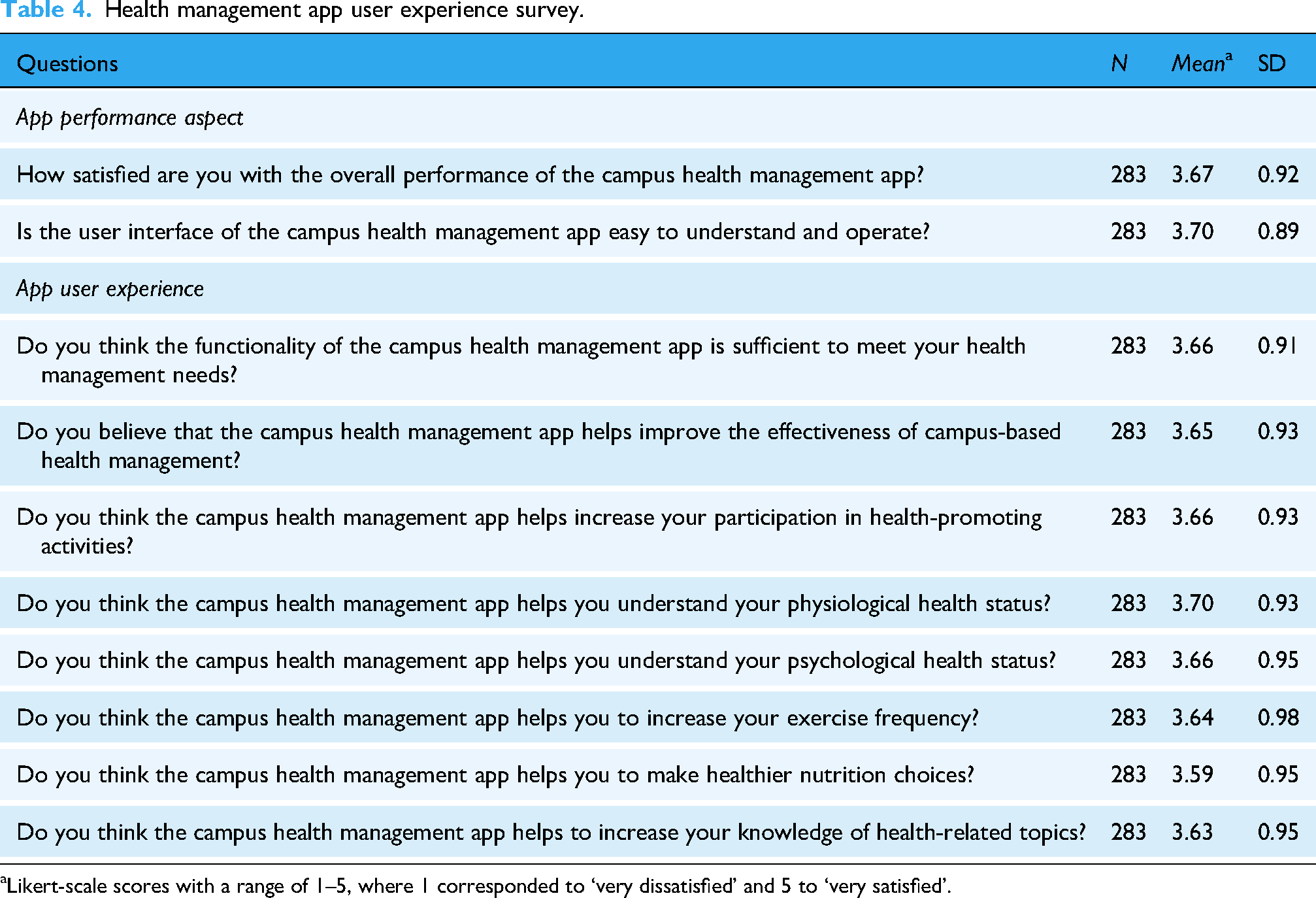
Likert-scale scores with a range of 1–5, where 1 corresponded to ‘very dissatisfied’ and 5 to ‘very satisfied’.
Discussion
The main purpose of this study was to describe the process of developing the campus health management app, evaluate its efficacy, and assess the students’ user experience. We used a descriptive exploratory method to gain a comprehensive understanding of how the app affected the health management routines of nursing students. By incorporating these tools into their health management, nursing students can proactively address potential health issues, improve their overall well-being, and maintain optimal performance levels in their studies and clinical practice. We also examined the app's usability and user experience, based on feedback from users concerning its interface, functionality, and overall efficacy in health monitoring and management within a campus setting. By helping students to understand their health status through apps like this one and regular health-promoting activities run by the center (e.g., weight loss competitions and sympathetic nerve function-improvement activities), we believe their health status can be significantly improved. The study's outcomes are anticipated to enrich health-monitoring practices among nursing students, ultimately fostering improved health outcomes and well-being in the academic sphere.
In planning the improvements to the app, we are focusing on three areas that received the lowest satisfaction scores: increasing exercise frequency (mean score: 3.64), making healthier nutrition choices (mean score: 3.59), and increasing knowledge of health-related topics (mean score: 3.63). The lower satisfaction scores in the areas of increasing exercise frequency, making healthier nutrition choices, and enhancing knowledge of health-related topics may reflect limitations in the app's ability to deliver personalized, practical, and engaging solutions. Users may find exercise plans insufficiently tailored to their fitness levels or challenging to integrate into busy schedules, while nutritional guidance might lack specificity, cultural relevance, or actionable resources such as meal plans or recipes. Similarly, the educational content may not adequately align with users’ interests or learning preferences, potentially due to a lack of interactivity or personalized recommendations. Addressing these shortcomings through user-centered design improvements, such as integrating adaptive features, interactive learning tools, and culturally relevant content, could enhance user engagement and satisfaction in these key areas. We aim to enhance these aspects through the implementation of the following strategies: (1) Increasing exercise frequency: (i) Developing individualized exercise plans and challenges to encourage users to set daily or weekly fitness goals and monitor their progress. (ii) Integrating exercise-tracking features such as step counters, exercise logs, and personalized training plans to simplify the tracking and recording of physical activities. (iii) Providing regular motivational content, such as exercise tips, reminders, and reward systems, to inspire users to maintain consistent exercise routines. (2) Improving nutritional choices: (i) Offering nutritional education, including healthy eating tips, diet plans, and recipes tailored to promote balanced diets. (ii) Incorporating a diet-tracking feature that allows users to record their food intake and receive instant nutritional analyses along with personalized suggestions. (iii) Creating engaging challenges focused on healthy eating habits, encouraging users to adopt and share their experiences and progress with peers. (3) Enhancing knowledge of health-related topics: (i) Providing access to a wide range of health information, including articles, videos, and expert-led seminars on various health topics. (ii) Designing interactive health questionnaires and quizzes to help users assess their knowledge of health-related issues, with recommendations for additional learning resources based on their results. These strategies are designed to empower users to increase their exercise frequency, make healthier nutritional choices, and expand their knowledge of key health topics. By addressing these specific areas, we anticipate improving both the effectiveness of the health management app and overall user satisfaction.
Many health management apps have been developed to provide support for various health conditions and improve self-health management. These apps use data-driven decision support systems, smartphone apps, and digital health interventions.24,25 Their goal is to provide personalized self-management plans for specific health conditions, such as chronic diseases or low back pain.26,27 They also collect and analyze health data, provide notifications and health recommendations, and store data for further analysis.28,29 They can be used to supplement routine care to support patients in managing their health conditions.30–32 Additionally, community health agents can use health management apps to map and monitor health services and provide prevention and care. 33 Overall, therefore, health management apps can provide a range of features and functionalities to support individuals and communities in effectively managing health. A campus-based health management app designed specifically for nursing college students is potentially a powerful tool for improving students’ physical and mental health.34,35 Nursing students often face challenges in maintaining a healthy lifestyle due to the demands of their program and a resulting decrease in health-promoting behavior.34,36 Mobile health apps can provide access to vital health information, support, and the encouragement needed to foster positive behavior change. 37 About user experience, the study identified that perceived usefulness and ease of use significantly influence nurses’ adoption of mobile health applications, underscoring the importance of usability in app design. 38 Similarly, the study highlighted practical challenges and strategies in implementing user-centered design for mobile health apps, reinforcing the necessity of involving end-users in the design process to enhance usability and acceptance. 39 Further, our app is integrated into the design of several courses, including Rehabilitation Nursing, Alternative and Complementary Therapies, Health Assessment and Experimentation, and Smart Health Care. In these courses, students can gain insight into the use of the health-monitoring instruments, health condition assessments, and aspects related to smart healthcare. By creating a healthcare app with the specific needs of nursing students in mind, we hope to see a positive shift in their health behaviors, which would have a lasting impact on their careers as nurses. Additionally, an intelligent health management system such as this would allow college students to manage their own health information and focus their attention on relevant health indicators. Such systems can provide valuable support and services to students, ensuring their wellbeing during the demanding undergraduate phase of their lives.
The survey results indicated that, on average, users had a positive experience of using the app. Based on the suggestions users provided in Part 3 of the questionnaire, we aim to incorporate approaches to optimizing the health management app in the future, including: (1) Incorporating a comprehensive mental health assessment module into the app. This may include validated questionnaires and tools to assess stress levels, anxiety, depression, and overall mental health. (2) Expansion of sports facilities and monitoring: continuous enhancement of the app's capabilities through the integration of more sports facilities and advanced monitoring features. This may involve real-time tracking of physical activity, personalized exercise plans, and integration with wearable devices for accurate data collection. (3) Enhanced messaging: implementing a strong messaging strategy in the app to provide users with timely updates, health tips, educational resources, and notifications about on-campus health-related events and measures. (4) Diversified user feedback channels: establishing diversified user feedback collection channels, including surveys, focus groups, and user forums. This will facilitate gathering a wide range of opinions and suggestions to further improve the functionality and user experience of the app. (5) Collaboration with healthcare professionals: facilitating collaboration with healthcare professionals, including nurses, doctors, nutritionists, psychologists, and health experts. This collaboration would enhance the development of evidence-based health management protocols, personalized health interventions, and telemedicine services within the app. (6) Enhancing cultural sensitivity and accessibility: ensuring that the content and functionality of the health advice provided by the app are culturally and gender sensitive and usable by a diverse group of students. This includes providing multilingual support, adapting to different cultural norms, and addressing the health disparities and specific health needs of different student groups. (7) Longitudinal studies and outcome evaluation: Conducting longitudinal studies to evaluate the impact of the app on student health outcomes, behavioral changes, long-term effects on academic performance, and overall well-being.
There were several limitations to this study. As our first app development endeavor, the scope was restricted to a single university, specifically targeting nursing college students, which limits the generalizability of the survey results to broader student populations. However, we focused on developing the app and evaluating its use by nursing students; detailed statistical analysis was not used. We will conduct more detailed analysis for different research purposes in the future. So, our app has been developed to integrate usage analytics to monitor device interactions, track workout frequency and duration, and provide dashboards for better visualization. Additionally, incorporating user feedback mechanisms and a scheduling system could optimize device deployment and usage, improving the overall user experience and resource allocation. Additionally, due to the predominantly female composition of the nursing student cohort, the data may reflect gender-related experiential biases. Moreover, the health standards used in the app were specifically tailored for Asian populations, and the health promotion strategies were based on the lifestyle habits of Taiwanese students, further limiting the applicability of the findings to other population groups. Although this study serves as a pilot investigation, the questionnaire requires further refinement to enhance its reliability and credibility. Future iterations should focus on improving the questionnaire design and incorporating robust tests for validity and reliability, ensuring that the findings are more comprehensive and generalizable across different contexts and populations. Our future work will examine users’ perceptions of the app's impact on their physical health and investigate its potential to address psychological health challenges, such as stress management, through tailored interventions like exercise recommendations.
Conclusion
This study highlights key findings on the efficacy and user experience of a campus-based health management application designed for nursing students. Using a descriptive exploratory approach and user-centered evaluations, this pilot study assessed the usability and user experience of a campus-based health management application for nursing students. Findings indicate the need for enhanced customization, improved technical reliability, and the integration of advanced data analytics to deliver personalized health recommendations. Incorporating mental health monitoring features, real-time health tracking, and robust stakeholder engagement strategies is recommended to strengthen the application's functionality and expand its usability. Longitudinal evaluations are warranted to examine sustained impacts on health behaviors and outcomes. By addressing current limitations, this tool has the potential to evolve into a comprehensive health management platform that supports evidence-based decision-making, fosters preventive practices, and advances student well-being. These findings provide a foundation for future research and development, guiding the creation of robust digital solutions that promote the health and professional growth of nursing students.
Supplemental Material
sj-docx-1-dhj-10.1177_20552076251330577 - Supplemental material for Developing and evaluating a campus-based health management app for nursing students: A pilot study on usability and user experience
Supplemental material, sj-docx-1-dhj-10.1177_20552076251330577 for Developing and evaluating a campus-based health management app for nursing students: A pilot study on usability and user experience by Andrew Ke-Ming Lu, Yi-Ling Chung, Yu-Hsia Wang, Sheng-Kai Lin and Jeng-Long Hsieh in DIGITAL HEALTH
Supplemental Material
sj-doc-2-dhj-10.1177_20552076251330577 - Supplemental material for Developing and evaluating a campus-based health management app for nursing students: A pilot study on usability and user experience
Supplemental material, sj-doc-2-dhj-10.1177_20552076251330577 for Developing and evaluating a campus-based health management app for nursing students: A pilot study on usability and user experience by Andrew Ke-Ming Lu, Yi-Ling Chung, Yu-Hsia Wang, Sheng-Kai Lin and Jeng-Long Hsieh in DIGITAL HEALTH
Footnotes
Acknowledgments
Special thanks to all participants in this study. The authors would like to express their appreciation to all members of the nursing college who assisted with the research. We would also like to acknowledge the Healthcare Information Technology Education Center and the Office of Institutional Research for their valuable help in processing the data. We thank Hsing-Ming Lee and Bor-Jen Jeng for providing the use of the well-being scale. Additionally, we thank Chih-Kai Yang for assisting us in establishing this health management application, and Shin-Jiuan Wu, Ya-Li Tang, Shu-ling Huang, Yu-Ling Bai, and Shih-Hau Fu for providing suggestions on health promotion strategies.

Author Contributions/CRediT
All of the authors have contributed significantly and intellectually to the study. The study idea was generated by JLH, who was the main supervisor of the study. AKML, YLC, and JLH designed the study, while YHW and SKL visualized the study and implemented data interpretation. AKML conducted the data analysis, structured the results. AKML and JLH contributed intellectually to the discussion. AKML was also the primary writer of the manuscript, while JLH provided critical revision and supervision. Finally, all authors have read and approved the final version of the manuscript.
Conflicting Interests
The authors declared no potential conflicts of interest with respect to the research, authorship, and/or publication of this article.
Funding
The authors disclosed receipt of the following financial support for the research, authorship, and/or publication of this article: This work was financially supported by two funding sources. (1) Chung Hwa University of Medical Technology within the framework of the Higher Education Sprout Project by the Ministry of Education (MOE) in Taiwan. (2) Tainan Municipal Hospital (Managed by Show Chwan Medical Care Corporation) in Tainan, Taiwan (RD-113011).
Ethics approval and consent to participate
The collection of health data by the Healthcare Information Technology Education Center was approved by the Institutional Review Board of Tainan Municipal Hospital. The consent of the analysis and use of school affairs data has been obtained when the students enroll, and all data will be de-identified for analysis. Prior to using the app, all users provided informed consent and agreed to its use for research purposes. Additionally, the data utilized in this study is anonymized and non-identifiable.
Data Availability
The datasets used and analyzed during the current study are available from the corresponding author on reasonable request.
Supplemental material
Supplemental material for this article is available online.
Notes
References
Supplementary Material
Please find the following supplemental material available below.
For Open Access articles published under a Creative Commons License, all supplemental material carries the same license as the article it is associated with.
For non-Open Access articles published, all supplemental material carries a non-exclusive license, and permission requests for re-use of supplemental material or any part of supplemental material shall be sent directly to the copyright owner as specified in the copyright notice associated with the article.
