



Abstract
Objective
To analyze and explore the products, techniques, and procedures shared on TikTok to assist postpartum mothers in healing cesarean section scars and to evaluate the platform's role in educating patients about cesarean scar healing. This descriptive cross-sectional study was motivated by concerns over the variability and potential misinformation in social media content, which could influence postpartum recovery practices.
Methods
A preliminary analysis of TikTok content was conducted using specific search terms related to cesarean scar healing. Videos were evaluated for engagement metrics (likes, views, and comments), content themes, and the types of products or techniques recommended. The relevance of the content to postpartum recovery, including physical and emotional aspects, was assessed.
Results
Our analysis found that CS healing is a widely discussed topic on TikTok, with videos serving purposes such as education, destigmatization, entertainment, and product promotion. Most content was created by laypersons or influencers, with only a small portion led by healthcare professionals.
Conclusion
TikTok provides a supportive platform for postpartum mothers to share experiences and learn about CS healing. However, misinformation and oversimplification on social media emphasize the importance of consulting healthcare professionals before making medical decisions or altering post-operative healing treatment plans.
Introduction
Increasing cesarean section rates and postpartum recovery
In recent years, cesarean section (CS) rates have risen worldwide. Women have reported that their physical recovery after a CS is hindered by various health issues, including pain, reduced mobility, wound infection, vaginal bleeding, and urinary incontinence. Many describe experiencing extreme pain during the postpartum period, which limits their mobility and ability to perform daily activities, including difficulties with caring for their newborn and breastfeeding.1–3 Previous studies have found that postpartum women were “not ready for the intensity and duration of the postoperative pain” associated with physical recovery.1–3
Concerns about cesarean scarring
The physical and psychological effects of cesarean scars can be significant. Changes in cosmetic appearance, ongoing pain, loss of movement from contracture or adhesion, and persistent itching can negatively impact an individual's quality of life and psychological recovery after surgery.4,5 Women with scars often report anxiety and depression, feeling stigmatized, and attempting to conceal their scars, which can hinder their ability to engage in social or work activities. 5 Beyond emotional distress, scarring also causes physical discomfort, including pain and itching. Treatments for CS scars include laser therapy, scar resection, hormone therapy, and various forms of manual therapy. Clinical practice guidelines endorse scar massage as a conservative treatment for postsurgical scars. However, inconsistencies regarding the timing of treatment initiation, optimal techniques, and dosage may hinder the integration of this therapy into current practice. 4
Social media's role in health education
TikTok, the most downloaded app in 2023, has introduced significant changes in social media networking. 6 Around 80% of internet users in the United States seek health information online, and social media is becoming increasingly important for educating patients. 7 With the majority of TikTok users being young adults and 54% being women, the platform holds significant potential for addressing health topics relevant to postpartum mothers, including CS scar healing.8–10 TikTok's engagement rate is exponentially higher than that of other platforms, enabling it to disseminate information to a wider audience. 10 Research on health information available on TikTok has spanned various fields, including plastic surgery, otolaryngology, and gynecology.6,8–10
In a preliminary analysis, TikTok users across the country are using the platform to share their experiences and provide content aimed at helping postpartum mothers heal after a CS. Initial data analysis revealed that CS scar healing is a highly engaged and popular topic on TikTok, gaining attention due to its impact on body image, pain control, and overall low cost. Given TikTok's broad appeal to users from various backgrounds, it is essential to explore and utilize the app to enhance healthcare delivery, improve public health management, and facilitate better healthcare education. 7
Evidence gaps and study aims
Despite the platform's promise, uncertainty remains about the content shared on TikTok regarding cesarean scar healing, including its accuracy and relevance. There has been minimal research on using social media as a means to disseminate health education specifically for postpartum recovery. This study is the first of its kind to examine the products, techniques, and procedures presented on TikTok to assist postpartum mothers in healing CS scars.
Methods
Sample selection
Our study uses a qualitative and observational approach. To ensure the integrity of the data collection process, a new set of TikTok accounts was created, devoid of any prior search history related to the topic. The following search terms were selected to initiate a comprehensive collection of CS postpartum scar healing: #csectionscar, #csectionscarmassage, and #csectionrecovery. Between February 25, 2024, and March 01, 2024, two trained researchers (T.J. and T.T.) independently recorded the links, number of likes, number of comments, number of views, account name, and number of account followers for the first 30 videos retrieved from each search term. Any duplicate videos were eliminated, resulting in a final sample size of n = 118 TikTok videos. A vast majority of videos appeared to be created by laypersons or “content-creators/influencers,” with only 11% of the content being led by healthcare professionals.
Data collection
A comprehensive codebook was developed to establish clear parameters for categorizing themes. Two researchers (T.J. and T.T.) conducted independent qualitative coding analysis for each video, identifying the primary content purpose (education, entertainment, or advertising), presence of specific content (scar massage content, scar oil/ointment use, and demonstrating scar massage techniques), and account dedication to postpartum healing in CS patients. Furthermore, the researchers documented any verbal or visual references to anatomy (e.g., animations, images, or props) featured in the videos. Disagreements in codes were discussed among the researchers to determine a consensus. Qualitative data was also collected, such as which massage products, CS scar symptoms, and advice were mentioned. When available, the credentials of each video's content creator were also recorded. The number of likes, views, comments, and account follower numbers was collected for every video. Because our researchers could have similar or different algorithms through TikTok, a list of 118 videos was created. The researchers collected up to 30 TikTok videos per hashtag to ensure no overlap between the compiled list of videos. Thus, each researcher, in theory, could have up to 90 videos for the three listed hashtags. If there was any overlap in the collection of videos, the duplicate was removed, and therefore, the sum of new videos was 118.
Data analysis
The initial data analysis began with ensuring there was no apparent discrepancy between the two coders. The coders had similar coding requirements, and there were no significant disagreements regarding the collection between the two coders. Once that was established, we could average the percentage of videos that fulfilled the coding criteria. Notably, a video could be coded for multiple criteria. For instance, a video could be coded as “education purpose,” “scar oil content,” and “scar massage content,” depending on the content in the video. Just because a video was coded into one category does not mean it was mutually excluded from the other categories. Per “Purpose of Cesarean Section Scar Healing Content,” the number of videos per category could be averaged out of N = 118.
Additionally, as part of the data collection and coding process, researchers had to identify the profession of the content creator. This was determined by going to the creator's TikTok profile, where creators list their credentials in their biography. From there, the average per profession out of N = 118 was calculated and placed in Figure 2.
Results
Content analysis and video metrics
Our data collection revealed that CS healing is a popular topic on TikTok. A total of 118 videos created by 49 unique accounts were identified. The videos collected had a median of 1722 likes, 58 comments, and 121,250 views. As seen in Figure 1, the videos had varying purposes, including education (81.3%), entertainment (18.7%), product advertisement (26.9%), and destigmatization (49.5%). Some videos included scar massage content (46.2%), including tutorials on exactly how to physically perform a scar massage (36.3%), as well as mention of scar oils and healing products (19.8%). The most popular form of healing products was silicone patches and gels (27%).
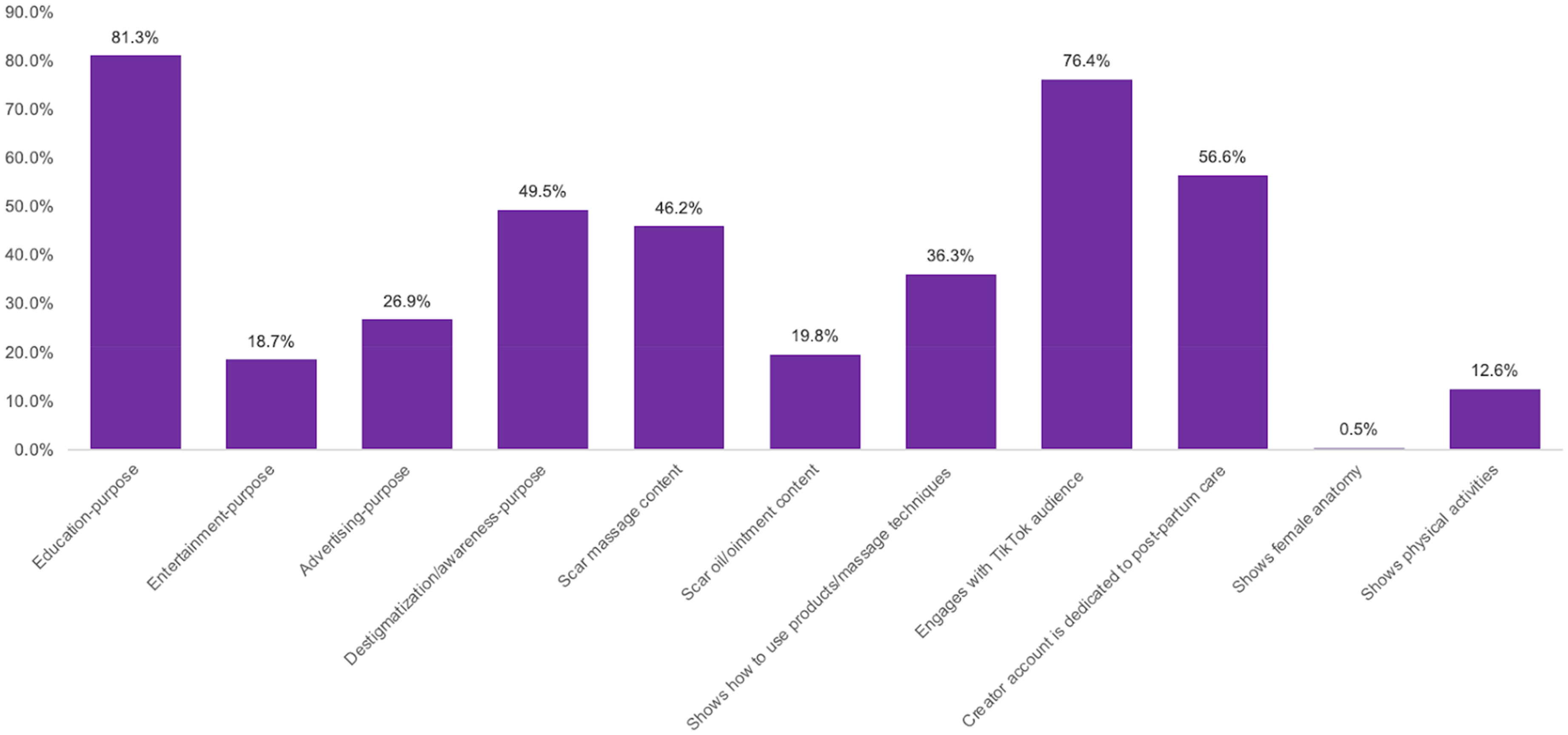
Purpose of cesarean section healing TikTok content.
We found that most of the accounts that posted about this topic were dedicated to post-partum care (56.5%), and many engaged with their audience in the comment section, answering questions and responding to comments (76.4%). While many videos we found were educational, very few showed female anatomy (0.5%), and a minority demonstrated physical exercise as a means of healing (12.6%). Most videos appeared to be created by laypersons or “content creators/influencers,” with only 11% of the content led by healthcare professionals (Figure 2). Upon further exploration, “content creators/influencers” did not always have professional credentialing or training to support their claims; their content was typically more aligned with their personal experiences. Content produced by healthcare professionals was normally coded to be educational, and their accounts were dedicated to women's health.

Content creator professions/credentials.
Discussion
TikTok offers an endless wealth of information regarding CS healing. Social media has revolutionized the dissemination of medical information, enabling rapid, widespread access to health education. It facilitates immediate communication and empowers patients with knowledge, but it also presents challenges in ensuring the accuracy and reliability of shared information. In our study, laypersons created the majority of cesarean section-related TikTok content, highlighting the need for experts like gynecologists and obstetricians to engage on the platform to curb misinformation. However, it's also important to acknowledge the value of content from lay individuals, as their personal anecdotes and advice play a crucial role in normalizing and destigmatizing discussions about CS healing.
There are obvious benefits to using social media as a platform for CS healing. Recovering from a CS can be emotionally challenging, and social media provides a space for new mothers to share their experiences, express their feelings, and receive support from others. Personal recovery stories, tips for managing pain, and recommendations for products or practices that aid healing can be invaluable. This peer-to-peer education can complement professional medical advice.
While social media can be a valuable resource for support and community, it is essential to approach medical advice on these platforms cautiously. The risks involved with using social media as medical advice include the spread of misinformation, susceptibility to those using misleading credentials without the proper qualifications, ignorance of individual differences between patients, and oversimplification of solutions, leading to ineffective or harmful self-treatment. Social media is also notorious for prioritizing product endorsements, encouraging content creators to promote health products and treatments for financial gain regardless of efficacy or safety.
Specifically, regarding using social media for advice on CS healing, research indicates that improper or aggressive massage can lead to complications such as increased pain, infection, and delayed wound healing. 11 Excessive pressure on the scar area can disrupt the normal healing process, potentially leading to hypertrophic scars or keloids. 12 Another concern is that massaging the area too soon after surgery may increase the risk of internal adhesions, which can cause long-term discomfort and complications. 13 Therefore, patients must consult with healthcare professionals before undertaking CS massage to ensure it is done safely and appropriately. Users should also prioritize information from reputable, credentialed sources. Balancing social media's benefits with an awareness of its risks is crucial for maintaining health.
Our study has several strengths, including that it is the first to analyze the quality and quantity of CS recovery-related content on the social platform TikTok. Data was collected via the user-facing side of TikTok, providing an authentic representation of audience experiences when using the app themselves. Additionally, two independent researchers performed and analyzed data collection, ensuring coder biases and misinterpretations remained minimal.
Limitations to our study include the usage of only four specific hashtags, which may represent only some relevant content on TikTok regarding this topic. The study did not account for metrics like views, likes, comments, and shares, which could indicate the impact and reach of the videos. Additionally, this descriptive analysis does not assess the quality and accuracy of cesarean section-related TikTok content. Future studies may include an evaluation of the accuracy and medical reliability of the information provided in the videos, especially those created by laypersons versus healthcare professionals, and an investigation of the impact of TikTok videos on viewers’ health behaviors and outcomes, particularly postpartum mothers’ actual practices in CS scar care.
Conclusion
TikTok provides a platform rich in information about CS healing, offering a supportive space for postpartum mothers to share experiences and access peer-to-peer education. This study highlighted popular practices and products commonly discussed on a social media platform, primarily by content creators or “influencers.” However, given the source of information, which was distinctly coded by their profession, there is potential for misinformation or improper practices, highlighting the need for users to evaluate the content and the person delivering the content they encounter critically. Individuals must exercise caution and consult healthcare professionals before making medical decisions or altering post-operative care based on social media content. Future research should focus on assessing the accuracy of TikTok content and its impact on health behaviors to promote safe and effective postpartum recovery.
Footnotes
List of abbreviations
Acknowledgements
Not applicable
Author contributions
Taylor Jamali: Conceptualization, data curation, writing- original draft, and formal analysis; Talia Thomas: Conceptualization, data curation, writing- original draft; Melanie Lagomichos: Supervision, validation, writing- review & editing.
Consent statement
Informed consent for information published in this article was not obtained because the information was obtained from publicly available social media platforms, and no specific account names, identifying details, or images have been included in the manuscript to ensure privacy and anonymity.
Declaration of conflicting interests
The authors declared no potential conflicts of interest with respect to the research, authorship, and/or publication of this article.
Ethical considerations
Ethical approval was not required for our research.
Funding
The authors disclosed receipt of the following financial support for the publication of this article: The research was funded by the Anne Burnett Marion School of Medicine at Texas Christian University Library Open Access Fund.
