




Abstract
Background
Young people face high rates of mental health issues, yet many do not seek professional help. In 2017, CHAT launched webCHAT – a free, anonymous, one-on-one synchronous web-based text service managed by case managers (CMs) to support young people aged 16 to 30 who may be hesitant about engaging in face-to-face mental health services.
Objective
This study aimed to explore the perspectives and experiences of users who accessed webCHAT for mental health support in Singapore.
Methods
A qualitative thematic analysis was conducted using transcripts of webCHAT sessions to identify main themes.
Results
Many users accessed webCHAT to seek support with emotional and behavioural concerns, valuing its immediacy and anonymity over traditional appointment-based services. A desire to ‘get better’ and self-realisation emerged as important motivators for seeking help, with webCHAT offering a supportive space for reflection. Key barriers to seeking additional support included fear of stigma, concerns about leaving a ‘medical record’, potential hospitalisation, and treatment costs.
Conclusions
webCHAT appears to be a viable early intervention and preventive approach, providing young people with a pathway towards in-person support services. Professional guidance from CMs is essential in encouraging users to pursue further support, emphasising the importance of human expertise in digital mental health platforms. By fostering early help-seeking and self-realisation, webCHAT has the potential to reduce the long-term impact of mental health challenges. Future research could explore webCHAT's long-term effects and identify improvements to facilitate users’ transitions to in-person support.
Introduction
Youth mental health is a global concern, with 62.5% of mental disorders emerging before age 25. 1 In Singapore, mental disorders are reported to be the leading cause of years lost to disease among ages 10–34. 2 The Singapore Mental Health Study conducted in 2016 found that those aged between 18 and 34 years had the highest lifetime and 12-month prevalence of any mental health disorder. 3 Despite these concerning statistics, young people often remain reluctant to seek professional help.4–6 Commonly cited barriers include stigma, concerns over confidentiality and trust, affordability, physical access to services, and wait times. 7 Addressing these issues promptly is crucial, as timely intervention has proven effective in reducing the long-term impact of mental disorders and associated complications. 8 Consequently, there is a compelling need for a comprehensive approach to mental health care that is accessible, acceptable, appropriate, effective, and equitable for young people. 9
Historically, mental health services have followed a model similar to general medical care, dividing care into paediatric, adult, and geriatric populations. In Singapore, this model is reflected in the delineation of psychiatric services, with child and adolescent services catering to individuals under 18, while adults services typically serve those aged 18 and above. 10 As a result, there exists a gap in specialised mental health assessment services tailored for youths who are navigating the transition between these age-specific services.
With support and funding from Singapore's Ministry of Health, CHAT – Centre of Excellence for Youth Mental Health was established in 2009 to enhance mental health awareness and service accessibility for youths aged 16 to 30. A core feature of CHAT's service is the provision of free and confidential mental health assessments, specifically designed to support youths who are experiencing mental health challenges.11–12 With the young person's consent, direct referrals are made post-assessment, to appropriate upstream specialised psychiatric services, and downstream school- and community-based mental health services to ensure timely interventions. Self-help strategies are also encouraged where appropriate, offering young people additional tools to manage their mental health independently. Most young people who accessed CHAT's mental health assessment service found it to be accessible, acceptable, and appropriate. 13 However, some were hesitant to attend the CHAT assessment session or talk over the phone due to discomfort with social interactions or reluctance to leave their homes for professional help.
Youth mental health programmes in Australia, particularly those offering web-based synchronous counselling, have effectively reached young people who might otherwise avoid or delay help-seeking if in-person services were their only option. 14 Supporting this, a systematic review by Zhou et al. found that online mental health interventions, including web-based synchronous chat counselling, are effective in managing various mental health conditions among young people. 15
In 2017, CHAT introduced webCHAT as a pilot service to reduce barriers such as stigma and discomfort with face-to-face professional interactions. As an online mental health assessment platform, webCHAT offered free, one-on-one synchronous text-based sessions, providing young people with privacy, anonymity, and immediacy. Users access webCHAT anonymously via the CHAT website (www.chat.mentalhealth.sg) and must first confirm their understanding of confidentiality and safeguarding processes before being assigned a case manager (CM). Guided by bio-psycho-social assessments, case formulation models, and strength-based interventions within a single-session framework, the assigned CM collaborates with users to identify reasons for seeking help, assess intervention needs, and evaluate any risks. Sessions last on average, about 60 min and are available on-demand during operating hours (Tuesdays to Saturdays, 1 p.m. to 8 p.m., excluding public holidays), making webCHAT appealing to those who value flexibility, privacy and after-hours support. CMs are allied health professionals with tertiary qualifications in psychology, social work, or counselling. Given the platform's anonymous design, emergency services can only be activated if users disclose their location. Accordingly, CMs are trained in suicide intervention and crisis de-escalation. They also convene weekly for case presentations and receive regular supervision from a senior clinician to ensure competency.
Online mental health interventions are not new in Singapore; however, only two local youth-specific e-mental health studies have been identified to date.16,17 In a study by Kit et al., 33 primary school children in Singapore (ages 9–12) reported positive experiences with online live chat counselling, finding it helpful for problem-solving. 16 Salamanca-Sanabria et al. found that university students viewed computer-delivered mental health interventions as beneficial but preferred human counsellors for personalised understanding. 17 These findings provide initial insights into youth experiences with e-mental health but highlight a research gap in online mental health services for Singapore's youth. Globally, Zhou et al. also identified a gap in research on web-based counselling, as their systematic review found few studies on synchronous chat services. 15
This study aimed to explore emergent themes that reveal why young people chose webCHAT over face-to-face mental health support, thereby contributing valuable insights to youth-specific e-mental health care and delivery.
Method
Data collection
The qualitative data used in this study were transcripts of webCHAT sessions conducted from January to December 2018. A total of 169 unique chats between CMs and users were anonymised by the first author, who was also the webCHAT lead CM (YPL), for analysis. While the names of organisations were retained, the names of individuals seeking help, as well as any other persons mentioned, and other identifiable data were redacted to maintain anonymity.
Ethics statement
Ethics approval was obtained from the National Healthcare Group's Domain Specific Review Board (DSRB No. 2019/00841). This is a DSRB-approved retrospective study. All transcripts used in this study were anonymised, with identifiable details redacted prior to analysis and participant consent was not required.
Data analysis
Thematic analysis was adopted to identify, analyse, and report patterns (themes), within the data, following the approach of King and Brooks. 18 The study team, comprising trained qualitative researchers and youth mental health clinicians (MS, SKV, CT, YYL, HO, YPL), independently conducted open coding on five transcripts. Open coding, defined as ‘the process of breaking down, examining, comparing, conceptualising, and categorising data’, was utilised in this phase. 19 Thereafter, the team meticulously developed major themes and subthemes, finalising a comprehensive codebook.
All chat transcripts and the codebook were then analysed using NVivo 12 Pro. Three experienced qualitative researchers (MS, YYL and HO) concurrently coded five chats to establish inter-rater reliability, with a Cohen's kappa coefficient of 0.71, before they independently proceeded to code 30 chats each. The lead researcher (MS) holds a post-graduate degree and was trained in qualitative research and has been working for 20 years in the field of mental health. The second researcher (YYL) has 7 years of experience in youth mental health work and qualitative research while the third research (HO) has 4 years of experience as a domain expert in youth mental health and has received training in qualitative research. Throughout the coding process, the researchers met regularly, recognising differences in domain knowledge and existing theoretical understanding of youth mental health. Flexibility was maintained, given the variable nature of some chats, which were at times short and abruptly terminated by the user. New themes and subthemes were identified, discussed, incorporated, and coded as new transcripts were coded. Data saturation was assumed when the coders could not identify any new information or themes from the transcripts.
Results
Our analysis revealed four main themes: reasons for contacting webCHAT, barriers to seeking further support, facilitators to seeking further support, and outcome of session. The verbatim statements were minimally edited for grammar and language, aiming to preserve their authenticity but improving comprehensibility.
Reasons for contacting webCHAT
Seeking information
About a quarter of users sought information about services, either for themselves, their family members, or friends. They sought details on the availability of services like venues, timings, and costs, that would aid them in deciding when and where to seek help. This intention was evident in statements like:
Hi WebCHAT, actually I have an enquiry. I have a friend who I believe is really in need of counselling. I was wondering if you do counselling sessions? Or referrals?
I wish I could find someone right now for counseling one to one, but I don't know where I can do so!
I just wanted to ask if I am able to schedule a weekend mental health check?
Crisis support
About one-tenth of the users were in crisis and wanted a non-judgemental outlet to talk about their concerns. They expressed discomfort discussing these issues with friends or family members and preferred to communicate anonymously with a trained mental health professional.
Just that I don’t dare to tell anyone until lately. The thoughts (
I need help calming down & establishing a (even temporary) mindset that I will not be forcefully outed as trans any minute and maybe logically discuss about this situation.
Understanding their experiences
About a quarter of the users were unsure if they were experiencing a mental health problem or simply going through a challenging period. They sought assurance of their well-being or an indicative diagnosis of their mental health condition from the CM.
I was just wondering if I could get advice here about how to recognise if I have a real anxiety problem or this is just routine normal stress-related anxiety that I need not worry about.
I've been kind of looking to seek help for a bit, but I felt weird going for the face-to-face sessions because I think my issues aren’t that serious.
I just want to know if there's anything wrong with me … just to clear my own set of doubts/questions.
Seeking help for problems related to mental health conditions
About half of the users reported having a mental health condition, either diagnosed by a mental health professional or self-diagnosed. They had drawn certain conclusions on their own and were seeking support from the CM. Table 1 lists the complaints stated by the users.
Symptoms/complaints stated by users.
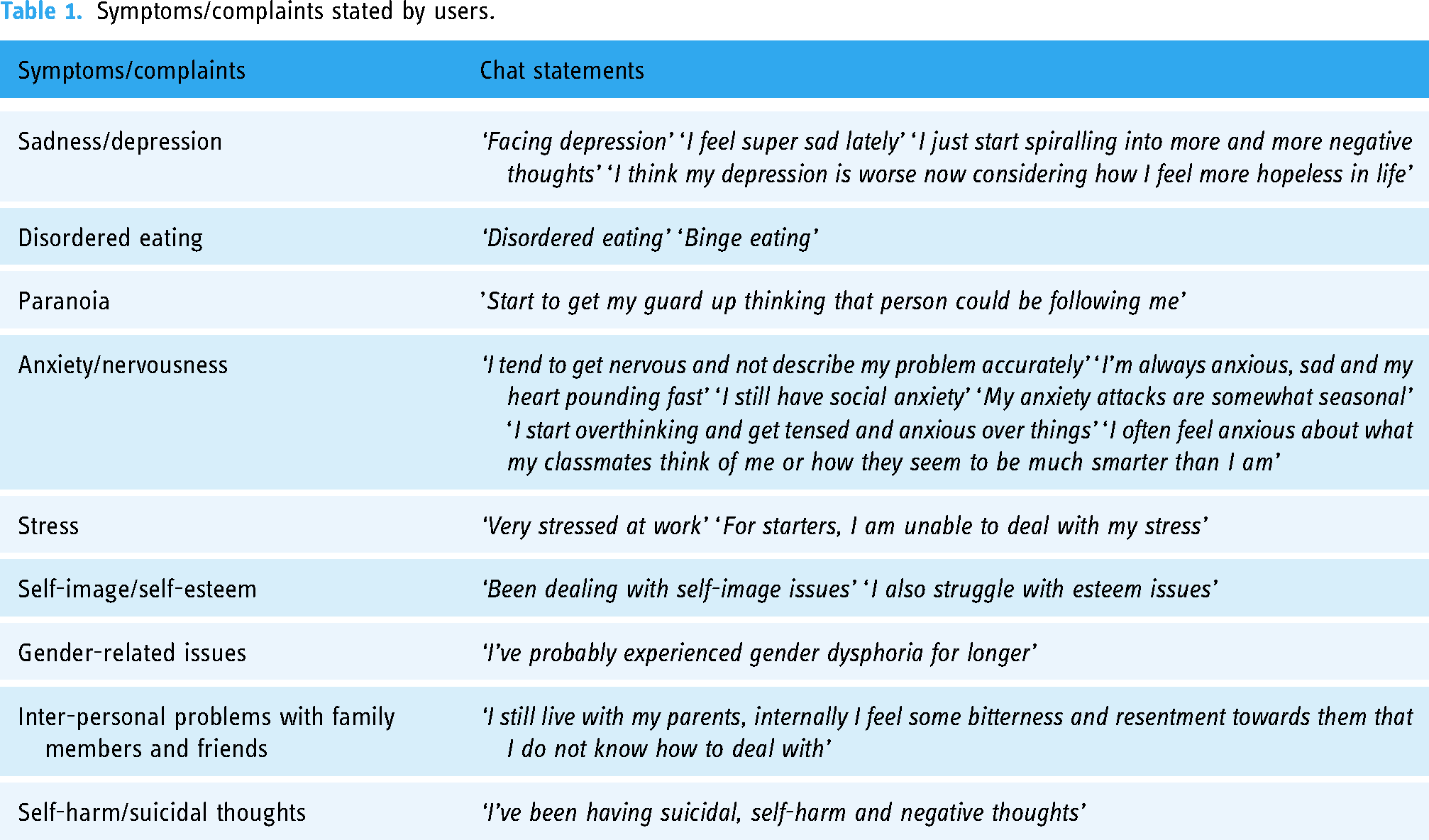
The requested support ranged from wanting a second opinion on their ‘diagnosis’ to seeking advice on managing their mental health condition. Some users sought information on their chances of recovery and the risk of relapse, while others expressed concerns about sharing their thoughts with their psychiatrists and the potential consequences of doing so, including fears of hospitalisation. Additionally, some users wanted to understand the pros and cons of medications and therapy.
Hi WebCHAT, just wondering if you have any advice on how to get over bulimia?
Alright. One last question … is it possible to fully ‘recover’ or come out of depression? Or is it something that will always be lurking in the background?
I was wondering if I shared with my psychiatrist that I have violent and suicidal urges, would I be hospitalised?
Barriers to seeking further support
About half of the users were reluctant to follow up with a mental health professional, even when recommended by the CM following the webCHAT session. The subthemes that emerged as barriers included:
Reluctance for face-to-face sessions
About a quarter of the users said that they felt overwhelmed sharing their concerns with a stranger and that face-to-face consultations would pose a significant challenge for them.
I don’t really like to talk face to face. I’m not good at talking with people I’m not close to.
I’m not comfortable or ready for another face to face.
Stigma-related privacy concerns
About a quarter expressed privacy concerns, ranging from a desire to conceal information from family and friends to worries about inadvertent disclosure to school counsellors or potential employers. They were also concerned about being perceived as ‘weak’ or ‘mad’ if their visits to mental healthcare facilities were revealed.
I do know that if it is serious and you get admitted, it will be on your records so employers can see it…
I am too scared to go down to speak to a professional. People finding out that I am seeking help and thinking I am weak, thinking I am mad etc.
Cost of care
About half of the users expressed cost concerns, especially among younger individuals who doubted their ability to cover the expenses without parental support.
However, I’m also concerned about the price as I heard it can be quite expensive.
I think it would be helpful, but I do not want to place the financial burden on my parents and neither do I want to worry them about this.
Fear of medication
Some users had apprehensions about prescribed medications, which they viewed as addictive and potentially harmful due to side effects. They believed they could address their problems through more ‘natural’ or non-pharmacological means.
I see medication as my last resort. I would assume that the medication that I'm given would also affect my emotions, right. I'm just afraid that it may affect too much of it, that it would just makes me numb.
Label avoidance or uncertainty regarding severity of condition
Some users hesitated to confirm their fears, preferring to avoid receiving a formal diagnosis; while a few believed their problems were not severe enough and would be dismissed by care providers.
Just because I feel like I’m afraid to find out how ‘not normal’ I am.
The major reason I haven't reached out to anyone is that I'm worried they'll just tell me I'm making a big fuss of nothing.
Previous experiences with care facilities
Some users were apprehensive about seeking care from mental health professionals due to past unpleasant experiences.
I tried once but I wasn't comfortable with the psychologist, so I stopped going.
Facilitators to seeking further support
Some users expressed their willingness to follow up with a mental health professional when CM recommended it. The subthemes that emerged as facilitators were:
Wanting to get better
Majority of the users who agreed to follow up with services wanted to feel better and lead a happier life by overcoming their low moods or anxieties.
I wish to deal with this problem so I can become a mentally healthier and happier person.
Overcoming my depression, helping me overcome my insomnia, my overthinking.
Self-realisation that they had a problem
Some users acknowledged that they had a problem that required treatment by a mental health professional.
Yes, and it has come to a point where I feel like I have to acknowledge it and face it.
I mean I definitely don't mind trying because I guess this is why I log into the chat, to get help.
Outcome of session
Facilitation of appointment by CM
Some users wanted the CM to assist in scheduling appointments at counselling centres or tertiary hospitals for follow-up treatment. Some accepted a CHAT referral to a tertiary hospital, appreciating the access to subsidised care. Others favoured making appointments independently after receiving relevant information regarding the cost, location, and timing of services.
I'll do my best to turn up for the 10am session WebCHAT. It's at XX venue (anonymised) right?
It does seem like now that you mentioned it. Perhaps I'll explore community services as I understand there's one near my house.
Information provision and signposting to mental health services
Others were provided with requested resources, like names of counselling services near their place of residence or information about online counselling services for those who were not keen on face-to-face sessions.
Thanks for waiting, here are some recommendations for individual counselling for you to consider: 1. Family Service Centre (FSC) – there's a FSC in every neighbourhood and they charge minimally based on income. 2. XX centre in BP 3. XX centre in the YK.
Oh, I forgot to mention that the FSC nearest to you is XXFSC @ BP.
Crisis management
Those in crises were either referred to the relevant emergency services or de-escalated through the webCHAT session.
I’m a lot calmer now.
Discussion
This study represents the first qualitative exploration in Singapore of the perspectives and experiences of individuals utilising a youth-centric, free, synchronous, text-based mental health chat service, focusing on understanding why they chose webCHAT over face-to-face mental health support.
The theme of ‘reasons for contacting webCHAT’ revealed that users turned to the service for a wide range of concerns, highlighting the complex and varied needs that drive young people to seek support through an anonymous, text-based platform. Immediacy was particularly valued by webCHAT users who felt overwhelmed and urgently sought assistance, contrasting with services requiring prior appointment scheduling. Users’ concerns included mental health, relationships, self-identity, medico-legal matters, queries related to services and resources – issues similar to those reported by young people accessing text-based counselling in other countries.14,20,21 This alignment suggests that webCHAT addresses a broad range of youth-specific concerns consistent with global trends in e-mental health, underscoring the relevance of its design in providing confidential, accessible support for young people facing diverse challenges.
The barriers to seeking further support cited by webCHAT users suggest that both self-stigma and perceived stigma from others play a critical role in shaping young people's hesitancy to seek in-person support. 22 Concerns about being seen as ‘weak’ or ‘mad’ reflect internalised beliefs that mental health struggles are shameful or unworthy of professional help. Additionally, fears around disclosure to family, friends or employers suggest perceived stigma from others, which may lead to ‘label avoidance’. These forms of stigma contribute to avoidance, 23 delays in seeking help,24,25 and reinforce the appeal of anonymous services like webCHAT, which offers a safer, private alternative for this distinct group of online synchronous chat counselling service users.26–28
The desire to ‘get better’ emerged as a key motivator in users’ willingness to pursue further support from in-person professional services. Expressions of wanting to overcome issues like depression, insomnia, and anxiety indicate an internal drive among users to enhance their quality of life. Self-realisation and acknowledgement of mental health struggles emerged as significant facilitators in users’ willingness to seek further support. Recognising the need for help aligns with findings from Vanheusden et al., which showed that young adults are more likely to seek help when they understand the potential adverse consequences of untreated mental health issues and the benefits of treatment. 29 These realisations help overcome self-stigma and other barriers, underscoring webCHAT's role as an accessible option for those hesitant to pursue in-person support or discuss their issues with friends and family. The platform's anonymity and confidentiality provide a safe space for users to explore their mental health concerns and consider further professional support.
Our findings also highlight the crucial role of CMs in easing users’ initial hesitation and facilitating their transition from anonymous, text-based support to face-to-face professional support. The guidance provided by CMs, as trained mental health professionals, appeared to play a significant role in some users’ willingness to pursue further services. For those reluctant to discuss their issues with friends and family, 28 CMs can encourage them to open up to trusted others, thereby broadening their support networks. This professional support, offering expertise and personalised understanding, underscores the importance of human expertise within digital mental health platforms. 17
Limitations
webCHAT was developed using an off-the-shelf system product with basic features for synchronous, one-to-one, text-based conversations between user and CM. As an out-of-the-box solution, this system limited our ability to capture comprehensive quantitative and qualitative feedback from users, which could have provided valuable insights into the user experience. Due to the retrospective and naturalistic nature of this study, as well as the intentional design choice for webCHAT to be fully anonymous, the study team could not obtain sociodemographic data from the users, limiting our ability to profile webCHAT users in detail.
Conclusion
webCHAT appears to be a viable early intervention and preventive approach, providing young people with a pathway towards in-person support services. Findings from this study underscore webCHAT's appeal to youths who might otherwise refrain from seeking help if limited to in-person support. The platform facilitates early help-seeking behaviour, which is crucial in mitigating the long-term impact of mental health challenges. Insights into users’ perceived barriers and facilitators aid CHAT in refining its webCHAT service model, potentially offering targeted interventions for those facing greater barriers to seeking face-to-face support. Further research investigating user return rates and reasons for revisiting webCHAT could shed light on the platform's efficacy in delivering long-term interventions for this distinct group of young people. Considering the surge in mental health issues associated with the COVID-19 pandemic, 30 an updated study on webCHAT could identify evolving factors, guiding the enhancement of online text-based services for young people in the post-pandemic period. Nonetheless, this current study provides valuable insights and contributes to the limited existing literature by examining a novel youth-centric digital mental health solution that addresses an important treatment gap unaddressed by conventional mental health services.
Supplemental Material
sj-doc-1-dhj-10.1177_20552076251314912 - Supplemental material for Delving into the world of webCHAT – an e-mental health support service for distressed youths in Singapore
Supplemental material, sj-doc-1-dhj-10.1177_20552076251314912 for Delving into the world of webCHAT – an e-mental health support service for distressed youths in Singapore by Yi Ping Lee, Ying Ying Lee, Hamidah Binte Otheman, Charmaine Tang, Mythily Subramaniam and Swapna K Verma in DIGITAL HEALTH
Footnotes
Acknowledgements
We would like to thank our ex-colleagues, Dr Ganesh Kudva Kundadak and Miss Vanessa Seet Ai Ling, for participating in the preliminary discussions on the thematic analysis of this study.
Contributorship
All authors have made substantial contributions to the conceptualisation and design of the study as well as analysis of data. YPL and MS were also involved in the investigation and interpretation of data as well as writing the original draft for important intellectual content. MS and SKV are joint senior authors and provided supervision for this study. All authors reviewed and edited the manuscript and approved the final version of the manuscript.
Declaration of conflicting interests
The authors declared no potential conflicts of interest with respect to the research, authorship, and/or publication of this article.
Ethical approval
Ethics approval was obtained from the National Healthcare Group's Domain Specific Review Board (DSRB No. 2019/00841).
Funding
The authors received no financial support for the research, authorship, and/or publication of this article.

Supplemental material
Supplemental material for this article is available online.
References
Supplementary Material
Please find the following supplemental material available below.
For Open Access articles published under a Creative Commons License, all supplemental material carries the same license as the article it is associated with.
For non-Open Access articles published, all supplemental material carries a non-exclusive license, and permission requests for re-use of supplemental material or any part of supplemental material shall be sent directly to the copyright owner as specified in the copyright notice associated with the article.
