



Abstract
Objectives
To investigate the satisfaction of service users with different aspects related to telehealth speech-language pathology (SLP) services, and examine the influence of client's demographics, medical diagnosis, and type of clinical services on the level of satisfaction with telehealth services.
Methods
A questionnaire was developed and validated to measure the satisfaction of clients and caregivers with telehealth services. Phone survey was used to collect data from clients and caregivers of clients who received telehealth SLP services.
Results
302 clients and caregivers completed the survey. Most of the respondents were strongly satisfied with different aspects related to telehealth, including their whole telehealth experience (82.12%), the perceived benefits from telehealth (69.21%), and the perceived quality of healthcare received through telehealth (87.75%). The levels of satisfaction with these aspects were not related to age or gender, but they were significantly influenced by the SLP diagnosis (p < 0.001). The results also showed high levels of satisfaction across all types of clinical services, including screening, assessment, therapy, and monitoring. There were no significant relationships between the types of clinical services and the levels of satisfaction with telehealth.
Conclusions
Most clients and caregivers were satisfied with SLP services received via telehealth irrespective of the type of clinical service, client's age, or gender. However, satisfaction with SLP telehealth and patient experience varied according to the client's diagnosis. These factors must be considered by policy makers and funding bodies while planning the implementation or expansion of telehealth SLP services.
Keywords
Introduction
The World Health Organization defines telehealth as “the delivery of healthcare services, where clients and providers are separated by distance”. 1 Telehealth uses communication technologies to exchange information for the evaluation and treatment of diseases and injuries, for research, and for the education of healthcare professionals. 1 In speech-language pathology (SLP), telehealth is the use of telecommunication technology to link speech-language pathologists/therapists (SLPs) to clients, caregivers, or other professionals to provide consultation, assessment, or intervention services from a distance.2,3 Most telehealth SLP services can be delivered to clients through video and/or audio communication without the need for sophisticated equipment, and thus can be conducted while the client is at home or any other location. 4 There are several advantages for the utilisation of telehealth, including reduced waiting time to receive healthcare service, increased access to care especially for clients living in rural areas or those with impaired mobility, lower costs, potential better health outcomes, and improved quality of life.3,5,6 The global pandemic caused by the novel coronavirus disease 2019 (COVID-19) lead to worldwide interruption of SLP services due to travel restrictions, national lockdowns, social distancing, reduction in healthcare services, and closure of many outpatient services. Thus, telehealth SLP had to be implemented in order not to delay service provision and to ensure continuity of care.7–9 However, little is known about the satisfaction of clients and caregivers with telehealth SLP services.
Telehealth in SLP has been available internationally as a potential mode of service delivery from before the pandemic.5,6 Telehealth has been shown to be an effective mode of service delivery across many SLP disorders, such as paediatric language disorders, speech sound disorders, aphasia, and fluency disorders.4,10–12 From the perception of SLPs, suitability for telehealth might be affected by several factors, including client's age, cognitive abilities, behavioural skills, and cooperation,8,9,13 and the perceived effectiveness of telehealth varies according to the client's diagnosis and age. 7 The few studies that explored the satisfaction of clients and caregivers with telehealth SLP services found high satisfaction among clients with different communication and swallowing disorders, including aphasia, stuttering, specific and developmental language disorders, and dysphagia.12,14–16 High satisfaction with telehealth rehabilitation services was documented by clients living in rural areas without close physical proximity to clinical services. 17 Despite the high satisfaction with telehealth services, studies across different healthcare disciplines documented that clients and caregivers raised issues with the use of telehealth that might contribute to dissatisfaction with telehealth services, including concerns around privacy, convenience, duration of the appointment, cost, technical challenges, poor sound or image quality, and lack of personal contact that might affect establishing rapport with healthcare clinicians.10,17,18 One study found that satisfaction with telehealth services varied by age, in which younger adults (median age of 54 years old, IQR 42–64) showed higher satisfaction with telehealth services compared to those with a median age of 60 years old (IQR 50–69). 18 However, to date, no study has examined the satisfaction of clients and caregivers with telehealth SLP services, including their satisfaction with different aspects of telehealth (e.g., quality of healthcare provided through telehealth, privacy, and communication with the healthcare provider). Moreover, the level of satisfaction has not been explored across different age groups, diagnoses, and clinical services. These gaps in the literature have been addressed in the current study.
The aims of this study were twofold. First, to identify the satisfaction of clients and caregivers with different aspects of telehealth SLP services, including patient experience, the quality of healthcare delivered through telehealth, the perceived benefits and appropriateness of telehealth, healthcare management (e.g., convenience and appointment duration), healthcare provider (e.g., ability to communicate with clinicians), and use of telehealth (e.g., ease of use of the telehealth platform). Second, to examine the effect of client's demographics (age, gender), and medical diagnosis, as well as the type of clinical service (e.g., assessment, therapy) on the level of satisfaction with telehealth, patient experience, the perceived benefits of telehealth, and the perceived quality of healthcare received via telehealth. Identifying the satisfaction of clients and caregivers with telehealth SLP services is essential, as it helps guide policy makers and funding bodies with the establishment and expansion of these services.
Materials and methods
The study was approved by King Fahad Medical City's Institutional Review Board (IRB No. 21-557). Written informed consent was obtained from all participants or their legally authorized representatives prior to study initiation.
Questionnaire development
The satisfaction of telehealth speech-language pathology Services questionnaire was developed by the author (the copyright holder) based on a literature review of factors that might impact the satisfaction of clients and caregivers with telehealth services,17–20 and the clinical expertise of the author. Content and face validity of the questionnaire were established with a focus group and then experts’ review in a three-steps process. First, the focus group, which consists of five SLPs with experience delivering telehealth SLP services evaluated and commented on the survey questions to ensure that they capture the factors of telehealth services that are important and had been raised as areas of concerns by clients or caregivers of clients with communication and/or swallowing disorders. Second, the questionnaire was reviewed by two experts in the field with over 10 years of clinical experience as well as an intern student who is not an expert in the field to evaluate whether the survey questions successfully captured the objectives of this research study. Third, the questionnaire was reviewed by an expert on survey question construction, to ensure that the survey questions did not contain any confusing or double-barrelled questions. The wording of three questions was modified throughout the validation process, and the final questionnaire consisted of three sections. The first section contains questions on the demographic information of the client, the second section consists of questions to obtain details on SLP services received through telehealth, and the final section was to rate the satisfaction with various factors related to telehealth services. The final section included 16 statements where respondents were required to rate each statement on a 5-point Likert scale. The Satisfaction of Clients and Caregivers with Telehealth Speech-Language Pathology Services survey is available in the Supplementary Materials.
Participants recruitment and data collection process
The study involved a phone survey, which was conducted in King Fahad Medical City, Riyadh, Saudi Arabia between May and November 2022. A dataset of all clients who received telehealth SLP services between April 2020 and May 2022 at the Communication and Swallowing Disorders Department in King Fadah Medical City (the biggest Medical Complex in the Middle East) were extracted from the hospital's electronic health records system. This included the demographic information of the client (age, and gender), medical diagnosis and their contact details. All clients or caregivers of clients (i.e., caregivers of paediatric clients, or adults with expressive difficulties) in this dataset were contacted via phone by trained research assistants. Those who answered the phone call were presented with the information sheet including details on rights to participate/withdraw and confidentiality. Only those who voluntarily consented to participation completed the phone survey. No compensation was provided for participation. Responses to the survey questions were recorded by the research assistant using Survey Monkey (www.surveymonkey.com). The average length of time to complete the survey was 10 to 15 min.
Data analyses
Data from Survey Monkey was exported and sorted in Microsoft Excel (version 16.63.1, 2022) and analysed using SPSS version 29. Participant demographics were displayed as frequencies and percentages. Responses to questions on telehealth services and satisfaction with different factors of telehealth SLP services were illustrated in percentages. The effect of demographics (gender, age), diagnosis, and type of clinical services on the satisfaction with telehealth experience, the perceived benefits from telehealth, and the perceived quality of healthcare were determined using Ordinal Logistic Regression and Pearson's Chi-square tests, because the data were categorical with ordinal dependent variable (degree of satisfaction on a 5-point Likert scale). Several models were conducted with the independent variables being either gender, age, diagnosis, or the type of clinical services. Bonferroni correction for multiple comparisons was applied to the p-value required for statistical significance (i.e., p ≤ 0.0125).
Results
Participants
A total of 302 respondents completed the phone survey; 51 of which were clients, and 251 were caregivers of clients who attended the telehealth sessions with the clients; this included parents (n = 185), spouses (n = 16), offspring (n = 28), siblings (n = 19), and others (n = 3). Background information of the clients is available in Table 1. The sample included a wide range of age groups from younger than 6 months to above the age of 65 years old. However, only 5% of participants were above the age of 65 years.
Client's demographic information.
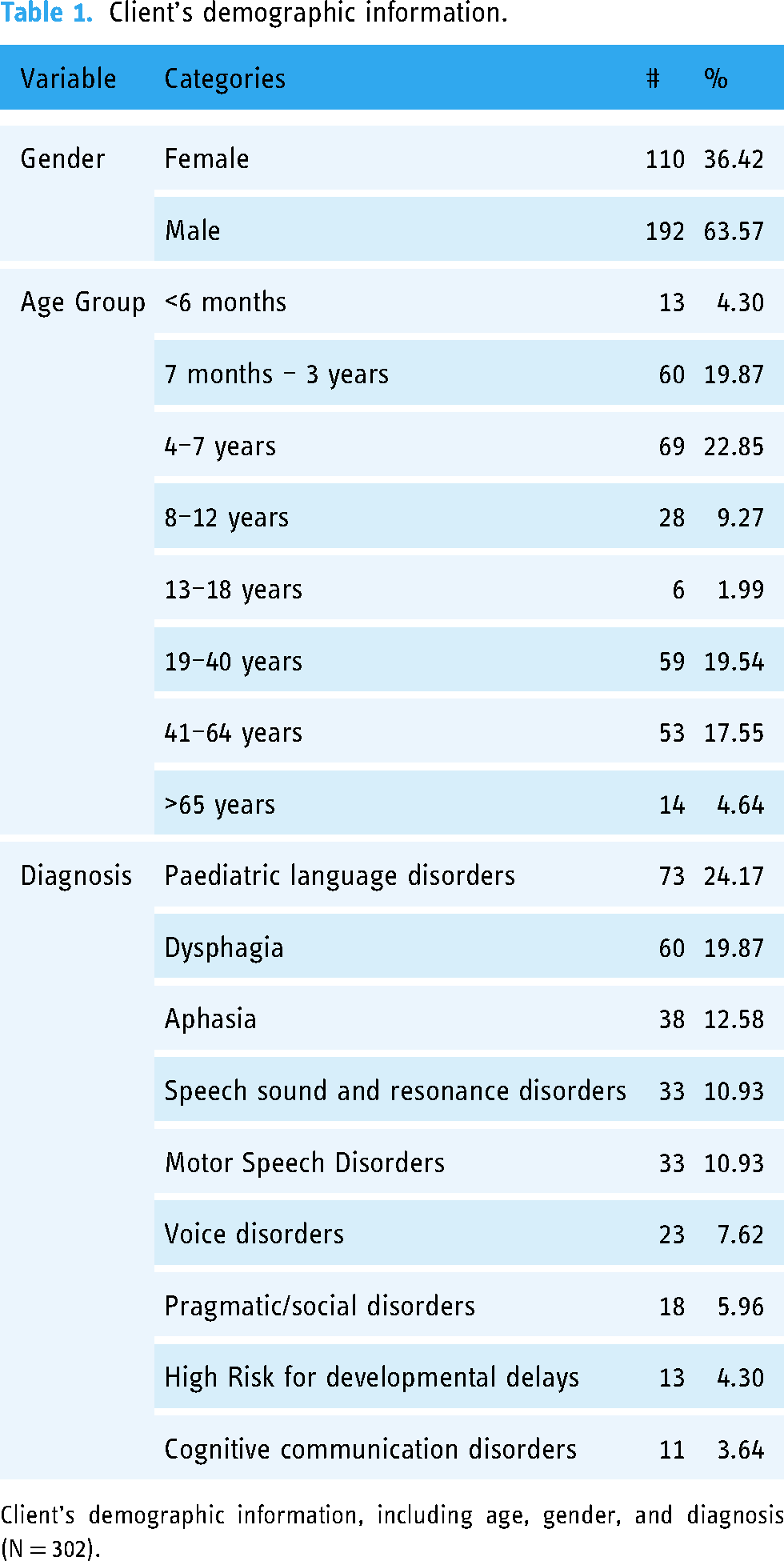
Client's demographic information, including age, gender, and diagnosis (N = 302).
Telehealth services
97.35% of the respondents reported receiving telehealth SLP services for the first time during the COVID-19 pandemic, and 2.65% received it before the pandemic. About 42.05% of the respondents received less than 6 months of telehealth services, whereas 23.51% received telehealth services between 6 months and 1 year, and 34.44% received telehealth services for more than one year. About 67.22% of the respondents reported receiving irregular telehealth services, and 32.78% reported receiving regular telehealth services ranging from two sessions per week to once a month.
Clients received different types of clinical services through telehealth (Figure 1A), with assessment (i.e., clinical examination) being the highest service (33.92%), followed by monitoring (i.e., follow up appointments to monitor progress) (24.38%). The most common reported mode of telehealth delivery (Figure 1B) was video-communication (e.g., Zoom calls) (51.3%), followed by audio-communication (e.g., telephone appointments) (32.78%), a combination of video-communication and audio-communication (9.27%), and video-communication alongside store-and-forward (i.e., asynchronous telehealth service that allows clients to submit clinical information, such as image, video, medical history, and demographic information, to their healthcare provider through electronic communications systems) (3.97%).

(A) The type of clinical services received through telehealth, presented in percentages. (B) Methods of telehealth service delivery, presented in percentages.
Satisfaction with factors related to telehealth SLP services
Results from the Likert-scale on the satisfaction of the respondents with different aspects of telehealth services are illustrated in Figure 2. As visualised in Figure 2, the most frequent response to all statements were either ‘agree’ or ‘strongly agree’, indicating high levels of satisfaction. The majority of respondents were satisfied with their whole telehealth experience (82.12%), felt that they benefited from their telehealth services (69.21%), and felt that the quality of healthcare received via telehealth was high (87.75%).

The satisfaction with telehealth Speech-Language Pathology services as reported by service users (N = 302) on a 5-point Likert-scale, illustrated in percentages.
With respect to aspects related to healthcare management received via telehealth, the majority of respondents reported that their clinical examination during telehealth sessions was thorough (65.23%), all instructions and treatment plans received via telehealth were clear (80.74%), all session materials and handouts that were received from their clinician via telehealth were easy to use (56.62%), and the duration of the session was adequate (87.09%).
In relation to aspects related to the healthcare provider, the majority of respondents reported that the clinician provided an appropriate level of healthcare through telehealth (91.06%), and interacted in a professional manner (95.36%). In relation to aspects related to participants confidence with telehealth, the majority of respondents reported that the use of telehealth was easy (90.07%), the picture and/or sound quality were good (87.42%), and that they were able to discuss their medical concerns (84.77%) and communicated adequately with the clinician during telehealth sessions (90.73%).
With reference to aspects related to the appropriateness of telehealth services, the majority of respondents found telehealth sessions to be convenient (86.09%), the appointment time suitable (85.43%), and that their privacy and confidentiality were respected and protected during telehealth sessions (97.68%).
The effect of clients’ demographics, medical diagnoses, and types of clinical services on the satisfaction with telehealth SLP experience
Findings from Ordinal Logistic Regression analyses and Pearson's Chi-square tests revealed a significant relationship between diagnosis and satisfaction with telehealth SLP experience (χ2(32) = 69.47, two-sided p < 0.001). The model fit statistics of the Ordinal Logistic Regression analysis indicates that the model fits the data well (χ2(8) = 23.17, p = 0.003), with one significant variable in the model, which was clients with social and/or pragmatic disorders (β = −2.05, p < 0.001). The model parameter estimates are presented in Table 2. The satisfaction of service users with their telehealth SLP experience on a 5-point Likert-scale is illustrated in Table 3 and presented according to client diagnosis. On the other hand, findings from Ordinal Logistic Regression analyses and Pearson's Chi-square tests revealed no significant relationships between age group and gender with the level of satisfaction with telehealth SLP experience.
Ordinal logistic regression analyses model summary.

Model summaries from three Ordinal Logistic Regression analyses on the level of satisfaction with telehealth experience, the perceived benefits from telehealth, and the perceived quality of healthcare received via telehealth as the dependent variables, receptively, and diagnoses as the independent variables. Significant variables after Bonferroni correction for multiple comparisons are indicated in bold.
The satisfaction of service users with telehealth Speech-Language Pathology services presented according to diagnosis.

The satisfaction of service users with telehealth Speech-Language Pathology experience, the perceived benefits from telehealth, and the perceived quality of healthcare on a 5-point Likert-scale, presented according to diagnosis. Bold indicates the highest rating per diagnosis for each statement. CCD = Cognitive Communication Disorders, HR = High Risk for developmental delays, MSD = Motor Speech Disorders, PLD = Paediatric Language Disorders, P/SD = Pragmatic and/or Social Disorders, SSD = Speech Sound Disorders, VD = Voice Disorders.
Results illustrated in Table 4 show that clients and caregivers were either satisfied or strongly satisfied with telehealth SLP services across all types of clinical services: consultations, screening, assessments, therapy, counselling, and monitoring, with no statistically significant relationship between the type of clinical service and the level of satisfaction with telehealth SLP experience.
The satisfaction of service users with telehealth Speech-Language Pathology services based on the type of clinical service.

The satisfaction of service users with telehealth Speech-Language Pathology experience, the perceived benefitsh from telehealth, and the perceived quality of healthcare on a 5-point Likert-scale, presented according to the type of clinical service. Bold indicates the highest rating per diagnosis for each statement.
The effect of clients’ demographics, medical diagnoses, and types of clinical services on the perceived benefits from telehealth
Findings from Ordinal Logistic Regression analyses and Pearson's Chi-square tests revealed a significant relationship between diagnosis and satisfaction with the perceived benefits received through telehealth SLP experience (χ2(32) = 65.66, two-sided p < 0.001). The model fit statistics of the Ordinal Logistic Regression analyses indicate that the model fits the data well (χ2(8) = 24.93 p = .002), with one significant variable in the model, which was clients with social and/or pragmatic disorders is the (β = −2.015, p < 0.001). The model parameter estimates are presented in Table 2. The satisfaction of service users with the perceived benefits from their telehealth SLP experience on a 5-point Likert-scale is illustrated in Table 3 and presented according to client diagnosis. On the other hand, findings from Ordinal Logistic Regression analyses and Pearson's Chi-square tests revealed no significant relationships between age group and gender with the level of satisfaction with the perceived benefits received through telehealth SLP experience.
With regards to the perceived benefits from SLP telehealth services across different clinical services, the majority of clients and caregivers either agreed or strongly agreed on the benefits of telehealth across all clinical services, including screening, assessments, therapy, counselling, and monitoring, except consultations where the majority of clients and caregivers either disagreed or strongly agreed on the benefits of the services received via telehealth (Table 4). However, there was no statistically significant relationship between the type of clinical service and the perceived benefits from telehealth service.
The effect of clients’ demographics, medical diagnoses, and types of clinical services on perceived quality of healthcare received via telehealth
Findings from Ordinal Logistic Regression analyses and Pearson's Chi-square tests revealed significant relationship between diagnosis and satisfaction with the perceived quality of healthcare received via telehealth (χ2(32) = 0.17, two-sided p < 0.001). The model fit statistics of the Ordinal Logistic Regression analyses indicates that the model fits the data well (χ2(8) = 28.91, p < 0.001), with two significant variables in the model, which were clients with social and/or pragmatic disorders is the (β = −2.34, p < 0.001) and clients with dysphagia (β = −1.824, p < 0.001). The model parameter estimates are presented in Table 2. The satisfaction of service users with the quality of healthcare via telehealth on a 5-point Likert-scale is presented in Table 3 and illustrated according to client diagnosis. On the other hand, findings from Ordinal Logistic Regression analyses and Pearson's Chi-square tests revealed no significant relationships between client's age group and gender with the perceived quality of healthcare received via telehealth.
Results illustrated in Table 4 show that clients and caregivers were either satisfied or strongly satisfied with the quality of healthcare received via telehealth across all types of clinical services: consultations, screening, assessments, therapy, counselling, and monitoring. However, there was no statistically significant relationship between the type of clinical service and the perceived quality of healthcare received via telehealth.
Discussion
The use of telehealth has increased exponentially following the COVID-19 pandemic. It is essential to examine the satisfaction of clients and caregivers with the use of telehealth as a mode of healthcare service delivery. This is the first study to show the satisfaction of clients and caregivers with telehealth SLP services in relation to the type of clinical services, diagnosis, client's age and gender. Several interesting findings were revealed in this study: (1) the vast majority of respondents were satisfied with their whole telehealth SLP experience, including high satisfaction with different factors related to telehealth, such as the perceived benefits, quality of healthcare services, healthcare management, relationship and communication with the healthcare provider, privacy, and use of technology; (2) there was no influence of client's age or gender on the level of satisfaction with telehealth SLP experience, the perceived benefits from telehealth, and the perceived quality of healthcare received via telehealth; (3) there were significant effects of diagnosis on the satisfaction with telehealth SLP services, the perceived benefits, and quality of healthcare of telehealth; and (4) there was high satisfaction with telehealth across all clinical services, including consultations, screening, assessments, therapy, counselling, and monitoring, without a relationships between the type of clinical services and the levels of satisfaction of telehealth, the perceived benefits, and quality of healthcare via telehealth.
The majority of clients and caregivers were satisfied with telehealth SLP experiences, including high satisfaction with different aspects related to telehealth, including the quality of healthcare (e.g., benefits, healthcare management, clinical examination, and treatment plan), services (e.g., convenience, appointment time, and duration), healthcare provider (e.g., interaction and professionalism), technology (ease of use, picture/sound quality), and client-related factors (e.g., privacy, and communicating concerns). These findings complement results from other countries where client's satisfaction was measured during the pandemic, including Belgium, Australia and America,14,21,22 as well as a systemic review showing high satisfaction of telehealth rehabilitation services for clients living in rural areas. 17 This compelling evidence encourages the implementation and expansion of telehealth as a service delivery model in SLP.
It is essential to consider the perception and satisfaction of both services users and service providers, as they may provide different insights. In a previous study, we examined the perceived benefits of telehealth SLP services from the clinicians’ perceptive and found that they vary depending on the type of clinical service, and according to the client's age. 7 Specifically, consultations and counselling were perceived as most effective type of clinical services delivered via telehealth, whereas assessment was the least effective; telehealth was most effective for clients aged 18–40 years, whereas it was least effective for those below the age of 3 years old. 7 This is different than the opinions of services users as reported in the current study, which showed that clients and caregivers were satisfied with telehealth SLP services across all clinical services and for all age groups. These findings resonate with another study that showed satisfaction with telehealth rehabilitation services including SLP regardless of client's age, and type of clinical visit. 22 On the other hand, the perceived benefits of telehealth SLP services from the clinicians’ perceptive vary depending on the diagnosis, 7 which is similar to the opinions of services users as documents from the findings of the current study. Specifically, our findings indicated that a quarter of caregivers of clients with social and/or pragmatic communication disorders were dissatisfied with their telehealth SLP services compared to the other diagnoses. The reduced satisfaction by clients with social and/or pragmatic communication disorders, who typically present with deficits in social interaction, could be because telehealth presents with challenges maintaining interactions between clients and clinicians who are not in the same room. Difficulties controlling children's interactions via telehealth were reported as a challenge by SLPs in India and Hong Kong.9,23 Another survey to SLPs indicated that clinicians felt that candidacy for telehealth varied according to client's behaviour skills, and cognitive abilities. 13 The discrepancy between the perceived benefits of telehealth SLP services from the clinicians’ perception versus the satisfaction of service users highpoints the importance of accounting for the views of service users, and not only healthcare providers.
The current study has some limitations. This was a retrospective study, and participants were asked to recount their satisfaction of past experiences, which might lead to the possibility for misremembrance. Phone surveys can potentially introduce social desirability bias, and thus, we took several steps to mitigate this risk. The phone survey was conducted by independent research assistants, who were not involved in the healthcare of the participants. Additionally, surveyors were trained to use neutral language and emphasize the confidentiality of responses to encourage honest feedback. Furthermore, the data in this study was collected from a single medical complex, albeit the largest in the area. A national multicentre survey could strengthen the findings of the current study.
Conclusion
The study revealed high satisfaction of clients and caregivers with SLP services delivered via telehealth across all clinical services (e.g., assessment, therapy), and irrespective of client's age and gender. The satisfaction was high for different aspects related to telehealth, including the perceived benefits, quality of healthcare service, healthcare management, communication and interaction with healthcare provider, privacy, and use of technology. The satisfaction with telehealth, however, differed according to the client's diagnosis. These interesting results may guide the establishment of telehealth services in terms of determining which client groups to receive healthcare via telehealth versus in-person sessions. This could also direct future clinical trials examining the effectiveness of telehealth in comparison to in-person services with different diagnoses. The knowledge from this study can be used to advocate for the expansion of telehealth SLP services in order to increase access to healthcare, and reduced wait time to receive healthcare services. Future studies can address clients and caregivers’ perception and attitudes towards telehealth SLP services in relation to the facilitators and barriers of telehealth. Understanding factors that could influence the satisfaction and implementation of telehealth is critical especially since telehealth services have become a more common mode of service delivery since the COVID-19 pandemic.
Supplemental Material
sj-docx-1-dhj-10.1177_20552076241313163 - Supplemental material for The satisfaction of clients and caregivers with telehealth speech-language pathology services
Supplemental material, sj-docx-1-dhj-10.1177_20552076241313163 for The satisfaction of clients and caregivers with telehealth speech-language pathology services by Reem S. W. Alyahya in DIGITAL HEALTH
Footnotes
Acknowledgements
I would like to thank my colleagues at King Fahad Medical City, Mohammad AlShalawi and Hawazen AlKhalaf, for assisting with participant recruitment. I am also grateful to SLP students/interns, Reema AlGhamdi, Aalya Albeeshi, Ghadi AlQahtani, and Shahad AlSubai, for their help with data collection.
Contributorship
R.S.W.A: Conceptualization, Methodology, Investigation, Formal Analysis, Project Administration, Visualization, Data curation, Writing - Original Draft, Writing - Review & Editing.
Data availability
Data associated with this research can be made available upon reasonable request from the corresponding author.
Declaration of conflicting interests
The author declared no potential conflicts of interest with respect to the research, authorship, and/or publication of this article.
Ethical approval
The study was approved by King Fahad Medical City’s Institutional Review Board (IRB No. 21-557).
Funding
The author received no financial support for the research, authorship, and/or publication of this article.
Consent to participate
Written informed consent was obtained from all participants or their legally authorized representatives prior to study initiation.

Supplemental material
Supplemental material for this article is available online.
References
Supplementary Material
Please find the following supplemental material available below.
For Open Access articles published under a Creative Commons License, all supplemental material carries the same license as the article it is associated with.
For non-Open Access articles published, all supplemental material carries a non-exclusive license, and permission requests for re-use of supplemental material or any part of supplemental material shall be sent directly to the copyright owner as specified in the copyright notice associated with the article.
