



Abstract
Objective
This scoping review explores patients’ experience with wearable technology. Its aims are to: (a) examine studies that contain empirical findings related to patients’ experience with wearables; (b) compare these findings within and across studies; and (c) identify areas in need of greater understanding.
Methods
A Preferred Reporting Items for Scoping Review (PRISMA) guided approach was followed. Four databases of peer-reviewed articles (CINAHL, EMBASE, PubMed, and Web of Science) were searched for empirical articles involving patients’ experience of using wearable technology. A standardized data abstraction form recorded relevant information on the articles identified. Data analysis included frequency counts for all abstracted categories; and itemized (by study) findings related to patients’ wearable experience including satisfaction.
Results
Forty-six studies comprised the final review sample. The research literature examining patients’ wearable experience is characterized by variety in terms of sample sizes, medical situations and wearable devices examined, research settings, and geographic location. This literature supports a positive patient experience with wearables in terms of satisfaction and usability, although the evidence is mixed when it comes to comfort. The moderate to higher satisfaction, usability, and comfort findings across studies do not suggest any sort of pattern with respect to the type of wearable, medical situation, or location.
Conclusions
The review findings suggest that health care organizations should view wearable technology as a viable complement to traditional aspects of patient care. However, from a patient experience standpoint, there is still much to know and validate in this regard, especially as the technology continues to advance.
Introduction
Patient care continues to incorporate the use of wearable technology for a range of different clinical purposes. Wearable technology includes a range of different devices and tools with the most common including patches and sensors that affix to patients externally for biometric and other forms of monitoring; and wristbands, bracelets, clips, and watches that collect and upload information to web-based applications. The U.S. wearable medical device market is expected to grow from 11 to 112 billion dollars over the next ten years 1 as physicians, hospitals, long-term care facilities, and other health providers embrace the technology as a means to help provide higher-quality care, real-time patient monitoring, and a better patient experience, and to potentially reduce health care costs by placing greater emphasis on prevention.2,3 That said, current evidence that wearable technology positively impacts health outcomes is limited,4,5 although recent review evidence suggests the use of wearables can be cost-effective and enhance quality of life years for patient populations. 6 At present, the use of wearable devices for home-based healthcare accounts for over 50 percent of market share, with remote patient monitoring accounting for 18% percent. 1
Wearable technology is in its infancy. Still, it is important not only to understand its impact on clinical outcomes, but also to gauge the patient experience. This experience is multi-faceted and may include perceptions of overall satisfaction with using wearable devices, as well as levels of comfort given that these devices can be more or less intrusive on the person. In addition, the overall usability of wearable devices is part of the patient experience, in terms of dimensions such as ease of use and functionality. Patient adoption of wearable technology is an important factor in whether and how the health care industry implements it in various areas of patient care. Thus, while market growth projections may be ambitious, the realization of those projections is shaped by how much patients embrace wearable technology, given that patients will play a major role in making that technology work as intended.
This scoping review explores the patient experience with wearable technology. Its specific aims are to: (a) examine studies in the literature that contain empirical findings related to patient satisfaction, usability, and comfort with wearable technology; (b) assess and compare the findings on satisfaction, usability, and comfort within and across studies; and (c) identify areas in need of greater study and understanding for this literature as a whole moving forward. We focus the review only on studies that examine wearable technology in the context of the monitoring and management of specific medical conditions or specific risks such as falls (e.g., falls risk among seniors). To our knowledge, this review is the first of its kind in terms of focusing on the patient experience with wearable technology.
Methods
We performed the initial literature search during January 2024, and included peer-reviewed articles published up to that time. A Preferred Reporting Items for Scoping Review (PRISMA-ScR) guided approach was followed for performing the review (Figure 1). Four databases of peer-reviewed articles (CINAHL, EMBASE, PubMed, and Web of Science) were searched for empirical articles that contained results involving patients’ experience of using wearable technology as part of their care (e.g., monitoring sensors, smart watches and bracelets, medication dispensers). The PubMed and Web of Science databases have extensive collections of peer reviewed articles from 20,000 journals. CINAHL covers a narrower field of interdisciplinary health-related topics. Embase is a large biomedical and health care article database which indexes 8500 journals.

Preferred reporting items for systematic reviews and meta-analyses (PRISMA) flow diagram.
Using these four article databases for our scoping review allowed for a comprehensive search to find relevant empirical studies examining the wearable experience among patients, and to explore the various findings in a nascent literature while identifying additional opportunities for future research. The terms “wearables”, “wearable technology” and “wearable devices” were each used in separate searches followed by the Boolean operator “AND” and each of four respondent terms (“patient satisfaction,” “patient experience,” “user satisfaction”, “user experience”). Duplicates within and across the four databases were identified and removed prior to moving to the next step in the filtering process. We excluded articles published prior to 2000.
Eligibility criteria and study selection
Once all duplicates were removed, article abstracts and, where necessary, the full text of articles were reviewed to identify and filter out articles: (a) that were in non-English journals; and (b) which did not contain an empirical finding related to patients’ wearable experience. Two of the co-authors performed this step and the third co-author reviewed any article abstracts and full-text articles where there was uncertainty as to whether a relevant empirical finding was present. Empirical findings could include anything ranging from a univariate to multivariate result for specific aspects of the experience such as satisfaction, usability, and comfort. The three co-authors met to resolve any disagreements. After non-empirical or non-relevant articles were identified and filtered out through either abstract or full article review, a total of 46 studies comprised the final review sample (Figure 1).
Data abstraction & analysis
A standardized data abstraction form created in Microsoft Excel was used to record relevant information on the 46 articles. The following information was abstracted from the articles: geographic (country) setting of study; research setting (e.g., home, hospital, other remote location); sample size (number of patients); time period of study (if identified); medical conditions examined (e.g., Parkinson's Disease, Diabetes); type of wearable device; and specific patient experience findings (e.g., satisfaction).
The data abstraction process was performed in the following manner. The three co-authors independently abstracted the above information for a group of the same five articles, then met and compared their results. This helped calibrate the abstraction approach across the co-authors. Subsequently, two of the co-authors each independently reviewed half the articles and abstracted the above information into the Excel spreadsheet. The third co-author reviewed these abstractions, double-checking a select number of original data abstractions made by the two co-authors. Any discrepancies in abstracting were resolved as a team.
Further analysis of data was also collaboratively performed by two of the co-authors. This analysis included frequency counts for all abstracted categories; and itemized (by study) findings related to patients’ wearable experience (e.g., satisfaction, usability, comfort). Consistent with the scoping review intent, we attempted to identify any patterns in the findings that might help clarify the patient experience with wearable technology at the present time, as well as identify key gaps in understanding that should be filled empirically moving forward to enhance our knowledge of how patients perceive the use of wearable technology in their care.
Results
The overall research literature examining patients’ wearable experience is characterized by variety in terms of sample sizes, types of medical conditions and wearable devices examined, research settings, and geographic location (Table 1). Sample sizes ranged from 6–115 patients, with most studies in the review (31/46) including fewer than 30 patients. Medical conditions examined included Parkinson's Disease, Huntington's Disease, orthopedic rehabilitation, epilepsy, cardiac/stroke rehabilitation, heart conditions, diabetes, and fall prevention. Research settings included wearables used at home only, at the hospital only, in both settings, and in other non-home remote settings. Eighteen studies were conducted in European countries and ten were conducted in the United States. Other countries where studies were performed included South Korea, India, Taiwan, Canada, and Cambodia. In twelve study instances, the country setting was not explicitly stated.
Studies included in the review (n=46)

Abbreviations: ECG, electrocardiogram; EEG, electroencephalogram.
Findings related to patient satisfaction with wearable technology
Twenty six of the 46 studies in the review sample contained a general satisfaction finding of some kind with respect to wearable technology (Table 2). In 20/26 of these studies, moderate to higher levels of patient satisfaction were identified. These included higher patient satisfaction with the use of a FitBit and software application to assess perioperative activity in urologic surgery 7 ; moderate to higher satisfaction with wearing a miniature eye camera to assist with visual impairments 8 ; higher satisfaction with ingestible and patch sensors that connect to a smartphone app to monitor medication adherence to help manage uncontrolled hypertension 9 ; and higher satisfaction with an electrocardiogram (ECG) device worn by hospital patients on the chest, with accompanying wristband, for continuous atrial fibrillation detection. 10
Main relevant satisfaction findings for select studies included in the review (n=26).

Note: To determine the level of satisfaction among respondents, we converted all numeric scores to score out of 100. We classified scores of less than 60 as “lower satisfaction,” scores between 60 and 80 as “moderate satisfaction,” and scores greater than 80 as “higher satisfaction.” We reverse coded scales for which a lower score indicated a more positive outcome.
Please refer to main finding for more information. Scores were not able to be converted.
QUEST 2.0: Quebec User Evaluation of Satisfaction with Assistive Technology
PSSUQ: Post-Study System Usability Questionnaire
A lower score is better.
In only four studies were patient satisfaction levels identified as lower, and across the studies there were no discernable patterns identified in terms of patient location (e.g., home vs. hospital); type of wearable device; or medical situation/condition. The studies which had the highest levels of patient satisfaction were equally split between more serious medical conditions (e.g., lung transplant monitoring during Covid vaccinations; blindness; stroke rehabilitation; atrial fibrillation) and more routine ones (e.g., diabetes; hypertension).
Findings related to patient usability with wearable technology
Twenty four of the 46 studies in the review sample contained a usability finding of some kind with respect to wearable technology (Table 3). In 21/26 of these studies, moderate to higher levels of patient usability were identified. These included higher perceived usability with a wearable leg sensor that provided biofeedback for orthopedic injury rehabilitation 13 ; higher usability with smart wristbands used during pregnancy to monitor heart rate and steps 29 ; moderate to higher perceived usability with finger-worn sensors uploading temperature, heart rate, and muscle tension information to a web-based application 31 ; and higher perceived usability with three body-worn sensors that provide information on the scope and severity of symptoms for patients with Parkinson's Disease. 51
Main relevant usability findings for select studies included in the review (n=24)

Note: To determine the level of satisfaction among respondents, we converted all numeric scores to score out of 100. We classified scores of less than 60 as “lower satisfaction,” scores between 60 and 80 as “moderate satisfaction,” and scores greater than 80 as “higher satisfaction.” We reverse coded scales for which a lower score indicated a more positive outcome.
Abbreviations: EEG, electroencephalogram.
SUS: System Usability Scale
PSSUQ, Post-Study System Usability Questionnaire
A lower score is better
Higher score indicates favorable result in this case.
TAM-FF: Technology Acceptance Model Fast Form
Please refer to main finding for more information. Scores were not able to be converted.
In only three studies, patient usability levels were identified as lower. Across these studies there were no similarities in terms of patient location (e.g., home vs. hospital); type of wearable device; or medical situation/condition. For the studies which had the highest levels of usability, a majority focused on wearable use in the home setting. Similar to the satisfaction findings, studies reporting higher levels of usability were equally split between more serious medical conditions (e.g., Parkinson's Disease; stroke and spinal cord injury sleep/gait monitoring) and more routine ones (e.g., orthopedic rehabilitation after knee replacement; overactive bladder; pregnancy monitoring).
Findings related to patient comfort with wearable technology
Fifteen of the 46 studies in the review sample contained a comfort finding of some kind with respect to wearable technology (Table 4). In 11/15 of these studies, moderate to higher levels of patient comfort were identified. These included higher perceived comfort with a belt device using a 3D camera and vibrating mechanism to make up for peripheral vision loss 19 ; moderate to higher comfort with smart wristbands used to monitor heart rate and steps during pregnancy 29 ; higher comfort with Google smart glasses worn by autistic children to help with social skill development 34 ; and moderate comfort associated with a waist belt and electronic bracelet serving as a virtual cane for visually impaired patients. 15
Main relevant findings related to comfort of wearable for select studies included in the review (n=14).

Note: To determine the level of satisfaction among respondents, we converted all numeric scores to score out of 100. We classified scores of less than 60 as “lower satisfaction,” scores between 60 and 80 as “moderate satisfaction,” and scores greater than 80 as “higher satisfaction.” We reverse coded scales for which a lower score indicated a more positive outcome.
Please refer to main finding for more information. Scores were not able to be converted.
A lower score is better.
Three studies reported lower patient comfort levels. Across these studies there were no similarities in terms of patient location (e.g., home vs. hospital); type of wearable device; or medical condition. The studies which had the highest levels of patient-reported comfort each addressed different medical conditions and involved different wearable technologies.
Comparing satisfaction, usability, and comfort findings across studies
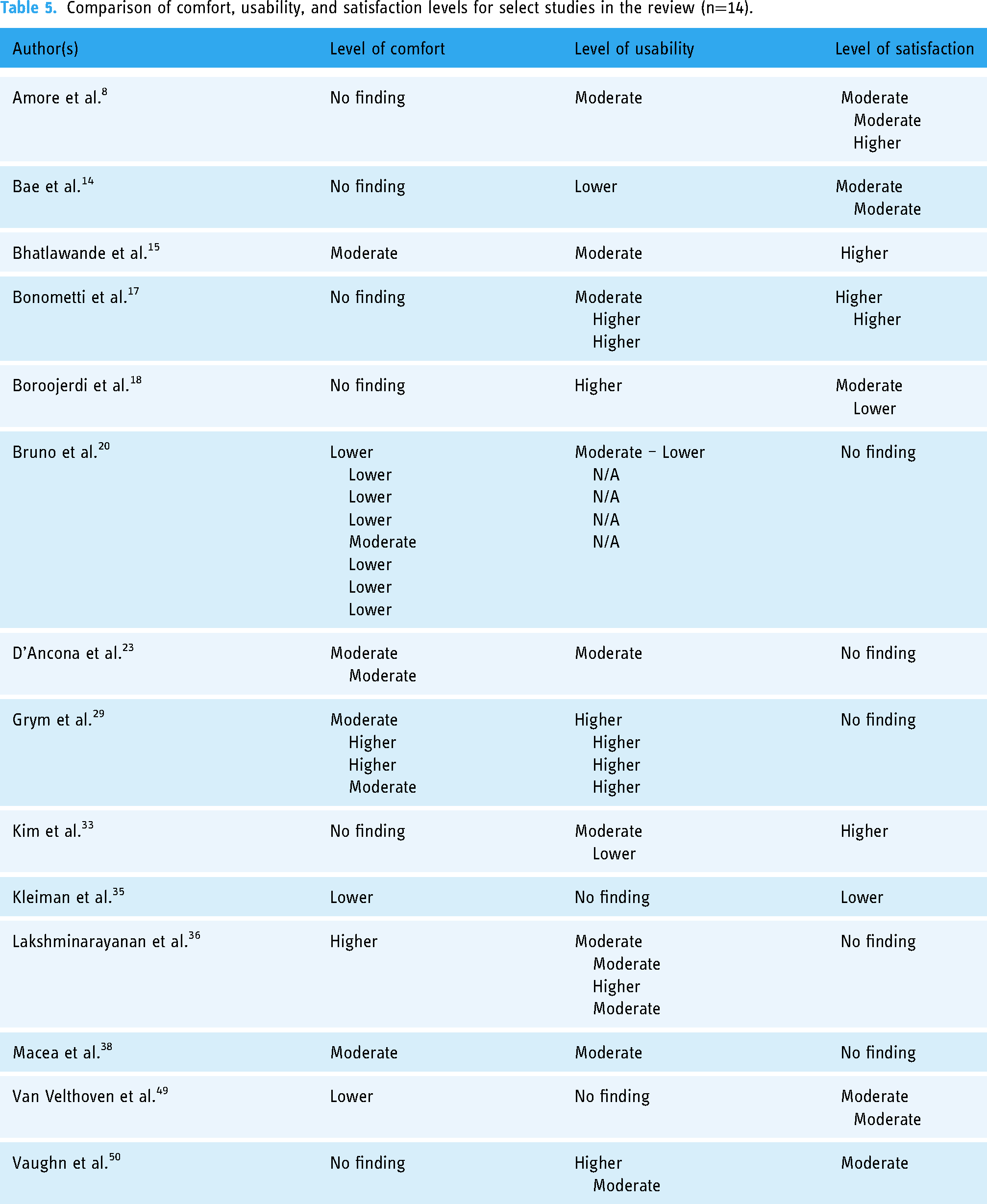
Only one study in the review (i.e., Bhatlawande et al. 2014 15 ) reported moderate or higher levels across all three dimensions of the wearable experience, i.e., satisfaction, usability, and comfort (Table 5). In part, this was due to the fact that several studies only examined one or two of the three dimensions. Six studies found moderate or higher levels of wearable usability combined with similar levels of patient satisfaction. Four of these six studies involved serious medical conditions such as Parkinson's Disease, blindness, spinal injury, and organ transplantation. None of the wearable technologies examined across the six studies was similar. In four separate studies, moderate or higher levels of wearable comfort were identified with similar levels of usability. Three of these four studies involved more significant medical conditions such as chronic heart failure, stroke, and epilepsy. None of the wearable technology across the four studies was similar.
Comparison of comfort, usability, and satisfaction levels for select studies in the review (n=14).
Discussion
To our knowledge, this represents the first review of published empirical articles examining patients’ experience with wearable technology. Several general observations can be made from the findings. First, at present there is not a large number of studies examining how patients experience wearable technology. This is surprising given the hype associated with wearables in health care.53,54 Much of this hype focuses on the benefits for health care quality and patients generally with using wearable technology to help promote wellness and prevention, while managing various medical conditions. However, from a patient experience standpoint, there is still much to know and validate in this regard, especially as the technology continues to advance. Second, the extant literature, limited as it is, does seem to support a positive patient experience with wearables in terms of satisfaction and usability, although the evidence is mixed when it comes to comfort. Third, the moderate to higher satisfaction, usability, and comfort findings across studies in the review do not suggest any sort of pattern with respect to the type of wearable, medical situation, or location. Rather, there is a fair degree of inherent variety in the literature suggesting that patients can have positive experiences with wearable technology regardless of the clinical context, treatment location, or wearable itself.
From a practical standpoint, the review findings suggest that health care organizations should view wearable technology as a viable complement to other traditional aspects of patient care, that can be used to help physicians in their clinical monitoring, for empowering patients to engage in their health care, and to provide important data for decision making. Extant literature already shows wearable technology to be cost-effective and able to increase quality-adjusted life years for individuals. 6 But to gain widespread acceptance, physicians will want to be reimbursed appropriately for investing in such technology and for the additional work associated with using wearable technology in their practices.
Future research opportunities related to the wearable experience
Additional research opportunities exist that will help enhance the empirical literature on patients’ experiences with wearable technology. An obvious one is the need for additional studies that examine the experience within a multivariate context, to help determine which factors are most associated with either a positive or negative wearable experience. 55 Such studies would require: (a) larger sample sizes in order to include more contextual variables in models that can isolate the independent effects of various factors on experiential variables like satisfaction and usability; (b) different types of wearables and medical situations examined in the same study to compare patients’ experience; and (c) greater inclusion of quality and effectiveness measures in the same studies as the patient experience measures. The ability to compare reported levels of quality and effectiveness in the same study as levels of satisfaction and usability can offer a robust picture of wearable value in patient care. For example, if a specific wearable can deliver both patient satisfaction and improved quality of care, it merits greater investment than one that does less.
Longitudinal studies that assess the wearable experience over time in patient care situations are also needed. There is evidence that individuals generally may become less engaged or satisfied with a wearable as they use it longer. However, this research has focused on the voluntary use of wearable devices for general health and wellness monitoring, such as in the use of smart watches. There is less understanding of whether patients whose conditions require them to engage with different types of wearables also experience a more negative or ambivalent experience as time goes on. Generally, patient perceptions of usability or comfort may indeed change over time. 56 If a wearable is used for a longer period, it makes sense to gauge how patients interact with that wearable for the full time they have it. In addition, qualitative investigations of patients’ experiences can create a more precise understanding of the most important parts of a patient's wearable experience. For instance, is comfort as important as usability? Can patients be satisfied with a wearable even if it is perceived as less comfortable? What specifically does “usability” mean across different types of medical situations and wearable technologies? Does satisfaction depend on other dimensions such as usability and comfort? Questions such as these require data collection from patients that go into greater depth around their everyday experiences with wearable technology.
Two related limitations of the review are worth noting. First, it is possible that some relevant empirical studies of the wearable experience were missed. For example, there could be peer-reviewed research that examines patient satisfaction or usability as a minor aim such that specific findings are not identified in an article title or abstract. Second, there may be data on the patient experience not published in peer-reviewed journals that was missed as only research published in peer-reviewed journals was included in the review. For example, survey data collected by private companies around patient perceptions related to wearables might exist, although it might be assumed that in these instances, validating whether or not a given survey respondent actually has used a specific wearable is difficult. We decided to hold to the gold standard of including only research that had undergone peer-review and which used patient samples where it was validated a specific type of wearable had been used by those being asked about their experiences.
Conclusion
This review shows that the early literature on patients’ experience with wearable technology paints a promising yet incomplete picture. In most situations, there are adequate levels of satisfaction, usability, and comfort expressed by patients towards wearable technology. What has to be better understood is the array of factors which drive these positive feelings, and how different dimensions of the experience interact with each other over time to produce higher levels of satisfaction with wearable technology.
Footnotes
Contributorship
All listed authors met the following criteria for this paper:
Made a significant contribution to the concept, design, acquisition, analysis or interpretation of data Drafted the article or revised it critically for important intellectual content Approved the final version of the article for publication Agreed to be accountable for all aspects of the work and resolved any issues related to its accuracy or integrity
Acknowledgements
N/A
Consent to participate
Not applicable.
Data availability
Information on review data is available by contacting the corresponding author.
Declaration of conflicting interests
The authors declared no potential conflicts of interest with respect to the research, authorship, and/or publication of this article.
Ethical considerations
Not applicable.
Funding
The authors received no financial support for the research, authorship, and/or publication of this article.
