




Abstract
Background
Pregnancy and childbirth are supposed to give a new beautiful meaning to life and it is a time of enormous delight and anticipation for both the women and their families. In these times, not only a baby is born, but a mother is born. However, inaccessibility and delays in obstetric care remain a common concern, particularly in low- and middle-income countries. Digital health technologies are being implemented to improve healthcare access worldwide, but there is a lack of documented data on available digital triage interventions. This article sought to examine and critique existing digital triage interventions in the healthcare system with reference to obstetrics.
Methods
Adopting a scoping review approach, using the five iterative steps proposed by Arksey and O'Malley, approximately 17 studies retrieved from databases like PubMed, Elsevier, EBSCohost, and google scholar were reviewed. Only the literature from 2014–2024 was included.
Results
The review revealed that there are various types of digital triage interventions. However, they are flooded with weaknesses and threats among of which are diagnosis inaccuracy, insufficient information, and shortage of resources.
Conclusions
The study recommends that strengths, weaknesses, opportunities, and threats should not be overlooked, particularly when aiming to leverage digital health to improve access to emergency care in maternity units through digital triage. However, they should serve as a reference for the development of optimal digital triage systems for maternity and emergency units. Furthermore, the findings should also be a benchmark for digital triaging improvement strategies in the healthcare context.
Introduction
Digital Health Interventions (DHIs) have become the new vogue in the healthcare industry. Although it has been gradually implemented over the past years, it was increased by the COVID 19 pandemic and now covers a wider scale in the healthcare system. Its use continues to grow in numbers and abilities. As of recently, it is used for diagnosing, clinical decision, health promotion, and disease prevention and treatment. It has become the better evolution of the healthcare system. The advent of advances in digital health technologies is gradually implemented to improve the accessibility of healthcare services.1–4 Recognizing the existence of DHIs, some healthcare institutions worldwide have progressed to the use of digital health for triaging purposes. The use of these digital triage systems was perpetuated by the COVID 19 pandemic. During that time, the main concern was to minimize the subsequent spread of COVID 19 infections. Other than that, countries such as Germany resorted to the use of the digital triage system to curb the use of emergency care by non-urgent patients and reduce the use of healthcare services.5–8 Some of the digital triage systems use advanced algorithms to assess the patient's medical history, laboratory results, and findings to anticipate the severity of the illness. It detects early signs of complications and allows healthcare professionals to prioritize patients in need of emergency care. 9 Meanwhile, in other institutions, they relied on the telephonic triage system and online self-triage of symptoms to prioritize urgent health problems. 10
However, despite the variety of types of digital triage systems. Several scholars have reported that digital triage systems indeed have an impact on reducing the use of healthcare services, but not all of them. The use of digital triage systems such as telephonic triage systems has minimized the workload and increased the patient satisfaction with healthcare services. In contrast, some patients expressed that with regard to digital triage system, such as telephone triage, it could be improved by providing detailed specific information.8,11,12 On the other hand, substantial data are reported on the use of digital triage in healthcare and the impact it has. However, there is still a paucity of data reported on the use of such digital triage practices within the obstetrics department. This was affirmed by a systematic review of the literature and the Play store which revealed thirteen mobile applications, and those applications were focused on emergency departments and disaster management. Among those applications, none focused on obstetrics and maternal health. 13 However, up to now only two types of digital obstetric system have been reported. These triage systems are obstetric telephone triage and WhatsApp triage.12,14
The use of such DHIs has been known to be beneficial to both healthcare consumers and healthcare providers worldwide. Ngwenya et al. 15 indicated that apart from digital triage interventions, there are various kinds of DHIs; some of which were directed to improving maternal health outcomes. For instance, DHIs such as Mobile4Health and SAFE@HOME were reported to be productive in improving rapid access to prenatal care and minimizing maternal mortality associated with obstetric conditions such as pre-eclampsia through telemonitoring and provision of nutritional and self-care advices to pregnant women. 15 On the same wavelength, in South Africa (SA) there is limited evidence about digital triage systems in the maternity units. Existing digital health technologies platforms in the maternal health field within SA are very specifically focused on health promotion and prevention (i.e. mom-connect, pregnancy plus). Moreover, existing evidence also suggests that digital health technologies are platforms that improve quality of care and timely provision of optimal care, particularly in maternity care. The use of digital health technologies engages women in their care and supports women and their families. Furthermore, it promotes good maternal health practices and facilitates quality maternal care.15–17 However, this presents a context gap in the triaging using DHIs in obstetric departments. As a result, this paper sought to examine and critique existing digital triage practices and interventions in the healthcare system with reference to obstetrics. Regardless of whether they are self-triage systems or clinician-led digital triage systems.
Material and methods
This review paper adopted a scoping literature review method, following the listed steps: Identification of the review question; Identifying relevant literature and study selection; Data extraction and analysis; Presentation of results; and Discussion of results.
Identifying the review questions
The scoping review underpinned this study to identify, critique, evaluate, synthesis, and interpret the available evidence on existing digital triage interventions in the healthcare industry. It further examined existing triage interventions to identify gaps in the digital triage interventions implemented in healthcare. Drawing from those gaps, the review will recommend a comprehensive digital obstetric digital triage intervention. This review was guided by the following research questions;
What are the existing digital triage interventions in healthcare to improve access to care for obstetric emergencies in maternity units?
Identifying relevant literature and study selection
A comprehensive literature search was conducted on online databases such as PubMed, Elsevier, EBSCohost, and google scholar; using keywords such as ‘digital triage’, OR ‘digital triage interventions’, OR ‘triaging in healthcare VS digital health’. The literature search was conducted from October 2023 to February 2024. Boolen operators were used to broaden the literature search and to specifically describe the phenomenon of inquiry. Backward and forward reference searching was employed to widen the search of the literature. In this review, English-written studies within the year range of 2014–2024 were included. This was because the authors were aware that the global digital health strategy by the World Health Organization was endorsed in 2019 by the 73rd World Health Assembly, since then digital health has gained superior prominence, so it was quite the best idea to look at studies not beyond 2014 before digital health gained its prominence. We reviewed all kinds of studies. These include qualitative, quantitative, reviews, and gray literature. In addition, it included qualitative and quantitative evaluation studies of digital triage interventions. However, opinion papers, studies that were not written in English, were inaccessible and focused on mass disaster triage were excluded from the review. Additionally, studies that did not focus on digital triage interventions in the healthcare industry were excluded. The inclusion and exclusion criteria are depicted in Table 1.
Inclusion and exclusion criteria.

Data extraction and analysis
The literature search yielded 691 publications. Following the selection of publications for duplicate and abstract selection for relevant publications. Seventeen publications met the inclusion criteria. The research team then independently reviewed full-text publications using a customized data extraction chart. The extraction chart included the author, publication date, design, and key outcomes. The data were analyzed using thematic analysis. The authors immersed themselves in the selected manuscripts and read all the studies with understanding to identify the meanings and patterns across the studies. The codes were then generated from the studies and fitted together to generate potential themes. The emerging themes and subthemes were refined and renamed when all authors reached consensus.18,19 Thematic analysis was conducted by each member of the research team separately, then the group met to compare the retrieved data to find any patterns or differences. Subsequently, consensus was reached on the similarities. The methodological quality of the literature was disregarded due to the paucity of data in the phenomenon of inquiry. The data extraction and charting process is shown in Table 2 and Figure 1 displays the flow chart of literature search processes.
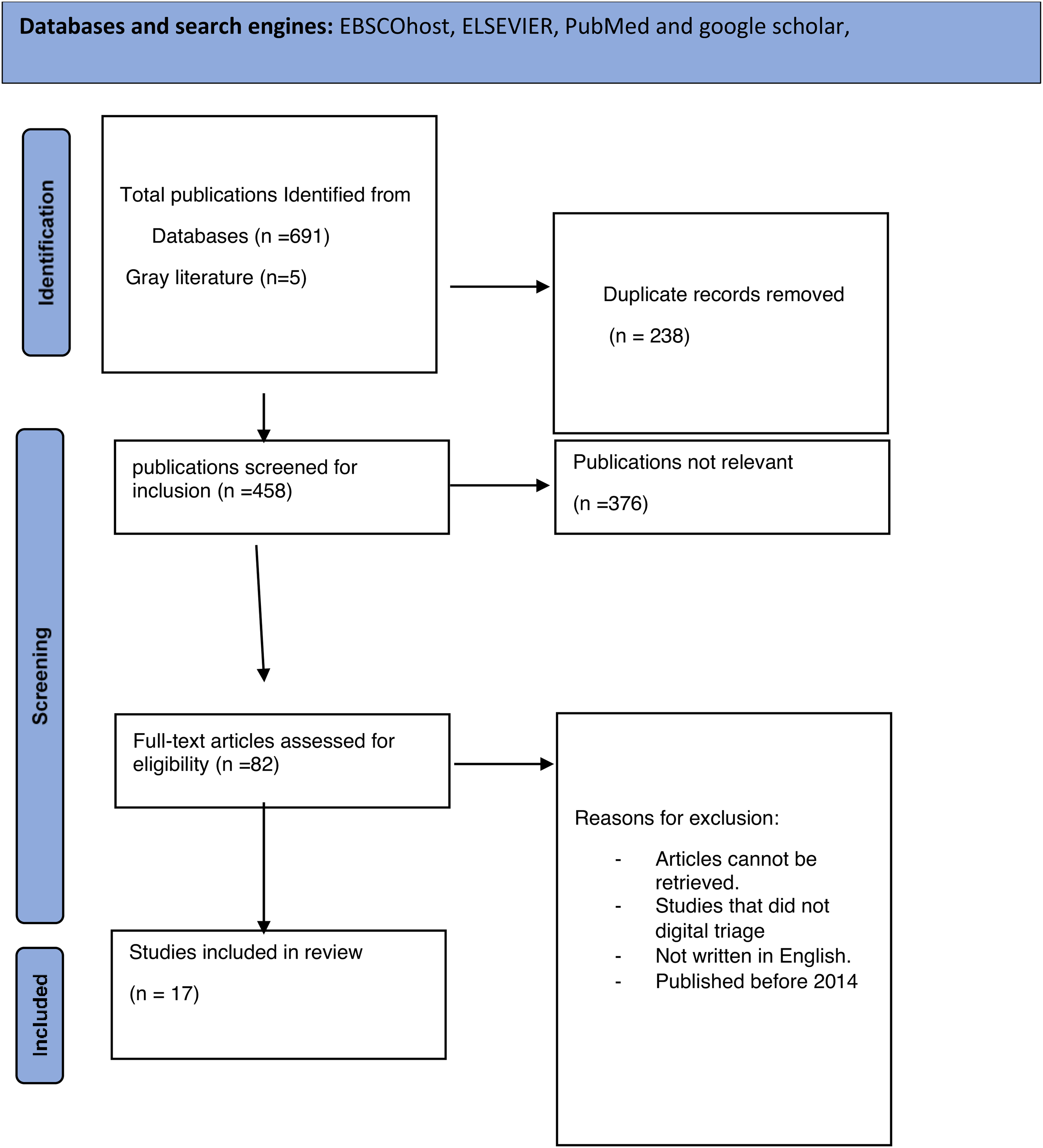
Flow chart.
Data extraction and charting processes.

Results
The purpose of the scoping reviews was to review the available evidence on digital triage interventions in the healthcare industry. Only 17 publications were eligible for inclusion. Subsequently, the research team reviewed and analyzed those publications using the thematic analysis technique. Five themes emerged from the analysis. The summarized themes are displayed in Table 2.
Theme 1: description of available digital triage interventions in the healthcare
The literature identified that there are a variety of types of digital triage intervention used in different disciplines within healthcare institutions. These include emergency departments, pediatrics, and outpatient departments. Some of the adopted digital triage systems are medical condition-specific. Meanwhile, others are patient-centric triage system and clinician-led.10,12,13 This literature to gathered a broader understanding, it critiqued and examined both patient-centric and clinician-led digital triage system studies. Thereafter the literature revealed that there are three different kinds of digital triage interventions, which are discussed below.
Mobile application-based digital triage interventions
The expansion of the use of mobile applications in healthcare care has been noted since the early 2000s. These mobile applications provide good options for patient monitoring and for the use of self-management interventions. 13 As a result of broad-spectrum problems such as unnecessary visits to emergency rooms by extension causing overcrowding and overutilization of scarce healthcare services; mobile triage applications are implemented. Among those mobile triage applications, we have Smart triage, symptoms pal, TRIAGIST, fast ED, emergency severity index triage, pedicmeter, and many more.13,20,21 The mobile triage applications like smart triage focus on the Bluetooth patient and treatment tracking system and clinical dashboard. It integrates pulse oximetry, respiratory counter, and other clinical variables which are collected from the patients, which are then used to make clinical prediction by the triage system in terms of prioritization of patients in the emergency departments. Triage systems like smart triage are operated by the healthcare personnel.13,21,22 Meanwhile, mobile triage applications like symptoms pal are triage systems which are operated by lay people. This mobile triage application allows them to use their health information to assess the presence of potential health problems. This triage system uses a diagnostic algorithm developed by a physician on the basis of medical evidence. It requires lay people to answer questions about their symptoms and in return it provides them with information on whether they should seek further care and treatment or emergency services. 20 Therefore, there is a dire need for mobile based triage systems to help pregnant women seeking obstetric care and emergency care.
Web-based and online digital triage interventions
On the other end, web-based and online triage systems are also within the healthcare systems. Some of which are patient-led, including an online symptoms checker. Online medical advice fits within a larger trend of searching the internet for health data and potential diagnoses. Online symptoms checkers such as web-based triage systems are considered useful for a more personalized assessment. Although its perceived usefulness is good, there are aspects in which some populations expressed that it needs improvement; such as privacy and security.23,24,30
Telephonic triage interventions
Telephone triage systems are different from the other digital triage systems. These triage interventions usually identify the patient as the primary user. Patients call their institutions and present their main complaints and symptoms; then healthcare personnel will select the patients based on their presenting symptoms by telephone. Thereafter, the patients are advised about whether to seek emergency care services.11,12 Although the benefits of these triage systems were reduced workload and patients’ satisfaction, their disadvantage was based on the sense that the clinical advice given to the patients is not based on objective and clinical data (Table 3).11,12
Summarized findings of the review.

Theme 2: strengths, implications, and advantages of digital triage systems
Clinical effectiveness and improved patient outcomes
The literature revealed that digital triage interventions present the healthcare system with advantages and have positive implications on patient care and how that care itself is provided. According to Chambers et al. 10 digital triage and online symptoms checkers are associated with high patient satisfaction. In addition, it has an impact on the quality of care. Novakowski et al. 22 affirmed that by stating that the digital risk prediction algorithm along with color-coded lanyards and the patient tracking system of the digital triage system helped healthcare personnel identify the severity of illness among patients, which consequently improved quality of care. The digital triage system assists healthcare personnel in identifying and prioritizing care for emergency cases and that lead to more timely care and improved patient outcomes.10,22 One could infer that high patient satisfaction with healthcare services and improved quality of care are the strengths and advantages of the digital triage system. As improved quality of care and provision of emergency care is equivalent to reduced mortality and morbidities related to delayed access of emergency care. 25 These strengths are the internal factors that can learned when considering the implementation of digital triage systems in obstetric departments.
Reduced workload
According to Pairon et al. 23 the use of digital triage algorithms alleviates pressure on the overstretched healthcare system. Thus, reducing the level of workload among healthcare workers. This was achieved through the use of digital triage interventions such as self-triage systems, that enhanced self-care among patients and better managed of the demand for healthcare. Implementing such self-triage systems results in minimal use of emergency cases by non-urgent patients, leaving emergency healthcare services available to those in need of them.5,8,11,12,26 Nonetheless, there is limited evidence on the association of clinician-led digital triage interventions and the reduction of workload.
Theme 3: weaknesses of digital triage systems
Despite the strengths of digital triage systems, these triage interventions are also infested with weaknesses that put them at a disadvantage. Addressing the weaknesses further optimizes the quality of care through digital triaging. The literature review identified several weaknesses that affect the implementation of digital triage in healthcare systems. Those weaknesses are discussed below in each subtheme.
Digital triage-related and resources weaknesses
Digital triage platforms overcome many weaknesses and challenges of traditional triage methods. However, it also has its own limitations and weaknesses. 26 Twenty-four percent of the studies have revealed that network connectivity, insufficient information, lack of awareness, and lack of security and reliability were common concerns with the use of digital triage systems among healthcare personnel and patients. These aforementioned factors were the weaknesses of digital triage interventions.12,22,24,26 Some authors suggested that to improve the efficiency and information insufficiency of digital triage services, more information should be provided to patients as well as explanation of how the interventions work to create more awareness.12,26 Aboueid et al. 24 affirmed that to address the identified weaknesses, more efforts must be made toward creating awareness related to the existence of digital triage interventions such as symptom checkers and their integration into the healthcare system as it is essential to maximize the benefits of these digital platforms.
On the other hand, Reynolds et al. 14 iterated that the issues of network connectivity were related to the matters of financial support, affordability of data, and inconsistent access to power sources. Since affordability and financial support are an issue, there should be provision of facility-owed phones to healthcare personnel to centralize accountability and data financing. 14 The implementation of the digital triage services is therefore limited to smartphones, tablets, basic computers, and local networks. Smartphones are affordable compared to other medical devices and in that manner mobile applications triage platforms can be widely implemented across the resources-limited settings.14,25
Nonetheless, poor security and reliability were common concerns that hindered the use of digital triage interventions by the patients. A study conducted by Aboueid et al. 24 reported that some of the patients who adopted digital triage interventions, such as self-triage systems, expressed that they find its reliability questionable and lack credibility. Moreover, those patients expressed that improvement is needed in areas of privacy, security, accuracy, and reliability. In contrast, the review conducted by Montano et al. 13 revealed that some of the triage interventions such as TRIAGIST had security measures in place as unidentified users were not allowed access into the triage application.
However, among other weaknesses, the lack of data standards was a concern with regard to the use of digital triage interventions. According to Lee et al. 25 and Gottliebsen et al. 27 a digital triage system should be able to deal with uncertainty and gaps in the data, as well as subjective descriptions and perceived symptoms as provided by patients. Moreover, to deal with such challenges, it is best interest that guidelines and protocols governing such digital triage platforms are formulated and implemented. As they will ensure easy transitioning and implementation of the triage systems.
Theme 4: opportunities of digital triage systems
Benefits and opportunities of digital triage interventions
Despite the identified weaknesses, we learned from the literature that there is a side of greener pastures with digital triage interventions. There are areas where one can draw lessons from and take advantage of, to ensure effective and efficient digital triage interventions. The review revealed that the use of digital triage interventions, particularly self-triage systems, enriches patients with the knowledge of their health status and their medical conditions, further improving the adoption of self-management practices. Digital self-triage interventions are the learning curve to help patients gain insight into the medical conditions they live with, and the improved health literacy among patients subsequently benefits the patient-physician therapeutic relationship. 23
On the other hand, other digital triage interventions such as smart triage application were reported to improve the confidence of healthcare personnel in reporting emergency cases identified via digital triage systems to their seniors for immediate emergency care and management.
22
This was supported by the following quote from the study by Novakowski et al.:
22
Now, with these vitals, you can all know that according to our triage system, a patient with this and this is not okay. And you can even alert your senior with confidence, which wasn’t there.
Lastly, several studies also indicated that digital triage systems are cost-effective quality improvement initiatives.23,25 There is increasing evidence that DHIs can improve quality of care and healthcare delivery. 25 These digital triage initiatives are cost-efficient both in operational services and in care diversion.
Theme 5: threats to digital triage systems
Although digital triage is of high significance in improving quality care and healthcare delivery in emergency departments, particularly in low-income and middle-income countries. 25 There are some threats identified by the review that can affect the successful implementation of digital triage systems. These are behavioral and associated social threats, digital-related threats, and resources and human resources threats. The identified threats are discussed in detail below.
Behavior and associated social threats
The review revealed that attitudes towards digital triage, resistance to change, and low technology literacy were common behavioral and social threats to implementation of digital triage systems. The reason behind the poor attitude and resistance to change by the healthcare personnel is that they perceived the use of digital triage interventions as extra work. Therefore, prioritization of the digital platforms was not followed and these practices were intentional by the triage staff and there was poor compliance with the triage systems. One could infer that such practices demonstrate the difficulty and reluctance to change the culture of triaging patients in the ordeal of arrival.22,24,25 However, the study of Novakowski et al. 22 argued that the use of digital triage interventions in the healthcare industry changes with time. This was supported by the observation that healthcare workers noted the impact of the digital triage interventions over time, their attitude toward the digital triage interventions changed and improved. On the other hand, with respect to patients, resistance was observed as some patients were stubborn and afraid to share health information. 14
On the other hand, low technological and digital literacy was the pressing social threat in the use of digital triage services. Healthcare personnel without computer skills and technological literacy faced a challenge in using mobile applications and computer dashboards from digital triage interventions. However, healthcare personnel with pre-existing computer literacy and experience using smartphones found the use of digital triage interventions so easy and was quick to learn. 22 The same thing applies to patients, the study by Pairon et al. 23 iterated that young and educated patients were the ones who tend to use digital triage tools and symptom checkers. Meanwhile, the elderly patients used the telephone triage.
Materials and human resources threats
Several studies reported that the significant threats to the widespread implementation of digital triage systems are the shortage of resources including human resources, particularly in resources-limited settings. The review identified that the poor widespread implementation of digital triage interventions was perpetuated by the shortage of supplies, the lack of equipment and digital resources. According to Lee et al. 25 the lack of availability of digital resources such as smartphones and computer infrastructures were the impediments to digital triage use in low-income and middle-income countries compared to high-income countries. Because in high-income countries, digital triage services were easily implemented as they already had the digital resources (computers, wireless network, and electronic health records). The study of Reynolds et al. 14 and Novakowski et al. 22 affirmed that the delays in rural and hospital facilities were the result of lack of resources such as medications, IV tubes, syringes, and needles. In some instances, patients and their families were required to buy their own, further causing delays in the triaging process. Despite the lack of supplies, in some cases equipment malfunctions further affecting the use of triage interventions.22,25 The health personnel in the study by Novakowski et al. 22 expressed that with triaging it is supposed to finish in 5 min, but the digital triage intervention does not allow one to skip some parts. That moment where one can see the patient is in pain and dying, yet the sensors are not working.
However, staff shortage and lack of training were among the threats to the use of digital classification systems. Several studies reported that some facilities experience a shortage of staff; in some days, the triage staff have to triage the patients and go ahead to admit the patients. For this effect, the triage staff adopted the paper-based records and not the digital triage platforms.14,22 Above all, lack of training further contributed to the non-use of the digital triage platforms. The high number of students also contributed to the need for ongoing training and mentoring. For these reasons, there is a need for triage training throughout the country to standardize practice and improve quality of care.10,14,25 Engeltjes et al. 31 suggested that when introducing changes in clinical practice that include new responsibilities and tasks, training is required to ensure greater chances of successful implementation.
Digital triage-related threats
A diagnosis accuracy is regarded as the ability of digital triage services to provide the list of the likelihood diagnosis and paint the clinical picture of those potential diagnosis. Meanwhile, the accuracy of the triage refers to the precision of the emergency levels assigned by the digital triage tools. Although the diagnostic and triage precision of all the triage systems is not properly established, approximately 24% of the studies have indicated that the overall diagnosis accuracy of some triage services is lacking and has potential triage errors.10,23,24,28 Although Choosri et al. 21 argue that in pediatrics the use of digital triage was associated with increased diagnosis accuracy in diagnosing some respiratory conditions. Potential triage errors relate to under-triage instances, where advice was considered to be of a low level of emergency compared to clinical need. 28 However, diagnosis inaccuracies in some of the digital triage interventions (self-triage) were solely associated with sociodemographic factors such as the level of education and gender. This is based on the fact that digital triage interventions provide patients with multiple likely diagnoses compared to a single diagnosis. In that way, those with a high level of education were likely to choose the correct diagnosis.23,29 One can conclude that these are threats that require serious considerations when implementing patient-led triage interventions, as they lack medical and health knowledge compared to healthcare personnel. Variables such as age and level of education play a pivotal role in the development and implementation of digital triage interventions. Moreover, it shows there is a methodological gap when it comes to designing of digital triage interventions.
Discussion
The primary objective of the review was to leverage digital triage to improve access in obstetric emergencies in the maternity units by reviewing existing digital triage interventions in different contexts of the healthcare system. Thus, it extensively examined and critiqued existing digital triage interventions in the healthcare system with reference to obstetrics. The review revealed that digital triage interventions like any other clinical interventions; it has its own strengths, weaknesses, opportunities, and threats. As such these should not be overlooked particularly when aiming to leverage digital triage to improve access to emergency care in maternity units. The World Health Organization (WHO) affirmed that digital health is a proven accelerator for advancing health outcomes and through digital health Universal Health Coverage and Sustainable Development Goals (SDGs) related to health can be achieved. 32 This involves DHIs such as digital triage systems.
However, we also learned from the literature that the healthcare system is infested with various digital triage interventions. The various triage interventions have the potential to improve quality care and patient outcomes through the provision of required emergency care in time.10,22 Most importantly, such digital triage interventions are a necessity in resources-limited settings, particularly in low-income and middle-income countries where delay in accessing emergency care is a common concern contributing to mortalities and morbidities. 25 More than 50% of these mortalities could be avoided if measures were in place to provide high-quality emergency care. These include measures such as digital triage interventions. 33 Regardless of improved quality care and patient outcomes, the literature clearly stated that adopting digital triage interventions reduces workload and improves health literacy and confidence among patients and healthcare personnel, respectively. By extension, this means that the use of digital triage systems, whether patient-led or clinician-led, relieves pressure on an overburden healthcare system, thus reducing workload and further reducing the urgency of current healthcare staffing shortage crisis. Meanwhile, ensuring that all healthcare service consumers get access to quality care at the right time and place.8,22,23
The potential and power of digital health has revolutionized the healthcare system. Since the dawn of time, healthcare professionals have tried to make informed decisions with a limited set of tools, but with digital health that has changed.3,34 However, despite its strengths, advantages, and implications for healthcare systems; there are numerous challenges, weaknesses, and threats to its successful implementation in healthcare systems. Surprisingly, the weaknesses and threats of this review are similar to the study by O'Brien et al. 35 conducted in 2022, which focused on a SWOT analysis of the use of digital health technologies in primary healthcare facilities in Sub-Saharan Africa. Among the findings were a shortage of resources, equipment and supplies, inadequate training, poor digital and technology literacy, and poor reliability. O’Brien et al. 35 suggest that changes should be made towards improving digital literacy among patients and healthcare providers. In addition, changes should also be directed toward improving access and providing clinical support. Based on the review findings, more efforts should be made to increase resources and human resource availability. In order to ensure successful implementation of digital triage interventions, the availability of necessary resources is a fundamental requirement. Future clinical digital developments and implementation studies should take advantage of the opportunities of DHIs, such as digital triage interventions, and focus on the promotion of DHIs as quality improvement initiatives that can improve patient health literacy and improve accessibility to healthcare services. 35
Among the findings of the review, resistance to change and attitude towards a digital triage system was also a concern. This agrees with the Technology Acceptance model that elucidates that the behavior and attitude of an individual towards acceptance and applicability of technology correlates the perceived usefulness and perceived ease of use. 36 In this review, it was found that resistance could be due to the difficulty in changing the culture practice and the perceived burden of the digital triage system, which changed over a period of time. After the healthcare workers noted the positive impact of the digital triage practices. 22
On the other hand, taking into consideration the identified weaknesses and threats in this review; it is worth considering that DHIs gained their prominence in the recent decade following the official endorsement by the WHO in the 73rd world assembly 2019; thus, it was anticipated that their implementation will definitely have an abundance of challenges, particularly in low- and middle-income settings. For instance, several studies indicated that implementation challenges such as little deployment of available DHIs, lack of validation of DHIs, and unavailability of the regulatory frameworks of DHIs have a dire impact on widespread implementation of DHIs, digital triage was no exception to such challenges.37,38 Compared to other DHIs, it seems the context plays a major role in implementation of DHIs. For instance, other barriers from Sub-Saharan Africa were poor power supply impacting internet connection due to loadshedding, poor socioeconomic status, and unaffordability of data that are similar across the African continent, however, different from high-income countries.38–40 Now, this introduces a new stain on achieving the Sustainable Development Goal 3 targets of reducing maternal and perinatal mortalities and morbidities, and achieving the universal health coverage goal of improving accessibility to healthcare services. Several other studies have highlighted that digital triage improves clinical outcomes.10,22 However, the barriers and challenges identified in the literature hinder its effectiveness and efficiency; and it further enhances the concern of accessibility to immediate care by healthcare consumers.
On the other hand, a study by Al-Shorbaji 41 also highlighted that DHIs play an important role in enhancing accessibility to healthcare services. Thus, it is part of the study recommendations to take into context barriers that vastly hinder the widespread of digital health interventions like digital triage. In general, speaking of digital triage interventions, the implementation challenges seem to also possibly be associated with the methodological gap. The review recommends that when developing digital triage interventions, researchers should use co-design approaches that involve consulting with the end-users of the products. As this could possibly avert challenges and threats such as insufficient information, resistance, and reluctance to change. 22 This is mainly because the use of co-designs emphasizes on involvement of the users from the initial phase in order to gather their preferences and needs, and these research approaches foster the contextualization of DHIs by placing the key participants at the centered attention throughout the designing and implementation process. In this manner, researchers would be able to identify socioeconomic and demographic factors that may impact the implementation of digital triage interventions. 42
Moreover, this review further suggests that for effective implementation of digital triage interventions, numerous factors should be taken into consideration, such as patient perspectives, the enabling clinical environment, and the perspective of healthcare personnel. These grounds the successful implementation of DHIs. Digital health is relatively new, and transitioning is not easy. Granted that the above-mentioned factors are taken into consideration, widespread implementation of digital triage could be successful. As we learned from the literature, it seems that digital triage has a significant positive potential influence on patient outcomes, for this effect, this study necessitates the need for longitudinal studies to further explore the possibility of development and implementation of digital triage systems in maternity units. Furthermore, evaluation studies should be conducted to look at the impact of user-centered digital triage systems. Moreover, one could conclude that maternity units require their own digital triage systems that could be patient- and clinician-led; as it was advocated by the literature that digital triage systems strengthen healthcare systems through improved accessibility to emergency care. Lastly, it was also noted in the literature that DHIs have positive patient outcomes, but the impacts of DHI implementation challenges on patient outcomes seem to be a niche area that is underexplored and also presents a substantial gap. Thus, research studies are required to explore the impact of DHI challenges on patient outcomes.
Limitations
The review was limited to the studies ranging from the year 2014 to 2024, which could have excluded important data published before 2014. Future review needs to consider expanding the year range to encompass a broader timeline, in order to capture significant advancements and foundational studies in digital triage systems prior to 2014. Additionally, the findings of this review may not be universally applicable due to variations in healthcare settings, regional practices, and resource availability, which could limit the generalizability of digital triage interventions. Therefore, a thorough analysis of the specific contexts in which the digital triage interventions were studied should be conducted. This includes examining the healthcare settings, regional practices, and resource availability. By categorizing findings based on these variables, researchers can provide insights into how these factors influence the applicability of digital triage systems.
Conclusions
This paper highlights the significant potential of leveraging digital triage systems to enhance access and improve outcomes in obstetric emergencies within maternity units. The analysis of various digital triage interventions, including mobile applications, web-based platforms, and telephonic systems, underscores their clinical effectiveness in facilitating timely care and reducing healthcare providers’ workload. These interventions demonstrate several strengths, including improved patient outcomes and streamlined processes, thereby optimizing resource allocation in maternity settings. However, the review also identifies notable weaknesses, such as resource limitations and challenges related to digital literacy among healthcare providers and patients. Additionally, various threats, including social behaviors, human resource constraints, and technological vulnerabilities, pose risks to the successful implementation of these systems. Despite these challenges, the opportunities presented by digital triage interventions such as enhancing maternal healthcare access and adaptability in emergency situations are significant. Future research should focus on addressing the identified weaknesses and threats while exploring strategies for effective integration and scalability of digital triage systems in diverse healthcare contexts. By doing so, healthcare systems can better leverage technology to support maternal health and improve outcomes for mothers and infants in urgent care situations. Thus, it is recommended from the study that the findings should not be outlooked but should be the center of attention to assist navigate the future development of optimal digital triage systems for both maternity and emergency units.
Footnotes
Contributorship
Conceptualization: M.W.N; methodology: M.W.N; validation: L.M, M.M.R, and T.M.M; formal analysis: M.W.N, L.M, and M.M.R; investigation: M.W.N; resources: L.M, M.W.N; data curation: M.W.N and L.M; writing – original draft preparation: M.W.N; writing – review & editing: L.M, M.M.R, and T.M.M; visualization: M.W.N; supervision: L.M, M.M.R and T.M.M. All the authors have contributed to the work.
Data availability
No new data were created or analysed in this study. Data sharing is not applicable to this research and required data is cited in this study.
Declaration of conflicting interests
The authors declared no potential conflicts of interest with respect to the research, authorship, and/or publication of this article.
Ethical approval
Ethical approval is not required. However, this study forms part of a PhD study which sought ethical clearance from the Turfloop Research Ethics Committee. Ethics approval number:
Funding
The authors received no financial support for the research, authorship, and/or publication of this article.
