



Abstract
Objective
The market for smartphone apps tracking menstrual cycles has expanded in recent years. These apps market themselves as empowering users to achieve their reproductive goals and maximize the chance of pregnancy. This paper presents the first open-access quantification of menstrual tracking app downloads globally, covering both the Global North and South. We also explore macro and micro-level reasons for app usage, testing national associations with downloads and analyzing user reviews.
Methods
We use data on app installations, reviews, and ratings from the Google Play Store and Apple App Store to estimate global app downloads using a Bayesian model. We perform regressions to test for national predictors of use, and multilingual topic models to analyze/cluster reviews left by users to understand individual reasons for use.
Results
We find that the majority of downloads are for three apps: Clue, Flo, and Period Tracker. Higher modern contraceptive prevalence and internet access are associated with more downloads, while low-income countries tend to have fewer. In low-income countries, a higher unmet need for family planning and total fertility rate are associated with more downloads. Individual reviews reveal the most common reasons for use are menstrual cycle tracking, achieving a pregnancy, community engagement, and avoiding pregnancy.
Conclusion
Existing research on menstrual tracking apps is largely confined to the Global North, but our study finds the use of these apps to be as prevalent throughout the Global South. Future research needs to urgently understand the implications these apps could have in a diversity of contexts.
Introduction
Smartphone apps that track menstrual period cycles are part of the rapidly growing, multi-billion dollar Femtech and mHealth markets. There are over 100 of these apps, such as Clue or Flo, which are thought to have more than 200 million downloads. 1 These apps collect user-inputted data on the timing of menstrual bleeding, as well as other biodata such as basal body temperature, cervical secretions, height, and weight. Using these data, the app algorithm estimates a date of ovulation, the next menstrual period, and a probable fertile window when the user is most likely to conceive. Broadly, the apps use two different methods for predicting fertile windows: those that use information from previous menstrual cycles such as the length of the previous cycle (calendar-based apps) and temperature rise across previous cycles (calculothermal apps), and those that use symptothermal measurements from the current cycle (fertility awareness-based apps). A limited number of menstrual tracking apps explicitly advertise themselves as a contraceptive method (e.g. natural cycles), however, most focus their branding on achieving pregnancy or improving self-awareness of menstrual cycle health. In particular, these apps adopt a narrative of empowerment through self-tracking, enabling the user to enact personal choice through an affordable and accessible platform.2–5
Public health researchers are increasingly interested in how these apps can help inform public health policy. For example, whether these apps can be used to improve user understanding of factors affecting fertility like maternal age, 6 how well the apps predict and assess the fertile window,7–11 and how effective the apps are at helping users avoid 12 or achieve a pregnancy. 13 There has also been interest in accessing the data from these apps to explore associations between fertility/sexual behavior and factors like cycle characteristics, age, and body mass index,14–17 predictors of menstrual and reproductive health outcomes18,19 and to explore what unmet need these apps fill for users.20–23
Understanding who uses these apps and why should also be of interest to demographers and social scientists. The function of menstrual tracking apps aligns well with demographic research about the role of information spread in changing fertility behavior,24,25 including the role of technology. In Malawi, for example, childbearing is associated with mobile phone use, as it provides better access to information and influences preference changes. Exploring the global spread of app usage could help demographers understand which normative expectations about childbearing are spreading, where they are spreading, and where more accessible information on achieving or avoiding pregnancy is needed. 26 For example, in a global context of childbearing postponement to older ages, 27 apps which guide the user to understand their chances of conception could counter the age-related decline in chances of having a child. Knowing this guidance is available could affect the likelihood that an individual may want children, change when they start trying to have biological children, or alter when they choose to give up on intentions to have children.
These public health and demographic research questions also feed into bigger-picture policy areas such as UN sustainable development goals (SDGs) regarding women's reproductive health and well-being, a as well as women's access to technology, resources, and information.b,c Mobile phones and their apps are increasingly popular modalities for public health interventions, particularly for sexual health care. 28 For example, UNICEF launched their Oky period-tracker app in December 2019 to improve information on menstrual health for young women in Indonesia and Mongolia. 29 These menstrual tracking apps fill a similar need, especially when seeking professional medical advice may be, or seem, difficult.
This study aims to provide a global overview of the prevalence of menstrual tracking apps by analyzing download data from the Google Play Store and Apple App Store. This is vital given that most prior research about these apps is based on small-scale qualitative studies, 30 is almost exclusively confined to the Global North, 20 and tends to focus on specific apps rather than across the market as a whole. In this study, we create a dataset of period-tracker app installations, describe the global patterns of downloads, and test whether various macro-level indicators (e.g. indicators of economic development, technological spread, and contraceptive use) are associated with downloads on a national level. We do this to understand whether the popularity of these apps is driven by the general socio-economic change that encourages the use of technology (e.g. economic development and ownership of smartphones) or whether there are more specific factors (like contraceptive access) that may encourage the use of menstrual tracking apps. We then focus more precisely on individual reasons through a topic model of app reviews left by users. This analysis allows us to better understand the appeal of these apps and therefore what potential impact these apps may have on reproductive behavior. The global focus of this article will also help establish whether messaging about reproductive health and women`s empowerment, developed by app-makers from high-income settings, is spreading to other global regions, and open a discussion about the appropriateness of this.
Data and methods
The data are collected from the Google Play Store and the Apple App Store. Both of these markets are available in the majority of countries (133), however, there are some countries where only the App Store (40 countries) or the Play Store (12 countries) are available. We selected 25 menstrual tracking apps that were available in both markets; we found that these apps were downloaded in 112 countries (see page 2 of the Supplemental Material for a full list). Data were downloaded between April and December 2021. d
We started with 10 popular apps known to the authors: Clue Period Tracker, Flo Period Tracker, Glow Cycle and Fertility Tracker, Fertility Friend FF App, Ovia Fertility and Cycle Tracker, Natural Cycles—Birth Control, Kindara: Fertility Tracker, Period Tracker by GP Apps, and Bellabeat Period Diary. Using the API, we then identified over 100 similar apps in terms of category (e.g., health and medical, fitness, or lifestyle) and selected 25 that had enough installations, reviews, and ratings (with at least 3000 installations, 10 reviews, and 60 ratings on the Google Play Store) and appeared in both the Google Play Store and the Apple App Store. e The date reviews were left ranged from October 2009 to December 2021.
The Bayesian model described in this paper aims to estimate the number of app downloads and analyze menstrual tracking app usage across different countries. Since the two markets, Google Play Store and Apple App Store, provide different data, the model integrates various pieces of information: the number of app installations from Google Play and the country-specific reviews and ratings from the Apple App Store. Using a hierarchical Bayesian approach, the model first estimates the number of downloads by correlating reviews and ratings to downloads. It then extrapolates this to estimate country-specific downloads, assuming a proportional relationship between reviews and downloads across countries. This comprehensive approach allows the model to fill in gaps where data is missing and make robust predictions about app usage patterns.
In the “Estimating number of downloads” section, we explain the methodology for estimating the number of downloads using the hierarchical Bayesian model. We discuss how the model uses reviews and ratings as proxies for downloads in countries where direct download data is not available. The “Explaining rates of menstrual tracking app usage across countries” section covers how we model the association between various country-level factors (such as internet access, contraceptive prevalence, and income) and the rate of menstrual tracking app usage among women.
In the “Multi-lingual topic models” section, we describe the process of performing a text analysis using contextualized topic models to identify reasons for app usage from reviews. This approach uses neural network models to understand the context of words in multiple languages, helping to predict topics in non-English reviews and uncover user motivations.
Estimating the number of downloads
The two markets have different information available about their apps for public download. Both markets allow the download of the apps’ reviews and ratings. However, only the Google Play Store releases information about the number of app installations, and only the Apple App Store has information available about the country that reviews/ratings were made from. We, therefore, modeled the number of downloads

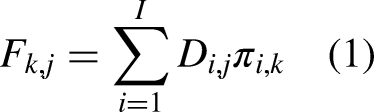
Figure 1 provides a graphical representation of the Bayesian model used for estimating the number of downloads and elucidating rates of menstrual tracking app usage across countries.

Directed acyclic graph illustrating relationships between data and parameters in the multi-level Bayesian model. Squares are data and circles are parameters. Solid lines are stochastic relationships and dashed lines are deterministic. Note that
Explaining rates of menstrual tracking app usage across countries
Our ultimate aim for the mapping exercise was to estimate the association between country-level covariates on rates of menstrual tracking app usage among women of reproductive age. To estimate these rates

We then estimated the association between

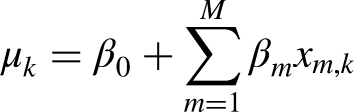


Secondly, we incorporated variables related to technological spread and prevalence, given the apps are accessed via smartphones: percentage of individuals using the internet and mobile-cellular subscriptions per 100 people. Lastly, we incorporated an indicator of national income through grouping countries into high, upper-middle, lower-middle, and low-income economies using World Bank definitions (see page 2 of the Supplemental Material). We included interactions between the country income groups and the contraception/childbearing and technological-spread related covariates. Table 1 provides a summary of the variables included in the models.
National-level predictors included in the model. The table provides the source for each variable, the variable name, and a description. All variables are for the year 2021.

Some of our country-level covariates (i.e. prevalence of modern and traditional contraception, unmet need for family planning, total fertility rate, and rates of internet access) contained missing data, so we used model-based imputation to fill in the most likely values given the model and the other data:

Multi-lingual topic models
After web scraping the reviews from the Google Play Store and Apple App Store, we ran contextualized topic models to see whether reasons for using the apps would be evident. Contextualized topic models are neural network models that use pre-trained representations of language based on word embeddings. This approach to topic models builds on the standard bag-of-words approach by allowing the model to incorporate the meaning of a word or group of words by understanding the context. As the reviews are in many languages, we use the ZeroShot model 31 with cross-lingual contextualized word representations and zero-shot learning to predict the topics from previously unseen documents in non-English languages (for more details on the model choice, see page 8 of the Supplemental Material).
We ran our reference corpus (the English reviews) with different numbers of topics from five to 80. We used fit metrics to assist model validation, based on the coherence of topics, which measures how similar the words and contexts within a topic are to each other. 32 According to our coherence measure, the ideal number of topics is 19 (see Supplemental Table 3). We also examined the results for models with the second-highest coherence (29 topics), and the results did not differ substantially—neither when using the reference corpus as Spanish or as Portuguese (see Supplemental Tables 4 and 5).
These topics require human evaluation, and we carried out the final annotation manually based on interpretations of the meaning of the topic by reading the top 20 words per topic and by reading the top 10 reviews that have the highest probability of belonging to the topic (see Supplemental Material for further explanation). Because we are interested in the reasons individuals use the apps, when calculating the representations of reasons for use, we removed the seven topics that we classified as relating to user experience.
Results
Global installations
The estimations of app installations revealed that the market for these apps is dominated by three apps: Flo, Clue, and Period Tracker (Figure 2).
We found that the highest concentrations of downloads are in the Global North, particularly in North America, the UK, France, Sweden, Australia, and New Zealand (Figure 3). However, downloads of these apps are not solely confined to these regions, with downloads throughout the Global South. In particular, installations in South America are comparable to the levels in Central and Eastern Europe. Of the countries included in the analysis, the lowest number of downloads globally is observed in Western Africa and South Asia. Estimates are largely missing for most of Sub-Saharan Africa, the Middle East, and China.

Number of installations for the 25 apps selected in the study. The numbers for the Google Play Store are downloaded, and they are used to predict the number of installations for the Apple App Store. For the Apple App Store, the median estimate is shown.
We found minimal differences in whether individual apps represented smaller or larger shares of total downloads in different world regions (see Supplemental Table 1). The only noticeable finding was that Flo was more prevalent than any other app on the African continent (see Supplemental Figure 2).

Geographic distribution of the decile distributions of the number of installations of the apps divided by the number of women of reproductive age in each country (sample 112). The darker colors towards blue indicate lower installations of menstrual tracker apps, while the brighter colors towards yellow indicate higher installations of menstrual tracker apps.
Macro-level predictors of downloads
Using the estimated installations by country, we then explored associations between these and (1) indicators of childbearing behavior, (2) indicators of technological spread (ITU), and (3) the income classification of the country. These explanatory variable groups were introduced stepwise into the model (Figure 4). We found that the national prevalence of modern contraceptive methods was consistently associated with more installations across all models. The prevalence of traditional contraceptive methods and the unmet need for family planning were not significantly associated. A lower TFR was predictive of a higher number of installations (model 1); however, this result was confounded when the prevalence of internet and mobile phone use was added to the model (model 2), the former of which was positively associated with number of installations. Relative to the reference category of high-income countries (as defined by the World Bank), low-income countries were significantly associated with fewer downloads (model 3).

Coefficient estimates from a Poisson log-normal regression. Model 1 includes data from the UN family planning indicators like the contraceptive prevalence of modern contraceptives (CPMCs), contraceptive prevalence of traditional contraceptives (CPTC), unmet need for family planning (UNMP), and total fertility rate (TFR). Model 2 includes ITU internet and ITU mobile. Model 3 adds regional dummy variables: high-income countries (HICs) as the reference category, medium-income countries (MICs), lower-middle-income countries (LMICs), and low-income countries. Models 4–7 attempt different interactions with regions. Model 4 interacts regions with CPMC, model 5 with UNMP, model 6 with TFR, and model 7 with ITU internet.
We also tested interactions between socio-demographic country groupings and the childbearing/contraception and internet access predictors. Relative to high-income countries, a higher unmet need for family planning and a higher TFR were associated with a higher probability of downloads in low-income countries (models 5 and 6), whereas reduced internet access was associated with fewer downloads (model 7).
As sensitivity tests, we ran out-of-sample and in-sample validations. For the estimation of the apps’ values, the out-of-sample fit shows an R2 of 0.98 for the apps and 0.81 for the countries, while the in-sample fit shows an R2 of 0.99 for the apps and 0.87 for the countries. A higher R2 value indicates a better fit of the model to the data, with 1.0 representing a perfect fit. Thus, these high R2 values suggest that our models perform well in both in-sample and out-of-sample scenarios. These model diagnostics are included in the Supplemental Material (see pages 5–7).
Micro-level reasons for use
To understand the reasons for using these apps, such as for conception or contraceptive purposes, we analyzed the user reviews for the apps from the two markets. We used topic models, which are automated content analysis techniques used to generate underlying themes from collections of text. The models do this by clustering words in a machine learning technique, with topics reflecting sets of patterns in the data. These types of models offer the advantage of relatively little input, where we discover rather than create the latent topics in the texts. This results in relatively generic topics that we can then interpret into reasons for app use.
Across the 12 topics generated from the user reviews, we identified four groupings indicating reasons for use: those related to general menstruation tracking and prediction; using the apps to achieve pregnancy; access to community and education; and use as a way to avoid pregnancy. We identified a further split within the menstruation tracking and prediction group: those who only refer to tracking/predicting in relation to menstrual period timing, and those who refer to tracking/predicting to also monitor symptoms across the menstrual cycle. We, therefore, split this broad group into two separate themes: (1) tracking symptoms over the menstrual cycle (as shown in Figure 5) as symptoms & tracker & prediction); and (2) predicting menstrual period timing (as shown in Figure 5) as track & prediction). When grouped, this broader theme relates to those who are aiming to understand their body's processes, without a specific aim for achieving/avoiding pregnancy. These four reasons for use came from combining individual latent topics shown in Figure 5). We did so by reading the top 10 reviews that had the highest probability of belonging to each individual topic, and then grouping them based on their themes as we interpret them. Box 1 shows some full-text examples from these four reasons for use.
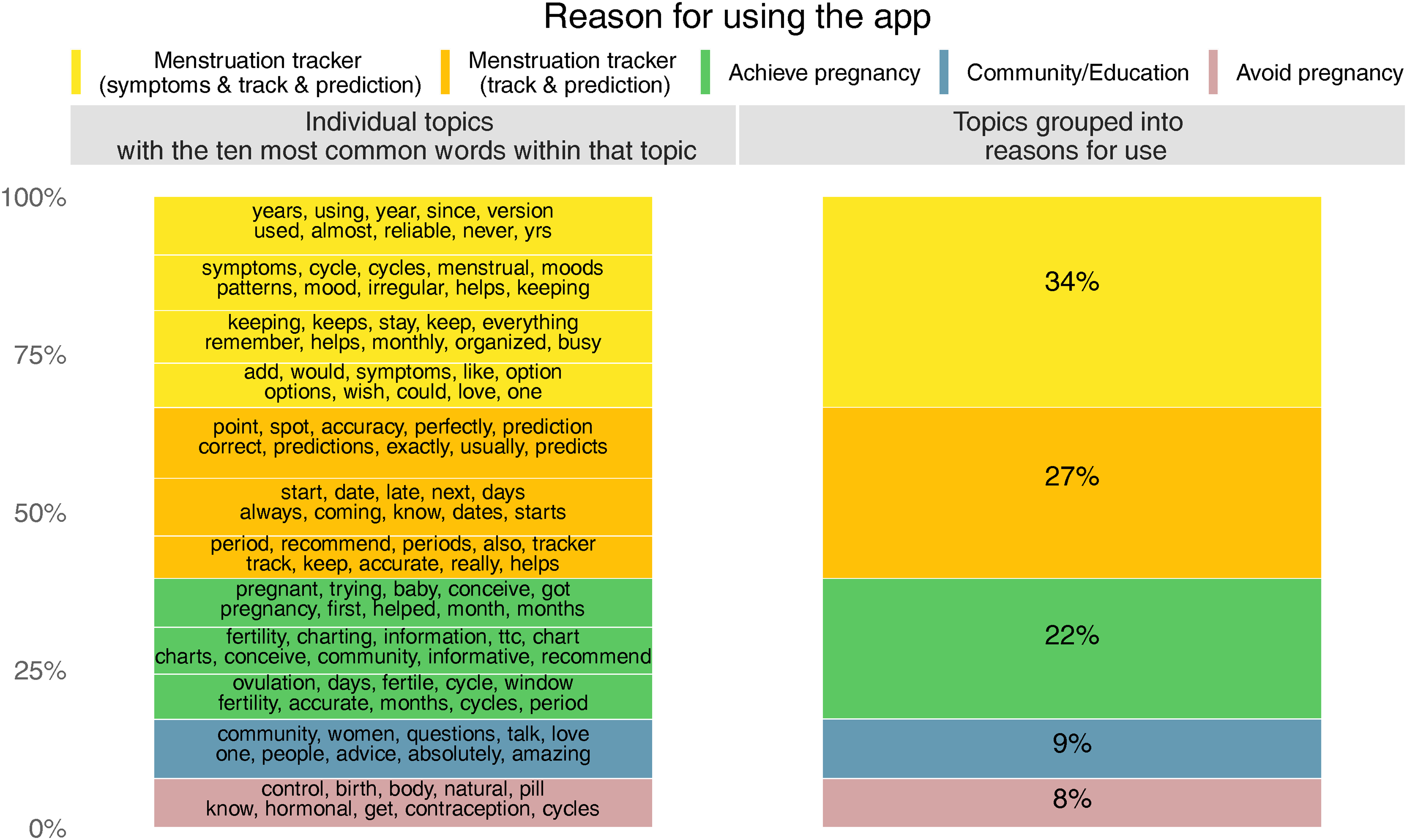
Five main reasons were identified in the reviews of 25 menstruation tracking apps: symptom tracking and prediction, menstruation tracking and prediction, achieving pregnancy, community, and education, and avoiding pregnancy (in order). In the left column, each topic is identified with the top 10 words, while in the right column, the percentages for each of the five topics are presented.
Conceptualization of different topic groups: Each entry includes examples of reviews with the highest probability of belonging to each theme, along with the app used and the date of the review.

We found that the majority of the reviews pointed to these apps being used generally as a menstruation predictor and tracker (61% of review content when grouped), with about half indicating they are mainly tracking menstrual period timing and half specifically mentioning symptoms tracking. However, explicit mention of aiming to achieve (22%) and avoid pregnancy (8%) was also evident in the themes (as shown in green and mauve in Figure 5). Nine percent of reviews across users are associated with community and education (as shown in blue in Figure 5).
The language of the review shows different popularity in the reasons for use. Norwegian, Finnish, Danish, and particularly Swedish reviews have above-average representation of the use of “avoiding pregnancy” (see Supplemental Figure 5). The proportion of those using the apps to achieve pregnancy varies little by language. The reasons for use split by the app for which the reviews were intended shows the leading apps (Flo and Clue) have varied reasons for use but the most common is still menstruation tracking, while the less-downloaded apps show clearer leading reasons for use (see Supplemental Figure 4). For instance, Nurx and Natural Cycles are mainly used for reasons related to avoiding pregnancy, while Ovia, Kindara, and Fertility Friend are mainly used for the purpose of achieving a pregnancy.
Discussion
This paper offers the first comprehensive quantification of menstrual tracking app use globally, moving beyond the existing literature which focuses heavily on high-income contexts. 20 We use this global map to understand potential national-level drivers for use such as economic development or an unmet need for family planning. We complemented this global picture with an analysis of individual reasons for use to pinpoint the gap these apps fill, and how these apps may be altering reproductive decision-making and behavior.
Our first finding was that installations are not confined only to the Global North, and that usage across South American countries is as high as in parts of Europe. The spread of these apps beyond the Global North is in some ways positive for public health strategies seeking to use app-based interventions in a variety of settings. However, our findings support concerns raised by existing research about the quality and type of information being spread by private corporations, and the inequalities these apps could perpetuate in a diverse set of contexts. 22 This is particularly important given that we found that the app market is dominated by only three apps, meaning the information and narrative that these apps choose to distribute needs to be accurate and appropriate for a diversity of users. The use of these apps outside of the Global North raises questions and concerns about the perpetuation of Western conceptions about reproductive health and “women's empowerment” in other contexts. For example, women outside of Western contexts may lack the agency to fulfill fertility goals and desire to reduce their family size.33,34 This is of particular concern given that existing research has found app content to contain many assumptions, such as that users are women, heterosexual, and monogamous, as well as assumptions about what should be considered a “normal” menstrual cycle. 35 Other research has also questioned the informational accuracy of menstrual tracking apps for improving menstrual health.36,37 Problematic assumptions and inaccurate information provision are concerning for users from all world regions, particularly given that these apps are not regulated and that the individual-level data held by companies from around the world is monetized. Our paper does not provide answers for policy-makers to address these issues, but it does highlight that it is timely to address them given the global popularity of these apps.
While we found good data coverage for these apps in South America, it is noteworthy that there is missing data for many Sub-Saharan countries and countries across Central Asia. In some cases, this is because there are different app markets in these countries (e.g. China), but in others, it is difficult to know whether missing data implies there are no app downloads, or whether data is not collected and monitored. Understanding more about menstrual tracking app use in these settings may need localized data collections or partnerships with the app providers. Other related limitations of this mapping exercise include that we used inference methods to estimate the installations from the two app markets, and used downloads to infer use. This means we cannot know exactly whether download patterns are an exact measure for use as, for example, apps could be downloaded more than once in different countries and downloads do not necessarily mean regular use. Nonetheless, this work still highlights menstrual tracking app use beyond the Global North, and has produced the first global data set of menstrual tracking app use.
In terms of why these apps are so pervasive globally, we examined both macro-level factors that could explain global spread, as well as individual reasoning for use. We explored whether app downloads in our global map were associated with socio-economic factors (which should be predictive of app use generally) or whether there were associations with childbearing-related variables which could explain a need in particular world regions (e.g. fertility rate and contraceptive access). We found that the prevalence of modern contraceptive technologies and internet prevalence were most predictive of downloads globally. One could hypothesize that if these apps fill a contraceptive need, higher prevalence and accessibility of modern contraceptive technologies should be negatively associated with downloads. The fact the opposite is observed suggests that, in this instance, modern contraception prevalence acts more as a marker of a country's economic status, with countries with a higher GDP being more likely to have modern contraception programs. This aligns with internet prevalence being associated with use, which is also a marker of a country's economic status. Given this, it appears that the use of menstrual tracking apps is predominantly driven by the accessibility of these apps through economic development. We would expect to see these associations with other non-menstrual-related apps on the market.
However, we also observed that when we added an interaction effect between countries’ socioeconomic status and the other explanatory variables, countries classified as low-income tended to have higher usage if they also had a higher unmet need for family planning and TFR. This effect was not present for high-income countries and mirrors macro and micro-level studies which find that poorer countries and women in LMICs tend to have reduced contraceptive use.38,39 While being cautious to not overinterpret these associations, this could indicate differing reasons for app usage in different global regions. In particular, the association with unmet needs could align with emerging findings that these apps are popular where there is reduced accessibility to, and acceptability of, reproductive health services and contraception. 40 This supports calls in the public health literature that the measurement and conceptualization of unmet need for family planning need to incorporate satisfaction with contraceptive methods,41,42 as these apps are seen as attractive alternatives to hormonal methods which carry side-effect risks.22,40 This same reasoning could also explain the global association between modern contraceptive technologies and downloads, as a growing number of individuals seek contraception options with fewer side effects.
Using the apps to help avoid a pregnancy was also found as a reason for use in the reviews (7% of reviews), as has been found in earlier qualitative work.43–46 Indeed, it could be even higher than estimated by our linguistic model, as some reasons given do not have a clear purpose. For example, do those who use the apps for “menstruation tracking” do so to improve their menstrual health or also to adjust their sexual behavior to reduce the chances of pregnancy? Furthermore, while the quotes within the “achieve pregnancy” and “avoid pregnancy” groups of our topic model uniquely identify the purpose of tracking fertile windows (i.e. the review says they’re doing it for one or other purpose), it is possible others do this with less clear cut or changing purpose. This ambiguity about the purposes of tracking is supported by qualitative findings in New Zealand where women did not classify using these apps as their contraceptive method, even though they described how they used them to avoid pregnancy during their interviews.30,47 The popularity of apps as a means of avoiding pregnancy warrants further attention by public health researchers interested in understanding how these apps can modify sexual behavior and how this may impact outcomes like unplanned pregnancies. We also found using the apps as a way to avoid pregnancy was more common among reviews left in Scandinavian languages. This is likely a reflection of natural cycles (which markets itself with a contraception focus) being a Swedish-owned company that is wellknown in the region. It is interesting that we did not find any other marked differences by language, which mirrored the minimal country differences in the macro-level analysis. This suggests that reasons for use are fairly homogeneous across global regions, despite differences in contraceptive access, average family size, and socio-economic context.
Our analysis of the app reviews suggests, however, that the majority of menstrual tracking apps are used for improving menstrual health (both in terms of menstrual period prediction and symptoms tracking) and achieving pregnancy. These have also been identified as the most common reasons for use in existing high-income43,44 and low-income country studies. 45 The ability to find community also came across as an important reason for why these apps appeal to their users. This mirrors qualitative findings from Denmark that the privacy for women to explore and engage with their menstrual cycle and body in a shame-free space was a key motivator for use. 21
The opportunity these apps provide for women to learn more about their bodies, enact their health goals, and better understand how to maximize chances of conceiving may be important lessons for existing family planning programs, which have typically failed to recognize that contraceptive choice is not made purely to restrict births but also to prepare for pregnancy (e.g. to allow appropriate birth spacing and quick reversal to being able to conceive when circumstances are more favorable).8,48 These apps also both brand themselves 49 and act (e.g. as evidenced in our reviews but also as found by others 4 ) as important informational resources for improving menstrual health literacy. Eschler et al. 36 defined menstrual health literacy as the baseline ability to understand and care for a menstruating body. For example, previous studies have highlighted the potential for these apps to improve user understanding and management of premenstrual symptoms,4,18 which is an issue that can be very debilitating but has typically been poorly researched and understood by healthcare providers.50,51 There is also evidence that these apps are not only used to understand and improve menstrual health, but also overall health. 52 The apps have the potential to give early signs of health issues such as thyroid disease, sexually transmitted infections, or polycystic ovary syndrome by identifying atypical patterns in cycle length and other cyclical symptoms.36,53,54 It can be validating for users to feel like they have gained an understanding of their symptoms and have been “listened to” because of real or perceived barriers to healthcare professionals seriously addressing concerns with pain and discomfort. The popularity of these apps demonstrates a clear need for healthcare providers to better address the informational support needs of people who menstruate in their practice, particularly given that evidence is not conclusive on how comprehensive and effective the health information provided by menstrual tracking apps is.36,37
The finding that most users are motivated by improving their chances of conceiving should also be of interest to sexual and reproductive health researchers. For example, if this is a primary reason for use then could these apps help counter age-related declines in fecundity within the context of first birth postponement? It would also be useful to understand whether individuals who use the apps to help achieve a pregnancy, rather than for avoiding a pregnancy, differ in their characteristics as this could have policy implications. For example, whether age or socio-economic status is associated with the likelihood of using these apps for different purposes and whether this shows particular kinds of unmet need within different groups. This is a limitation of our work as the anonymized nature of the reviews meant we could not understand more about the individuals who left them. Exploring these questions would only be possible through data sharing agreements with the app-makers, or by adding questions about app use into existing fertility surveys.
Conclusion
In conclusion, in the context of a rapidly growing digital health market, apps which track menstrual cycles have the potential to both improve or disadvantage reproductive health. Our paper provides the first fully open-access evidence that these apps are globally pervasive, and we suggest there is an urgent need to understand the implications of these apps outside of the Global North where most existing research is conducted. The popularity of these apps implies important perceived or real barriers to the holistic treatment of menstrual health, and we note this has potential learnings for more local-level clinical practice with the aid of more localized research. On this basis, we hope this work inspires researchers from social science, medical, demographic, and health disciplines to consider how these apps may be changing reproductive decision-making and behavior, and to consider conducting similar analyses with the wealth of anonymized and publicly available information available from these apps.
Supplemental Material
sj-docx-1-dhj-10.1177_20552076241298315 - Supplemental material for “UPDATE: I’m pregnant!”: Inferring global downloads and reasons for using menstrual tracking apps
Supplemental material, sj-docx-1-dhj-10.1177_20552076241298315 for “UPDATE: I’m pregnant!”: Inferring global downloads and reasons for using menstrual tracking apps by Francesco Rampazzo, Alyce Raybould, Pietro Rampazzo, Ross Barker and Douglas Leasure in DIGITAL HEALTH
Footnotes
Acknowledgements
We would like to thank Tommaso Rigon, Jakub Bijak, Jason Hilton, and Claire Dooley for valuable feedback that improved initial versions of the Bayesian model, and the Evolutionary Demography Group at LSHTM for their feedback on the paper. Special thanks to the reviewers and editorial team at Digital Health for their feedback.
Consent to participate
Not applicable. The data used is anonymized, aggregated data in the public domain, so no consent is required.
Contributorship
FR and AR conceived the idea of the research. PR coded and executed the scraper for collecting the data. FR, DL, RB, and AR analyzed the data. All the authors contributed to writing the manuscript.
Declaration of conflicting interests
The author(s) declared no potential conflicts of interest with respect to the research, authorship, and/or publication of this article.
Ethical approval
The project received ethical approval from the Saïd Business School Departmental Research Ethics Committee (SBS DREC) at the University of Oxford (Approval ID: SSH_SBS_C1A_21_03).
Funding
The author(s) disclosed receipt of the following financial support for the research, authorship, and/or publication of this article: This work was funded by the Leverhulme Trust through the Leverhulme Centre for Demographic Science (Grant RC-2018-003).
Guarantor
FR.

Supplemental material
Supplemental material for this article is available online.
Notes
References
Supplementary Material
Please find the following supplemental material available below.
For Open Access articles published under a Creative Commons License, all supplemental material carries the same license as the article it is associated with.
For non-Open Access articles published, all supplemental material carries a non-exclusive license, and permission requests for re-use of supplemental material or any part of supplemental material shall be sent directly to the copyright owner as specified in the copyright notice associated with the article.
