



Abstract
Objective
It is not clear whether self-rated health is associated with internet use among community-dwelling patients living with diabetes. This study investigated what kind and level of use of the internet is desirable for the subjective sense of health among patients living with diabetes in the community.
Research Design and Methods
This was a cross-sectional study of patients living with diabetes aged 18 years or older who visited our clinic between April 2022 and June 2022. The final analysis included 654 subjects (mean age: 56–90 years). The objective variable was self-rated health, and the explanatory variable was purpose of internet use. We used logistic regression analysis to identify odds ratios (ORs) and 95% confidence intervals (CIs) for the association between internet use and self-rated health by purpose of internet use.
Results
Of the 654 patients living with diabetes using our clinic, 488 (64.7%) were internet users. Communication with friends/family (66.6%) was the most common use of the internet, followed by social media (54.3%) and shopping (36.7%). Logistic regression models showed that social media (OR: 1.81; 95% CI [1.02, 3.21], p = 0.04), shopping for food and other items (OR: 1.95; 95% CI [1.00, 3.77], p = 0.04), online securities and banking (OR: 2.75; 95% CI [1.02, 7.39], p = 0.04) were associated with self-rated health.
Conclusions
Using the internet for social media, shopping, and banking were found to be associated with self-rated health. Use for these purposes could help support diabetic care.
Introduction
The current COVID-19 pandemic, caused by a novel type of coronavirus, has raised concerns about secondary health risks such as poor glycemic control and more severe illness among patients living with diabetes in the community. Patients living with diabetes remains a serious public health challenge and is associated with increased risk for cancer and death. 1 In 2021, the global population with diabetics reached 537 million, and 1 in 10 adults (10.5%) are diagnosed with it. 2 Interventions have been reported to reduce the severity of the disease, including diet, aerobic exercise, and strength training. 3 Social factors, such as social support, have also been reported as contributing to the stabilization of glycemic control in patients living with diabetes and to support improvements in physical and dietary habits. 4
Currently, the use of the internet is being studied to determine whether it promotes health behaviors. The population using the internet is growing every year, and the percentage of internet users aged 65 and older in the US will reach 73% in 2019. 5 A similar trend can be seen in Japan, where the percentage of Japanese aged 65 and over who use the internet will reach 63.6% in 2019. 6 The internet has impacted daily life in many ways, making it easy to interact with friends and family, shop, and conduct useful interactions, such as online health screenings. Previous studies have found that diabetic patients with higher levels of knowledge use the internet more frequently 7 and that the risk of developing depression is 30% lower for healthy older subjects who use the internet and live in the community. 8
In addition, the need to assess the self-rated health (SRH) for patients living with diabetes in the community has been recognized. SRH reports a subjective perception by an individual of his or her health status and is commonly used as a health indicator. 9 In fact, lower SRH is associated with an increased risk of developing type 2 patients living with diabetes in middle-aged men and women. 10 SRH does not require the use of special equipment or large amounts of time, and poor SRH is associated with lack of physical activity, obesity, smoking, unhealthy eating habits, alcohol consumption, and genetic factors, as well as patients living with diabetes.11–13
It is not clear, however, what use of the internet is associated with SRH among patients living with diabetes in the community. This study investigated what use of the internet is desirable to promote the subjective sense of health among patients living with diabetes in the community. The findings may help promote health behaviors through novel means of online engagement.
Methods
Study design
This was a cross-sectional study of patients living with diabetes aged 18 years or older who visited the authors’ clinic between April 2022 and June 2022. Exclusion criteria were missing limbs, use of a pacemaker, inability to complete the survey alone, and missing data on survey items in the medical records. After these exclusions, data from 654 patients (mean age: 56–90 years; 345 males and 309 females) were included in the final analysis (Figure 1). Consent for this study was obtained, in accordance with the Declaration of Helsinki, after subjects were fully informed in writing and orally of the purpose of the study, the contents of the examination, and the protection of their personal information. This study was approved by the Ethical Review Committee of Hana-no-Oka Hospital (02025).

Subject selection flow.
Objective variable
The outcome was SRH (poor, normal, good, or very good) as assessed in response to the question “How is your current health?” SRH has been validated as a strong predictor of mortality and hospitalization. 14 SRH is defined as dichotomous (bad/normal vs good/very good). 15
Explanatory variable
The explanatory variable was the purpose of internet use. First, respondents answered whether they had used the internet in the past year, using a yes or no response. Then, the subjects were asked about their internet use in seven categories: (a) communication with friends/family, (b) social media including Facebook and Twitter, (c) information collection about health and medicine, (d) searching for medical facilities, (e) purchase of drugs and vitamins, (f) shopping, and (g) online banking. The respondents were asked to indicate yes or no for each of the seven categories. 8 Participants could select multiple objectives for each use. These categories were analyzed as binary variables: set to 0 if participants answered no to any of the items and otherwise set to 1.
Confounding variable
Confounding variables were gender, age, marital status, currently employed, drinking status, smoking status, exercise habits, educational attainment, meeting with friends, diseases requiring treatment, body mass index (BMI), and hemoglobin A1c (HbA1c), drawing on previous studies. 8 The age groups were under 39, 40–64, 65–74, and 75 + years. Marital status was defined as with spouse and without spouse. Current employment, drinking status, and smoking status were all categorized as yes and no. Exercise was 1 time or more per week and less than 1 time per week. Educational background was grouped as less than 10 years, 10–12 years, and 13 years or more. The frequency of seeing friends was 1 time or more per week and less than 1 time per week. For disease in treatment, the options were stroke, osteoporosis, hypertension, trauma and fracture, joint disease and neuralgia, respiratory disease, and heart disease. 16 BMI and HbA1c were reported as continuous values.
Statistical analysis
All data were analyzed using STATA 16.0 software (STATA Corp. LLC, College Station, TX, USA). First, the respondents were divided into two groups: internet non-users and internet users. The corresponding percentages and mean values for each variable were checked using descriptive statistics. Descriptive statistics were then used to obtain the applicable percentage and mean value for each variable with respect to purpose of internet use and each variable. Finally, we used logistic regression analysis to confirm odds ratios (ORs) and 95% confidence intervals (CIs) for the association between internet use and SRH with respect to purpose of internet use.
Results
Of the 654 patients living with diabetes using our clinic, 488 (64.7%) were internet users (Table 1); further, 69.3% of internet non-users indicated good SRH, while 80.3% of internet users indicated good SRH. Younger, male, and more educated patients living with diabetes were more likely to use the internet. Communication with friends/family (66.6%) was the most common use of the internet, followed by social media use (54.3%) and shopping (36.7%). Health-related internet items were information collection on health and medicine (29.9%) and searching for medical facilities (13.5%). The categories with the highest percentages of SRH by purpose of internet use were banking (87.5%), shopping (81.6%), social media (80.8%), and communication with family and friends (80.6%) (Table 2). Banking was used by a majority of men (75.0%). Other characteristics fell out nearly equally among the seven different intended uses. Logistic regression models showed that social media (OR: 1.81; 95% CI = [1.02, 3.21], p = 0.04), shopping for food and other items (OR: 1.95; 95% CI = [1.00, 3.77], p = 0.04), and online securities and banking (OR: 2.75; 95% CI = [1.02, 7.39], p = 0.04), were associated with SRH (Table 3).
Characteristics of internet nonusers and users.
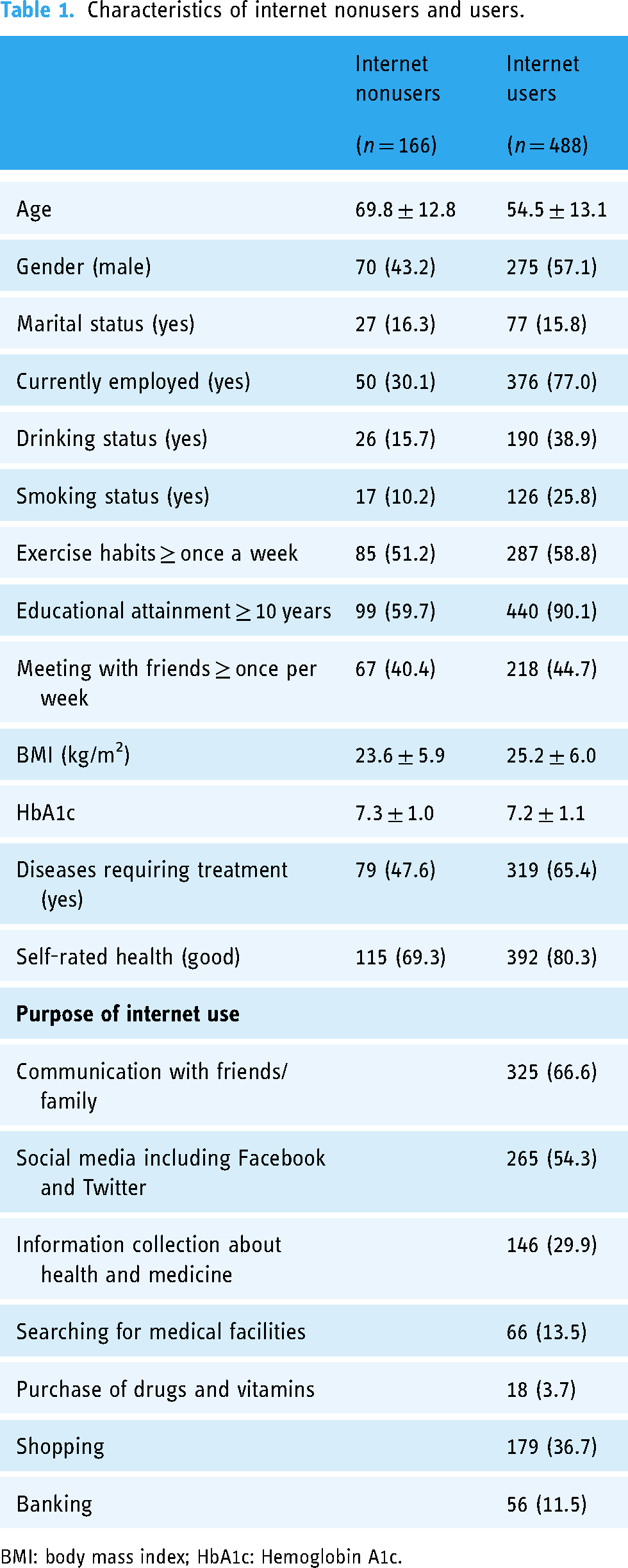
BMI: body mass index; HbA1c: Hemoglobin A1c.
Characteristics of people using the internet for each purpose.
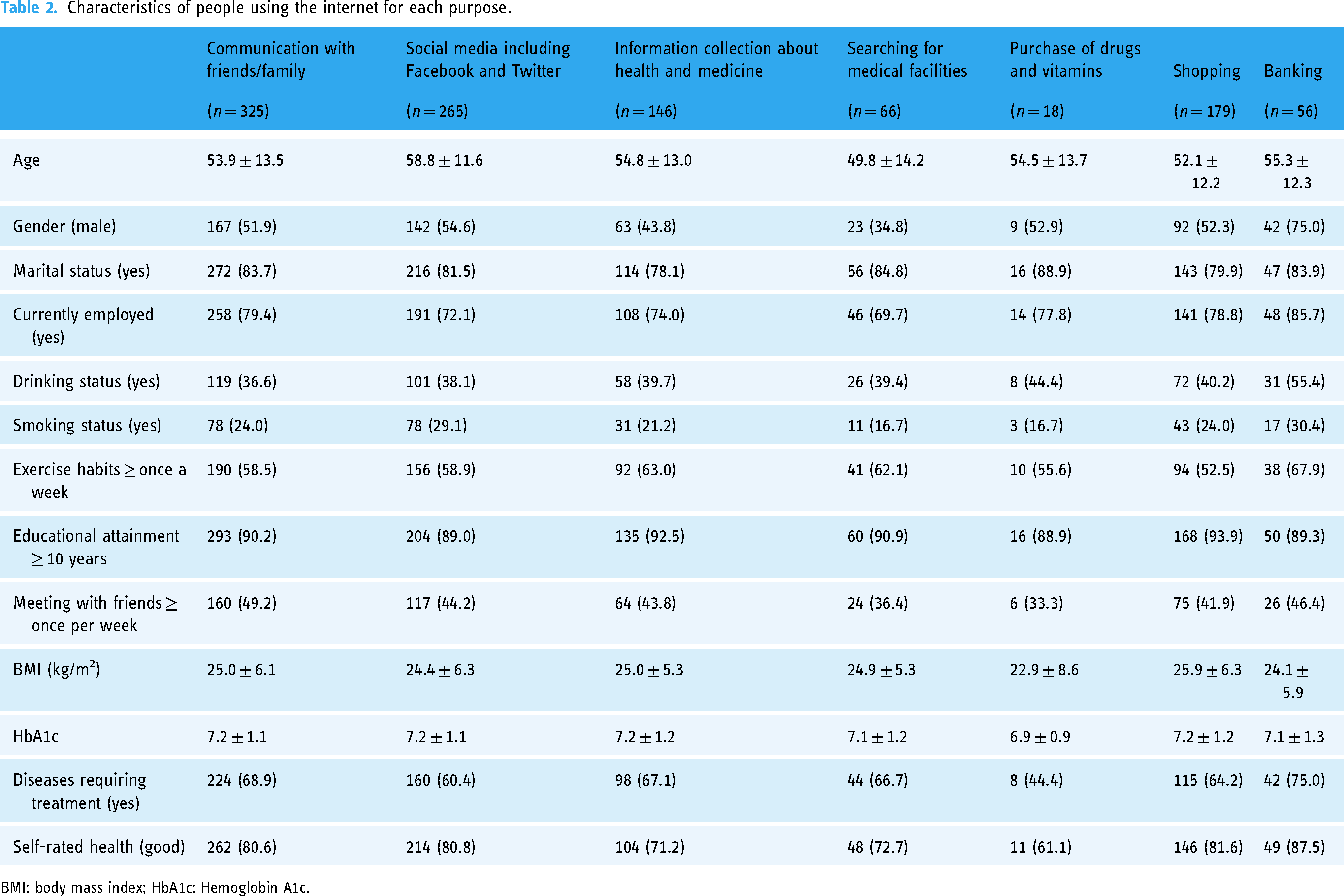
BMI: body mass index; HbA1c: Hemoglobin A1c.
Associations between internet usage for seven purposes and self-rated health.
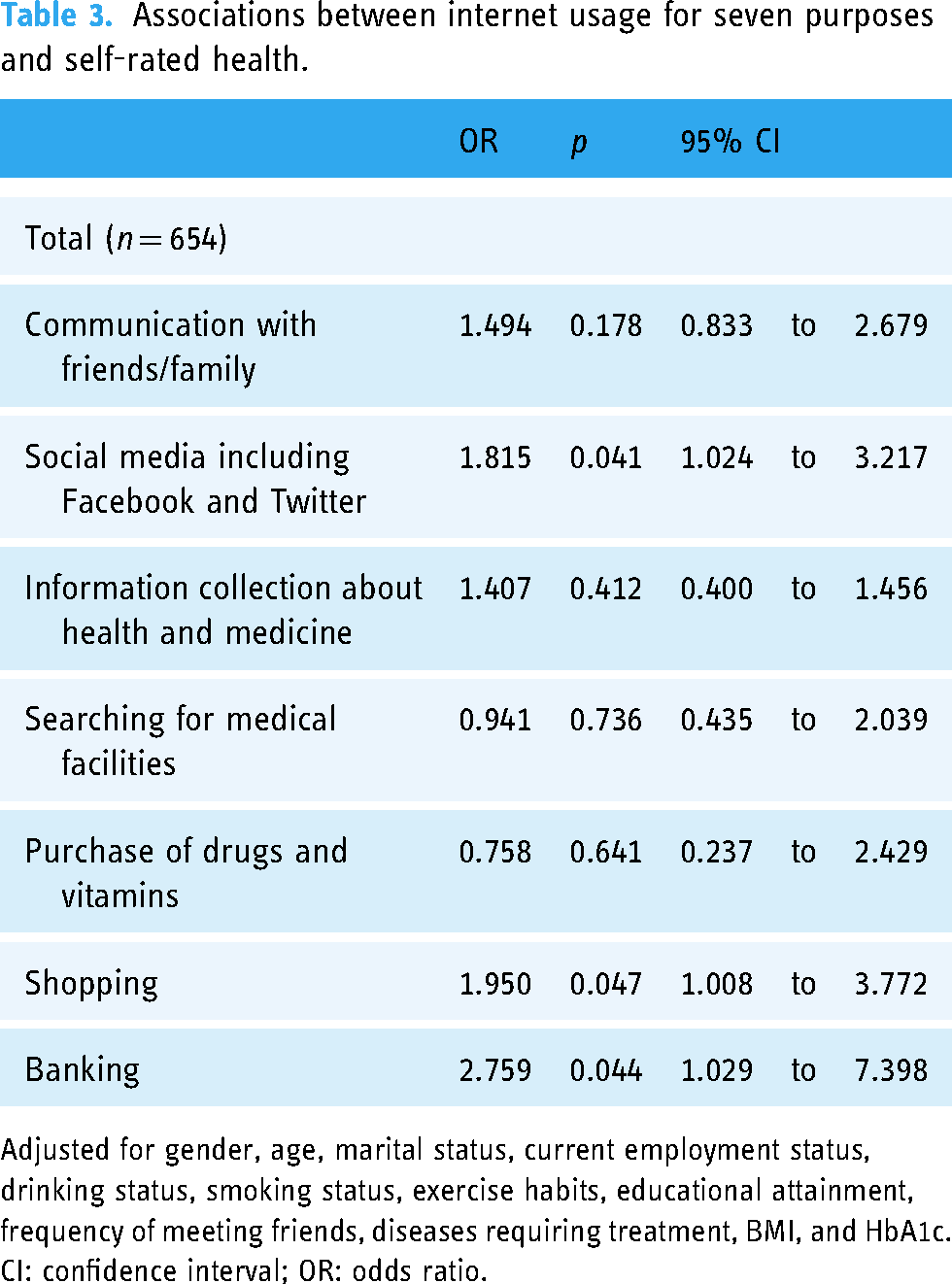
Adjusted for gender, age, marital status, current employment status, drinking status, smoking status, exercise habits, educational attainment, frequency of meeting friends, diseases requiring treatment, BMI, and HbA1c.
CI: confidence interval; OR: odds ratio.
Discussion
This study investigated what types of internet use are associated with SRH among community-dwelling patients living with diabetes. Of the 654 patients living with diabetes who participated in this study, 488 (64.7%) were internet users. By purpose of internet use, social media, shopping, and banking were most closely associated with SRH. However, internet use for other purposes, such as communication with friends and family, did not show any association with SRH.
The average age of internet users in our study was 54.5 years, compared to 69.8 years for those who did not use the internet. It is possible that age differences are also tied to internet use among as well. In fact, a study of 909 patients with type 2 patients living with diabetes attending a primary care clinic showed a similar trend to our study, with an average age of 59.5 years old for internet users and 70.0 years old for internet non-users. 17 These internet under-users may be 10 or more years older and have less educational background.
A study of an older population reported that communication with friends/family reduced the occurrence of depression, but no change was reported for other uses. 8 These results tended to differ from some aspects of our study, which included community-dwelling patients living with diabetes.
Social media use was associated with SRH. A systematic review of previous studies reported that interventions that delivered health information to patients living with diabetes using social media showed improvements in health indicators.18,19 Social media use has increased dramatically in recent years, and 40% of internet users in our study used social media. Indeed, the most commonly reported outcome in intervention studies using social media, such as Facebook closed groups, Facebook chat, and Skype, is HbA1c. 19 This has also been reported to improve satisfaction with intervention, health-related quality of life, patients living with diabetes knowledge, and empowerment. 19 Social media has many channels that support clinical care and treatment guidance, and it may be effective as an educational resource for improving self-management and promoting positive behavior change in those affected by chronic disease. 20 These indicate that social media can provide a more intensive communication function between healthcare professionals and patients, and this influence may have been favorable in our study. In recent years, Internet addiction has become an issue, but as in previous studies, 21 the results of this study suggest that Internet use may have been linked to improved health.
Shopping for food and other items on the internet was positively associated with SRH. Prior studies have found that older adults who consider that a grocery store is near to them have a lower incidence of frailty 22 and mortality. 23 The proximity of grocery stores enables the purchase of foods containing a variety of nutrients. In fact, in patients living with diabetes, food insecurity and poor diet quality have been found to directly affect metabolic outcomes, including HbA1c. 24 On the other hand, the presence of fast-food restaurants in the community has also been reported to exacerbate the risk of patients living with diabetes. 25 The patients living with diabetes in our study are those who visit our clinic. It is therefore possible that doctors, nurses, dietitians, and physical therapists provide patients with useful health information at visits, and after gaining knowledge of nutritional balance, patients can easily purchase healthy foods over the internet.
The use of banking on the internet was associated with SRH. Few previous studies have been performed on this use of the internet and health indicators. It may be that subjects who use online securities and banks on the internet are more conscious of investing in their own future and may be more health conscious. In addition, users of online securities and banks may have stable incomes. In this light, it can be recalled that the lower the income, the higher the rate of patients living with diabetes, 26 and it is possible that online securities and bank users are financially stable and have better SRH.
Strengths and limitations
Our study had several strengths. First, it was the first study to identify the types of internet use are associated with SRH among community-dwelling patients living with diabetes. It is interesting to note that these results differed in part from those of healthy subjects living in the region. 8 Second, we were able to adjust for socioeconomic factors, including educational history and family structure, as confounding factors. Because many medical studies of patients living with diabetes do not adjust for these factors, the association we showed with SRH even when these factors are taken into account is of interest. However, this study had three limitations that should be mentioned. First, we could not show temporal causality because our study design was a cross-sectional study. Second, the medium used for the internet and the time spent using the internet were not evaluated. For the generalization of these results, responses should be stratified by medium used and time of use. Finally, frequency of Internet use was not evaluated. Among those who use it infrequently, the impact of online communication is likely to be small.
Conclusions
This study investigated what types of internet use are associated with SRH among community-dwelling patients living with diabetes. Of 654 patients living with diabetes, 488 (64.7%) were internet users. By purpose of internet use, social media, shopping, and banking were found to be associated with SRH. Use for these purposes could help support diabetics care.
Footnotes
Acknowledgments
This study used data from our clinic supported by Grants for Medical Staffs from the Japan Association for Diabetes Education and Care: 2021-MED-012. The views and opinions expressed in this paper are those of the authors and do not necessarily reflect the official policies or positions of the respective funding agencies.
Contributorship
Conception and design: YM and TT; data collection: HK and KM; analysis, interpretation of the data, and writing the article: YM; critical revision of the article: YM, TT, HH, MH, and HS. All authors read and approved the final manuscript.
Declaration of conflicting interests
The authors declared no potential conflicts of interest with respect to the research, authorship, and/or publication of this article.
Ethical approval
This study was approved by the Ethical Review Committee of Hana-no-Oka Hospital (02025).
Funding
The authors received no financial support for the research, authorship, and/or publication of this article.
Guarantor
HS conceived the research question, supervised the study, and is the guarantor.
